Vermont This Week
July 5, 2024
7/2/2024 | 26m 45sVideo has Closed Captions
State Parks Special
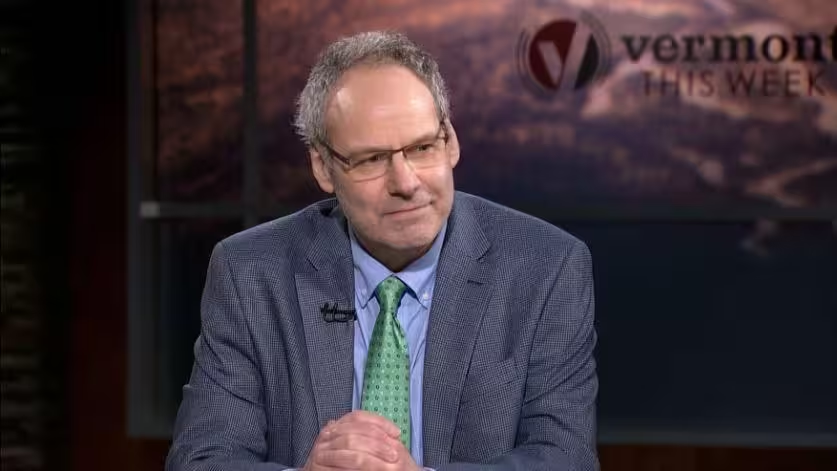
State Parks Special | Panel: Mitch Wertlieb - Moderator, Vermont Public; Judy Chaves - Author, Secrets of Mount Philo: A Guide to the History of Vermont's First State Park; Nate McKeen - Director of Vermont State Parks; Ali Kosiba - University of Vermont Extension Assistant Professor of Forestry.
Problems playing video? | Closed Captioning Feedback
Problems playing video? | Closed Captioning Feedback
Vermont This Week is a local public television program presented by Vermont Public
Sponsored in part by Lintilhac Foundation and Milne Travel.
Support provided by:


Vermont This Week
July 5, 2024
7/2/2024 | 26m 45sVideo has Closed Captions
State Parks Special | Panel: Mitch Wertlieb - Moderator, Vermont Public; Judy Chaves - Author, Secrets of Mount Philo: A Guide to the History of Vermont's First State Park; Nate McKeen - Director of Vermont State Parks; Ali Kosiba - University of Vermont Extension Assistant Professor of Forestry.
Problems playing video? | Closed Captioning Feedback
How to Watch Vermont This Week
Vermont This Week is available to stream on pbs.org and the free PBS App, available on iPhone, Apple TV, Android TV, Android smartphones, Amazon Fire TV, Amazon Fire Tablet, Roku, Samsung Smart TV, and Vizio.
Support the crew
Help Mitch keep the conversations going as a member of Vermont Public. Join us today and support independent journalism.Providing Support for PBS.org
Learn Moreabout PBS online sponsorshipVermont state parks are celebrating their 100th anniversary this year.
On today's show, we'll discuss the past, present and future of some of the state's most treasured assets.
Ahead on a special edition of Vermont this week from the Vermont Public Studio in Winooski.
This is Vermont This Week, made possible in part by the Lintilhac Foundation and Milne Travel.
Here's moderator Mitch Wertlieb.
Thanks so much for joining us.
I'm Mitch Wertlieb.
It's Friday, July 5th.
And with us on the panel today, we have author Judy Chaves, director of State Parks Nate McKeen and University of Vermont Extension Assistant Professor of Forestry Alli Kosiba.
Thank you all so much for being with us today for this special program celebrating 100 years of Vermont state parks.
This is a really exciting time.
And Judy, I want to start with you, because you wrote a book about Vermont's first state park, Mount Philo.
First, what's the book called?
It's called Secrets of Mount Philo.
It's a guide to Vermont's first state park.
Fantastic.
And tell us a little bit about the history of the land here and how the park came to be.
Sure.
So for thousands of years prior to European settlement, the mountain would have been used for hunting and gathering, and it would have been totally forested, except probably the the upper bald spot that everybody knows is the main outlook that probably was intentionally kept bare for thousands of years, possibly by fire for use as an observation point, just the way we use it today.
And it wasn't until European settlement starting in the about well, actually 1787 was the first farm establish at the base of the mountain.
And that's when human influence on the land really started to happen.
By the mid 1800s, the mountain was surrounded by farms.
And believe it or not, Mount Filer would have been pretty much deforested.
Yeah, it's really hard to imagine, but the trees would have been all cut down for lumber, for firewood, making potash, and then also just clearing the land for raising crops and for pasture edge.
In the middle of the 1800s.
Sheep would have been grazing all over the mountain merino sheep.
There was a thing called sheep fever in the state.
Merino sheep came over originally from Portugal and so Mount Philo had sheep grazing all over it, very few trees on it.
And there's actually still evidence that you can see in the park of this time period, there's a bit of a it's like a 100 foot length of stone wall hidden away in the woods.
If you know where to look, you can see it from the marketing.
Well, we've got pictures of that, right?
Yeah.
Yeah, it's incredible.
It's amazing.
And when you stand there, you can you know, even though you know, intellectually, that sheep fever happened and all that, when you stand at that stone wall surrounded by trees, you get it sort of at a gut level that, wow, it really happened and it happened here on Mount Philo.
When you say sheep fever, what do you mean by that?
Exactly.
So so in 1810, the original, the first sort of flock of merino sheep came over from Portugal and went wild all over New England, not just Vermont, but all over New England.
People were raising lots and lots of merino sheep.
I think the figure is 1.7 million sheep in Vermont in 1840.
So and Mount Philo was no exception.
If you look at the tax records of farms from that time period, you can see how many sheep they had in each farm.
So that had a pretty devastating effect.
It not not only on that file throughout New England, the deforestation, both for raising merino sheep and for the use of the lumber.
It was very, very intense.
So when does mount finally become the first state park?
So?
So sheep ever died out for many, many reasons.
After the Civil War and dairy farming came in to instead.
And so a couple, Frank and Clara Lewis, had a farm at the base of Mount Philo, and they did what many dairy farmers did at the time period, end of the 1800s.
They were taking in tourists and they eventually built the Mount Fallow in, which is still there today, looking very much the way it looked when they first put it up.
And in the summer of 1900, two people came up from Boston, James and Frances Humphreys to stay at the inn.
And they convinced the owner of the inn, Frank Lewis, to build a carriage road from the starting at the inn all the way up to the top.
And so Frank Lewis did that between 1901 and 1903.
He built the carriage road of all sorts of amenities next to it.
Lots of evidence of things that he built alongside the road gazebos and an observation tower and railings at observation points.
And the Humphreys kept coming back summer after summer.
They eventually built their own house.
And well, I should have said before that they bought up acreage on the mountain and gave Frank Lewis permission to build that carriage road in the year of 1914, James Humphreys died.
Francis, his widow, became sole owner of 150 acres on the mountain.
And I have a lovely quote from her when people asked her, What do you plan to do with the mountain?
And at that point, because sheep weren't grazing, there were trees that had come back.
What do you expect to get off Mount Philo?
Is the question often asked me what benefit is it to you?
When do you expect to cut the wood off?
Not a stick of it.
If I can help.
It was her answer.
I dislike to see the mountain changed.
There is something in the world besides money.
Good as it may be.
If the people of Vermont appreciate the privilege of riding at Mount Philo or walks through its paths, that is all that is asked by us, by its owner.
So in 1924, 100 years ago, Frances Humphreys gives 150 acres on Mount Philo to the state of Vermont to be used as a park.
That is fabulous.
And I know that you showed us a picture before of James Humphreys.
Yes.
I couldn't locate a picture.
I cannot find it.
If anybody out there has a picture of Frances Humphreys, because she is she is to be celebrated.
She's the hero of the story.
And and it really I mean, that generosity, that love of the mountain and the desire to share it with the with Vermont.
That's what we're celebrating right now.
Yeah, that's remarkable.
And I guess it's one of the secrets of Mount Farlow.
Where is the picture of where?
Hopefully we could find that at some point, Ellie could see.
But the widespread deforestation I think that Julie was was talking about a little bit here in the mid 1800s.
Was that a reality for the majority of our earliest state parks?
Yeah, and it was a it was a reality for most of Vermont.
It really depends on the landowner, the location.
But Judy really illustrated that, well, sort of the various uses of the land over time, from agriculture to settlements for the need for firewood and lumber and the impact of those varied uses in such a short time frame on the land.
And we saw that with farmland, abandonment, a lot of places regrew like Mount Thilo, but the forests that regrew were not the same, forests that existed prior.
So we see that we have sort of different species composition, that we have a younger forest, a less complex forest in some places we actually had planting of trees and Mt.
Filer has planted trees as well.
That actually occurred when we saw, you know, people started becoming concerned about deforestation, the impacts we had soil erosion that affected water quality downstream.
We had loss of topsoil.
We had concerns about tourism and sort of the sustainability of these practices.
And so folks began to be worried about that.
And so we had things like the Civilian Conservation Corps that came up and planted over 1 billion trees in the state of Vermont.
We had the state of Vermont establish the first commissioner of Forestry in 1904 and then shortly thereafter the first state forester.
And so we saw this change of really needing to have plans for forests, sustainable management using science.
Because we think about this early time in the 1800s, people didn't have a good knowledge about ecology, sustainability, long term management of forests like we do today.
And McKean, I imagine, you know, some of these problems that Alice discussing here are still issues today, right?
And we were talking before about the Conservation Corps and the connection to the state parks that goes back and so much work has been done there.
Tell us more about that.
Yeah, that's a great point.
And I feel the the period in the late twenties to the early thirties was really setting the stage for the Civilian Conservation Corps.
And Vermont just really grabbed hold of that opportunity.
And it was a disproportionate amount of investment.
And workers here in Vermont from the Civilian Conservation Corps, which was a depressed depression era work program for youth from all over all over the country.
Many people were here in Vermont, but folks came from all over New England, young men, and they built camps to live in and they built dams, roads, bridges, planted a billion trees.
And they're close to it.
And they they also really focused on outdoor recreation and built some of our picnic shelters, which are still standing today are fireplaces.
And there's a lot of historic remnants in the parks and there's a lot of facilities that we are still using today.
They're important part of the they're kind of a landmark, but also an important part of the operations of the park.
That's one of the things I love about the state parks, is what you just mentioned is things like the picnic tables and just some of those stands that you wouldn't necessarily think go back that far.
But they do.
There's that connection back there.
Judy Chaves About I love it.
I mean it's, you know, it's easily accessible.
It's an I wouldn't say it's an easy hike, but it's easier than a lot of hikes.
It's less than a thousand feet to get to the summit.
But when you get up there, if anyone's been up there, the view is spectacular.
What are folks looking at as they look out over that view of the top of Mount Vernon?
So you're looking at Lake Champlain, quite an expanse of Lake Champlain, the Adirondack Mountains.
Beyond it, if you turn a bit, I was up there this morning, so I'm remembering you can see quite a bit of the green mountains.
And then you also see the Champlain Valley, which is the sort of the classic Vermont landscape of it's this patchwork of still open working farmland and and woodland.
And it's just it's utterly spectacular.
You really should not get that good of you for so little hiking.
And even if you drive up, it's even more unfair.
Yes, it's utterly spectacular.
Yeah, we should mention that, too.
Yeah.
As you showed the carriage before in that old, old picture.
But some folks do take the cars up there now.
Oh, sure.
Yeah, yeah, that's part of it.
Yeah.
How is file old changed over time?
What are some of the biggest changes, whether it's paths or things that, you know, would be noticeably different today?
Well, in the thirties the CPC did major work.
They they built the buildings that are up at the summit area.
They built the down road so that you would now have a complete loop.
The original carriage road was only what we now call the upper road.
They put in power lines, picnic areas, all that.
The I don't know if folks remember the ice storm of 1998 did major damage to the trees.
Many of the plantations that the state and the key put in were were destroyed by that ice storm.
That was a major change.
There's a relatively new parking lot down at the bottom that didn't that wasn't there prior to the ice storm.
And today, there is all sorts of new stone work being done on the trails to eliminate erosion.
There are viewpoints that maybe have gotten overgrown.
Some of them the park folks, decide to open them up again.
So, you know, it's a combination of human change that goes on and then just natural things that that changed the landscape.
And in what way did the building of Mount File, the state Park Mirror work?
Perhaps that was being done at the national parks?
Well, that's a really cool thing because the CCRC was a federal program.
They were working under the auspices of both the National Park Service, as well as the Vermont Department of Forestry.
So they were working with guidelines that were established by the National Park Service.
It's called NPS style, or sometimes it's called park texture.
And the hope.
That was park architecture.
Yes.
And the philosophy was and this is throughout the country, that your infrastructure should play second fiddle to the reason people are going there, which is for the natural landscape.
So the buildings are more horizontal than vertical.
They're located in places that won't block the view.
They're they like to use natural materials, local materials.
And so the, you know, for example, the two buildings up on the top of Mount Philo, they're very sort of humble versions of what you see in the national parks.
Okay.
Yeah, almost like a smaller model for in a way.
Exactly.
Yeah.
So, Nate, Vermont has 55 state parks in total.
Do all these parks adhere to these national park design guidelines or are they more unique to Vermont?
Yeah, well, the Civilian Conservation Corps, a development that was really the birth of the Vermont State Park System and set our brand very similar to the National Park Service.
The same kind of construction was going on in the national parks.
And then again in the sixties and seventies, it's called Mission 66, mid-century modern architecture was happening in the state and the national park system, and they were at their 50th year anniversary and they had a large initiative to expand the national park system and improve their facilities.
And Vermont had the foresight to also begin in the late fifties, appropriating $1,000,000 every two years for park expansion and for facility improvement.
So that area also marries quite closely to the National Park Service because it was the same initiative.
And we're using the same architecture.
And then from there, different legislation has come along and very important, like the ADA, Americans with Disabilities Act came along in the early nineties, Public Drinking Water Safety Act.
So a lot of the work we were doing at the National Park Service is doing also or was doing so a lot of it mirrors each other.
We don't necessarily follow national park system guidelines, but we they were a great resource from our state parks.
We have our own standards for construction, accessibility, lighting, signage, things like that.
But I think you'll find that it does mirror quite closely to the park.
So Mount Filer becomes the first state park 1924.
How the next one to follow would be what and when did that happen?
The next one would be Townsend State Park, which is a beautiful example of the Civilian Conservation Corps architecture.
That's a really magnificent house and park office there.
That's a small campground down at Townsend, Vermont.
It's lovely.
And then Alice State Park on top of Bear Mountain in Brookfield.
It's a nice fire tower there and that's also beautiful.
And then there were a series of other others leading up to 17 total that were state parks, became state parks in the thirties.
Ali, we've talked a lot about the history of the parks.
And, you know, as a forestry expert, I'm sure you're concerned about, you know, everything from fire to climate change to drought.
What were some of the major challenges that are facing Vermont state parks today and maybe some that folks had to deal with even a hundred years ago?
Right.
So our forests are facing a lot of stressors.
So we have things like Judy mentioned, ice storms that happened in 1988.
So things that have have historically occurred.
But we're are projecting that those sort of events may become more frequent, maybe become more severe with climate change.
So the stress of climate change impacting our trees and our forest health, along with things like insects, diseases that maybe ash borer has introduced from afar, that maybe we don't even have on our radar at this point.
We don't even know what's coming down the pike.
Invasive plants are also a big problem because they impede regeneration of a new cohort of trees.
So if something comes through like emerald ash borer and kills the overstory mature trees, we need an understory of young trees to take over.
And and in many places we have invasive plant infestations that are impeding that process.
And so and then this is coupled with this land use, this complex land use history we've already talked about.
So we have sometimes places where we have fewer tree species than we would have historically may be one tree species because it's a plantation and we may see conditions like that.
Those sort of forests are more vulnerable to a drought, a windstorm, an insect, because different tree species have different vulnerabilities and tolerances to those stressors.
And so that's a big concern we have.
And then, you know, particularly in our parks, anytime you have infrastructure, you're more concerned roads, power lines, campgrounds, buildings and tree death is a natural part of forests.
And I think that's really important for folks to recognize.
But what we're concerned with is if we see more trees dying or larger extents of trees dying and we don't see that we have younger trees that can can take over that space quickly enough.
So it's certainly a management issue near people in the infrastructure that we have to consider that might be different than deeper in the forest where we can make different, different sort of management decisions.
I would have to imagine, too, there must be a lot of communication between you in extension, for example, and the state parks folks.
You must be talking all the time about dealing with these challenges.
How does that communication work?
They don't want you sort of have to.
We rely heavily on UVM and the extension and the experts.
They're like Allie.
We also have a sister division in the forestry division within our department and they are magnificent of God.
They help guide us.
They help us plan out vegetation management, landscape management, and it's a real partnership there.
And they have a very close ties to UVM extension also.
So it's a team effort.
And what about the human impact that Allie was talking a little bit about?
I mean, you know, you want people to come to these parks, enjoy themselves, have a good time.
You don't want to necessarily be laying down the law, but there are things that people can do that will have a negative impact on the state parks.
What were some of the things you see normally that, you know, you really have to warn people just to be careful about?
Yeah, I think that that's a good point that there we're very proud of our our our visitors, our fans.
And when people come to the state parks, they really build community.
Some folks that come in and they'll camp at the same park the same week and they'll know everybody around them on that camping loop and I think it's a great sort of environment for people from all walks of life, different political persuasions, socioeconomic backgrounds, and they really bond in the park.
We have a really solid staff and we we have our park rules.
And in terms of folks sort of coming to a park, then the park is already busy.
We really are understanding our design standards are really, really important.
So at a place like Mount Pilar, for example, we want more people to come there, even though it's one of our busiest parks in the state.
And to allow that to happen and make sure there's no degradation to the to the landscape, it just takes really good design, construction and people management.
And we're learning every year and any of the projects that we do, we're really focused on that because we want more people to come to the park.
If the park is really busy, we don't want it to feel that way.
And we have a lot of our parks that that's interesting because, Judy, I know you've used the term love to death to describe about 5 million other state parks.
So, you know, I'm wondering, what is what does that mean and what are your concerns about the landscape?
Yeah.
Affected.
Well, it's interesting.
So what Nate is saying is absolutely right about learning new methods to to deal with the numbers, the the trails prior to the work that's been done in the past couple of years, the trails have been heavily eroded, as is the the summit area where people sort of hang out.
And recently there has been unbelievably beautiful stone work done on on the on the hiking trail up to the summit.
It not only is it taking care of a problem, but it's adding to the park.
It's an asset.
Now, it reminds me if you've ever been to Acadia National Park, there's this old stonework that was done in the in the teens in the twenties, in the 20th century that is utterly active.
It's like works of art.
And so that's what's going on in Mount Flow now.
Sure.
It's it's preventing erosion, but it is spectacular.
So it's a great solution to the problem.
I like good solutions.
Yeah.
Boneheaded.
You were about to say.
Let's say also state parks are so important to connect people to the forests.
Right.
So kids going out I mean I was one of those grew up going, I'm from Massachusetts, but going camping with my family.
We need people to care about and love forests.
And that's such a great way for people to have that connection.
You're talking about folks that go to these, you know, go to the same spot every year and having that, you know, attention and understanding for seeing wild species and animals and plants is is really critical.
And so being able to foster that, I think is really important with the connection to the state parks.
And of course, Vermont State Parks is fostering that now because it is the centennial of the 100th year.
How is Vermont State Parks helping to celebrate and mark that occasion?
Yeah, it's a remarkable year for us, for sure.
And we have some really cool stuff going on.
One thing we're really focusing on are events in the parks.
There are a number of event events in the parks all summer long and every park, and those are on our events calendar, on our website, things like Judi's Walk and guided hikes at Mount Farlow, where it's a good that's a good example of what's available out there.
We also have our new park passport, which this year you can get the passport and every single park, all 55 of them have a unique stamp.
So you go and collect the stamp once at the park and you can make a little note.
So that's cool.
Our most important initiative, we feel, is hearing from our fans and our visitors, and we want as many people as possible to log on to our 100 the anniversary landing page on our website and tell us your story about what Vermont State Parks mean to you.
Or we know there are many, many great stories out there, folks experience in state parks.
And we want we want the videos, the photos.
We want to hear about that.
And that really will help inform us moving forward about what is important to folks in the state parks.
And those stories are available to everybody on our website, and we really want to share those stories as well.
I'd like to share your stories for them.
I would like to put all three of you on the spot here in just a couple of minutes left.
Tell tell me just a quick anecdote or a story or something that you love about Vermont State Parks.
Judy, let's start with you.
So I have a very fond memory of my dad.
My dad was an avid hiker because that's why I love hiking.
He had a stroke late in life.
I drove him up to the upper parking lot of Mount Philo, and we walked very slowly to the outlook.
And at one point he looked at me and he said, I didn't think I'd ever do this again.
So that's that's what can happen in a park.
That is lovely.
Yeah, neat.
How about you?
I do like that story, and I want that great thing about Mount Fire.
A low amount of scanning where you can drive to the top.
It really provides access to folks who can't really necessarily do the the harder hikes.
But we recently queried our are all of our staff trying to figure out what the secret you know special park is like one state park staff favorite park and more.
So most of us really had a story.
I felt strongly about the part that we worked at first, and I think that is because of all the blood, sweat and tears that goes into managing the park and then all the joy that you see that you're creating and experiencing there in the park.
So mine was Little Rubber State Park in Waterbury.
That's where I started, and that was only a three year stint as a seasonal park manager.
But I just have so many stories from from that park and most of them really good.
Allie, how about you?
Well, I was also going to mention Little River State Park.
I live fairly close to it.
And one really cool walk that folks can do is a historical daily loop trail up Ricker Mountain, where there was a small town, a settlement, and you can see evidence of this.
So it's a really great way to sort of see this history of land use in the forest has regrown around these.
There's even a house there.
There's a cemetery, there's old farms.
You can find vestiges of these settlements and you can walk around and and explore and you sort of can see time pass by.
Just looking at these historic structures, it's a very cool spot to check out.
It's just a little history lesson all contained right in there.
The Bay State Park just walking my dog.
There is just a great memory for me.
And that's where we'll have to leave this for today.
Our thanks to the panel author Judy Chaves, director of State Parks Nate McKean, and University of Vermont Extension Assistant Professor of Forestry Allie Seba.
Thank you all so much.
At home for watching and listening as well.
We hope you join us next week for a special hour long episode of our Daily Show Vermont Edition hosted by McHale of Rock.
Starting at 7 p.m., we'll mark the one year anniversary of devastating flooding across the state with a conversation from Johnson focused on the unique challenges that community faces.
I'm Mitch Merkley.
Thank you so much for joining us today on Vermont.
This Week.
And.

- News and Public Affairs

Top journalists deliver compelling original analysis of the hour's headlines.

- News and Public Affairs

FRONTLINE is investigative journalism that questions, explains and changes our world.












Support for PBS provided by:
Vermont This Week is a local public television program presented by Vermont Public
Sponsored in part by Lintilhac Foundation and Milne Travel.