
July 6, 2023
6/28/2023 | 55m 38sVideo has Closed Captions
Bill Richardson; Tara Tahbaz; Alexander Betts; Dr. Fatima Cody Stanford
Former U.N. ambassador Bill Richardson discusses the plight of Americans imprisoned in Iran. Tara Tahbaz, daughter of a detained American in Iran, says her family needs help from President Biden. Author Alexander Betts discusses Britain's asylum policies. Obesity expert Dr. Fatima Cody Stanford explains how the diabetes drug Ozempic works.
Problems playing video? | Closed Captioning Feedback
Problems playing video? | Closed Captioning Feedback
July 6, 2023
6/28/2023 | 55m 38sVideo has Closed Captions
Former U.N. ambassador Bill Richardson discusses the plight of Americans imprisoned in Iran. Tara Tahbaz, daughter of a detained American in Iran, says her family needs help from President Biden. Author Alexander Betts discusses Britain's asylum policies. Obesity expert Dr. Fatima Cody Stanford explains how the diabetes drug Ozempic works.
Problems playing video? | Closed Captioning Feedback
How to Watch Amanpour and Company
Amanpour and Company is available to stream on pbs.org and the free PBS App, available on iPhone, Apple TV, Android TV, Android smartphones, Amazon Fire TV, Amazon Fire Tablet, Roku, Samsung Smart TV, LG TV, and Vizio.
Watch Amanpour and Company on PBS
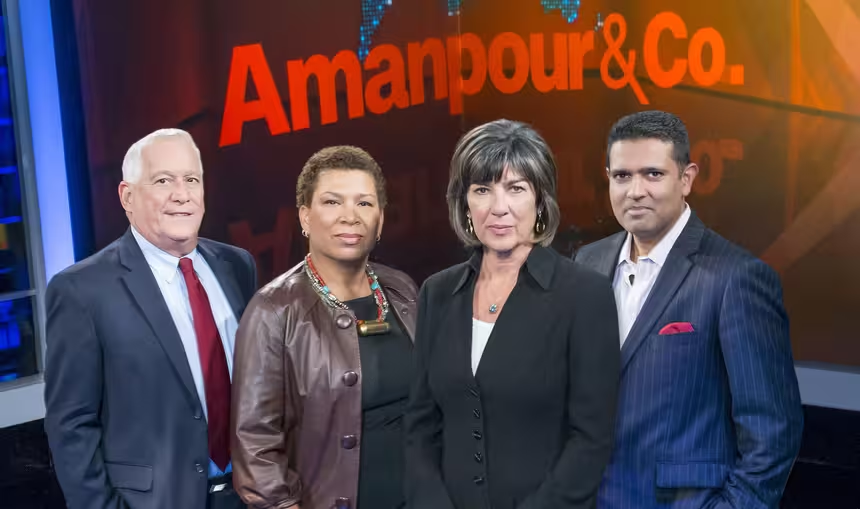
PBS and WNET, in collaboration with CNN, launched Amanpour and Company in September 2018. The series features wide-ranging, in-depth conversations with global thought leaders and cultural influencers on issues impacting the world each day, from politics, business, technology and arts, to science and sports.Providing Support for PBS.org
Learn Moreabout PBS online sponsorship[exciting music] - Hello everyone and welcome to Amanpour & Company.
Here's what's coming up.
Iran claims a deal is on the table to free jailed American citizens, but the US calls it a cruel lie.
After our extraordinary interview inside Evin Prison with Siamak Namazi, I now speak to Tara Tahbaz, whose father, Morad, is also there.
And to former ambassador Bill Richardson, who lobbies for Americans imprisoned abroad.
Also ahead.
- There's been no easy answers.
It's been tough to get the balance right.
- [Christiane] The BBC scrambles to save face in a row over impartiality, but was sports commentator Gary Lineker wrong about the issue of Britain's refugee policy?
My conversation with migration expert Oxford University Professor Alexander Betts.
- And.
- These medications have gotten so much attention that they're changing what we think about this disease.
- [Christiane] Hari Sreenivasan talks to Dr. Fatima Stanford about obesity in the United States and the impact of a breakthrough weight loss drug.
Plus.
- Ladies, don't let anybody tell you you are ever past your prime.
- "Everything Everywhere All at Once" cleans up at the Oscars, and Michelle Yeoh breaks ground as the first Asian woman to win the award for best actress.
We revisit our interview with her.
[bright music] - [Announcer] Amanpour & Company is made possible by the Anderson Family Fund, Sue and Edgar Washenheim, III, Candace King Weir, Jim Attwood, and Leslie Williams, the Family Foundation of Leila and Mickey Straus, Mark J. Blechner, Seton J. Melvin, Bernard and Denise Schwartz, Koo and Patricia Yuen, committed to bridging cultural differences in our communities, Barbara Hope Zuckerberg.
We try to live in the moment, to not miss what's right in front of us.
At Mutual of America, we believe taking care of tomorrow can help you make the most of today.
Mutual of America Financial Group, Retirement Services and Investments.
Additional support provided by these funders, and by contributions to your PBS station from viewers like you.
Thank you.
- Welcome to the program everyone.
I'm Christiane Amanpour in London.
The families of Americans imprisoned in Iran are being buffeted by sort of psychological warfare between adversarial states.
Over the weekend, Iran's foreign minister said a prisoner swap agreement between his country and the United States has been broken, and now the ball is in their court.
But Washington quickly quashed that.
The State Department's Ned Price told CNN, quote, "It's a cruel lie that only adds to the suffering of their families."
Now this follows the heartbreaking appeal made by the Iranian American Siamak Namazi when I spoke to him inside Evin Prison last week.
He spent seven and a half years there, repeatedly left behind in other prisoner swap deals between the two countries.
Two other Americans are also imprisoned alongside Siamak: Emad Sharghi and Morad Tahbaz.
They call themselves hostages and that they are pawns caught up in the decades-long standoff between Tehran and Washington.
Just ahead, we'll hear from one of their daughters.
But first my next guest has made it his mission to try to help.
Bill Richardson has been an American cabinet secretary.
He's been ambassador to the UN, and the former governor of New Mexico, a long time interlocutor with regimes like Russia, North Korea, and more, to secure the release of American captives.
And he's joining me now from Albuquerque.
Governor, welcome back to our program.
It's a long time since we've spoken, and I just wanna get your opinion based on your experience.
These dueling narratives and claims now about any kind of a deal to get the remaining Americans in Iranian prison released and returned.
- Well, what my role is, is we work for the families though like the Sharghi family and others that are parents or families of wrongfully detained.
I am not the lead negotiator, I'm not a negotiator, but I've talked to both sides, the Iranians and are very capable Iran envoy, Rob Malley.
There's very serious negotiations going on, but I agree with the administration view.
There is no deal at this time, but they're meeting intensively.
And the victims here are these three Americans that are suffering, that are wrongfully detained, that are being used as political pawns, and this has happened in Russia, Venezuela, Iran, North Korea.
It's a pattern.
It's a new hostage diplomacy that we have to start confronting.
And this president, I believe, has done a good job so far.
- Well, I'm gonna get to that later about how one does start confronting, you know, more on a global issue, but can I just then put to you this rather heartbreaking plea that Siamak Namazi asked me to be able to direct to the president himself via the media, via us.
This is what he said on on Thursday to us.
- [Siamak] President Biden, I certainly hear, and I sincerely appreciate your administration's repeated declarations that freeing the American hostages in Iran is its top priority.
But I remain deeply worried that the White House just doesn't appreciate how dire our situation has become.
It's also very hurtful and upsetting that after 25 months in office, you haven't found the time to meet with our families, if just to give them some words of assurance, Sir: Morad, Emad and I have now collectively languished here for 18 years.
Our lives and families have been utterly devastated.
We desperately, desperately need you to finally conclude that we've suffered long enough as Iran's hostages.
- You can hear the emotion, a man who's been unjustly held in an Iranian prison for seven and a half years, plus the other two.
So I wanna ask you, based again on your experience with other such cases and lobbying for families.
You know, do you think that the president could and should, as a matter of just comfort and commitment, meet with the Namazi family, the Tahbaz family, you know, Sharghi families?
- Yes, the president should meet with him and the president in the past with Trevor Reed and the Griners' case, and other families has met with him.
I think the president should meet with them.
I think it's the responsibility of every president to try to get American hostages home, regardless.
And usually if it's a prisoner exchange or it's some kind of deal, it's worthy to do even though it may be unseemly.
So yes, I think the president should meet with them and I would support the president if he makes a negotiated deal with the Iranians.
I think it's our responsibility to bring these three home.
They've suffered enough, their families have suffered.
We represent, we work very closely with one of the families, the Sharghi family.
I think it's important that it happened.
But so far, I think if you look at the record on Venezuela, on Russia, the President does meet with these families.
He should do that, too.
- So why do you think he hasn't, Governor?
- They deserve to be heard.
- They're appealing for that desperately.
Why do you think, in this case, and is Iran, particularly now, super-sensitive in some way?
Is the case of Iran something that's unpalatable for the President?
- No, no, I think, I think here's two issues.
One, I think the President may be waiting, and I'm not the negotiator, for some kind of framework of a deal to happen.
So he's waiting for that.
That hasn't happened yet.
And I think what might happen is a meeting where a framework is close, he should meet with them regardless.
These are wonderful Americans, and they're Americans.
And many that I have dealt with around the world, they're American veterans and they're wrongfully detained, and there may be 70 around the world.
So he should, I think it's the duty of every president to do that.
They don't always listen to me.
But yes, and I think your interview shows the pain that many of these Americans have, and they want hope, and it's the President that can make this happen.
- So you know, you've said correctly that presidents, you know, and we're just talking about Iran now, presidents from, I guess Ronald Reagan, have made these deals to get Americans back, whether they are the American hostages in the embassy over the revolution, whether they were the ones held in Lebanon where there are several prisoner swaps that have happened and none, certainly Siamak has not been released and in the last few years, nor has Tahbaz and Sharghi.
So do you think the president can persuade, you know, the usual suspects who would disagree, you know, whether it's the conservatives in Congress, whether it's the conservative media, do you think that he can, he can sell this, a proposal to make a deal with Iran for American citizens?
- Well, I, as I understand it, and I've talked to both sides, I think that what is involved here is not necessarily prisoner exchange, but I'm not gonna go into the details of the other issues.
- Yes.
- So is the deal doable?
Yes.
Is it possible?
Yes.
Is it gonna be soon?
I believe so.
I'm an optimist.
- Mm-hmm.
- The Griner deal was a swap with a man named Bout, who was a horrendous person.
- Right.
- It may not be a good deal that will please everybody, conservatives, Republicans, whatever, but I think it's a solemn duty of a president to do everything he or she can to bring Americans home.
And I'm optimistic, but I don't have the details.
We should be very circumspect.
Look, the relationship with Iran is not good.
We have a nuclear treaty that probably is in shambles, but that doesn't mean that on humanitarian issues, on issues relating to prisoners, Americans wrongfully detained, that the president shouldn't make a deal.
- Mm-hmm.
- And it's probably not gonna be popular, but I'll support him.
And I think many will support him, as they did with the Griner deal, with Trevor Reed, with Venezuelans.
The president is an empathetic guy.
He's good at these meetings with family.
He should do that soon.
- So you're gonna recommend to him?
You could pick up the phone.
You could pick up the phone and suggest it.
- Well, they don't always listen to me.
- All right.
- I mean, I don't work for them.
- No, I know.
- I have a foundation.
I work for the families.
- I know.
- You know?
So I hope he does.
- Okay, so let me ask you this.
- At the very least.
And I think if there's a deal, yeah.
- Yeah, you're saying that he could sell it, and of course they have done in the past.
Many Americans have been freed, having been held by Iran, often in order to get their own money back.
It appears that this deal, brokered by Qatar, is about giving Iran the money that South Korea should have paid, and actually not going straight to Iran, but in an escrow account, used the humanitarian purchases.
South Korea got oil worth some $7 billion, and Iran wants the money back.
And it appears Qatar has figured out something from the Iranian side that seems acceptable, and next it has to go to the US, which so far deems it not acceptable.
So let's play devil's advocate for a moment, because there is a whole sort of global notion.
Any kind of deal to get anybody back, does it not risk encouraging the same countries, other countries, to do that?
Is there a way to get some kind of global, I don't know, treaty on this kind of issue so that these issues are dealt with in partnership?
- Well, I think the first thing we should do is we should publicly announce that any country that wrongfully detains Americans is gonna get sanctioned immediately.
Not just individual people, but industries, et cetera.
That's one.
Number two, as unpleasant as it is, it should be the foreign policy duty of our country, especially if it involves American veterans, especially if they're wrongfully detained, or the three in Iran, for us to do whatever it takes to bring them back.
It could be unpopular.
It could be a bad person in a prisoner exchange.
But in this case, I'm not gonna go into details.
One of the problems is that Iran and the United States don't talk to each other.
So we have to do it through intermediaries, and that has been a problem.
But progress is being made and our government is trying very hard to get 'em out.
But at the very least, meet with them, feel the pain of the parents, of the families, and find a way to make this happen.
I will support the president, no matter what the deal is.
- Okay.
Yeah.
- Let me just finally ask you- - We all should.
- Yes, certainly the families do believe that, obviously, and there's so much precedent, as you said, including for Britney Griner, who let's face it, was, you know, released in an exchange during a period where the United States is, in a way, you know, certainly adversarial with Russia, who is holding her right now.
Anyway, I wanna ask you in terms of American foreign policy, what you make and should the United States be concerned of China now acting as a peace broker, if you like, certainly between Iran and Saudi Arabia.
This has really set a lot of the foreign policy establishment, you know, steam is coming out of their ears, 'cause it's so extraordinary that, A, China would do this and B, cut out the Americans, and C, between two such strong adversaries in that region.
- Well, it is a significant development, but is it tectonic shift?
I don't think so, and I think we have to have a vision and a strategy to deal with it.
Here's the way I see it.
Number one, Russia is moving with China into a anti-US, Europe axis.
I think that's what is happening.
Number two, the Saudis, when I was energy secretary, they were a steadfast allies.
I'm not sure they are anymore.
They're playing all sides mainly with the eastern block, with Russia and China.
I think Iran has gotten some cover in the region by this arrangement, and China is a geopolitical player.
So what do we have to do?
First, we don't panic.
When you exchange relations, diplomatic relations, doesn't mean then that Iran and Saudi Arabia are immediately friends.
There's still a lot of grievances with each other.
But we gotta adapt to this.
And my answer is engagement, dialogue, talk to bad people.
You know, I've done it all by life, not that it's always worked.
- Yeah.
- But you gotta have a dialogue.
You gotta have engagement.
You can't just say, "Oh, this is terrible.
What are we gonna do?"
No, let's deal with it.
Let's have a strategy, let's have a vision.
It is significant.
- All right.
Governor Richardson, thank you so much indeed for joining us.
Really important conversation there.
And now, let's turn to one of the prisoners in Iran.
In 2019, Morad Tahbaz, an environmental conservationist, was sentenced to 10 years in prison for cooperating with a hostile government, that government being the United States of which he is a citizen.
And despite the Biden administration saying it is, quote, "working tirelessly to secure the release of her father and other detainees," Tara Tahbaz says that she and the other family members have not been able to meet with President Biden so far on this issue, as we've just been discussing with the governor.
Tara is now joining me live from Connecticut.
So Tara, you just heard what governor Bill Richardson says, and he holds a very important position, not an official position, but he has walked the walk for many other families in the past.
And as he said, he's working with one of the families, one of your families right now.
What did you make of what he said about the key issue of meeting the president?
- First and foremost, I would like to thank you so much for having me today and for all of your continued support for our families.
It means so much to us.
Everything that he said, it meant so much to us to have that support, and we couldn't be more aligned with him.
You know, definitely, we need the congressional support across the board and we need all the American people to support us, because ultimately President Biden will have the power to make the final decision that will bring my parents home, Siamak Namazi home and Emad Sharghi home, and we just need everybody to stand with our families in supporting him to make that difficult but necessary decision.
- You said something quite pointed the other day after the interview and when the lawyer and you, members of family, held a press conference, and you referred to Brittany Griner and her release and how she was treated, and her family was treated, compared to you by the White House.
What were you saying?
- You know, I think the administration from day one has stated that our loved ones are priority to come home and now they have been in office for 25 months, yet our three families have not been able to even speak to the president for five minutes.
And while my father, my mother, Siamak, Emad are not celebrities or high-profile citizens, we should be afforded the same fortitude that was applied for Brittney Griner and the opportunity that her family received to be able to tell their plight firsthand to the president and really just share our pain, our fear, and begging him to do whatever is needed to bring them home.
At the end of the day, they're innocent Americans and they're there because they are Americans.
So they should be afforded the protection from their country and to have anything and everything done to bring them home for them to be reunited with their families.
- How long is it since you have not seen your parents, and I know your mother is not detained, but she is not free to leave Iran at the moment.
How long since you've seen them?
- So I was actually with them in Iran in November of 2017, and upon leaving was when my father's travel ban began, but I had to come back home to start a new job.
And it was January 10th of 2018 that my father was detained, and then at that time my mother was put on a travel ban.
So I haven't seen either of them since I left the country.
- It's around six years or so since then.
- Yeah.
- Tell us about your father.
We described him as, you know, an environmentalist, a conservationist.
Give us some details about him and also how he's doing.
- Yes, of course.
So my father, his whole life from a young age, has been very passionate about environments and environmental conservation and wildlife preservation, which led him to found the Persian Wildlife Heritage, co-found, the Persian Wildlife Heritage Foundation.
But my father is an amazing person.
He is so calm, so kind, so generous, so noble.
He will move mountains to protect the people that he cares about.
He's an amazing father, that goes with out saying, and I think just how my siblings and I have been able to carry ourselves through this surreal nightmare is just a testament to him and my mother and everything that they've instilled in us and who they are.
- Tara, can I ask you a slightly tricky question?
As you know, there are thousands of Iranians, women, children, men who've been rounded up in the latest crackdown on civil rights, human rights in that country.
We now hear that some 22,000 more have been given a pardon from jail.
But nonetheless, most of them also don't have access.
They don't have access to the press.
They don't have access to lawyers.
They don't have, you know, proper trials, et cetera.
And I wonder whether you feel that you are caught between, you know, I don't know, Iranian exiles or others who don't want this government, as it's cracking down on human rights, to get any kind of deal, any kind of money, even if it's their own money that's gonna go into escrow somewhere else.
- I think at the end of the day, they are Americans, so they belong here.
They're only there because they are innocent Americans.
And it's heartbreaking to see everything that is happening there.
And I think that just speaks more to the urgency that, as Americans, we need to bring them back home here where they're safe and protected.
- Can I ask you another question?
Because I have heard from people in your position that during the Trump administration, it was easier to get to meet with the senior officials for families.
What was your experience during the Trump administration?
You remember the Secretary of State made quite a big, Pompeo at the time, I think it was, that returning hostages, prisoners, captives was a top priority for the administration.
Did they engage with you any more or differently than the current administration?
- Our family has been very grateful both to the National Security Council, as well as the State Department in both administrations.
They have been very open with us and supported us, especially this administration.
But at the end of the day, while they're providing all these supports, it's nearly six years that I'm still without my parents.
And you know, he was left behind from the previous administration, as well as by the UK government when Liz Truss, Foreign Minister Liz Truss, struck a deal that brought home two other UK citizens and left my parents behind.
And we saw Siamak, he's been left behind by two previous administrations.
So at the end of the day, I think this is speaking that much more to why we are trying to get to Biden and ultimately he is the one who will make the decision to bring them home.
So we are so grateful for everybody in between who has been with us, but at the end of the day, Biden will make the ultimate decision that brings them home.
And we can't emphasize enough that we need the congressional support and all the American people to stand with us to help him make the difficult but necessary decisions to give our families back.
- Tara Tahbaz, thank you very much, indeed, for talking to us.
And you mentioned the British angle because your father is also a citizen of the UK.
- Yes.
- Yeah.
Thank you so much.
Next to refugees and the British government and the BBC.
The 100-year-old broadcaster with a sterling global reputation is trying to recover from what's being described as a devastating own goal.
The former England football star and host of "Match of the Day" Gary Lineker is back on air after being briefly suspended when the BBC accused him of breaking their impartiality rules.
Lineker, a longtime supporter of refugees' rights, had criticized Britain's new and Draconian policy to stop them crossing the channel, calling the government's language and approach to asylum seekers reminiscent of 1930s Germany.
Migration is a hot-button issue in many parts of the world.
Just yesterday, at least eight people died after two smuggling boats capsized off San Diego's shores.
"The Wealth of Refugees," by the Oxford University Professor Alexander Betts, highlights how refugees have always added value to their host countries, and he's joining me now live from Oxford.
Alexander Betts, welcome back to our program.
We have talked many times over the years about this issue.
So can I just try to talk about the policy rather than the politics of the tweet and all the furore over the last several days?
So before we discuss the Lineker tweet, Suella Braverman, the current home secretary in charge of this new policy about trying to, you know, stop the small boats coming across the English channel, says, "There are 100 million people around the world who could qualify for protection under our current laws.
They are coming here."
Are those numbers from Braverman exaggerated?
Are 100 million people around the world trying to come here now?
- This is an enormous exaggeration.
According to the UN Refugee Agency, there are 100 million displaced people around the world, and actually only around a third of them, 32 million are refugees.
And of those refugees, over 80% are in low and middle income countries.
So the idea that a hundred million people are potentially all aspiring to come to the UK is a gross exaggeration and a misrepresentation.
In reality, last year the UK received about 45,000 people by boat across the English channel and received about 75,000 asylum applications.
If we put that in perspective across Europe, at least three other countries in Europe received higher numbers of asylum applications: Germany, France, and Spain.
And again, if we put that in global perspective, we can see countries around the world like Jordan, Lebanon, Turkey, Uganda, Kenya, some of the poorest societies in the world with many multiples of the number of refugees and asylum seekers who come to the UK.
So it really is an exaggeration at quite a populist and irresponsible level.
- So then let's dissect the tweet on the policy aspects of it.
Gary Lineker's tweet started with questioning the idea by the government that there's a massive influx into this country by the channel or wherever.
And he said something similar to what you've just said, "We take far fewer refugees than other major European countries."
So you know, you've just mentioned the EU, they reported 330,000 irregular border crossings last year, well above the number you quoted, some 47,000 coming to the UK.
So he's right on the policy that there is no massive influx into this country?
- So I think we need a bit of balance.
We need to recognize that numbers crossing English channel are rising.
We need to recognize that the UK has received more asylum applications than at any point in the last 20 years.
But we also need to get a sense of perspective, that the reasons for these numbers rising are we're in a more fractured global world.
We have more people facing war persecution and in fragile states who need to cross borders as the last resort to access the most fundamental human rights.
And most are not coming to the UK.
Those coming to Europe are going to other parts of Europe.
Last year there were about 550,000 asylum applications across Europe.
Nearly 5 million Ukrainians received access to temporary protection in the European Union.
And the UK was very generous in offering about 160,000 places to Ukrainians through its Homes for Ukraine scheme.
But 160,000 compared to that overall number of some 5 million means doing our bit is very much what we're doing, but we are not disproportionately taking large numbers of refugees.
- Mm.
Well, I mean that's a huge discrepancy, 160,000 versus 5 million.
So we just park that for a moment and digest that.
Then I wanna ask you about the other thing that got a lot of the government and its acolytes in the press upset, and that was Gary Lineker's description of this policy: "This is just an immeasurably cruel policy directed at the most vulnerable people."
So what is the policy and how cruel is it?
I mean, we've heard of Rwanda, we've heard of them being sent back to country of origin, if that's what it takes.
What is the cruelty here?
- Well, he began by also discussing the language, and aspects of the language talked about the patriotic majority, and contrasted that with exaggerated claims of the threats to taxpayers, the threat to national security and the large numbers.
But what does the policy itself imply?
It implies that people who cross the English channel will immediately be liable to detention and that they won't have access to bail or judicial review, but they'll be confined to detention centers and they won't be admissible to have their asylum claim assessed, even if their refugees coming from war-torn societies, but will face immediate removal either to their country of origin or a third country that might be one that they've never been to, and might be one in a different part of the world, such as Rwanda.
So this policy, this bill, if it is enacted, and there's quite significant doubt that it will be enacted, it faces being questioned in the courts and there are questions about how implementable it is in practice, given the lack of third country agreements for removal.
But even if it was enacted, the historical significance is it's effectively a liberal democratic state abandoning the principle of the right to asylum.
It abandons the principle that universally anyone seeking sanctuary can come to the UK or another country and say, "I am a refugee.
I would like a fair hearing to assess my claim."
- Even the home secretary herself, Suella Braverman, has suggested that this plan may not work.
She said, "more than 50% possibility the UK would breach its obligations under the European Convention on Human Rights."
And the UN Refugee Agency also has condemned these plans.
So from your perspective, is it illegal?
- So I think it's interesting when you open up the bill, on the first page, there's a big red flag which basically says this might be in violation of the European Convention on Human Rights.
And it's also very difficult to see how disallowing people to avail themselves of the right to seek asylum doesn't violate the right to seek asylum, which is an established principle of human rights law and international refugee law, that's part of English law, part of law within the region of the European Union and the wider European region through the European Convention on Human Rights and international human rights and refugee law principles.
It's very difficult to see what the government's case could possibly be that justifies that this could be compatible with national or international human rights and refugee law standards.
- And if- - We don't know, 'cause we haven't seen the government's legal case.
- Yeah, I think, you know, it's going through its first reading tonight after we speak, or second reading.
Some conservatives, senior conservatives, disagree with this thing, and say they won't vote for it.
The question is, will it work?
Even if it goes through, will it work?
- Yeah, so there's a question of will it go through parliament?
And there's debate about whether it'll get through the House of Commons, then the House of Lords.
There's debate about whether it will get through the courts after that.
It will face challenges, just as the Rwanda removals policy did.
But even if it's succeeded in those areas, which is highly doubtful, then there are questions about whether it's implementable in practice.
And there are two massive obstacles there.
One is, can the government realistically detain the number of people crossing the English channel?
They've talked about using military bases, Royal Air Force bases and repurpose them, but the scale at which that would be necessary to provide detention that's in any way humane, including possibly for children and unaccompanied minors, is open to question.
And then the other question is the agreements they need with third countries.
So they've struck an agreement with Rwanda, but no planes have left from the UK with asylum seekers through Rwanda yet, and they've talked about a deal with Albania, and in the bill there's a list of a number of countries that they could send people back to as countries of origin.
There just aren't that many countries in the world willing to take- - Right.
- The asylum seekers coming to the UK.
- And very, very finally, clearly this is a lot of what one might say in the, you know, in the political press, red meat to the base.
It looks like this is something that certain parties, as we've seen it before, can campaign on around elections and this and that, and certainly recent poll says public opinion now is much more positive towards immigration.
So tell me one thing, how political do you think it is?
And how much does this country actually need migration, obviously managed, to fill jobs that are massively empty right now?
- This is, I think very much a political move.
It's with a view to a general election coming up.
The conservative government is struggling in the polls, and it needs to do something to be successful in the elections, and actually it recognizes that it's conservative base in many key constituencies is very concerned with the small votes.
And so making this announcement, they hope will do something to buttress their support in their core constituencies.
- This is a long discussion to be had, and we really, really appreciate you setting the record straight, Alexander Betts.
Now, we turn to a drug that our next guest says could, quote, "change the conversation about an often stigmatized medical condition."
Nearly 2.3 billion people globally, and more than two in five American adults, live between overweight and obese.
With the help of breakthrough weight loss drugs, Dr. Fatima Cody Stanford is seeing some patients lose as much as 15 to 16% in weight.
And she joins Hari Sreenivasan to discuss the recent buzz around these medicines.
- Christiane, thanks.
Doctor Fatima Cody Stanford, thanks so much for joining us.
You are an obesity medicine physician at Mass General, and I wanna know right now if I open a newspaper, I'm dating myself.
If I open my phone, I see headlines about a new class of medications with names like Wegovy and Mounjaro and Ozempic.
First of all, just explain to us what these medicines do.
- Absolutely.
This particular class of anti-obesity medications are what we call GLP-1 receptor agonist.
Now, that's super fancy, and it stands for glucagon-like peptide-1 agonists.
You may not have to remember that.
I do, but let's talk about how these medications work in your body.
They actually work primarily in the brain by causing two pathways to function in the way we want them to.
There's a pathway of our brain called the POMC pathway.
It's a pathway that tells us to eat less and store less.
And these medications work by really augmenting that pathway, stimulating that pathway to be more active.
But it also works by downregulating or inhibiting the pathway called the AGRP pathway.
And that pathway tells us to eat more and store more.
So you can imagine that since it's working directly in the brain, we're seeing really potent degrees of weight loss in the order of somewhere between 15 to 20% total body weight loss on average for the agents that you mentioned at the outset.
But they work in a few other ways.
They actually slow movement through your GI tract.
What does that mean?
You go and eat something and it moves really slowly.
So you can imagine if you eat breakfast and things move really slowly, by the time lunch happens, you're probably still full, whereas you would normally be hungry, so that's another way it works.
And it actually improves how your body secretes a hormone called insulin.
And then finally, and this is what a lot of people don't know, it actually browns your white fat tissue.
You might be like, why does that matter?
The more brown our fat tissue is, the more active it is, which means that even when we're sitting here like we are doing, Hari, we're burning more at rest than we would be normally.
So it works in a lot of different ways in the body, and this is why I think it's gotten as much attention as it's gotten.
- So I, we should mention that you do consult for a number of pharmaceutical companies, including the people who manufacture Ozempic, and now you say that this is kind of a game-changer for how we think of obesity.
Why is that?
- You know, I don't necessarily think of this as a game-changer, but I think that these medications have gotten so much attention that they're changing what we think about this disease.
You know, it was in 2013 when the American Medical Association acknowledged obesity is a chronic disease, but that news story came and it went.
Now, we actually see people really taking medications and benefiting from these medications.
We're seeing responses such that they feel like they no longer have to struggle with weight and they realize that their weight struggles are not all their fault.
And so I think that's where we talk about this changing the conversation surrounding obesity, what we see today here in the US and around the world.
- So tell me a little bit about the side effects that this class of drugs have.
I know that each drug is different, but I have yet to meet a drug that doesn't have a side effect.
- You are 100% true in terms of looking at this.
The number one side effect from GLP-1 agonist is nausea.
So if you look at the clinical studies, particularly as you're titrating the dose, so if we're looking at semaglutide, which for the treatment of obesity goes up to a dose of 2.4 milligrams, as that patient is titrating from 0.25, 0.5, 1 milligram, 1.7, and then finally 2.4 milligrams, that titration, they may feel nausea.
Up to 44% of individuals can experience that.
Now, what I have found is that if you need to stay at a dose longer to help mitigate that side effect, that's gonna be really important.
Behind nausea, the second most common side effect is constipation.
And if you go back to how these medicines work, right, if things are moving through the GI tract very, very, very slowly, things can get stuck, stopped, you know, and so sometimes we have to change a person's bowel regimen to make sure that we don't have constipation, which can be very common.
Those are the two most common side effects that we see in the population.
There are other kind of more rare side effects, but those are the most common side effects.
- So is this a forever medicine?
I mean, one of the things that people have been reporting is that if they get off of this drug that the weight that they worked hard to lose is gonna come back.
- You know, Hari, that's an excellent question.
I'm so glad you asked it, 'cause I really wanna answer it and make sure that we understand this.
I want us to think about this, and I'm gonna divert our attention to thinking about diet and exercise.
You know, we don't expect to eat one healthy meal or eat healthy for one month and that to last us.
Similarly, we don't expect those exercises we were doing back in the late '90s, I was a Tae Bo enthusiast, to last us 'til today.
Similarly, when we're looking at these medications, they only work when we're using them.
Tae Bo was really great back in the day, but if you're not doing it today, it's not giving you that impact.
When you withdraw the medications, and the wilding studies in the New England Journal really demonstrated this.
When you pull that back, what we started to see is weight regain back to where the patient was prior to adding that in.
Why?
We're no longer acting on those pathways of the brain we talked about.
It can't work if it's not being utilized.
So if you are a responder, if you do need these medications and they do work for you, this is a chronic use medication for the chronic relapsing, remitting disease that is obesity.
- What are the criteria that you are kind of checking off in your, you know, mental checklist that says this might be a candidate that would benefit from this versus another candidate who might just have to hear that hard news, that diet and exercise is really gonna be the best thing for you?
- I typically follow the guidelines and there's several sets of guidelines, but they all align with each other.
So they say that we should consider medications for patients with a body mass index of 27-plus in obesity-related disease, and which diseases, Hari?
These are diseases like high blood pressure, Type II diabetes, obstructive sleep apnea.
Now, if a patient has a BMI greater than or equal to 30, which places them into having obesity by BMI criteria, we could utilize medications in that group also.
So those are the key criteria that we're often utilizing.
Now, I am not a huge fan of BMI.
People have heard me talk about this.
And so I think on an individual clinician basis, it's also important to look at the full profile of that individual.
What type of obesity do they have?
Do they have obesity-related disease?
What's necessary for that individual in front of you?
But making sure, like you said, to use this in patients that actually need them and not just people that want these medications.
- So what if there are people watching right now who might not qualify under the category of obese, but their doctors are probably concerned about them heading into a pre-diabetic mode, maybe they have 15 or 20 pounds to lose.
Is there a world where these drugs are introduced for a short time to try to get somebody like that jumpstart until to get them kind of into a safer zone where they can get off it?
Or this is just not for that kind of person?
- Yeah, no, I don't see these as medications as a jumpstart, because that puts us into this idea of weight cycling, right?
We have something acutely that brings us down and when we weight cycle we can lose, and then we typically regain, you know, as soon as we withdraw.
So I look at these as appropriate tools for people that do need these long-term, not for a jumpstart or, you know, anything of that sort.
And just thinking, like I said, treating this as a chronic disease.
I wouldn't put, you know, someone on a high blood pressure medicine that came in with one high blood pressure reading, right, and then they didn't have evidence of sustained, you know, elevation in their blood pressure.
And that's kind of how I think that we should be thinking about these medications.
- I ask about need versus want, because one of the things that we have seen with this category of medicines is it's really viral and it's successful on social media, and you see a lot of people who, especially kind of in Hollywood who almost brag about the fact that, well, this is how I lost my weight, this is where it's worked for me.
And some people it's kind of like this sort of hush-hush thing where they're kind of passing around access to this, and what has that done to people who actually need the drugs?
- Well, you know, Hari, I think that's actually, you know, a little bit disgusting.
I don't necessarily use that word when I give interviews, but let's talk about why I see it as disgusting.
There has been a major shortage of these medications.
This lasted throughout the course of 2022 and was a major sore spot for me and my patients.
I only treat patients with obesity, and so for patients that I see, these are patients that do need these medications, but for six, seven, eight months of 2022, my patients couldn't get these medications.
So when these patients that need it, that can benefit from the metabolic benefit from these drugs, can't get the medicines and they're being utilized for people that don't need them, that creates a dynamic of the people that need these for longevity of life, reduction of heart attack, strokes, et cetera, aren't getting them, and people that are just trying to look cute in a bikini or for whatever their next event on the red carpet, you know, to look great.
I tell my patients that I'm caring about their health and getting them to the healthiest weight possible.
I don't care about the next wedding they have or the next reunion or whatever it is.
I wanna align with their health goals and not their aesthetic goals.
And I think that's extremely important.
- There's also a pretty significant cost here.
I mean these are not cheap drugs if you're not being prescribed them, which kind of for me raises kind of an access and an equity issue as well.
- You know?
Absolutely.
I'm the director of equity here at Mass General for the endocrine division.
So I'm always thinking about equity and the role it plays in access to therapies, particularly for chronic diseases like obesity.
And you're right, this has created this dimorphism such that those that have wealth and have this tremendous access or able to access them and those without aren't able to.
And that really creates significant angst for me as someone who cares for a sizeable portion of the population who are recipients of Medicaid, which means that the medications would not be covered.
Now, I happen to reside in the commonwealth of Massachusetts, where our private insurers, meaning Blue Cross Blue Shield of Massachusetts, Mass General Brigham's Insurance, et cetera, are covering these medications for patients that have those high-tier plans.
People, you know, that fall into the group of myself.
But what about those people that don't have those high-tier plans?
Where they can't get these medications for $30 a month, which is very accessible?
It creates a situation where I can't even prescribe these medications to those individuals that are most needing these medications.
You know, I really would like to see a shift in us thinking about this from a Walmart approach, right?
If we get full access then people are able to get what they need, we can drive down costs.
It's just pure economics.
That's what I would like to see eventually, because we're talking about over 110 million adults and over 20 million children that could potentially benefit.
And right now we're seeing less than 2 million potentially being able to access any agent, including this class of medications, here in the United States.
- I wanna also talk a little bit about kind of the cultural costs, because it seems like all the previous conversations we've always had about weight has been with a little bit of a bias that we've all kind of been told, it's diet and exercise that'll do it.
And if you don't exercise enough, if you don't eat right, you're gonna end up obese.
And then the inverse, if you're obese, then that means you must not be exercising, that you must not be eating right.
But I know people in my own life who do everything by the book and cannot change the way their body is shaped.
- Yeah.
All right.
I'm gonna change one of your words.
I'm gonna delete the word obese, just 'cause it can promote stigma.
But you're right that the most common form of stigma that's still acceptable is weight bias, right?
We are well within our purview of treating people that have excess weight, obesity, and ways that are demeaning, devaluing, and not believing what they say, not recognizing that they're putting forth the sweat equity and they're just not yielding results.
And I really learned this as a resident, my own biases as a physician, as someone who's always not struggled with my weight, has been an athlete, these types of things.
I had a patient that was in her mid-40s who had severe obesity and had struggled with severe obesity her entire life.
I was an internal medicine and pediatric resident in South Carolina.
And what I would do is every single visit, she would come in and see me every two to three months.
I would give her this diet recommendation or this exercise recommendation, all of these things, and over the course of three years, you know, I didn't see her weight shift.
She would shift maybe down two pounds, up one pound, really maintaining her weight set point.
Well, one day, Hari, I was leaving my workout, I ran into the grocery store, and who did I see but this patient, as she was about to check out at the grocery store line.
So I'm talking to her, she's like, "Hey, Dr.
Stanford."
I'm like, "Hey."
We're talking, but I'm trying to glance at her cart and I'm trying glance without looking right?
I'm trying to be inconspicuous, not doing a good job at it, because she says the following to me, she says, "See, Dr. Stanford?
I've done everything you told me to do."
And when you looked at her cart, and this generates some emotion for me, it was pristine, perfect, everything we had ever talked about for three years in her grocery cart as she's about to check out at the grocery store.
And it was at that point that I realized that this is not just about diet and exercise.
Now, as someone who no longer works and has not worked in South Carolina for over 12 years, I've been in Boston, I have no idea where she is and what her health is, but I can tell you that I failed her.
I didn't know that I was just giving her more and more recommendations.
She was doing all the things, but I wasn't changing her biology.
And so it brings me significant pain to know that I wasn't able to have a major positive influence, and in many ways was reflecting my own stigma and bias against what she was or was not doing until that key moment in the grocery store.
So I think that was where it was a, you know, moment, an inflection point in my life and my training is what brought me here to Boston and to Harvard to do three years of obesity medicine fellowship, to learn how I could be better for patients.
And that's really changed everything in the world for me and my patients that I care for.
- You also sit on the obesity section of the Academy of Pediatrics, and I wonder what you think about giving children over 12 access to these medications?
- I think a lot of people have fear and a lot of the backlash that I've heard in the media, particularly in social media about the new guidelines that were released by the AP regarding the use of medications and surgery, is like we're setting people up for eating disorders and we're gonna have people hyper-focused on their way.
But I have a 12-year-old patient that is being treated with pharmacotherapy for obesity that I've been taking care of for the last two years, and I happen to take care of both her father and her mother.
Recently, for some reason, they asked her what she thinks about her weight doctor.
I don't call myself that, but that's what they asked her.
And she was like, I don't see a weight doctor.
And they were like, "Well, yes you do, Dr.
Stanford."
She was like, "Oh, is that what she does?"
And so you wonder how am I able to talk and deal with a patient from the ages of 10 to 12, seeing her at least seven or eight times over that time and her not know what I'm doing, because my focus is her overall health.
I know this can be done in a way that's respectful, that doesn't set someone up for disordered eating and something that when she looks back at 12, she had no idea even what I do for a living until recently when her parents told her, that she will not feel as though this was a punitive situation.
She's been able to live life in a much fuller fashion after being treated for her obesity.
Similarly, my patients that underwent surgery, several of my patients underwent bariatric surgery in their, you know, teens, 14, 15.
They're now in their mid-30s.
And the opportunities they have in life, because we know that weight stigma sets up for discrimination in the workplace, discrimination with hiring, discrimination in higher education, et cetera.
And those opportunities are very different after they've been treated and treated with dignity, kindness, and respect.
- Dr. Fatima Cody Stanford, obesity medicine physician at Massachusetts General Hospital and a professor at Harvard, thank you so much for joining us.
- Important discussion there.
And finally tonight, a night of glitz and glamour that made history for all the right reasons.
[crowd cheering] Actors, directors, writers, and producers of Asian descent took this year's Oscars by storm.
The multiverse indie "Everything Everywhere All at Once" saw leading Lady Michelle Yeoh become the first Asian woman to win for best actress, and only the second woman of color to win the prize ever.
She said that to her, the golden statue is a beacon of hope.
- This is proof that dreams, dream big, and dreams do come true.
And ladies, don't let anybody tell you you are ever past your prime.
- And we can all agree with that.
When I spoke to Yeoh shortly before the awards, she told me about her own big dreams and her refusal to be pigeonholed.
- You receive scripts and as the years get bigger, the numbers get bigger, the roles seem to shrink with that, right?
As you know, as a woman, as an aging woman, or whatever it is, somehow they start putting you in boxes.
And it's always the guy who gets to go on the adventure and save the world and you know, rescue your daughter.
And you think, why can't I do that too?
- This was Yeoh's first leading role in a Hollywood film, and, boy, does she prove her doubt is wrong.
Earlier in the show, of course, we spoke about the hostility and cruelty facing many of the world's refugees, which Yeoh's costar Ke Huy Quan has experienced firsthand.
He won best supporting actor and in an emotional speech, he reflected on his own journey from Vietnamese refugee to Hollywood Star.
- My journey started on a boat.
I spent a year in a refugee camp, and somehow I ended up here on Hollywood's biggest stage.
- What a remarkable pair and a true celebration of diversity in film.
That is it for our program tonight.
If you wanna find out what's coming up on the show, sign up for our newsletter at pbs.org/amanpour.
Thanks for watching Amanpour & Company and join us again tomorrow night.
[exciting music]

- News and Public Affairs

Top journalists deliver compelling original analysis of the hour's headlines.

- News and Public Affairs

Today's top journalists discuss Washington's current political events and public affairs.












Support for PBS provided by: