
June 10, 2024
Season 3 Episode 6 | 27m 29sVideo has Closed Captions
Kentucky 38 out of 50 in new report ranking the well-being of children across the U.S.
Kentucky 38 out of 50 in new report ranking the well-being of children across the U.S., Kentucky Secretary of State Michael Adams receives John F. Kennedy Profile in Courage Award and, Kentucky Wildcats are headed to the College Baseball World Series.
Problems playing video? | Closed Captioning Feedback
Problems playing video? | Closed Captioning Feedback
Kentucky Edition is a local public television program presented by KET
June 10, 2024
Season 3 Episode 6 | 27m 29sVideo has Closed Captions
Kentucky 38 out of 50 in new report ranking the well-being of children across the U.S., Kentucky Secretary of State Michael Adams receives John F. Kennedy Profile in Courage Award and, Kentucky Wildcats are headed to the College Baseball World Series.
Problems playing video? | Closed Captioning Feedback
How to Watch Kentucky Edition
Kentucky Edition is available to stream on pbs.org and the free PBS App, available on iPhone, Apple TV, Android TV, Android smartphones, Amazon Fire TV, Amazon Fire Tablet, Roku, Samsung Smart TV, and Vizio.
Providing Support for PBS.org
Learn Moreabout PBS online sponsorship♪ ♪ >> It reminds us the Kentucky is not the best place in >> Where one report says Kentucky is coming up short when it comes to kids.
120 people are killed.
Every day in the United States from gun violence.
And that is 827 people in Kentucky per year.
That are killed.
Survivors and those who lost loved ones to gun violence on their efforts to KET others.
>> From suffering the same loss.
>> It's like the FOX is guarding the hen houses.
A University of Kentucky professor talks about politicians rigging the election system.
>> There's nobody covering the >> And a heads up play puts Kentucky in the College World Series.
>> Production of Kentucky Edition is made possible in part by the KU Team Millennium Fund.
♪ ♪ >> Good evening and welcome to Kentucky EDITION on this brand new week.
It's Monday, June, the 10th.
I'm Renee Shaw.
Thank you so much for spending some of your Monday night with us.
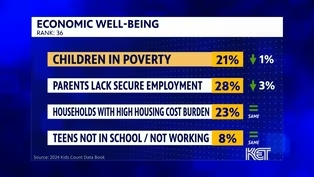
Kentucky is moving up but still sitting toward the bottom in an annual report ranking the well-being of children across the U.S. and the 2024 kids Count Data book, Kentucky received an overall ranking of 38 out of 50.
That's up 2 places from last year.
This year's report released by Kentucky Youth Advocates focused on children's educational outcomes and what's keeping them from learning.
>> We are in that bottom wrong of states when it comes children and well-being.
It reminds us the Kentucky is not the best place in America to be Always begin with economic well-being because my hypothesis is that of the 16 indicators that we look at.
Absolutely the the canary in the coal mine.
If you want to call it that is the data point about the number of children in poverty.
The good news is that we begin to inch in a positive direction around the percentage of children in poverty.
We improved just by one percentage point, but it's at least in the right direction.
So we should we should take encouragement from that.
But we also have to remember, even with these numbers.
That more than 200,000 kids in Kentucky woke up this morning living in poverty.
What we have seen over more than 3 decades of kids count data is where childhood poverty lives today is where those other indicators will be tomorrow.
The theme of the book, as you know, this year for the first time in 35 years of kids count.
Is education just the most cursory look at the education indicators shows one commonality, which is we're getting worse on every national indicator.
Of education.
You know, in some of the numbers.
Are astounding.
7 out of 10 0th graders.
Do each meet minimal national proficiency in reading.
8 out of 10 0th graders unable to meet minimal national proficiency when it comes to masks.
And this isn't a national phenomenon, but it's certainly very true.
And in Kentucky is the dramatic rise in chronic truancy and absenteeism.
One in 4 Kentucky students.
Recorded in attendance record considered.
Chronically absent for the last year measure.
I mean, you want to know why 8th graders can't do math cause.
They're never in math class.
And so we've got to get creative and innovative.
And how do we get those young people to school on a regular, stable basis.
The General Assembly and the governor talked a lot about workforce.
And and I understand that.
Can you project Kentucky's workforce in 2 decades?
2 out of 10 employees can do math.
And 3 out of 10 employees can read at a national level.
So you're talking and achievement crisis today.
But you're talking about a workforce me tomorrow.
I think that the most alarming stat maybe in the whole report.
Is the increase in child and teen mortality rates.
Recent data shows that 91% of homicides in Kentucky.
The victims were aged one to 17.
And that 66% of those deaths involved firearms.
And no, there's a lot of folks who don't want to talk about it, but we are either going to talk about the role of guns in our society or we're going to talk continue to talk about increased in child mortality rates.
>> Interesting data, Kentucky youth advocates as some of the ways to improve child well-being include providing access to tutoring mental health services after school care low or no-cost school meals and reliable Internet service.
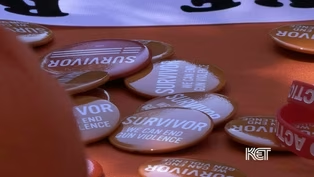
Last Friday was the 10th anniversary of Wear Orange Day a day to promote gun violence awareness survivors and those who lost loved ones to guns gathered in Lexington to call for an end to gun violence.
>> Too many killing one another.
Our youth using a gun against a brother, too many mothers losing a son.
>> I'm the grandmother of Tyler Williams who was murdered in 2017.
We have a history in our family.
People being killed.
Martin, back in.
My grandmother's mother.
My grandmother's brother.
My grandmother, son.
And it goes on.
And then there's Tyler.
And there was my grandmother's.
Son's son.
That's no history that anybody wants to Bayer I grew up in eastern Kentucky.
>> And it was there on January 18th 1993.
That I experienced the gun violence that forever altered the course of my life.
On that day, a classmate walked in later in this classroom.
And shot and killed our English teacher, Deanna McDavid and the school custodian.
Marvin Hicks.
He then held us hostage for nearly half an hour.
But for letting us go turning himself in to the authorities.
My former classmate into 2 lives that day and radically changed the lives of 22 others.
There are 22 kids in that class that lost all sense of safety and security.
They will ever know this cycle.
Got it.
And we've got to love on a baby's.
>> I lost my son, Shawn Howard in 2017 August 5th, almost 8 years ago.
Wow, our case was.
Soft.
Are.
The perpetrator was found not guilty.
So every day we live with these.
Remembrance that.
Our loved ones are not here with us.
Sean will be forever 19.
He would have been 27 this year.
But he will be forever.
19.
>> My son was William Cole.
Joshua, he was murdered in 20.
22 may the 22nd.
I didn't think I was going to be able to make it through.
May.
So you go you go through Mother's Day.
There's nothing like being a mother with no child.
You have no child because somebody decided to take a gun.
or to yours.
So I feel a certain type away every day we need to arc to fit all of us.
Praying for a single mom is in kids dealing with trauma.
Gunshots at night is hard to dream with his side of >> A lot of times when you're a gun violence survivor, you have a loved one that's killed by gun violence.
>> Year with the elephant in the room.
>> It's the stairs.
It's the >> people looking at you and all corn us, you know that.
Well, they don't have to speak to you on what's happened to one of the most detrimental things you can go through.
One of our speakers said today their heart hurts your heart hurt every day.
When you lose a loved one any time you lose loved one.
But when you know that someone is taken that loved one from you, it's something different because it's out of your control.
It's out of your power.
So to have our community step up and be behind us and stand with us and say, hey, we're going to join this fight with you, sir.
Nobody else has to go through it.
It really impacts our lives and helps us know that we're not alone in this journey because we do walking alone a lot of times.
>> The entire month of June as national gun violence Awareness Month.
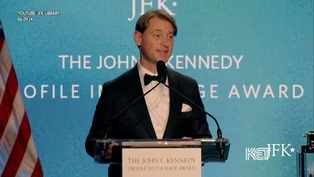
And politics now, Kentucky secretary of state Michael Adams as leadership not follow worship is needed to protect our democracy.
Secretary Adams remarks came yesterday as he received the John F Kennedy profile in Courage Award and Boston.
The award from the Kennedy family recognized Adams for his role in expanding voting rights in Kentucky and fighting conspiracy theories about election fraud.
Adam said the threat to public servants today is not just political but physical.
>> In his book profiles in Courage.
Senator Kennedy's observations, the timeless.
Such is the various pressures we want the deficiencies in making decisions.
What seems quaint 68 years on.
Is that now more than political courage is needed.
Today when we refer to courage in our public servants B, they secretaries of state County clerks, more workers.
School board members.
Even public health officials and practitioners.
We refer to physical courage.
The courage to risk of physical harm in order to serve the public.
I have not received this award for that reason.
There are others who have risks for more.
The 9.
I would like to think I've been given this award to celebrate a happy ending.
Into market example.
Others should follow in order to KET the American experiment in some government life.
>> Secretary Adams also praised Kentucky voters for rejecting many conspiracy theorists running for public office.
Speaking of election and election integrity.
Josh Douglas, a University of Kentucky law professor, has just written a new book called the Courts versus the voters.
He looks at some legal decisions by the nation's highest court over the years that he says have hurt our election process.
On Friday, I spoke to Professor Douglas about his new book.
>> This book The Faces of It is that the U.S. Supreme Court rulings have fundamentally changed.
>> Voting rights and how our elections are run and this country is it for better or for worse.
>> It's unfortunately for worse.
And this has been something that happened really over the past 50 years.
You know, a lot of people I have heard of cases like Citizens United from 2010, which is about campaign finance or maybe Bush v Gore.
Yeah, right.
Which ended the 2000 presidential election.
But in the book, I trace cases that no one's really heard of talks about from the 1970's, 1980's in 1990's that lead the foundation for today.
Now the court failing to adequately protect the constitutional right to vote.
>> And of course, the court has changed in composition over the last half century.
So many of us would think that perhaps the can the court seeming to be more conservative now that the pace would have quick and on the erosion of voting rights.
But you say it dates back much farther than that.
>> Yeah, I mean, so certainly in the past 10 to 20 years have had a series of cases have harmed the constitutional right to vote.
Yes.
>> Cut back on protections and the Federal Voting Rights Act.
But the foundation for doing so with the made in these earlier cases, again, that no one's really heard of that one.
Yes.
1992 Burdick versus to come.
She is a really interesting case.
This involved an individual named Alan Burdick in Hawaii who went to his polling place that day and didn't like any of the candidates so sought to write in a candidate to a write-in vote.
And the poll worker said he wasn't allowed to.
Actually the Parker said the machines wouldn't allow it and he didn't know if that meant the actual voting machines or the political of Hawaii that was trying to control things.
And, you know, didn't want to sent from a write-in candidacy.
He took his case all the way to the Supreme Court because Hawaii law would not an outright in voting and he lost now that that in and of itself maybe is not that important, that, you know, the Constitution does not require a state to allow write-in voting.
But what was really important was the test.
The court said that and which began to say that instead of scrutinizing a state law really carefully and making sure that the state has a really good justification for its rule.
Instead, we're going to start deferring to states.
We're going to trust states to run their election.
So in the why he case the state said, well, you know, basically we just we think this is easier for the ease of election administration.
And the court said that's fine.
Now actually tracked down Allen in Hawaii, which was fascinating out to interview him via Zoom Naha and he still angry to this day really about what that's the case stands for and how the case stands for this beginning of the erosion of the constitutional right to vote.
That cases cited all of the time in current cases for the idea that we can just trust the state politicians to run elections as they see fit the very people.
We should trust the least when it comes to voting rules.
Well, and some people would say there's always the conversation about states rights.
So why should that apply on how elections are run down with that wind?
The Constitution does give states.
>> The first caught at an acting voting rules.
Article one Section 4 says The Times places and manner of running elections shall be determined by the state legislature's and says Congress can alter or amend those laws.
>> So yes, states can have the first say in the crafting voting rules.
The problem is when those rules are enacted essentially to entrench the majority in power to make it easier for your supporters to vote and harder for your opponent's supporters to vote.
Then we have a situation where the politicians are, you know, essentially rigging the game and, you know, skewing the system.
So we need judicial oversight to ensure that is the voters who are paramount in our system, not the state politicians.
I refer to this as undue deference to state politicians.
It's like the FOX is guarding the hen houses.
When you know, these people are the ones who are most self interested.
So yeah, they should have the ability at that taking a first cut it at coming up with the voting rules but only so far and they should have the burden of justifying why they need to run the election the way they are.
>> Well, as you very well know, there's a lot of scrutiny in these last few years about elections and election integrity and election security.
How does how do those concerns fit into the conversation that you're having about SCOTUS rulings impacting voting rules and does it perhaps even further that divide the chasm that we have between those who believe that our elections are rigged and those who believe that they're not.
I think the problem here is that states are justifying all sorts of voting rules.
>> By pointing to the concern of fraud, the concern of election security with 0 evidence that there's a problem that needs to be facts.
Now, of course, our system should be set up to deter fraud to make sure the integrity of the election is paramount but not at the expense of the voters.
And so here you have a situation where a plaintiff voting rule and says it harms the ability to participate and in the election.
And the court says we need to provide really, really, really strong evidence, plaintiffs voters to demonstrate the disenfranchisement and then they asked the state okay, what your justification for the rule and the state will say well, are concerned about election integrity.
And the court then asks, well, is there a problem that you have evidence that the elections have not been secure and that the state says, well, no, we're just worried about it and the courts as well.
That's fine.
So the balance is off.
We're making the voters provide a time.
Khan of evidence to demonstrate the harms that they're suffering and we're trusting the states to just say what we care about.
Election security.
And that's enough to defer to the state's rules.
That's backwards.
If you think about the fundamental nature of the constitutional right to vote.
The starting place in a constitutional democracy.
So give us some examples for those who are curious, what exactly.
>> Erosion of particular voting rights or rules that interfere with unfettered access to the polls.
>> Well, you know, you could go back to 2008 and the case called Crawford versus Man County out of Indiana involving voter ID laws and not all voter ID laws are bad.
I think here in Kentucky, we, you know, have a pretty good compromise law that requires people to show ID but has lots of different kinds of ideas that counts has a failsafe mechanism for people who show up to the polls and don't have an ID.
Indiana's laws, not strict lot fewer kind of ID's If you don't have your ID, you've got to go to the county clerk's office several days, you know, within several days after the election, most voters aren't going to do that.
So this was challenged and the plaintiffs had evidence that this kind of all what actually disenfranchise some people who simply don't have a need for an ID and their everyday lives.
And again, the courts as well.
Do you have Indiana on stage of evidence that there's a problem here and Indiana says, well, no, we don't have any actual record of someone showing up to the polls and pretending there someone they're not and the courts as well.
That's OK, we're going to just trust the state and we're going to hold the law.
You know, more recently you have these challenges you know, the ability to drop off your ballot again, Kentucky.
We do a pretty good job of this.
We have drop boxes.
They're secure.
There are lots of different locations.
Yes, states like charges that are passing laws to restrict the number of drop boxes allowed or Ohio.
Same thing that restrict how many drop boxes there can be in Ohio.
It's I think it's one drop box location per county, which means that, you know, the county with Columbus with millions of people could only have one drop box.
So this is challenge and again, the plaintiffs say, look, this is going to make it so much harder for us to participate.
And on the other hand, us the state.
What your reason?
And they say, wow, we're concerned about fraud or just trust us around the election.
And now the Supreme Court, but also the lower federal courts are trusting the state and refusing to strike down those laws.
>> You'll hear more from Professor Douglas tomorrow.
I asked him to grade the election process in Kentuckyian how quote, voter friendly it is hear his assessment tomorrow night on Kentucky EDITION.
In November, Kentucky voters will decide on a school Choice Amendment Amendment.
Number 2, if passed, it could mean public money could be used for private schools and education.
People feel very strongly about this on both sides.
And you'll hear from both sides on Kentucky tonight.
That's this evening at 8 Eastern 7 central right here on KET.
♪ ♪ As Pride Month kicks off.
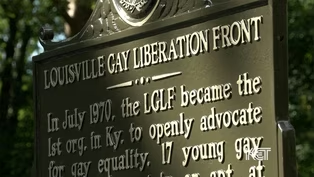
A new marker is going up honoring 2 landmark events in Louisville's LGBTQ history.
The Fairness campaign unveiled the city's first LGBTQ Kentucky historical highway marker last week.
They say it's one way to preserve history.
That's often a raced or never acknowledged.
>> So this is banned nearly a decade in the works to plunk.
This a piece of metal down to Marc Louisville's first LGBTQ historic site.
The markers celebrates and commemorates the founding of the Louisville Gay Liberation Front in 1970.
>> At 4.20, Belgravia court when Tracey Knight and Marjorie Jones applied for a marriage license right here in Louisville.
On July 6, the 1970, they KET better than to use their real names.
>> They're real addresses.
They're actual places of work.
They KET very well.
They were challenging the closet and the brutal harassment and condemnation that kept so many queer people in the closet.
When 13 lesbians into game and gathered right over there at 4.20, Belgravia 3 days later to establish the Louisville Gay Liberation Front.
What we're calling the LG E L F. In part to support Knight and Jones's legal challenge.
They to acted with great courage.
Jones and night to their case to trial.
They didn't win marriage rights at that time in 1970, but they lit the way for them.
>> And for the wider Queer liberation that was to come and for the wider liberation that was to come.
And they became an important first, the first lesbian marriage trial in U.S. history.
>> We're extremely happy that the Kentucky historical marker group has decided to identify this as the first.
LGBTQ marker it.
It just gives us recognition and the hope that Kentucky can move forward in a welcoming environment for the future and that it recognizes a foundation from 50 years ago.
So thank you all.
>> The Louisville, Gay Liberation Front was the first LGBTQ group to advocate for equality in the state.
The organization set up Louisville's first LGBTQ hotline and shelter.
♪ ♪ >> For the first time ever, the Kentucky Wildcats are headed to the college Baseball World Series to get there.
The CATS beat Oregon State twice in a best of 3 series over the weekend.
UK one 10 to nothing on Saturday.
Here's the winning play from the 7th inning and Sundays.
Gay.
>> 2, 2 game in the 7th Vo 2.
>> He struck him out, but the ball got away from weather McCarthy to 3rd.
There's nobody covering the plate.
It's a race.
♪ ♪ >> He's the one to they catch them.
Now that 3 to 2 lead with the win last night, Kentucky had said the College World Series in Omaha which begins Friday.
The College World Series is an 18 tournament.
Kentucky's first opponent is either Georgia or North Carolina state.
They play each other tonight at 7 in the final game of their series college World Series games will air on ESPN.
Today.
We're looking back on Abraham Lincoln's parents wedding and the first Triple Crown winner.
Our Joe Gibbs has details on that and much more as we review this week in Kentucky history.
♪ >> Abraham Lincoln's parents, Thomas, like Ann and Nancy Hanks married on June 12, 18?
0, 6 in Beachwood in Washington County.
Lincoln was born about 2 and a half years later.
Lewis has led to a native of Louisville received a patent for the gas mask on June 12, 18.
49.
It's also called the inhaler or the long protector.
General.
John Hunt, Morgan lot of Confederate attack on sent the Anna on June.
11th 18.
64 is men set the town on fire burning down about half of the buildings.
Watching to open the public library on Second Street on June 13, 19, 0, 5, with money donated by millionaire and philanthropist Andrew Carnegie.
Kentucky University changed its name to Transylvania University on June 12, 19.
0, 8, Racehorse, Sir.
Barton won the Belmont Stakes on June.
11th 1919, after winning the Kentucky Derby and the Preakness that made him the first Triple Crown winner.
Although that term wasn't debuts at the time.
With a Hatfield McCoys feud officially ended on 6/14/2003 when the 2 families signed a truce on the CBS Morning Show.
But actual fighting had ended decades earlier.
And that's a look at this week in Kentucky history.
I'm told he gives.
>> As always, thank you.
Toby gives that to do it for us tonight.
We hope to see you right back here again tomorrow at 6.30, Eastern 5.30, central for Kentucky EDITION.
I'm Renee Shaw.
Take really good care.
And Alston said.
♪
Kentucky 38 out of 50 in New Report Ranking the Well-Being of Children Across the U.S.
Video has Closed Captions
Clip: S3 Ep6 | 4m 37s | Kentucky 38 out of 50 in new report ranking the well-being of children across the U.S. (4m 37s)

Kentucky Wildcats Headed to the College Baseball World Series
Video has Closed Captions
Clip: S3 Ep6 | 1m 5s | Kentucky Wildcats are headed to the College Baseball World Series. (1m 5s)
New Marker Goes Up Honoring Two Landmark Events in Louisville's LGBTQ history
Video has Closed Captions
Clip: S3 Ep6 | 2m 43s | New marker goes up honoring two landmark events in Louisville's LGBTQ history. (2m 43s)
Secretary of State Michael Adams Receives John F. Kennedy Profile in Courage Award
Video has Closed Captions
Clip: S3 Ep6 | 1m 48s | Secretary of State Michael Adams receives John F. Kennedy Profile in Courage Award. (1m 48s)
Survivors and Those Who Lost Loved Ones to Guns Gather to Promote Gun Violence Awareness
Video has Closed Captions
Clip: S3 Ep6 | 3m 58s | Survivors and those who lost loved ones to guns gather to promote gun violence awareness. (3m 58s)
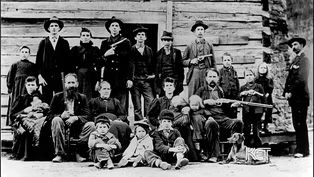
This Week in Kentucky History (6/10/2024)
Video has Closed Captions
Clip: S3 Ep6 | 1m 43s | This Week in Kentucky History (6/10/2024). (1m 43s)
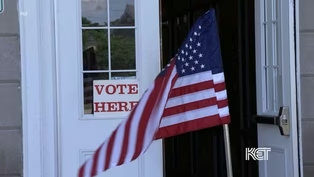
UK Law Professor on U.S. Supreme Court Decisions He Says Have Hurt Election Process
Video has Closed Captions
Clip: S3 Ep6 | 9m 13s | UK law professor on U.S. Supreme Court decisions he says have hurt election process. (9m 13s)
Providing Support for PBS.org
Learn Moreabout PBS online sponsorship
- News and Public Affairs

Top journalists deliver compelling original analysis of the hour's headlines.

- News and Public Affairs

FRONTLINE is investigative journalism that questions, explains and changes our world.












Support for PBS provided by:
Kentucky Edition is a local public television program presented by KET