Vermont This Week
June 12, 2026
6/12/2026 | 26m 45sVideo has Closed Captions
Widespread layoffs underway at UVM Health
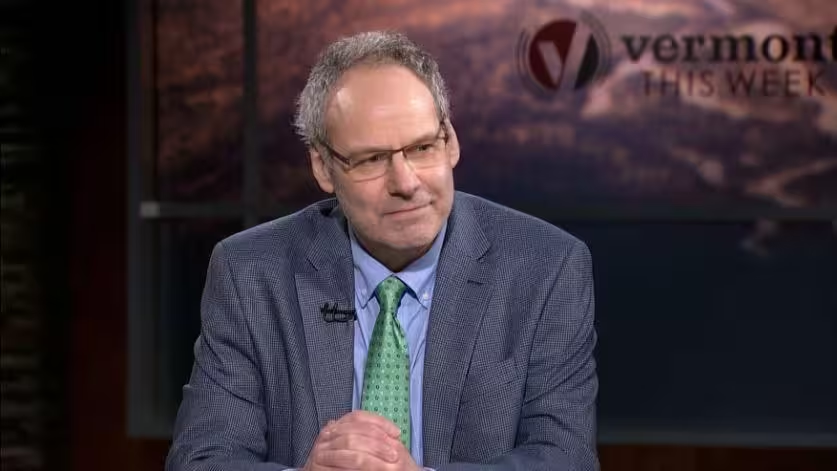
Widespread layoffs underway at UVM Health | New entrance on Canadian side of Haskell Free Library | Proposal to increase fees in VT National Forests| Moderator - Mark Davis; Lola Duffort - Vermont Public; Paul Heintz - Boston Globe; Greta Solsaa - VT Digger
Problems playing video? | Closed Captioning Feedback
Problems playing video? | Closed Captioning Feedback
Vermont This Week is a local public television program presented by Vermont Public
Sponsored in part by Lintilhac Foundation and Milne Travel.
Support provided by:


Vermont This Week
June 12, 2026
6/12/2026 | 26m 45sVideo has Closed Captions
Widespread layoffs underway at UVM Health | New entrance on Canadian side of Haskell Free Library | Proposal to increase fees in VT National Forests| Moderator - Mark Davis; Lola Duffort - Vermont Public; Paul Heintz - Boston Globe; Greta Solsaa - VT Digger
Problems playing video? | Closed Captioning Feedback
Where to Watch Vermont This Week
Vermont This Week is available to stream on pbs.org and the PBS app.
Support the crew
Help Mitch keep the conversations going as a member of Vermont Public. Join us today and support independent journalism.Providing Support for PBS.org
Learn Moreabout PBS online sponsorshipThis week brought news of widespread job cuts at one of the state's largest employers.
It's the second straight year that University of Vermont Health has implemented a big round of layoffs.
And projections indicate a lot more belt tightening will be needed.
On the other end of the state, the upper Valley gets a new surgical center that claims it can reduce health care costs in the Northeast Kingdom, and iconic library resumes a cherished tradition in Franklin County.
A business prepares to close and all across our beautiful state.
It's about to get more expensive to access public parks.
All that and more ahead on Vermont this week.
From the Vermont public studio in Winooski.
This is Vermont this week.
Made possible in part by the Lintilhac Foundation and Milne Travel.
Welcome back everyone.
I'm Mark Davis, news director of Vermont Public.
I'm in for Mitch Wertlieb It's Friday, June 12th.
We have an excellent panel today.
Let me introduce you to them right now.
Joining us, we have Lola Duffort, a reporter from Vermont Public.
Paul Heintz is the Vermont reporter at the Boston Globe.
And joining us for the very first time, we have Greta Solsaa.
She's the southern Vermont Reporter for Vtdigger.
Thank you all for making the time to be here today.
Beautiful day.
Lola.
We got to just go ahea and jump right into this here.
University of Vermont Health, one of the biggest, most powerful institutions in this state.
Dropped some pretty big news this week.
What's going on?
And what does this mean in the big picture?
Well, yeah, they announced that they were cutting 76 jobs across the entire network.
So that's in Vermont and New York, and also restructuring 66.
So 66 people were told, you may have a job, but you're going to have to reapply to something new.
Basically, the context is that, health care in Vermont is extremely expensive.
And our largest health care provider is also starting to lose money.
And is not doing well.
That's for a lot of reasons.
Some of it is, you know, has been imposed by the state, right?
We've seen really big drug price cap.
Some of it is lower utilization.
And for all of these reasons, the health network has to, undergo some really major changes.
And I think that what we saw this week, it's very safe to say, will not be the last of what we see.
So let's step back here.
UVM health, we have three hospitals in Vermont.
We have three hospitals in New York, a bunch of other satellite facilities across this state.
An astonishing figure.
I wanted to triple check and quadruple check with you.
And you got here the Burlington Hospital, the one everyone most associated with UVM health loses.
How much money a day?
$460,000 a day.
Almost half a million bucks a day.
Almost half $1 million a day.
You know, I've said this before.
No one is worried that UVM is going to go bankrupt anytime soon.
There are those active concerns about some of our smaller hospitals, UVM, MSK has a lot of runway.
Right.
That being said, there are some really big structural problems there.
And of course, you know, so much talk about health care costs in Vermont.
UVM seems to bear the brunt of the criticism, I feel like from regulators, from insurers, from the public, how much of these moves sort of mollify those concerns?
A little bit, a little bit.
So these moves in addition to other things.
Right.
So, not too long ago, a state appointed overseer hired these consultants and these consultants crunched a bunch of numbers like, went to clinics, talked to providers, and, decided that the hospital network has to cut $100 million a year in expenses every year for the next three years.
Right?
So that's the goal.
And at that time, those, consultants also said, by the way these are nice numbers, right?
Like we're giving you the number we think you can achieve.
Not necessarily the number.
Like we really think you should be hitting the, cuts that we saw.
This week will save the network about $9 million.
I'm not a huge math person, but, like, there's a big gap.
So they're saying 300 million over three years.
This cut which obviously is devastating to a lot of people, gets you 9 million.
The obvious follow up would be should we be looking for more layoff rounds at UVM i the health in the near future?
And I think the answer is yes.
I, I'm not going to say like in in what time frame.
Right.
But I think everyone expects there to be more.
I talked to that state appointed overseer, today, Mike Smith, who said, you know, this is a start.
And I talked to Owen Foster, the chair of the Green Mountain Care Board, and he also said, this is a great start.
I also heard, regulators say we're glad that they are trying to protect direct patient care as much as possible.
The cuts that were made this week were mostly administrative.
There were, you know, some nurses in primary care clinics, etc., that apparently got cut.
But by and large, we are not talking about people who provide direct patient care.
And that has been, an explicit priority both from regulators and also new leadership at the hospital system that has said, we know that we desperately need to reduce our expenses.
And we also don't want to break things.
Paul, Lola brought up regulators.
It's sort of been a long running tension here between health care regulators in the state and UVM.
Can you sort of help fill in that gap of that context and sort of I can certainly try.
Yeah.
I mean, I think, you know, as Lola touched on, the response to this news, obviously the response from the employees who lost their jobs, it's not a positive one, from the unions who represent them, not a positive one, but from people who are sort of in those health policy circles and who are thinking about the overall cost of care.
It seems like you're you're seeing some kind of measured positive response along the lines of, it's a start.
We're glad to see that the hospital is taking seriously the need to cut costs.
And there does seem to be a shift over the last year or so.
As far as I can tell.
You know, for many years, going on care board, was really fighting, the UVM Health Network, UVM health now, in a pretty dramatic fashion.
Pretty it got a little bit nasty at times.
I think that the I think UVM health finally got the message, and it, I think notably last fall reduced a number of very high level positions, changed leadership of the hospital.
You know, I think Doctor Lefler is seen as a straight shooter by many people in health policy circles.
And so, you know, and I think the involvement of Mike Smith in that liaison role between the care board and the hospital, it seems to be, working as intended, at least in terms of facilitating, facilitating this conversation between these entities.
So, you know, people are, at least talking, more positively, I think about, the, you know, the ability, or the recognition about what needs to happen.
But of course, as well said, they've got a long wa to go to actually make this a, you know, to balance the budget, I guess, it's hard to overstate the significance of this institution and for what we're talking about 15,000 people.
We're talking about hospitals that everyone's either been to or said family that that goes to one of the most important employers.
You were sort of talking off camera, sort of little about the sort of the almost the public perception of the way these things are being handled at that level.
And communicating it to, to the public.
What what are you seeing?
Yeah.
I mean, you know, the question you were asking earlier, it a few a year and a half ago, right.
The cardboard cut UVM budget by like, what, $80 million, something like that.
And the response was to say, okay, we're going to cut dialysis, we're going to cut primary care clinics.
And, it was, you know, it kind of did not go over well.
Right.
And, regulators responded very aggressively and so did lawmakers.
And then soon after we saw UVM oust its leader.
And, you know, while everyone kind of said this was mutual try to be diplomatic about it.
UVM also said at the time, like, acknowledged like we know we need to reset.
And, you know, seemed to have found itself where all of a sudden it was public enemy number one.
And that is not a good place to be.
And so, yeah I think we are seeing everyone play a lot nicer right now.
Right.
We are seeing, UVM tell regulators we hear you.
We're trying to make these changes.
We're trying to save money without also doing things, that are going to hurt patients.
But the really big open question is whether or not they can hit these really monumental target $300 million.
Right.
Well, I'm guessing we'll be sitting around this table talking about that, much in the years to come.
Huge news up here.
Pretty big health care news on the other end of the state law.
Sticking with you here, our regulators this week, approved a new operation.
It's pretty common in most parts of the country.
Fairly novel here in Vermont.
Tell us about the Upper Valley Surgical Center.
Yeah.
So, there is this thing called, a type of healthcare facility called an ambulatory surgery center.
And it is basically a standalone, surgery center where you can go and it's not associated with a hospital, and you can get outpatient procedures done.
And, these kinds of center have become incredibly popular across the country because, they're usually cheaper.
Outcomes are usually just a good as they are in hospitals.
And they can often get patients in faster.
Right.
We have only one multi-specialty surgery center in, the entire state.
It's the Green Mountain Surgery Center in Colchester.
And it took years for that surgery center to get approval.
This one, meanwhile, got approval in six months.
And I'm sure the folks in the upper Valley would not tell you, like, oh, it was only six months.
That's great.
But compared to what it's been like in the past, it was relatively smooth sailing.
And, you know, I talked to Owen Foster, the chair of the Green Mountain Care Board, and he said that was on purpose.
Right.
We, I am trying to learn from our mistakes.
Well, yeah, I mean, speaking is they mean to put this in context, basically, these centers are saying we can get this done faster and cheaper than the big hospitals can.
There are almost 30 of these, I believe you're reporting said in New Hampshire.
There's 15 in Maine.
This will no just be the second in Vermont.
And, obviously this this center is going to be just a few miles from the other health care behemoth we have in the state.
We just talked about UVM.
Dartmouth-Hitchcock.
It's the other one.
This i this has to be a bit of a shot across the bo at Dartmouth-Hitchcock.
Right.
The folks who are opening the surgery center would not say it so.
But, yeah.
Yes, to your point, right.
I think there is now this kind of emerging thought in the health care space that the big problem in Vermont is that, we have a hyper consolidated marketplace, and basically we have created a monopoly.
And it's sick.
Right?
So, our prices are really high, but it's also like, not doing super well, and that what we really need is more competition in the marketplace.
Right.
And that is explicitly what, Owen Foster told me is we need, we need competition.
We we need lower cost providers.
And in general, hospital transformation efforts are happening at the state level.
And the big idea is that we need to migrate care out of hospitals.
Right.
Well, the other piece, I mean, this comes as they're talking about a birthing center in central Vermont, for example.
More more facilities like this to improve wait times, drive down costs.
Well, we could probably give this whole show over to health care at this rate, but, we should move on the Haskell Free Library.
Paul, famously sits right on the international border at Derby Line and Stanstead.
That has long been sort of an iconic symbol of Vermont.
In the past couple of years, it's become internationally known, as a symbol of tensions between Canada and the Trump administration.
You were up there recently for what a lot of locals are saying is very good news.
That's right.
You know, the more recent backstory is that, this library beautiful place, has sat on the right on the border.
The border runs right through the facility.
You can see a, line of electric tape across the floor, and you can kind of jump back and forth across the border if you so choose.
You know, for a long time, the U.S.
has allowed, Canadians to cross into the United States in order to enter the front door of the librar without going through customs.
It's this very unique arrangement.
It was, you know, the library officials viewed as a somewhat tenuous one.
And, sure enough, when President Trump took office, last year, his then secretary, Homeland Security Kristi Noem, made a visit to the Haskell Library, just weeks into his, his tenure, and she was told, by Border Patrol agents at the time that there were security concerns at the library.
You know, Border Patrol officials said, well, people can kind of slip through the library from one side of the border to the other.
Library officials can attest that, but it led, Border Patrol to end that practice.
In March of last year.
And say, if you are Canadian and you want to go into this library, essentially if you go through customs, and around, that front door, well, library officials at the time said we're just going to open up the back door, which may not actually, help with these, supposed security concerns.
But, you know, it was a more complicated situation than that.
They needed to create a real entrance.
They need to make sure tha it was an accessible entrance.
So the work on that, finally finished in recent weeks.
And, there is a ceremony on Wednesday marking the forma inauguration of this new door.
At one level, this is a new door to a library.
And it's not that fancy a door.
But it, I think is a very, symbolic change.
And there at the ceremony, there are almost about 100 people there, and dignitaries from both sides of the border who had a really clear message.
No one, no one mentioned the president's name.
People certainly alluded to the decisions that le to the necessity of that door.
But mostl people were talking about the, the, tie between these two communities.
Another side in Stanstead on the Canadian side and Derby Line on the Vermont side.
These are communities that, you know, have been very close for a long time.
And, you know, people described this as sort of a bridge reconnecting.
These two groups of people quickly reported this.
This new door cost about a half million dollars, and most of the half of that money was raised internationally because they had to go through historic preservation on both sides.
There is an anecdote in your story.
I'm hoping you can quickly recount that Krist Noem visit was quite infamous.
You reported there was another, visitor.
Tom Homan.
The borders are a controversial figure himself.
He was there recently.
It sounded like that went a little differently.
Yeah.
So when Kristi Noem visited, she famously, referred to Canada as the 51st state in a way that was, you know, perceived as quite insulting by the library officials there, many of whom are Canadian.
And, I learned when I was up there on Wednesday, I did not know this, that when Tom Homan, the border czar, was in Vermont about a month ago, he made a visit, a very quiet visit to the Haskell.
And the same tour guide who had, brought Kristi Noem around, a woman named Cathy Converse is a retired English teacher.
An American.
She she saw a with his security detail, recognized him, and offered to give him a tour as well.
And, as he was walking around the facility, he paused.
At one point, she told me, and, presented her with a medallion, with his name on it, his position, the Great Seal of the United States.
And she interpreted it as an important moment, in which, she perceived this as a different signal coming from the administration, less antagonistic, at least towards this one facility.
Yeah.
I don't want to overstate the significance of this.
But to this person and this library, it seemed like a shift.
And, you know, it does not seem like, Border Patrol has, said anything, concerning about the new door.
You know, library officials are hoping that will get back to business as usual.
Nice.
Nice reporting there.
Well, we've got some tough news in Franklin County going on there.
Perhaps a little reason for hope.
After more than 125 years in operation, the Franklin Foods processing center in Enos Berg Falls is preparing to close in just a few weeks.
There are 100 people employed there.
They make cream cheese.
It's a very important local employer.
Franklin Foods was bought by a German company several years ago.
They're getting out of the cream cheese business.
And in the United States.
Perhap little room for optimism here.
The state is working with a group of supporters who want to reopen that facility under new ownership.
They want to make plant based cream cheese, among other things.
And they're hoping that that, if this all comes off, they can employ around 20 people.
Greta, it is finally warm.
It finally feels like summer, which means we're going to be seeing tens of thousands of people in Vermont go into the state parks.
They might be curious to learn.
They're probably going to b paying more for that privilege in the not too distant future, are they?
Yeah.
So on both state parks, Department of Fish and Wildlife Lands and the U.S.
Forest Service, recreation sites where, there are various proposal for increased recreation fees.
Top line, these agencies are, you know, feeling cost.
Cost crunch.
There's, you know, increased inflation and deferred maintenance, that all of these agencies are facing the Forest Service has proposed, increased, dollar amounts for various camping boating, and picnicking sites.
And that proposal's up for public comment until the end of July.
But around 80% or more can go to, that revenue that, will come in through the U.S.
Forest Service through this proposed fee hike, will go towards local maintenance to address wear and tear.
Some of these sites, though, were free to enter previously and now they will come with a fee.
There's also premium sites that will, that involve lean tos or access to water bodies that the Forest Service say it says is, more expensive to upkeep.
So, there's that proposal.
There's also the Department of Wildlife is, considering a, fee for those, accessing, fishing areas that are around 200 fishin areas in the state of Vermont.
This would apply to those without a license to hunt or fish on these lands.
Also would not apply to children.
But there's, a recognition by the department that they need, additional funding due to, Yeah.
So what this is getting at here, I think is sort of this long growing tension.
We've heard if you're a hunter, if you fish, you have to pay the state.
You have to have a license to do that.
If you want to jump in a kayak or canoe at these 200 spots, you don't have to do that right now.
The plan is to charge a fee so that you then have to.
If you have a fishing license already, you wouldn't have to pay the fee.
But this is effectively what a broadening the customer base for these these fees.
Is that fair?
Yeah, I think that's fair to say.
They also, the department said that it, addresses and an equity issues.
Yeah.
Thanks.
So, yeah, the fact that those who are regularly hunting and fishing on these lands have to pay a fee, but more casual recruiters are not facing fees.
They're trying to broaden their customer base and broaden that.
Yeah, that that fee.
There's also a proposal on, state park lands to have more flexibility within the department to, increase, costs based on use demand and cost recovery is how they phrase it.
So, they're also feeling, the effects of inflationary pressures.
And need to address, maintenance costs and, want to, have more flexibility to increase, fees or change fees to pay based on demand and use and their, these under this proposed rule, they would have 90 days to of notice for the public to see those fees.
Interestingly, governor Scott, usually not such a huge fan of fe seems to be in favor of these.
So we'll see there.
Quickly, the Forest Service has come up for you a couple of times, this week, of course, that's the federal agency.
I believe there's a lot about 400,000 acres that the Forest Service has in Vermont along the Green Mountains.
You did a very deep dive into what life was like in the Forest Service in Vermont in the early days of the Trump administration.
Can you just sort of give us the quick highlights of what you learned in that reporting?
Yeah.
Top line.
So, background, the U.S.
Forest Service, has a multi use mandate to maintain lands for logging, for wildlife prevention, but also for long range uses, research, wildlife management, flood resilience, various usage usages on these lands, for the public.
And in the first few months of the Trump administration, I accessed these internal documents, internal messages between leadership in the Green Mountain National Forest, reviewing budget precarity, staffing capacity being limited and also spending authority being frozen and significantly reduced in order to do work on the ground.
And so I access those documents, tried to trace that history, seeing the kind of confusion within, you know, the workers and messages from leadership and trace that to today.
So we do see these increased, recreation fees that the Green Mountain National Forest.
There's also this plan to reorganize, Forest Service and as part of that, there's a, a review to potentially close Burlington facility, among others, across the country.
And that one is perhaps less controversial than some of the many other things that they're, talking about.
It was it was excellent reporting effectively, what you found, it was chaos down there, especially in the early months.
And even the local officials didn't quite know, what was going on.
It was excellent reporting.
Recommend everyone go to digger, and check it out.
Speaking of the early days of the Trump administration, we had some news this week on a case that, came to international attention.
Actually, early on, that would be, what was the model with the Palestinian activist Upper Valley residents, who the Trump administration has been trying to deport?
Several months ago, immigration judge sort of shut that down.
So the government hadn't me their burden to to prove that, things have changed recently.
Yeah.
The the immigration judge who shot that down, was subsequently fired in a purge of a number of immigration judges.
And her replacement, seems to have come to a different conclusion.
And, issued an order of removal, saying that he'll need to leave the country and go to Jordan.
This is unlikely to happen imminently.
Because there is sort of a parallel, legal situation playing out in the Second Circuit Court of Appeals, which sends back to his original arrest, in Vermont in April of 2025.
As viewers will recall, he was, in prison here for about two weeks.
Federal judge in Vermont released him, essentially saying that, he was facing discrimination due to his protected speech.
And the government had appealed that case to the Second Circuit hearings last September on that question of whether the federal judge had overstepped, and for reasons I cannot tell you, there still is not a ruling in that case.
And, and even once there is, it'll probably be appealed.
Higher, perhaps the Supreme Court.
So, you know, I guess if you're him, it's good news that this is winding along slowly.
Because he'll remain in the US, during that time.
But certainly a troublin development for him this week.
All right, well, we want to end on a happier note.
We had a lot of talk about the state parks.
Earlier in this show, I was joking around with the panelists.
I'm going to need some good state parks story.
There was one that stood out above all others.
Lola, before, with the time we have left your best state parks story in Vermont.
I got married at a state park.
And the venue rental, was $200, which, And to be honest I felt like I was getting away with something not to endorse.
I'm not endorsing the fact that.
No, no, we don't do that.
We don't do that.
But, But it did.
It did feel, like a steal.
And that was new Discovery State Park.
As more pond is really, really, really beautiful.
And it will be free this weekend.
It's the free state park day across the state.
So you can go to the historic marker that is no doubt already been placed there.
Well, that got married.
Excellent recommendation, Paul Hinds, how many state parks have you been to recently?
I've been to two this week.
Climbed camel's Hump on Tuesday and was on Waterbury Reservoir last night for some boating.
Swimming.
My nine year old did some water skiing, which was a sight to behold.
So yeah, hope to get out a lot more.
All right.
Well, can't say much better than that.
And we have to leave it here.
My thanks to our panel.
Well, the before from Vermont Public, Paul Hines from the Boston Globe.
Curtis also from Vtdigger.
Thank you all so very much.
And thank you to our loyal audience, for watching and listening.
Don't worry.
Mitch is back next week and we'll see you again next Friday.
And.
 New Episode
- News and Public Affairs

Top journalists deliver compelling original analysis of the hour's headlines.
 New Episode
- News and Public Affairs

Today's top journalists discuss Washington's current political events and public affairs.
 New Season


 New Episode
 New Episode
 New Episode

 New Episode
 New Episode
Support for PBS provided by:
Vermont This Week is a local public television program presented by Vermont Public
Sponsored in part by Lintilhac Foundation and Milne Travel.