Vermont This Week
June 14, 2024
6/14/2024 | 26m 45sVideo has Closed Captions
No property tax relief in sight | State lawmaker caught harassing colleague
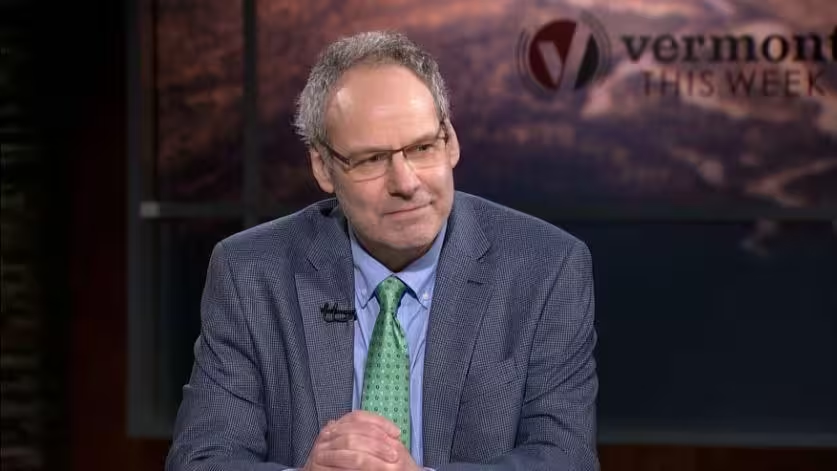
No property tax relief in sight | State lawmaker caught harassing colleague | Vt. home prices spiked more than any other state last year | Panel: Mitch Wertlieb - Moderator, Vermont Public; Calvin Cutler - WCAX; Carly Berlin - Vermont Public/VTDigger; Kevin McCallum - Seven Days.
Problems playing video? | Closed Captioning Feedback
Problems playing video? | Closed Captioning Feedback
Vermont This Week is a local public television program presented by Vermont Public
Sponsored in part by Lintilhac Foundation and Milne Travel.
Support provided by:


Vermont This Week
June 14, 2024
6/14/2024 | 26m 45sVideo has Closed Captions
No property tax relief in sight | State lawmaker caught harassing colleague | Vt. home prices spiked more than any other state last year | Panel: Mitch Wertlieb - Moderator, Vermont Public; Calvin Cutler - WCAX; Carly Berlin - Vermont Public/VTDigger; Kevin McCallum - Seven Days.
Problems playing video? | Closed Captioning Feedback
How to Watch Vermont This Week
Vermont This Week is available to stream on pbs.org and the free PBS App, available on iPhone, Apple TV, Android TV, Android smartphones, Amazon Fire TV, Amazon Fire Tablet, Roku, Samsung Smart TV, and Vizio.
Support the crew
Help Mitch keep the conversations going as a member of Vermont Public. Join us today and support independent journalism.Providing Support for PBS.org
Learn Moreabout PBS online sponsorshipNo property tax relief in sight after the Scott administration and lawmakers failed to reach a deal.
We acknowledge that there is a risk in using the reserves in this manner, but there is risk in doing nothing.
Change the trajectory of education spending.
So therefore we are proposing to use the reserves, but with the mitigating strategy of providing a payback plan transparently over time.
Plus, a state lawmaker is caught on camera harassing a colleague.
And it's not just your imagination.
A recent nationwide analysis shows Vermont home prices spiked more than any other state last year.
That and more ahead on Vermont this Week.
From the Vermont Public Studio in Winooski.
This is Vermont this Week, made possible in part by the Lintilhac Foundation and Milne Travel.
Here's moderator Mitch Wertlieb.
Thanks for joining us.
I'm Mitch Wertlieb.
Leave it is Friday, June 14th.
And with us today on the panel, we have Calvin Cutler from WCAX, Carly Berlin, from Vermont Public and VTDigger and Kevin McCallum from Seven Days.
Thank you all so much for being with us today and quite a week.
You know, I know this summer is supposed to be slow, but there is a lot going on.
The big story we've got to start with is what we teased there at the top.
There is no property tax relief in sight right now.
Disagreements between the governor and Democratic lawmakers over this.
Calvin, what is the biggest dispute here?
Well, the biggest dispute is to what degree that state lawmakers and really that government is able to provide immediate relief to property tax payers this year.
Ever since the December 1st letter came out from Commissioner Polio, that was forecasting almost a 20% increase in property taxes.
There's been a big scramble at the state house to try to figure out how do we chip away and reduce that number, but also still deliver for kids and for schools that are that are asking and need this funding in many cases.
And so state lawmakers landed on 13.8% as an average increase in the yield bill.
But for Governor Phil Scott, that's still did not go far enough.
He said that would you know, his members of his administration said that would exacerbate homelessness, raise rents, you know, really force people out of their homes in some cases.
And so there was a last ditch effort, I think maybe is one way to put it, to try to, you know, present a buffet of options or a menu of options to Democratic lawmakers to try to buy down that rate, some more ahead of the veto session next week.
But like with a previous plan that we saw from Commissioner Folio that the state treasurer put cold water on because it would hurt our credit rating potentially.
This plan was also somewhat of a nonstarter for for Democrats as well.
So it appears as though heading into next week that that 13.8% is is what homeowners and renters will see.
And safe to say, Democrats did not pretty much like that buffet of menu options that the governor was giving paying down through some of the reserves bond rating.
Here's what House Speaker John Krasinski had to say about that.
Let me be clear.
She said the governor still has not provided any feasible alternative plan.
The governor proposed stripping kids of access to school meals and risked increasing tax rates even higher than those facing us today.
Kevin MACCALLUM, you've been covering this as well.
Talk a little bit about the school meals program and what Governor Scott is proposing to do there to help pay down these property taxes.
Sure.
So one of the ideas that he came to the table with was to eliminate essentially the state's new Universal Meals program, which costs about $20 million, essentially to give kids no matter their background, no matter their means, a free meal.
And there's a lot of good reasons that educators think that that's a smart thing to do to keep kids fed, keep the kids not having to worry about whether they qualify or not.
And it's a it's a high Democratic priority.
So the notion of cutting that program, Democrats really just thought that was beyond the pale.
They thought of all the things that you could take money from to to address property tax increases, you're going to literally take food out of kids mouths.
So they mentioned that in their statements multiple times.
And the other thing that they were very disappointed about was not hear that from the governor's mouth himself.
He didn't show up to the meal.
He didn't come to the meeting.
He has been harping on this meeting for weeks now, saying he wanted to to to hash out a compromise with lawmakers.
And he he said he mentioned even the day before that this meeting was going to happen.
And lawmakers said they expected him to be there.
And if it was a real negotiating session to get to the bottom of this, to hash out a compromise that he would have been there and he wasn't so they him pretty hard on that one to you know that that's policy but in some ways it's personal to the optics of it.
Yeah, absolutely.
I mean, I think, you know, from a policy perspective, this was a very important meeting, an important, important turning point in the property tax education saga, but also in terms of the relationship between the Democratic supermajority and the governor.
You know, House Speaker Joel Krinsky and Senate President Pro Tem Phil Ruth really slammed the governor for not showing up to this meeting.
And Speaker Krinsky, in a statement, even even went as far to say that this is election year politics essentially, you know, pushing some of these these ideas that, you know, that they seriously had had concerns with the governor of course, his staff said that this is we're talking policy here.
It doesn't matter whether he's in the room or not.
These are Vermonters bottom lines in their budgets that we're talking about.
It doesn't really matter who's at the table.
And it was it was really interesting just to see that that back and forth.
So it really was a turning point, I think, in terms of the policy of education and property taxes, but just the relationship that has increasingly been strained.
A lot of people I've spoken with in and out of Montpelier this past session, but even just this week said things are really at a turning point here.
You know, we're seeing a lot of rancor right now.
And this is reflected in another story which really seems so bizarre.
Kevin McCallum, you broke this story in seven days and this has to do you're going to have to give us some backstory here for for those who may not be familiar with this.
It has to do with two lawmakers in Montpelier, Jim Carroll, Democrat, Mary Morrissey, a Republican, and a bag that had been damaged a number of times.
What in the world happened here?
Well, it is a complicated story that takes a little while to explain.
But in essence, Jim Carroll was in the habit of hanging a canvas bag outside of his committee room in the state house on a regular basis and with increasing frequency.
Throughout the session, he was coming out to find that it was wet, the bag was wet, bag was wet.
He didn't know why.
He had no explanation.
He's looking up at pipes in the ceiling.
He's trying to think if he, you know, maybe was walking under a tree outside when he was on his way into the building and snow fell in it, maybe somebody bumped into it by accident.
But it's happening over and over and over and over again.
And so he's really starting to question his sanity and wondering what is happening here.
And he's telling Jill Crow Ski and he's telling the Capitol Police chief that he's he can't figure out what's going on with this bag and even showed his bag once to Jill Krinsky and opened it up and show it to her.
And they're ice cubes in it so that it is clear that if something was happening.
And so the fascinating thing here is that he decided to take it upon himself to do basically a one man state house sting operation.
And he he said, I got to get to the bottom of what's happening here.
So he he gets his hands on a small spy camera.
He mounts it on a jacket across from his stuff, and he aims it at his bag.
And he uses an app on his phone to turn that camera on.
And he waits to see what happens.
And then it goes back home at night and looks at the tape.
And lo and behold, as you see here, he he gets images of his beddington Republican colleague Mary Morrissey going directly to his bag and pouring a cup of water into it.
And this is the video we're looking at right now you're seeing go by.
And I think you had mentioned in the article two word clear if it was definitely heard first, but it really was her.
There's no doubt it's her.
And she's even apologized subsequently.
And that's just one of two videos that exist of this exact behavior.
The other one, she's wearing a different outfit, but does the exact same thing straight up to the bag, pause it in, walks off.
So he's he's, you know, gobsmacked by this.
He's looking at it going, oh, my God, I cannot believe that this happened.
Shows it to Jill Krinsky, shows it to the police chief.
And a lot has happened since.
A lot of disciplinary measures and we can get into that.
Why why was she doing this?
Yeah, I wish I knew.
I mean, there's there's starting to be some hints of a long standing feud between these two.
You know, Representative Carroll wasn't super eager to be on the record in this story early on.
So the first versions of it didn't have his voice in there.
Newer versions are starting to have him express that.
Not only was it water, but it was a long pattern of just sort of mean spirited, sort of verbal harassment of him as well.
And, you know, part of the problem here is that he's had his own legal troubles this year.
He had a DUI in in February.
He went to rehab.
And then he comes back from that rehab.
And that's when he says that the the incidents started to increase dramatically.
So Democrats are really worried that what we've got here is not just some sort of schoolyard sort of antics, but we've really got a sort of pattern of behavior, of harassment of someone who's kind of fragile in a place of recovery.
And that's why they're so upset about it as well.
We do have this statement from Mary Morrissey as she did apologize for for what happened.
Here's what she said.
Donald Sterling, I don't know why I did this.
I was not meaning to hurt Carol.
It is something very certainly very out of character for me.
And I am ashamed of myself.
Now, Kevin, you've heard that statement.
It was made to you.
Has that been the only thing that she said about that?
Has she said this kind of repeatedly, if you will, that what you heard there was a was a written statement that she was reading to a reporter over the phone.
So she's trying to stay on script and apologize and express regret.
And we've been trying to get an answer to the why question as many ways as we possibly can.
I interviewed her.
I talked to her on the phone.
I asked her whether she denied this initially when confronted by Speaker Cronin Ski, which that's what Carol says, she wouldn't go there.
She's she's not willing to sort of get into the details about this because there's an ongoing ethics probe into her conduct.
And I think she's a little worried that if she says the wrong thing, that might not go her well.
Strange story, indeed.
And we'll keep following your reporting on that.
Let's move on to something else now that is affecting really everybody.
And this has to do with reporting.
You did Kalie Berlin on home prices in Vermont.
To say they went up is an understatement.
How much did they go up?
And in context, what are we looking at here?
Yeah, so we're talking about a 12.8% jump in the first quarter of 2024 versus the first quarter of 2023.
So this analysis comes from the Federal Housing Finance Agency.
And the Vermont spike here is the highest year over year appreciation of any state.
The national average was 6.6%.
Wow.
Yeah.
We're looking at the graphic right now and you can see that there is a lot of home price spiking in the northeast, but Vermont more than any place else.
And I want to give a bit of a caveat here.
So this is a really specific subset of homes that this analysis looks at.
So it's single family homes paid for with mortgages.
So excludes anything paid for in cash, also includes vacation homes.
So it's not just those primary homes that are owner occupied.
And the data came with a caveat that due to the relatively small size of Vermont's real estate market and real estate transactions could skew the rating.
But it is one thing, one data point among many that show us that home prices have been spiking for a while now.
Here in Vermont, I appreciate that context so much because it's kind of striking.
When I first saw that you have to remember it's Vermont is a small state per capita and all that.
Do we know what's driving this, though?
I mean, experts point to a lack of inventory of of homes.
And, you know, another data point I want to draw out in that story is there was a really dramatic drop last year and the number of homes sold.
So from 2022 to 2023, this was a separate state analysis.
The number of homes sold dropped 26% to the lowest number since 2012, when Vermont was still recovering from the Great Recession.
So we're seeing this real gridlock.
I think that's my favorite word for describing Vermont's housing market right now.
Lots of things driving that, right.
I mean, the lack of of homes available for sale is one of them.
But there are also factors like high interest rates that mean that if you own a home now and you got in when interest rates were 3% and you're looking to move, but you would need to be taking out a new loan at 7%.
You know, why?
Why would you move?
Why would you why would you give that up and pay so much more?
So those are some of the reasons why we're seeing our housing market be so tight and stagnant right now.
People realizing the equity, the value they have in their home.
Yeah.
Why would you want to necessarily give up and go looking for something that's going to be way more expensive?
You must have talked about a lot of these issues when you did a housing panel discussion a while back with Jen White, the host of One A and I really urge people to go and check that out.
You can find it at Vermont Public Mortgage Housing.
What were some of the takeaways in that discussion when it comes to dealing with these high home prices in Vermont?
What did you all talk about there?
So, so many things.
We talked actually a lot about this set of statistics and what's driving them.
So if, you know, viewers are hungry for more context on that, I would definitely point you towards the discussion.
It's really informative.
It honestly is.
And we we talked about how rising homelessness in Vermont is also, you know, one of the results that we see from the lack of housing in the tight housing market, too.
So I think we we did a nice job of connecting some of the dots in the larger picture.
Also, rents are difficult to those seem to be going up as well.
That's also a problem, right?
Of course, from Vermont, too.
Yeah.
So people have got to be watching for that as well.
I also want to talk about service providers bracing for a loss of money that it's keeping people housed.
And you've been reporting on this as well.
What's the situation there?
Yeah, so this is a pot of money the state has.
It's called Housing Opportunity Grant Program that goes towards a variety of things like funding shelters and also programs that can keep people housed or move people out of emergency shelter.
So this story you're pointing to us specifically about a pot of money that goes towards small scale grants to really stabilize people's housing situation.
So that's things like paying for security deposits or short term rental help or even moving costs, things to to help ensure that people stay housed or get rapidly housed once they're in shelter and the state is saying that we're anticipating a 70% drop in that specific type of of homeless prevention money this coming fiscal year, which which begins in July.
A little bit complicated how we get there.
Last year, that program was kind of set of programs, was funded specifically by one time funds through the legislature.
You didn't see those earmarks this year.
And the the Department for Children and Families that decides how this money gets divvied up is really prioritizing ongoing operating costs for new shelters that were jumpstarted last year with one time funds.
So it's a hard choice to make.
And speaking of temporary shelters and whatnot, Kelvin, I know you've been covering central Vermont is losing a temporary shelter at this point.
Yeah.
You the service there?
Yeah, you bet.
So there is over the winter there was a shelter that was set up using some of this money at the old Elks Club where the old golf course used to be in Montpelier.
They were going to put several FEMA trailers there back after the flooding.
That plan fell through.
Half a million dollars is now heading to Montpelier.
But there was this basically the shelter that it was a congregate shelter that was serving people throughout the course of the winter.
And homeless providers, excuse me, in in central Vermont are telling me this was a really important tool to keep people, you know, number one, keep them alive, but also be able to connect them with services, food, shelter, etc.. And so now that we just don't have this this this tool or this the shelter right now, it's really the future is in question.
And there, you know, we talk a lot about, you know, visible homelessness and poverty in Chittenden County and in Burlington, but also providers in central Vermont are, you know, saying to people, prepare for camping and more visible homelessness in central Vermont as well.
You know, in coming up next month, we're going to be talking so much about the anniversary of the flooding that happened.
And Carly, back to you, because there was a story you reported on I really found fascinating on the one hand, at first I thought, well, this sounds like good news because they're talking about building back in a manufactured mobile home park in Berlin, you know, because that was such an area so hit hard by the flooding.
But there's a problem with that potential problem anyway.
What is the problem there?
So this manufactured home community in Berlin is in the floodway of the Stephen's branch of the Winooski River.
Highest risk designation given by the Federal Emergency Management Agency.
It's basically, you know, it's not a 1% chance, 100 year flood plan.
You hear those terms.
It's like this place will flood.
It is it is the floodplain of this river.
It's right there.
That happened last summer.
The park flooded catastrophically.
You know, dozens of families were displaced.
And it's been sitting there uninhabited for most of the last year.
But recently there's been construction going on down there that has been open to the ICRC and Calvin has witnessed it, too.
I was down there recently, you know, appears to be a new pad for a manufactured home going in.
Some new looking homes staged nearby, saw construction crews working there.
The caveat is there is specific oversight for building in floodplain.
So the town of Berlin has, you know, flood plain building rules.
And the town administrator told the owner of this park back last summer, hey, if you want to rebuild here, you're going to have to follow these rules.
You're going to have to apply for permits with the town.
Town says no permits have been filed.
So there is this concern that, you know, there is potentially unlawful building going on there that could put future residents of this park should new people move in at risk of future flooding?
Do we know if legal action is going to be taken at this point?
So there's been some hints.
I was speaking with the state's chief recovery officer, Doug Farnham, earlier this week who suggested that the town and the state had been having conversations about legal action.
That is all very hypothetical right now.
The town refused to comment on on those possible plans.
So we'll be keeping tabs on that.
Appreciate the update on that.
Okay.
The big thing that's coming up next week, and I know you're all very excited about it, the veto session override.
There are going to be so many bills here.
Again, the contention between Democrats and the Republican administration is really palpable at this point.
Kevin, what are some things that you're particularly looking at and what are the chances of, you know, most of these bills being overridden?
I would think certainly in the House there's a good chance.
Yeah, no, I think it's safe to say that we're now up to eight bills that we are seven.
Okay.
By my count.
Okay.
My count is eight, but I could be wrong on that.
And so because yesterday the governor had two new ones, right?
He had one on the actually 50 bill.
And what was the other one and the data privacy bill.
So that's this was two last minute sort of vetoes from the governor setting up this big showdown on Monday.
I think that the Democrats almost certainly have sufficient votes to overcome, if not all of them, most of these vetoes.
Right.
They have a supermajority.
The leadership has made it abundantly clear in their statements following these vetoes that they have no intention of allowing these to stand, that the policies that they worked so hard on during the session in their mind are the right ones, are appropriate ones, and that they are going to fight for them.
So, you know, anything can happen in a veto session, right?
It all depends on who shows up.
First of all, it's you know, two thirds is the threshold, but not everybody shows up.
Not all 180.
You know, lawmakers are going to be there on Monday.
It's summer right there.
Some are on vacation, some are sick, some or whatever back at their full time jobs.
And so it's two thirds of those present in voting.
So, you know, technically, the threshold is 100 votes in the House and, you know, 20 in the Senate, too, to be able to override these vetoes.
But we'll see who shows.
And the big one, of course, is the property tax bill.
We're pretty sure that one's going to go to an override.
I think so.
I mean, at this point, as we talked about at the beginning of the show, they didn't take the governor up on any of his ideas at the last minute.
And if we don't have a yield bill in place by July 1st, that's even more devastating in some ways than this 13.8%.
So I don't what would happen, Calvin, if, from my understanding, we'd have to go back to last year's yield bill.
And from what I've heard and what I've read, it would be about a 30% increase for non homestead.
So for for renters, I don't know what the homestead rate is, but it would be pretty catastrophic.
Many, many people have told me.
But I think it's interesting and it's worth kind of taking a step back for a second of, you know, taking a look at what the veto session is and how frequent they are.
I mean, before and the first one that we really had was in the 1990s during Governor Howard Dean's administration.
And then since Governor Phil Scott has been in office, he's always been in the political minority.
He's always been up against a Democratic majority or supermajority.
And so out of by my count, I think it's 196 vetoes ever in state history.
51 of them have been from Governor Phil Scott, almost a quarter of them.
And so really, that does show the the, you know, political differences, the difference in governing fiscal philosophy, all of these these things.
And it really just kind of gets back to the question, though, of, you know, come November two, there's going to be a lot of turnover in the Senate.
Six new seats.
There's about 19 or 20 in the House.
What will be the political implications of this veto session?
What message will lawmakers try to send to their constituents come November?
How will this play out on the campaign trail?
I don't know.
We'll find out.
It's going to be absolutely fascinating.
It does feel like there's an inflection point here that's coming.
It will.
It really does.
I quickly want to mention a sad story for a local solar panel manufacturer, the largest one in Vermont actually Sun Common, the parent company filing for bankruptcy.
What do we know about that at this moment?
Well, we don't know a ton about you know, we don't have insight into why Sun's books.
But certainly, you know, people that we've talked to have said that they according to they filed for Chapter seven bankruptcy this week or last week.
That is, they've been hemorrhaging money about a quarter million dollars every single week.
And again, we don't know whether there was mismanagement or whether, you know, there was, you know, inflationary pressures or we just we don't know.
You know, I think people can speculate.
But the really the greater, you know, economy right now for our solar industry, you know, tariffs are hitting materials hard.
Carly earlier talked about high inflation and interest rates.
That has also, you know, playing into, you know, building out solar because also a lot of these projects are financed by taking on debt, too.
So there's a lot of factors here that are indicative.
Kevin, go ahead.
And we do know a little bit about the internal turmoil going on at this company, right?
Because we're starting to see from the bankruptcy filings that there's been this sort of changeover in the leadership.
Right.
So the CEO of the company is there.
Then they bring in this outside venture capitalist turnaround kind of specialist guy who comes in and he's out within a matter of days and now he's suing over his ouster.
Right.
And so the original CEO is back in place.
And so it just it speaks of a culture, a real turmoil going on in the company.
And Derek Brower, my colleague, wrote the story about about this bankruptcy.
And he he pointedly noted that the CEO of the company was still making about $1,000,000 a year while the stock for this company is down to $0.02.
And other local jobs at stake here, too.
Absolutely.
Yeah.
No, I think there's layoffs that have already been occurring.
This is more than 200 people work at the place.
And so I think there's real concern that a wholesale dismantling of this company through the bankruptcy process, if that happens, could lead to some significant layoffs.
That's not it's not certain that that's what's going to happen.
There are some odd things going on with some capital funds out of Texas that are sort of aligned with the fossil fuel industry that are like making them loans, too, and maybe going to make a bid for the assets of the company.
So who knows what the company comes out of bankruptcy looking like, but there's definite fear.
Thank you for updating us on all that situation.
I want to mention that coming up next week, it's Juneteenth.
There are a number of celebrations that are happening around Vermont.
And you can take a look at some of the things that you can do to help celebrate Juneteenth.
That is happening next week.
And of course, we'll all be following the veto session coming up on Monday.
That's going to be fascinating and we'll be following all of your reporting on this.
I want to thank you all for doing such a wonderful job, as always, and keeping us all informed.
That would be Calvin Cutler, WCAX, Carly Berlin of Vermont Public and VTDigger and Kevin McCallum of Seven Days.
Thank you all for being here.
I'm Mitch Wertlieb and I hope you'll join us again next week on Vermont this Week.

- News and Public Affairs

Top journalists deliver compelling original analysis of the hour's headlines.

- News and Public Affairs

FRONTLINE is investigative journalism that questions, explains and changes our world.












Support for PBS provided by:
Vermont This Week is a local public television program presented by Vermont Public
Sponsored in part by Lintilhac Foundation and Milne Travel.