
June 15, 2024 - PBS News Weekend full episode
6/15/2024 | 26m 44sVideo has Closed Captions
June 15, 2024 - PBS News Weekend full episode
Saturday on PBS News Weekend, a new study highlights how bias affects the detection and treatment of some types of cancer in the LGBTQ+ community. Then, a look inside the world of domestic workers and their lack of labor protections. Plus, what groups in Philadelphia are doing about the death toll of birds crashing into windows.
Problems playing video? | Closed Captioning Feedback
Problems playing video? | Closed Captioning Feedback
Major corporate funding for the PBS News Hour is provided by BDO, BNSF, Consumer Cellular, American Cruise Lines, and Raymond James. Funding for the PBS NewsHour Weekend is provided by...
Support provided by:

June 15, 2024 - PBS News Weekend full episode
6/15/2024 | 26m 44sVideo has Closed Captions
Saturday on PBS News Weekend, a new study highlights how bias affects the detection and treatment of some types of cancer in the LGBTQ+ community. Then, a look inside the world of domestic workers and their lack of labor protections. Plus, what groups in Philadelphia are doing about the death toll of birds crashing into windows.
Problems playing video? | Closed Captioning Feedback
How to Watch PBS News Hour
PBS News Hour is available to stream on pbs.org and the free PBS App, available on iPhone, Apple TV, Android TV, Android smartphones, Amazon Fire TV, Amazon Fire Tablet, Roku, Samsung Smart TV, and Vizio.
Providing Support for PBS.org
Learn Moreabout PBS online sponsorshipJOHN YANG: Tonight on PBS News Weekend, a new study highlights how bias affects the detection and treatment of some types of cancer in the LGBTQ community.
Then a look inside the world of domestic workers and their lack of basic labor protections.
And as the spring bird migration season draws to a close the death toll of birds crashing into windows and what groups in one American city are doing about it.
MAN: Folks don't recognize just how serious of a threat this is because it's such a passive threat.
This is simply by us existing in the way that we live having windows.
It's a threat to birds and it's killing birds.
(BREAK) JOHN YANG: Good evening, I'm John Yang.
More than 90 nations including the United States are making a show of support for Ukraine at a two day peace summit in Switzerland.
Ukraine hopes the United Front will strengthen its negotiating position with Russia, which pointedly was not invited to the gathering at a resort in the Alps.
Vice President Kamala Harris is representing the United States.
She announced a $1.5 billion aid package aimed at Ukraine's hard hit energy sector.
Meeting with Harris, Ukrainian President Volodymyr Zelenskyy look forward to a post war Ukraine.
VOLODYMYR ZELENSKYY, Ukrainian President: We are here today for the sake of diplomacy.
And Ukraine has always believed in the power of diplomacy.
War is not our choice.
It's Putin's choice.
JOHN YANG: National Security Adviser Jake Sullivan called a proposed Russian deal to end the war a completely absurd vision.
The Israeli military says eight soldiers died in an explosion in southern Gaza today, the second deadliest attack on Israeli forces of the war.
In Gaza families are preparing for a bleak Eid al-Adha tomorrow, one of the most important festivals in the Muslim calendar.
It's usually celebrated with big family meals and gifts for children.
But this year, there's only war, hunger and misery.
The holiday marks the end of Dhul-Hijjah witch peak today with nearly 2 million Muslims gathering on a sacred hill in Saudi Arabia for a day of worship.
The Hill of Mercy is believed to be the site of the Prophet Muhammad's final speech known as the Farewell Sermon.
Across France hundreds of thousands of people turned out to protest against a far right political party in advance of French parliamentary elections.
Labor unions, students and groups fighting racism called for the protest after the right wing national rally party trounced President Emmanuel Macron's centrist party in last week's European Parliamentary elections, the first round of snap French parliamentary elections will be held at the end of the month.
And Kate, the Princess of Wales, made her first public appearance today since she said she's being treated for cancer.
It was at festivities to mark the official birthday celebration for King Charles III, who himself was treated for cancer in January.
Kate said in a statement yesterday that she's not out of the woods yet and will continue chemotherapy for a few more months.
Still to come on PBS News Weekend, why U.S. domestic workers have fewer workplace protections than other employees.
And how the city of Philadelphia is working to protect birds from deadly window collisions.
(BREAK) JOHN YANG: A first of its kind report from the American Cancer Society is shedding new light on cancer risks for LGBTQ people.
The finds that some LGBTQ populations are more likely to have cancer risk factors like smoking, heavy alcohol use or excess body weight.
Transgender people are less likely to be screened for cervical, colorectal and prostate cancer.
And LGBTQ people continue to face barriers to high quality health care, including discrimination.
Dr. William Dahut is the American Cancer Society's Chief Scientific Officer.
Dr. Dahut, this is the first time this has being done, this is being looked into.
Why now?
Why did you decide to do this now?
DR. WILLIAM DAHUT, American Cancer Society: Well, thanks very much for having me on today.
It's really a great question.
You know, it's really important to know that this was really a way for us to get a clue to the cancer risk to this population.
Cancer communities, cancer registries do not collect data for cancer deaths, cancer incidents, based on sexual orientation or gender.
So I think this is really important to begin to understand is the risk different.
So we begin to capture that information in a much more critical way.
JOHN YANG: Were there things on your findings that surprised you?
And what do you think are the key takeaways from this report?
DR. WILLIAM DAHUT: Yes, a couple of things are really important.
I think, first of all, you really need to disaggregate the data by the population.
This isn't really one homogeneous group.
So certain groups, I think, as you commented on early on, looking at bisexual women in their 40s and 50s.
You know, much higher alcohol use, obesity use, tobacco use, these are real risk factors for cancers.
Other things were also interesting.
You know, overall, the vaccination rates were actually fairly similar to other populations and cisgender populations.
I think that was good news.
Screening rates are actually are fairly good, except, as you mentioned, and transgender men, where there's much fewer screenings done for colorectal cancer in transgender men with the cervix of cervical cancer and prostate cancer.
So there's a lot of variety, I think.
JOHN YANG: The risk factors, are these directly related to being gay or lesbian or transgender?
Or is it also part of because of the stress that comes along with the stigma of being in those communities?
DR. WILLIAM DAHUT: Well, the risk factors themselves are really risk factors for anybody to have cancer.
You know, our data, there's about 40 to 42 percent of cancers are actually preventable.
And probably the risk of dying from cancer is actually -- the risk prevention, it's much probably easier to prevent die from cancer by changing behavior.
And so we focus on those behaviors, you know, alcohol use, obesity, tobacco use, and we did see them higher in this population, particularly in the bisexual woman.
And so that gives us concern that there'll be a higher risk of cancer rates and deaths.
And then if folks are not seeking medical care because of biases, then there's likelihood that people present with even more advanced diseases or outcomes.
JOHN YANG: You mentioned biases, how much of this has to do with the culture of maybe society or medical care?
There was a long with this report, there was a study came out from Dana-Farber Cancer Institute that said 80 percent of LGBTQ cancer patients they surveyed, said they didn't get appropriate preventative screening, 34 percent said their partners felt welcome in the part of their treatment, and only 4 percent of the partners said they felt respected by caregivers.
DR. WILLIAM DAHUT: Yes, it really is concerning.
There was one fact that the paper pointed out that only about 25 percent of current medical students actually felt comfortable and taking care of transgender individuals.
And 30 percent, there was really a sense of potential perceived bias, actually, when you thought about it.
So I think seeing this hesitancy to seek medical care for real and perceived bias can actually lead to much poor outcome.
You know, even if you're screened on time, if you have symptoms, you don't -- if you're not seeing your symptoms, you're much more likely to present with more advanced disease.
So there clearly are personal concerns by people from this community.
JOHN YANG: What lessons can be learned from this and what things can be done to overcome these problems?
DR. WILLIAM DAHUT: Well, I think number one, the first lesson is I think we need more data.
We need data actually on true cancer incidence and mortality in the LGBTQ population.
So that's important.
And secondly, the same things that are likely to drive risk for all folks, we need to focus in on this population to, you know, ensuring people have a normal healthy weight, exercise, don't smoke, and decrease alcohol use.
And then really begin to educate our students, our interns, our residents, that's really to have a much more inclusive welcoming attitude because if we actually push people away, the outcomes of particularly in cancer could really be devastating.
JOHN YANG: Dr. William Dahut of the American Cancer Society, thank you very much.
DR. WILLIAM DAHUT: Yes.
Thanks so much for having me.
JOHN YANG: In many American households, domestic workers like nannies, housekeepers, and home health aides perform essential tasks.
But as Ali Rogen reports they also have fewer rights and protections than most U.S. workers.
ALI ROGIN: Each day nearly 2.5 million nannies, aides for the elderly and home cleaners do jobs that allow much of the rest of the American workforce to do theirs.
But despite being such a foundational part of the economy, many of these workers are excluded from key workplace protections.
Those include the Fair Labor Standards Act and the Occupational Safety and Health Act, which respectively cover wages and workplace safety.
Protections also vary by state, 11 states and the District of Columbia have passed their own Domestic Workers Bills of Rights.
But there is no such federal law.
Members of Congress have tried and failed to pass a federal version for several years.
Kaitlyn Henderson is a Senior Researcher at Oxfam, a global organization fighting poverty and injustice, where she studies how states treat workers and working families.
Caitlin, thank you so much for being here.
First of all, why have domestic workers historically been excluded from these sorts of protections?
KAITLYN HENDERSON, Senior Researcher, Oxfam: So unfortunately, that reflects a long history of sexual and racial discrimination in this country, where black women were really excluded from labor protections in the 1930s during President Franklin Roosevelt's New Deal.
Unfortunately, when we were creating this social safety net that still exists today, a lot of Southern senators were very nervous about including black workers in frameworks of minimum wages, overtime protections, and the rights to organize.
ALI ROGIN: And beyond their exclusion from these statutory protections, why is it that these workers are so vulnerable to mistreatment?
KAITLYN HENDERSON: As you mentioned earlier, domestic workers are excluded from the Occupational Safety and Health Act, which means that a lot of protections most workers have for their workplace does not extend to domestic workers, because usually that means people's homes, so they're very exposed to issues of discrimination and harassment.
Domestic workers are also not included in the Civil Rights Act from the 1960s.
So they're uniquely exposed to types of vulnerabilities that most workers don't have.
The majority of domestic workers in the United States are women, women of color, and especially immigrants.
And as another collective of workers that has also been excluded from the National Labor Relations Act, which establishes the right to unionize.
A lot of these workers feel uniquely exposed and vulnerable, and not as comfortable bringing up issues to their employer, especially since they are very classically at will.
And their employers, which is, again, often families individuals can terminate their employment at any time.
ALI ROGIN: As you mentioned, there are efforts to correct these issues, what is happening on the federal level?
KAITLYN HENDERSON: So we have in front of Congress today a bill that's called the Domestic Workers Bill of Rights, which is a very exciting piece of legislation.
As you mentioned, a similar piece of legislation has passed in 11 states and D.C. and Puerto Rico and several cities.
So we know that it works really well.
This would be a piece of legislation that establishes minimum wage provisions, overtime protection, protection at work from harmful chemicals, for example, protection against discrimination and harassment and the ability to collectively organize.
ALI ROGIN: There have been efforts for several years now to pass this bill of rights.
Why does it keep getting stalled, apparently?
KAITLYN HENDERSON: We're waiting for the political will from a lot of individuals to see the value in this.
We know as you mentioned, domestic workers are the workers that let all other work happen.
So these are intrinsically valuable, absolutely essential workers to our economy.
Hopefully, people will change their minds and realize the importance of this sooner than later.
ALI ROGIN: Another piece of this seems to be making sure that workers know their rights.
Why is it such a challenge to reach these workers where they are and close that awareness gap?
KAITLYN HENDERSON: It's so hard when your workplace is someone's home, and you work by yourself.
One of the best ways to organize workers is when you find them in a collective and domestic workers usually work alone or in a vacuum.
So it's taken a lot of time for the National Domestic Workers Alliance among other organizations to reach out build community and collectively organize these workers.
ALI ROGIN: What sort of mistreatment typically happens to this segment of the workforce?
KAITLYN HENDERSON: Because they're working alone at the house often, they are extremely exposed to issues of sexual harassment, discrimination, exposure to chemicals in the cleaning products as an example.
There's also a tendency to not pay workers if they are canceled upon if their shift is canceled at the last minute.
So it's hard for these workers to have a plan in terms of if they have their own caregiving responsibilities.
ALI ROGIN: How did the COVID pandemic affect the domestic workplace?
KAITLYN HENDERSON: COVID was a huge problem.
So especially since we were all told to go home, shelter at home, and that's usually the workplace for domestic workers.
So it was an incredibly economically vulnerable moment for domestic workers that we're still trying to solve for today.
ALI ROGIN: It seems contradictory that a part of the workforce that is so foundational to the American economy is also treated as part of the periphery.
Does that perception need to change?
And if so, how does that happen?
KAITLYN HENDERSON: Absolutely care work really is the work that makes all other work possible.
And I think the COVID-19 pandemic did an important thing in terms of allowing all of us to recognize how crucial care work is whether it's childcare, elder care, care for people with disabilities or domestic work.
JOHN YANG: That's Kaitlyn Henderson with Oxfam, thank you so much for being here.
KAITLYN HENDERSON: Thank you.
JOHN YANG: Every year in the United States, as many as a billion birds die while migrating.
It's not due to climate change or some toxic substance in the air or water.
This culprit is hiding in plain sight.
The birds are killed when they collide with glass.
For the latest in our Saving Species series, we went to see an effort to reduce this carnage in Philadelphia where it turns out, residents love a lot more birds than just the Eagles.
STEPHEN MACIEJEWSKI, Volunteer, Bird Safety Philly: And so the birds are attracted to the brightness.
JOHN YANG (voice-over): The sun is barely up over downtown Philadelphia and the guy known as the Birdman is already at work.
Stephen Maciejewski is a fixture here during the spring and fall migrations, looking for birds not in the skies, but on the sidewalks where they fallen after hitting a window.
Some are dead, some are injured, others just stunned.
STEPHEN MACIEJEWSKI: They don't know what glass is.
They don't know glass is hard.
They just say reflection or they think they can go in or through.
And then they start hitting.
JOHN YANG (voice-over): It didn't take long for Maciejewski's eagle's eyes to spot a dead ovenbird, a small songbird.
STEPHEN MACIEJEWSKI: So beautiful.
Yes, there's orange crown, and they have this loud voice singing teacher, teacher, teacher.
JOHN YANG (voice-over): The species and other details go into his logbook.
The dead bird goes into a plastic bag to be taken to the lab for study.
All too common routine done, he moves on.
Maciejewski is a volunteer for Bird Safe Philly, a partnership aimed at creating safe spaces for birds.
Since 1970, the United States and Canada have seen a decline in bird species of 30 percent.
While much of it's due to habitat loss, glass windows posed the third largest threat.
Robin Irizarry is with Audubon Mid-Atlantic.
ROBIN IRIZARRY, Audubon Mid-Atlantic: Folks don't recognize just how serious of a threat this is because it's such a passive threat.
It's not something that we're actively doing like engaging in deforestation or, you know, paving over areas of habitat.
This is simply by us existing in the way that we live having windows.
It's a threat to birds, and it's killing birds.
JASON WECKSTEIN, Academy Of Natural Sciences at Drexel University: Sort of organized how we classify birds.
JOHN YANG (voice-over): So Jason Wettstein, runs a lab studying birds with the Academy of Natural Sciences of Drexel University.
JASON WECKSTEIN: And you can see this is filled with specimens with Safe Philadelphia.
JOHN YANG (voice-over): It's collection of the birds killed in windows strikes dates back nearly 150 years.
JASON WECKSTEIN: If you look here, you know, they're specimens from 1877.
JOHN YANG: Wow.
JASON WECKSTEIN: This one from 1906 is actually from the early window kills that happened here in Philadelphia.
So this was on city hall.
When City Hall was first lit up, we actually had windows strikes happening or, you know, there were some window strikes just from glass alone.
That does happen.
And certainly glass on its own is a problem when it's reflective.
But you add lights into the mix, and it makes it a lot worse.
JOHN YANG (voice-over): Birds make their long migratory journeys mostly at night.
And for reasons still not fully understood, they're drawn to artificial lights.
Philadelphia sits on a migratory superhighway known as the Atlantic Flyway, so it's brightly lit skyline is ripe for the sort of mass collision that occurred on October 2nd, 2020.
STEPHEN MACIEJEWSKI: We had around 450 birds just at this building.
And, you know, I take care of like a number of birds.
I process them.
And people say there's more down there and more down there.
JOHN YANG: How many birds did you collect that day?
STEPHEN MACIEJEWSKI: Eight or 900.
JOHN YANG: Wow.
STEPHEN MACIEJEWSKI: And we kind of thought that there was probably over 1,500 that were killed.
MARIANNE SCOTT, Building Industry Association of Philadelphia: And that happened essentially my backyard.
I live in that area.
JOHN YANG (voice-over): That catastrophic event move bird lover Marianne Scott to action.
MARIANNE SCOTT: There is a general misconception that everyone -- it's the high rises that are the biggest problems.
So, yes, the statistics I think is that it's four stories or less where the most fatal collisions occur.
JOHN YANG (voice-over): As Executive Director of the Building Industry Association of Philadelphia, she's working to convince the members of that residential real estate trade group to turn off lights both inside and outside between midnight and 6:00 a.m. during migration seasons.
MARIANNE SCOTT: I think by and large people don't know that there's a problem.
They're shocked to hear when I say there might be 300 million birds traveling across the country now.
JOHN YANG (voice-over): In fact the night before we went on patrol with Stephen Maciejewski, an estimated 660 million birds were in the skies over the United States in the midst of their spring migration north.
That makes for a busy morning.
An injured ovenbird is placed in a paper bag for transport to the School of Wildlife Centers Clinic for rehabilitation.
Then Maciejewski helps and apparently stunned birds \struggling to regain its sense of direction and get on its way.
Next, an injured yellow throated warbler.
And at the entrance of an office building, a box safeguarding the body of a dead bird left by building staff who've gotten to know much Maciejewski.
OLIVIA FERMANO, Building staff: I actually have him in my contacts on my phone because this is sadly regular occurrence.
There's been times when I've been sitting there and they've flown in, you know, to the window.
DON HAAS, BOMA Philadelphia: Really all the building staff whether it's security or janitorial predominantly, who used to just clean up and move on.
Now we're trying to save as many as possible.
JOHN YANG (voice-over): Building Manager Don Haas is a key leader in the Building Owners and Managers Association of Philadelphia or BOMA.
He's working to get his counterparts on board.
DON HAAS: We were controlling all the outside lighting in the crown lighting, lobby lightings.
So we encourage all of our BOMA members to sign on to the Birds Safe Lights Out Philly Program.
We had a terrific response.
I think we're probably at 60 buildings.
JOHN YANG (voice-over): Some cities and states require bird safe design.
In Maryland state law says buildings that are at least 50 percent publicly funded must follow bird safe design practices.
On New York City law mandates that all city owned buildings turn off lights at night during migration season.
In Canada, Toronto requires new and existing buildings to take steps to be bird friendly.
In West Philadelphia, the University of Pennsylvania makes being feather friendly part of its sustainability plan.
Many school buildings take part in Lights Out Philly.
And in some like the Singh Center for Nanotechnology, window glasses etched with vertical stripes, a pattern that's been found to reduce collisions.
It's the same ideas the dots on the transparent film covering the windows of Water College House one of the campus dorms.
ZADE DOHMAN, Student, University of Pennsylvania: I've sort of become the bird expert in my friend group.
I received tax where friends will say, I heard this bird at this late hour of night is this normal.
JOHN YANG (voice-over): Student eco rep, Zade Dohman, monitors the campus for bird strikes as part of his work study program.
ZADE DOHMAN: There have been birds I've picked up right after they were hit.
And most of them were dead.
So I can feel the sort of remnants of life leave their body.
And it is really hard.
And it's not something that gets any easier.
To me, it's always struck me as this sort of microcosm of how humans interact with the environment.
In general, it's our architecture, it's our human influence on the environment around us that is causing these birds to get hurt and to die.
JOHN YANG (voice-over): It's an idea that helps inform the work of university landscape planner Chloe Cerwinka.
CHLOE CERWINKA, Landscape Planner, University of Pennsylvania: The way I got interested in birds was through trying to find another way to understand whether our landscapes were functioning because if we're inviting these birds in by creating these important habitats that they need, then we absolutely have to make sure that it's a safe space for them.
We can't invite them in just to let them die in the built environment.
JOHN YANG (voice-over): The solutions Penn is employing are just some of the methods found to be effective.
At the Discovery Center in Philadelphia, Robin Irizarry shows us others.
ROBIN IRIZARRY: These are Acopian birds saving blinds.
These are a simple technique, a really cost effective technique.
And this is just a network of paracord that protects birds from flying into the glass here.
You want to have a distance of about four inches.
So when a bird is flying through there, it's not going to feel comfortable going through that space.
STEPHEN MACIEJEWSKI: I like they call me Birdman.
It's an honor.
JOHN YANG (voice-over): Back on the streets of Philadelphia, Stephen Maciejewski wraps up his day.
He's collected 13 dead and injured birds.
The injured were sent to rehabilitation.
The dead were neatly placed in a freezer at the Academy of Natural Sciences alongside other birds that have met similar fates, all available to be used for research.
STEPHEN MACIEJEWSKI: It's very sad to find these birds.
I mean, they're coming up north looking to raise a family, traveling like thousands of miles from, you know, South America, Central America, the Caribbean to come this far and then to die on the streets of Philadelphia.
JOHN YANG: Now online, educators in Missouri worry that a new bill, promising salary increases doesn't guarantee them.
All that and more is on our website pbs.org/newshour.
And that is PBS News Weekend for this Saturday.
On Sunday, Nick Schifrin sits down with National Security Adviser Jake Sullivan at the Ukrainian Peace Conference.
I'm John Yang.
For all of my colleagues, thanks for joining us.
See you tomorrow.
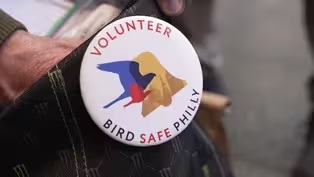
How Philadelphians are protecting birds from window crashes
Video has Closed Captions
Clip: 6/15/2024 | 9m 17s | How Philadelphians are working to protect birds from deadly window collisions (9m 17s)
Study shows why LGBTQ+ people may have higher cancer risk
Video has Closed Captions
Clip: 6/15/2024 | 5m 23s | Study highlights why LGBTQ+ people may be at greater risk for cancer (5m 23s)
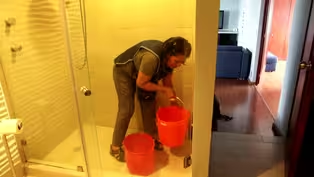
Why U.S. domestic workers lack basic labor protections
Video has Closed Captions
Clip: 6/15/2024 | 5m 31s | Why U.S. domestic workers have fewer labor protections than other employees (5m 31s)
Providing Support for PBS.org
Learn Moreabout PBS online sponsorship
- News and Public Affairs

FRONTLINE is investigative journalism that questions, explains and changes our world.

- News and Public Affairs

Amanpour and Company features conversations with leaders and decision makers.












Support for PBS provided by:
Major corporate funding for the PBS News Hour is provided by BDO, BNSF, Consumer Cellular, American Cruise Lines, and Raymond James. Funding for the PBS NewsHour Weekend is provided by...