
June 19, 2023 - PBS NewsHour full episode
6/19/2023 | 57m 46sVideo has Closed Captions
June 19, 2023 - PBS NewsHour full episode
June 19, 2023 - PBS NewsHour full episode
Problems playing video? | Closed Captioning Feedback
Problems playing video? | Closed Captioning Feedback
Major corporate funding for the PBS News Hour is provided by BDO, BNSF, Consumer Cellular, American Cruise Lines, and Raymond James. Funding for the PBS NewsHour Weekend is provided by...
June 19, 2023 - PBS NewsHour full episode
6/19/2023 | 57m 46sVideo has Closed Captions
June 19, 2023 - PBS NewsHour full episode
Problems playing video? | Closed Captioning Feedback
How to Watch PBS News Hour
PBS News Hour is available to stream on pbs.org and the free PBS App, available on iPhone, Apple TV, Android TV, Android smartphones, Amazon Fire TV, Amazon Fire Tablet, Roku, Samsung Smart TV, LG TV, and Vizio.
Providing Support for PBS.org
Learn Moreabout PBS online sponsorshipAMNA NAWAZ: Good evening.
I'm Amna Nawaz.
GEOFF BENNETT: And I'm Geoff Bennett.
On the "NewsHour" tonight: America's top diplomat and China's president agree to stabilize relations, while leaving daunting differences unresolved.
AMNA NAWAZ: New reporting shows FBI leadership resisted investigating former President Trump's role in the Capitol insurrection for more than a year.
GEOFF BENNETT: And a group of young people find a unique clause in Montana's Constitution to sue over inaction on climate change.
CLAIRE VLASES, College Student: As I have learned about climate change and I have seen what our lawmakers have done promoting fossil fuel industries, I have realized that that is unconstitutional acts.
(BREAK) GEOFF BENNETT: Welcome to the "NewsHour."
Search operations are under way tonight for a submersible that carries paying tourists to view the wreckage of the Titanic.
The five-person craft is owned by OceanGate Expeditions.
AMNA NAWAZ: Canadian officials say the vessel was reported overdue Sunday in the North Atlantic.
It disappeared 435 miles south of St. John's, Newfoundland, near where the Titanic went down in 1912 after hitting an iceberg.
The U.S. and Canadian Coast Guards are searching by air and sea, but it was unclear this afternoon exactly how many more hours of oxygen the submersible's crew has left.
REAR ADM. JOHN MAUGER, U.S. Coast Guard: In terms of the hours, we understood that that was 96 hours of rescue or emergency capability from the operator.
And so we anticipate that there's somewhere between 70 to the full 96 hours available at this point.
AMNA NAWAZ: The ocean depth in the search area is roughly 13,000 feet.
GEOFF BENNETT: Now to the rest of the day's news.
The Deep South grappled with a new round of severe weather.
Tornado strikes in Central Mississippi killed at least one person overnight.
Nearly two dozen others were hurt.
More than 100,000 customers in the Deep South were still without power after earlier storms.
And the region faces heat index is in the triple digits this coming week.
A scorching heat wave in Northern India has now claimed the lives of nearly 170 people.
Temperatures have hit 110 degrees and power failures have knocked out air conditioning.
That has hospitals in two of the country's most populous states overflowing.
SUMIT KUMAR SINGH, Relative of Patient (through translator): I visited the hospital last night to admit my relatives suffering from heatstroke.
There were no beds available, so I came back to the hospital again this morning.
The staff advised me to spread a bedsheet on the floor to get treatment.
Last night, I saw people being treated on the floor.
GEOFF BENNETT: Northern India is known for summer heat waves, but officials say this year's temperatures have consistently gone above normal.
Israeli forces and Palestinian gunmen waged their fiercest day of fighting in years in the occupied West Bank.
An Israeli raid on a refugee camp in Jenin killed five Palestinians, including a 15-year-old boy, and injured at least 90 others.
Smoke rose as Palestinians set off roadside bombs to disable armored vehicles.
The Israelis struck back with helicopter gunships rarely seen in West Bank raids.
Seven Israeli soldiers were wounded.
Gun violence across the U.S. killed at least 10 people and wounded dozens over the weekend.
The worst was in Kellogg, Idaho, where four people were found shot to death at a home on Sunday.
Last night in San Francisco, six people were wounded when shooters in two cars fired on each other.
In Detroit, four teenagers were wounded in their car.
In Ukraine, government forces say they have recaptured an eighth village in a counteroffensive in the southeast.
But the latest gains appear to be incremental, and Ukraine's defense minister acknowledged the situation is difficult.
British intelligence reported, both sides have taken heavy losses.
The jailed Russian opposition leader Alexey Navalny faced a new trial today, this time on charges of extremism.
Journalists were barred from the courtroom and instead watched a video feed remotely.
His parents were also denied access.
ALEXEY NAVALNY, Russian Opposition Leader (through translator): For me, it's obvious that all this is done to close this process for political reasons, because the investigators, prosecutors and the authorities in general do not want the public to know about the trial and how weak the evidential basis is.
GEOFF BENNETT: A conviction on these new charges could keep Navalny in prison for more than 30 years.
And delegates from 193 nations have adopted the first treaty to protect marine life on the high seas.
Today's vote at the U.N. came after more than 20 years of discussions.
That treaty would create a new body to oversee conservation of ocean life and establish protected areas.
It'll take effect once it's ratified by at least 60 countries.
And still to come on the "NewsHour": new questions about the Greek Coast Guard's response to the deadly sinking of a migrant vessel; Tamara Keith and Amy Walter break down the latest political headlines; and the grandmother of Juneteenth discusses what the holiday means for Americans.
AMNA NAWAZ: Secretary of State Antony Blinken finished up a high-stakes visit to Beijing today, the first visit by an American top diplomat to China in five years.
Relations between the two preeminent global powers are at their lowest point since ties were restored 50 years ago.
Blinken's mission, to see if there's a way to right them.
XI JINPING, Chinese President (through translator): Good afternoon.
AMNA NAWAZ: A firm handshake, despite a shaky relationship.
Today, Secretary of State Antony Blinken wrapped up his postponed trip to China, marathon meetings with several top officials and a short visit with President Xi Jinping.
Both sides expressed optimism.
ANTONY BLINKEN, U.S. Secretary of State: I stressed that direct engagement and sustained communication at senior levels is the best way to responsibly manage our differences and ensure that competition does not veer into conflict.
And I heard the same from my Chinese counterparts.
We both agree on the need to stabilize our relationship.
XI JINPING (through translator): The two sides have agreed to follow through with the common understandings President Biden and I had reached in Bali.
The two sides have also made progress and reached agreement on some specific issues.
AMNA NAWAZ: President Xi referring to a meeting with President Biden last November in Indonesia, where the leaders set an agenda to warm relations, but the winter brought frosty relations.
In February, the U.S. shot down a Chinese spy balloon over its airspace, the reason for this trip's postponement.
Blinken and she did not publicly address the furor this weekend.
Several other issues went unresolved, most notably resuming military-to-military contacts, which Secretary Blinken confirmed China is not yet ready to do.
ANTONY BLINKEN: It's a work in progress.
AMNA NAWAZ: But in an interview with CBS News, he emphasized its continued urgency.
ANTONY BLINKEN: We want to, at the very least, make sure that we don't inadvertently have a conflict because of miscommunication.
AMNA NAWAZ: A potential point of conflict, Taiwan.
China has ratcheted up its military activity around the island that it claims as a breakaway province, while the U.S. has upheld a policy of strategic ambiguity, committing to a One China policy, while also selling arms to the island.
On several occasions during his term, Biden has also said the U.S. would defend Taiwan from Chinese attack.
Also unsettled, the two nations' battle for military and economic influence in the Indo-Pacific region.
In.
2021, the U.S. announced a security pact with Australia and the United Kingdom that would supply Australia with nuclear-powered submarines.
It garnered a strong rebuke from China.
WANG WENBIN, Chinese Foreign Ministry Spokesman (through translator): Establishing the so-called trilateral security partnership will only trigger an arms race, damage the international nuclear nonproliferation regime, and harm regional peace and stability.
AMNA NAWAZ: Since then, President Biden has made a trip to the region and has hosted several of its leaders.
India's prime minister will visit Washington this week.
Meantime, China has increased military exercises in the South China Sea and its confrontations with the Americans.
Just a few weeks ago, a Chinese fighter jet cut in front of a U.S. aircraft over the South China Sea, which the U.S. military called a -- quote -- "unnecessarily aggressive maneuver."
A week later, a Chinese warship cut off an American warship in the Strait of Taiwan.
Although there were no breakthroughs on these major points of tension this weekend, Secretary Blinken struck a note of cautious optimism.
ANTONY BLINKEN: My hope and expectation is, we will have better communications, better engagement going forward.
It is critical to doing what we both agree is necessary.
And that is responsibly managing the relationship.
AMNA NAWAZ: And to decode Secretary Blinken's China visit and its ramifications for Washington's relationship with Beijing, I'm joined by Ryan Hass, a senior fellow at the Brookings Institution.
He was the director for China, Taiwan and Mongolia at the National Security Council in the Obama administration.
Also with us is Miles Yu, a senior fellow and director of the China Program at the Hudson Institute.
He served as the China policy adviser to Secretary of State Mike Pompeo during the Trump administration.
And welcome to you both.
Thanks for being here.
RYAN HASS, Brookings Institution: Thank you.
MILES YU, Hudson Institute: Thank you for having me.
So, Ryan, this was reportedly a relatively short meeting, about 30 or 35 minutes, right?
What does it say to you that the meeting happened at all between President Xi and Secretary Blinken?
RYAN HASS: Well, I think it was significant that President Xi and Secretary Blinken had a chance to sit down, because it really accomplished two things.
The first is that President Xi was able to articulate in his own words the future direction that he intends to see the U.S.-China relationship travel.
And this is a departure from the previous statement, which was his accusation that the United States seeks to contain and circle and suppress China.
AMNA NAWAZ: Right.
RYAN HASS: So, Secretary Blinken succeeded in moving President Xi on that.
The second signal that it sent was a signal to the rest of the Chinese government that President Xi expects and is comfortable with his counterparts engaging directly with their American counterparts to seek to moderate tensions.
So, all in all, I think it was a pretty productive day of diplomacy.
AMNA NAWAZ: Miles, productive?
How would you rate it?
MILES YU: I think I will give you a C-plus, A-minus.
The third signal that Ryan has not mentioned is that this is also very good optics for the Chinese, because Xi Jinping sits at the head table.
He talks like an emperor, talking down, showing his contempt for the American over approach.
But I think this is in sharp contrast in 2018, last time a U.S. secretary of state with China, when Xi Jinping sits side by side with Secretary Pompeo.
Even though he despised Pompeo, but then at least they know he also has some sort amount of fear.
This is a conversation that needs to happen, but needs to happen on equal terms.
I think China right now is in a position to sort of challenge Americans' not only goodwill, but also American strength, and by playing this sort of optical game.
So I think it's important both sides sit down to talk about -- engage to avoid a crisis.
And I think, also, it's very important for us to keep in mind what's at stake on the Chinese side.
AMNA NAWAZ: Ryan, President Biden has said that he believes U.S.-China relations are on the right trail.
Do you agree with that after these meetings?
RYAN HASS: Well, I think that the past two days put us on a better pathway than we were on a week ago at this time.
The reality is that it's important for the United States and China to have the capacity to communicate directly with each other.
It's important to shrink space for miscalculation.
It's important to explore whether there's mutual intents to try to moderate the relationship.
And so we're doing these things because they're in America's interests to do.
And on the issue of seating charts, we can quibble over what the proper protocol is for a seating chart.
The reality is that the United States is abundantly stronger than China in pretty much every material category that you could use to evaluate.
And so I think that, from questions of military power, diplomatic partners around the world, alliances, the world reserve currency of the United States dollar, America's innovation ecosystem, we're very comfortable and confident in our capacity to engage China from a position of confidence.
AMNA NAWAZ: The failure, though -- you mentioned the military capabilities.
The failure to reestablish those military-to-military communications, that's a bit of a failure for the U.S., right?
That was important in terms of bringing down the risk of miscalculation.
RYAN HASS: Well, let's take this as a first step, Amna.
AMNA NAWAZ: Yes.
RYAN HASS: Secretary Blinken doesn't speak on behalf of the American military, and his Chinese counterparts don't speak on behalf of the Chinese military.
And it's important that we get to a point where our militaries are able to reestablish connectivity with each other, but, Secretary Blinken's trip was the first step.
And, ultimately, questions of war and peace will be decided at the leadership level, not between both militaries.
And the fact that we were able to reestablish connectivity with China's top leader, I think it's an important step.
AMNA NAWAZ: Miles, there's the issue of China's faltering economy at this moment, right?
You mentioned Chinese leverage in these talks.
But doesn't that give the U.S. some leverage?
MILES YU: Ryan's right.
You're absolutely right.
The U.S. has tremendous leverage, the leverage we should have used, but we have not used efficiently.
So, as you say, China's economy is in shambles.
We have to understand China needs United States much more than your United States needs China.
China's economy, China's technology, China's military is -- depends to a larger degree on Western technology and exports.
So it's in their best interests to engage with the United States.
So I think that's why we have this advantage, the advantage that we can use, and I think we should have used more.
Secretary Blinken's visit to China, for example, is based upon the assumption that somehow we could establish a direct military-to-military professional contact.
That's a dream.
We have tried for decades.
And we have to understand the nature of the Chinese Party-military relationship.
The Chinese Communist Party would never allow its military to conduct independent communication with the Western... AMNA NAWAZ: Never?
That will never happen?
MILES YU: Never.
This is the -- that's right.
We -- this show again and again in 2001 EP-3 plane incident.
AMNA NAWAZ: Yes.
MILES YU: Nobody from Chinese military would pick up the phone call, and even though we had robust communication with them.
The nature of the party-military relationship is totally different from the West.
So, this is even worse than the Soviet time, when the U.S. military and the Soviet high command could have some kind of semblance - - some kind of communication.
No, this is not.
AMNA NAWAZ: So, Ryan, what are you going to be watching for now in the days and the weeks ahead to judge how these meetings actually went?
What's the impact of these talks?
RYAN HASS: Well, we need to explore whether or not the mutual intent to lower the risk of miscalculation or miscommunication exists.
And we will have a series of follow-up meetings in both Washington and Beijing in the coming weeks that will sort of bring into light how much progress is possible between now and November, when we expect that President Xi will travel to United States to meet with President Biden on the margins of the APEC leaders summit.
And so we have this window now over the next several months to see if we can shrink space for miscalculation, if we can establish a cooperative agenda that is based upon mutual self-interest, where we both take actions that are in parallel to each other that serve each of our respective interests.
And, if so, the world will be a better place.
But, if not, the United States isn't a confident, strong position to get caught trying.
AMNA NAWAZ: Miles, what are you watching for?
MILES YU: China has to be responsible.
Chinese Communist Party, their actions and deeds are most important in deciding the nature and direction of U.S.-China relationship.
So that's why I think I'm very, very satisfied that the new China policy paradigm that emerged during the Trump administration more or less continue on to this day.
The China challenge is not just a partisan issue.
It's an American issue.
So, for that, and I think I give Biden credit - - administration credit.
However, there are some misconceptions.
There are some understanding of how the Chinese system operates.
We should have no illusion.
For example, China always throw out this red herring called Taiwan independence.
There is no Taiwan independence, because no political party in Taiwan is advocating for Taiwan independence.
Taiwan maintain -- wants to have status quo.
Status quo, in fact, is independence.
There is no need for that.
So China always force the United States to make a statement, say, U.S. do not support Taiwanese independence.
This is red herring.
It's basically an own goal which we should not have scored.
AMNA NAWAZ: Gentlemen, we will have to leave it there.
I have a feeling we will talk about this some more.
Please come back and join us again.
Miles Yu, Ryan Hass, thank you for your time.
RYAN HASS: Thank you, Amna.
MILES YU: Thank you.
GEOFF BENNETT: The U.S. Department of Justice initially resisted opening an investigation into former President Donald Trump and his associates' role in January 6 and efforts to overturn the 2020 election.
That's according to exclusive investigative reporting by The Washington Post.
It took nearly a year after the Capitol attack for a DOJ inquiry to begin, and the FBI only opened its investigation into the fake electors plot in April 2022.
Aaron Davis is one of the reporters who broke this story, and he joins me now.
Thanks for being with us.
AARON DAVIS, The Washington Post: Thanks for having me.
GEOFF BENNETT: So, two days after the Capitol attack, the FBI started announcing charges against some of the rioters, the so-called foot soldiers.
What accounts for the DOJ's much slower, more cautious approach in investigating Donald Trump and his allies?
AARON DAVIS: We found that the FBI was very gung-ho, ready to go out and get those who had broken into the Capitol, the people who were on TV that day breaking the windows, going inside, threatening lawmakers.
But they were much more hesitant to go after the -- all the incidents, the episodes, the activities that took -- that fomented the sentiment that led to that rage on that day.
They were wanting to seek a direct connection between the violence and somebody via phone record or something else to be -- to launch that investigation.
You have to realize is this is an FBI that was twice stung with the investigation into Russian interference with the Trump election in 2016 and, before that, James Comey's decision to open -- reopen an investigation into Hillary Clinton.
And this was the third time, if you will, the FBI stepping into the breach to investigate a president or presidential candidate.
And they really wanted solid evidence.
They wanted something they could touch and feel.
This, we can hold on to.
We can show this is why we're investigating Donald Trump.
GEOFF BENNETT: In this piece reported by you and Carol Leonnig, you quote a former Justice official, who says of the current DOJ: "You can work so hard not to be a partisan that you're failing to do your job."
How widely held a view was that within the DOJ, that the Garland DOJ was, in many ways, overcorrecting for the perceived ethical failures of the Barr DOJ?
AARON DAVIS: There was a huge culture shift.
In Garland's own words, this was to try to get back to regular order.
Under Bill Barr, there were many times that the attorney general said, this is a valid investigation, this is not a valid investigation.
The attorney general, Garland, wanted to come in and say, I'm not going to make those decisions.
These should bubble up to me from the bottom through evidence.
The problem was, there was such a culture that had been effected by -- under the previous administration, where it was hard to go up the chain.
There wasn't the mechanism to go up and try to make these cases.
And very early on, even before Garland came in, there was an attempt to investigate Trump's orbit.
And it was batted down in the very early weeks after January 6, saying it's premature to do that.
Let's build up from the evidence and get there.
The problem was, at some point in time in this investigation, they realized there was no connection between the people entering the Capitol and the people who had done some of the fake electors and more of the conspiracy type of work leading up to January 6.
As we quote in the story, there was no ladder to get from here to there to get to those other potential investigations.
GEOFF BENNETT: Well, take us inside the decision by the DOJ to pursue the rarely charged seditious conspiracy against the militia, the militiamen who were involved in January 6.
AARON DAVIS: This is interesting, because this was a big part of the whole idea of, if you think about it, investigating January 6 like a organized crime-type syndicate, that you had your foot soldiers who went in the Capitol, and somewhere up there, there might have been an architect who designed and put this all in play.
And so if you get those rioters and you get their phones, and you go up and you keep going up, the seditious conspiracy, the Oath Keepers, the Proud Boys who were a big part of that were considered the linchpin in that whole effort.
And so if you could charge them with seditious conspiracy, that's -- that carries potentially decades in prison.
Maybe they will actually be motivated then to tell you what they know about the planning.
The problem was, that took so long.
It took like months to -- it was first brought up as early as February, but it took until November to actually have a draft prosecution memo where they were debating it.
And it took many more weeks for senior Justice Department officials to actually agree on what should be charged and who should be charged.
And then, when they finally got and arrested, like, Stewart Rhodes and Oath Keepers in January, they realized these folks were not going to turn or be able to flip on someone.
They just didn't have that view of what had really been going on inside the White House.
GEOFF BENNETT: So what then prompted the pivot within DOJ?
AARON DAVIS: You know, that is a good question.
We asked it many times: What changed in your world view?
Because so much of the evidence that, ultimately, they began investigating, of course, with fake electors had been bubbling out in the public over the course of the whole year.
There were identical versions of the fake elector documents that were obtained under the Freedom of Information Act in March 2021, just two months after the attack.
John Eastman and the memo about using fake electors had been out there for weeks at the time that they finally did in November.
They're also -- you can't deny that there was a lot of pressure put on DOJ by the House Select Committee and what they were turning up, by the wave of opprobrium from critics around the country.
And there just was, at that point in time, finally a little bit of breathing room inside the Department of Justice, inside particularly the U.S. attorney's office, where they're now putting Oath Keepers and Proud Boys, and those are getting ready for trial.
And they said, we still need to look at these other areas of investigation that we have.
They brought him in an investigator named Tom Windom.
He went to the FBI and said: Will you help me investigate the fake electors?
And even then, 10 months afterwards, the FBI Washington field office director, Steven D'Antuono, said: No.
You don't have enough evidence.
You're not going to -- I'm not going to subpoena the Willard Hotel.
GEOFF BENNETT: Final question.
Based on your reporting, to what degree was the investigation now overseen by special counsel Jack Smith, to what degree was it adversely affected by this delay by the DOJ?
AARON DAVIS: Well, it's interesting.
There really became such a split, where you had prosecutors had to turn to the U.S.
Postal Service inspector, the National Archives inspector general agents, and they were the ones helping the prosecutors subpoena and do the grand jury work and months late, in '21, early 2022.
That -- and all that work began, like, a year after the fact.
And in those early months, White House officials were not interviewed.
Records were potentially lost.
Social media posts and private encrypted messages were potentially deleted.
We just don't know what could have been done quicker, if we were always destined to be in this position now, where Trump is running again and his potential legal culpability from 2020 is still an open question.
GEOFF BENNETT: Aaron Davis with The Washington Post, thanks so much for being with us.
We appreciate it.
AARON DAVIS: Thanks for having me.
GEOFF BENNETT: As we reported, search crews are looking for a submersible craft that was taking tourists to see the Titanic and ultimately went missing.
For more on this effort, we turned to Kristin Romey, an editor for National Geographic.
Thank you for being with us.
And as we learn more, Kristin, about this search-and-rescue effort, help us understand first the difference between a submersible and a submarine and what these vessels are typically used for.
KRISTIN ROMEY, National Geographic: Right.
A submersible can't power by itself, unlike a submarine, which could leave port, steam out to where it needs to go and come back.
A submersible is reliant upon a mother ship.
And, currently, that mother ship is some 900 miles, nautical miles east of Cape Cod.
GEOFF BENNETT: As we understand it, rescuers are looking about 900 miles, as you said, off the coast of Cape Cod, about 13,000 feet deep.
They're searching through the water.
How difficult, onerous a process is this?
KRISTIN ROMEY: Well, when you consider that it's very -- it's almost more difficult to travel to the bottom of the ocean than it is to space nowadays, I mean, everything down there is conspiring to keep humans out.
When you think about it, 12,500 feet, which is where the Titanic is roughly, you're talking about 380 times the pressure that's being expended on you versus at sea level.
On top of that, I mean, you have extremely cold temperatures.
It's an inhospitable place.
And you're trying to find a submersible the size of a truck at the bottom of the vast expanse of the North Atlantic.
GEOFF BENNETT: What is known about the company that owns the submersible that's now missing?
KRISTIN ROMEY: OceanGate has really been a leader in developing these deep sea submersibles.
I spoke to the CEO, Stockton Rush, when he was actually developing this submarine back in 2016.
The Titan is very unique, in that it is a carbon fiber and titanium submarine.
Up until now, most of the tourist rides to Titanic have been on very older Soviet steel submersibles.
So this is new technology.
And it does come with a real-time monitoring system that monitors the integrity of the hull.
So it's interesting that we haven't been hearing anything regarding that, because, if there was an issue with the hull, we would think that there would be some information being conveyed to the mother ship.
GEOFF BENNETT: Help us understand the increase in the numbers of people who have been going on these extreme, dangerous excursions post-pandemic.
KRISTIN ROMEY: Well, I mean, it began before the pandemic, but it's a combination of technology and people who have the money to kind of create - - create these bucket lists and achieve them.
I mean, what Stockton Rush is doing with OceanGate is very closely paralleling what we're seeing in the commercial space field, particularly with Blue Origin, as well as Virgin Galactic.
So, this is a new emerging brave new world of travel.
And it does not come without risk.
GEOFF BENNETT: And, Kristin, understanding that you're learning more about this case at the same time we are, what more is known about the five people who were on board this craft?
Have we heard from their families?
KRISTIN ROMEY: Well, right now, there are no discussions regarding who is on board.
There has been a little bit in social media.
I think that the concern really, before we identify who is on there, is just getting them up.
There is a limited amount of oxygen on this submersible, roughly 96 hours, four days' worth of oxygen.
If this submersible did indeed leave around 2:00 a.m. Sunday morning East Coast time, as they estimate, they're about halfway through that available oxygen supply.
GEOFF BENNETT: And what will you will be watching for as this search-and-rescue effort continues?
KRISTIN ROMEY: It is a massive deployment of resources, Canadian Navy, Canadian Coast Guard, U.S. Coast Guard.
This is an amphibious rescue mission.
There are -- we have ships patrolling with sonar.
We have airplanes actually flying over the North Atlantic who are able to detect objects deep below.
And we hope that they get to them in time.
GEOFF BENNETT: Kristin Romey, thanks again for being with us with that reporting and your insights.
We appreciate it.
KRISTIN ROMEY: Thank you.
AMNA NAWAZ: There were recriminations, mourning and anger in Greece and other parts of the world today, as the search continued for missing migrants in the Mediterranean Sea.
They came from many countries, and hundreds are presumed dead in last week's sinking of the overfilled vessel.
John Irvine of Independent Television News reports from Kalamata, Greece, on what's perhaps the greatest Greek sea disaster since antiquity.
JOHN IRVINE: They were missed by most cameras here today, but these ITV news pictures show the suspected traffickers who the Greek police believe are responsible for the deaths of the 500 migrants who drowned in this country's worst maritime disaster of the modern era.
The nine Egyptians who all survived the sinking were taken from the police station, handcuffed in threes, for the short journey to the local court, where they appeared for the first time, as the wheels of justice went into motion here.
The nine Egyptians face a litany of charges, including negligent homicide, causing a shipwreck, and belonging to a criminal organization.
The proceedings here today involve them being formally interviewed by the prosecuting judge who's building a case against them.
Their lawyers have indicated they will deny the charges on the basis they were just migrants themselves, rather than people smugglers.
That the nine were all men was a reminder that no women or children were found among the dead or the rescued.
When the trawler was abandoned, it was every man for himself.
Women and children were not even last, let alone first.
They were not at all.
In Pakistan, the prime minister declared today a day of mourning for the dozens of citizens presumed dead in the sinking.
At least 25 came from this village in Azad Jammu Kashmir.
Robina Bibi (ph) fears that her son Shamrez (ph) has been lost, leaving his children without a father.
She welcomes the crackdown on traffickers just announced by the Pakistani government.
She said she wanted to caution parents the world over not to send their children abroad using people smugglers.
In doing so, she had lost money and a son.
Here, Greek officials, aid workers, and relatives of the dead have been honoring the victims with flowers.
And as questions continue to be asked whether or not more could have been done to prevent this tragedy, the Hellenic Coast Guard has again defended its conduct, saying it acted according to maritime law.
AMNA NAWAZ: President Biden traveled to swing state Pennsylvania over the weekend, as the 2024 races are gearing up.
For analysis, we turn now to our Politics Monday team.
That is Amy Walter of The Cook Political Report With Amy Walter and Tamara Keith of NPR.
Good to see you both.
Thanks for being here.
So, the 2024 race is certainly heating up on both the Republican and the Democratic sides.
I just want to play a little bit of what we have seen from President Biden this weekend.
Here he is delivering his message to voters in Pennsylvania over the weekend.
JOE BIDEN, President of the United States: Under my predecessor, infrastructure week became a punchline.
On my watch, we're making infrastructure a decade headline.
(CHEERING AND APPLAUSE) AMNA NAWAZ: So, Tam, you got the first broadcast interview with Mr. Biden's campaign manager, Julie Chavez Rodriguez, since she took on that role.
What did you learn about their reelection strategy at this point in the campaign?
TAMARA KEITH, National Public Radio: They are working hand in hand with the Democratic National Committee in a way that past Democratic campaigns and even the Obama campaign certainly did not.
And that goes all the way down to, literally, I interviewed Julie Chavez Rodriguez in her office that was sparsely decorated in DNC headquarters.
The way it was described to me is that the DNC is the chassis, and then the Biden campaign will come on top of it as the race car going around the track.
But, right now, they feel pretty confident in the way that this chassis is built, in part because they didn't go through the typical boom-and-bust cycle that the party has gone through the past.
They have invested really heavily in the party infrastructure.
And what does that look like?
What does that mean?
That means that they sent money and resources and ere making calls, had Democratic volunteers from all over the country making calls into Wisconsin for that state Supreme Court race.
And the Democratic-supported -- the Democratic Party candidate, supported candidate, won in that race.
But, also, they were able to test out the strategies that they will be using in the presidential campaign and in Senate races and in House races and races up and down the ballot, testing out strategies for reaching voters and actually reaching them and getting them to go out and vote.
AMNA NAWAZ: So, Amy, let's talk about some of those voters they need to reach.
You had a really interesting look at one segment in particular, which is Latino voters, the fastest growing electorate in America.
AMY WALTER, The Cook Political Report: Right.
AMNA NAWAZ: How is the Biden coalition doing there?
AMY WALTER: Well, this survey of Latino voters, looking at how they voted in 2022 in battleground states, and then who didn't vote in 2022, and what do we think we know about those voters?
And that, to me, was the most interesting findings of this survey is those voters who showed up and voted in 2020, again, Latino voters in battleground states, but didn't vote in either midterm, they are -- lean a little bit more Republican than they do Democrat.
And on the issue of the economy -- and this is what was really interesting, I thought, about the president's speech this weekend and Philadelphia focusing a lot on the economy.
These voters, they give on the issue of inflation Republicans a 13-point advantage.
But when you ask the question of who do you think looks out for the wealthy, who do you think looks out for working people, Democrats have a huge advantage on that question of looking out for regular people or working people.
And I think that's what you're going to see the Biden campaign do with these swing voters.
That's why, in his speech, he didn't talk about Donald Trump, he didn't talk about democracy, he didn't talk about abortion.
He talked about jobs and the economy, jobs and the economy.
When inflation is still as high as it is, I don't think the Biden campaign is going to be able to convince people that they shouldn't worry about inflation.
It's going to be a top issue.
But what you do when the economy is not doing well, and people don't think you're doing a particularly good job as the president... AMNA NAWAZ: Yes.
AMY WALTER: ... you make the issue of the economy about more than just the economy, who's looking out for you and your family, and even if you're feeling a little bit stretched by the economy versus this party or this candidate who's not looking out for you.
AMNA NAWAZ: I want to take a look at the latest Democratic polling as well, because, of course, Mr. Biden is the incumbent, but he's not the only candidate.
AMY WALTER: Right.
AMNA NAWAZ: And I want to get your take on this, because, obviously, Marianne Williamson has also declared her candidacy, and also Robert F. Kennedy, Jr., you see right there, polling at 17 percent, still far behind Mr. Biden's 70 percent.
But this is someone, Tam, who has been pushing conspiracy theories when it comes to vaccine efficacy, on election fraud as well.
What does it say to you that he's actually polling in double digits right now among Democrats?
TAMARA KEITH: What it says is something that we have been talking about on this -- in this segment for a very long time, which is that there is a share of the Democratic Party who maybe likes Joe Biden, but doesn't want him to run again.
And it's very clear that they do not want him to run again.
And so you throw a couple names out there.
Kennedy's a name people recognize.
They say, OK, Kennedy.
It's not necessarily that his campaign is taking off in any way.
It's more of a place for people to go who are concerned about President Biden's age, who didn't think he was going to run again, who don't want him to run again.
And what I will say, though, is, as we talked earlier about the Democratic Party and that whole party infrastructure, that is set up to make sure that President Biden does not have a legitimate or real or anything-to-worry-about primary challenge, because there are not going to be debates.
AMY WALTER: Yes, but there is -- I mean, I would be wary of feeling as confident if I were the DNC or the Biden campaign, only in that your point is, there's an incredible amount of ambivalence.
It's in the polling that we have here at the "NewsHour."
We see a significant portion of the Democratic electorate saying, I wish there was somebody else.
And so what I'm sort of surprised by is the fact that outside groups -- again, I don't think the Biden campaign will do this -- but groups supporting Biden haven't gone out and tried to make a contrast with RFK Jr., in talking about some of the things you talked about, Amna, about his positions on vaccines, but also the fact that he's being supported or at least showing up on podcasts of conservatives that I think many Democrats would find not to their liking.
AMNA NAWAZ: Meanwhile, on the Republican side, we have a current field of declared major candidates of 10 people so far.
hat this point, they are chasing the current front-runner of former President Donald Trump, who's solidified his support, despite facing federal charges.
And that's leading to a lot of uncomfortable and persistent questions of all the other candidates, like this exchange with former Vice President Mike Pence over the weekend.
CHUCK TODD, Moderator, "Meet The Press": If you were President Biden, would you pardon him right now?
MIKE PENCE (R), Presidential Candidate: I just think this whole matter is incredibly divisive for the country.
And, look, I just think, at the end of the day, it's -- it is -- it is saddening to me that we are now in this moment.
AMNA NAWAZ: Tam, we know this trial is not likely to wrap up before the election.
Can the candidates actually steer conversations back to policies and their priorities?
TAMARA KEITH: Well, some of them don't want to.
Some of them want to be out there defending Trump, but then saying, however, do you really want this drama?
I think that they are all still trying to figure out a way to run against him without actually running against him, because his voters are quite loyal.
His voters feel that he's been mistreated.
So it's almost like they want to be able to go out and say, Trump derangement syndrome is real, but do you really want to have to deal with that for four more years?
AMNA NAWAZ: Amy, what's your... (CROSSTALK) AMY WALTER: Well, and I think that's what they're trying to figure out.
The difference, to me, in talking to Republican strategists this time around versus 2016... AMNA NAWAZ: Yes.
AMY WALTER: ... in 2016, there was so much confidence: Oh, don't worry, we have got Trump.
We figured this out.
Now they are.
They're basically saying: We don't know what's going to work.
But I think, essentially, the message will come down to this from Republicans who'd like to beat Donald Trump: It's not so much that he can't win the election.
It's that if he wins the election against Joe Biden, he won't be able to get much done because of all of these reasons.
The deep state is going to come after him.
The media's going to continue to go after him.
The Justice Department, it won't -- it'll be his Justice Department.
Whatever.
There will be -- there will be other issues that will make it impossible for him to win.
But I think, fundamentally, the reason so many of these candidates aren't breaking through is that they haven't given a reason yet to voters who may be curious.
They're not making a compelling case for why they should be the one to be the nominee.
That's the challenge going forward for them.
AMNA NAWAZ: Still plenty of time.
AMY WALTER: Plenty of time.
Got plenty of time.
AMNA NAWAZ: It's very early.
We can't say this enough.
(LAUGHTER) AMNA NAWAZ: Amy Walter, Tamara Keith, thank you so much.
Good to see you both.
TAMARA KEITH: Good to see you.
GEOFF BENNETT: A first-of-its-kind trial is under way in Montana, where a group of young people argue the state's lawmakers aren't doing nearly enough to address climate change.
Montana is one of the nation's biggest coal producers, and the industry there has strong political support.
William Brangham reports on how the plaintiffs are using a unique clause in the state Constitution to try and force a change.
WILLIAM BRANGHAM: It was back in middle school when Claire Vlases first asked some adults to do something for the environment.
Her middle school in Bozeman, Montana, was undergoing a major renovation, so she thought, why not put solar panels on all that new roof?
She presented the idea to the project managers.
CLAIRE VLASES, College Student: I was immediately shut down.
They just told me that the idea wasn't feasible and it was way too expensive.
Went home, cried about it a little bit, and then thought about it more.
And I realized, if the only barrier to putting solar panels on the school was the cost, how it wasn't a big deal.
I could just raise the money myself.
WILLIAM BRANGHAM: And this is middle school you having this idea?
(LAUGHTER) CLAIRE VLASES: Yes, it worked well because I didn't have any idea of what money was.
I didn't know.
I didn't know that $125,000 was a big amount.
(LAUGHTER) WILLIAM BRANGHAM: So the teenager and some other classmates held fund-raisers, and they raised the money.
Those panels now supply a quarter of the schools's power, saving the district an estimated $8,000 a year.
But Vlases, who's now going to be a junior in college, has set her sights on an even bigger issue.
She and 15 other young people from across Montana, including multiple members of Native American tribes, are suing their state.
They say Montana's support and permitting of oil, coal and gas projects is polluting the atmosphere, exacerbating climate change, and harming the state's environment, which, they argue, their state Constitution explicitly prohibits.
Their case, known as Held v. Montana, is the first such state case to ever go to trial.
CLAIRE VLASES: One reason why I love Montana is because, in our Constitution, it says that every person here has a right to a clean and healthful environment, which isn't in almost all the constitutions in the United States.
WILLIAM BRANGHAM: Right.
That is pretty rare.
CLAIRE VLASES: Mm-hmm.
That's not a political issue here in Montana.
We all are here because of the land.
And we have a right to protect that.
And so, as I have learned about climate change, and I have seen what our lawmakers have done promoting fossil fuel industries, I have realized that that is unconstitutional acts.
WILLIAM BRANGHAM: Montana's Constitution has this unusual clause because, back in the 1970s, some citizen conservationists who were concerned with mining and clear-cutting wanted to enshrine a more overt environmental protection right near the top of their Constitution.
Sandra Zellmer, who teaches and researches environmental law at the University of Montana's law school, says these young plaintiffs are testing the strength of that protection.
SANDRA ZELLMER, University of Montana: This allows the plaintiffs to put on evidence that the state's decision-making is exacerbating greenhouse gas omissions and leading to climate change, warmer, dryer, temperatures with all of the adverse effects heat waves, wildfires, depleted fisheries, destruction of the stability of our agriculture.
So to be able to introduce experts and to get that before a judge in a courtroom at trial is really quite phenomenal.
WILLIAM BRANGHAM: But the plaintiffs are facing strong opposition.
This year, the Republican supermajority in Montana's capitol and the governor's mansion passed a series of laws promoting further coal and gas development and hampering renewable energy.
It barred state agencies from considering the impact of greenhouse gasses when issuing permits.
And it repealed the state's official energy policy, which narrowed the scope of the youth lawsuit.
Republican Senate Majority Leader Steve Fitzpatrick, who supported these legislative moves, points out that Montana already uses a lot of renewable energy and argues any further changes will have no bearing on climate change.
STATE REP. STEVE FITZPATRICK (R-MT): Just because there's something going on doesn't mean that we necessarily need to take steps that are going to be expensive, that are going to cost people jobs.
We are one million people in a country of over 300 million people.
We're one million people on an Earth with 7.9 billion people on it.
I think there's very little that we're going to do at the state level that's going to have an impact on Earth's temperatures.
WILLIAM BRANGHAM: The young plaintiffs are being represented by Our Children's Trust, an Oregon-based environmental law firm that has tried, mostly unsuccessfully, to bring similar cases in every state and against the federal government.
Montana's being represented by it's attorney general, Austin Knudsen.
His office described the suit as a meritless publicity stunt and, in a statement to the "NewsHour," said these young plaintiffs are being manipulated -- quote -- "Our Children's Trust is a special interest group that is exploiting well-intentioned Montana kids, including a 4-year-old and an 8-year-old, to achieve its goal of shutting down responsible energy development in our state."
CLAIRE VLASES: Even though I'm a younger person, it doesn't mean that I'm manipulated or that I don't know the decisions that I'm making.
He knows the decisions that he makes every day, and I believe it is our decisions that define us as people.
And so there shouldn't be a question to my decision just because I'm a couple of years younger than him.
WOMAN: Claire, you spend a ton of time moving around outside, apparently.
WILLIAM BRANGHAM: Last week, Claire Vlases took the stand at the courthouse in Helena, testifying how a shrinking snowpack impacted her job as a ski instructor and how smoke from wildfires made it hard for her and her cross-country team to run in high school.
CLAIRE VLASES: Knowing that there is something I can do to protect the landscape and the world that's given so much to me and allowed me to be a strong individual, that's the most important thing.
WILLIAM BRANGHAM: Vlases and her fellow plaintiffs hope the judge will rule that state that the state's support for fossil fuels is harming the environment, and thus is unconstitutional.
And even though that kind of ruling won't immediately change Montana's energy or environmental policies, they see a longer-term goal.
CLAIRE VLASES: We hope that it will be the check that our legislature needs to keep them back on the right track, but it, moreover, would set an example to the other states that this is something that people want, especially young people, and that we can make a difference.
WILLIAM BRANGHAM: The trial is scheduled to finish by the end of this week.
For the "PBS NewsHour," I am William Brangham in Bozeman, Montana.
GEOFF BENNETT: One hundred and fifty-eight years ago today, Union Army General Gordon Granger arrived in Galveston, Texas, to inform the country's last enslaved people that they had been freed under the Emancipation Proclamation.
The day we now know as Juneteenth was formally recognized as a national holiday two years ago, due in large part to the activism of a 96-year-old retired Texas schoolteacher.
Opal Lee first gained national attention in 2016, when the then-89-year-old walked more than 1,400 miles from Fort Worth, Texas, to Washington, D.C., in a campaign to convince lawmakers to recognize Juneteenth as a federal holiday.
OPAL LEE, Activist: I just wanted it to be a holiday.
And I didn't know what else needed to be done.
I don't know if I would have tried to stand on my head to make somebody aware.
GEOFF BENNETT: Juneteenth commemorates the end of slavery in the U.S.
Even though President Abraham Lincoln signed the Emancipation Proclamation in 1863, Texas enslavers deliberately withheld the news.
On June 19, 1865, Union General Gordon Granger led some 2,000 Union troops, many of whom were Black, into Galveston Bay, where they announced that the more than 250,000 enslaved Black people in the state were free by executive decree.
The day came to be known as Juneteenth, a combination of June and 19th.
Now 96 years old, Lee says the message of Juneteenth is a simple one.
OPAL LEE: It's not a Texas thing and it's not a Black thing.
It's freedom for all of us.
And we are not free yet.
We have got too many disparities, I mean, the joblessness, the homelessness, the health care that some of us can get and that others can't, and climate change that we are responsible for.
We're not free yet.
GEOFF BENNETT: As part of her walking campaign, Lee trekked two-and-a-half miles each day, representing the two-and-a-half years Black Texans remained enslaved after the signing of the Emancipation Proclamation.
It didn't take long for word to spread and countless others to join her march.
And the campaign picked up momentum in the wake of demonstrations for racial equality after the killing of George Floyd.
JOE BIDEN, President of the United States: We are blessed.
We are blessed to mark the day in the presence of Ms. Opal Lee.
As my mother would say, God love her.
(APPLAUSE) GEOFF BENNETT: In June of 2021, President Joe Biden signed a bill to recognize Juneteenth as a federal holiday and acknowledged Opal Lee's singular mission.
JOE BIDEN: She's walked for miles and miles, literally and figuratively, to bring attention to Juneteenth, to make this day possible.
I ask once again we all stand and give her a warm welcome to the White House.
(APPLAUSE) OPAL LEE: To be in the White House with the president and the legislators and all of those good people, I could have done a holy dance, but my kids say, when I try, I'm twerking.
So I didn't.
GEOFF BENNETT: Asked about the best part of realizing her dream for Juneteenth, the retired schoolteacher is quick with an answer.
OPAL LEE: To see how eager the children are to learn.
And I think it's a travesty taking books out of the school.
We should be able to teach the good, the bad, the ugly, so it doesn't happen again.
GEOFF BENNETT: Opal Lee says we should honor our country's second independence day by reflecting on our shared history and future.
OPAL LEE: If people can be taught to hate, they can be taught to love.
It's not going to happen in a day.
You are going to have to work at it.
But I do believe, when we are all on the same page, we are going to make this the greatest country in the world.
GEOFF BENNETT: Hmm.
It is worth emphasizing that Ms. Lee started her walking campaign in her late 80s.
And, in the interview, she said that she wasn't sure that she would live to see the day where her dream was finally fully realized.
And that's one of the reasons why she's so grateful.
AMNA NAWAZ: Such a great interview.
Talk about an American hero.
GEOFF BENNETT: Absolutely.
AMNA NAWAZ: Meantime, that is the "NewsHour" for tonight.
I'm Amna Nawaz.
GEOFF BENNETT: And I'm Geoff Bennett.
Thanks for spending part of your evening with us.
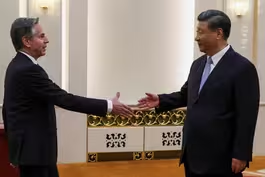
Blinken and Xi agree to stabilize deteriorated relations
Video has Closed Captions
Blinken and Xi agree to stabilize relations, but differences remain unresolved (11m 27s)

Grandmother of Juneteenth discusses what the day means
Video has Closed Captions
The grandmother of Juneteenth on what the holiday means for Americans (4m 26s)

Greek coast guard questioned over migrant vessel sinking
Video has Closed Captions
Greek coast guard questioned over response to deadly sinking of migrant vessel (3m 11s)

Report: DOJ resisted investigating Trump's role in Jan. 6
Video has Closed Captions
Report says DOJ resisted investigating Trump's role in Jan. 6 for over a year (7m 10s)
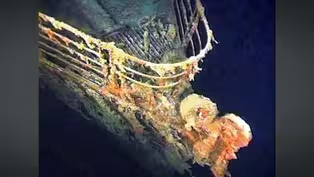
Submersible visiting Titanic wreckage reported missing
Video has Closed Captions
Submersible visiting Titanic wreckage with five people onboard reported missing (4m 21s)
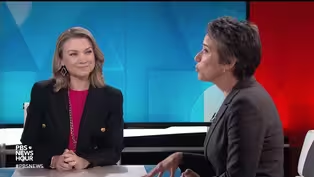
Tamara Keith and Amy Walter on Biden's campaign strategy
Video has Closed Captions
Tamara Keith and Amy Walter on Biden's campaign strategy (9m 7s)
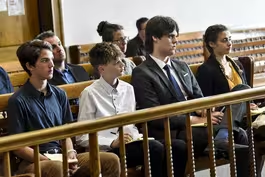
Young people sue Montana over inaction on climate change
Video has Closed Captions
Group of young people sue Montana over inaction on climate change (7m)
Providing Support for PBS.org
Learn Moreabout PBS online sponsorship
- News and Public Affairs

FRONTLINE is investigative journalism that questions, explains and changes our world.

- News and Public Affairs

Today's top journalists discuss Washington's current political events and public affairs.

 New Episode





 New Season
 New Episode
Support for PBS provided by:
Major corporate funding for the PBS News Hour is provided by BDO, BNSF, Consumer Cellular, American Cruise Lines, and Raymond James. Funding for the PBS NewsHour Weekend is provided by...