
June 19, 2024
Season 3 Episode 13 | 28m 1sVideo has Closed Captions
Kentucky’s top elections official quells lawmakers' concerns about non-citizens voting.
The state’s top elections official quells lawmakers' concerns about non-citizens voting. The University of Kentucky is out of the Men’s College World Series. A tour lets people learn about the history of Louisville one step at a time.
Problems playing video? | Closed Captioning Feedback
Problems playing video? | Closed Captioning Feedback
Kentucky Edition is a local public television program presented by KET
June 19, 2024
Season 3 Episode 13 | 28m 1sVideo has Closed Captions
The state’s top elections official quells lawmakers' concerns about non-citizens voting. The University of Kentucky is out of the Men’s College World Series. A tour lets people learn about the history of Louisville one step at a time.
Problems playing video? | Closed Captioning Feedback
How to Watch Kentucky Edition
Kentucky Edition is available to stream on pbs.org and the free PBS App, available on iPhone, Apple TV, Android TV, Android smartphones, Amazon Fire TV, Amazon Fire Tablet, Roku, Samsung Smart TV, and Vizio.
Providing Support for PBS.org
Learn Moreabout PBS online sponsorship♪ >> Like many small towns, you're just attached to the things that you like and that you enjoy.
>> Kentucky Edition is on the road and Hopkinsville where the arts and aliens are drawing them in.
>> During my tenure in office, I have seen no evidence that noncitizens have voted.
We're to the vote in our elections.
>> Talk is top elections.
Official quelled lawmakers concerns.
And it was a must win game for the Kentucky Baseball Wildcats.
>> Production of Kentucky Edition is made possible in part by the KU Team Millennium Fund.
♪ ♪ ♪ Good evening and welcome to Kentucky EDITION for this Wednesday, June.
The 19th.
>> I'm Renee Shaw coming to you once again and Hopkinsville.
Thank you so much for joining us.
We're on the road again as we continue to explore Kentucky's Penny Royal region.
The area has a strong agricultural heritage as well as a diverse culture, both of which will highlight in just a few minutes.
But first, we're acknowledging Juneteenth.
It was June 1918, 65 when union soldiers liberated the last enslaved people in Galveston, Texas.
It is not a state holiday, though.
Just a couple of weeks ago, Governor Andy Beshear signed an order to make it a holiday for state government workers and the executive Branch State Representative George Brown of Lexington says he will introduce legislation next year to make it a state holiday.
>> We'll have more on June Tate's tomorrow on Kentucky EDITION.
How many noncitizens are voting in Kentucky's elections?
Non according to the state's top elections official.
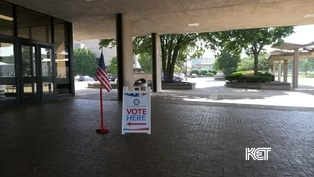
>> During my tenure in office, I have seen no evidence that noncitizens have voted.
We're tempted to vote.
In our elections.
But that does not mean we should not be concerned about this issue and failed to take proper precautionary measures.
Every voter registration card prompts a voter to provide a Social Security number.
Illegal immigrants to not get a Social Security number.
In some circumstances, though, illegal immigrant can get a Social Security number if authorized to work in the U.S. by the Federal Department of Homeland Security.
I think our best tool in preventing non-citizen voting is our photo ID to vote law.
You can get a driver's license in Kentucky.
If you're a legal immigrant.
So it is important that the Bush administration's drivers licensing centers, which also can register persons to vote exclude legal immigrants from their pitch for voter registration.
>> Kentucky voters will decide this fall if they want to ban non-citizens from voting in state and local elections.
It's already illegal.
But a ballot measure would make it explicit in Kentucky's constitution.
A committee of state lawmakers led by Republican Senator Robby Mills question education, health care and law enforcement officials on how often they encounter undocumented immigrants.
The numbers are unclear.
They said the Department of Education officials said they never ask a students immigration status because all students are federally guaranteed a public education.
Well, in some sports news after a great Ron, the University of Kentucky baseball season is now over the back at last 15 to 4 to the Florida Gators and College World Series in Omaha.
This was the first time ever that UK made it to the World Series.
Great try guys.
♪ ♪ ♪ As we continue our visit here in Hopkinsville in Christian County, we'll talk about where the community is today, but how do we get here?
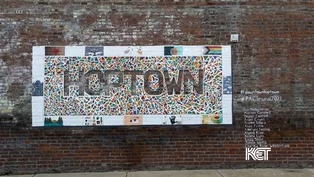
All Begins tells us about some of the important people at events in the history of Hopkinsville to to our column.
You and Martha and would of Jonesboro, Tennessee settled present-day Hopkinsville and 17 96.
>> The Woods claimed 1200 acres of land and built a cabin.
Other settlers arrived and after the town built a courthouse in jail, the committee called itself Christian Courthouse to honor the Woods family.
The town was later renamed Elizabeth after their eldest daughter that cause confusion with Elizabeth Town.
So in April of 18, 0, 4, the Kentucky General Assembly renamed it Hopkinsville after Samuel Hopkins, a revolutionary War.
Colonel who rose to the rank of general during the war of 18, 12 Christian County is also named for a revolutionary war figure.
Colonel William Christian agriculture dominated the local economy with farmers growing corn, winter, wheat and tobacco.
The Civil War divided, Hopkinsville and Christian County with some people supporting the union and others providing support to the Confederacy.
Hopkinsville changed hands.
At least a half dozen times in December of 18, 64, just a few months before the war ended.
Confederate forces burned the Christian County Courthouse used by Union forces as an army barracks.
The Evansville Henderson in Nashville Railroad arrived in Hopkinsville in 18.
68 Hopkinsville and Christian County, a part of the black patch to back about and the fight over tobacco prices frequently turned violent.
Many tobacco farmers saw the American tobacco company has a monopoly keeping payments to farmers as low as possible in 19 0 for tobacco planners the dark tobacco district Planners Protective Association to fight big tobacco in 19.
0, 7.
The association's Knight riders sees Hopkinsville as police station cut off contact with the outside world and set fire to 3 warehouses to punish tobacco executives who bought tobacco from farmers who weren't members of the association.
Christian County can claim a vice president, at least even to the first vice president under Grover Cleveland from 18 93 to 18.
97 was born in Christian County in 18.
35, he's better known grandson, Adelaide Stephenson.
The second was the Democratic nominee for president in 1952.
1956, its most famous recent native is probably bell Hooks.
The author, educator and Social critic born Gloria Jean Watkins in Hopkinsville in 1952, she died in 2021. for Kentucky Edition.
Toby Gibbs.
>> Thank you so much, Toby.
The city of Hopkinsville pays homage to its history while evolving with the Times by encouraging downtown rose investment and interest our Laura Rogers spoke with some of the people dedicated to saying the city drive.
Downtown was like the business center.
>> I mean, really still is there's a train going by right now means death still is just passing through here all the time.
The city of Hopkinsville to history.
Museum's been here downtown, holding down this corner since 1976.
And that a bustling center of One of the things about up until we are the batter capital of the world.
And that comes from that connection to an agriculture and industry.
Christian County is the leading wheat producer and the state.
Hence this week's sculpture at the corner of 9th and main downtown has changed so much since my childhood.
When I was growing up here in the 1980's and 90's, I KET really one thing about downtown.
And it was here is the other.
She's a great beacon.
She's been here a long time.
She holds a lot of great memories for our community.
Found Amber Theater as a focal point of downtown.
A fixture for 95 years.
Its last major renovation in 2018.
We're so fortunate to have maintained this downtown beauty and not many downtown still have a historic theater today, the Performing Arts Center host live season performances and educational programming that helps drive economic development.
It's a real quality of life.
And people are looking for that in their community.
The arts are so important.
This is our regional and cultural center for us.
>> Here in Hopkinsville >> Holly Baga says the downtown Renaissance director at Community and Development Services.
She helps the city secure funds and implement projects like streetscapes and Park improvements.
It's so rewarding because you get to see those tangible results and know that you've been a part of something that is just making our community a better place.
>> No, the locals as hop down the city has undergone a transformation in the 21st century.
>> We've had, you know, a lot of businesses come.
We've had some businesses go as well.
But we have created an environment that we believe is business friendly and it is welcoming.
>> August says they've been able to attract small business owners and investors in part by offering tax rebate sent some reimbursements for expenses.
>> About 15 years ago, the city of Hopkinsville implemented some incentive programs to assist to offset the cost of those restoration projects.
Because while they may have good bones, those buildings require a whole lot of attention and it can become very costly to get them seeing double for occupancy.
>> The office has received and approved more than 100 applications since those programs were adopted.
She says that sealed at about 13 million dollars of private investment.
Like many small towns.
You're just attached to the things that you like and that you enjoy.
And we do have a lot of historic properties in which we're very proud of.
>> We're putting our banks property.
This is one of the oldest have properties in the city.
Now home to planters.
Bank.
This building once housed union and Confederate soldiers during the Civil War.
>> Since family friend invited to other historic properties and everybody last of other.
>> More recent properties.
And so we've we own about 4 blocks in downtown.
We're committed to improving our area of 9th Street.
>> Elizabeth McCoy says the focus now turns to the future.
We've had some consultants in town to help us think about how do we go to the next level on what else do?
We didn't want to continue to improve visual appearance of our downtown.
We've also had a number of new restaurants open downtown.
The happens.
A brewing company has been a big draw.
So lots of that kind of small investment that added up to a really big impact.
That includes the 6 street projects that began a decade ago and which improvements were made that encourage private investment.
>> So there's not a vacant storefront on that street now.
And we're so appreciative of how the community has supported those businesses.
>> Area known for an alleged alien encounter in 1955.
Would receive renewed interest in its relation to the cosmos when it became the epicenter of the eclipse and 2017, when you really think of like the heart and soul.
>> Of Hopkinsville, it is right here in these few little streets that surround our downtown area.
This is what drew people in to this community 100 years ago, 200 years ago.
And that's what still drawing people in today.
>> For Kentucky edition, I'm Laura Rogers.
♪ >> We're now inside the beautiful majestic historic Alhambra theater here in Hopkinsville.
This is a glorious 650 seat performing arts center.
Lots happening here.
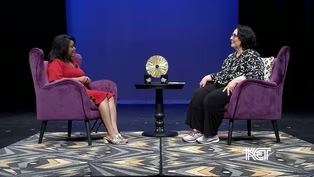
We are having camp here for the week while we've been here and I had the pleasure of talking with Jennifer Brown, who is the co-founder editor and publisher of the Hop Town Chronicle.
It's Good to have you.
Thank you.
I'm glad you're here.
>> I love this setting.
This is just in this place has energy and it's alive and colorful.
And it just gives so much to this community.
It's beautiful.
And if you lived here for a long time is on him.
>> You have many layers of experiences here.
I saw Star Wars in this movie theater.
My children performed here, you know, in plays and a And now, you know, we have some musicians who come here and we try to come to all the shows.
What we encourage folks to make the drive to see it because it is certainly something to see while usually on Wednesday as we talk with Rylan Barden about political happenings and midweek.
But we wanted to take the opportunity to be here.
>> Since we're here to speak with you about Hopkinsville, the Hop town Chronicle and the reason why your paper or what the purpose is and what void it's filling.
Sure.
>> I was in print journalism for 30 years at a Kentucky new era.
I was the editor there and the opinion editor in the last several years when I laughed in 2016, it was not intended to be a retirement from journalism.
But I will also admit I didn't have a definite plan about what was going to do.
And so, you know, wife 50 gap here, McCain to gap years and I was seriously underemployed, but I was the conferences and doing some pretty Lansing.
And I just had this little idea that there was something significant happening in downtown Hopkinsville that there was a true revival happening that people are talked about for years.
But now it seemed to be happening.
And so in the fall of 2018, there were signs going up all over downtown about a real estate auction.
And these were going to be 12 or properties that belong to sort of the last great merchant class family in Hopkinsville who used to own the Big Department when downtown was stabbing.
And so I went to that option and I took notes.
Interview.
People took photos.
Not really knowing what I was going to do with this story.
And it went home and wrote a story and created a Facebook page and just sort of asked the community.
Are you interested in more stories like this and so we've sort of experiment farm a few months and then a former colleague of mine.
Contacted me and she wanted to help build a website and she advise me to create a nonprofit.
So Mark, my former new era colleague who now lives in Madison, Wisconsin.
Julia Hunter is our engagement editor.
And she really made all of those things One, that's what started my in my inbox.
You know, I get the newsletter.
I get the out.
What is it called the day police can to daily scoop.
I get that and I read that every.
>> Every time it comes out.
And so it really helps inform those who of a sewer several 100 miles away are hundreds of miles away to know what's happening here because you do a tremendous job.
And it's interesting because where we are is a good 3 hour.
Plus drive from the center of Power in Frankfort.
And I'm curious about how people here feel about that disconnection.
>> I've been aware of that disconnection all my life.
I was born in Memphis.
But my family came here when I was 4 years old.
And I think that Western Kentucky INS have off has for a long time.
May be ignored at times or not really in the loop there are many reasons for that distance is one of them we are geographically different from eastern Kentucky.
We're not big.
You know, a horse farm country.
We are the grain farm country.
And also we're connected to the national in a way that other people in Kentucky are not so.
We really have to work to stay informed about what's going on in state government.
And that's part of Pop town chronicles mission because we have partnerships with other nonprofit newsrooms and Kentucky Public radio be able to publish stories about what's going on in Frankfort.
>> On Monday night, you're with us.
Our remotely here in Hopkinsville as we talked about the state of the news media and a comment you made, I really struck me about how many people may feel like Nashville as the state Capitol riot, western Kentucky, western because that's the news that you're saying, right?
And and hopefully the hop town Chronicle is helping to KET people with all the different partners.
You have informed.
Do you feel like people steal a tighter connection to the inner workings of state government in Kentucky because of what you're doing.
>> It's hard for me to say.
I certainly hope So, yeah.
And you're going to KET doing it.
Yes, I'm you know, I'm one of one of my own.
I guess a joke is that when I say we we as a big word for an uptown Chronicle, we only have to pay to employees.
And so there's a lot of room for growth.
But you know, you don't know what you don't know when you start something and I've learned so much.
But we have the potential for a lot of growth.
Yes, we're still very young, right?
Right.
>> But you've done some great storytelling and have been here when they're when disaster struck when the community has needed to be informed.
And that's what local journalism is all about.
And many ways and accountability, but also connecting people to information that they need to help their daily lives.
>> We were less than a year old when the pandemic hit.
And what I imagined Hop town chronicles coverage being suddenly changed in a big way.
Yeah.
we were very dedicated to a daily update of what was going on with the virus.
Here and in the state so that that was important to the community.
I think a mile.
>> Hopped on Chronicle.
KET on keeping on Jennifer Brown.
It's always good to speak with you.
and we'll be seeing you again on Kentucky tonight again on Monday night.
So we're so glad you're here.
Thank you.
Thank you.
♪ >> Each year, thousands gather on sacred ground.
Hopkinsville for the Trail of tears Powwow, the Trail of Tears Heritage Center has hosted the event for decades as a way to honor the culture and traditions of the indigenous people who travel and died along the trail.
>> The powwow is something that there's a variety of different perspectives into native cultures and dancing isn't a part of the ceremonies is also part of it.
There's social dances.
There's there's a variety of ways in which which dancing is a part of various cultural expressions and foundations.
If you go to the powwow, you'll see a lot of common elements is typically a grand entry of dancers.
There's almost always if not always a honor veterans.
And since there's a long history of need is a service in the armed forces of the United States.
There's singers and drummers.
And then there's, you Powell has a has a really strong and see.
But it's also, you know, even within the fund and everything there's there's a strong respect for what's also going on.
And and every powwow has its has its roots.
>> How well he to face a different people.
Our power around is a major They do dance competitions, drumming competitions this.
So it just kind of a good time for the general public to watch.
But it's also one of our mission statement.
See you on our Trail of Tears Commission.
>> Is that education and the general public now made of American history and culture.
Almost every Native American tribe has removal story and >> And many of them are called, you know, trail where they crown a trail of tears.
We're referring to the trail of tears were talking about the charity, too painting Hopkinsville.
>> Typically when people talk about the trail of tears, the emphasis is on the Cherokee Nation and the experience of the Cherokee Nation from the fall of 18.
38 to the early spring to late winter of 18.
39 when the U.S. government forced them from from their lands in Georgia, North Carolina and Tennessee.
It was through Tennessee through the kind of western corner of Kentucky crossing the Mississippi in and around Illinois, Missouri, and then traveling across southern Missouri.
And in some cases to Arkansas and into what was then called Indian territory.
With us now, welcome.
The trailer itself is one of these experiences.
It's hard to really kind of understanding capture certainly for anyone in the present And particularly when you think of how little they were able to take from their rooms before being forced into these camps and then being put on the trail on an average day removal party again to somewhere around 1,1200 or so would move maybe 10 to 12 miles.
Most of the individuals would be walking.
There was poor food.
There was overcrowding in the summer of 18.
38 was incredibly hot.
You will listen and help treat a issues amount Rishon all along the young and old and Cherokee men, women and children were.
We're dime.
And that's what happened to chief white pants.
And last minute.
>> Now, White has was later the traditional church.
He he was from a little place called to account Georgian.
He was a former.
That he would go back and forth to Washington, D.C., fighting the removal.
He returns from one of his trips to expand your family living in this camp and they have taken over storm.
And in the state of Georgia, he had no right to you.
So he surrendered themselves to one of the stock aides to want to come true.
He left the first of October 18.
38 in the first week of November 18.
38.
Last man was from a place called Ball Ground Ga.
He was ahead.
Councilman.
We know we had a small family.
He was about 75 when he passed away years.
But that's about all we know Is, you know, kind of the carrier here.
>> I get a lot of seen that from May to use to.
They know you what happened here.
They know who is here to.
There is a lot of time spanned not publicly.
Jerome showing respect for the teams that are buried I out of the Mary are come here on always take a back room, sage hours, look around and see the only ones I want to be on.
The young was grown to be a part of this dance.
Now they're juniors, you young adults, they can happen to see who they're carrying on the traditions makes me feel good to I'm coaching my team, my people, Susan >> This year's trail of tears Powwow takes place September, the 7th and 8th.
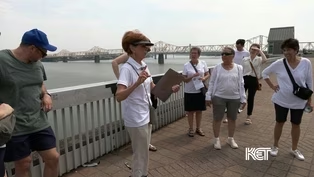
♪ ♪ The Frazier History Museum is giving people the chance to learn about the history of Louisville by hitting the streets.
The museum is now offering walking tours, leading the way a former high school history teacher.
He says she hopes people walk away with the same passion she has from Louisville's history.
>> It's one of my loves to really.
Selma city.
I'm proud of Louisville and lived here all my life.
So I get a lot of joy satisfaction in louden people to learn about us.
>> 1937 float was devastated it specially because those are river city.
Everything relates to the Ohio River.
We wouldn't be here without that river.
So to me, the history begins at the river.
And then the excitement of our city, I think, is how we have how he merged Adam being really an industrial city based and now we service city.
Think about it.
We are in or team and the arts sports we've got the UPS home to find people and for conventions.
That's our real drawl.
So I'm proud of as we transition.
If we make progress in the city and so much to come.
So another 5 years, we'll be talking a lot more about the new things.
All right.
Let's go this way.
I taught for Jefferson County for 30 years.
My students who went where they were jog, roughy students are history.
Students.
We always did a downtown urban field.
Walk.
I like engaging people.
Whether there are students or adults, they can is questions and we're always open to.
I may not have all the answers.
But I will give you, you know, one of the knowledge that I have and I think that makes a difference that you are on site.
You really see it crying and those people walk around and they are in this way and there look at what's in the sidewalk.
This will look at the sidewalk.
There are some things you can see are behind something are what he used to be.
I think it gives them a great and grounding.
Hey, a sense of I get a better feel for the city.
Is flipping through a book?
I'm really trying to emphasize the idea of it.
Our city is not dying.
There's progress there to see that they're going to that's new.
And this is new and and a lot of cities are really not moving on at all.
We are.
>> We've got to do it for us tonight for Kentucky Edition will have more great stories about half its all coming your way tomorrow night at 6.30, Eastern 5.30, central for we inform connect and inspire.
I'm Renee Shaw until I see you again.
Take really good care.
♪
Video has Closed Captions
Clip: S3 Ep13 | 2m 51s | History of Hopkinsville (2m 51s)
Kentucky’s Top Elections Official Quells Lawmakers' Concerns About Non-Citizens Voting
Video has Closed Captions
Clip: S3 Ep13 | 1m 51s | Kentucky’s top elections official quells lawmakers' concerns about non-citizens voting. (1m 51s)
Tour Lets People Learn About the History of Louisville One Step At a Time
Video has Closed Captions
Clip: S3 Ep13 | 2m 38s | Tour lets people learn about the history of Louisville one step at a time. (2m 38s)
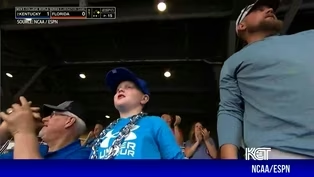
University of Kentucky Out of College World Series
Video has Closed Captions
Clip: S3 Ep13 | 20s | University of Kentucky out of College World Series. (20s)
Providing Support for PBS.org
Learn Moreabout PBS online sponsorship
- News and Public Affairs

Top journalists deliver compelling original analysis of the hour's headlines.

- News and Public Affairs

FRONTLINE is investigative journalism that questions, explains and changes our world.












Support for PBS provided by:
Kentucky Edition is a local public television program presented by KET