
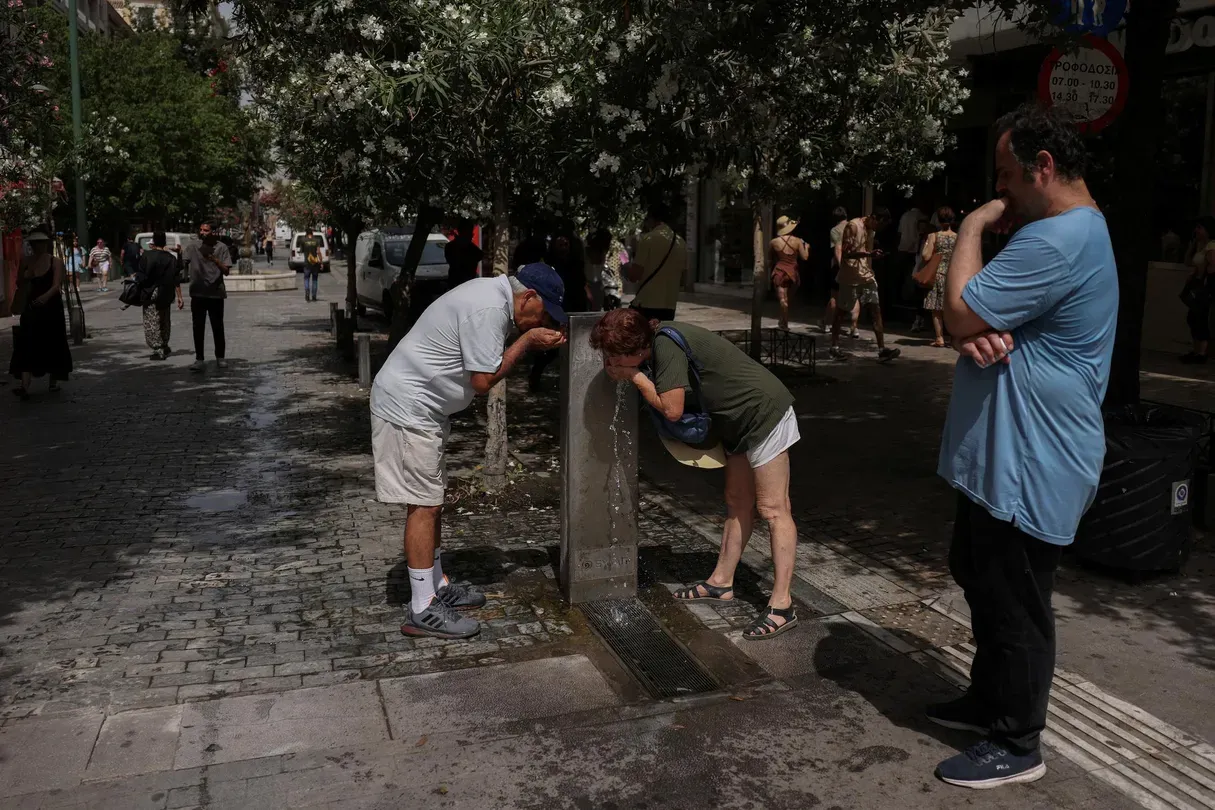
June 19, 2024 - PBS NewsHour full episode
6/19/2024 | 57m 46sVideo has Closed Captions
June 19, 2024 - PBS NewsHour full episode
Wednesday on the News Hour, millions face record-breaking temperatures as a dangerous heat wave scorches the Midwest and East Coast. Russian President Vladimir Putin signs a defense agreement with North Korea's Kim Jong Un which could increase weapons supplies for Russia's war in Ukraine. Plus, an investigation reveals America's broken promise to formerly enslaved people after the Civil War.
Problems playing video? | Closed Captioning Feedback
Problems playing video? | Closed Captioning Feedback
Major corporate funding for the PBS News Hour is provided by BDO, BNSF, Consumer Cellular, American Cruise Lines, and Raymond James. Funding for the PBS NewsHour Weekend is provided by...
June 19, 2024 - PBS NewsHour full episode
6/19/2024 | 57m 46sVideo has Closed Captions
Wednesday on the News Hour, millions face record-breaking temperatures as a dangerous heat wave scorches the Midwest and East Coast. Russian President Vladimir Putin signs a defense agreement with North Korea's Kim Jong Un which could increase weapons supplies for Russia's war in Ukraine. Plus, an investigation reveals America's broken promise to formerly enslaved people after the Civil War.
Problems playing video? | Closed Captioning Feedback
Where to Watch PBS News Hour
PBS News Hour is available to stream on pbs.org and the PBS app.
Providing Support for PBS.org
Learn Moreabout PBS online sponsorshipGEOFF BENNETT: Good evening.
I'm Geoff Bennett.
AMNA NAWAZ: And I'm Amna Nawaz.
On the "News Hour" tonight: Millions face record-breaking temperatures as a dangerous heat wave scorches the Midwest and East Coast.
GEOFF BENNETT: Russian President Vladimir Putin signs a mutual defense agreement with North Korea's Kim Jong-un, which could increase weapons supplies for Russia's war in Ukraine.
AMNA NAWAZ: And, on Juneteenth, an investigation uncovers new details about America's broken promise to formerly enslaved people after the Civil War.
ALEXIA FERNANDEZ CAMPBELL, Center for Public Integrity: It wasn't just a promise that was spoken and then broken.
They lived there for like up to a year-and-a-half before they were kicked off.
(BREAK) AMNA NAWAZ: Welcome to the "News Hour."
Tens of millions of Americans are baking in a dangerous early summer heat wave.
Dozens of cities from the Midwest to New England are expected to reach record highs, as the heat index hits triple digits.
The powerful heat dome is forecast to keep temperatures well above normal across much of the country through the weekend.
In the meantime, wildfires are raging across the West, fueled by soaring temperatures and dry conditions.
In New Mexico, two massive blazes forced thousands of evacuations and killed at least one person.
And a major fire north of Los Angeles remained less than 40 percent contained.
GEOFF BENNETT: Across the globe, authorities say hundreds died in Saudi Arabia, where temperatures reached 125 degrees at the Grand Mosque in Mecca this week.
More than a million people traveled to the country this week for the Hajj, the annual Islamic pilgrimage.
In Greece, a stifling heat wave was responsible for the deaths of multiple tourists, including a 55-year-old man from Floral Park, New York.
For more on the impact and implications of all this, we're joined by journalist Jeff Goodell.
He's author of the book "The Heat Will Kill You First: Life and Death on a Scorched Planet."
Welcome back to the program.
It's good to have you here.
JEFF GOODELL, Author, "The Heat Will Kill You First: Life and Death on a Scorched Planet": Good to be back.
GEOFF BENNETT: Some 75 million Americans are under an excessive heat warning or heat advisory today.
Some of these warnings are the first ever issued in places like New Hampshire and Maine.
How unusual is this heat wave that we're seeing right now and how much of it is driven by climate change?
JEFF GOODELL: Well, that's a really good and important question.
Obviously, heat waves are nothing new.
But what else is not new is that scientists have known for more than 100 years that adding CO2 to the atmosphere by the burning of fossil fuels primarily is warming up our planet.
2023 was the hottest year on human record.
Ten of the last hottest years have been in the last decade.
So what we're seeing today is completely consistent with what science tells us.
We're seeing longer heat waves.
We're seeing more extreme heat waves.
We're seeing them starting earlier in the year.
And we're seeing them in unusual places that we haven't seen before.
GEOFF BENNETT: I know, from having read your book, that extreme heat is the deadliest form of severe weather.
What are the particular dangers of a drawn-out heat wave like this?
And who's the most affected?
JEFF GOODELL: Well, our bodies are like these heat machines.
We have this kind of unconscious mechanism in our bodies that keeps our bodies at a very stable temperature.
I think everyone knows that.
When you go to the doctor, the first thing the doctor does is take your temperature.
It's a sign that things are wrong.
And so what happens during these extreme heat events is that our body has to work much harder to maintain that temperature.
And so what happens is, your heart starts pounding and starts pushing more blood towards the surface of your skin, where it can be cooled through sweating.
And that can work for a while.
But if the temperatures get too high, it really puts your life at risk.
Not everybody is equally vulnerable.
People who are older, people who have weak hearts, young children, pregnant women, people who are on certain kinds of medications, their bodies can't regulate the temperature.
And once your body starts warming up, it's really not pretty what happens.
GEOFF BENNETT: It raises the question of what to do about all of this.
And earlier this week, a coalition of labor and environmental groups filed a petition to urge FEMA to include extreme heat and wildfire smoke in their definition of major disasters.
How might that help?
And what are the challenges to that approach, logistical and otherwise?
JEFF GOODELL: Yes, that's an important question too.
I mean, FEMA has been focused on major disasters that impact infrastructure where federal money is needed to, say, rebuild power lines and provide housing for people whose homes have been destroyed in hurricanes and other events like that.
Heat waves are entirely different.
Heat waves are events that really don't do a lot of damage to infrastructure, but do a lot of damage to human beings.
And so they are really potentially mass mortality events.
And FEMA is in the process of reevaluating how it defines a major disaster.
And it's not just FEMA, I should say.
The federal government is sort of behind on thinking about how they deal with extreme heat in other cases also.
The OSHA, the Occupational Safety and Health Administration, has been working for seven years or so on federal heat standards.
It still hasn't been able to come up with it.
So the government is really behind on understanding and dealing with these extreme heat events.
GEOFF BENNETT: In the meantime, the world is getting hotter.
That is clear from all of the data.
What does life on a much hotter planet look like, Jeff?
(LAUGHTER) JEFF GOODELL: Well, I live in Austin, Texas.
I can tell you very well what life on a much hotter planet looks like.
We had 40 days above 105 degrees last summer, and it's looking like that again.
You live a vampire life.
You stay inside during the day if you're lucky enough to have air conditioning.
You go out in the morning, you go out in the evening.
The -- this is manageable to a certain level.
But as this heat increases hotter and hotter, more -- the risks to vulnerable people gets greater and greater.
I call heat a predatory force in my book.
It really does go after the most vulnerable people first.
And so we're going to see more and more suffering and more and more loss as these temperatures climb.
GEOFF BENNETT: That is journalist and author Jeff Goodell.
Thanks so much for your insights.
JEFF GOODELL: Thanks for having me.
AMNA NAWAZ: In the day's other headlines: The first named tropical storm of the Atlantic hurricane season is brewing in the Gulf of Mexico.
It bears the name Alberto, kicking off the alphabet for what's forecast to be a busy year for these storms.
Alberto formed this morning some 300 miles southeast of Brownsville, Texas, with sustained winds of 40 miles per hour.
Tropical storm warnings were in effect today along much of the state's southern shoreline.
It's due to make landfall in Northern Mexico on Thursday, an area that's already seen rough waves and heavy rains.
Relatives of the victims of two Boeing 737 MAX crashes have asked the Justice Department to criminally charge the plane maker and seek a fine of more than $24 billion.
In a letter to the DOJ, a lawyer for 15 families wrote that the request is legally justified because -- quote -- "Boeing's crime is the deadliest corporate crime in U.S.
history."
The letter comes a day after Boeing's CEO, Dave Calhoun, apologized to families in a dramatic moment in Senate testimony; 346 people were killed in those two Boeing crashes in 2018 and 2019.
Cyril Ramaphosa has promised a new era for South Africa as he was sworn in for a second full term as president today.
Ramaphosa's reelection comes after his African National Congress party lost its 30-year majority in last month's vote.
The ANC then struck a deal with the opposition Democratic Alliance to form a coalition government.
Today, a military parade marched through the capital before Ramaphosa addressed the nation, saying voters want to see unity from their leaders.
CYRIL RAMAPHOSA, South African President: The people of South Africa have stressed that they are impatient with political bickering.
Today, I stand before you as your humble servant to say that we have heard you.
AMNA NAWAZ: Ramaphosa went on to say that South Africa remains -- quote -- "deeply unequal and highly polarized" and promised to work on providing basic services like housing and clean water.
He is set to appoint a Cabinet for the new coalition government.
A Russian court has sentenced an American soldier to nearly four years in prison for stealing and making threats of murder.
Officers brought staff Sergeant Gordon Black to the court in Vladivostok in Eastern Russia today.
Authorities say he was arrested during an unauthorized trip to the country to see his girlfriend, who accused Black of stealing money from her wallet.
The sentence comes as the U.S. continues to work on the release of other Americans held in Russian jails.
They include former U.S. Marine Paul Whelan and Wall Street Journal reporter Evan Gershkovich.
British authorities arrested two climate activists today for defacing the Stonehenge monument.
Video captured the protesters spraying the megaliths with orange paint as an onlooker tried to stop them.
They're members of the environmental activist group called Just Stop Oil, which said on social media that the paint is made of cornstarch and will dissolve in the rain.
The incident comes a day before thousands will gather at the 45-hundred-year-old monument to celebrate the summer solstice.
Mexico's president asked his foreign minister today to work with the U.S. ambassador to resume inspections of avocados.
The U.S. suspended inspections in the state of Michoacan after two Agricultural Department employees were assaulted and temporarily held by assailants.
Michoacan is Mexico's biggest exporter of avocados.
Farmers there say they're worried about their jobs if the suspension continues.
JESUS VILLEGAS, Michoacan, Mexico, Avocado Farmer (through translator): We are losing a lot with the USDA suspension.
We can't export even a single avocado.
The government should do its job and guarantee the safety of the inspectors, so they can do their job.
We want to work, but we can't do it without them.
AMNA NAWAZ: Rest assured, the current halt on inspections won't entirely block shipments of Mexican avocados to the U.S.
Many Michoacan avocados are already in transit and the state of Jalisco also exports them.
Louisiana has become the first state to require that the Ten Commandments be displayed in all public school classrooms.
That includes kindergartens all the way through state-funded universities.
The Republican-led bill that became law today mandates a poster-sized display of the Commandments be clearly visible.
And it must include a four-paragraph context statement describing how they were -- quote -- "a prominent part of American public education for almost three centuries."
The displays must be in place by the start of 2025.
Critics question the constitutionality of the measure and say lawsuits can be expected.
And Americans have been honoring the Juneteenth federal holiday, marking the moment in 1865 when word reached the enslaved people of Galveston, Texas, that they were freed by the Emancipation Proclamation.
That was two-and-a-half years after President Lincoln issued the decree.
The city of Dallas commemorated the event, a two-and-a-half-mile Walk for Freedom.
That's an annual March led by 97-year-old Opal Lee, who's widely known as the grandmother of Juneteenth.
OPAL LEE, Civil Rights Activist: I'm delighted, I really am, that so many of you are celebrating freedom.
And I don't mean freedom in Texas or freedom for Black people.
I mean freedom for all of us.
AMNA NAWAZ: Lee was instrumental in making Juneteenth a nationally recognized holiday in 2021.
The day was already celebrated by many Black communities for more than a century.
Still to come on the "News Hour": a look at the latest round of primary election results from Virginia, Georgia, and Oklahoma; Dr. Anthony Fauci discusses death threats and his legacy in the second part of our interview on his new memoir; and baseball mourns the passing of one of its all-time greats, Willie Mays.
Russian and North Korea have taken a step toward improving relations, as President Vladimir Putin and Kim Jong-un signed a strategic partnership agreement today.
Both sides pledged to help each other's defense and security and to fight off sanctions.
Stephanie Sy has the story.
STEPHANIE SY: As the Russian jet rolled in to Pyongyang, the North Koreans rolled out the red carpet.
Leader Kim Jong-un welcomed President Vladimir Putin to North Korea for the first time in 24 years.
As Putin looks for support for his war in Ukraine, Kim hopes to find an economic and military ally.
The tone for the summit was set with a sturdy embrace.
In recent years, the countries have flirted with stronger ties.
Kim Jong-un first traveled to Russia in 2019 and again in 2023 to meet Putin.
But neither trip produced a formal alliance.
The U.S. accuses North Korea of sending ammunition and weapons to Russia for its war in Ukraine and worries that, in exchange, Russia is boosting North Korea's nuclear program.
Kim and Putin have denied it, since such a trade would violate U.N. sanctions.
But, in March, a Russian veto on the Security Council ended the U.N.'s monitoring of nuclear sanctions on North Korea and raised alarm bells.
VLADIMIR PUTIN, Russian President (through translator): We highly appreciate your consistent and unwavering support for Russian policy.
I'm referring to our fight against the hegemonic policy imposed for decades, the imperialist policy of the United States and its satellites.
STEPHANIE SY: Today's summit formalized the strongest relationship between the two countries since the Cold War.
KIM JONG-UN, North Korean Leader (through translator): Our two countries' relations have been elevated to a new high-level of alliance, laying the legal groundwork for the grand ideas of leadership of the two countries.
STEPHANIE SY: The treaty includes military-technical cooperation between the two countries, a mutual defense pact and opposition to Western sanctions against North Korea.
Before the agreement was announced, the Pentagon raised red flags.
MAJ. GEN. PATRICK RYDER, Pentagon Press Secretary: The deepening cooperation between Russia and the DPRK is something that should be of concern.
JENS STOLTENBERG, NATO Secretary-General: What happens in Europe matters for Asia and what happens in Asia matters for us.
STEPHANIE SY: NATO Secretary-General Jens Stoltenberg appeared with Secretary of State Antony Blinken yesterday ahead of the summit.
ANTONY BLINKEN, U.S. Secretary of State: We have seen, as you have said, Russia try in desperation to develop and to strengthen relations with countries that can provide it with what it needs to continue the war of aggression that it started against Ukraine.
STEPHANIE SY: In Pyongyang, the state visit came to an end with dinner and drinks, as the two leaders made a show of their deepening partnership.
While the details of what the Russians and North Koreans agreed to has not been made public, some observers are concerned.
For more, we turn to Robert Gallucci.
He was the U.S. State Department's lead negotiator with North Korea in 1994, when the North agreed to freeze its nuclear program in exchange for economic benefits.
He's also a professor at Georgetown University.
Robert, thank you so much for joining the "News Hour."
So, Putin and Kim announced they signed a comprehensive strategic partnership treaty, and Putin called it a breakthrough document.
As we start to see some details come out, do you see it that way?
Is it a big deal?
ROBERT GALLUCCI, Georgetown University: It is important and negative.
I think it is both those things.
But it's not a fundamental change in the nature of relations of major states.
It isn't good news in terms of what the North Koreans have been supplying the Russians, so that they can more effectively prosecute their invasion and war against Ukraine.
That's not good news.
And on the other hand, we can't be really sure what it is exactly the Russians are going to transfer to the North Koreans.
STEPHANIE SY: Yes, let's break down the significant parts of what we do know, starting with what Putin called military technical cooperation.
Do you think that is a concerning development, the announcement of that?
And what could it mean as far as Pyongyang's nuclear weapons capability?
What could they transfer?
ROBERT GALLUCCI: The key issue is, will the Russians materially assist the North Koreans in having a more effective, more threatening nuclear weapons capability?
And by that, I mean not only the weapons themselves.
Will they be thermonuclear weapons assistance, as opposed to simple fission weapons?
Will now their yield go up?
Will the confidence that North Koreans have in their weapons go up, thanks to Russian assistance?
Will the delivery vehicles, the ballistic missiles, particularly the intercontinental ballistic missiles?
There have for a long time been real questions about whether the North should have any confidence in their ICBMs, their ability to deliver nuclear weapons against the continental United States, given that they can't be sure that the warheads containing these nuclear weapons would actually survive the trip and reentry and work effectively.
And it's not clear at all when, in what we understand will be the language of this, when and if it's released, that the Russians are committing to these kinds of transfers.
STEPHANIE SY: I assume those would be violations of international law and sanctions.
Both countries have been under varying sanctions, especially North Korea.
And if you believe U.S. officials, both are already violating these sanctions through these arms and ammunition transfers to do with Ukraine.
You have engaged in high-level diplomacy with North Korea in the past.
What can and should be done now by the Biden administration?
ROBERT GALLUCCI: We should deplore what the Russian moves signals, and that is first no longer a willingness on the part of the Russians to see the direction of events to lead to an eventual denuclearization of the peninsula.
In other words, the Russians had been aboard with the Chinese and sort of the rest of the world at sanctioning, U.N. sanctions, sanctioning the North Koreans for their ballistic missile and nuclear weapons development.
I think this, if it does nothing else, signals the Russians are no longer aboard.
And that ought to be deplored.
It ought to be criticized.
STEPHANIE SY: You said it was bad news.
Is it also bad news that part of this agreement includes a mutual defense pact?
ROBERT GALLUCCI: I do not know what it means.
I certainly -- even if I had the text in front of me -- and nobody does, as I understand it -- it is hard to tell.
I mean, when the Russians make a deal, and it's -- they have been clear -- they don't call it an alliance.
The North called it an alliance, but not the Russians.
I mean, the last time the Russians made a security commitment that I know of like this was 1994 in the Budapest Memorandum when they promised that they would not threaten Ukraine's security.
Well, we all know what that was worth.
We all ought to remember nothing has changed here, really.
The North has been providing this military aid to the Russians.
The Russians are still pursuing their invasion of Ukraine.
We have talked about the one thing that might be important and different, and that is if the Russians started supplying technical assistance to the weapons of mass destruction and delivery vehicles that the North Koreans have been developing for the last 25 years.
STEPHANIE SY: Robert Gallucci, thank you so much for joining us with your analysis.
Appreciate it.
ROBERT GALLUCCI: Thank you much.
AMNA NAWAZ: Virginia, Oklahoma and Georgia held primary and run-off elections last night, and the results in some key races could say a lot about the state of the Republican Party this election cycle.
Lisa Desjardins has been following it all closely and joins me now.
Lisa, let's begin in Virginia now, where the chair of the House Freedom Caucus is in danger of losing his seat to another Republican.
Tell us about the race and the results so far.
LISA DESJARDINS: We're in extraordinary political times, and this is one of the most extraordinary primary races that we're probably going to see all year.
Now, we're talking about Republican Bob Good.
He is the chairman of the House Freedom Caucus.
He had a Republican challenger, both men very conservative, both men big supporters of former President Trump.
Let's look at where this race is right now.
If you look at the total there, there you go, just barely within half-a-percentage point.
And my calculation is, it's just 321 votes separate these two men right now.
But look at that.
John McGuire, he's a brand-new state senator, just took that office in January, winning over the incumbent congressman by 321 votes right now.
What's the big difference between these two guys?
Let's look at this.
Former President Trump endorsed McGuire, the nonincumbent, and opposed Bob Good.
Why is that?
Well, it happens that Bob Good endorsed Ron DeSantis in the primary.
Now, you have a situation here where both of these men have signs saying they support Donald Trump, but this has been a real test of Trump and whether he can convince people in a district to vote against an incumbent who has served them for almost two terms now.
AMNA NAWAZ: Lisa, it's rare for an incumbent to lose in a primary like this.
Why else does this race matter?
Why is it one to watch?
LISA DESJARDINS: Right, because what's happening here is Trump taking over the Republican Party continually.
The House Freedom Caucus, while it does generally support former President Trump, is one of the few wild cards left in the House.
We have covered the dysfunction and the kind of bucking that's gone on from the House Freedom Caucus.
Bob Good is someone who led -- who pushed for and led to the ouster of Kevin McCarthy.
This is a hard group to control.
Now, so it could be said that this is a group that perhaps someone coming into office as a president would like to make sure he can control.
Bob Good didn't endorse him.
That's something that the former president didn't like.
And, overall, when you talk to political experts like Larry Sabato of the University of Virginia, they say this is a highly unusual race.
LARRY SABATO, Director, University of Virginia Center for Politics: Incumbents almost never lose party primaries.
And the fact that one who is as entrenched as Bob Good, who's also a major national figure, being chairman of the Freedom Caucus, should lose even by one vote is a headline.
The message was very clear.
Donald Trump was saying, if you cross me personally and if you cross my agenda, this could happen to you.
LISA DESJARDINS: Conservative outside groups poured $10 million in this Republican-versus-Republican race.
That's extraordinary, Groups from everything from Marjorie Taylor Greene in supporting John McGuire.
Kevin McCarthy has gotten involved in this race.
The Club for Growth has gotten involved.
Right now, where it stands is, Bob Good is not saying that he's lost.
He's going to wait, because, under Virginia law, ballots that were filed that got postmarked by election time, if they're received by Friday, they still count.
So we really don't know where this race is going to end up.
AMNA NAWAZ: I know you're tracking a number of other races as well.
Tell us where else you have been watching and why they matter this cycle.
LISA DESJARDINS: Some other big names.
Tom Cole is a well-known Republican, one of those powerful Republicans, now the chairman of the House Appropriations Committee.
He also had a challenger from the right who said Tom Cole is too friendly with Democrats.
Tom Cole easily won that election.
But it was something that people were watching very closely.
He's sort of a voice of moderation at times in the House Republican Conference.
Then, also another race in Georgia in the Fifth Congressional District, a candidate there was -- is someone who was convicted on January 6.
We're going to get to the deficit in just a second.
But there was a candidate in Georgia Fifth Congressional district who was convicted of entering the Capitol with his wife on January 6.
That's Chuck Hand right there, the Republican.
He lost in that primary.
It was a real test to see if there was support for someone like that who faced actual jail time because of January 6.
So those are two races that we were watching as well.
AMNA NAWAZ: This is the point in the conversation when I do want to turn to the Congressional Budget Office.
AMNA NAWAZ: It's a story that is related to this in some way, but let's just focus on that story first.
The CBO came out with a stunning conclusion about the deficit.
Tell us what that was.
LISA DESJARDINS: Yes, let's get right to that graphic that popped up.
It's really hard to ignore.
The CBO has said that their projection is now that we will have a $1.9 trillion deficit this year.
That is much larger than they originally forecast.
And it is about 7 percent of our gross domestic product.
So, right now, we're approaching about a trillion dollars in interest payments in this country each year just on interest on our debt.
Now, why did things go up?
Student loans, the forgiveness programs from the Biden administration, that costs more than CBO had thought it would.
And Medicaid costs also have been larger than expected.
AMNA NAWAZ: And how is this connected to the races you're following, Lisa?
LISA DESJARDINS: Let's tie it all together, as we like to deal here at "News Hour."
It is connected, because Bob Good and the Freedom Caucus, their central kind of raison d'etre has been about spending and cutting spending.
And if former President Trump or whoever becomes president, whoever wins this election, they will have to reckon with potentially a Freedom Caucus that will still try and say, we aren't going to support any bills that raise spending or that don't cut it more.
So, a Freedom Caucus that has less power really does have an effect potentially on the debt, deficit, and also on the functioning and potential shutdowns ahead.
These issues are all very connected.
Freedom Caucus is one of the loudest voices on the deficit, but a voice that some people say is too disruptive.
So that's why Bob Good and these races matter quite a lot.
AMNA NAWAZ: All right, Lisa Desjardins, thank you very much.
LISA DESJARDINS: You're welcome.
AMNA NAWAZ: After the Civil War, the federal government's pledge of 40 acres and a mule to the formerly enslaved has long been known as a broken promise.
But a new investigative report reveals that not only did the government grant land to hundreds of formerly enslaved people; it also took that land back and returned it to white Southerners.
That two-year reporting project done by the Center for Public Integrity, Reveal, and Mother Jones is now the largest collection of land titles from the 40 acres program ever to be analyzed and published.
I spoke recently with Alexia Fernandez Campbell, a senior investigative reporter at the Center for Public Integrity.
Alexia, welcome.
Thanks so much for being here.
ALEXIA FERNANDEZ CAMPBELL, Center for Public Integrity: I'm so happy to be here.
AMNA NAWAZ: So take me back to the fall of 2021.
You were working on an entirely different project unrelated to this.
You're digging through the digital archives at the Smithsonian, and you come across the name Fergus Wilson on an 1865 document.
How does that change the course of your reporting?
ALEXIA FERNANDEZ CAMPBELL: So, I didn't immediately realize what I was looking at.
I did some Googling.
I'm like, this is the 40 acres program.
And I was thinking, but everything I knew about it was that it was a promise that was never kept.
It's something that didn't happen.
So, to me, like, that disconnect where like, oh, there are land titles.
I don't think this is common knowledge.
AMNA NAWAZ: So a lot of folks have heard this phrase, right, 40 acres and a mule.
As you say, a lot of people thought, OK, this just never happened.
And your reporting is called "40 Acres and a Lie."
What's the truth behind this program?
What do people not know?
ALEXIA FERNANDEZ CAMPBELL: What people don't know is that there were -- it wasn't just a promise that was broken.
People who received land titles, we found more than 1,250 people who got land titles, men and women, they picked out their plots of land, mostly on the plantations where they were enslaved.
Actually, not everyone got 40 acres, which is another misconception.
It was up to 40 acres.
And then people were living there.
They were planting their crops.
They were selling them in Savannah.
Some of them formed governments, elected a sheriff.
They were living their lives, and they lived there for like up to a year-and-a-half before they were kicked off.
AMNA NAWAZ: They were kicked off.
I want to stop you there so you can tell us a little bit more and also remind people what it took you to get to the point of finding those 1,200 people that you did.
You and your reporting team, you reviewed thousands of records.
You conducted hours of genealogical research.
You even employed artificial intelligence to sort through the millions of documents online.
You mentioned these families.
And we're talking about a stretch of land in Georgia and South Carolina, we should point out.
How did they get kicked off the land that the government gave them?
ALEXIA FERNANDEZ CAMPBELL: Basically, because Lincoln was assassinated.
I mean, they had promised this land.
They gave land titles.
The government said, this is yours.
You deserve it.
You're going to keep it.
But Congress needed to make those titles permanent.
They had a majority in Congress who were willing to do it, but Andrew Johnson, he was the vice president.
He was a white supremacist.
He sided with the planters who wanted their land back, and he vetoed every effort to make those land titles permanent.
AMNA NAWAZ: So how were those families removed?
They were literally forcibly removed from the land?
ALEXIA FERNANDEZ CAMPBELL: Some of them were.
Some of them revolted.
Some of them were pressured to sign work contracts basically to work for their former enslaver.
And some just said no way, and they left.
AMNA NAWAZ: I want to name some of the people you uncovered here, because their names have otherwise been lost to history.
Fergus Wilson is one.
Jim Hutchinson is another.
Pompey Jackson is a third.
You managed to track down some of their descendants as well.
Did they know about the land and the history you're sharing with us now?
ALEXIA FERNANDEZ CAMPBELL: A lot of them did not.
And I even spoke with one descendant who has been researching her family diligently.
She lived with her great-grandmother, who was Pompey's daughter.
And even she thinks her daughter -- his daughter didn't know.
So she was amazed to hear this history.
AMNA NAWAZ: You did a little more research to talk about the value of the land.
This is an important part of your reporting here.
One four-acre lot that you identified in Jacksonville, Florida, based on a sale last year, that it would -- today, 40 acres would be worth $2.5 million there.
It's not just the land that was lost here in your reporting.
Tell me about what else you found.
ALEXIA FERNANDEZ CAMPBELL: Yes, well just that generational wealth that wasn't passed on.
This 40 acres land was all the coast.
It's like expensive coastal real estate.
We found gated communities, golf courses and restaurants, incredibly valuable lands.
This is wealth that was not passed on.
And that's kind of what we're trying to show is the impact.
This is not a history lesson only.
It's the impact on people who are alive today.
AMNA NAWAZ: The people who live there now, the communities that are there now, is any of this history part of what they know?
Are they aware of it?
ALEXIA FERNANDEZ CAMPBELL: No, absolutely not.
It was very jarring for me to go to some places where it's -- there's no sign.
Other than the Habersham Plantation gated community.
That's, I guess, that sign.
But as far as the 40 acres that it was given to someone and taken back, there's zero signs.
AMNA NAWAZ: Do you have any way of calculating the full loss of generational wealth here?
ALEXIA FERNANDEZ CAMPBELL: That was actually one of the hardest things to do.
We wanted to, because there were like 75 plantations more where the land titles were handed out, but we couldn't find maps for all these old plantations to figure out exactly where they were.
So we had to just use these examples.
And the examples we found, some of them were, like, shocking, like you said, millions of dollars for 40 acres today.
AMNA NAWAZ: So, when you speak to descendants of these families, what kind of reaction did you get?
I mean, knowing about the generational wealth that was lost, about the historical injustice that transpired here, what are their reactions today?
ALEXIA FERNANDEZ CAMPBELL: People have had a lot of different reactions.
I would say a very common one was the cynicism, kind of like, yes, of course, the government took it away.
Like, of course, we would be given land and my ancestors would be given land and it would be taken away.
That was just the beginning of many hundreds of years of injustices against the Black Americans.
So, a lot of people were not surprised.
There were some people who were surprised to find out they were personally connected to that history, but no one was surprised that the land was taken back.
AMNA NAWAZ: There is a sort of what now component to all this, right?
Is there a way to correct a historical injustice like this?
ALEXIA FERNANDEZ CAMPBELL: Some people have been asking if there's any legal recourse.
Everyone we spoke to, the experts, said that, because they weren't permanent titles, that they needed to be basically ratified by Congress, there's no legal recourse.
But no one's ever challenged a situation like theirs in court.
However, there are people we spoke to who think that there is a moral issue here.
It's such a glaring injustice.
And there are people with names who got land titles and descendants.
Like, it's not just some abstract idea.
Like, people lost this wealth, and that maybe there's a moral claim for, like, reparations or something that.
AMNA NAWAZ: It's just a remarkable piece of reporting, I know a labor of love for you and your team, 2.5 years of work there.
AMNA NAWAZ: It's online now for anyone who wants to read the whole thing, "40 Acres and a Lie."
Alexia Fernandez Campbell, thank you so much for joining us today.
ALEXIA FERNANDEZ CAMPBELL: Thanks for having me.
GEOFF BENNETT: Now part two of our conversation with Dr. Anthony Fauci.
Last night, we discussed his experience leading the country through two of the greatest public health crises of our time, HIV/AIDS and COVID-19.
Tonight, more on his fraught relationship with former President Trump, the partisan attacks he faced that turned into real threats, and how he views his own legacy after a nearly six-decade career, all of it captured in his new memoir, "On Call: A Doctor's Journey in Public Service."
What was your relationship behind the scenes with President Trump like?
DR. ANTHONY FAUCI, Former Chief Medical Adviser to President Biden: Well, I described it in some detail in the book.
It was really -- it was complicated, because, when we first met, we had a real good rapport with us.
You know, I describe it, maybe it was sort of a guy raised in Queens and a guy raised in Brooklyn.
We had that similar New York swagger, whatever you want to call it, that we related to each other.
In the beginning, he actually listened to what we were saying and went along with it.
But when it became clear that the virus was not going to disappear and it was not going to peak in February and go away in March and April, the way the flu does, and as we got into the season of preparing for the election, then we started to go separately, because that's when I had to contradict him, which was painful for me to do that.
The people in the White House staff thought I was doing that because I wanted to get at -- not at all.
It was not comfortable for me to do that.
But that's when it went from, hey, we're buddy-buddies to this guy doesn't know what he's talking about, he's wrong most of the time, and those kinds of things.
So it started off of actually quite a good relationship.
GEOFF BENNETT: You write in the book that he once told you that he'd never had a flu shot because, to him, he'd never had the flu, so there was no reason to get a flu shot, which sort of reveals a certain lack of understanding about the kind of work that you do.
GEOFF BENNETT: Was he receptive to the information that you were sharing with him during the pandemic?
DR. ANTHONY FAUCI: Well, I think, at the moment I was giving the information to him, he was receptive.
But the way the White House worked is that you walked out of the Oval Office or the Situation Room, and then somebody else would be talking to him.
And it is, I would say, not likely, but it happened that that would contradict the information that I gave him.
So, it isn't as if I tell him this and I'm the last word, as well as with Deborah Birx too.
I mean, she would say something, and maybe not the last word.
And that's what happened when Scott Atlas came into the White House, and he would undermine some of the things that Deb Birx and I were trying to tell him.
GEOFF BENNETT: The attacks on you, the rhetorical attacks on you, actually led to real threats.
In one case, in August of 2020, you're opening your mail and this white powder just explodes all over you, your face, your chest.
It turned out that the powder was not dangerous, still a harrowing experience.
After that, you went back to work.
DR. ANTHONY FAUCI: Yes.
GEOFF BENNETT: I think a lot of people would have forgiven you if you had said, you know what, this is too much, I have served this nation well, I'm done.
But why did you go back?
Why did you continue to continue to -- continue on the job?
DR. ANTHONY FAUCI: Well, there was no question that I would go back, because this was -- I mean, this is what I do.
I mean, I'm a physician.
I'm a scientist.
I have devoted my entire professional career to fighting outbreaks of infectious disease.
There wasn't a chance in the world.
I mean, they could have had somebody come in with a gun and point that at me.
I still would have gone to work the next day.
GEOFF BENNETT: You never thought about quitting.
DR. ANTHONY FAUCI: No.
GEOFF BENNETT: How'd your family feel about that?
DR. ANTHONY FAUCI: My wife, Christine Grady, Dr. Grady, is incredibly supportive of me.
There were times when she would bring up the question: "Is this what you really want to do?"
And I would say: "Chris, yes, I do."
And once I did that, she was 100 percent supportive.
GEOFF BENNETT: Reflecting on the pandemic, the partisan policy responses, the misinformation, the disinformation, it raises the real question of whether Americans will listen to federal public health officials and the guidance that they provide the next time a major epidemic rolls around.
How do you see it?
DR. ANTHONY FAUCI: I'm very concerned, I mean, deeply concerned about what misinformation and disinformation has done, because, right now, we have what I have called and have written about as the normalization of untruths.
There's so much false information and untruths out there that, after a while, people shrug their shoulders and say, well, we don't know what's true.
And once you have a doubt as to what's true or not, science, which is based on the truth and data and evidence, all of a sudden, you stop trusting the scientific process and science.
And that's really dangerous.
GEOFF BENNETT: How do you respond to the accusations that mixed messaging from public health officials, to include yourself, added to the confusion during the pandemic and added to some of the lack of trust?
DR. ANTHONY FAUCI: You know, I think, to be perfectly honest and humble about it, there was some mixed and perhaps garbled message that came out.
It came out, I know, and the CDC even admitted that there were times when the message was garbled for the man and woman in the street.
GEOFF BENNETT: You say in the book that you wanted to reflect on what it means to devote one's life to public service.
What has that required of you and what has it required of your family?
DR. ANTHONY FAUCI: It's required some sacrifice.
In a perfect world, where there's no conflict, it's hard work, long hours, but very, very gratifying.
And the rewards that you get personally of seeing what you can do, saving lives, making people feel more safe is - - makes up for all the 16-and 18-hour days.
When you throw into that the complication of the divisiveness that we had to face, that makes it much, much more stressful, because it's tough enough, and the gratification is there.
But when you have what I and my colleagues -- I'm not alone -- had to go through, that's tough.
And I hope that that's not a disincentive for people to want to go into science, medicine, public health, and public service.
But I keep saying -- and I'm honest about it, the truth -- is that the gratification that you can get from saving lives and protecting the health of the American public is overwhelmingly, in the balance of risk/benefit, the benefit is way out there.
GEOFF BENNETT: Is that what you would tell young people who want to follow in your footsteps?
DR. ANTHONY FAUCI: I do.
I do, because they do ask me now, frequently, now, Dr. Fauci, if you were in my shoes back then, would you do this now knowing what you knew?
And I tell them, absolutely, 100 percent, I would do it again.
GEOFF BENNETT: The process of putting together a memoir like this, I imagine you think a lot about your impact, how you want to be remembered, your legacy.
What do you want people to take away from your life and your contributions to this country?
DR. ANTHONY FAUCI: You know, I think it's simple.
I think, when you talk about legacy, to me, legacy are for other people to evaluate years from now or maybe a year or two or maybe 10 years from now.
What I would like people to know, if they ask me, what do you want me to know about you, is that, without a doubt, I gave it 100 percent, 110 percent every day.
And to use a metaphor from sports, I left it all out on the court every day.
And that's what I want to be remembered for.
Whether you think I did well or how good I was or what might come, that's what I did every day.
GEOFF BENNETT: Dr. Anthony Fauci, the book is "On Call: A Doctor's Journey in Public Service."
Thanks so much for speaking with us.
We appreciate it.
DR. ANTHONY FAUCI: Thank you for having me.
GEOFF BENNETT: Finally tonight, we say goodbye to the Say Hey Kid.
Baseball great Willie Mays died peacefully surrounded by his family on Tuesday afternoon in the Bay Area, where he's forever remembered as a star of the San Francisco Giants.
He was 93 years old.
We look back now on his legacy.
ANNOUNCER: Way back, back.
It is -- oh, my!
GEOFF BENNETT: His play was the stuff of legend.
ANNOUNCER: Willie Mays just brought this crowd to its feet with a catch which must have been an optical illusion.
GEOFF BENNETT: Known simply as The Catch in game one of the 1954 World Series, a championship Mays would go on to win, the iconic and logic-defying play captured the magic of Willie Mays' career, one that earned him the nickname the Say Hey Kid.
(SINGING) GEOFF BENNETT: Appearing in a record 24 All-Star Games, he could do it all.
With 12 gold gloves, the center fielder could catch.
He could steal bases with blazing speed, sometimes losing his hat along the way, and when it was his turn at bat, home run after home run after home run; 660 home runs rocketed past the fences, the sixth most all time.
BOB COSTAS, Hall of Fame Sports Broadcaster: I think the general consensus now is that Willie Mays is the greatest so-called five-tool player in baseball history, hit for average, hit for power, run, field, and throw.
He could do all of those things at the highest possible level.
GEOFF BENNETT: Mays was voted into the Hall of Fame in 1979, his first year of eligibility.
But his beginnings were far more humble.
Born in Westfield, Alabama, in 1931, Mays was the son of a Negro Leagues player, and he started his pro career in 1948 with the Negro League Birmingham Black Barons at just 16 years old.
In 1951, he made his Major League debut with the New York Giants, a year he captured National League Rookie of the Year, beloved by fans for his dazzling play, his exuberant smile, and for giving to the game's next generation.
Mays would play stickball with children in New York City streets.
WILLIE MAYS, Former Major League Baseball Player: They'd knock on my window.
I would go out, play stickball for about an hour, two hours, and then I'd buy everybody ice creams.
GEOFF BENNETT: Less than a decade later, his play went coast-to-coast, when the New York Giants became the San Francisco Giants.
Even though he was already a star and a World Series champ, the welcome wasn't always warm.
WILLIE MAYS: Every time I went to the plate, they were expecting a home run out of me.
But why?
I mean, why are they booing me?
GEOFF BENNETT: But it didn't take long for Mays to win over another city and another fan base.
BOB COSTAS: Joe DiMaggio, though he played for the Yankees, was from San Francisco, and San Franciscans wanted their own players, so they had Willie McCovey and Orlando Cepeda.
They felt like maybe Willie was a New York Giant.
But then, over time, he won them all over, because, even those though those were Hall of Fame players, Willie was the best of all of them.
GEOFF BENNETT: Taking the Boys of the Bay to a World Series appearance in 1962 and an MVP season in 1965.
In 1972, Mays went back to where it all began, New York City, to play for the Mets.
The aging superstar played less and less, but he helped elevate yet another team to the World Series in 1973, a series they would lose.
But when he retired that same year, he looked back on a storied career and knew he'd left nothing on the field.
WILLIE MAYS: The game of baseball has been great to me.
GEOFF BENNETT: Others after him, even outside the world of sport, acknowledged the path he paved.
BARACK OBAMA, Former President of the United States: It's because of Giants like Willie that someone like me could even think about running for president.
GEOFF BENNETT: Former President Barack Obama honored Mays with the 2015 Presidential Medal of Freedom for his indelible mark on American sports and society.
For some more perspective on the legacy of Willie Mays, we're joined by Howard Bryant, author and senior writer for ESPN.
Howard, thank you for being with us.
HOWARD BRYANT, ESPN: My pleasure.
GEOFF BENNETT: What made Willie Mays the signature player of his day and ultimately the greatest all-around player of all time?
HOWARD BRYANT: Well, I think the first thing about him is the electricity.
I think it's an interesting contrast to baseball today, where the game is essentially sold by math and science and numbers and launch angle and exit velocity and statistics.
And William Mays was joy.
He was electricity.
He was emotion.
The people who talk about him with that sort of reverence, when they watched him play, he made you feel something.
It was all about the projection of young kids wanting to be like him, the real idolizing of a hero who could do things on the baseball field that everyone wished they could do.
And then he also put up the huge numbers as well.
But when you think about Willie Mays as a player, the thing that you think about most isn't the 660 home runs of the 3,283 hits or any of those things.
It's the movement.
It's the catch.
Even in black and white -- people turn their turn their backs on things that are black and white these days, but, even then, you watch him run the bases, you watch him move, and that's a ball player.
That makes you want to go to the ballpark.
It brings back all the memories.
He was representative of the golden age of New York baseball in the 1950s and baseball in general.
GEOFF BENNETT: And is that how he managed to capture the American imagination?
HOWARD BRYANT: Well, I think it was two things.
I think it was that, obviously, I think charisma.
We love stars, and we love stars especially as we're getting into the television age, where it's not -- you're moving away from baseball and sports and media in general being a newspaper industry into a television industry.
And to watch him play just was pure joy.
I think it was that.
And I also think it was something else, which people don't talk about a whole lot when it comes to Willie Mays.
And that was, in contrast to Jackie Robinson, who was a smoldering player, who was constantly pushing boundaries, Willie was the Black player who was there at the beginning of integration, who didn't force that on you.
So you were able to enjoy him.
You were able to see integration in action without the heavy politics of it.
And that was a very interesting balance for him.
But when you think about the joy that he brought to the game, it was an uncomplicated joy, whereas Jackie Robinson was an extremely complicated player, because he was so much more political.
I think that had a lot to do with it.
GEOFF BENNETT: How did Willie Mays view his role and his responsibility?
Because, to your point, he did face some criticism, including from Jackie Robinson, for not using his platform, his position in American life to be more prominent in the civil rights movement.
HOWARD BRYANT: That's right.
Not everyone will protest.
Not everyone is a marcher.
Not everyone is the one who was going to make those headlines.
Willie still had to deal with things.
Willie was a rookie in 1951.
And during spring training, when the Giants, New York Giants, used to train in Arizona, Willie wasn't allowed to stay with his teammates because Scottsdale was a sundown town.
Scottsdale, Arizona, did not allow Blacks after sundown.
So Willie dealt with a lot of things.
When Willie -- when the Giants moved to San Francisco, Willie wasn't allowed to buy a house down in the peninsula.
There were all kinds of different things that Willie went through.
Willie was absolutely hurt by Jackie's criticism.
In fact, in Jackie Robinson's book, his 1964 book, "Baseball Has Done It, he criticizes Mays for not using that outsized celebrity for -- to force people to take him as a whole, that, if you're going to enjoy my talent, if you're going to emulate me, then you also have to allow me and want me to live next door to you.
I can't just carry that inside.
Willie carried it inside.
And I think he was very conflicted by, one, that it wasn't his personality, but, two, he was being criticized for things that hurt him as well.
GEOFF BENNETT: Lastly, Howard, how did Willie Mays elevate the game of baseball?
HOWARD BRYANT: Well, once again, it's an interesting contrast to where we are today.
When you think about baseball, the very first thing that baseball, that people talk about with the sport, it's not just the fact that there's only 6.3 percent Black American participation in the game.
It's also the game lacks stars.
Who's the greatest player in baseball today?
There's no baseball player at the equivalent, say, of a Tom Brady or a LeBron James or any of those great players in the other sports that people -- or a Lionel Messi -- that people just look at and you say, yes, that's our game.
Willie Mays was a staple.
When you said baseball, when you said Willie Mays's name, everybody knew who you were talking about.
He used to be on "The Donna Reed Show."
He was on sitcoms.
And he was the face of a sport for an entire generation or two.
And that's what sports does for people.
And Willie Mays was the -- Willie Mays was the guy who made you connect to the sport.
And that lasted until the very day he passed.
GEOFF BENNETT: Howard Bryant, thanks so much for sharing your insights with us.
We appreciate it.
HOWARD BRYANT: My pleasure.
AMNA NAWAZ: All right, before we go, we have heard from some of you that your DVR recordings of the "News Hour" have mysteriously stopped.
We have ever so slightly renamed the program "PBS News Hour," with a space between "News" and "Hour," as part of our recent rebranding on air and online.
This change is throwing off some scheduled DVR recording.
So, please do reset.
We apologize for the inconvenience, and thank you for your online feedback.
GEOFF BENNETT: I encountered that problem myself.
(LAUGHTER) GEOFF BENNETT: Join us again here tomorrow night for new book recommendations to add to your summer reading list this year.
And that is the "News Hour" for tonight.
I'm Geoff Bennett.
AMNA NAWAZ: And I'm Amna Nawaz.
On behalf of the entire "News Hour" team.
Thank you for joining us.
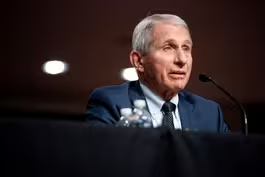
Fauci on his relationship with Trump during the pandemic
Video has Closed Captions
Fauci on his fraught relationship with Trump and the attacks he has faced (7m 55s)
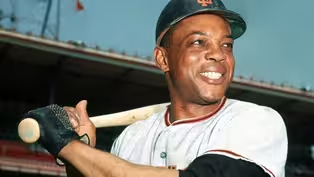
The legacy of Willie Mays on and off the baseball field
Video has Closed Captions
The legacy of Willie Mays on and off the baseball field (9m 39s)

Millions face record-breaking temperatures amid heat wave
Video has Closed Captions
Millions face record-breaking temperatures amid dangerous heat wave (6m)
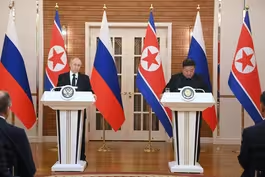
Putin's North Korea pact could land weapons for Ukraine war
Video has Closed Captions
Putin signs pact with North Korea that could increase weapons for Russia's war in Ukraine (8m 5s)
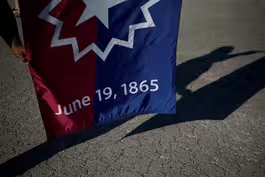
Report shows formerly enslaved people were ousted from land
Video has Closed Captions
Report reveals how formerly enslaved people were ousted from land received after Civil War (6m 33s)
What primary results say about the state of the GOP in 2024
Video has Closed Captions
What the latest primary election results say about the state of the GOP in 2024 (6m 11s)
Providing Support for PBS.org
Learn Moreabout PBS online sponsorship
- News and Public Affairs

FRONTLINE is investigative journalism that questions, explains and changes our world.
 New Episode
- News and Public Affairs

Today's top journalists discuss Washington's current political events and public affairs.
 New Episode
 New Episode
 New Episode
 New Episode
 New Episode
 New Episode
 New Episode
 New Episode
 New Episode
Support for PBS provided by:
Major corporate funding for the PBS News Hour is provided by BDO, BNSF, Consumer Cellular, American Cruise Lines, and Raymond James. Funding for the PBS NewsHour Weekend is provided by...