
June 2021: Tampa Bay Watch
Season 2021 Episode 6 | 26m 47sVideo has Closed Captions
The environmental organization dedicated to restoration and protection of Tampa Bay.
Tampa Bay Watch is an environmental organization dedicated to restoration and protection of the Tampa Bay estuary since the early 2000s. Learn how this nonprofit educates and raises awareness about the health of our regional waters.
Problems playing video? | Closed Captioning Feedback
Problems playing video? | Closed Captioning Feedback
Up Close With Cathy Unruh is a local public television program presented by WEDU
June 2021: Tampa Bay Watch
Season 2021 Episode 6 | 26m 47sVideo has Closed Captions
Tampa Bay Watch is an environmental organization dedicated to restoration and protection of the Tampa Bay estuary since the early 2000s. Learn how this nonprofit educates and raises awareness about the health of our regional waters.
Problems playing video? | Closed Captioning Feedback
How to Watch Up Close With Cathy Unruh
Up Close With Cathy Unruh is available to stream on pbs.org and the free PBS App, available on iPhone, Apple TV, Android TV, Android smartphones, Amazon Fire TV, Amazon Fire Tablet, Roku, Samsung Smart TV, and Vizio.
Providing Support for PBS.org
Learn Moreabout PBS online sponsorship- [Announcer] This is a production of WEDU PBS Tampa, St. Petersburg, Sarasota - Environmental restoration, scientific study, community engagement these are the efforts of one nonprofit organization committed to the improvement of Tampa Bay's natural habitat.
Learn about Tampa Bay Watch dedicated to the health and protection of this important estuary, coming up next.
(bright upbeat music) Founded in 1993, Tampa Bay Watch is a leader in habitat restoration and the protection of west central Florida's natural environment.
This nonprofit organization is volunteer driven with thousands on board with its scientific and educational endeavors.
Tampa Bay Watch engages students through field trips and summer camps and works to raise community awareness of local environmental issues.
The organization also makes a real impact on improving the local environment through scientific programs and restoration projects.
In this episode, we learn more about these efforts along with the state of the Tampa Bay estuary and habitat.
Welcome to upClose I'm Cathy Unruh.
With us today is Peter Clark, he is the Founder and President of Tampa Bay Watch.
Also, we have Eli Rose who has been a volunteer with Tampa Bay Watch since 2012, along with his wife, Janet they both happen to be retired Obstetricians.
Thank you gentlemen for being with us today.
- Thank you.
- Our pleasure.
- I wanna start with a definition of Tampa Bay as it applies to Tampa Bay Watch, we often say we live in Tampa Bay we don't actually live in the bay we live in the region so what are you covering when you watch Tampa Bay?
- Well, we include everything from the enclothed river all the way down to Sarasota Bay and then of course up into the main part of Tampa Bay.
So it's not just a body of water but it's also the Tampa Bay community that we like to work with.
- And tell us why Tampa Bay itself is such an important estuary.
- We are, we are the largest open water estuary in the state of Florida and that's really because the fresh water that comes down off the land it's diluted by the saltwater from the Gulf of Mexico.
And that makes for an extremely productive community in the Tampa Bay estuary.
And because of that we have a lot of fish and wildlife that utilized this very special area at least part of their life cycle.
- And we're talking about 400 square miles that all goes into the Gulf of Mexico, correct?
- Yeah, the bay itself is 400 square miles in size, but for us to protect and restore the bay, we have to look up into the watershed or that area that whenever it rains that rainwater gets carried down into the bay and that's 2,200 square miles, much, much bigger area - That is.
So you started this organization, why, what happened?
What prompted you to do so?
I did, I used to work for the government and while I enjoyed wearing a tie and carrying a briefcase every day there was a very apparent need by the community to get more involved with hands-on projects to make the Tampa Bay estuary a better place.
So I left my government job and started Tampa Bay Watch off in 1993 and had been working with not only the community but school groups to provide those hands-on opportunity to make Tampa Bay better in terms of water quality and restoring habitat in the bay.
- Had you started a nonprofit before ever?
- I had not, no.
- Okay, so it's been an adventure.
- But I had a lot of wonderful examples around and of course a lot of wonderful volunteers like Eli that really helped make a difference.
- And Eli what brought you to Tampa Bay Watch?
- Well, my wife and I were getting ready to retire and we wanted something to do that would give back to the community that's been so good to us and just then I got a newsletter in the mail from Tampa Bay Watch and I showed it to my wife and she said, "this is exactly what we're looking for".
So we went ahead and volunteered for the first time and just stuck with it because it's so enjoyable.
- And you have volunteered over 800 hours I believe that correct?
- We have never counted the hours we just look at the calendar to see what they have available as far as being a volunteer.
And if we don't have some place to go someplace else like being out of the city or out of state then we sign up.
So that's something we don't keep track of it's so much fun that it doesn't matter how many hours we put in.
- Peter, tell us about Cunningham Key which was your first location.
- It is, it's a small piece of land it's an island right at the entrance to Fort De Soto Park.
And it used to be a big shop out here and my wife and I would come out and buy a couple of dozen shrimp from Rita at Rita's bait shop.
Oh my gosh, what a paradise she had.
And when it came up for sale in 1997 we quickly realized what a wonderful location this would be to establish a Marine and Education Center.
And it took three years working with the county and the state but ultimately they purchased it and we maintain a 50 year lease agreement in order to run our programs and projects out here.
It's a wonderful facility.
It's a great place to bring kids down and have them share the Tampa Bay experience.
- Well, when we talk about the facility we are now talking about a facility that was built in 2005?
- That's correct.
The land was purchased in 2000 and we actually worked out here starting in 2002 but the main Marine and Education Center was completed in '05.
- [Cathy] And you do events and weddings and things there also in your beautiful space.
- There is a wonderful community room that looks right out over the shell key preserve.
So it's a great place for meetings and we're very proud of our education programs.
We bring down about 3,500 kids a year including nine weeks of summer camps, take the kids out on the water so that we can show them firsthand the pristine nature of what the Tampa Bay estuary really should look like.
And oftentimes this is their very first experience getting out on Tampa Bay.
- Eli.
- [Eli] Yes.
- Do you go to that facility very often or you're mostly out on the bay doing things?
- Well, it's like it's almost half the time.
There are some projects we do at the main facility itself at the entrance of Fort De Soto Park but the other half we go around the various counties and we do projects in Hillsborough County, Pinellas, Pasco, Manatee so it's quite diverse in terms of the areas that we cover as volunteers.
- So let's talk about some of the projects that actually take place and I can throw some ideas at you of what you can tell us about but I should probably open it up to what are some of the most important things, that you Peter, let's start with you, things that the organization has done to improve Tampa Bay.
- So we started off by planting a salt marsh grass and closed all tidal ponds around the bay.
The salt marsh grass helps to filter out nutrients before it enters the bay and also provides a nursery grounds and other habitat for a critically important fish and wildlife resources.
So the kids would grow the salt marsh grasses for the coastal restoration projects.
And then we started to add on a oyster contingent program as well.
Oysters we probably lost between 80 and 90% of oysters around the bay.
So we looked for every opportunity that we can to restore these oyster communities.
Now, people love to eat oysters but they don't realize they create these large reefs that also filter out the water seven days a week out there in the bay.
- [Cathy] Tell us the mechanism by which the oysters do that.
- Yeah, they filter feeders they're a bivalve so they pump the water in and filter out algae and nutrients in their gills and they use that as a food source.
So they're actually removing the nutrients and the algae that we don't want in the water.
So they're cleaning up the water and also providing habitat.
- And Eli you've been involved I'm sure in many cleanup projects.
- Yes, the cleanup projects we have several times during the year and we'll have it in six or eight locations all around the area of Tampa Bay and anywhere from 20 to 50 volunteers will go there and clean up an area that shouldn't have been dirtied by the public but it has been.
So it reaffirms what we're doing to improve the quality and the life and the Tampa Bay estuary.
- And there are a couple of stats that we pulled that the organization has removed 5,200 pounds of debris 836 miles of fishing line collected and recycled.
What other sorts of things have you had to pull from the bay?
- Most probably last year.
- Yeah, well, we do twice a year a derelict crab trap recovery from all over the bay.
We usually go out from six different locations and the oyster and shell fishermen, the crab fishermen are alerted ahead of time that at a specific Saturday any trap found in the water is gonna be removed and we remove quite a few derelict crab traps which is very important because they get caught up in fish in dolphins, turtles and even the propellors of boats.
So to clean them up it's helpful for the environment and it's also helpful for our friends and neighbors who like to boat in Tampa Bay.
- And Peter, how do you decide what projects do you do it just by word of mouth or what you can actually see in the bay, or is there research that goes into it or all of the above and more?
- Yeah, so internally what can we generate the biggest bang for our buck?
How do we stabilize the shoreline and still protect a colonial bird nesting island as an example.
So by doing that, we get the water quality benefits, we restore a habitat and also protect the bird sanctuaries at the same time.
We also hear from our program partners about important projects that they need to accomplish that we can utilize our community volunteers to do as well.
So there's a lot of different interaction within Tampa Bay and that's one of the big secrets of our success.
- And what is a program partner?
- Program partner can be a government agency that knows that they're gonna restore a shore line but they need it planted with salt marsh so they would come to Tampa Bay Watch or National Audubon who manages these bird islands out here, but they see we're rotting away so we can create an oyster bar or living shoreline on those islands, help protect the bird sanctuary but also get the water quality benefits that we're looking for in the bay.
- So how are your projects funded?
I would assume that some of your program partners may help with the projects but you need to do a lot of fundraising correct?
- They do.
We are nonprofit and we depend on a wide diverse funding source in order to implement a lot of our programs and projects.
So yes, we do get a lot of government grants we also have a wonderful membership program, individual support, foundation grants and we use things like weddings to help support our program activities as well.
- Are there any other scientific partnerships or scientific engagements or study or research that you'd like to tell us about briefly?
- You know, we actually have a grant where we work with the Canadian government to share some of our restoration techniques with them.
We also work with Restore America's Estuaries nationwide to look at climate change impacts to coastal bodies of water to see how we can implement some of those tools here locally in Tampa Bay.
So there's a wide variety of organizations that we work with and it takes a broad amount of participation in order to effect the level of change that we've been able to see here in Tampa Bay.
- Eli, can you speak to some of that level of change?
What have you seen improve in the bay since the time you started volunteering?
- Well, from the time that Peter started this organization our friends in Pinellas County have seen more of a direct change than we have in Hillsborough although there's plenty of change here in Hillsborough.
I have a very good friend who is an account executive at UBS and he has a 34 foot boat, goes out fishing all the time and lives in Pinellas County.
And he has said to me, over the last 10 years he has seen the water clarity improve to the point that he can see the bottom when he goes out fishing.
And also the numbers of fish and the variety of fish have improved greatly which I think is a feather in the cap of Tampa Bay Watch.
- And Peter, do you do measurements of water quality, I would think?
Can you give us some idea of how you determine how well your work is improving the bay?
- You bet.
So there are a lot of agencies that monitor water quality as well as others that look at the sea grass growth in the bay.
And we've been able to identify that sea grass and water quality's returned levels that we have not seen since the 1950s.
That's huge, there's very few coastal bodies of water that are able to say because of what we've done over the last 30 or 40 years we've been able to see such dramatic improvements in the bay's resources.
So we all should be very proud of what we've been able to accomplish.
And like Eli said, people see it, they can see the results of all these different activities on the bay it really is making a difference.
- Let's give a shout out to the volunteers all of them who work with Eli, including his wife, Janet and you have over a hundred thousand volunteers over your history, is that correct?
- Oh, it's well over a hundred thousand.
On a good year, we typically do eight to 10,000 volunteers a year.
During COVID we had a bubble of volunteers that really picked up the slack and did a lot more projects multiple days a week including Eli and Janet.
And that's really what was able to help us move restoration progress forward.
- Eli, what have you learned while working with Tampa Bay Watch?
- Well, I've learned a lot about the fish life, the life cycle of the mullets, the clams.
I was quite surprised to learn that depending on the flow of water a single oyster will filter anywhere from two to 10 gallons of water an hour.
And that means removing toxins and pollutants that too many people put into the bay not realizing the influence that it has.
- And Peter, those are just the kinds of things that you're trying to educate people about what Eli is talking about.
So let's get back to those students now how do you engage students?
- The first program was to go up into area schools called Bay Grasses and Classes and the kids will actually grow salt marsh in on-campus nurseries.
And we've had upwards of about 18 middle in the high schools grow the coastal salt marsh for restoration projects.
Now that we have the facility here where we can do our education programs and the new one downtown St. Petersburg at the Discovery Center we have a much broader opportunity to get the kids down on the shores of the bay, get them out on the water so they can see firsthand the results of restoring the bay.
And a lot of these kids are from communities where they haven't been out on a boat before or they haven't been on the beach.
They literally live 15 or 20 minutes away.
So this is their first opportunity to get out on the water and it's so gratifying to see their reaction and program to better understand why we all work so hard to protect the bay which is in their community as well.
- And you have broadened your community, reach to students and otherwise this is very popular with kids by the Tampa Bay Watch Discovery Center at the new St Pete Pier and we visited there to learn a little bit more.
(bright upbeat music) - What we do at Tampa Bay Watch Discovery Center is really inspire patrons and visitors whether from here or far to become stewards of their own environments.
Here, we're really focused on what we can do with the public.
And for us, what that means is that we're able to inspire them through the exhibits that they see, the programs they participate in here.
They will come in and do things like we have flying frish by section and it sounds really gross, but it's really popular we sell out almost every weekend.
From the exhibit side, we have some incredible exhibits, some aquatic exhibits which feature native species and then a variety of interactive exhibits.
One of the ones we're really proud of is the one second wave of plastic and it's basically 1500 water bottles in the sculpture of a wave.
And that represents what we go through in water bottles in the United States in one second.
You know, one of the things that makes us unique is we're a small facility as all the buildings are around the Pier.
But when you engage with our volunteers when you engage with our staff, you're gonna walk out really learning a lot more and having a fun time doing it.
You're not just an observer you're a participant you're actively engaged.
And so, so many people come in here and say this is kind of small, what's it gonna be about?
And they leave here wowed, they leave here in awe because they found out a lot of the history of Tampa Bay, they found out what they can do to make a difference in the bay and what's already been accomplished over the last few years.
So it's really a wonderful environment to be able to work and inspire people.
- Peter, this has been called the floating classroom.
- So we have just started a new eco vessel in downtown St. Petersburg, it's 45 foot long it can carry upwards of about 50 people, and we use that to take students in the morning in community Eco trips in the afternoon- - An example of the diverse ways to learn, including that the exhibits will rotate at the Discovery Center.
So they're not fixed in time forever.
I wanna move on to the current state of the bay and some of the things that make news and that are very concerning to you I'm sure, Piney Point.
Do you wanna just summarize briefly, well, Eli, you can.
Why don't you tell us what happened there?
And then Peter will tell us about the impact on the bay, quickly.
- Well, unfortunately, I think Piney Point was reservoir for wastewater and previous pollution and toxins.
And it started to break down the barriers that were holding this polluted water in place.
And in order for them to prevent it from breaking down completely and releasing hundreds of thousands of gallons of waste into the bay, they actually intentionally released some of the polluted water into the bay in order to take the stress off the remainder of the equipment that was holding that pollution in place.
- Right, and we should say maybe that the water was from a former phosphate plant and so that is intended now to close completely.
But Peter, when you see and hear of something like that how does that impact you and your organization?
- We have all worked so hard to reduce the amount of nutrients flowing in the bay.
The discharged from Piney Point was 220 million gallons of industrial water in the bay that literally dumped about a hundred thousand bags of fertilizer equivalent amount of nutrients all within a two week period into the lower part of the bay.
We have been able to go out with our program partners and look for algae blooms that you would expect to be a result of that level of discharge in the bay.
Around Piney Point we have not seen it it looks like it's been diluted at this point but we are seeing large algae blooms pop up in the lower part of the bay that needs to be quantified but that could be the result of Piney Point as well as the nutrients that you would expect to see as a result of the summer season and coming into the bay.
- Another huge issue for the bay is the loss of sea grass.
- It is, yes.
We've made monumental strides in the recovery of sea grass, but we're starting to see some areas of the bay where she grasses are starting to decline again.
So as we make these measurable improvements we still need to look at these local areas that are affecting water quality and the health of communities like sea grass beds.
- What causes sea grass to decline?
- So sea grass' like grass on your lawn they are very dependent on light.
And when you have algae blooms that occur in the water column above the sea grass it shades it out.
So poor water quality, dark colored water all that contributes to the loss of sea grass beds in the bay.
So we need to reduce those nutrients that flow in the bay, keep the water clear and have sea grasses that can continue to grow in recovering the bay.
- And what are some other critical issues that Tampa Bay Watch is looking at and are working on right now?
- So nutrients is certainly the big thing.
Those nutrients also come from urbanized areas in the bay in terms of stormwater runoff.
So as we look at fertilizer on people's lawns or these developed areas, all of those areas contribute to the discharge of nutrients out on the bay.
So we're able to clean up our wastewater treatment plants in a lot of the industrial sources the long-term problem really comes from what happens in yours, in my back yard that ultimately contributes those nutrients down into the bay.
- Yes and Eli not every citizen can do what you are doing to help the bay but what can every citizen do?
Let's start with the backyard that Peter referenced what can we all do to try to improve the health of the bay?
- There are a couple of things that the average person can do.
First of all, don't throw anything in the bay that doesn't live there.
In other words, grass clippings, leaves those all break down in the water and cause algae growth and decrease the quality of the water.
Also fertilizer that Peter alluded to so many people, almost everybody puts fertilizer on their lawns but they need to be careful that they do it in such a way that it's not washed away by the rain or by their artificial watering systems, their sprinkling systems that would push that fertilizer into the bay.
As you can imagine, if one person does it, it's probably not bad but the problem is everybody's doing it.
So the more people can be aware of that the more they can do something about it.
- And Peter how much longer do you think Tampa Bay Watch will exist?
- Well, if it doesn't exist for another 50 or 100 years, it'll be all of our fault.
There are a lot of issues that continue to plague the bay.
There's a lot of educational needs in our community.
So I think we've been able to set up an organization in a footprint that will be able to continue on for many, many years to come - Well, thank you for what you are doing and Eli thank you to you- - Thank you.
- And your wife Janet as well and we appreciate you being with us here.
- Thank you.
- Thank you.
- And for more information about this nonprofit organization you can visit tampabaywatch.org.
This episode of upClose may be viewed in its entirety at wedu.org.
I'm Cathy Unruh.
Thank you for being with us and I will see you next time on upClose.
(upbeat music)
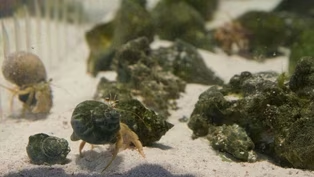
Preview: S2021 Ep6 | 29s | Learn how Tampa Bay Watch raises awareness about the health of our regional waterways. (29s)
Providing Support for PBS.org
Learn Moreabout PBS online sponsorship













Support for PBS provided by:
Up Close With Cathy Unruh is a local public television program presented by WEDU