
June 2023
Season 7 Episode 9 | 26m 51sVideo has Closed Captions
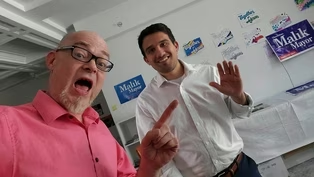
Visit Akron’s presumptive next mayor, the Akron Art Museum and The Ninja Hive.
Look ahead with Akron’s presumptive future mayor Shammas Malik to learn about his vision for the city, then look back into the history of one of Akron’s proudest institutions, the Akron Art Museum. Finally, learn what it takes to be an American Ninja Warrior at The Ninja Hive on S. Arlington Street.
Problems playing video? | Closed Captioning Feedback
Problems playing video? | Closed Captioning Feedback
Around Akron with Blue Green is a local public television program presented by WNEO
June 2023
Season 7 Episode 9 | 26m 51sVideo has Closed Captions
Look ahead with Akron’s presumptive future mayor Shammas Malik to learn about his vision for the city, then look back into the history of one of Akron’s proudest institutions, the Akron Art Museum. Finally, learn what it takes to be an American Ninja Warrior at The Ninja Hive on S. Arlington Street.
Problems playing video? | Closed Captioning Feedback
How to Watch Around Akron with Blue Green
Around Akron with Blue Green is available to stream on pbs.org and the free PBS App, available on iPhone, Apple TV, Android TV, Android smartphones, Amazon Fire TV, Amazon Fire Tablet, Roku, Samsung Smart TV, and Vizio.
Providing Support for PBS.org
Learn Moreabout PBS online sponsorship- Hey out there Akronites, welcome once again to a "Around Akron" with Blue Green.
And wow, do we have an amazing show ahead of us today.
I'm gonna meet up again with Shammas Malik, the presumptive future mayor of Akron.
I'm gonna head down to the Akron Art Museum, learn all about that amazing place, the building, the outside campus and the amazing displays they got going on as well for the rest of the summer.
Then it's off to South Arlington Street to learn all about the Ninja Hive.
Now, to kick this show up today, I sit down with Shammas Malik, the presumptive future mayor of Akron, to learn all about what he plans to do as the future Mayor.
Let's go see what Shammas Malik is all about.
(gentle music) - So I think it's really about kind of trying to shift culture and shift perspective.
We walk around Akron, a lot of folks in Akron walk around with their head down and kind of embarrassed that we're here.
When I moved back home, people would say, so when I was in law school in Boston, people would say "You're moving home to Akron.
"Why are you moving home?"
And then I got home and people were like, "Why did you move back here?"
And like, I'm doing somebody a favor, something like that.
Like we have so much to be proud of in Akron.
I live half a mile from a national park.
We have just amazing things in our community.
But again, like I said, we need to be better leveraged and better connected.
And so we're trying to kind of spread that energy and that optimism, you know, the level of excitement, energy, and hope for the city that we've seen come out of our campaign have been really inspiring.
Now we have to live up to that.
So we had four plans that we talked about in our campaign up on the wall there together for Akron, safety, housing, jobs, and education.
And so we are gonna be focused on that stuff relentlessly, particularly safety.
Everybody deserves to feel safe.
It's really a basic building block when it comes to doing everything else in the community.
If we're gonna stop managing decline and actually grow or at least stabilize the population, we have to make safety first.
So that's really what we're gonna be focused on, community policing, building trust between police and the community, addressing the racial disparities in our community head on.
So those are some of the things.
I'm very excited.
I feel like I'm in "The Sound of Music".
These are a few of my favorite things.
(upbeat music) I'm the youngest person, I think, who's ever been elected to serve as mayor of the city.
I've been the youngest person on council for a number of years.
I think the young people in Akron often can't wait to leave.
I think we're so stuck in, we're always looking back at the past, at the rubber industry.
I mean, when you look at rubber, I was born in 1981 and the rubber industry was largely gone before I was born.
And polymer has been like waiting to happen since I was born.
And so we have tremendous opportunity in this community.
We have a beautiful legacy.
Like I mentioned Dave Lieberth, you know, the Akron History Center is gonna be just next door to us.
I have tremendous love and respect for our history and tremendous appreciation for our future in polymers but we have to get to a point where we're empowering young voices.
That doesn't mean, you know, just electing people, that's part of it.
But it also means just making sure that there's space for each person.
My focus is going to be how do we bring every voice into a conversation, voices that that I think are needed but also voices that I disagree with, vehemently, right?
While I, you know, I've been very vocal in pushing for police reform, I wanna make sure there are police voices at the table too, right?
I wanna make sure that every voice is represented.
I truly believe we can find real consensus, but you know, we are not gonna compromise in terms of creating real justice, real opportunity in our community.
(upbeat music) First, change is gonna take longer than four years, right?
Real, meaningful, lasting change.
Culture change in some of these systems gonna take longer than four years, but in four years, I would like us to pick that head up a little bit and have more energy and more optimism and more hope.
I would like young people who are graduating to consider staying.
You don't have to stay, right?
There are times when it makes sense to leave for other opportunities but I want every young person to see a path to a thriving life here in Akron.
And I wanted us to be building a city hall where people feel heard and where people feel like regardless of whether they agree with every last thing on my policy agenda, they feel like they have an opportunity to provide their input and that we are working on their behalf, that we're getting better at delivering basic services like water and sewer and snowplowing and road paving but also that we are making a real meaningful dent on some of these things like safety and better schools for kids.
If we don't really start moving the needle on that, nothing else matters really.
And so we're gonna be relentlessly focused on safety and on our schools.
(upbeat music) - Next up, it's down to the Akron Art Museum in downtown Akron to learn all about history, it's architecture, what they got on display, and all that amazing artwork.
Let's go see what the Akron Art Museum is all about.
(upbeat jazz piano music) - The Akron Art Museum was originally founded as the Akron Art Institute back in 1922.
And at that time we were working out of just an extra room in the Akron Summit County Public Library and with the Akron Art Institute name, we were a little bit more oriented toward actually teaching art, doing art classes.
Now, as the Akron Art Museum, we're more oriented toward displaying artwork and hosting exhibitions.
In between, during that hundred year period of our existence, we've expanded our space considerably through a number of different buildings that we've sort of housed ourselves in over time.
Now we have a building with a wonderful architectural variety to it.
It started in the 1980s with a building we inherited, an 1899 post office building and that was our home base for a while.
And then in 2007, onto that, directly from the side of that building, we built out a metal and glass architectural addition, which is now the largest portion of our building, designed by the Austrian architectural firm, Coop Himmelb(l)au.
And we have that kind of wonderful visual smashing together of a more traditional style building and this very new style building.
And that reflects what we have in our collection, which spans from 1850 to the present.
Oftentimes, we've shown the earlier half of our collection in the 1899 building and the newer half of our collection in this wonderful glass and metal addition that we have.
Sometimes we like to mix it up too, but it's wonderful that our collection and it's temporal range is also reflected in our architecture.
And it's also exciting that for many people when they come to the museum, the architecture is in a sense, the first artwork that they get a chance to see.
(upbeat jazz music) If you think of an art museum as a fancy place for people who already are very well informed about art in the art world, that's definitely not how we approach things at the Akron Art Museum.
We believe that art is for everyone, and we make the museum a place where everyone can feel welcome.
As the curator, I am in charge of choosing what art we're gonna put on the walls and how we're gonna write about it and labels and how we're gonna present it.
And my thought is always to show things that will be exciting for as wide a range of audiences possible to explain them in a way that will help people have a foundation really from which they can launch their own interpretations and their own experiences.
And then it's really a team effort here.
Through many of my colleagues, we have all manner of programs, a summer concert series, a winter concert series.
I do talks and tours.
We have activities for young kids where they're literally encouraged to come in and make a mess and do some art making activity of their own.
And we have, every Thursday there's some sort of community connection program going into the evening and we're always free on Thursdays.
So, that's a great day to come down.
Through all these different ways, we try to connect art to people and their lives as much as we possibly can because those connections are really when you look for them, always readily at hand.
(upbeat jazz music) A really exciting thing about having a collection that spans from 1850 to the present is that it covers a period of time in which art has really changed dramatically.
If you were to ask someone in 1850 what art is, they really would've said painting, sculpture, drawing, maybe printmaking.
Now we've vastly expanded what can be included under the rubric of art making and so it includes all manner of different media, strange things that artists combine in really elegant ways into sculptures or immersive installations and things that are getting almost it seems bigger and bigger over time.
Art to me, is always getting more immersive or more exciting.
All the way into digital art and video film photography.
Photography's actually a really major part of our collection and became a bigger thing for museums to show all the way across the 20th century.
So having been founded in 1922, we were timed just right to really be part of that upswing.
That variety, I think just makes everything all that much more engaging and exciting.
And I know that as time goes on, we are gonna make sure to keep a close watch on what artists are doing, what new media they are bridging into and that we'll be including more and more digital or otherwise experimental art in our collection as we go along.
(upbeat jazz music) We always want to be an institution where there is not a firm division between the inside of the museum and the outside.
We really like the idea of art, not just being on the walls but spilling out into the community, finding ways where we can get out and be part of events that are going on.
And then also do that right around our own building.
So not only do we have indoor galleries but we also have an outdoor garden space which includes an area where we can host events like our own concert series or weddings, outdoor parties, and then also display sculpture.
And over time we organize exhibitions that can go in that space with art that's specifically made to be outdoors and have that very direct connection with anybody who might happen to be walking or driving by even if it wasn't their plan to go to a museum and see art that day.
So the exterior of our if you could call it a campus, I guess, is a really exciting space that over time we hope to use even more to make our little street corner in downtown Akron, a vibrant, exciting place that people wanna stop and enjoy some art.
(upbeat jazz music) I think museums are really important because art and creativity are just something essential about what humans do and what we are.
And for better or worse, as a culture, when someone is able to create something really incredible, we place a lot of value on it.
And works of art can become very expensive and that can make them less accessible to the really broad public who I think deserve to have access to their own cultural heritage.
And so for a museum to exist as a place where we're a nonprofit organization, we try to make things as affordable and accessible as possible.
But at the same time, to have world-class art to inspire people, to get them thinking, to have objects and different presentations of art that engage with some of the most important questions of what it means to be human, or what it means to be, to living in our current moment.
I think providing that for people and not having it something that's hidden away in a private collection is a really wonderful thing.
And so I'm very glad to work at the Akron Art Museum.
(gentle jazz music) - Next up, you don't gotta go all the way out to LA to see the Keith Haring exhibition.
You can go to downtown Akron.
Let's go to the Akron Art Museum and see what the Keith Haring exhibition is all about.
(upbeat jazz piano music) - Our current large scale exhibition is "Keith Haring: "Against All Odds", that opened in the middle of April and will be here all the way into September.
That's a bit of a longer run for an exhibition for us actually, but we're so excited about this show.
We wanna have a good long period when it's on view for people to come and have a chance to check it out.
If you don't know Keith Haring by name, you've probably seen something with his design somewhere or other.
He's had a really big and lasting impact on t-shirts, posters, buttons, stickers.
His aesthetic, which you see in in the space that I'm in right now is sort of simple with a stick figure kind of a look.
Comic book inspired to an extent graffiti inspired in part, but he was able to use that style to make images that are really eye-catching, often with universal themes that he could use to tell stories, that he could bring a lot of energy, often a lot of color.
It was this very versatile way of working that across the 1980s made him really one of the most famous young upcoming artists in the United States.
Haring was born in a small town in Pennsylvania and wanted to do art really from a pretty young age.
His parents suggested that as a practical thing, maybe he could go into graphic design.
He tried that for a year and decided, no, I really I wanna move to New York City.
I want to be part of the most exciting thriving art scene in the United States at the time.
And he really just dove right into it.
He was originally doing video, performance art, abstract painting, things that are somewhat different from what he's known for now.
And it was in 1980 when he just happened to be in a subway station in New York City and he saw the frame that was used for an advertisement board.
And when an advertisement was out of date, pasted over it would just go a blank sheet of black paper and that would just stay there until a new advertisement could be glued right on top of it and everything would just keep layering and layering.
But he realized that these in between states, this black piece of paper was an empty spot that he could fill with an image and that it would be visible to a really large audience.
And so in a moment of inspiration, he ran, bought a piece of chalk, ran back down to the subway, and did a drawing right there on the spot.
That was so exciting to him because he wanted so badly to reach as big of an audience as possible with his art that he kept doing the exact same thing and he made over 5,000 drawings in the New York subway between 1980 and 1985.
And these became these figurative comic book like images that really are the foundation of his career.
And this was a new thing for him.
And so he was making these thousands of drawings, getting better every time he did it, working really fast, interacting with people, and having conversations.
And that's really how he fine-tuned his style and started his career, which eventually went on to include works of art in large scale museums, fine art galleries, murals of really large size all around the world, not just in the United States.
And really that's how he became a tremendously influential artist.
The show that we have surveys the height of his career which lasted only from 1980 until his pretty early death in 1990 at the age of 31.
Haring was a very openly and proudly gay artist.
And in the 1980s, that meant contending with the height of the AIDS crisis and it was an AIDS-related illness that ultimately ended his life really early.
But just in that 10 year period, from age 21 to age 31, he had an unbelievably prolific career and really left a mark on the history of American art.
(somber music) In addition to the Keith Haring exhibition, over the last couple months, we really have reinstalled, I think, just about every gallery in the museum, but one.
So if you are a frequent visitor but you haven't been just in the last month or two, now is a great time for you to come back.
And if it would be your first time coming here, we've got a lot of new things that we're really excited to show you.
That includes our collection galleries, where on the occasion of the museum's hundred year anniversary last year, we reinstalled all of our collection galleries.
And that was a very exciting, pretty big project.
We enjoyed doing it so much that we've now changed about 50% of the works of art that are on view in those galleries.
So it's yet another big change as we continue to mark our centennial.
Those galleries now include some collection favorites that I know people have been eager to see come out.
Those include William Merritt Chase's "Girl in White", Chuck Close's "Linda", a variety of artworks that we're really excited to bring back out of storage.
And then a variety of new acquisitions, as well as some loans from the Art Bridges program, which is essentially a wonderful library of artworks for art museums to borrow.
They have a small but really incredible collection of about 175 artworks by some of the best American artists across our country's creative history.
We were able to borrow nine works from their collection, which is one of the larger loans that they have ever done so far.
And those are interspersed in our collection galleries and some of them are really incredible.
I'm really excited to start sharing those galleries with our visitors.
(gentle jazz music) The Keith Haring exhibition will be open all the way until September, so there's plenty of time for you to come in and see it but you can still look forward after that.
Our next large scale exhibition will be a show of African American works on paper, all drawn from a collection of actually this amazing couple, who are a retired stone layer and a retired school teacher, really just some, some people who, despite not being the prototypical jet setting art collector, created an incredible collection of, like I said, works on paper by African-American artists.
We're drawing from that collection to create a show and that effort is being spearheaded by a guest curator, Dr. Tameka Ellington.
And she has titled the show "Retold African-American Art and Folklore" and that connection to folk stories and the way that they have been used in black culture to explain really how our world works and how artists have picked up on that in many different ways.
That's gonna be the basis of that show and I'm really looking forward to seeing how Tameka puts it all together.
(gentle jazz music continues) - Now to wrap this show up today, it's down to South Arlington to learn all about what it takes to be an American Ninja Warrior.
There's a place down there called the Ninja Hive, all built by hand to teach you and your children, maybe your business, maybe your team, all about what it takes to be an American Ninja Warrior.
Let's go see what the Ninja Hive is all about.
(majestic music) - Growing up, I'd always watched like the TV series, right, "American Ninja Warrior".
I'd never actually been to an ninja gym until I was about 20.
So about five years ago when I, they opened up a ninja gym pretty close to where I was living but growing up I always played sports so I was always pretty active and this was just right up my wheelhouse.
So, I was actually looking in Utah for a little bit and just had a feeling that I should be looking here instead.
I went on and this was actually the very first building that popped up when I was searching in this area.
So, I found it actually within a couple minutes which was actually really cool and really special that this was just the first thing that I saw.
And it was the absolute perfect fit.
(majestic music continues) The ninja community, it's so unique and I've spent years and years building it up and when I moved out here to build this gym, I wanted something that I could bring people in as a community and I was just, I was living in Utah at the time and Utah actually is the Beehive State.
And so that kind of was like, oh, how can I spin off with this?
And I was like, oh, a hive, like that's a community.
And so I was like, oh, that could be a kind of unique name the Ninja Hive and it's cool colors too, the black and the yellow to make our obstacles pop a little bit more.
So the Ninja Hive is the ninja community here in Akron, Ohio.
(majestic music continues) So, our facility here, we've got about 700 square foot for our party rooms and then our bathrooms and everything.
And the gym space itself, we have 10,000 square feet of ninja obstacles and foam pits and toddler areas for all the kids and everyone here.
I'm kind of building out this gym.
It's all, a lot of it, we handcrafted ourselves.
A lot of our metal obstacles are, we got a fabricator to do it for us just 'cause I'm not a welder but everything out of wood built ourselves.
We actually put this gym up in, I'd like to think a really fast time.
We were kind of rushing to get it open just so that we can really help the community come and enjoy this gym as fast as we could.
So, we put this gym up in about three weeks.
(gentle inspiring music) This gym specifically is, it's unique.
This is just my gym here, so I built and designed it.
So, it's not a chain, it's family owned, it's super family friendly and this is just, it's my gym, everything I've created myself.
Yeah, with some help, of course, with some help.
But yeah, everything was built and designed by me, all my ideas trying to pull outta my head, you know.
But this is kind of what we came up with.
(gentle inspiring music continues) (gentle inspiring music continues) (gentle inspiring music continues) So, here at the Ninja Hive, we do have birthday parties.
We actually have two party rooms that are specifically designed for birthday parties but we also offer classes for little kids.
So like five to seven year old classes, eight to 12 year old classes, teen and adult classes as well as we have sports teams come in and do team bonding, as well as corporate events here as well.
And we got summer camps too, as well as, we also are in a league called the UNAA, Ultimate Ninja Athlete Association.
And so we'll have competitions for kids as well as professional athletes here.
(gentle inspiring music continues) We have not only our classes, which are for the the kids and our adults, single passes for memberships, as well as we have family membership passes, which is actually a lot cheaper than a lot of places around here, just 'cause we wanna make sure that we have people come in and have fun.
We wanna make this enjoyable for everybody, yet affordable for people to make sure they can come in, have fun, stay fit, stay active in a different way than people are used to.
It's basically a giant indoor playground for kids as well as adults, which makes you feel young, stay happy, meet a bunch of amazing people that are also trying to just continue to stay fit in their life.
(gentle inspiring music continues) I was living out in Utah.
I was running, I've been running ninja gyms in Utah for about five years now, and my family actually lives out here and a bunch of my aunts and uncles as well.
And so when I wanted to do a gym for myself, I just wanted to move out closer to be with my family.
So, before I came to this location, this gym was actually a gymnastics gym.
So not a whole lot different from what we're doing here but definitely a little bit more unique, a little bit more specialized as well.
(inspiring music continues) Kind of what my goals are is, of course, it's focused on kids, right?
But it is helping pro athletes as well.
So, I'm a professional athlete for the sport of Ninja.
So I travel around the the country competing in the biggest competitions we have and as well as helping people grow and learn and progress towards doing that themselves.
(inspiring music continues) - Thank you once again for watching this episode of "Around Akron With Blue Green".
Now if you have any questions or comments, you can catch me on social media.
Thank you and have an amazing day.
(upbeat music) I'm gonna meet up with the presumptive.
(upbeat music) (Blue Green making gibberish noises) Sometimes it's just hard to get the words out correctly.
(laughing) (Blue Green making gibberish noises) (upbeat music continues)
Preview: S7 Ep9 | 30s | Visit Akron’s presumptive next mayor, the Akron Art Museum and The Ninja Hive. (30s)
Providing Support for PBS.org
Learn Moreabout PBS online sponsorship













Support for PBS provided by:
Around Akron with Blue Green is a local public television program presented by WNEO