
June 21, 2023 - PBS NewsHour full episode
6/21/2023 | 57m 46sVideo has Closed Captions
June 21, 2023 - PBS NewsHour full episode
June 21, 2023 - PBS NewsHour full episode
Problems playing video? | Closed Captioning Feedback
Problems playing video? | Closed Captioning Feedback
Major corporate funding for the PBS News Hour is provided by BDO, BNSF, Consumer Cellular, American Cruise Lines, and Raymond James. Funding for the PBS NewsHour Weekend is provided by...
Support provided by:

June 21, 2023 - PBS NewsHour full episode
6/21/2023 | 57m 46sVideo has Closed Captions
June 21, 2023 - PBS NewsHour full episode
Problems playing video? | Closed Captioning Feedback
How to Watch PBS News Hour
PBS News Hour is available to stream on pbs.org and the free PBS App, available on iPhone, Apple TV, Android TV, Android smartphones, Amazon Fire TV, Amazon Fire Tablet, Roku, Samsung Smart TV, and Vizio.
Providing Support for PBS.org
Learn Moreabout PBS online sponsorshipAMNA NAWAZ: Good evening.
I'm Amna Nawaz.
GEOFF BENNETT: And I'm Geoff Bennett.
On the "NewsHour" tonight: An underwater noise heard in the search for the missing submersible offers a glimmer of hope as the window for a rescue closes.
AMNA NAWAZ: Smugglers are detained over the deadly migrant boat disaster in the Mediterranean that is renewing criticism of immigration policies in Greece.
GEOFF BENNETT: And Judy Woodruff reports on how local school boards have increasingly become battlegrounds for the nation's divisions on race, gender, and other hot-button issues.
(BREAK) GEOFF BENNETT: Good evening, and welcome to the "NewsHour."
The search for the missing submersible in the North Atlantic Ocean intensified throughout the day.
AMNA NAWAZ: And the U.S. Coast Guard says it's still treating the mission as a search-and-rescue operation, even as the supply of oxygen is likely dwindling for the five people aboard.
More ships and special equipment are heading to the area this evening.
The day began with a surprise, reports of banging noises detected by sonar.
The first glimmer of hope in the massive maritime search.
CARL HARTSFIELD, Woods Hole Oceanographic Institute: There have been multiple reports of noises, and every one of those noises is being analyzed, tracked, look for patterns and reported upon.
AMNA NAWAZ: A Canadian military plane picked up underwater noises in the North Atlantic on Tuesday, as the hunt for the missing submersible stretches to day four.
At a U.S. Coast Guard briefing in Boston today, officials said more sounds were heard today, and experts are reviewing the data.
CARL HARTSFIELD: They're trying to put all the pieces together.
The noises have been described as banging noises.
But, again, they have to put the whole picture together in context.
There are a lot of vessels in the area, and they each make noise, right?
So all of that has to be eliminated.
AMNA NAWAZ: The submersible vanished on Sunday during a deep sea tour of the Titanic shipwreck, the watery grave of one of the worst ocean disasters in the 20th century.
The Titan, roughly the size of a minivan, set off with about four days' worth of breathable oxygen.
Officials say that is enough to last until tomorrow morning.
For the international search-and-rescue operation the clock is ticking and the pressure growing.
Several countries are bringing in additional surface ships and underwater vessels to aid the effort.
Canadian ships have dropped sonar buoys to detect any underwater sounds in the search area about 400 miles off the southern coast of Newfoundland.
And following reports of the noise, French researchers dispatched an unmanned robotic vehicle set to arrive this evening capable of hooking the sup to a cable that could tow it to the surface.
Jules Jaffe is an oceanographer at the Scripps Institution.
JULES JAFFE, Research Oceanographer, Marine Physical Laboratory, Scripps Institution of Oceanography: The ocean is inherently a noisy place.
We have lots of marine mammals making sounds.
And there's a lot of instrumentation in the ocean there, geophysical explorations going on.
Sound travels pretty well underwater, and so I would give it a low chance of identification that, in fact, the banging noises that we heard were from the underwater submersible.
AMNA NAWAZ: As questions remain about how to reach the sub, past allegations and questions about the company that runs the voyage, OceanGate Expeditions, have surfaced.
In 2018, a terminated OceanGate employee sued the company, raising concerns about the safety of its submersible technology.
That same year, more than three dozen industry experts sent a letter with similar concerns to CEO Stockton Rush, warning of potential catastrophic outcomes.
Rush insisted at the time OceanGate took adequate safety measures.
Rush was piloting this latest trip and is now among the five passengers aboard the missing vessel.
PETER GIRGUIS, Harvard University: Oftentimes, when organizations want to push the technology envelope, they will use materials that are uncommon or take designs that have been -- haven't been tested.
AMNA NAWAZ: Peter Girguis is a professor at Harvard University, where his lab develops ocean instruments and samplers.
PETER GIRGUIS: I think what we're seeing, though, is more and more information coming out from documents from OceanGate and from others engaged with them that raise the possibility that they -- that there may have been oversights as they tried to get this experimental submersible in the water and on kind of active duty, if you will.
AMNA NAWAZ: Even as the estimated oxygen deadline looms, Coast Guard officials said they are not giving up.
CAPT.
JAMIE FREDERICK, U.S. Coast Guard: There are a lot of factors you consider.
And then after you consider all of those factors, sometimes, you're in a position where you have to make a tough decision.
We're not there yet.
But if we continue to search, potentially, we could be at that point.
But, again, we're not there yet.
GEOFF BENNETT: In the day's other headlines: Federal Reserve Chairman Jerome Powell warned that inflation is still too high and that more interest rate hikes are likely this year.
At a congressional hearing, he said there's still a long way to go to reach the Fed's goal of 2 percent inflation.
But, he said, pausing rate hikes last week was consistent with that goal.
JEROME POWELL, Federal Reserve Chairman: Given how far we have come, it may make sense to move rates higher, but to do so at a more moderate pace.
And now we're monitoring that pace, much as you might do if you were to be driving 75 miles an hour on the highway, then 50 miles an hour on a local highway, and then, as you get closer to your destination, as you try to find that destination, you slow down even further.
GEOFF BENNETT: Powell said there's no timetable for future rate hikes, but that economic data will dictate those decisions.
A new assessment finds pandemic learning losses are still getting worse.
The U.S. Education Department reports test scores for 13-year-olds have dropped again.
From 2020 to 2023, average math scores fell by nine points, the most ever, to their lowest level since 1990.
Average reading scores for the age group fell four points to their lowest since 2004.
In the Middle East, hundreds of Israeli settlers stormed a Palestinian town in the occupied West Bank today.
Palestinians said at least one person was killed.
Social media footage showed dozens of buildings and vehicles burning.
The attack came a day after two Palestinian gunmen killed four Israelis in the area.
This evening, an Israeli drone attacked a car carrying suspected gunmen.
Palestinian reports said three people were killed.
Russia's military says it downed to drones near a base outside Moscow today.
It blamed Ukraine, but Kyiv had no immediate comment.
Ukrainian President Volodymyr Zelenskyy did acknowledge that progress in his army's counter offensive has been slower than desired, but he said he won't be pressured to speed things up.
China and the U.S. are in a new dispute after President Biden likened Chinese leader Xi Jinping to a dictator.
He said last night that Xi had not known about the alleged Chinese spy balloon over the U.S. in February.
President Biden said -- quote -- "That's a great embarrassment for dictators when they didn't know what happened."
Beijing called the comments extremely absurd and irresponsible.
But the State Department rejected the criticism.
VEDANT PATEL, Principal Deputy State Department Spokesperson: We won't hesitate to call out areas where we disagree or to be blunt and forthright about some of these differences.
And, of course, one of those areas and that the president the secretary have been clear about is the differences between democracies and autocracies and what they have.
GEOFF BENNETT: The exchange came on the heels of Secretary of State's Antony Blinken is meeting with Xi in Beijing to repair relations.
The Air National Guardsman accused of leaking classified military documents was arraigned today in federal court outside Boston.
Jack Teixeira pleaded not guilty to federal charges of willful retention and transmission of secret military information.
He's been jailed since his arrest in April.
The IRS improved its performance during this year's tax season.
A watchdog report shows the agency has cut its backlog of paper returns by 80 percent.
And it's slowly getting better at answering phone calls.
The IRS received $80 billion in new funding last year, but lost some of that money in the recent debt limit deal.
On Wall Street, tech stocks lead the broader market lower.
The Dow Jones industrial average lost 102 points to close at 33951.
The Nasdaq fell 165 points.
The S&P 500 was down 23 points.
And, in Southern England, some 8,000 revelers descended on Stonehenge to mark the summer solstice.
They gathered around the prehistoric stone circle to greet the sunrise on this longest day in the Northern Hemisphere.
The crowd included Druids, tourists and locals all ushering in the official start of summer.
Still to come on the "NewsHour": we take the temperature of voters on some of the nation's most contentious issues; Supreme Court Justice Samuel Alito faces scrutiny over an undisclosed luxury trip from a GOP donor; and new questions arise about former President Trump's business ties with Oman.
AMNA NAWAZ: It's been one week since an overloaded fishing trawler filled with hundreds of migrants sank off the Southwest Coast of Greece.
The vessel left poured in Libya and crossed the Mediterranean before becoming disabled.
It drifted for hours before capsizing.
The anger, grief and political fallout continue.
Hundreds remain unaccounted for.
Special correspondent Malcolm Brabant has spent years reporting on these desperate journeys, and he sent us this update.
MALCOLM BRABANT: This video from a European border force patrol plane shows the fishing boat drifting before it capsized and sank.
Around 600 are still missing and feared drowned, among them, women and children trapped below decks.
Just over 100 survivors have been rescued, all of them men.
GILLIAN TRIGGS, Assistant Secretary-General, UNHCR: I think that the sinking of This relatively small and seriously overloaded fishing vessel and the apparent loss of between 400 and 750 people, this is, I believe, one of the worst over recent years, if not the worst.
MALCOLM BRABANT: Gillian Triggs is the U.N.
Refugee Agency's assistant secretary-general with special responsibility for the protection of those in peril.
She says the death rate among those trying to reach Europe is rising.
GILLIAN TRIGGS: We are concerned that people are even more desperate now.
They will take these voyages knowing full well what the risks are.
When we ask people who've survived these shipwrecks, they will all say that they're well aware of the risks, but they are so desperate that this is what they will choose to do, including with their families.
MALCOLM BRABANT: The Greek authorities say they will continue a search for bodies as long as is necessary.
But there's no hope of finding anyone alive.
Survivors are recovering in a refugee camp near Athens.
Adil Hussain, originally from Pakistan, is looking for a friend of his brother, who was also on the boat.
ADIL HUSSAIN, Brother of Missing Migrant (through translator): I don't know where my brother is.
He is, I don't know, missing.
My brother left Libya last Friday, three days.
I can't find him.
No one will tell me.
MALCOLM BRABANT: Hussain last spoke to his brother just after he boarded the vessel in Libya, where migrants are frequently terrorized before embarkation.
ADIL HUSSAIN (through translator): As soon as he got into the boat, he said only 50 people will fit and they were putting 750 on board.
He said it's 100 percent sure it will take in water.
I told him to get off, don't go.
And he said: "The mafia won't let us.
They have guns.
They have knives."
They were forcing people in.
MALCOLM BRABANT: Many of the victims came from Pakistan.
The family of 25-year-old Shehryar Sultan said he was tricked into believing the trip to Europe would take two to three days.
ADNAN IFTIKHAR (Cousin of Missing Migrant): We just heard the news recently, about two or three hours ago, that it had been confirmed that the dead body of the -- Sultan's companion has been found.
MALCOLM BRABANT: Nine Egyptian men, plucked from the water have been charged in connection with the shipwreck and are in pretrial custody.
The traffickers charged $4,500 passenger and stood to make over $3 million.
The suspects all deny wrongdoing.
Where does the fault lie?
Is it the smugglers, or is there culpability elsewhere?
GILLIAN TRIGGS: Well, clearly, we're concerned about people smugglers, criminal elements, trafficking, and we fully support efforts to manage that element of crime.
But accountability rests in so many areas.
And we need a joined-up European and North African approach, so that we have more reliable search-and-rescue, more reliable disembarkation, and ultimately redistribution of people in need of international protection.
MALCOLM BRABANT: Greece is facing a barrage of criticism.
It's Coast Guard was alerted to the stricken vessel 15 hours before it went down.
This picture was taken from a Coast Guard cutter.
Greece has denied claims that the fishing boat capsized during an attempted tow.
The disaster has appalled Craig Spencer, an emergency doctor from Rhode Island.
Spencer spent six months in the Mediterranean on board the Aquarius rescue ship, where the safety of migrants in distress was paramount.
DR. CRAIG SPENCER, Brown University: I don't think any of us can imagine what its like getting your small child and putting them on a boat in the middle of the night without food, without water, on an unseaworthy vessel, that that being your only option, and to be confronted by a Coast Guard that is responsible under international and national maritime law to save lives at sea.
It's just -- it's truly unbelievable.
MALCOLM BRABANT: Greece is under fire because of its hard-line anti-migrant policy, including proven cases of so called pushbacks, where rescued refugees have been taken back out to sea, in stark comparison to the Italians, who honor their obligations under international law.
As far as you can tell, is this a consequence of Greece's well-documented pushback policy?
GILLIAN TRIGGS: I can't give you a definitive answer to that until we see the results of the investigation.
But what I can say is that countries on the front line, some of them in particular, have not accepted their responsibility for search-and-rescue.
They have pushed back both at land frontiers and at and sea borders.
MALCOLM BRABANT: The European Union has pledged more than $15 billion to bolster its migration policy.
Much of Europe is exasperated by the never-ending flow of migrants.
But, despite the risks, they keep on coming.
For the "PBS NewsHour," I'm Malcolm Brabant.
GEOFF BENNETT: This week marks the anniversary of the U.S. Supreme Court decision overturning Roe v. Wade.
It also marks critical final days in the current Supreme Court term, with major rulings expected soon on affirmative action and religious rights, among others.
That's as trust in the court remains low, according to a new NPR/"PBS NewsHour"/Marist poll.
Lisa Desjardins is here to unpack that finding and more.
It's great to have you here.
So, Lisa, confidence in the court dropped significantly after the Dobbs decision last year.
Was that a short-term reaction, or does this poll show that the sentiment persisted?
LISA DESJARDINS: That's exactly what we wanted to find out.
And, of course, no, polling is exact.
But this does tell us a little bit about the country.
The Supreme Court's had up and downs through its history.
The past year has been one of its lowest points.
Let's look at where we are right now.
If you look at this, here are the numbers of the Supreme Court's approval rating over the years.
That last number there on the right is the number from our poll, 39 percent approval rating.
Oh, look at that.
It's exactly the same as it was a year ago, Geoff.
And you see that drop-off point there in the middle.
That is, of course, when we learned about the Dobbs decision.
Basically, this is just to say that no opinion has not changed in the past year of the Supreme Court.
It took a historic jump down after we learned about that decision, and it hasn't come back up.
We did find some interesting outliers in this poll.
To me, polls, you got to look at the broad kind of sweeps here of it.
And I saw something in the politics and gender of how people react to the Supreme Court.
Let's look at some of these numbers.
Now, the group that seemed to have the least amount of confidence in the Supreme Court, of course, Democrats.
That's not a surprise.
This has always been a political sort of question.
However, what was surprising to me, if you look at the bottom of these numbers, Republican men were the ones that had the most confidence by quite a lot more than Republican women.
Those Republican men are really the ones who are backing up the Supreme Court the most.
Now, how has anybody's opinion about the Dobbs decision itself changed?
Let's look at that.
Here's where we are in our poll right now; 57 percent of Americans, a clear majority, oppose that decision to overturn Roe v. Wade.
What was it a year ago?
Let's look at these numbers.
Exactly the same.
And that just proves our point.
GEOFF BENNETT: Our team also asked about an issue before the court right now, affirmative action.
What did we learn?
LISA DESJARDINS: Yes, this is an important - - this has obviously been a long-running issue in American society.
So let's look at what Americans told us that they believe, adults in America say.
Look at that top number.
We asked, should those people programs be continued?
Fifty-seven percent of American adults said, yes, they believe affirmative action should be continued.
Again, the outliers tell us something.
Trump 2020 voters, Geoff, look at that number, completely the opposite.
That is the group that most opposes affirmative action programs in our poll.
We dug in a little bit deeper too looking at gender in this poll specifically.
It is men who really most want to abolish those affirmative action programs.
And you see that, kind of men, Trump voters, something that stood out to us when I was looking at these numbers.
GEOFF BENNETT: And there are some major findings on how people see gender and gender identity.
Tell us about that.
LISA DESJARDINS: This is not just a cultural issue, but it is increasingly, of course, a political issue.
So, we asked the question of, should gender be the sex that is on your original birth certificate only, or should people be more open?
Is that an out-of-date concept?
When we asked all adults in this country, only 36 percent said that it is an out-of-date concept; 61 percent, almost two-thirds, said gender as the sex listed on your original birth certificate, that's the only way to see male and female in society.
So, again, let's dig down a little bit deeper here and look at the change.
A year ago, the numbers were more even.
The country was more 50/50 on this question.
No surprise.
This is something that's been on the headlines.
In particular, Republicans have been pounding away at this.
It also came up in a hearing today in Senate Judiciary Committee, the Human Rights Campaign president back and forth with a Republican senator.
Let's listen.
SEN. JOHN KENNEDY (R-LA): And how many genders are there?
KELLEY ROBINSON, President, Human Rights Campaign: I think that gender is expansive, and the definitions are always growing.
Today, I can tell you... SEN. JOHN KENNEDY: More than five?
KELLEY ROBINSON: ..
I talk to young people talk about nonbinary as... SEN. JOHN KENNEDY: More than five?
KELLEY ROBINSON: I think that gender is not a binary.
SEN. JOHN KENNEDY: There's an infinite number of genders?
LISA DESJARDINS: In our poll, most Americans said they see two genders, but, obviously, that is a conversation that we heard just today on Capitol Hill.
GEOFF BENNETT: Lisa Desjardins, thank you so much for that analysis.
And this poll is on our Web site.
LISA DESJARDINS: You're welcome.
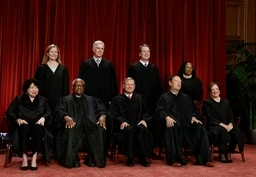
AMNA NAWAZ: In 2008, Supreme Court Justice Samuel Alito took an undisclosed fishing trip to Alaska with billionaire donors, including hedge fund manager Paul Singer, who later had business before the court.
Coupled with previous reporting on the relationship of Justice Clarence Thomas and Republican megadonor Harlan Crow, it raises serious ethical questions regarding the High Court.
Josh Kaplan is one of the ProPublica reporters who broke the story.
And he joins me now.
Josh, welcome back.
At the heart of your story is this July 2008 trip that Alito took to Alaska, traveling there on a private plane paid for by that billionaire, Paul Singer, his stay at the lodge also paid for by another major donor on the trip.
Neither of those things was disclosed.
So tell us a little bit about what your reporting revealed about that trip and why people think it should have been disclosed.
JOSHUA KAPLAN, ProPublica: Singer was not just another guests on the trip.
He provided Alito with a private jet to fly him across the country to Alaska.
And if Alito had chartered that plane himself, it could have cost easily more than $100,000, we were told.
And Alito didn't disclose any of this.
It's been secret until now.
And experts told us that he appears to have violated a government ethics law passed after Watergate that requires justices to disclose most gifts to the public.
AMNA NAWAZ: That man, that billionaire, Paul Singer, his hedge fund later had a case before the Supreme Court, a case that the court, as you reported, previously declined to take up, right?
So why did the experts you talk to say that, in this case, Alito should have recused himself from that case?
JOSHUA KAPLAN: Alito didn't recuse himself in any of the more than at least 10 cases that Paul Singer had after the trip.
And they said that they never -- experts said that they'd never heard of another example of a Supreme Court justice sitting on a case after receiving an expensive gift from one of the parties.
There is a law that governs when justices must recuse themselves from the case.
And it sets a very high standard, but a subjective standard.
It's that, if there's the appearance of impropriety, a justice must recuse.
But when it comes to the Supreme Court, the only person that interprets that standard, the sole arbiter of when a justice should recuse from a case is the justice him or her self.
AMNA NAWAZ: So, Alito has responded in the form of an op-ed published in The Wall Street Journal.
In brief, he basically says he doesn't believe his relationship with Paul Singer warranted recusal.
He doesn't think that the hospitality provided needed to be reportable.
He claims, in his words, ProPublica misleads its readers.
And he writes: "It was and is my judgment that these facts would not cause a reasonable and unbiased person to doubt my ability to decide the matters in question impartially."
So, Josh, this is one of the central questions, right, on impartiality.
Do we know if his relationship with Singer or this trip or anything else had any impact on his decisions?
JOSHUA KAPLAN: We don't know that they had any impact, in terms of the quid pro quo, that a case went one way or another because of this trip.
There's no evidence that.
And I should say that when Justice Alito wrote this op-ed, saying the article was misleading, the article hadn't come out yet and he hadn't read it.
But he -- in terms of recusal, it's -- one expert put it to us, as, you know, it's fairly simple.
If you were on the other side of the case in any court in this country, and you learned that the person that you're fighting against had given an expensive gift, taken the judge sitting on the case on vacation, you would have questions about that judge's ability to sit.
And they said that means that Alito clearly should recuse in this case.
AMNA NAWAZ: And we asked Kathleen Clark, who is a professor of law at Washington University in St. Louis, who focuses on government ethics, about this report, about your last report about Justice Clarence Thomas and the gifts he had received.
Here's what she had to say.
KATHLEEN CLARK, Washington University of Saint Louis: It is a systemic problem.
It's a problem for the entire institution.
These weaknesses are not about us one or two bad justices.
The court has failed to adopt and apply state ethics standards.
And until it does or until Congress imposes those standards, we will continue to have stories about unethical Supreme Court justices.
AMNA NAWAZ: Josh, what does all of your reporting say to you about the court's ability to police themselves on these issues?
JOSHUA KAPLAN: Well, I think one of the root issues in all of this is the lack of transparency and oversight on the High Court that really is a stark contrast to the other branches of government.
If you work in the executive branch, there is an ethics office that clears things for you, that analyzes these sorts of problems when they come up.
There are strict rules on what gifts you can accept.
There are extremely strict rules on what gifts you must disclose.
And the justices are more or less left to police themselves.
And they always have been.
These -- when Alito went on this vacation and accepted this private jet ride that could have cost $100,000 to charter from a person he didn't know who had just had a case before the court, that was completely within the court's rules.
He had to disclose it.
And experts say he violated the law by not disclosing it.
But there was no restrictions on this.
And then, if a conflict comes up or a potential conflict comes up, the only person who decides if a justice should recuse is the justice.
And that's a decision that can't be appealed.
AMNA NAWAZ: That is Josh Kaplan of ProPublica joining us tonight with his latest report.
Josh, thanks for making the time.
Thanks for having me.
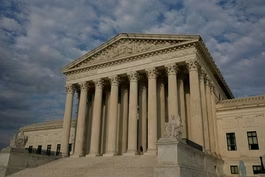
GEOFF BENNETT: We're going to shift our focus now to the remaining major decisions we're expecting from the court, including ones that could reshape higher education and immigration policy.
For that, we turn to the "NewsHour"'s Supreme Court analyst, Marcia Coyle.
Thanks for coming in.
MARCIA COYLE: My pleasure, Geoff.
GEOFF BENNETT: So, we have got a handful of big cases left.
Many see the most significant one being the affirmative action case, which centers on whether colleges and universities can continue to consider race as part of their admissions decisions.
Remind us, who brought this case, and what core arguments are the justices weighing?
MARCIA COYLE: Well, this case really is the project of one person, Ed Blum, who has been fighting racial preferences of all kinds for a long time.
And what he does is, he's not a lawyer, but he goes out and he finds someone to challenge the preference.
He hires the lawyers, pays the lawyers.
He was behind the court's major decision striking down a key section of the Voting Rights Act in 2013.
And he created the -- the organization Students For Fair Admissions that brought the challenge to the Harvard admissions policy and the University of North Carolina's admissions policy.
So they got to the Supreme Court, and the charge is that these two colleges are discriminating against whites, Asian Americans, and Native Americans, Harvard, in particular, discrimination against Asian Americans.
The lower courts found against them after really detailed trials and looks at the policies involved.
But they came back to the Supreme Court.
And, this time, they're asking the court to basically throw out the key precedents that have upheld the use of race as a factor in a holistic examination of each applicant to the college.
GEOFF BENNETT: We are also expecting a ruling on President Biden's student loan forgiveness plan.
It's worth noting that one in five adults have student loan debt, and 92 percent of student loans are through the federal government.
There was a question as to whether the plaintiffs in this case had legal standing.
How might that affect the outcome?
MARCIA COYLE: This is a very serious question.
The states that have brought the challenges, they're red states led by Republican governors, and two individuals who brought a separate challenge, whether they actually have what the court requires for standing, and that is a concrete injury.
And it really is very attenuated here, especially for the two individuals who brought the suit out of Texas.
So it could kill the case.
If the justices decide that they don't have standing, the case will be gone.
GEOFF BENNETT: There's also a pair of immigration cases that could affect deportation proceedings.
Tell us about that.
MARCIA COYLE: Well, Geoff, to me, this case is a lot like a federal agency being between a rock and a hard place.
Right now, both sides agree.
The two states that have brought the challenge to the Department of Homeland Security's so-called guidance believe -- agree that Congress has never given the department the resources it needs to seek, detain and deport 11 million undocumented immigrants in this country.
So what's the department to do?
It came up with a guidance that prioritizes who they really should be going after, most likely serious criminals, people with terrorist backgrounds, perhaps also repeat people who come in and out, in, and then get deported, come back illegally, get deported again.
But Texas and Louisiana claim that this guidance violated the Administrative Procedures Act, that the department didn't follow the rules for putting out the guidance, and that the statute, the immigration law, says clearly that the department must detain and deport these undocumented immigrants.
The court has to take a look here at the realities, as well as what the language of the statute is, and whether Texas and Louisiana really have an injury here if the guidance goes into effect.
GEOFF BENNETT: Marcia, one of the rulings we're waiting for focuses on this legal theory that could limit the ability of state courts to review election laws passed by state legislatures?
Unpack that for us.
MARCIA COYLE: Yes, North Carolina has pressed this theory that its Supreme Court and -- has no authority whatsoever to look at what North Carolina does with elections, and that includes redistricting.
The North Carolina Supreme Court said, uh-uh, no, this is not constitutional and ruled against them.
They came, the state came to the Supreme Court to argue this theory.
In the meantime, the North Carolina Supreme Court switched from being Democratic-led to Republican-led.
And the Republican-led North Carolina Supreme Court reversed the ruling of the Democratic-led Supreme Court.
So, the U.S. Supreme Court has a bit of a mess on its hand to decide whether this case is moot and should be dismissed or whether it should continue and rule on the merits, because this theory may come up again at some point.
So we have to wait and see what they do with it.
GEOFF BENNETT: As we reach the end of yet another term, public confidence in the court is waning.
It sits at historic lows.
The court is facing fresh ethics controversies.
Why hasn't the Supreme Court come up with its own code of ethics?
MARCIA COYLE: Well, you will hear a variety of reasons.
They say there are separation of powers concerns, especially if Congress were to mandate or come up with its own code for them.
They say there are recusal problems.
This is a court of nine justices.
If one has to step aside, eight are left, and that really heightens the risk of deadlocked decisions.
It doesn't seem to many that these are insurmountable obstacles.
I don't know, Geoff.
I sit and think, gee, why don't you just adopt one?
And it would really sort of lower the temperature for a while, at least.
So, I really -- I really don't know.
Well, I'm sure we will learn more after the news today.
(LAUGHTER) GEOFF BENNETT: Yes, one imagines.
Marcia Coyle, thanks so much.
MARCIA COYLE: My pleasure, Geoff.
GEOFF BENNETT: As former President Donald Trump makes another run at the White House, he's partnering with a key U.S. ally on a new business venture.
Laura Barron-Lopez has more.
LAURA BARRON-LOPEZ: The multibillion-dollar deal between Trump, the government of Oman, and a Saudi firm will develop a luxury complex, according to a new New York Times report.
And the project is raising serious ethical questions.
Joining me now is Eric Lipton of The New York Times.
He's investigated Trump family international deals since 2016.
Eric, thanks so much for joining.
You traveled overseas to investigate this real estate deal, which is located in Yiti, Oman, along the coast east of Oman's capital city, Muscat.
And you report that this deal is unlike any international deal so far that the Trump family has signed.
Why?
ERIC LIPTON, The New York Times: In this case, instead of simply having their name being sold to help increase the value of a golf course or condos, they're actually in business with the government of Oman, because the government of Oman owns the land, and it's going to be taking a cut of the profits from this deal.
And so they are now a partner of a government entity that is doing this multibillion-dollar project that has a 30-year contract with the Trump family.
And it's not only for their name.
They're going to be reviewing the hotel design.
They're going to be helping build the golf course and the golf club.
And they're going to be managing the hotel and golf club for decades to come.
So they're going to have a significant financial stake that involves the government of Oman itself.
LAURA BARRON-LOPEZ: Mr. Trump was at the deal-signing in New York City at Trump Tower with Saudi real estate executives in November.
That was just before he announced his presidential bid.
He's already brought in some $5 million from this project.
Eric, how much does the former president stand to benefit?
ERIC LIPTON: In fact, the Trump Organization and the Saudi real estate company that is the lead developer on the project would not tell us how much they're going to be paid.
It's going to be in the tens of millions of dollars over the course of the life of the contract, but we just really have no idea, because they won't tell us.
And if he is -- as a candidate, and if he's reelected as president, he will have to file financial disclosure reports, at least annually, and we will get some idea of how much he's making in the next several years.
But we don't know, in total, how much he's going to make.
But it's a very big project.
It's one of the biggest projects that the Trump family internationally has ever been involved in.
LAURA BARRON-LOPEZ: That gets me to my next question, Eric, which is, what are the potential conflicts of interest here?
ERIC LIPTON: Well, I mean, Oman is in a really sensitive location.
I mean, it's just 20 miles across the Strait of Hormuz from Iran.
It's right next to the United Arab Emirates, and it's close to Saudi Arabia.
And it is sort of an intermediary between the Saudi political concerns and the Iranian concerns.
And it actually is a place where, recently, Biden administration officials have gone to potentially talk to Iran about resolving some of our differences.
So if -- at the same time as -- this is a country that we have provided F-16 fighter jets and missiles to.
And to think that then comes into the mix the considerations as to, well, how will this negotiation we're having over Iran or over Saudi Arabia, how might it impact our deal over managing a hotel and golf resort complex, and is it going to hurt our relationship with the Omani government, that that's even part of the calculus and is -- and might they do a better deal for Oman because they have millions of dollars or billions of dollars riding on it, is a question that an American president has never faced before.
LAURA BARRON-LOPEZ: Right.
That's if he were to be reelected again to office.
And, Eric, you report that this is not the only business deal that the Trump family has crafted in the Middle East.
Federal prosecutors who recently charged Mr. Trump for mishandling classified documents were also seeking information about those other deals in the Middle East.
Can you just connect the dots for us about why it matters that the former president has all of these ties to that region?
ERIC LIPTON: I mean, to some extent, you would say, well, if you look at what he did as president, it's not surprising.
Jared Kushner, his son-in-law, was doing shuttle diplomacy in the Middle East as they were trying to reach some decline in tension between Israel and some of the Arab nations, and that Trump was quite engaged with Saudi Arabia after the Khashoggi murder and defending actions there and downplaying the role of the Saudi government.
He was quite friendly with Saudi Arabia.
And so now, after he leaves office, his son-in-law gets $2 billion worth of investment from the Saudi public sovereign -- sovereign wealth fund.
And then the sovereign wealth fund always - - also LIV Golf.
And LIV Golf puts several of its tournaments at Trump golf courses in the United States.
And this -- there's a lot of money between the Middle Eastern companies, be it in Saudi Arabia or now in Oman, and Trump business operations that overlap with his activities as president.
What were those deals and reward for his actions as president?
It's an open question.
But, again, we have never seen something like this in -- even in the aftermath of a presidency, where a president is profiting as much from a foreign government that he -- foreign governments that he was closely active with during his presidency LAURA BARRON-LOPEZ: Eric Lipton of The New York Times, thank you so much.
ERIC LIPTON: Thank you.
AMNA NAWAZ: School boards have traditionally been the domain of nonpartisan civic service, with volunteer community members weighing in on curricula and budgets.
But in the last few years, school boards around the country have also increasingly become reflections of the nation's polarized political divisions.
Tonight, Judy Woodruff reports on one district in Northwest Pennsylvania where policies around library books, gender and sports and how race and history are taught have divided some community members.
It's her latest installment of America at a Crossroads.
JUDY WOODRUFF: At Saegertown High School, students stream into the building in the waning days of the school year.
It's one of three high schools in a sprawling, mostly rural district called Penncrest, which covers 400 square miles south of Erie, Pennsylvania.
And it's a community where resident Jeff Brooks says ties to the area run deep.
JEFF BROOKS, Board Member, Penncrest School District: My grandfather was supervisor for 50 years.
My mom started the rec board here, was involved in the church.
JUDY WOODRUFF: Brooks lives on the family farm where he grew up.
A social worker in Erie, he's lived in this area his entire life, save four years in the Navy.
JEFF BROOKS: It's the same people I grew up with.
When I'm at any place, I know people.
I know their parents.
I know their kids.
JUDY WOODRUFF: Brooks graduated from the Penncrest District himself, and had three children go through the district, his youngest still in high school.
And you decided at some point to run for the school board?
JEFF BROOKS: Yes.
JUDY WOODRUFF: Why?
JEFF BROOKS: Penncrest used to be a top 50 district in the state.
And when I did a little research, we're kind of living off our reputation.
JUDY WOODRUFF: Brooks was elected to the board as a Republican in 2017 and reelected to a four-year term in 2019.
JEFF BROOKS: The way school board should be done is a very boring, thankless job that you don't get paid for.
You show up at a couple of meetings.
You hear people talk about curriculum.
And that's not what it's been.
JUDY WOODRUFF: Like in many school districts across the country, Penncrest has found itself caught up in debates over cultural values and what belongs inside the school walls.
Brooks says the recent turmoil began in the spring of 2021, when a school board member shared a Facebook post of a photo of LGBTQ-themed books on display at a district high school library.
The board member, David Valesky, added -- quote - - "Besides the point of being totally evil, this is not what we need to be teaching kids.
They aren't at school to be brainwashed into thinking homosexuality is OK." Valesky did not respond to interview requests from the "NewsHour."
TERESA BARICKMAN, Parent: It's a school board member calling students in the district evil.
And that, to me, is appalling.
JUDY WOODRUFF: Teresa Barickman: is a parent in the Penncrest district.
Her son graduated last year.
And her daughter, Claire, will be a junior at Saegertown this fall.
TERESA BARICKMAN: Some of the political rhetoric that we have heard on the national level has empowered people and let them feel like it's OK to say these not-so-nice things about people.
JUDY WOODRUFF: The dust-up around the book display didn't immediately lead to any policy changes.
But later that summer, a resolution was introduced against teaching Critical Race Theory, or CRT, in this overwhelmingly white district.
JEFF BROOKS: I think, if you ask 20 people to write down what they thought it was, you would get 20 different definitions.
It's not being taught.
No one has given an example of CRT being taught.
It's just a boogeyman that's out there to scare everybody.
This would reassure everybody, so that they're not pulling their kids out of their school because they think we're doing something that we're not.
JUDY WOODRUFF: While the original resolution didn't pass, the board did affirm that the district has multiple policies which protect students from indoctrination.
LUIGI DEFRANCESCO, Board Member and President, Penncrest School Board: Penncrest is a very conservative district, and they care about the kids, and they want the kids educated, nothing else.
JUDY WOODRUFF: Luigi DeFrancesco is president of the Penncrest School Board.
He immigrated to the United States from Italy as a child and moved to this rural area of Pennsylvania in 1977.
A retired civil engineer, he's served on the school board off and on for more than a decade.
How has the board changed in the last few years, would you say?
LUIGI DEFRANCESCO: The only thing that changed is that the community finally got involved into what's going on with the board.
The majority wants to make sure that they protect the community standards and the children get educated in what they're supposed to be educated for.
JUDY WOODRUFF: Last December, the board introduced two new controversial policy changes, one designed to ensure students join athletic teams only that are consistent with their gender at birth, even though no transgender athletes have identified themselves, and one targeting library materials that include -- quote - - "visual or visually implied depictions of sexual acts, explicit written depictions of sexual acts, or visual depictions of nudity," exempting anatomy for science or classical works of art.
JEFF BROOKS: My original reaction was that this is wanting to limit the world that our kids see and to villainize our LGBTQ community.
We shouldn't be creating division.
We should be focused on creating the best opportunities for our kids in school.
JUDY WOODRUFF: Teresa Barickman learned about the proposed change from her daughter.
TERESA BARICKMAN: There already was a policy in place.
If a parent disagrees with one of the books, they can fill out something.
The school district will look into whether the book is appropriate or not.
When I talked to the superintendent, he had never had a parent fill out this form and send it in.
CLAIRE BARICKMAN, Student: The following copies of our petition include over 180 signatures from people across the district.
JUDY WOODRUFF: Claire Barickman and a friend drafted a petition opposing the policy change that they circulated among students and community members and presented it to the board in January before the vote.
CLAIRE BARICKMAN: These books cover many crucial topics for students and are representative of many groups throughout the district, covering topics of race, sex, gender identity, and diverse backgrounds, which allow students to feel safe and seen.
JUDY WOODRUFF: But, just days later, the board approved both the new book and trans athlete policies, despite reservations raised by the district's lawyer that the changes could open the district up to lawsuits.
DAVID VALESKY, Board Member, Penncrest School Board: It is essential that this policy needs to be pushed through.
It's legal.
And my conscience is clear on it.
If we go to court over it, so be it, because, at the end of the day, we are standing up for what's right and standing up for what God has said is right and truth.
JUDY WOODRUFF: So those policy changes were passed.
JEFF BROOKS: The policy changes were passed.
JUDY WOODRUFF: And what effect do you think they have had?
JEFF BROOKS: The biggest effect that it's had is, it's taken time away from our administration to be able to focus on classrooms.
JUDY WOODRUFF: The district administration undertook a review of about 150 books, ultimately removing about 10 of them.
BRETT ZOOK, Parent: There is some agreement that some things are off-limits.
My argument is, this is more about where to draw the line, and why not err on the side of caution?
JUDY WOODRUFF: Brett Zook is a parent of three kids in the Penncrest District and one who just graduated.
After learning about the proposed book policy from two of his daughters, he spoke at a Penncrest board meeting in support of the policy.
BRETT ZOOK: That was first time I had attended any school board meetings.
JUDY WOODRUFF: So you felt pretty strongly about it?
BRETT ZOOK: I did.
I mean, I think these are things that are very important to people.
At the same time, I wanted to be part of a healthy discussion, if possible, and try to have some input to the conversation that could be received by those who didn't agree.
JUDY WOODRUFF: Zook contends the fact that parents could already ask librarians for books to be off-limits for their children was inadequate, and that the policy as written does not target any particular group.
Students could go to the public library and check out these books.
And, certainly, there's so much available right now online and social media.
How much of a difference does it make because some books have been taken off the shelf?
BRETT ZOOK: Yes, I don't view it as a war to be won.
I view it more as acknowledging that, if there's a shared space, which a public school library is, and there are some that feel this isn't appropriate, here's the standard we're going to have.
Even with the policy in place, parents still have the opportunity to present whatever they want to their children.
TERESA BARICKMAN: You know, this is a public school.
And if they want to shelter their kids, then homeschool them or send them to a private school.
You know, it's not about me.
It's not about my daughter.
I can take my daughter to the library.
I can buy her the books.
But because it is such a rural and lower-cost-of-living community, there are families that can't.
And those are the kids that I worry about.
JUDY WOODRUFF: Board President Luigi DeFrancesco denies that the policy discriminates against any group, including the LGBTQ community, and insists that change was necessary to conform with Pennsylvania state laws against providing explicit material to minors.
A number of these books that you're citing, there's real disagreement that that's pornography, that they will say, yes, there's some explicit language in there, but it's brief, it's within the context of a story.
These young people are learning about different experiences.
It doesn't mean that they're going to become that or do whatever they read.
LUIGI DEFRANCESCO: But the law doesn't say that.
The law says, do not provide pornographic material, period.
You know, if they get information from someplace else or whatever, you know, I don't want to be guilty.
JUDY WOODRUFF: What about their argument that they're just trying to protect children from bad things, bad material, bad influences?
JEFF BROOKS: I understand that.
And I think that a school should be a safe place for every kid.
But there's no way to protect everyone from every idea that's out there.
To me, to be protected would be understand the world around you and be prepared to deal with it.
JUDY WOODRUFF: Teresa's daughter Claire says that the divisiveness of the book controversy among school board members has not trickled down to students.
CLAIRE BARICKMAN: Overall, I feel like people, for the most part in our school try to be kind to others.
And there are people that have come up to us and said that they didn't sign the petition only because they just didn't want to get involved with all the drama and the politicalness that it had become.
JUDY WOODRUFF: That political drama now has a chance to be resolved at the ballot box.
In May, residents voted in primaries to fill seven seats on the nine-person Penncrest School Board.
Luigi DeFrancesco ran for a two-year term, but came in third and isn't expected to be on the ballot this November.
LUIGI DEFRANCESCO: It really don't matter to me if I win or lose, as long as we have a board that will protect the kids and educate them.
JUDY WOODRUFF: Jeff Brooks decided not to run again.
JEFF BROOKS: It had become very personal attacks on me, that I was a groomer for children, that I supported kiddie porn.
And I didn't feel like I could respond in an election in a way that would be what a school board member should respond.
The other thing, I thought that I was a poster child as some sort of liberal socialist.
And by me not running, then the issues could be on the facts and not the fiction.
JUDY WOODRUFF: With school out for the summer and the primary passed, things have quieted down in the district, but divisions in this close community have been opened up, as everyone waits to see the makeup and actions of the new school board this fall.
For the "PBS NewsHour," I'm Judy Woodruff in Saegertown, Pennsylvania.
GEOFF BENNETT: And there is much more online, including a story about how water issues continue to plague Michigan cities.
We look at a Detroit suburb facing mounting debt because of water costs.
That's at PBS.org/NewsHour.
AMNA NAWAZ: And join us again here tomorrow night, when we will hear about a reparations program in Evanston, Illinois, that's giving Black residents $25,000 in cash payments.
And that is the "NewsHour" for tonight.
I'm Amna Nawaz.
GEOFF BENNETT: And I'm Geoff Bennett.
Thanks for joining us.
Have a good evening.
Alito faces scrutiny over undisclosed luxury trip from donor
Video has Closed Captions
Clip: 6/21/2023 | 6m 10s | Supreme Court Justice Alito faces scrutiny over undisclosed luxury trip from GOP donor (6m 10s)
Analyzing major decisions expected from the Supreme Court
Video has Closed Captions
Clip: 6/21/2023 | 6m 35s | Major decisions expected from Supreme Court could reshape education and immigration policy (6m 35s)

Boat disaster renews criticism of immigration policies
Video has Closed Captions
Clip: 6/21/2023 | 5m 45s | Deadly migrant boat disaster renews criticism of immigration policies in Greece (5m 45s)

More ships join search for sub after report of banging noise
Video has Closed Captions
Clip: 6/21/2023 | 4m 31s | More ships, equipment joining search for missing sub after reports of banging noises (4m 31s)
Poll shows Americans' trust in Supreme Court remains low
Video has Closed Captions
Clip: 6/21/2023 | 4m 53s | Poll shows Americans' trust in Supreme Court remains low (4m 53s)

School boards become battlegrounds for nation's divisions
Video has Closed Captions
Clip: 6/21/2023 | 13m 8s | School boards become battlegrounds for nation's divisions on race, gender and more (13m 8s)

Trump business deal with Oman raises new ethical questions
Video has Closed Captions
Clip: 6/21/2023 | 5m 41s | Trump's business deal with Oman raises new ethical questions (5m 41s)
Providing Support for PBS.org
Learn Moreabout PBS online sponsorship
- News and Public Affairs

FRONTLINE is investigative journalism that questions, explains and changes our world.

- News and Public Affairs

Amanpour and Company features conversations with leaders and decision makers.











Support for PBS provided by:
Major corporate funding for the PBS News Hour is provided by BDO, BNSF, Consumer Cellular, American Cruise Lines, and Raymond James. Funding for the PBS NewsHour Weekend is provided by...