
June 22, 2023
Season 2 Episode 16 | 27m 29sVideo has Closed Captions
A.G. Daniel Cameron calls for an FBI investigation into London's mayor.
A.G. Daniel Cameron calls for an FBI investigation into London's mayor's campaign donations, McConnell disagrees with new calls for Congress to pass ethics rules for SCOTUS, a KET forum introduces us to an Autism advocate, and a bank is giving some Lexington students the opportunity to be money managers.
Problems playing video? | Closed Captioning Feedback
Problems playing video? | Closed Captioning Feedback
Kentucky Edition is a local public television program presented by KET
June 22, 2023
Season 2 Episode 16 | 27m 29sVideo has Closed Captions
A.G. Daniel Cameron calls for an FBI investigation into London's mayor's campaign donations, McConnell disagrees with new calls for Congress to pass ethics rules for SCOTUS, a KET forum introduces us to an Autism advocate, and a bank is giving some Lexington students the opportunity to be money managers.
Problems playing video? | Closed Captioning Feedback
How to Watch Kentucky Edition
Kentucky Edition is available to stream on pbs.org and the free PBS App, available on iPhone, Apple TV, Android TV, Android smartphones, Amazon Fire TV, Amazon Fire Tablet, Roku, Samsung Smart TV, and Vizio.
Providing Support for PBS.org
Learn Moreabout PBS online sponsorshipBut the others still have passed their game.
But whatever, we have to just like go to work and everything.
We're right here.
Students at one Lexington School don't have to travel far to learn about finance firsthand.
That's the purpose of the march, is to show what we have and what's what's available, see what's ready to roll in the event of an emergency.
I wasn't expecting to see people enjoying something physically built.
And this family knows all about life on the wild side.
Check out this unique family business with a surprising historical connection.
Production of Kentucky Edition is made possible in part by the KET Endowment for Kentucky Productions, the Leonard Press, Endowment for Public Affairs and the KET Millennium Fund.
Good evening and welcome to Kentucky Edition for Thursday, June 22nd.
I'm Cassie Parker Bell filling in for Renee Shaw.
Attorney General Daniel Cameron, the Republican nominee for governor, is calling for an FBI investigation into London.
Mayor Randall Wells attempt to donate money to the campaign of Governor Andy Beshear and the Kentucky Democratic Party.
As we told you Tuesday, six associates of Wells gave $2,000 apiece to the Beshear campaign, but all the donations were from a credit card and Wells name.
In Kentucky, it is illegal to make contributions of more than 20 $100 in the names of other people.
The Beshear campaign and the state Democratic Party gave back the money when this came to light.
Governor Beshear today responded to Cameron's call for an FBI investigation into the what donations?
Every election I've been in, I have advised and required that my campaign follow the letter and spirit of every campaign finance law and when any situation arises to address it with transparency, to do what's right and to work directly with the regulators.
My understanding is that the campaign has met.
Each of those requirements worked directly with Congress, explaining everything they knew about the situation and worked to remedy it again directly with the regulator.
That is an open, transparent way of trying to do what's right.
The governor was also asked about a federal judge's decision to block part of a new Arkansas law preventing doctors from providing gender affirming hormone treatment, puberty blockers or surgery to anyone under 18.
That's similar to a provision in Kentucky.
Senate Bill 150 passed by lawmakers earlier this year.
Here's the governor's response to the Arkansas decision.
I believe that Senate Bill 150 stripped away the rights of parents to make medical decisions for their children.
Now, I hear the General Assembly claim they're for parents rights, but they took away every choice a parent has in this area for their kids.
Now they want to focus on some of the most extreme areas that don't happen.
What they took away are basic medical decisions for parents to be able to make.
I believe that we all want to do what's right for our children and that we should be able to make those decisions.
And I think you are seeing that in these decisions around the country.
The ACLU of Kentucky is asking a judge to block the health care section of Senate Bill 150 before it goes into effect on June 29th.
More than 20 Kentucky counties affected by the 2022 floods are eligible for millions of dollars to help fix water infrastructure.
The money is from the U.S. Department of Agriculture.
Communities can apply for help for the next 60 days.
The counties covered by a major disaster declaration in 2022 are all eligible to apply.
Speaking of water, rain has helped Kentucky's drought picture some, but most of the state is still too dry.
First, let's take a look at the US drought monitor map from a week ago.
The brown areas have a moderate drought.
The yellow areas are considered abnormally dry.
Now let's switch to this week's map just out today.
As you can see, the brown and yellow areas are smaller and there is more white, which is considered normal.
Earlier this week, some lawmakers were briefed on Kentucky's handling of the COVID 19 pandemic.
Cabinet for Health and Family Services Secretary Eric Friedlander discussed some of the lessons his team learned over the last three years.
He's also critiqued his department's handling of the pandemic, adding that the state's response will be studied for decades to come.
There were good decisions made.
There were bad decisions made, and we're going to probably pass that out as folks examine what was effective, what wasn't, what had an impact, what didn't.
I promise you, we were going with the best of our knowledge, and it changed over time.
Even within like masks, Snowmass and all that kind of stuff.
All of that.
You just go with the best of your knowledge at the time, which is what we were trying to do.
But looking back, we're going to find places that were more effective and less effective.
The state's public health deputy commissioner, Dr. Connie White, also told lawmakers there are an enduring improvements to come out of the impending come out of the pandemic, including enhanced relationships between state and local health departments, as well as improved methods for data collection.
State Senator Stephen Meredith, a Republican from Litchfield, said he's concerned about complacency before the next pandemic.
I don't think this will be once in 100 years situation, unfortunately, and I'm hoping that we have some plan in place that we can mitigate and the impact of this in the future because we know it's there.
Secretary Friedlander added that the state desperately needs a new laboratory.
He said the pandemic merely stretched the existing lab to its breaking point.
His department has submitted a capital request for funding for a new lab, which will be considered during next year's legislative session.
U.S.
Senator Mitch McConnell of Kentucky says he disagrees with new calls for Congress to pass ethics rules for members of the US Supreme Court.
Yesterday, ProPublica reported that Justice Samuel Alito took a vacation with a billionaire who donated to Republican causes and later had business before the Supreme Court.
This is after criticism of Justice Clarence Thomas taking vacations paid for by another billionaire Republican donor.
The Lexington Herald-Leader has this quote from Senator McConnell from yesterday.
Quote, I think the chief justice will address these issues.
Congress should stay out of it because we don't, I think, have the jurisdiction to tell the Supreme Court how to handle the issue, unquote.
Senator McConnell is also denouncing the Biden administration for new emission standards in heavy duty trucks.
McConnell says this will hurt the trucking industry, which will affect the entire economy.
And he says the tougher emission standards aren't necessary anyway.
The nitrogen oxide emissions of new trucks on the market today are already 98 or 99% lower than they were in the late 1990s.
So we're talking about regulation in search of a problem.
Supporters of the tougher emission standards say the reduce pollution will prevent almost 3000 premature deaths each year and save $29 billion by the year 2045.
More people than ever are being diagnosed with autism.
In Kentucky, about one in every 54 people are diagnosed with Autism Spectrum Disorder, or ASD.
It's a complicated diagnosis that refers to a broad range of conditions that are hard to define and sometimes difficult to understand.
As part of Katie's upcoming forum, Understanding Autism, Kelsey Starks sat down with Kody Clark, a local man with autism.
Clark has incorporated his autism into a traveling magic show to help advocate for those with a neuro difference and help others understand it better.
Well, Kody Clark is an adult living with autism, and he owns Cody Clark Magic, where he visits schools and businesses to introduce people to the autism community.
Tell us a little bit about your journey.
Well, I was born in 1993 and I am a twin.
I have a twin sister.
That's awesome for a lot of reasons.
But what that also means is that said, 15 months young, which is the usual diagnosis age.
My sister Kelsey continued all the milestones like walking and talking, but I did not.
That's usually the first sign of alarm as those 15 month milestones don't get hit.
So the pediatrician confirms I have autism, and for some reason a lot of people get read the riot act when their child or themselves have an autism diagnosis.
My parents are told I never walk, talk, get married, have children, hold down a job.
And while they were worried, they did immediately put me into therapy at the of Autism Center.
They did a good job of accepting it while still making sure I was in a good position to improve in the areas where I genuinely wanted to improve.
Wow.
And that parent advocacy is so important and self advocacy, which is what you do now, introducing people all around the city and state to people.
Why?
How did you end up there doing that?
Well, self advocacy for the longest time, I didn't want to mention my autism in my act or in my personal life, because a lot of people on the autism spectrum do what is called masking.
Essentially, if we can hold conversations, hold down jobs, and do at least most things decently well, a lot of us feel mentioning it would cause people to have stereotypes about us.
But what a lot of us find is the quirks come out and people start wondering what exactly is different about us.
So I decided, with the help of my mentor, Richard Wright Bufano, who is a fellow magician I met when I was a theater arts minor at the University of Louisville.
I experimented with just one written about my autism, then another, then an entire show that I still toward the country with.
And that's when I realized people actually aren't going to judge me for knowing that I'm autistic.
But they'll admire me for having the courage to mention it.
You can see the second part of Cody's interview tomorrow.
He explains his biggest challenges and common misconceptions about the autism population.
You can see the entirety of Cody's interview and some of his magic, too, during the forum under Standing Autism.
It airs Tuesday, June 27th at 8 p.m..
The unemployment rate went up in 96 of Kentucky's 120 counties from May of 2022 to May of 2023 and went down in 22 and stayed the same in two.
The state says Carroll County had the lowest jobless rate last month at 2.8%.
It was highest in Magoffin at 8.9%.
Renee, Sean, her guests.
We'll talk about jobs, inflation and the economy next Monday on Kentucky tonight.
Her guests include business experts and economists from across the political spectrum.
See that Monday at eight Eastern, seven Central right here on E.T.. A bank is giving some Lexington High School students the opportunity to be money managers and moneymakers.
U.K. Federal Credit Union broke ground on a new bank branch that will be located inside Frederick Douglass High School.
The branch will be managed and operated by students who will be earning while they are learning financial literacy.
It's the collaboration between the University of Kentucky Federal Credit Union and Frederick Douglass High School's Academy of Professional Service.
They feature entrepreneur, business, finance, and we are now opening a branch for banking.
We have about seven students that are going to be hired as branch employees in collaboration with the credit union.
So the possibility of serving our community by having financial services in-house, as well as providing an educational experience for our kids, we can't take out mortgages, we can do car loans.
But for the most part, anything a branch can do, we'll be able to do, we'll be able to do deposits, will be able to do withdrawals.
There's a lot of opportunities for not just our community, but also for our students to partner with the University of Kentucky's Federal Credit Union.
We're here because we believe and we are passionate in teaching financial education to our young students.
What drew me in was saying, like a lot of business people around my family who either had businesses of their own or work in different type of businesses.
Just making a difference kind of starting like people's lives and everything.
That's what I want to do.
It's not revolutionary the way that career academies have changed the narrative for students and the dynamic of a public high school.
It's no longer English, math, science and social studies.
Yeah, we still do English math, science and social studies, but we also have career pathways built in to their electives.
It's totally different.
There's a different culture, there's a different environment.
It's just a different feel, more efficient, more focused and intentional for the student and the learner.
We have kids.
Tell us all the time.
I went into this academy and I studied this pathway and I realized that was my passion early.
A lot of kids worried mainly about like, Oh, how am I gonna get to school?
And they have to do co-op and all that.
But with it being here, I mean, you can still do co-op and everything, but with it being here, you don't have to leave.
Well, we still have classes today, but whatever.
We have to just, like, go to work and everything.
We're right here.
There's no need to, like, go outside school.
None of that.
It's right there.
It really tells all students and they walk by and they see the bank.
It tells all students, pump.
We're here not just learning the core content.
We're here also experiencing careers and career pathways.
The student interns have started their training with UK Federal Credit Union and will start managing the new branch at Frederick Douglass in the fall.
The Woodford County Fairgrounds hosted an exhibition of emergency management vehicles and tools that are crucial to the state in times of need.
Here's more about the Bluegrass Health Care Coalition and the important work it's doing.
The health care Coalition is kind of a meeting of the minds with local health departments, hospitals.
We have contingent from emergency management, which is basically trying to get about 15 counties all together so that we're all thinking on the same page.
We we meet every other month and talk about concerns that we've had in the past.
How can we address needs that are coming up and then be prepared for any kind of emergency or disaster that may fall on the bluegrass region?
People don't think about the health department or the health care coalition being able to bring mobile showers or air filled tents to do decontamination.
We've got the evacuation trailer where, you know, we can bring you a bunch of wheelchairs and that type of thing.
So we just bring all of our assets together in one location so that you can see what we have and we can start talking about whether or not there's anything else that we're missing that might be needed in case of a disaster.
We have mobility assets so that we can actually have ambulances and extra beds so that if we need to evacuate a hospital or any place that has mass casualties, that we can do so with just a bus that's actually equipped with multiple units and capabilities to treat patients that might be on oxygen or or that are in mobile and wheelchairs.
Both the both of those units were deployed to eastern Kentucky for the floods when we knew we had hundreds of people that were affected right on day one, sent a whole bunch of ambulances and those two vehicles so that once they figured out where the medical treatment was going to happen, they could transport a lot of people all at the same time.
We have ready up system, which is emergency notification system.
All of our counties are loaded into that alert ready up system for emergency notification.
And so there was a hospital that needed generators because their power went out.
They sent out the message to all the coalition partners to get actual portable generators to bring to that location.
And within minutes, people were responding with what their assets they had available, where and how they could get them to the hospital that was in need.
So we actually can do that fairly quickly in the event of an emergency.
We really like to deploy local assets to assist the community whenever we can.
Our goal today was to have people understand what resources we can bring.
That's the purpose of the mass, is to show what we have and what's what's available for the community.
We want them to understand that because just because it's called the health care coalition, it's not just for health care professionals.
It's great to see them help all across the state.
The group is always looking to add assets that will help communities all over Kentucky.
Former Louisville Mayor Harvey Sloan led the city through a tumultuous period in the 1970s, weathering everything from natural disasters to civil unrest.
What lessons did he learn from those experiences which could be applicable today?
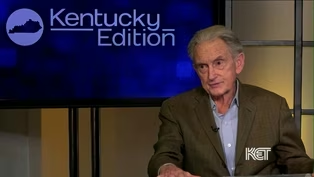
In the second part of our interview with Dr. Sloan, our Chip Paulson asked him what advice he'd give to leaders today.
So, Dr. Sloan, when you and I were talking on the phone about getting together for this interview and I told you I wanted to look at lessons you had learned from the 1970s and how they could be applied to the situation that Louisville finds itself in today.
You immediately said something without hesitation, very directly said, it's the guns.
Do you feel that way?
Well, I feel it's soft guns.
Yeah.
No question.
We've had in this country 200 or so massacres.
And of course, we had one here in Louisville a month or so ago.
And I just don't see any place for assault weapons in the civilian society.
Tom Brokaw came down here in 1989 after the massacre at Sandy Hook reviewer and he went to a gun range in the adjacent county, a bullet county.
And there was a lady there on a machine gun and just ripping up a refrigerator.
And he asked her, what what?
Why do you do this?
She said, Well, it just makes me feel good.
You know, we don't have machine guns in the streets.
We do have assault weapons.
Why can't assault weapons just be in the ranges?
People can shoot them all they want, but in the streets, these are sort of monstrous weapons that tear the body absolutely apart.
We've had 200 of these massacres.
This year.
Now, you've met with Mayor Greenburg in the last hour, right?
Correct.
What what advice did you give him?
What did you tell him in that meeting?
Well, I didn't he you know, he he he's been through hell.
He's been through the trial.
He got shot at during the campaign and he had this massive I'm not sure I could tell him anything.
And he's got a massive problem with the police.
I mean, he's got to the Justice Department is given all sorts of recommendations, and that has to be fulfilled.
But he's got to remember that police have a job.
And so far there are a lot of vacancies in the police department and they just can't be going into a combat zone within their department as well as out.
So it's a difficult, difficult problem.
Dr. Sloan, final question.
You close your book with a quote and it was always strive for something bigger than yourself.
I think you've done that in spades.
You feel like you've done that?
Yeah, I think I've done that.
It's not only the experience in Louisville and Kentucky, but I spent 12 years in Russia working on HIV, aids in Siberia, in the Russian Far East, in the prisons, and that all has been a reward to me personally.
I'm very fortunate.
My family has stuck with me during all these adventures and experiences, and I've been blessed.
I had a privileged background to start with and I could build on that and I've just met people there that have been, first of all, very generous but fascinating and having a vision in life.
And I think I have to quote this one person who worked with this, Lou Byron.
He was in the Public Works department, and I asked him about our administration after and he said, you know, we just didn't know what we couldn't do.
And that's the motto.
I hope other young people adopt.
And in the end, it's public service.
It's public public service.
And the more we can encourage that, the better it is, because you meet people that you never would meet before and also you get out of your little cocoon, right?
Well, it has been an adventurous life.
Yeah, Well, again, the name of the book Riding the Rails My Unexpected Adventures in Medicine, City Hall and Public Service.
Dr. Sloan, thanks so much for being with us today.
Thanks very much for this.
Appreciate it.
KC, back to you.
For information on Sloan's book, you can google Harvey Sloan.
Riding the Rails.
You may have heard of the movie.
We bought a Zoo.
Well, this family built a zoo.
Wentz Wildlife adventure started as a traveling petting zoo.
But it's put down roots in Nicholas County.
The zoo still has goats and llamas, but now there's so much more.
We've been on the road since 1996, providing animal displays and encounters for people at fairs and festivals and at different events.
And now we're to the point in our life where we wanted to get off the road.
So we opened this.
We opened our farm up to the public.
So I'm a third generation animal owner, handler, trainer.
My grandfather raised different types of animals in the fifties and sixties.
I worked for my uncle for several years, learning how to do a traveling, petting zoo and camel rides and things of that nature.
And it just expanded from there.
We have several popular attractions here, and one of them has been our sloth exhibit.
So we have a trio of sloth, a male and two females, and and Lola, our female, had a baby on Easter morning.
We also have an encounter with parakeets.
We have 2 to 300 parakeets.
We're building a new enclosure for them.
But what you do is you walk in with them, with the birds, their feet stick, and the birds will land on your hand.
And people love that as well.
Me and my wife are involved 24 hours a day.
Our boys, they work alongside with our other help, just about five days a week.
And we have a young daughter who just she kind of runs a place we bought.
We bought this farm about five years ago or six years ago.
And one of the things that drew us to this property was Daniel Bond's last home here.
He built it in 1795 and lived here for five years before he moved to Missouri.
The building is on our farm, but tourism owns the building.
They probably went to went from 800 or 900 visitors A to probably closer to 10,000 visitors a year since we opened up.
You go to a bigger zoo and you can see animals from a distance.
But here you can get up fairly close to things you wouldn't normally be able to get to.
And I think that's what makes us that's what sets us apart from a bigger source of.
But when you're putting money into our business, we're putting that money back into our community.
You know, our local female, we rely on them and a lot of different businesses around here, the gas company that we buy all our fuel from.
And we put a lot of our money back into the community.
When we were building it, it was, you know, I wasn't expecting to see people enjoying something physically built.
You know, you put a lot of time and effort into a project.
And the first couple of weeks we were open, I just I couldn't believe how people reacted to what we had built.
And in a positive way.
And that was a surprise for me.
The winds have Airbnbs on the park property, those wanting to stay overnight and they plan to add a cafe to the zoo in the future.
We'll recap the political news of the week tomorrow night on Kentucky Edition.
Plus, nine on one, dispatch centers rely on money from landline phone fees, but more and more people are getting rid of their landline phones.
The impact on dispatch centers Friday on Kentucky edition.
We hope you'll join us again tomorrow night at 630 Eastern, 530 Central for Kentucky Edition, where we inform, Connect and Inspire.
You can subscribe to our weekly Kentucky Edition email newsletter and watch full episodes and clips at KET dot org.
You can also find Kentucky edition on the PBS video app on your mobile device and Smart TV.
Send us a story idea at Public Affairs dot org and follow Kate on Facebook, Twitter and Instagram to stay in the loop.
Thank you for joining us for another edition of Kentucky Edition.
I'm Cassie Parker Belle.
Hope you enjoyed the show and that you have a great night.
Video has Closed Captions
Clip: S2 Ep16 | 10m 22s | Former Louisville Mayor Dr. Harvey Sloane sits down with KET's Chip Polston. (10m 22s)
Providing Support for PBS.org
Learn Moreabout PBS online sponsorship
- News and Public Affairs

Top journalists deliver compelling original analysis of the hour's headlines.

- News and Public Affairs

FRONTLINE is investigative journalism that questions, explains and changes our world.












Support for PBS provided by:
Kentucky Edition is a local public television program presented by KET