
June 22, 2023 - PBS NewsHour full episode
6/22/2023 | 57m 46sVideo has Closed Captions
June 22, 2023 - PBS NewsHour full episode
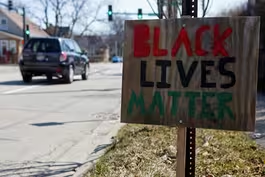
Thursday on the NewsHour, a tragic end to the search for the missing submersible after debris is located near the Titanic. President Biden welcomes India's prime minister for a state visit amid concerns over India's human rights record and China's growing influence in the world. Plus, we take a closer look at the impact of the nation's first-ever cash reparations program for Black residents.
Problems playing video? | Closed Captioning Feedback
Problems playing video? | Closed Captioning Feedback
Major corporate funding for the PBS News Hour is provided by BDO, BNSF, Consumer Cellular, American Cruise Lines, and Raymond James. Funding for the PBS NewsHour Weekend is provided by...
June 22, 2023 - PBS NewsHour full episode
6/22/2023 | 57m 46sVideo has Closed Captions
Thursday on the NewsHour, a tragic end to the search for the missing submersible after debris is located near the Titanic. President Biden welcomes India's prime minister for a state visit amid concerns over India's human rights record and China's growing influence in the world. Plus, we take a closer look at the impact of the nation's first-ever cash reparations program for Black residents.
Problems playing video? | Closed Captioning Feedback
How to Watch PBS News Hour
PBS News Hour is available to stream on pbs.org and the free PBS App, available on iPhone, Apple TV, Android TV, Android smartphones, Amazon Fire TV, Amazon Fire Tablet, Roku, Samsung Smart TV, and Vizio.
Providing Support for PBS.org
Learn Moreabout PBS online sponsorshipGEOFF BENNETT: Good evening.
I'm Geoff Bennett.
Amna Nawaz is on assignment.
On the "NewsHour" tonight: a tragic end to the search for the missing submersible, after debris is located near the Titanic.
President Biden welcomes India's prime minister for a state visit amid concerns over India's human rights record and China's growing influence.
And we take a closer look at the impact of the nation's first-ever cash reparations program.
ROBIN RUE SIMMONS, Chair, Evanston Reparations Committee: It is time to do something radically different than we've done in the past.
And reparations is that answer.
(BREAK) GEOFF BENNETT: Good evening, and welcome to the "NewsHour."
The U.S. Coast Guard confirmed this afternoon that the missing submersible in the North Atlantic Ocean was destroyed in a -- quote - - "catastrophic implosion."
Its debris was found on the ocean floor, and all five people aboard were killed.
William Brangham begins our coverage.
REAR ADM. JOHN MAUGER, U.S. Coast Guard: This morning, an ROV, or remote-operated vehicle, from the vessel Horizon Arctic discovered the tail cone of the Titan submersible, approximately 1,600 feet from the bow of the Titanic on the seafloor.
WILLIAM BRANGHAM: It was the news no one wanted to hear.
The missing submersible, which disappeared on Sunday on a descent down to visit the wreckage of the Titanic, had been completely destroyed.
U.S. Coast Guard Rear Admiral John Mauger: REAR ADM. JOHN MAUGER: The ROV subsequently found additional debris.
In consultation with experts from within the unified command, the debris is consistent with a catastrophic loss of the pressure chamber.
WILLIAM BRANGHAM: The U.S. Coast Guard and the company that ran the trip, OceanGate Expeditions, expressed their condolences to the families of the five passengers who perished.
They are Hamish Harding, Shahzada Dawood and his son Suleman Dawood, Paul-Henry Nargeolet, and OceanGate CEO and captain of the vessel Stockton Rush.
In a statement, OceanGate thanked the vast international search operation that mobilized over the last few days, saying -- quote -- "The entire OceanGate family is deeply grateful for the countless men and women from multiple organizations who worked so very hard on this mission."
Coast Guard officials said that the nature of the implosion and the depth at which the wreckage sits could make any salvage operation and recovery of the deceased very difficult.
REAR ADM. JOHN MAUGER: This is a incredibly unforgiving environment down there on the seafloor, and the debris is consistent with a catastrophic implosion of the vessel.
WILLIAM BRANGHAM: As those recovery operations continue, and the families grieve their losses, there are sure to be further questions about OceanGate, its safety record, and the overall adventure tourism industry.
In fact, as this saga unfolded over the last few days, past criticisms of OceanGate had reemerged.
Will Kohnen is chairman of the Marine Technology Society's Manned Underwater Vehicles Committee.
Back in 2018, he addressed a critical open letter to the now-deceased OceanGate CEO, Stockton Rush.
And in an interview before today's discovery, he argued that the Titan was not certified to travel down to those depths.
WILL KOHNEN, Marine Technology Society: There are only 10 vehicles in the whole world that can go 4,000 meters or deeper, and all of them are certified, except the Titan.
WILLIAM BRANGHAM: Coast Guard officials couldn't say exactly when the Titan imploded, but said the banging noises heard earlier in the week were seemingly unrelated to this disaster.
The Titan's remains now lie in pieces on the ocean floor less than 2,000 feet from historic wreckage its passengers wanted to see.
For the "PBS NewsHour," I'm William Brangham.
GEOFF BENNETT: Some additional perspective on this accident now and what it could mean going forward.
We're joined again by Jules Jaffe, an oceanographer with the Scripps Institution of Oceanography at the University of California, San Diego.
Thank you for being with us.
And, Jules, when the Coast Guard says that the submersible's debris is consistent with the catastrophic loss of the pressure chamber, what does that mean?
What, based on your vast experience, likely happened?
JULES JAFFE, Research Oceanographer, Marine Physical Laboratory, Scripps Institution of Oceanography: Well, as we know, the vehicle lost contact about one-and-three-quarters hour after it left the surface.
And it was about 2.5 hours to the bottom.
So my conjecture is actually that it was not quite at the bottom, but was probably around 800 or 900 -- 8,000 or 9,000 feet deep.
And from what we understand, the pressure at that depth is around 4,000 pounds per square inch.
So, think about a square inch.
Think about 4,000 pounds.
When you think about the pressure, it's actually coming from all directions.
So the best analogy I could think about was, imagine you have an egg in your hand and you simply crush it.
And I think, honestly, that is what happened to the vehicle.
GEOFF BENNETT: What happens next?
Will there be a recovery effort, or does the ocean depth make that impossible?
JULES JAFFE: Well, we do have these underwater robots that have arms on them.
And I think, in fact, we could probably pick the debris up and load it into, say, a large basket.
These underwater robots are pretty versatile.
And I'm hoping that we can do that and learn really exactly what the failure was, so a future version could ameliorate that problem and make tourist exploration of the deep ocean more accessible and less dangerous.
GEOFF BENNETT: As we just heard in the report, there were questions about safety issues having to do with OceanGate, about the quality of engineering, the level of testing that went into the development.
How does all of that strike you, in light of today's news?
JULES JAFFE: Well, I guess my dad used to say, hindsight is 20/20.
It strikes me, sadly, that perhaps the company was not up to speed and understanding -- remember, we have already made two trips.
They are making about one trip a year, as far as I can tell from my reading the news.
So they did one in 2021.
They did one and 2022.
And here we are on the third trip.
And what happens to anything that's under stress, a mechanical component, is, it fatigues.
And think about the tremendous pressure, and then it relaxes, and the tremendous pressure, and it relaxes.
The other part of the equation that I really worried about, and maybe it's validated, was, when we take planes, we are convinced of their safety.
But we don't always understand that the aerospace industry has strict standards for doing what's nondestructive tests and evaluation.
And they use ultrasonic probes to examine the integrity of the metal components.
If you have ever seen a plane, the wings are flexing, and those guys are world expert on ensuring our safety.
It's pretty clear, sadly, that the people in this company were not up to speed on testing this vehicle and ensuring its safety for such a tragic occurrence as happened probably four days ago, when they lost contact with the surface.
GEOFF BENNETT: Is adventure tourism going to change because of this?
Should it change because of this?
JULES JAFFE: Well, there's another company that makes underwater vehicles that have gone into the Mariana Trench, which is 35,000 feet.
And this one, and I wouldn't call it a shallow application, but it's 12,000 feet.
I think adventure tourism is going to be here to stay.
And I am a supporter of innovation in underwater vehicle development.
But, clearly, we need to be a little more vigilant ensuring the safety and understanding the forces that are on vehicles.
I mean, this design was very new.
It was a carbon fibers combined with titanium.
And I think we need to worry a bit more about the stresses and the fatigue that happens when we make repeated excursions into the deep ocean.
GEOFF BENNETT: Jules Jaffe, thanks so much for your time and for your insights.
JULES JAFFE: My pleasure.
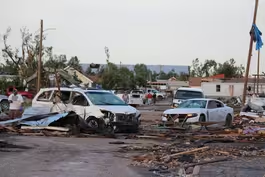
GEOFF BENNETT: In the day's other headlines: A small Texas town faced the aftermath of a tornado that killed four people and ripped apart homes and businesses.
At least one twister tore through Matador last night, a town of 570 people about 70 miles from Lubbock.
Daylight brought the damage into focus, a mile-long stretch of smashed buildings and wrecked vehicles.
Damage crews crawled over piles of debris.
The storm front also spewed hail the size of softballs and winds gusting near 100 miles an hour.
Tropical Storm Bret is closing in on the islands of the Eastern Caribbean tonight.
Officials in Dominica, Martinique, and St. Lucia issued warnings today as they braced for heavy rain, landslides and flooding.
The islands have also suspended public transportation and closed airports and schools.
President Biden today defended calling China's President Xi Jinping a dictator.
His comment earlier this week came after Secretary of State Antony Blinken had met with Xi in Beijing.
But at a White House news conference today, the president said his words will not undermine chances of better relations.
JOE BIDEN, President of the United States: We had an incident that caused some confusion, you might say.
But President -- but Secretary Blinken had a great trip to China.
I expect to be meeting with President Xi sometime in the future in the near term, and I don't think it's had any real consequence.
GEOFF BENNETT: The president went on to say that his blunt talk is -- quote -- "just not something I'm going to change very much."
Meantime, Beijing filed a formal protest.
It said the U.S. should act to undo the damage or bear all of the consequences.
In the war in Ukraine, an explosion damaged a key bridge linking Crimea to occupied parts of Southern Ukraine.
The Chongar Bridge serves as an important supply link for Russian forces facing a Ukrainian counteroffensive.
The damage left a gaping hole in the bridge.
The Russians blamed missiles fired by Ukraine's army.
They said repairs could take several weeks.
A court in Moscow has denied an appeal by Wall Street Journal reporter Evan Gershkovich to end his pretrial detention.
He's been held since late March on charges of espionage.
Today, he appeared in court behind a glass barrier and smiled to reporters.
Afterward, the U.S. ambassador to Russia denounced what she called hostage diplomacy.
LYNNE TRACY, U.S.
Ambassador to Russia: This was a procedural hearing appealing the conditions of his continued detention.
And we were extremely disappointed by the denial of his appeal.
He is an innocent journalist who was carrying out journalistic activities and has been wrongfully detained.
GEOFF BENNETT: Today's ruling means Gershkovich must stay in detention until at least late August while he awaits trial.
And, back in this country, Wall Street turned in a mixed performance after central banks in England, Norway, Switzerland, and Turkey raised interest rates.
The Dow Jones industrial average lost a fraction of a percent to close at 33946.
The Nasdaq rose 128 points, or 1 percent.
The S&P 500 added 16.
Still to come on the "NewsHour": former Texas Congressman Will Hurd becomes the latest Republican to launch a bid for the White House; people brought to the U.S. illegally as children share their hopes and fears ahead of a court ruling; and a CIA officer reflects on his long career and a new book.
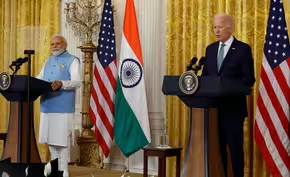
The prime minister of what is now the world's most populous nation was received with the fanfare of a state visit today at the White House.
India's Narendra Modi visits the U.S. at a critical moment, as the White House seeks to marshal democracies to confront China and support Ukraine.
But Modi's own conduct is also under the microscope.
The most elevated form of American diplomacy, a state visit for Indian Prime Minister Narendra Modi, heralded by marching bands and honor guards, while standing with President Biden before a packed crowd on the South Lawn.
During the visit, the two leaders announced major defense partnerships, pledged to share technology, conduct more joint military exercises, and increase security cooperation in the Indo-Pacific.
JOE BIDEN, President of the United States: We discussed our work through the Quad, and how India and the United States, together with Australia and Japan, can ensure the vital Indo-Pacific region remains free, open, prosperous, and secure.
GEOFF BENNETT: What brings them together, closer than ever before, is the rising challenge from China in the Indo-Pacific region.
Washington has long viewed New Delhi as a counterbalancing force to Beijing.
India has its own concerns, given escalating tensions along its 2,100-mile-long border with China.
Outside the White House today, human rights groups protested Modi, focusing on what many observers see as democratic backsliding in the world's largest democracy.
When asked about it by an American journalist in a joint press briefing, Modi pushed back.
NARENDRA MODI, Indian Prime Minister (through translator): I'm actually really surprised that people say so.
Democracy is in our DNA.
Democracy runs in our veins.
We live democracy.
We have always proved that democracy can deliver.
And when I said deliver, this is regardless of caste, creed, religion, gender.
There's absolutely no space for discrimination.
GEOFF BENNETT: But since Modi's Hindu right government came to power in 2014, discrimination and hate crimes against India's Muslims have sharply increased, including open calls for genocide from far right groups affiliated with Modi's political party.
Modi's critics say he cracks down on dissent, targets journalists, and has introduced policies that human rights groups say discriminate against Muslims.
Born as a tea seller in a small town, Modi represents India's rags-to-riches story, but he has roots in a staunchly far right Hindu nationalist ideology.
In 2002, he was accused of presiding over widespread anti-Muslim violence in his home state of Gujarat when he was head of the state government.
More than 1,000 people were killed.
AAKASHI BHATT, Daughter of Jailed Whistle-Blower: All of that was done to (INAUDIBLE) the political ambition of one man, the then-chief minister of Gujarat, the now prime minister of India.
GEOFF BENNETT: Aakashi Bhatt is the daughter of a former police officer, Sanjiv Bhatt, who testified against Modi, linking him to the carnage.
Bhatt is now jailed, sentenced to life imprisonment in a different case.
His daughter says he was convicted on false charges for speaking out against Modi.
AAKASHI BHATT: As my father started submitting evidence and started testifying before various investigating bodies, him and us as a family were -- were -- we had to face intimidation of various sorts from the government, be it death threats, attempts at his life, attempts at our life, our house being bulldozed, my father being dismissed from service, only because he testified against Modi.
GEOFF BENNETT: Following the riots, the U.S. imposed a travel ban on Modi under a federal law for severe violations of religious freedom.
The ban was lifted only after he was elected prime minister of India.
India's top court later exonerated him of all charges.
AAKASHI BHATT: By inviting him, by rolling out the red carpet, you are condoning his crackdown on human rights, the crackdown on free speech, on media, on the judiciary.
GEOFF BENNETT: After a morning spent at the White House, Modi later addressed the joint session of Congress.
President Biden hosts Modi at a lavish state dinner tonight.
With Narendra Modi, President Biden and his team have soft-pedaled many of the criticisms they often leveled at other leaders who they believe are falling short on democratic values.
We look at why and why this relationship is growing in importance with Daniel Markey.
He's the senior adviser on South Asia at the U.S. Institute of Peace.
That's a federally funded institution that works toward conflict resolution.
He's also served in the U.S. State Department.
Thanks so much for being with us.
DANIEL MARKEY, U.S. Institute of Peace: Of course.
GEOFF BENNETT: So, President Biden is rolling out the red carpet for a leader who is said to be increasingly autocratic, but who could be a key ally, given rising tensions with Russia and China.
What's the cost/benefit analysis for the U.S.?
DANIEL MARKEY: Well, certainly from the Biden administration's perspective, there are huge upside benefits.
They're thinking about the long term and they're thinking about geopolitical competition with China, an enormous country.
The scale issue looms large, right?
It's 1.4 billion or so people in China, and now we have about the same number or a little bit more in India.
So, as they think about how to balance China, I think they look at India as an necessary factor in that.
And they see it as enormously helpful because India has this population, a huge market for U.S. goods, huge numbers of skilled workers, some of the brightest brains that have led to growth in America's own industry, especially the I.T.
industry, and so on.
So they see that as a huge upside benefit over the long term.
And, in the near term, as your piece pointed out, India's facing a huge challenge along its border with China, a very acute military threat.
And the Biden administration recognizes that it has an interest in making sure that India isn't intimidated, that it isn't bossed around, because that sends a dangerous message to other countries in the region.
And so there's sort of a long-term concern and a near-term interest as well.
GEOFF BENNETT: I spoke with senior White House officials, who said that President Biden is trying to expand and fortify a coalition of democracies to really confront and counter China and Russia.
What strategic role does India play in both of those equations?
DANIEL MARKEY: Well, in terms of countering China, India is enormous.
And it is also, interestingly, located right along -- of course, it sort of dominates the Indian Ocean.
And that is something that makes it useful, because many of China's shipping lanes cross through the Indian Ocean.
And so India is useful to the United States as it thinks about a strategy for, in a sense - - in a sense, containing China.
With respect to Russia, though, the story is very different.
Here, India has been a longtime partner of Russia, going back to the Cold War.
India continues to buy a considerable amount of military equipment from Russia.
But the United States recognizes that, at this moment, as Russia is in this war with Ukraine, it's less able to deliver to India what India needs.
So maybe this is a potential turning point in India's relationship with Russia.
The United States would like to be on the receiving end of Indian orders of defense equipment going forward.
GEOFF BENNETT: Is that why this major defense partnership is so important?
Is this a serious deliverable?
Or is this just something that appears on a one-sheet that the White House can say, look, we have met and we have done something?
DANIEL MARKEY: No, this is serious.
This is something that it's been in the works for some time.
Haven't quite cracked the code on how to get India to buy huge amounts of U.S. military equipment or fundamentally turn toward American and Western suppliers and away from Russia.
But this may be the moment for that to happen.
In the past, we have seen sort of promises gone unmet.
Now we're looking at a jet engine deal that could potentially power Indian jets for this generation and the next generation.
We're looking at a big sale of drones.
So, we're talking tens of billions of dollars, and probably a lot more than that.
So, no, this is a big deal.
GEOFF BENNETT: The Indian prime minister does not often do press conferences.
His team tightly controls his message, his media availability.
But he did engage in a press conference today.
And he was asked by Sabrina Siddiqui at The Wall Street Journal about his human rights violations, his alleged record of human rights violations.
And he said: "Democracy is in our DNA.
There's no question of discrimination."
Is he right about that?
DANIEL MARKEY: I don't believe that he is.
I believe that, under Modi's leadership, India has become steadily less democratic.
Your setup piece, I think, appropriately identified a number of the problems that have happened on his watch with respect to communal violence, particularly with respect to the Muslim community, which is over 200 million or so in India.
It's an enormous part of the Indian society.
We're talking about a lot of people.
And that's dangerous for a reason that President Obama pointed out actually today in an interview.
He recognized that if India begins to be more divided as a society, less unified, it's a less powerful and less capable American partner going forward.
And because India is so large, it's a threat, or India's instability would be a threat to world stability.
And so I think it's important that we ask serious questions about what Modi is doing, as a leader, and particularly on the democratic front.
It is very apt that today was one of the first times that he submitted to questions from the press.
In India, this just doesn't happen.
He has more or less muzzled the press, made it a less effective sort of watchdog of his government.
And that's how he likes it.
That is not the type of thing that a true democratic leader does.
GEOFF BENNETT: How does the Indian prime minister benefit from all of this back home, the state visit, all of the trappings that come with it?
DANIEL MARKEY: Yes, this is enormously helpful for him politically.
Every time that he is celebrated on the world stage, he very skillfully brings that back to the Indian public, portrays himself and India as a visual guru, as a world leader.
And this is something that he will play up this trip, certainly, other trips to other capitals in the world, as well as the G20, which India's hosting this year.
All of these are leading up to next year's national elections.
And so he's very shrewdly using his statesmanship as a means to suggest that he is the appropriate leader back to Indian voters next year.
GEOFF BENNETT: Daniel Markey, really enjoyed speaking with you.
Thanks for coming in.
DANIEL MARKEY: Thank you.
Appreciate it.
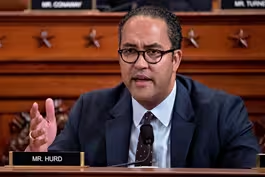
GEOFF BENNETT: The long list of Republicans seeking their party's nomination for president grew by one more today.
Former Congressman Will Hurd is kicking off his campaign with a direct hit at the field's front-runner.
Lisa Desjardins has more.
FMR.
REP. WILL HURD (R-TX), President Candidate: The soul of our country is under attack.
LISA DESJARDINS: Former Congressman Will Hurd reentering the political arena, this time in a run for president, is casting himself as a candidate who can bridge partisan divides.
FMR.
REP. WILL HURD: Common sense says we're better together.
I know it.
You know it.
There's more that unites us than divides us.
LISA DESJARDINS: Hurd left Congress in 2020, after three House terms where he regularly took on then-President Donald Trump on issues like a Southern border wall, guns and political rhetoric, and he is openly taking on Trump again now.
FMR.
REP. WILL HURD: And if we nominate a lawless, selfish, failed politician like Donald Trump, who lost the House, the Senate and the White House, we all know Joe Biden will win again.
LISA DESJARDINS: In 2014, Hurd beat a Democratic congressman to win a district that stretches across the Texas-Mexico border.
FMR.
REP. WILL HURD: My colleagues know I'm the only Republican on the border.
LISA DESJARDINS: A former CIA officer with stints in Afghanistan, India and Pakistan, Hurd focused on defense and national security.
But he notably broke with Republicans on some key issues.
He voted to protect LGBTQ Americans from discrimination and in favor of bipartisan police reform.
FMR.
REP. WILL HURD: Keeping bad cops off the force could prevent another killing like George Floyd LISA DESJARDINS: On guns, he was one of eight House Republicans who supported universal background checks in 2019.
WOMAN: The bill has passed.
(CHEERING AND APPLAUSE) LISA DESJARDINS: That was before 19 kids and two teachers were killed in Uvalde, Texas, last year.
Hurd represented that community in Congress.
And on the anniversary of that shooting, he told "NewsHour" he wants more limits on who can buy some guns.
FMR.
REP. WILL HURD: We know, if you move -- if you turn the age to have a high-caliber rifle to go from 18 to 21, which is -- it's you have to be 21 to get a handgun, that alone would have changed Uvalde and would have changed the lives of 21 families.
LISA DESJARDINS: With cross-party votes came cross-party friendships.
Hurd made headlines in 2017 when he took a road trip from San Antonio to D.C. with then-Democratic Congressman Beto O'Rourke.
FMR.
REP. WILL HURD: We don't always agree -- didn't always agree, and we showed that we could disagree without being disagreeable.
LISA DESJARDINS: When he left Congress, Hurd was the only Black Republican in the House.
FMR.
REP. WILL HURD: Howdy, Iowa.
LISA DESJARDINS: And, in this race, he will be the most high-profile Texan.
FMR.
REP. WILL HURD: We live in incredibly complicated and dangerous times.
And we need commonsense leadership to solve these problems.
LISA DESJARDINS: A straightforward message, but Hurd is part of a growing Republican field, all aiming to stand out.
For the "PBS NewsHour," I'm Lisa Desjardins.
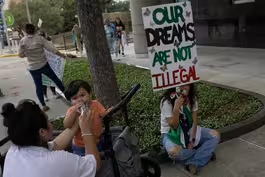
GEOFF BENNETT: After marking its 11th anniversary this month, a longstanding immigrant protection program could be struck down by a federal court in Texas.
A judge is expected to hand down a decision this month about the legality of DACA, or the Deferred Action for Childhood Arrivals, that protects undocumented immigrants who came to the U.S. as children from deportation.
There are more than half-a-million DACA recipients, and many are in limbo as they await the judge's ruling.
We hear from some of them now.
JONATHAN RODAS, DACA Recipient: Hi.
My name is Jonathan Rodas.
I am a DACA recipient.
I am originally from El Salvador.
KATIA RUBIO LEAL, DACA Recipient: My name is Katia Rubio Leal.
I was born in Hidalgo, Mexico, raised in Arkansas, but now reside in Kansas City.
I attend Rutgers University.
I'm a rising senior.
ONION HA, DACA Recipient: I go by Onion Ha.
I have lived in this country since I was 5, 6 years old, and have been on DACA since 2016.
AURORA, Migrant: My name is Aurora.
I am 24 years old.
I came here when I was 10 months old from Mexico.
I applied for DACA, but I have been blocked.
So, meantime, I'm undocumented.
I don't have DACA.
JONATHAN RODAS: With my DACA, I felt -- for this 10 years, 11 years now, I have felt that I'm part of this country.
I'm part because I'm paying taxes.
I have a good job.
I'm going to school and I'm getting in-state tuition.
I get all the benefits as a U.S. citizen or a green card holder, and everything.
KATIA RUBIO LEAL: I'm able to find, like, really good jobs that, like, not many people wouldn't be able to do because I have a work permit.
JONATHAN RODAS: The only con it is that -- is that we are in constant fear, in a constant fear that, like, for example, this judge can strike it down real quick.
And then we're in limbo.
KATIA RUBIO LEAL: That strain that it's $500 every two years for myself and my two brothers.
There was one case when the mail lost my brother's card, and we had to pay the $500 again, even though the mail carrier lost it.
And, again, it's just $500 isn't always that easy for people.
AURORA: So, I was a freshman in college.
And so that was the first time I applied.
And the Trump administration blocked applications.
That was the first time I got blocked.
And then the second time was in 2021.
That was a day that everything changed once again to me, because I thought that my future would be different.
KATIA RUBIO LEAL: There's still so much that I can't do.
There's -- since I'm majoring in biomedical engineering, I have to do a lot of research, especially to get into grad school.
When I try and look for opportunities, all of them are like, you have to be a U.S. citizen, you have to be a U.S. citizen, a resident.
So I just go down the line knocking off things that I can't do because of my status.
ONION HA: I can only think in to two-year increments.
It's traumatizing because you can't have any peace.
You can't live with peace.
You have to constantly think of, like, contingency plans and backup plans.
And you just got to just kind of work with the flow.
And it's unfair, because your life is just in the whims of people that don't even though what you're going through.
AURORA: Another struggle is that everyone's moving forward.
I have seen my family, friends graduate and already start families, buy a house.
And I'm still in the same situation in my life, that I haven't been moving forward.
KATIA RUBIO LEAL: I have been having it for, like, six years almost, about.
I have been in school.
I have had really good grades.
I have done good jobs.
I don't even have a speeding ticket.
Like, what is prohibiting me from becoming a citizen if I'm a law-abiding person?
And people prove themselves year after year that they want to be here in this country, they want to do good, they want that security, but they're still not granted it at all.
ONION HA: I constantly struggle between, am I Korean, am I American?
Because now people are telling me I'm not American, and I don't deserve to be in this country, and that I need to get out of here because I made the wrong choice when I was 5, 6 years old.
And it's like I have never made a decision anyways.
It's insane.
So it's like, yes, like, there's a daily struggle with like your identity, of who you are.
And you have to reaffirm that you are -- you rightfully deserve to be in this country.
GEOFF BENNETT: In 2019, Evanston, Illinois passed the first reparations law in American history.
It set out to address decades of segregation and legalized housing discrimination.
Economics correspondent Paul Solman recently visited the Chicago suburb to follow up on the progress of the program.
It's part of our ongoing series, Race Matters.
LOU WEATHERS, Reparations Recipient: Evanston, Illinois: Evanston Hospital wouldn't accept Black mothers, so my father had to drive me to Cook County Hospital to be born.
But, as a baby, I came back tot house.
My father bought the house in 1930.
PAUL SOLMAN: Eighty-eight-year-old Lou Weathers' house in Evanston, Illinois, home to a longstanding Black community which comprises some 16 percent of the city's 75,000 inhabitants, some of whom, like Donna Walker, still bitter about the past.
DONNA WALKER, Owner, Cutting Edge Hair Gallery: I am truly waiting for 40 acres and a mule.
A jackass would be fine for me, but just give me some acreage, and I will be OK. PAUL SOLMAN: Evanston isn't offering the acreage, but, given the persistent and huge wealth and health gaps ever since slavery, it is trying to make amends with a first-of-its-kind reparations project that's spreading.
ROBIN RUE SIMMONS, Chair, Evanston Reparations Committee: We had an official side event at the United Nations last week sharing the model, the growth, that it was Evanston in 2019.
And, today, there are over 100 localities that have taken a first step towards reparations for their community.
PAUL SOLMAN: Former City Councillor Robin Rue Simmons spearheaded reparations here in 2019, $10 million to be spent over 10 years, funded by taxes on newly legalized cannabis sales and by real estate transfers, so far, 16 recipients of, $25,000 each.
LOU WEATHERS: I just figured the country would not approve nothing like that.
PAUL SOLMAN: Lou Weathers wasn't just surprised.
Yes.
LOU WEATHERS: I was shocked.
PAUL SOLMAN: Shocked.
LOU WEATHERS: Yes.
PAUL SOLMAN: Weathers used his $25,000 to reduce his son's mortgage here in Evanston.
LOU WEATHERS: Well, any time you can reduce your mortgage, your mortgage payment is going to be lower.
His bill is going to be lower.
He can use the money for other things.
DONNA WALKER: I have said from the beginning that we were not going to see this money at all.
PAUL SOLMAN: But hairdresser Donna Walker was wrong.
DONNA WALKER: Some people did see it, and I'm very happy that they did.
And I'm happy that the elders are able to pay taxes on their home and fix it up.
PAUL SOLMAN: Walker's next-door neighbor, fellow hairdresser Gigi Giles, is on the waiting list for funds that will come in future years.
So you figure you will get it eventually?
GIGI GILES, Owner, Ebony Barbershop: Eventually.
If not, my grandchildren or my daughters will get it.
PAUL SOLMAN: What will you do with the money?
GIGI GILES: I would fix up my home.
I would do my kitchen and my two bathrooms.
PAUL SOLMAN: Can you do that for 25,000 grand?
GIGI GILES: I'd make it work.
(LAUGHTER) PAUL SOLMAN: Initially, reparations money only counted toward housing-related projects, mortgage payments, home improvements, or a down payment.
In March, Evanston's City Council added the option of direct cash payments, because some had felt a restricted grant was demeaning.
Recipients should be able to do what they want with the $25,000.
DONNA WALKER: Most of us here can't even afford to live here.
PAUL SOLMAN: Like Donna Walker.
DONNA WALKER: If you give me something, you can't tell me how to spend it.
So its like, you have people like, well, what are they going to spend it on?
Man, I'm going to buy a new Porsche and a Cadillac.
Come on, really?
(LAUGHTER) PAUL SOLMAN: Newport cigarettes, that is.
Lou Weathers, though, prefers housing investment.
LOU WEATHERS: Anytime you have grants and stuff like that, two sides have to get something out of it.
The city making people improve their property helps me, because I own property.
That's going to increase my value of my property.
PAUL SOLMAN: Now, not everyone in Evanston is pro-reparations, of course.
MAN: I don't think it's a good idea.
There are people who need help, and help should not be predicated on someone's race, creed, color, orientation.
PAUL SOLMAN: A local businessman, who called us later trying to take back the interview, a bit late, but, as a courtesy, no name or face.
MAN: We had laws that were against the Chinese, and those were enforced around 1883 to 1943.
So, if we go by that standard, well, then we owe the Chinese recompense, we owe the Japanese even more recompense.
And there comes a point where we're a flawed society.
I think the thing we need to do is move forward.
PAUL SOLMAN: Evanston Mayor Daniel Biss wasn't surprised to hear of the reluctance to say this on camera.
DANIEL BISS, Mayor of Evanston, Illinois: I do think people feel like, if I come out and say reparations is a dumb idea, we should not do that, I'm just not going to make a lot of friends.
I'm not going to gain a lot of support.
PAUL SOLMAN: But reparations champion Simmons says taking a stand means ignoring the blowback, no matter how unpleasant it's been to see what she herself has received online.
ROBIN RUE SIMMONS: Its the ghetto lottery, or, you know, you monkey, you slave, and go back to Africa, that type of stuff.
PAUL SOLMAN: But the overall reaction, at least in this liberal city, according to the liberal mayor: DANIEL BISS: It's something that we're enormously proud of.
I think it's an important step, one might argue a partial step or an inadequate step, but still a really important step, toward both, on a factual level, reckoning with our past, but also creating the concrete equity that our community has been talking about for probably four or five generations but has never really fully realized.
PAUL SOLMAN: Is the pride pervasive, I asked our camera-shy businessman?
So, if roughly half the population are white, what proportion of those people do you think don't think this is a good idea, think as you do?
MAN: You don't even bring it up, because people are afraid to really express their thoughts.
And so I wouldn't be able to give you an honest answer.
PAUL SOLMAN: At nearby Northwestern University, Professor Al Tillery is studying the response to the reparations initiative.
ALVIN TILLERY, Northwestern University: We so far have gotten close to 4,000 respondents, people writing in.
PAUL SOLMAN: So he doesn't have results yet.
But, although, in nationwide polling, few whites are in favor: ALVIN TILLERY: I don't think were going to be at the 15 percent for where white people are nationally.
I think we're going to be much higher than that.
Will we be over 50 percent with our white population?
I don't know.
PAUL SOLMAN: Fifty percent approve.
(CROSSTALK) ALVIN TILLERY: In support, who approve, yes.
I mean, so, if we found between 30 percent and 50 percent approve, I think that would be like finding the pot of gold at the end of the rainbow.
I mean, that -- nowhere else will it have been so high.
PAUL SOLMAN: And where does the program go from here?
DANIEL BISS: So, over the course of time, more revenue is going to come in, both through the cannabis and also through the real estate transfer tax, that will allow more grants to be allocated.
There's a long waiting list of ancestors behind them.
There is a long waiting list of descendants.
And behind them are a lot of other people in this community who were mistreated or whose ancestors were mistreated by the city government through policies the city government deliberately enacted.
And we have a lot of work to do.
PAUL SOLMAN: Just to deal with the 600 or so applicants thus far, especially, says the mayor, in a city now so pricey, many Blacks can't afford to stay, like Dwayne Logan at Gigi Giles' salon.
DWAYNE LOGAN, Former Resident of Evanston, Illinois: I'm from Evanston, but I don't currently live in Evanston, because the taxes were so high, I had to buy a house in Skokie.
PAUL SOLMAN: Right, says Simmons, because Blacks were never able to build generational wealth, which is why she was inspired to push for reparations.
ROBIN RUE SIMMONS: I was looking at the race gaps and every area.
I was looking at the loss of Black community, residents leaving almost every day because of lack of affordability, not feeling a sense of place, going to other communities where they felt more hopeful and opportunity.
The Black experience in this city and in this nation has been in a state of emergency since we were kidnapped from West Africa and brought here.
And so it is time to do something radically different than we have done in the past.
And reparations is that answer.
PAUL SOLMAN: About time, says Gigi Giles.
GIGI GILES: People want to see money.
Money talks.
And then they probably will be happy, but, you know, it is what it is.
It's a start.
PAUL SOLMAN: And she's still living here and running the business her father started 60 years ago.
For the "PBS NewsHour," Paul Solman in Evanston, Illinois.
GEOFF BENNETT: The CIA and the Defense Department are two of the U.S. government's largest agencies, which run both secret paramilitary and military operations around the world.
Amna has this conversation now with the author of a new memoir who has played key roles in both agencies.
AMNA NAWAZ: Since the 1980s, the United States has carried out a number of large-scale covert military operations aimed at the Soviet Union, al-Qaida, and Osama bin Laden, Iran, and North Korea, just to name a few.
A lot has been written about all of this, but now one man who played a key role in part of those operations has stepped out of the shadows to share his story in a new book called "By All Means Available: Memoirs of a Life in Intelligence, Special Operations, and Strategy."
That author, Michael Vickers, joins me here now.
Mike, good to see you.
MICHAEL VICKERS, Author, "By All Means Available: Memoirs of a Life in Intelligence, Special Operations, and Strategy": It's great to be with you, Amna.
AMNA NAWAZ: Thank you for being here.
So, it was in 1984 that you got your first permanent assignment at the CIA.
You were chief strategist for the Afghanistan covert action program that was arming the mujahideen that were fighting the Soviets, who'd invaded in 1979.
You came in, and you essentially changed the entire CIA program.
Tell us about that.
What did you do?
MICHAEL VICKERS: Well, so, the program had just received a very large increase in funding, quadrupling the budget, from Congress, from - - particularly led by a Democratic congressman at the time, Charlie Wilson.
A movie has been made after that story and his role.
And so I thought there were a lot of possibilities with these greatly increased resources that CIA hadn't asked for, but were just given to them.
And then I thought, well, maybe we could do more than just impose costs on the Soviets for their occupation of Afghanistan.
Our analysts believed there's no way the resistance could win.
The Red Army hadn't been defeated.
And so that's what I set about to do.
And some months later, I came up with a plan to do it that then got implemented.
AMNA NAWAZ: This was all about beating the Soviets, not just... (CROSSTALK) AMNA NAWAZ: ... right?
MICHAEL VICKERS: Well, it became -- actually, our policy objective shifted about four months later, when President Reagan signed a then-top secret directive to beat the Soviets, to drive them out of Afghanistan by all means, available.
And, hence, that's where the title of the book comes.
AMNA NAWAZ: We now know all these many years later, right?
We know how that U.S. support for the Afghan mujahideen at the time led to other consequences, to the empowerment of other Islamic extremists, contributed to the birth of al-Qaida, who ultimately then, of course, attacked the U.S. on 9/11.
You wrote about this, about that hindsight, in the book.
You say: "We missed the strategic significance of the Afghan Arabs, the volunteers who would provide the foundation for al-Qaida.That we also did not anticipate how the defeat of one superpower would motivate al-Qaida to want to wage a global war against the sole remaining superpower," or the U.S.
If you could go back and do something differently, would you have changed how you run the program all those years ago?
MICHAEL VICKERS: No, I don't think -- I don't think I would have changed... AMNA NAWAZ: You were arming some of the most extreme militants... (CROSSTALK) AMNA NAWAZ: ... right?
MICHAEL VICKERS: Well, the Afghan resistance was divided between more fundamentalist groups, some of which were the favorite of the Pakistanis, and then more traditionalist, some royalists, some more secular.
And some of the fundamentalist groups did make common cause with the Taliban after 1996, and then became -- we became their enemies and they became ours.
So I don't think -- I don't think we would have done anything differently in terms of the Soviet war.
AMNA NAWAZ: You left the CIA after the Soviets withdrew from Afghanistan many years later.
You joined the George H.W.
Bush administration working on special operations.
And one of your main areas of focus there were drone strikes that were ramping up at the time.
And there was a period of time in which I personally, actually, was on the ground, as I mentioned to you earlier, in the part of the world where the U.S. was dropping more drones and drone strikes than anywhere else, in the Pakistan and Afghanistan border region.
And I saw the buildup of anti-American sentiment at the time as a result of those strikes.
Were those strikes worth it in the end?
MICHAEL VICKERS: Yes, I think they really helped prevent another 9/11 attack.
After al-Qaida resettled in the Afghanistan-Pakistan border region, the threat to the United States went way up.
And so we had the transatlantic airline plot to blow up 10 airliners over the Atlantic, a 9/11-scale attack that might have killed several thousand people, in 2006.
And so President Bush made the decision to launch a new campaign in 2008, to really start using these weapons, these drone strikes against al-Qaida and its safe haven providers in the border region, and President Obama sustained it.
And within about four years of that, core al-Qaida's back was essentially broken in that region.
Its ability to plot more was limited.
And from polling I remember at the time, the closer -- the closer you were to the militants, where you were being bullied by them or other things, the more the local populace supported it.
The further you are away, it looked like a violation of Pakistani sovereignty.
So people in the so-called settled areas of Pakistan had much stronger feelings against these things than those right in the border region.
AMNA NAWAZ: Many of those strikes were carried out against people who we did not know who they were.
Their identities weren't known until after they were killed in some cases, right, the signature strikes in which people were being targeted simply based on signature behavioral aspects or location.
And we also know a number of civilians were killed along the way too.
There were mistakes, women and children killed.
A U.S. citizen, Warren Weinstein, who was held hostage in the area, was killed.
MICHAEL VICKERS: Yes.
AMNA NAWAZ: Do we get know the full cost in terms of civilians and people who shouldn't have been killed as a result of U.S. actions?
MICHAEL VICKERS: Well, I think we have a pretty good idea.
I mean, one of the decisions President Obama made late in his administration was to release the best data that we had in the U.S. intelligence about the number of noncombatant or civilian casualties.
But that number was pretty small.
It was in 60 to 100.
AMNA NAWAZ: You're saying 60 to 100 civilians killed?
MICHAEL VICKERS: Yes, out of about 3,000 combatants.
So... AMNA NAWAZ: Because the Bureau of Investigative Journalism that tracks this says the civilian casualties could be upwards of 1,700 people.
MICHAEL VICKERS: Yes, I don't think that's right.
And I don't think the U.S. government believes that either.
AMNA NAWAZ: You mentioned another major operation you were a part of, which was the U.S. operation to kill Osama bin Laden in Abbottabad, Pakistan in 2011.
And that option, that nighttime special forces raid, was really the most risky of all the options on the table at the time, is my understanding.
You were in meetings with President Obama.
And the CIA had secretaries of defense and state.
How was that option chosen?
MICHAEL VICKERS: So, the options operationally ranged from airstrikes, big bomber strike, to a small drone strike, and then various kinds of raids.
And some were rejected.
Like, a big bomber strike would have caused collateral damage, not only would have killed women and children in the house with Osama bin Laden, but neighbors as well.
And so that one got rejected pretty quickly.
A small drone strike option didn't have much reliability to it.
It would only work when bin Laden was walking around for exercise, and a very small bomb might not -- might have missed, might have injured him, and then he would have fled.
So, President Obama settled on the SEAL raid that we ended up one version of a special operations raid, but the one we ended up conducting, and that was the best option.
It had its risky elements, but we tried to reduce the risk as much as we could by adding additional helicopters, reinforcing forces, et cetera, to make sure the force could get in and out.
So, with the special operations raid, if we got him and got his DNA, we would be able to convincingly tell the world.
If we had done an airstrike, we wouldn't have.
AMNA NAWAZ: The book is "By All Means Available: Memoirs of a Life in Intelligence, Special Operations, and Strategy."
Michael Vickers, thank you so much for being here.
MICHAEL VICKERS: Pleasure to be with you.
Thank you.
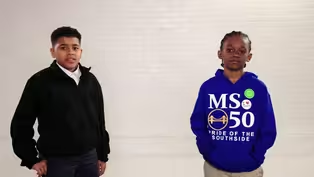
GEOFF BENNETT: The New York City Urban Debate League has helped over 100 New York City schools get access to debate training for students.
Tonight, we hear from two middle school students who participate in the league with their Brief But Spectacular takes on debate and democracy.
FRANCIS, New York City Urban Debate League: To have a good debate, you need to stay calm and prepare.
ERICK, New York City Urban Debate League: Respect is a huge factor in debate, because, if you don't respect your opponent, you can't even respect the judge.
Then what are you doing there, to be honest?
It's not even a debate at that point.
It's just argument.
I'm 11 years old, and I go to MS 50 in Brooklyn, New York.
I'm currently a sixth grader, and I'm a debater and a basketball player.
FRANCIS: I go to PSMS 161 in Harlem, New York.
I'm in seventh grade.
ERICK: I have been doing debate for three to four years now.
Well, it all started in third grade, where there was this new program happening in my elementary school, and I was quite eager to try it out.
And then, there, we learned how to, like, debate.
And now here I am.
QUESTION: Should the United States federal government ban TikTok?
ERICK: TikTok should be banned due to -- amid concerns that their partner company would give users' information, data, like such as browser history and location, to the Chinese government and push propaganda.
FRANCIS: I think we shouldn't ban TikTok, because it gives the young people and other people the voice that they deserve.
New York City Urban Debate League is just basically a league of debate, where different schools and different cultures around New York City and the boroughs, they come together for different tournaments.
ERICK: Its important to have these programs out, because it promotes diversity in all communities.
FRANCIS: I love debate because I get to talk.
A lot of the time, I have had to switch my - - how I usually perceive things.
ERICK: When somebody asks me a question, I try my best to answer it fully and then come at them with a question that's even harder.
QUESTION: What's the better borough, Manhattan or Brooklyn?
FRANCIS: I think the best borough is Manhattan.
We have lots of good arts and culture and entertainment in Manhattan.
There's a really good food.
Practically almost everywhere, there's some kind of train station.
So, in and out, you can be all the city from an hour to 30 minutes.
ERICK: I see your point, but I believe Brooklyn has also a lot of culture, with mostly mixed communities like Dominican and Black and Jewish all in one community.
We have a lot of diversity.
One of the most important things about debating is being yourself, because, if you're not yourself, then who are you?
You know, you have to be confident in your abilities and What you can do as a person.
If you're confident in yourself and your abilities, you can do anything you want.
FRANCIS: Debate is important for the real world, because it will allow you to understand others' perspectives.
Sometimes, looking at the other person's perspective can change your own.
If people could understand the other perspective, then it would make it much easier to do things.
ERICK: To be honest, if you win or you lose, it's still winning at the end of the day, because you're learning something, trying your best, being excellent in your own way, and just pushing through.
FRANCIS: My name is Francis.
ERICK: My name is Erick.
FRANCIS AND ERICK: And this is my Brief But Spectacular take on debate and democracy.
ERICK: Nice to meet you.
FRANCIS: Nice to meet you too.
(LAUGHTER) GEOFF BENNETT: Some compelling arguments there from Francis and Erick.
That's fantastic.
You can watch more Brief But Spectacular videos online at PBS.org/NewsHour/Brief.
And that is the "NewsHour" for tonight.
Join us again tomorrow, as we will hear from women about their experiences in the year since the U.S. Supreme Court overturned Roe v. Wade and the constitutional right to an abortion.
I'm Geoff Bennett.
Thanks for spending part of your evening with us.
Biden hosts Modi for state visit amid human rights concerns
Video has Closed Captions
Biden welcomes Modi for state visit amid concerns over India's human rights record (10m 52s)
A Brief But Spectacular take on debate and democracy
Video has Closed Captions
A Brief But Spectacular take on debate and democracy (3m 20s)
CIA officer reflects on long career in new memoir
Video has Closed Captions
CIA officer reflects on long career in new memoir 'By All Means Available' (8m 31s)
DACA recipients share hopes and fears ahead of court ruling
Video has Closed Captions
DACA recipients share hopes and fears ahead of court ruling that could end program (4m 36s)
A look at the nation's first cash reparations program
Video has Closed Captions
The impact of the nation's first cash reparations program for Black residents (8m 37s)
News Wrap: Tornado kills 4 in small Texas town
Video has Closed Captions
News Wrap: Tornado kills 4 in small Texas town (3m 46s)

Search for the missing Titanic sub reaches tragic end
Video has Closed Captions
Search for missing Titanic sub reaches tragic end with all 5 on board dead (8m 6s)
Will Hurd latest Republican to launch White House bid
Video has Closed Captions
Former Texas Congressman Will Hurd becomes latest Republican to launch bid for White House (3m 19s)
Providing Support for PBS.org
Learn Moreabout PBS online sponsorship
- News and Public Affairs

FRONTLINE is investigative journalism that questions, explains and changes our world.

- News and Public Affairs

Today's top journalists discuss Washington's current political events and public affairs.












Support for PBS provided by:
Major corporate funding for the PBS News Hour is provided by BDO, BNSF, Consumer Cellular, American Cruise Lines, and Raymond James. Funding for the PBS NewsHour Weekend is provided by...