
June 22, 2026 - Full Show
6/22/2026 | 26m 50sVideo has Closed Captions
Watch the full June 22, 2026, episode of "Chicago Tonight."
Debating data centers in Illinois. A lawsuit over Chicago’s sidewalks and accessibility. And Cook County invests in violence prevention.
Problems playing video? | Closed Captioning Feedback
Problems playing video? | Closed Captioning Feedback
Chicago Tonight is a local public television program presented by WTTW
WTTW video streaming support provided by members and sponsors.
June 22, 2026 - Full Show
6/22/2026 | 26m 50sVideo has Closed Captions
Debating data centers in Illinois. A lawsuit over Chicago’s sidewalks and accessibility. And Cook County invests in violence prevention.
Problems playing video? | Closed Captioning Feedback
Where to Watch Chicago Tonight
Chicago Tonight is available to stream on pbs.org and the PBS app.

WTTW News Explains
In this Emmy Award-winning series, WTTW News tackles your questions — big and small — about life in the Chicago area. Our video animations guide you through local government, city history, public utilities and everything in between.Providing Support for PBS.org
Learn Moreabout PBS online sponsorship>> Hello and thanks for joining us on Chicago Brandis Friedman.
Here's what we're looking at.
>> Here in Illinois were setting a higher bar for data center development.
>> Data Center policy discussions heat up in Illinois, my friend.
>> And Cook County invests in gun violence prevention board President Toni Preckwinkle joins to discuss more in depth.
>> First off tonight, a 3rd case out of the federal prosecutors office in Chicago is being dismissed as U.S.
Attorney Andrew Boutros is office reviews, scores of cases connected to the same prosecutor who led the broad view.
6 case.
Boutros today filed a motion to dismiss our son charges against 5 people after he found that his prosecutor again had conversations with grand jurors outside of the cases, official proceedings in July of last year during that conversation, she reportedly told jurors that quote, she can prove this case before adding, quote, We don't catch the smart ones and most of them aren't as smart as they think.
The U.S.
attorney says he's reviewing more than 100 grand jury cases related to that same prosecutor, Sherri Mecklenburg dating as far back as 2007.
Faith leaders and some city officials are calling on Chicago to create a permanent Department of Gun Violence reduction.
This comes just days after a drive-by shooting injured.
More than a dozen people on the city's far south side.
>> The reality is that Chicago currently has what many residents would describe as a ghost out of violence prevention in the office.
They have adequately staffed in adequately resourced in an able to fully meet the scale of this crisis facing our communities.
>> The group says it has the support of the deputy mayor for Community Safety manual.
Andrea, as they push forward, an ordinance that would create this department, they say it would establish gun violence.
Prevention core function of city government that cannot be dismantled when leadership in city hall changes among other steps, the ordinance would give the New Department procurement and Contracting Authority establish a community advisory board and coordinate citywide efforts to prevent and respond to gun violence.
A lawsuit accuses the city of having sidewalks with accessibility issues.
Plaintiffs argue the poor maintenance of the walkways make it difficult.
And in some cases impossible for folks with disabilities like those with limited mobility or low vision to use them after a court-ordered action to fix walkways in 2023.
Chicago's being sued again.
The city has filed a motion to dismiss the case saying, quote, plaintiffs have not plausibly alleged facts to establish personal knowledge of and intent to use every pedestrian facility in the city totaling more than 7400 miles of sidewalks curb ramps and crosswalks.
The court appointed monitor his report on the city's progress installing accessible pedestrian signals is expected July 1st.
Logan Square residents may have noticed some updates to their neighborhood.
City officials cut the ceremonial ribbon today on the now completed redesign of Logan Square, which includes a new public plaza next to the CTA Blue Line Station there.
It's called love that.
>> The Plaza reminds us that.
Were never meant to live life alone.
Plus, all our democratic spaces they belong to everyone.
You don't need money than to pass You don't need an invitation to enter a class.
A you don't need to prove to anyone that you belong.
Your president is enough.
that's why places like this matter for us.
>> Plus, he to is part of a larger project that transformed Milwaukee Avenue between Belmont in Logan Square, making a portion of Milwaukee that once cut through the square easier for pedestrians to navigate some surrounding roadways have also been reconfigured making way for new Green space.
The project also restored 8 historic globe light fixtures surrounding the Centennial monument and address some longstanding traffic safety issues in the area.
The debate over data centers right after this.
>> Chicago tonigh made possible in part by the Alexandria and John Nichols.
Family.
The Pope Brothers Foundation.
And the support of these donors.
>> Data centers are one of the most hot button topics in Chicago in Illinois and around the country alongside more construction comes more public scrutiny of their economic and environmental impacts.
They're strain on the power grid and their role in AI development earlier this month, Governor Pritzker suspended tax breaks for data center development.
And while a General Assembly bill regulating new data centers did not make it across the finish line this spring, it will likely come up again in the fall.
Joining us to talk about data center development Brad tight states state directives.
It's a policy director of the Data Center Coalition, Walling, CEO of the Illinois Environmental Council.
Andrey attention, director of regional government affairs for the Alliance for the Great Lakes and Ramiro Hernandez, vice president of public policy for the Illinois Chamber of Commerce.
Thanks to all of you for joining us.
So Brown, starting with you first wire data centers receiving so much attention now.
Well, and you have to take a step back.
The data center industry has been around for decades, There's been 20 plus data centers in Elk Grove Village.
since early 2, thousands.
>> Obviously, we are seeing a growth trajectory with the industry because of the demand from residents, businesses for digital services and data.
Right.
So the average household today has 21 connected devices in it.
We're going to use twice the amount of data in the next 5 years.
The news in the last 10 years, 95% of Fortune 500 companies are operating on a cloud-based system.
91% of small businesses are using AI embedded tools business practices.
So that is what our industry is working to meet is the demand for data and it's not just entertainment, right?
your hospital records.
Bank records, government schools, public safety, remote work, you know, telehealth like the list goes on.
So that were working for.
Obviously, I think the growth is causing communities to ask questions will work with you try to a part Janet was a data center industry was focal point for environmental advocacy.
>> Data centers use a colossal amount of energy which contributes to climate change.
If it's not done if we are using the power sector in a way that we're bringing more.
>> Carbon sources online or keeping them online longer.
It's going to be it's we proposed approach that's bring your own new, clean energy.
It also is something that uses a ton of water and will leave that to others to discuss.
But also has a strong impact in communities.
There's noise, pollution.
There's ways that it impacts area where it develops and we're extremely concerned data centers and environmental impacts.
Rivera went back to data centers have on the state's economy.
>> I think they play a huge role in economic impact of the overall state growth innovative sectors for sure.
The tech sector, especially I think looking at the Department of Commerce and Economic Opportunities report it annually review the incentive and just based off of the projects that have received the incentive over the last few years, there's been almost 16 billion dollars of investment in those projects.
obviously that's just a fraction of what the industry represents across the across the state.
So from that perspective, it's it's a major driver for jobs and investment and also local revenue.
>> And of course, Jen mentioned water.
Andrea, what makes data water policy issue?
Yeah, you know, we the line for the Great Lakes has been working for 50 years, protect the Great Lakes and the clean water.
Not only that, we that keep those lakes clean and and and healthy for ecosystem, but also drinking water.
Many of us receive drinking water from it.
>> It also it really helps to infuse our groundwater in one of the concerns as Jen was noting is the amount of water that is used, especially at large scale large-scale.
We had a report last year about the large scale data users and data centers, but also other large killed users that really are playing up a lot of resources in terms of water.
We need to manage it, right.
We need to ensure not only the in the amount water that's going in, but the any of the output.
So any pollution that's going out that we're protecting ensuring those no additional pollution.
You know, at the alliance, we helped years ago past the Great Lakes Restoration Initiative dealing with the last century's pollution from industry.
We just want to make sure that we're not causing those kind of harm's on communities on our neighbors.
on our ecosystems and we need to keep our drinking water clean.
Brad, to that point, how do data centers use water and are they using more of as >> as we continue to grow and to flourish?
as a >> well ups and you have you know, not every data center even uses water and some are using hybrid systems where in a climate like Illinois, for 90% of the year, they'll use the outside air temperature to cool their facilities and then maybe for a few weeks during the summer go to a liquid or water cooling solution and we're getting more and more efficient by the day.
I'm sure, you know, most people heard of the closed loop system now, but there's direct a chip liquid immersion, so many different innovations happening in the space.
But we use far less water than other industries do and we use less water.
The golf courses.
There was a report that came out from Elk Grove Village.
There data centers.
They're using less water than car washes and laundromats 83% of data centers in Virginia.
The capital for data centers in the world are using less water than average commercial building.
So we could go on with all the different examples.
We're going to become more and more efficient.
I mean, by Twenty-thirty, many remember companies have committed not to be water positives actually additive to the water system.
And there are so many different things we can do for water.
Reuse treated wastewater infrastructure perspective we want to play a role in that, Okay.
So we talked about legislation in Springfield but didn't make in this past session.
Tell us bit about the proposed regulations in the Power >> So we introduced with lawmakers to protecting our water, energy and rate payers act.
This is a bill that looks at 3 main components of data center regulation.
>> It's setting guardrails on data centers.
We make sure that data centers pay their fair share.
We're making sure that an energy usage they're using clean energy and they're not prioritized over other electricity users.
We look at communities making sure there's process and transparency when one of these facilities go in and then looking at the water requirements, making sure that we have closely been other systems.
And but no moratorium on data centers.
There's no moratorium.
There's no ban their communities all over that are enacting moratoriums or bans on data centers.
The city of Aurora has an active parallel regulation to the power Act.
So we're seeing these things happen in different ways all over the state, but it's not a moratorium.
It's not a ban.
Its guardrails on data centers.
I don't mind jumping in here the issue of guardrails are really important night.
I noted the Great Lakes Restoration Initiative we had >> to spend billions of dollars to clean up the last century's pollution.
And we want to ensure that not only are we protecting groundwater in Great Lakes, water, but we want to ensure that we're not for further polluting.
And so we do that by having smart guardrails.
We do that by ensuring there is monitoring of water use and water output right?
Those guardrails are reasonable and designed to be on the kind that can ensure that our communities no, what's both being used in what's going out.
And if there are moments of drought like we have had downstate that we can ensure that these large water users that these data centers do not pull waterway either for away from agriculture or from homes, bread.
Thoughts concerns with the Power Act.
>> Yeah.
So I mean, it's a 638 page bill that regulates one industry unlike any other industry in the country.
And quite frankly, they were to sink lot of time.
Having just drafted moratorium like that is the practical impact of what this bill would do.
Illinois already experiencing.
We were number 2 in the country for data center growth.
2023 in our number 8, 9, or 10 and most state rankings so ready slipping pretty significantly, which means, you know, the 2.5 billion dollars in state and local tax revenues are no wonder come here Indiana or Wisconsin or Iowa.
The jobs, the investment like the list goes on.
So, you know, they're having said that there are certainly areas within the power Act that we can work on.
we've talked to John and others about that.
And we'd like to have those conversations.
We were begging for negotiations to happen all throughout session.
And whatever happened, which was I think it's unfortunate.
So I think the hope is to get there, though, and reach a package in the fall veto session, a lame duck session, OK?
So 2024?
Report from Lawrence Berkeley.
National Lab found the data centers accounted for about 2 per cent of total electricity consumption in the country in 2018.
>> This top 4% in 2023 and is expected to reach between 6 and 12% by 2028.
And this trend is expected to be similar in Illinois to keep growing Rivera.
What kind of economic and environmental policies for that matter?
Do think the state should be considering to to keep up with that growth?
>> Yeah, no, I think to what the parents have already alluded alluded to.
I think you have a situation where we on the table, a proposal that you know is is fairly broad and does encompass a lot more.
You know, then any one specific regulatory framework, obviously there were over a dozen pieces of legislation that would introduce in Springfield, this this legislative session, one of which was the power acts, right?
I think they're just a lot of concerns kind of one size fits all approach to kind of some of the regulations that are contained in the larger package.
6 over 600 pages of regulatory framework, whether it's the permitting costs of increases on fees and certain other types new onerous provisions on industry.
I think it's a challenge from our perspective to on a philosophical level, allow such immense kind of a burden the industry.
You know, different communities have different water sources and are environmental concerns.
What what might some local communities, Ramiro might or Mike?
They want a data center in the area.
What are the benefits for them?
>> Absolutely.
I think one of the pieces that I highlighted on the economic basis as the local revenue, right.
I think you see several different projects not only on the investment on the capital infrastructure side, but you see a lot of good partners in the community that are providing substantial property tax benefits to local communities throughout the state rate.
Not just the ones that receiving the current incentive that that is scheduled to be pause.
So from that perspective, I think you see a lot of them revenue generated not just by the industry, but kind of the ancillary ecosystem that is built obviously good paying jobs on both the construction side to our partners over organized labor, but also kind of a cumulative impact on the economy locally.
>> So when governor announced earlier this month that he be suspending the tax incentives for data center construction.
Jen, do you think causing that dresses any of the environmental concerns that you have?
>> We're thrilled that the governor paused the didn't center tax incentives and came out with 7 principles that really mayor the power Act.
But I don't think that this is going to be a long-term solution.
Hopefully it pushes everybody to the table.
We've talked about the economic benefits, but I think the thing we haven't highlighted here is energy affordability that what this is going to do in energy in Illinois has already done is wild.
64% of energy growth in the next 10 years is expected to be from data centers.
When we look at there are 24 gigawatts of peak power in the comment territory right now in the summer.
There's 70 their side, 28 gigawatts of proposed data centers.
That infrastructure is going to cost 24 billion dollars to meet those needs of which we need to make sure people are that residents are not paying from things that data centers are causing, which is already happening to our electricity bills.
Right?
That's unfortunate where we'll have to leave.
But I'm sure we'll be talking about this.
More is more happens over the summer of potentially Brett Heat, stonewalling and retention and the Mayor Hernandez, thanks, everyone.
Thank Thank you.
>> Up next to Cook County Board, President Toni Preckwinkle on the county's latest gun violence prevention efforts.
This gun Violence awareness month.
Cook County leaders are touting a major milestone.
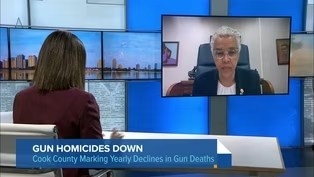
Gun homicides have decreased by more than 50% since 2021.
Marking several consecutive years of decline.
Cook County Board.
President Toni Preckwinkle says those games are partly driven by the county's investments community violence prevention programs.
Last Wednesday.
The prep liquid Ministration announced an additional 20 million dollars for street outreach case management and victim services.
Joining us to break down the investment is Cook County Board.
President Toni Preckwinkle.
Welcome back.
Madam President, thanks for joining us.
You're not good evening.
So walk us through, please what?
This new 20 million dollar investment will be for.
How will it be used?
>> Well, first of all, I want to express my concern and sympathy for those who are victims of gun violence.
You know, it's a it's a terrible tragedy and impacts families and communities more broadly.
So I think we need to understand that every shooting is one too many.
We've invested a lot of money over the last 5 years in violence, prevention work, community violence, intervention in particular, having outreach workers in the streets to tamp down the violence that sometimes follows in retaliation to a shooting and to work with those who are at high risk of being involved in violence to provide them with job training, to provide them with behavioral health, supports to provide them with.
Housing.
If need be.
So we're working with a variety of of community-based organizations that are involved in violence, prevention work and the 20 million dollars was an investment in in the outreach workers who to the dangerous and difficult work of trying to tamp down violence and some of our most struggling neighborhoods.
>> We hear about that work and get a lot of it.
Madam President, we know is done by community organizations doing that sort of community violence, intervention, work.
We give us some examples of if you would up organizations that will be receiving that funding and the kind of work that they do.
>> Want to talk about the kind of work that's done.
Some of it is with those who are coming out of jail or prison to help them find a more productive path to support them in their journey to productive being productive members of the community.
Some of that goes to young people who are just as involved to try to be sure that they could.
They have the opportunity to straighten out their lives.
Some of the goes to the outreach workers that I mentioned earlier.
But the whole point of the of the investment is to try to provide wrap-around services for those who need them and might be at risk of being either the victims or perpetrators of violence.
>> of course, as we mentioned, gun homicides have decreased by more than 50% since 2021, how do we know that?
It is the the violence prevention funding and the work that you know, that gets funded by this money that that is the source of the decline.
>> Well, we we have a an academic partner in Northwestern University and Northwestern found in his research that those communities that receive the most violence intervention, investment.
So the biggest reductions in violent crime.
So we've done this work in partnership with academic researchers.
And that's what's been reported.
>> Are there geographic Lee?
Are there any neighborhoods are suburbs that are that are still a challenge?
>> Well, we have challenges across the city and county, but the point I think I would make is that there's a government alliance for safe communities, gas, and it involves the state and the city and the county.
And we're investing complimentary in a complimentary way rather than being duplicative in.
We've learned over the last 5 years.
What works?
And we're investing in what works.
>> These type of investments they were, you know, we know kick started by dollars from the American Rescue Plan Act Arpa.
And we know that.
I think it is through the end of this year that you have to spend those funds.
How much or do you believe that Cook County will be able to continue to support these efforts beyond the end of this year?
>> We've put aside money to continue to make investments in violence prevention because we know how critical it is to the communities that have been struggling with violence for so long.
So we're devoting county resources.
There's the federal funding diminished to to addressing community violence.
>> As we mentioned, you you all have been making these sort of similar investments in violence prevention since 2021, what is it about these meetings programs that let you know that you know, that they're working?
>> But we've seen this dramatic reduction in And that's that's the indication.
As I said, Northwestern University's researchers found that those communities where we invested Corey made the biggest investments.
saw largest reductions in violent crime.
So clearly there's a correlation between the investments we make in the violence reduction.
>> And while we have you, madam the county budget, your office is forecasting a 550 million dollar budget shortfall in 2027, the largest in 16 years.
And of course, a balanced budget.
A Cook county is something that that's been sort of a hallmark of your term.
There.
What would you say is the cause of that gap this time?
>> Well, first of all, I think it's important to remember that for 16 years we've balanced budgets.
We've strengthen our reserves.
We've improved our bond ratings.
We've gotten upgrades our bond ratings each year for the last 4 years.
And we're a historic product.
Progress on pension funding.
So that's put us in a good financial position to meet the president challenges.
And their challenge is not just for OS but for the city and the state as well.
Part of it is the the loss of the federal resources.
The American Rescue Plan Act resources.
As you pointed out earlier, part of it is rising costs for labor and for our pensions.
But it's also court decisions.
We've had some headfirst course decisions which have impacted.
The county potentially impacted the county significantly.
>> About 30 seconds left, what what do you think the plan might be going forward to bridge that gap?
>> But we're always going to look for efficiencies and we already instituted a call back to be sure that we meet our budget projections for 2026 and will be looking for efficiencies and to tighten our belts in in the the fiscal year.
Coming up 2027.
But it's going to be it's going to be difficult for us as it was for the state to balance our budget.
we've had a lot of experience with tough challenge.
Isn't and I know we'll make it through this one.
>> Cook County Board, President Toni Preckwinkle, thanks so much for joining us.
And we're back to wrap things up right after this.
>> In this Monday night, stay connected with our reporters and what they're working on by following us on Instagram at W T Tw Chicago and join us tomorrow night at 5, 30 10 author of the new book Crime Fiction's joins us to discuss wrongful convictions and Chicago's infamous place in that history.
Now for all of us here in Chicago Brandis Friedman, thank you for watching.
Stay healthy and safe.
We have a good night.
>> Closed caption is made possible by Robert, a clicker and Clifford law a Chicago personal injury and wrongful death that supports
 New
NewCook County Board President Toni Preckwinkle on Violence Prevention, Budget Gap
Video has Closed Captions
A Cook County push to invest in violence prevention programs. (6m 46s)
 New
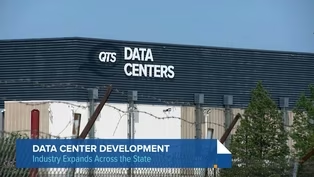
NewPublic Scrutiny on Data Centers Increases as Construction Push Accelerates
Video has Closed Captions
New efforts to regulate data center development in Illinois. (12m 4s)
Providing Support for PBS.org
Learn Moreabout PBS online sponsorship New Episode
- News and Public Affairs

Top journalists deliver compelling original analysis of the hour's headlines.
 New Episode
- News and Public Affairs

Today's top journalists discuss Washington's current political events and public affairs.


 New Episode
 New Episode
 New Episode
 New Episode
 New Episode
 New Episode
 New Episode
Support for PBS provided by:
Chicago Tonight is a local public television program presented by WTTW
WTTW video streaming support provided by members and sponsors.