
June 23, 2024 - PBS News Weekend full episode
6/23/2024 | 26m 44sVideo has Closed Captions
June 23, 2024 - PBS News Weekend full episode
June 23, 2024 - PBS News Weekend full episode
Problems playing video? | Closed Captioning Feedback
Problems playing video? | Closed Captioning Feedback
Major corporate funding for the PBS News Hour is provided by BDO, BNSF, Consumer Cellular, American Cruise Lines, and Raymond James. Funding for the PBS NewsHour Weekend is provided by...
June 23, 2024 - PBS News Weekend full episode
6/23/2024 | 26m 44sVideo has Closed Captions
June 23, 2024 - PBS News Weekend full episode
Problems playing video? | Closed Captioning Feedback
Where to Watch PBS News Hour
PBS News Hour is available to stream on pbs.org and the PBS app.
Providing Support for PBS.org
Learn Moreabout PBS online sponsorshipJOHN YANG: Tonight on PBS News Weekend, how one state is trying to help teenagers transition from foster care into adulthood.
Then the unregulated shadow industry charging veterans to help make disability claims despite a federal law bargain.
And how researchers and medical experts are trying to better understand why every year as many as a million pregnancies in the United States end in miscarriage.
WOMAN: All of us end up blaming ourselves.
I did that myself and I am a specialist in this field.
But most of the time, it's not your fault.
It's not something you did.
(BREAK) JOHN YANG: Good evening, I'm John Yang.
Palestinian saying Israeli airstrike on a United Nations aid distribution site in Gaza City has killed at least eight people.
The Israeli military said Hamas and Islamic Jihad had been operating from the building.
Palestinian witnesses said those killed were either sheltering at the site or had gone there to get water or other aid.
It came as Israeli Prime Minister Benjamin Netanyahu doubled down on his complaints about the Biden administration support.
BENJAMIN NETANYAHU, Prime Minister, Israel (through translator): About four months ago, there was a dramatic decline in arm supplies from the U.S. to Israel.
Over long weeks, we have turned to our American friends with a request to speed up deliveries.
We did it time and again.
JOHN YANG: Israeli Defense Minister Yoav Gallant and Netanyahu rival is to meet in Washington this week with Biden administration officials.
The White House has denied any slowdown in weapons shipments.
The Saudi Arabian health minister said that more than 1,300 Muslims making this year's Hajj pilgrimage died amid scorching heat.
Able bodied Muslims are required to make the journey to holy sites around Mecca at least once in their lifetime.
More than half of those who died came from Egypt, leaving Egypt to revoke the licenses of 16 travel agencies for failing to provide adequate services or protection from the heat.
At least two Americans were among the dead.
Police in Arkansas said they believed the victims of a grocery stores shooting were targets of opportunity.
The motive and Friday shooting and Fordyce a small town south of Little Rock remains a mystery.
14 people ranging in age from 20 to 81 were shot for them fatally.
The suspect has been charged with capital murder.
And star American sprinter Sha'Carri Richardson is headed to the Paris Olympics.
The winning time and last night's women's 100 meter Olympic trials in Eugene, Oregon, was the world's fastest so far this year.
In 2020 Richardson won the Olympic trials but was banned from the Tokyo Games after testing positive for THC.
Still to come on PBS News Weekend, the search for answers to why pregnancies end in miscarriage and how 1/9 grader is helping restore Mississippi's oyster reefs.
(BREAK) JOHN YANG: On any given day in the United States, more than 400,000 children are living in foster care.
And each year nearly 20,000 of them become adults too old for the system that leads them without the support of a guardian or government assistance.
In Arizona lawmakers have passed and sent to the governor a measure creating a pilot program to help teenagers and fun foster care find safe and permanent homes before they age out Darcy Olson is the founder and CEO of the Center for the Rights of Abused children.
Darcy, you're not only an advocate for foster children, but also your foster mother, yourself, children who aged out of the system, what are they facing when they aged out of the system.
DARCY OLSEN, Center for the Rights of Abused Children: But we all know that children should be growing up in families.
And there are so many reasons for that.
And kids who age out are a testament as to why our families are so important.
Most of those kids will disproportionately become homeless, pregnant before they would like to be, they will be unemployed, and they will fill our prisons.
JOHN YANG: And of course, they're beginning their adult lives that must have an impact on their lives further on.
DARCY OLSEN: Well, it's devastating for children.
And, you know, this program that we have passed in Arizona should reduce the number of children aging out of the system by about 30 percent.
So you're talking about 5,000 or 6,000 children a year, teenagers 1617 and 18.
Having families who otherwise wouldn't.
JOHN YANG: Explain this plan in Arizona, how does it work?
How do you prevent these children from aging out?
DARCY OLSEN: Well, the Arizona plan is based on a model from Georgia that was studied and worked very well.
And what we will be doing in Arizona is the system will red flag kids who look like they're at risk of aging out and there are a lot of ways to determine that.
But if you're 16 years old, and you're in the system, there's only a 5 percent chance you're going to get a family.
So we know for sure, it'll be a lot of the older children who have lingered in the foster care system.
Once they're identified, we will build a team around them, psychiatrists, attorneys, private investigators, the private investigators, for instance, will look for any relatives that might not have been identified when the child first came into the system.
And you build this team around the child and you are meeting monthly, you are talking weekly, and you are supercharging your efforts to find a home for this child.
So it's critical that we implement programs like this and really incentivize the government to step up and make it happen for these kids.
JOHN YANG: And the ideal in foster care is that they are eventually adopted or are eventually reunited with family members?
DARCY OLSEN: 100 percent.
When you go into foster care for temporary safety, the goal is hopefully you can go home, you know, they hope that it's a situation that can be remedied.
If it is a situation that can't be, they're going to look for relatives, aunt, uncle, sister wherever they can, if they can't take you, then they're going to look for a foster family.
So I as a foster mother, foster 10 that little ones, and then four of them needed to stay forever because no family or kin came forward.
And that's pretty much what happens nationwide.
So this program will help them will help build a bridge to those families.
JOHN YANG: May ask what happened to those foster children, you were fostering, who said had to stay forever?
DARCY OLSEN: Well, the ones who stayed forever, they're mine.
Now, you know, my car smells like feet and French fries like any other mom's car.
And the other six went on to find almost all two relatives and one took a special placement with a special family.
JOHN YANG: You said that the model for the Arizona program was Georgia, are there other states that have similar programs?
DARCY OLSEN: We're not aware of any states that have been as successful as Georgia in reducing the number aging out or increasing the number of children who get families.
And so we thought this was the best model out there.
Hopefully we can do even better than Georgia learning and you know, standing on their shoulders.
And we believe that there is a home for every child and that it is simply the government's job to build that bridge, build that bridge from these children in need to the loving and Safe Families who would love nothing more than to take them in and give them a great home and family.
JOHN YANG: Are there other states that are looking at programs like this?
Are you pushing for programs like this and other states?
DARCY OLSEN: We're taking this all over the country.
So we hope to see most state legislatures open in January.
So we hope to see many of them and many of their governors introducing this program, JOHN YANG: Darcy Olson of the Center for the rights of abused children.
Thank you very much.
DARCY OLSEN: Thank you so much.
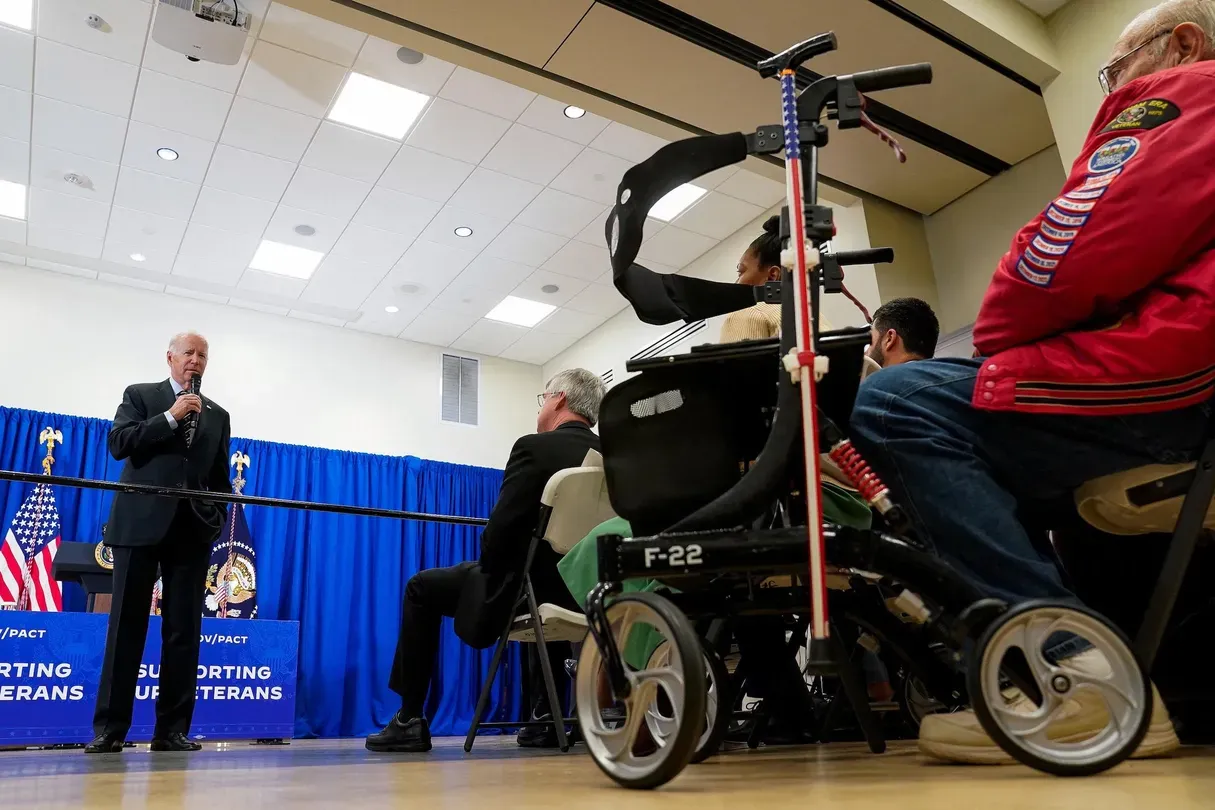
JOHN YANG: In the two years that the landmark expansion of veterans benefits known as the PACT Act has been in effect, more than 1 million disability claims have been approved and more on the way but as Lisa Desjardins reports a number of more profit companies are also reaping benefits even though what they do is against the law.
LISA DESJARDINS: The bipartisan PACT Act is the largest expansion of veteran's benefits in a generation, including care for veterans exposed to burn pits.
Some 3.5 million people could benefit, and the program could near $1 trillion in spending.
As the disability claims grow, so have the profits of private firms pledging to help those with claims.
That's despite a federal law banning companies from charging vets for those types of services.
According to a Washington Post report, scores of uncredited for profit companies are making hundreds of millions of dollars helping veterans file disability claims.
Patrick Murray is legislative director at the Veterans of Foreign Wars.
And, Patrick, let's just back up.
How is it that these firms are making money off of this work with veterans?
PATRICK MURRAY, Veterans of Foreign Wars: What they do is falsely offer veterans hope that they can get their claims done better and faster if you pay for it.
As you mentioned, it is illegal, but right now there's no penalty for actually breaking the law.
In 2006, that was removed.
So these companies are operating in a legal loophole that allows them to charge exorbitant fees and not be held accountable.
LISA DESJARDINS: That's really odd to have a lawyer with no sort of penalty or criminal punishment.
We've talked about this PACT Act before, but the idea that the federal government is prohibiting anyone from charging these benefits.
We see that the companies involved, however, are advertising as if this service was legal.
For example, here's a company that the Washington Post mentioned in their story that offers sometimes a level of free advice, sort of as an entryway, and then later on, as you see here on this page, would charge a price, sometimes a percentage of any benefits that someone would get.
How is it that they're able to operate even if there's not a penalty without anyone kind of overseeing this?
Is this about the bureaucracy at the VA or what's happening?
PATRICK MURRAY: So actually, VA has sent multiple demand letters to these companies telling them to stop.
So it is illegal.
And the agency of jurisdiction, the Department of Veteran Affairs, is telling them what you're doing is illegal.
However, sternly worded letters are about as far as they can go because the criminal penalties were removed in 2006.
LISA DESJARDINS: I'm not sure everyone realizes how large the PACT Act is.
Does this kind of misconduct and illegal activity?
Does it predate the PACT Act?
Did it grow because of the PACT Act?
Help us with what's going on now.
PATRICK MURRAY: It did predate the PACT Act.
Many of the larger companies operated for years.
The PACT Act really amplified what it is that they're looking to take from veterans.
VA just recently announced their 1,000,000th PACT Act claim granted.
They're putting out so much more money into veterans' pockets, and these companies, a lot of unscrupulous actors around the country are seeing an opportunity to take a cut of that.
So it was happening.
The PACT Act really amplified that.
LISA DESJARDINS: You've been talking to veterans who've kind of fallen prey to this.
What's their experience been like?
What have they felt that they've gained or lost from this, and how is it that they've gotten involved with these companies?
PATRICK MURRAY: Many of these veterans that we've spoken to didn't know this is illegal, thought that this was just almost a fast tracked way to get things done.
Much like, you know, a passport, you can kind of pay a company to walk it through for you.
That's the way they advertise.
But that's not true.
Anybody, whether it's the VFW, a county service officer, an accredited agent or attorney, or any one of these claim sharks, once they submit your claim for you, it goes into VA. And VA adjudicates that as they come in, first come, first serve.
So the companies that say, if you give us 5, 10 upwards of $20,000 to get it done faster, it's a lie.
LISA DESJARDINS: Now, these companies, of course, have something to say as well.
Veterans Guardian is one of these for profit companies that offer services like this.
And in a statement that they sent us, they wrote, anyone who has filed a disability claim with the VA knows that the system is extremely onerous and time consuming, which has created a backlog of nearly 300,000 pending claims.
We believe that more options and expertise is necessary to clear the backlog and provide the benefits that veterans have rightfully earned.
Dealing with many of these kinds of systems, Social Security, Medicare, Medicaid, can, in fact, be owners, especially for seniors trying to navigate the system.
What's so wrong with having a service help them navigate?
PATRICK MURRAY: So what that statement is taking a real issue.
There are claims that is called the backlog.
It's currently taking about 150 days to go through the entire process for a veterans claim.
But what they're misleading people about is that anybody on the front end can, frankly make that any faster.
Our accredited service officers help veterans every single day.
But once we file, it's up to VA first in is how they actually look at these claims.
So just sending someone a bill afterwards doesn't make the service any faster.
LISA DESJARDINS: But could it help them understand what documents they need, how to get those documents to the VA?
That can be complicated.
PATRICK MURRAY: It can.
And that's what we tell every veteran we work with.
Make sure you have all your documents ready to go.
Whether you work with someone like the VFW or you do it on your own, being armed with all the information ahead of time is the best way to get your claim process as effectively as possible.
LISA DESJARDINS: Is there any sign that these agencies are perhaps pushing peoples whose claims aren't valid?
PATRICK MURRAY: Yes, we know that VA is rejecting some of the claims of these folks, they'll ask a veteran in California to speak to a mental health professional in South Carolina.
30 minutes later, they get you know, what's called a Nexus letter for PTSD for someone they've never spoken to.
VA's rejecting those.
So they're sending people to doctors, often in their own networks that they have financial ties with, and the appointments are worth the paper they're written on, because VA is just rejecting them outright.
LISA DESJARDINS: What advice do you have for veterans about how to approach this?
PATRICK MURRAY: What we try to tell everybody is, you know, do your homework first, right, whether it's work with the VFW, work with another organization like the DAV or your county or state service officer, or on your own.
There's resources out there, some of these companies in their contracts even say that their expertise is the same as publicly available information.
It's out there for everybody.
There are so many people looking to help veterans for free and like the VFW regardless of membership, for free.
So that's what we want people to do, armed themselves with the most information beforehand.
LISA DESJARDINS: Patrick Murray, thank you for this and for your service.
PATRICK MURRAY: Thank you.
JOHN YANG: Every year in the United States, about 1 million pregnancies end in a miscarriage, and in as many as half of those cases, doctors are at a loss to explain why they happened.
Experts say stigma and shame are hampering efforts to learn more about what causes miscarriages, NewsHour Deputy Senior Producer Courtney Norris looked into this for a very personal reason.
COURTNEY NORRIS: As many as one in four pregnancies in America will ended a miscarriage but we still know little about why I experienced this firsthand.
When I miscarried earlier this year, doctors couldn't give me a reason.
Experts say research on the issue is lagging.
DR. ZEV WILLIAMS, Columbia University: It is by far the most common complication of pregnancy.
Yet most people think it's very rare.
And a big part of that is there is such a reluctance to even speak about it.
COURTNEY NORRIS (voice-over): I turned to experts like Dr. Zev Williams with Columbia University's Irving Medical Center, and Dr. Diana Bianchi, the director of the National Institute of Child Health and Human Development.
DR. DIANA BIANCHI, National Institute of Child Health and Human Development: What's different about miscarriage is the guilt factor.
You know, why couldn't I continue this pregnancy?
In my former practice, people came up with all kinds of explanations why they lost the pregnancy, and probably none of them were true.
COURTNEY NORRIS: One problem and miscarriage research is the stigma that comes with the loss.
Dr. Asima Ahmad is an OB/GYN who herself miscarried.
DR. ASIMA AHMAD, OG/GYN: All of us end up blaming ourselves.
I did that myself and I am a specialist in this field.
But most of the time, it's not your fault.
It's not something you did.
There are other reasons for pregnancy loss, but the majority are genetic and you will have control over it.
COURTNEY NORRIS: While most miscarriages occur due to chromosomal abnormalities.
Little is known about other potential reasons.
ZEV WILLIAMS: There is still this black box area where pregnancy losses occur.
And we don't know why those are happening.
And that's a big area of investigation.
COURTNEY NORRIS: Part of the problem is the stigma around discussing pregnancy loss despite the fact that it's the most common pregnancy complication.
DIANA BIANCHI: It's not something that people are willing to share.
It's often kept as a family secret.
In many cultures, it is particularly important for a woman to be fertile and any discussion of anything that doesn't result in a live born baby is not encouraged.
COURTNEY NORRIS: Another reason science is behind on miscarriages, she says is how hard it can be to connect with patients when they lose a pregnancy.
DIANA BIANCHI: With a miscarriage, particularly in early miscarriage, it's quite difficult to collect the material to study.
So oftentimes, the first indication that there's a miscarriage is there's bleeding, and one may not recognize that they're actually passing tissue.
COURTNEY NORRIS: Finally, it's difficult to get participants for clinical trials for new treatments.
ZEV WILLIAMS: There is a greater willingness to participate in studies, but a reluctance to be randomized to a placebo group to not receive treatment.
And so that I think is a very real limitation to the interventions that we send to sort of conducting the rent the rigorous randomized control trials that we ideally would like to perform.
COURTNEY NORRIS: While the science catches up.
Dr. Ahmad says there are ways to support people who miscarry from friends checking in to employers giving time off after a pregnancy loss.
ASIMA AHMAD: Even if it's really early on in pregnancy versus like it was a 25 week loss, it can still be hard for that person, so giving them that time to be with their family heal.
COURTNEY NORRIS: And one hopeful thing research does show many women who miscarry go on to have full term pregnancies.
COURTNEY NORRIS (voice-over): For PBS News Weekend, I'm Courtney Norris.
JOHN YANG: Over the past two decades, the oyster population in Mississippi's Gulf waters has been devastated by natural and manmade disasters, including Hurricane Katrina, and the Deepwater Horizon oil spill.
Among those working to restore oyster habitats, called oyster reefs is a ninth grader named Demi Johnson.
The National Geographic Society recently recognized her work over the past two years, growing more than 1,000 oysters.
And those oysters are likely to spawn millions more in the years to come.
Recently, I spoke with Demi and asked her what goes into an oyster farm.
DEMI JOHNSON: First, you obviously oysters and appear to do it off of and you need cages.
And you need to be able to do weekly maintenance on these wasters.
JOHN YANG: What does it take to sort of raise oysters?
I mean, you don't plant them, you don't put them in the in the crowd like seeds, how does it work.
DEMI JOHNSON: So you're going to put oysters in a cage, and then you're going to have a room and you're going to tie it to the outside part of a pier.
And naturally, if you were to drop these cages in, well, they're tucked up, they're going to be just kind of in the water.
Honestly, when it comes to like maintaining or taking care of once a week is fine, just to shake the cages and to get the critters out because they are seen as a food source to other animals.
Once I'm done with the oyster gardening, they are dumped out into another area and they start to become their own reef.
JOHN YANG: How did you get started this?
How did you get interested in it?
DEMI JOHNSON: So I found out about this to my Girl Scout troop simply from my Girl Scout leader.
So there's a thing called a silver award and you have to do a project for your community, something community based, and she just kind of put it up in the air.
She was like, Hey, you can do Oestergaard and get my peer.
And I was like, okay, I'll do it.
Like, it doesn't sound too bad.
And you know, it's something easy for me to do.
JOHN YANG: And then a researcher at Auburn University, found out about you I understand, and it has actually become a mentor, what have you gotten out of working with her?
DEMI JOHNSON: I find a bunch of information about oyster gardening.
So when I first started oyster gardening, or storing this product, I had no clue about this, I only thought oysters can be eaten.
I didn't know they can be used for restoration.
So I was able to learn a lot through her.
And she was able to keep in contact with me.
And I've been able to learn more and more and more opportunities have been given to me.
JOHN YANG: When this began, you really had no idea about this, and you've learned a lot.
What's the coolest thing you've learned?
DEMI JOHNSON: I think the coolest thing I've learned is that oysters actually serve as a filter in the water.
I did not know that.
And they actually can serve as a home to over 300 species in the water.
So that's just typical.
JOHN YANG: How does it make you feel that you're, you're teaching people about this?
DEMI JOHNSON: It's really cool, because I went from having little to no background about this topic to knowing a lot more than I did.
So I just think that's like super cool.
And I'm happy that people want to learn more.
JOHN YANG: Where does this project go from here?
DEMI JOHNSON: Well, in September, oyster season will be starting.
And I'm going to go from five cages like I did last season to nine cages.
So just expanding.
JOHN YANG: As this affected what you think you might want to study in college and maybe what you want to do as a career?
DEMI JOHNSON: Yes.
So I want to attend University of Michigan and specifically I want to major in environmental law.
And once I'm done with that career rise, I want to represent environmental groups.
JOHN YANG: Demi Johnson, oyster farmer, thank you very much.
Now online ahead of this week's first presidential debate of 2024, a new poll finds that many Americans aren't happy with either of the leading candidates.
All that and more is on our website pbs.org/newshour.
And that is PBS News Weekend for this Sunday.
On Mondays PBS NewsHour with the depletion of the Great Plains Aquifer means for the agriculture industry.
I'm John Yang.
For all my colleagues, thanks for joining us.
Have a good week.

How private firms profit from veterans’ disability claims
Video has Closed Captions
What to know about the private firms illegally profiting from veterans’ disability claims (7m 6s)

How to reduce the number of teens aging out of foster care
Video has Closed Captions
How Arizona aims to reduce the number of teens aging out of foster care (5m 7s)

Ninth grader helps restore Mississippi’s oyster reefs
Video has Closed Captions
Meet the ninth grader who’s helping restore Mississippi’s oyster reefs (4m 17s)

Why little is known about what causes many miscarriages
Video has Closed Captions
Why little is known about what causes many pregnancies to end in miscarriage (4m 4s)
Providing Support for PBS.org
Learn Moreabout PBS online sponsorship
- News and Public Affairs

FRONTLINE is investigative journalism that questions, explains and changes our world.
 New Episode
- News and Public Affairs

Today's top journalists discuss Washington's current political events and public affairs.
 New Episode
 New Episode
 New Episode
 New Episode
 New Episode
 New Episode
 New Episode
 New Episode
 New Episode
Support for PBS provided by:
Major corporate funding for the PBS News Hour is provided by BDO, BNSF, Consumer Cellular, American Cruise Lines, and Raymond James. Funding for the PBS NewsHour Weekend is provided by...