
June 24, 2023 - PBS News Weekend full episode
6/24/2023 | 26m 45sVideo has Closed Captions
June 24, 2023 - PBS News Weekend full episode
June 24, 2023 - PBS News Weekend full episode
Problems playing video? | Closed Captioning Feedback
Problems playing video? | Closed Captioning Feedback
Major corporate funding for the PBS News Hour is provided by BDO, BNSF, Consumer Cellular, American Cruise Lines, and Raymond James. Funding for the PBS NewsHour Weekend is provided by...
Support provided by:

June 24, 2023 - PBS News Weekend full episode
6/24/2023 | 26m 45sVideo has Closed Captions
June 24, 2023 - PBS News Weekend full episode
Problems playing video? | Closed Captioning Feedback
How to Watch PBS News Hour
PBS News Hour is available to stream on pbs.org and the free PBS App, available on iPhone, Apple TV, Android TV, Android smartphones, Amazon Fire TV, Amazon Fire Tablet, Roku, Samsung Smart TV, and Vizio.
Providing Support for PBS.org
Learn Moreabout PBS online sponsorshipJOHN YANG: Tonight on PBS News Weekend, an attempted armed rebellion inside Russia threatens President Vladimir Putin's two decades in power.
Then, one year after the Supreme Court overturned Roe v. Wade, we examine the current state of abortion access in America.
WOMAN: I would describe the landscape when it comes to abortion access in America today as chaotic and fluid.
The harder it is to figure out where law and politics are going, the more frightened people become.
JOHN YANG: And more Americans who rent are facing eviction now that pandemic protections have expired.
(BREAK) JOHN YANG: Good evening.
I'm John Yang.
It has been a tumultuous day in Russia.
Late this afternoon, Wagner mercenary group founder, Yevgeny Prigozhin ordered an about face in his advance on the capital city of Moscow.
His forces were on the move earlier today after taking control of Rostov-on-Don a city near the Ukrainian border that's a Russian military headquarters.
Yevgeny Prigozhin said he stopped his forces just hours short of Moscow to save Russian lives.
He explained in an audio message.
YEVGENY PRIGOZHIN, Wagner Group Founder (through translator): In the last 24 hours, we have got to within 200 kilometers of Moscow.
We didn't spill a single drop of our fighter's blood.
Now the moment has come when blood could be spilled.
Understanding responsibility for the chance that Russian blood could possibly be spilled one side, we are turning our columns around.
JOHN YANG: Earlier, Russian army soldiers and Wagner group mercenaries had prepared for a clash.
Russians ready to fight Russians.
Wagner group forces had been barreling toward Moscow hours after they had seized Rastov-on-Don.
Prigozhin called it retribution for what he claimed were Moscow's attacks on his fighters in Ukraine.
YEVGENY PRIGOZHIN (through translator): We have taken Rostov's military objects under our control, including an airfield.
There are no issues.
So when we are told that Wagner has interfered and that something has collapsed on the front lines, we are not the reason for that collapse.
JOHN YANG: Russian helicopters attacked Wagner vehicles as they headed north through the city of Voronezh.
Prigozhin accused the Russians of firing on civilian targets, including a fuel depot, to slow his advance.
Russian President Vladimir Putin accused Prigozhin of staging a coup.
VLADIMIR PUTIN, Russian President (through translator): We won't allow a repeat of a civil war.
What we are facing now is treason.
Unreasonable ambitions and personal interest lead to treachery, state treason and betrayal of one's own people.
JOHN YANG: In an audio message, Prigozhin said he and his forces were Russia's true defenders.
YEVGENY PRIGOZHIN (through translator): As for betraying the motherland, the president is deeply mistaken.
We are patriots of our motherland.
We have fought and we are fighting everyone from the Wagner private military company.
JOHN YANG: Prigozhin has been a vocal critic of Russia's military leaders, including Defense Minister Sergey Shoigu and Military Chief of Staff Valery Gerasimov.
YEVGENY PRIGOZHIN (through translator): We have a 70 percent shortage of ammunition.
Shoigu, Gerasimov, where is the ammunition?
Look at that.
JOHN YANG: As tensions between the two Russian factions escalated, Ukrainian President Volodymyr Zelenskyy posted a taunting tweet, today the world saw that the bosses of Russia do not control anything.
JOHN YANG: Late today, the Kremlin said it will drop all criminal charges against Prigozhin and that he will move to Belarus.
That country's president, Alexander Lukashenko brokered the deal that defused the rebellion.
Candace Rondeaux is the senior director for the Future Frontlines Program at the think tank New American.
She's writing a book on the Wagner group.
Candace, what was it that Yevgeny Prigozhin wanted, and did he achieve any of it?
CANDACE RONDEAUX, New America: Well, he certainly achieved attention getting.
I think he had the attention of the entire world today with his march for justice from Rostov-on-Don up to Moscow, at least toward Moscow.
The demand was apparently an explanation for why Putin and Russia's military leaders were fighting the war so poorly and why so many men had died on Putin's watch during these last few days as the Wagner group has pressed forward in Ukraine.
JOHN YANG: He seemed to be doing so well.
I mean, he seemed to have planned this, and it was going so well.
Why do you think he stopped?
What was the pressure on him to stop?
CANDACE RONDEAUX: Well, this has been just a non-stop drama from the moment that he made his declaration that apparently Russian forces had attacked a group of Wagner forces near the Southern Military District area near Ukraine and the border of Rostov-on-Don.
And that was some sort of precipitating action.
And then we saw him moving north with apparently thousands of troops, tanks, infantry, you know, fighting vehicles.
I think what he achieved today was insulation from what would have been maybe his inevitable downfall had the Wagner group been brought under the control of the Ministry of Defense, which was another precipitating cause.
Just last week, Sergei Shuigu, the Minister of Defense, called for complete unity command, and that is for all Wagner group and volunteer forces to be under the control of the Kremlin of the Ministry of Defense.
And you know, Prigozhin immediately raised objections to that very loudly.
And so this march seems to have been designed to forestall that.
And he seems to have once again slipped the noose, so to speak, and moved to Belarus for safety.
As for a safe harbor.
JOHN YANG: Tell us a little bit about who Yevgeny Prigozhin is and is taking a high risk gamble rolling the dice like he did.
Is that characteristic of him?
CANDACE RONDEAUX: Absolutely.
This is a guy who, as a young man, trained as a cross country Olympic skier, didn't luck out because of a couple of different things that happened.
He had an injury as a young man, turned to a life of crime, spent 10 years behind bars, while most of the rest of his contemporaries actually fought on the front lines in the Soviet war in Afghanistan.
So he has that in common with Putin.
He did not go to the front lines of Russia's biggest war other than, of course, Chechnya and this war.
And when he got out of jail, out of prison, he turned himself around and became an entrepreneur of upscale food restaurants, big bistros in St. Petersburg.
He was, of course, often connected with Putin because there are a few places at that time in the 1990s in St. Petersburg where you could actually have a good and upscale meal and Putin became sort of a patron.
But there were other patrons that have been operating in the shadows for Prigozhin for many years that people forget, people close to Putin, like Gennady Timchenko, the head of Volga Group, Sergey Chemezov, the head of Rostec, Russia's largest arms dealer.
So that kind of relationship, those sets of relationships, have helped Putin give Prigozhin the path he needs to take the kinds of risk that he did over these last couple of days, as we've seen over the last year and a half.
JOHN YANG: Prigozhin, as I said, was highly critical of the way this war was being fought.
Other critics have been pursued and dealt with, but Putin seemed to allow him to go on.
What does this say about his relationship with Putin and then his turn in the last couple of days seemingly opposed Putin?
CANDACE RONDEAUX: Well, it is hard to imagine a situation of this kind unfolding in any other country in the world other than Russia.
The only maybe other comparisons, maybe North Korea, but even that seems a bit of a stretch.
I think what we saw today was something nobody would have believed.
First, Putin threatening to deal brutally with the mutineers who mounted this kind of rebellion, a revolt against his regime, these mercenary fighters, and then suddenly within 8 hours, there's kind of a turnaround.
Doesn't matter, you're all good.
Just, you know, move next door and wait to see what happens.
I think there is something a little bit strange about this outcome and I don't think we've seen the last of Mr. Prigozhin and I don't think for Putin he comes out of this looking good or smelling like roses.
JOHN YANG: Candace Rondeaux of the New America Think Tank.
Thank you very much.
CANDACE RONDEAUX: Thank you.
JOHN YANG: More violence on the West Bank today is a Palestinian gunman fired on an Israeli military checkpoint before security guards killed him.
Palestinians have accused Israeli settlers on the West Bank of mob attacks on Palestinian villages, setting fire to homes and shooting at civilians.
It's the latest in a week of deadly clashes in one of the deadliest years in the West Bank in over a decade.
At least 137 Palestinians and 24 Israelis have been killed so far this year.
It's putting pressure on Israel's far right governing coalition to bring calm.
And in Florida, a federal court has temporarily blocked a new state law that bans minors from attending adult live performances like drag shows.
The law, which took effect in May, won't be enforced until a trial is held to decide whether it's constitutional.
Florida Governor Ron DeSantis's office says the state will appeal.
Still to come on PBS News Weekend, a look at the current state of abortion access in America, one year after Roe v. Wade was overturned.
And more Americans are facing evictions as rents rise and affordable housing is in short supply.
(BREAK) JOHN YANG: It was a year ago today that the Supreme Court overturned Roe v. Wade, erasing the nearly half century old constitutional right to seek an abortion.
It was a tectonic shift, leaving it up to each state to decide whether abortions would be legal within its borders.
Now, as the 2024 election looms, abortion is shaping up to be a key issue.
In Charlotte, North Carolina, vice President Kamala Harris told abortion rights supporters today that their cause was not unlike the civil rights movement of the 1960s.
KAMALA HARRIS, U.S. Vice President: We all of us are now called upon to advance the promise of freedom, including the freedom of every woman to make decisions about her own body, not the government, telling her what to do.
JOHN YANG: In Washington, DC her predecessor, former Vice President Mike Pence, spoke at antiabortion rally at the Lincoln Memorial.
He called for a nationwide ban on abortion.
MIKE PENCE, Former U.S. Vice President: Gather here knowing that we've not come to the end of this cause.
We will never rest and never relent until we restore the sanctity of life to the center of American law in every state in the land.
JOHN YANG: Ali Rogin looks at the current state of abortion access in America.
ALI ROGIN: When the ruling came down, the reactions were immediate and passionate supporters of abortion rights mourned.
WOMAN: I was disgusted because abortion is health care.
I mean, you can die giving birth.
We don't even have universal health care.
Women are going to go into debt giving birth, and it's a health care issue.
ALI ROGIN: Opponents celebrated.
WOMAN: This has been by far the best way of my life.
It just -- there's now hope for the women and children who have been hurt and killed by abortion.
ALI ROGIN: Following the Dobbs decision, abortion bans in 13 states immediately took effect, restricting access to abortion.
Some states, like Texas, banned abortions with almost no exceptions, and the penalties are severe.
Under Senate Bill 8, anyone caught helping someone access an abortion can be sued, and the state trigger laws criminalize doctors performing the procedure.
They risk losing their medical license, $100,000 fine and prison time.
One study revealed that the average travel time for an abortion increased from 28 minutes in 2021 to over an hour and a half in 2022.
A separate study found that in the first 100 days post-Roe, 66 clinics across 15 states were forced to stop performing abortions.
But the clinics that stayed open saw an influx of out of state patients.
DR. Gabrielle Goodrick, Family Physician, Camelback Family Planning: We had a woman travel from Oklahoma.
We've had women travel from Louisiana and Texas coming here.
If were closed, where would they go?
ALI ROGIN: One case crystallized the new reality post-Roe that of a ten year old rape victim from Ohio who had to travel to Indiana for an abortion.
Mary Ziegler is a legal historian and constitutional law professor at the University of California.
MARY ZIEGLER, University of California, Davis School of Law: The idea of a ten year old child being sexually assaulted and then denied access to abortion seemed to, I think, many conservatives, to be kind of just a scare tactic, not something that we would see in real life.
And the fact that it happened so quickly, I think, was a reminder that the America we live in now is very different than the one before the Supreme Court reversed Roe v. Wade.
JOE BIDEN, U.S. President: These are the laws that not only put women's lives at risk.
These are the laws that will cost lives.
What we're witnessing is a giant step backwards in much of our country.
ALI ROGIN: As pressure mounted, President Biden signed executive orders to help preserve access to abortion, medication and emergency contraception.
But their impact was limited, says Tracy Weitz, the director of the Center on Health, Risk and Society at American University.
TRACY WEITZ, American University: Executive actions are incredibly important.
They're symbolically important, and they make small differences.
But only Congress and state legislatures can secure the right to abortion for people in the United States.
MARY ZIEGLER: President Biden can't tell the Supreme Court how to interpret the Constitution, and the courts themselves, especially the U.S. Supreme Court is very conservative now, and so I think that's made the Biden administration cautious and potentially with reason.
ALI ROGIN: Grassroots activists and abortion rights groups came up with ways to get around the new laws.
One California doctor proposed a floating abortion clinic in the Gulf of Mexico.
Planned Parenthood launched a mobile abortion unit in the Midwest.
And the healthcare company, Just the Pill, which delivers abortion medication, launched a mobile clinic in Colorado.
It parks near the border with states where abortion access is restricted to let visitors access pills.
But access to one of those pills came under threat in April.
A federal judge in Texas ruled that the drug mifapristone had been improperly cleared for use by the FDA 20 years earlier.
For now, providers can still prescribe mifapristone as they wait for a decision from a federal appeals court.
Meanwhile, abortion began playing a major role at the ballot box.
Kansas voters were the first to weigh in on post-Roe policy last August.
They rejected an amendment to the state's constitution that would have said it did not guarantee the right to an abortion.
Critics said it was meant to curtail abortion rights in a state where the procedure was legal until 22 weeks.
MARY ZIEGLER: Kansas is a conservative state that generally elects Republicans.
America is so divided and so partisan that it was the first time we got a chance to see what voters would do if presented the abortion issue directly, rather than asked, do you want a Republican or a Democrat?
This is just a straight up and down.
What do you think about abortion rights in your state?
And what we learned from that was pretty revealing.
ALI ROGIN: Abortion remained a major issue throughout the midterm elections.
Voters in California, Michigan, Vermont, and Kentucky enshrined abortion protections in their state constitutions.
In six states, new abortion bans have been blocked by state and county judges.
And the debates over abortion access aren't falling entirely on partisan lines.
In South Carolina, five women senators, including three Republicans, formed a filibuster to stop a six-week abortion ban, but they failed to block it, and the bill became law in May.
SEN. MIA MCLOED, South Carolina: It's so disheartening to think that 41 men in this body can make decisions for women and girls that will impact women and girls across our state for generations to come.
ALI ROGIN: Today, abortions at any stage are still banned in 14 states.
Georgia does not allow abortion after six weeks, Nebraska after 12 weeks, Arizona and Florida after 15 weeks, Utah after 18 weeks, and North Carolina after 20.
TRACY WEITZ: The vast majority of abortions in the United States are to people who face the structural inequities of our country.
That is, people who are low income and people of color.
And that's because of long standing inequalities in access to health care.
And those are also the people who struggle with having to travel, with having to take time off, with having to find additional resource, financial resources, to get to a state that could be thousands of miles away in order to have an abortion.
ALI ROGIN: Now, a year after Roe v. Wade was dismantled, the United States is a patchwork of abortion laws.
MARY ZIEGLER: I would describe the landscape when it comes to abortion access in America today as chaotic and fluid.
And chaos means confusion for patients, right?
It means confusion for doctors.
The harder it is to figure out where law and politics are going, the more frightened people become.
ALI ROGIN: And as states decide what happens next, many women are forced to navigate that chaos.
For PBS News Weekend, I'm Ali Rorgin.
JOHN YANG: Now that the Pandemic's renter protection programs have expired, eviction filing rates are soaring.
Princeton University's Eviction Lab says that in some cities, the average weekly filings are more than 50 percent higher than they were before for the Pandemic.
One reason is the rising rents and a shortage of affordable housing for those with the lowest incomes.
The National Low Income Housing Coalition says that to afford a modest two bedroom apartment, someone working a 40 hours week needs to earn between $16 and $42 an hour.
That's much higher than the minimum wage in most states.
Diane Yentel is the CEO and president of the National Low Income Housing Coalition, which is an advocacy group.
Diane, is this rebound or surge in evictions?
Was this inevitable once these protections went away?
Or is there something else going on, other factors going on?
DIANE YENTEL, National Low Income Housing Coalition: You know, before the pandemic, we had about 10 million of the lowest income renters who were paying at least half of their very limited incomes towards rent just to keep a roof over their heads.
And of course, when you have such limited income to begin with, you're always one unexpected bill or financial shock away from missing rent, facing eviction, and in worst cases, becoming homeless.
But the federal government stepped in really in unprecedented ways and provided protections and resources that kept millions of renters stably housed who otherwise would have lost their homes.
But just as those protections were expiring and those resources were depleted, renters were reentering really a brutal housing market where rents were skyrocketing and costs across the board had increased, and the lowest income renters are being squeezed more than ever.
I'm talking about people who make less than 30 percent of the area median income.
So, for example, that's a family of four bringing in less than $25,000 in annual income.
Or it's an individual senior or a person with disabilities who has a limited twelve to $15,000 a year income.
So they have very little available to pay for rent and have enough money left over for all of life's other necessities.
And it's people of color who are most impacted and most harmed by the housing market.
Black, Latino and indigenous people are disproportionately extremely low income renters due to decades of systemic racism and ongoing discrimination in many systems.
And so they are disproportionately likely to be evicted or become homeless in our country.
JOHN YANG: And obviously becoming homeless has a big impact.
But also, even if they aren't evicted, just getting that eviction filing against them has an impact.
DIANE YENTEL: That's exactly right.
Just a single eviction filing on somebody's record can create really a spiraling down into poverty that becomes very difficult for that family to climb back out of.
It becomes more difficult for them to be able to find decent apartments and landlords that will rent to them.
So they often are led to communities with lower performing schools or higher crime rates, which has all sorts of associated costs and challenges for that family, for the community, and really for the country.
JOHN YANG: You talked about how the pandemic protections sort of protected against that shock, and it was the pandemic that was the shock.
Could in any sense that be a model for safety net programs for renters who do get that shock because of a medical bill?
Because of some other factor?
DIANE YENTEL: Oh, absolutely.
The emergency rental assistance programs that were created during the pandemic are a success story.
Congress provided 46 and a half billion dollars in emergency rental assistance and with those funds, communities created over 500 programs across the country to quickly get cash into people's pockets to pay the rent and stay stably housed.
So we absolutely should make this program permanent and permanently funded, keep this infrastructure that we built throughout the country, build off of these lessons that we learned, and continue to keep people stably housed into the future.
JOHN YANG: The other part of this, as you've said, is the lack of affordable housing.
Are there efforts that you think are particularly successful in trying to solve that problem?
DIANE YENTEL: So there is a tremendous shortage of homes, and especially for the lowest income people, there is a gap of 7.3 million homes affordable and available to of the lowest income people.
So another way of saying that same number is for every 10 of the lowest income households, there's just a little over three homes that are affordable and available to them.
And that gap grew pretty substantially during the pandemic So there's a number of ways that we can fill that gap.
We can fill it through short term emergency rental assistance programs, through longer term rental assistance, through preserving and building more apartments that are affordable to the lowest income people, and by creating and enforcing really robust tenant protections.
But it's going to require increased political will at all levels to be able to get the solutions at the scale needed to truly address this challenge.
JOHN YANG: Diane Yentel of the National Low Income Housing Coalition.
Thank you very much.
DIANE YENTEL: Thanks so much for having me.
JOHN YANG: And that is PBS News Weekend for this Saturday.
I'm John Yang.
For all of my colleagues, thanks for joining us.
See you tomorrow.
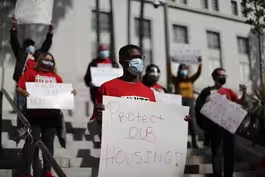
Evictions mount as rising rents squeeze low-income Americans
Video has Closed Captions
Clip: 6/24/2023 | 5m 46s | Evictions skyrocket as rising rents squeeze low-income Americans (5m 46s)

The state of abortion access in the U.S. a year post-Roe
Video has Closed Captions
Clip: 6/24/2023 | 7m 56s | The state of abortion access in America a year after Roe’s reversal (7m 56s)

What to know about the turmoil between Russia and Wagner
Video has Closed Captions
Clip: 6/24/2023 | 8m 29s | What to know about the turmoil in Russia as Wagner halts its advance on Moscow (8m 29s)
Providing Support for PBS.org
Learn Moreabout PBS online sponsorship
- News and Public Affairs

FRONTLINE is investigative journalism that questions, explains and changes our world.

- News and Public Affairs

Amanpour and Company features conversations with leaders and decision makers.












Support for PBS provided by:
Major corporate funding for the PBS News Hour is provided by BDO, BNSF, Consumer Cellular, American Cruise Lines, and Raymond James. Funding for the PBS NewsHour Weekend is provided by...