
June 27, 2023
Season 2 Episode 19 | 27m 29sVideo has Closed Captions
A summary of the day's news across the state, plus fascinating places, people and...
A summary of the day's major developments, with Kentucky-wide reporting, includes interviews with those affecting public policy decisions and explores fascinating places, people and events. Renee Shaw hosts.
Problems playing video? | Closed Captioning Feedback
Problems playing video? | Closed Captioning Feedback
Kentucky Edition is a local public television program presented by KET
June 27, 2023
Season 2 Episode 19 | 27m 29sVideo has Closed Captions
A summary of the day's major developments, with Kentucky-wide reporting, includes interviews with those affecting public policy decisions and explores fascinating places, people and events. Renee Shaw hosts.
Problems playing video? | Closed Captioning Feedback
How to Watch Kentucky Edition
Kentucky Edition is available to stream on pbs.org and the free PBS App, available on iPhone, Apple TV, Android TV, Android smartphones, Amazon Fire TV, Amazon Fire Tablet, Roku, Samsung Smart TV, and Vizio.
Providing Support for PBS.org
Learn Moreabout PBS online sponsorshipHow do you not go into details of that?
I just need it happened that I was wrong.
A new book to come this fall from former Democratic Governor Paul Patton.
He writes about his accomplishments and his extramarital affair while in office.
But when we're thinking about who underrepresented clients are, unfortunately, that number and who that is continues to grow.
University of Kentucky law students are stepping in to meet the growing need for legal services and rural Kentucky.
We love our sports in the Commonwealth and people want to be able to make the choice of their own free will to make a wager on a sports event.
When can you place a bet?
Sports gaming becomes legal this week.
Production of Kentucky Edition is made possible in part by the KET Endowment for Kentucky Productions, the Leonard Press Endowment for Public Affairs and the KET Millennium Fund.
Good evening and welcome to Kentucky Edition for this Tuesday, June 27th.
I'm Renee Shaw in Pikeville in eastern Kentucky.
Thank you for joining us.
We're spotlighting Eastern Kentucky all this week as we take Kentucky's edition on the road.
We're in Pikeville in Pike County, which is the largest county geographically in Kentucky.
It's home to the University of Pikeville, where more than 2600 students are enrolled in more than 30 undergraduate programs.
It's also where you'll find the largest hospital in southeastern Kentucky, Pikeville Medical, which employs more than 3000 people.
Later this week, we'll hear from leaders of both the university and the hospital.
Today, I spoke with Governor Paul Patton, who was governor from 1995 to 2003.
And you'll hear part of that conversation coming up in just a few minutes.
But first, the news.
U.S.
Senator Mitch McConnell was in Lexington today to discuss farming issues at the University of Kentucky.
McConnell is in his seventh term as a U.S. senator from Kentucky, and he was asked if he'll be running for an eighth term in 2026.
You're asking me to predict what I might do three years from now.
I don't have a prediction on that.
No news to make on that subject.
Senator McConnell is 81 years old.
He'll be 84 in 2026.
New laws passed by the Kentucky General Assembly will take effect this Thursday.
We continue our look at some of the new laws.
From legalized sports gaming to scholarship dollars for trade schools.
Our kacey parker bell has that report.
We love our sports in the commonwealth and people want to be able to make the choice of their own free will to make a wager.
Kentuckians will soon be able to place a bet on their sporting event of choice.
House Bill 551 allows the Kentucky Horse Racing Commission to regulate the new gambling option and a new source of revenue for the state.
This is not a huge amount of money for the state.
Let me be clear.
It's roughly by the fiscal now at about $23 million annually in revenue.
Even though sports betting will become legal, gamblers will have to wait before placing their first bets.
The Horse Racing Commission will have to take up administrative regulations before betting goes live.
Another bill taking effect will allow Kentucky students going to trade school to use their keys money.
That will allow students attending schools that teach things like welding or plumbing to receive extra scholarship dollars.
As we know, we want to get people to work.
And I talked about it with my university is in my district about making sure we provide educational opportunities where the jobs are there and they can make good, good careers.
The legislature also passed a bill that will toughen regulations on products containing Delta eight.
THC products containing the psychoactive substance are likely to see new regulations on testing, packaging and age limit restrictions once the state government finalizes regulations.
For Kentucky Edition, I'm K.C.
Parker.
Belle and Lexington.
Parents and teachers spoke out about Senate Bill 150.
Transgender students and gender neutral bathrooms during a Fayette County school board meeting last night.
Senate Bill 150 says schools can't let transgender students use bathrooms that match their gender identity.
Several speakers said that's why Fayette County needs to add gender neutral bathrooms to schools.
Ten first came out.
He became dehydrated.
He didn't want to drink water.
He got migraines.
He had UTIs.
He had all sorts of different health issues.
And this is before it was illegal for him to use the restroom of his choosing.
I think we need to make sure that we give students every opportunity to have gender neutral restrooms, which are readily available to all students.
I agree with the Senate Bill 150 and no disrespect to anyone else.
I think that sexuality should be taught by the parents.
It shouldn't be in public education.
You guys are speaking one side of it, but you have to understand there's other side of it.
They don't want this being taught to them either.
There's young kids that don't want this either.
It goes on both sides.
Parents should teach kids about their sexuality, what they like, what they don't like.
It shouldn't be done in public school.
No decisions were made last night about gender neutral restrooms.
A programing note tonight on Katie, a panel discussion on autism.
It'll include resources that offer education and support, among them, a two year residential program at Western Kentucky University.
If you'll try, Lisa FA is a WQ graduate and Life Works participant.
I've learned and I'm still working on budgeting how to manage your money and stuff.
Life works as a transition academy for young adults with autism.
It gives me a better understanding of what to be prepared for when I am living on my own life.
Works opened three years ago as a way to help those young adults find employment, learn to live independently and be part of a community that we've seen tremendous growth in their self-confidence and the maturity levels in their self esteem.
And it also helps me expand my support system.
This spring, Life Works added a new edition, becoming a satellite location for the Warren County Public Library.
There are lots of wonderful resources that come through the library system that we have access to.
I love having books.
I love so close.
It is the only library in the state that is dedicated to the Neurodiverse population.
This library is smaller, not as overwhelming.
They can feel comfortable, ask me questions.
Part of the enjoyment is a new friendly face when it comes to IRL.
And then the more confidence you have.
Earl Willis is the librarian at Life Works and Special Populations Liaison.
Aside from his regular duties, he is also a mentor to life works Participants leading small group lectures and discussions is very wise and experience working with individuals of all backgrounds, especially those with neurodiversity.
Getting to give the library to people who otherwise, this time last year didn't think about the library.
It wasn't even part of their world.
So I've introduced the library to people.
Many of the books focus on helpful life skills like cooking and household chores.
The hub of the community is the library.
Because you have education, you have entertainment.
Aesha is a fan of poetry, even writing her own about her journey with autism.
Be your own kind of star and do what's right.
Who knows?
It might change your whole life.
The Library at Life Works aims to be a place of support, encouragement and education.
And I want everybody that comes here to realize this is somewhere for them to be and someone that people care about.
This kind of thing also helps to expand your knowledge in the world.
For Kentucky Edition, I'm Laura Rogers and you can learn more about resources and support for those with autism and a special form this evening, our Kelcey Starks hosts Understanding Autism Forum tonight at eight Eastern, seven Central right here on KCET teens and young adults in Louisville are spending their summers learning numerous trades and summer works, a program that partners people ages 16 through 21 with local labor unions.
It gives them a chance to earn money and acquire new skills while providing an alternative to college for young adults who've already graduated from high school.
The summer works is such an important program.
It gives these young adults who are 15 to 21, the opportunity to learn a new trade and to really get on the right path towards a great paying career path job.
So it's great to be with them today and seeing the skills that they're learning and they're really excited about the future.
It's great for them, for their families.
It's also part of our public safety solution.
Also, we need more young adults to understand, like these kids here today, that they have great opportunities in life and this just helps expand their horizons.
So for the past few weeks, we've just been working on different fields in the trade in our unit and everything like that.
Just getting familiarized with the different types of drywall technique.
We did drywall last week actually, and this week we're doing forklifts and everything like that.
I wasn't considering this a career when I came into it, but now, like in the program and like learning more about it, I'm like, I could be a painter and I could be a glass worker and everything like that.
So this just like opened my eyes to everything and the pay is like, fantastic.
So in this day and age, there are so many different ways to be successful.
And so what summer works does is it gives kids an experience where they understand so many more of the different parts in life, whether it's a two year associate's degree, whether it's a four year college degree, or whether it's just joining a union and becoming part of a skilled trade and going right to work after high school.
All of those can be great paths for kids and young adults these days.
One of the benefits that you get, you know, joining one of these trades is an associate's degree from Ivy Tech, which is a recognized technical school here locally and across the state.
So and they're getting a debt free after their three years or four years of the program.
They're leaving with associates and apply tax, no money, old cap and gowns.
They even walk off ceremony.
All kids are not meant for college.
So we want to give them the revenue to turn a good living.
My advice is to come into it with an open mind.
Don't ever think that you won't enjoy something like always try something new even if you are scared to do it.
Like I'm scared of heights.
I'm still going to go on a list, even if you're like, Oh, I'm never going to do this.
I'm never going to do that.
Just try it.
And I guarantee you you'll have ten times more fun than you ever expected.
Mayor Greenberg says he hopes to expand the program and make it more accessible to young people who are interested in expanding their skill set.
As part of our road tour today, we spoke with former Governor Paul Patton at the University of Pikiell, where he is Chancellor Patent, who is from Pichel, served from 1995 to 2003 in the governor's office, and his time in office was highlighted by reforming higher education and workers comp.
But the end of his term was marred by a personal failing.
Tonight, we hear from him about his affair with a nursing home owner, Tina Conner, and if that impacted his future political aspirations.
Governor Patton, it's a pleasure to be with you.
Chancellor, I don't know what to call it, sir.
I do want to because we hear some clanging coming from your hands, Governor, and we want to draw attention to that.
Real quickly before we move on to talk more about the book.
Talk to us about your your your ring game going on here.
Again, I was president for four years.
Our basketball team won the NBA in national championship.
We had about three or four women's bowling team national championships.
I lost their head on this finger here and lost it.
That's a cheerleader's trophy of some sort.
This is basketball.
That's match kickball.
That's football and that's bowling.
So and we've got I just don't have enough fame.
You just don't have enough fingers.
I really have three or four more rings that you want to be able to lift your hand over time.
We did something significant.
We we bow our team members brains.
And I just bought one from Brazil.
Sure, why not?
That's what you can do is dance.
Let's return back to your book because we know that of all the accomplishments you had in policymaking, there were also some missteps.
Tina Conner, one of the big Are you honest and open?
And do you reveal anything that we do not know about that situation?
I don't think that there's anything.
I did not go into details of that.
I just it did happen that I was wrong and it almost destroyed my marriage and took some time to repair there.
I think we've seen that now.
We're very close now.
You mentioned about how it's taken you time to prepare with Miss Judy First Lady Judy from that incident.
When you think about that, and that's almost more than 20 years ago now, how do you think that impact in your future political ambitions?
I mean, many have thought and you've said perhaps even the US Senate, what is going to be next after governor?
It probably did impact that, although in my position, I believe that my call for a tax increase had a lot more to do with not running for the Senate.
I certainly planned to run for the Senate, which was but one year after my term was ended, which gave me the year two, laid the groundwork to do that.
I guess, Jim money.
And I think I would have had a good chance at race.
But the year before we had a depression and we passed a budget which by the time the legislature adjourned, it was obsolete.
One go to happen.
And so I publicly advocated for a special session to raise taxes, and I didn't get much support for that.
I do want to visit some other elements that are maybe addressed in your book, in addition to the Tina O'Connor incident.
You also had some campaign finance issues and patronage issues with the merit system.
These things came after the Tina Conner incident that were near the end of your gubernatorial reign.
Did those also have an impact, do you think, on your immediate legacy now that we're 20 something years beyond, perhaps there's a different view?
I listen, I had great relationships with the press.
I didn't had trouble.
And we gave them never say they treated me well until the tenure kind of thing came up.
And then they sort of tried to play catch up.
And that's what I really think a lot of that stuff amounted to.
I know they made a big issue out of the bypass that summer, said going through the farm of a group of supporters of ours.
And they they tried to make that look like that.
That was favoritism.
After I left office, the inspector general over the Transportation Committee did a review of that situation and found out he was perfectly legitimate.
And so I think that after the tenure kind of thing, the press tried to play catch up.
Let's talk about the Kentucky Democratic Party and where it stands now.
You know, even during your last few years in office, there were some shifts occurring where they were eventually would lose power of the Kentucky State Senate.
And then, of course, as you know, a few years later, the House would fall to Republican hands, super duper majorities, as they're called now.
But we also look on the local level and a lot of the local elected officials identify as Republican.
How do you view the strength or the weakness of the Kentucky Democratic Party?
And is it in a position to make a comeback and win?
And what will it take to get there?
Well, I just do my career.
Kentucky is a very conservative state where Jared Pearce said we didn't take sides in the Civil War.
And after the war we sat in with the losers.
And so we became a southern state in almost every respect except party registration.
And when the the the Civil Rights Act of the Johnson era, we had all these other states switched from different from the solid Democratic South.
All of them switched Republican except Kentucky.
And we maintained a Democrat tradition.
But the people were conservative and it started to sneak up on us.
My first term as governor, we started losing Senate seats.
We thought they were aberrations.
They weren't.
That was the that was the tide.
And you had switches and defections.
Well, in the last four four by a second term, we had two switches for various reasons that made this city republic and majority.
And so it we are a Republican state and and you can ten have always been a Republican state in voter performance very for you should have won his election against you.
Yes.
He was too overconfident.
He didn't work as hard as he did.
He just miracle to win that election.
How about you write another book about that these days?
Thank you, sir.
Tomorrow night, we'll talk to Patton about his position at the University of Pikeville and his major accomplishments as governor.
For those living in rural areas of Kentucky, access to certain resources like legal aid can be really hard to come by.
The University of Kentucky Legal Clinic wants to change that.
It's expanding its reach to provide legal services to more rural populations.
The clinic's director said it's a move that not only benefits low income clients, but the law students as well.
So Kentucky JAY David Rosenberg, College of Law Legal Clinic is basically a legal class.
So the students that are participating in the program are licensed by the Supreme Court of Kentucky to practice under a limited scope agreement.
And so once they're enrolled in the class, they are taking on real life cases.
By the time I got to my third year at the legal clinic was, you know, like a shining beacon.
You go before you get out into the real world.
You want real experience, you know, real time in court with real clients.
Each student, on average is doing at least four cases, sometimes five, sometimes six.
So on average were somewhere around 50 cases or so each semester where student attorneys with only limited licenses.
But we can we can meet some of the need that is out there where you can kind of fill the gap.
But we take a little bit of everything.
The great thing is that we have freedom to pick and choose what we want to take based on what the community needs, based on what student interest is, so that it's been everything from consumer work, divorce, wills, estates, work, living wills, set pieces, expungements name changes.
The cases that I handled were criminal expungements you know, sort of getting rid of old criminal convictions from somebody's record.
I did some wheel drafting and estate planning for a few clients.
I also handled a few name change cases and those were kind of, you know, particularly a point of pride that we try to reach out and meet our clients wherever they are.
When we're thinking about who underrepresented clients are, unfortunately that number and who that is continues to grow.
I think over the last few years in legal services, the need and the requests really coming from not just folks at the far end of the spectrum, people who are on disability, people who are not currently working, people who are experiencing homelessness, but really seeing that expand up through low income and into what we would otherwise have classified as middle income folks.
I think the legal clinic, if it does anything, it highlights just how much unmet legal need there is for regular folks all across Kentucky.
I don't think a single one of us came out of our experience without being very acutely aware of that.
And the hope is that by giving students not only that knowledge, but giving them the practice experience to do something about it, that once they graduate, that they're interested in and excited about doing that kind of work, and whether that's becoming it becoming their post-graduate job or whether that's doing pro-bono or just participating in volunteering in some way in community around the state.
That's our hope, right?
Is that exposure and access equals action.
I've accepted a position with the Department of Public Advocacy, so the State Public Defender agency, and I'll be working in Pikeville for that and tremendously excited when I was graduating and thinking, you know, I knew I wanted to work in the EPA and very passionate about their work, but wanted to find a place that was both close to home and close to family, close to, you know, a community that I have deep connections with and really love.
It's really also been wonderful to see that a number of our students that are coming from sort of the far flung spots outside of the central part of the state are really, really excited to do work in their hometowns, right, and in their home regions to give back.
And I think that's such a beautiful thing that we can provide and do.
And I think we can just continue to to work with partners around the state to expand on that.
Hughes says there are currently serving about 20 counties, but that they will continue to expand that number.
There are so many inspirational people and amazing stories here in eastern Kentucky that includes the people behind Kane Kitchen and Whitesburg.
For years, the organization has been working to improve physical and mental health through food.
We caught up with owner Valerie Horn, who was also a winner of the James Beard Foundation's National Leadership Award at Community is Not Healthy.
One is almost one in three have diabetes.
We have some of the highest cancer rates in the country.
We have high hypertension, obesity.
We do feel like food and healthy food is at the root of healing.
This is romaine lettuce.
I work with the Kaplan Community Center, see what is very farmer's market and cane kitchen.
We sometimes refer to these as three sisters in reference to the Native American growing technique that used that grew means corn and squash together to use the least resources and provide the most gain.
We have tried very hard to lift up and find a space for everyone to have access to.
When you drive by live on Thursday night, there's no family that would have to feel that that was not for you and it is for me.
Primarily, the free aspect is for that portion of our community, over 50% that live below the poverty line.
But at the same time, we have our most affluent there and they enjoy it.
And so it's common ground in an opportunity for all to be there.
It's a farmer's market that no matter how many dollar bills were in your pocket, I think you'd be happy to be in an enjoy and want to have it provide proof of concept that it's not just a nice idea or sweet or cool, but it even makes financial sense that it there is value to it.
I was very pleased to learn that had been a an award winner for the James Beard Leadership Award.
It was a personal award as that's the way the awards are distributed.
But I very much except on behalf of this this team that is here and in this last year between the pandemic and between the flood, our community would not have survived without these helpers who had stepped up to do whatever they could at whatever level of resources that they had.
We'll have more on eastern Kentucky as we come to you from Pikeville again tomorrow night.
And we'll have part two of my interview with former Governor Paul Patton.
And when you think about Eastern Kentucky, you think about coal.
But solar energy is a growing industry.
We'll take you to one operation in Martin County Wednesday on Kentucky Edition, which we hope you'll join us for again tomorrow night at 630 Eastern, 530 Central, where we inform, Connect and Inspire.
Subscribe to our weekly Kentucky Edition email newsletter and watch full episodes and clips at Katie Dawg and follow us on Facebook, Twitter and Instagram to stay in the loop.
I'm Renee Shaw.
Coming to you from Pikeville again tomorrow night.
Thank you for joining us.
Until I see you again, take really good care.
Video has Closed Captions
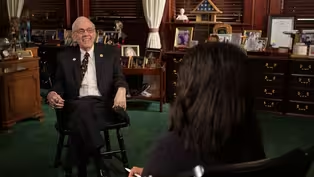
Clip: S2 Ep19 | 49m 14s | Renee Shaw sits down with Paul Patton, the 59th Governor of Kentucky who served 1995-2003. (49m 14s)

Video has Closed Captions
Clip: S2 Ep19 | 2m 59s | CANE Kitchen has been working to improve physical and mental health through food. (2m 59s)
Video has Closed Captions
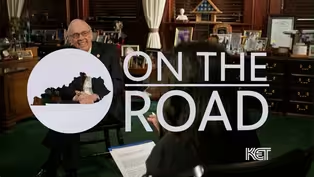
Clip: S2 Ep19 | 7m 35s | Gov. Paul Patton talks about his affair and the state of the Democratic Party in Kentucky. (7m 35s)

Video has Closed Captions
Clip: S2 Ep19 | 4m 4s | UK Legal Clinic is expanding its reach to provide legal services to more rural populations (4m 4s)
Providing Support for PBS.org
Learn Moreabout PBS online sponsorship
- News and Public Affairs

Top journalists deliver compelling original analysis of the hour's headlines.

- News and Public Affairs

FRONTLINE is investigative journalism that questions, explains and changes our world.












Support for PBS provided by:
Kentucky Edition is a local public television program presented by KET