
June 27, 2024
Season 3 Episode 19 | 27m 30sVideo has Closed Captions
Kentuckians respond to the latest U.S. Supreme Court ruling on abortion.
Kentuckians respond to the latest U.S. Supreme Court ruling on abortion. Kentucky State University receives the largest federal financial award in school history. Louisville prepares to host the final match of the Cricket World Cup.
Problems playing video? | Closed Captioning Feedback
Problems playing video? | Closed Captioning Feedback
Kentucky Edition is a local public television program presented by KET
June 27, 2024
Season 3 Episode 19 | 27m 30sVideo has Closed Captions
Kentuckians respond to the latest U.S. Supreme Court ruling on abortion. Kentucky State University receives the largest federal financial award in school history. Louisville prepares to host the final match of the Cricket World Cup.
Problems playing video? | Closed Captioning Feedback
How to Watch Kentucky Edition
Kentucky Edition is available to stream on pbs.org and the free PBS App, available on iPhone, Apple TV, Android TV, Android smartphones, Amazon Fire TV, Amazon Fire Tablet, Roku, Samsung Smart TV, and Vizio.
Providing Support for PBS.org
Learn Moreabout PBS online sponsorship♪ ♪ >> The U.S. Supreme Court rules on an abortion case days after the two-year anniversary of the overturning of Roe versus Wade.
Kentucky's only public historically black college makes a big announcement.
>> This is something that they don't get to do a lot.
Some of them.
This is their first time even coming to swim or chapel.
>> They're making sure everyone gets a little cool time at this bowling Green facility.
Most of us.
It would like to do is like a sports that below.
And that's that iPhone Little Cricket Club.
Well, a wildly popular sport from abroad is making swings in Kentucky.
>> Production of Kentucky Edition is made possible in part by the KET Millennium Fund.
♪ ♪ Good evening and welcome to Kentucky EDITION on this Thursday, June, the TWENTY-SEVENTH I'm Renee Shaw.
>> Thank you so much for winding down your Thursday with us.
We start with news from the U.S. Supreme Court.
And a decision on abortion case out of Idaho.
That's drawing reaction from both sides of the issue here in Kentucky and a 6, 3, ruling the justices reinstated a lower court ruling temporarily allowing hospitals in Idaho to perform emergency abortions to protect the life and health of the mother.
However, the ruling is pursued roll with the justices saying they took the case too early and it needs to go to another lower court for hearing.
The case is expected to make its way back to the U.S. Supreme Court immediately following today's decision, Kentucky advocates for and against abortion responded both pointing out that this type of emergency care has remain legal in Kentucky.
The Family Foundation released a statement saying in part today's ruling and Morial is certainly troubling, but it should also serve as a stark reminder that our work to protect unborn children in Kentucky did not end with dogs more was a complete when the General Assembly passed the Human Life Protection Act, end quote and from Planned Parenthood of Indiana in Kentucky, quote, They say even with emergency care allowed under the current abortion bans, legal ambiguity, jeopardizes access to medical care for miscarriage is a topic pregnancies and other pregnancy related issues, which means pregnancy-related medical emergencies are mounting, end quote.
Monday marked the two-year anniversary of the Supreme Court's decision to overturn Roe versus Wade known as the Dobbs decision.
Now, more news today from the U.S. Supreme Court and a 5 to 4 vote.
The high court rejected at nationwide settlement with Purdue Pharma.
>> The maker of OxyContin, the deal would have protected the Sackler family who owns the company from civil lawsuits related to the opioid epidemic.
It would have also met the family would have to fork over up to 6 billion dollars and put future profits toward treatment and prevention.
It's unclear what happens next.
All the lawyers involved in the case expect negotiations to resume.
Now they're in our state, Kentucky State University announced today that it will be receiving its largest federal financial award in school history last year.
The State Auditor's office published a scathing report outlining irresponsible financial management by former leadership which put KSU historically buck university at risk of losing federal dollars and accredidation status.
Today, current president coffee, a capo rebuild.
How much KSU received and said the funds will go toward agriculture and food research.
>> Right as yet today is that big a?
>> Agron that we got from a natural science foundation.
For some it may not be that high.
But for us, this is a history making.
This is the first time.
Kentucky State University is getting 7 million dollars.
>> The world faces a number of challenges.
Global challenges, including how we're going to feed 2 billion, 3 billion more people.
And why not show people how to do that right here in Kentucky State where the center of innovation.
That's what we want to be known for.
Not only to see the government but the seed of innovation.
>> Folks, we would not have put this together.
We now call the support and constant encouragement and a lot of work to legalize.
I had.
>> KSU leadership says the grant will last for years.
The money for years.
One and 2 is already been awarded and years.
3, 4, will be secured once the school completes goals set by the National Science Foundation.
People experiencing a mental health crisis in Louisville will soon be able to get help at any time of the day with the expansion of the city's crisis call diversion program.
Mayor Craig Greenberg announced Wednesday that beginning July first.
The program also known as deflection will operate.
24 hours a day, 7 days a week and all 8 Louisville Metro police divisions.
The program diverts calls involving mental health crises, 2 trained operators or counselors.
City leaders say the program free-up officers to go where they are needed most.
>> People are dealing with a mental health crisis and they call 9-1-1.
There is going to be a behavioral health specialist that is there to help them when they're KO means the criterion.
That means more people across Louisville will be able to benefit from the services.
That means or LMPD officers can stay focused on preventing violent crime from happening or responding to those dangerous situations.
And our Metro safe call takers will be able to more quickly.
The answer.
The emergency calls that are coming in.
Our commitment is to public safety.
And we talk about public safety.
We want everyone to feel safe.
>> The entire community and sometimes.
That means that we have a run that may come in and we want to ensure that the best resources or dispatched to that call for service and sometimes that response is not an individual with a badge and a gun.
Sometimes that needs to be someone who's experienced and mental health because mental health and mental health crisis is very real in our community.
And that's something that we need to recognize and and provide the appropriate services to those individuals.
>> City leaders say this year alone, the Metro Safe 9-1-1, center has diverted 1500 calls and mobile crisis response team made up more than 5 100 mobile runs to help individuals in need.
Kentucky State representatives could Tour Heron and George Brown were among 60 state legislators invited to the White House to discuss efforts to curb gun violence.
>> The visit comes one day after the U.S. surgeon general called gun violence, a public health crisis.
It's the first ever public health advisory on gun violence from the surgeon general's Office.
Representative Brown praised the surgeon general's decision to label gun violence as a public health crisis saying in a statement that it gives him and Representative Haron, quote, even more incentive to pursue those policies at home that we know will save lives, end quote.
New numbers out from the state show.
Unemployment rates rose and 109 Kentucky counties in May.
>> Martin County recorded the state's highest unemployment rate at 9.5% followed closely by Magoffin County had 9.4%.
Brevard County was 3rd with 8.4%.
Cumberland and Washington counties recorded the lowest jobless rates in the commonwealth.
At 3.4%.
Each.
♪ And a look at medical news today.
Researchers at the University of Kentucky have found that for much of the past 2 decades Appalachian, Kentucky hands have been more likely to die from colorectal cancer compared to the rest of the state and country's population.
Their study was recently published in the Journal of Gastroenterology.
Yesterday I sat down with the UK researchers to learn more about where you live can contribute to higher chances of dying from colorectal cancer.
>> I think one of the the points that were making the study is that there's a real signal with regards to people that are from rural Kentucky, especially Appalachian counties and in particular, they haven't quite benefited as much from the, you know, the the Medicaid expansion and increased screen rage has been a benefit but nowhere near the kind of benefit that the rest of the country has a enjoyed from reduced colon cancer.
Right?
>> Let's talk about some of these barriers.
What are they that sing to distinguish them more rule Appalachian dwellers from their urban counterparts?
Will these barriers on different levels?
We have to consider patient barriers, organizational barriers as well.
On the patient level, these barriers could be.
>> Perceived to fear of screening or, you know, perceived pain as it was all off, offer screening of probably due low health literacy o purple to colorectal cancer.
The other could be, of course, little appear.
People saying in the low socioeconomic status, meaning they're probably thinking that they're not all able to afford called cancer screening.
And the same time the researchers also show that educational attainment is a big factor.
He's also a towards Colorado cancer screening, which study showing that people who have achieved less than high school education level education are basically have need in the straits of colorectal cancer screening and that probably access to health care is another one of them given the location off eastern Kentucky.
That is There are issues related transport and other access to major health care networks where they seek care.
>> How much does the fact that they may or may not have a medical home or by Mary Care physician with whom they interface with frequently to make those referrals and to make sure they're doing screening such as colorectal screenings.
Is that important?
>> It's very important because when you don't have access major health care network such as user can talk and the other major networks it's very important to, you know, be in touch and have regular apartments with your primary care provider so that they can guide you regarding screening processes.
As you know, probably not everyone is willing to undergo colonoscopy because some of them probably have had a bad experience.
But there are other modalities available to screen patients for council such as to still probably believe the room.
>> Let's start at home.
Exactly A lot.
And right to abuse rules.
Physicians have a huge role to play in terms of educating the community.
And, you know, pushing through with all of that.
And he's the former screening needs to be done well in these patients.
>> And is it a matter that to Barrett of there not being enough gastroenterologists and those rule Appalachian areas that also of pain point, I think that has improved.
I think the in terms of screening costly to have gotten better.
I don't think it's it's a deal.
And I think in what you find in the world communities is there's a barrier with you guys.
Just transportation.
We talked about this so that before the associated that feeling in the city, you can get an alley.
You can get public transportation.
It's a little bit harder to get out how are, you know, get out of there.
Go to the Dodgers place.
Have somebody to drive you home to transportation, I think is one of the unique barriers that you see in the rural populations, especially Appalachian that you may not see in an indigent population, the city.
Right.
And I expect some point you raise.
I really think you're a family practice is how they get keepers.
And and one of things that I've noticed here at the university is said the state really gets on top of our family practice guys for screening rates.
Like if if they're screening rates aren't up to par, they threatened that they're not getting the funding there.
They're going to withhold funds.
So we have all sorts of mechanisms for increasing their screening rates.
So if you can get the patient into the family practice, doctors office you they're probably going to find a way to get him screen rights right?
>> So let's talk about going to sometimes it seems like they the information about the standard of care about when to get screened at what age and how often it can often be confusing.
It seems to vacillate between this aid in that age.
Can you set the record straight on when the appropriate age or conditions for screening?
So on to down to 45 now.
So we're we're starting to screen at 45 in as part of a national trend that Tom cancers occur in younger age.
She writes, and certainly this 45 too late for some population.
Yeah.
So if you're a family, it's like a primary family members getting colon cancer under 65.
And you should be probably looking at an earlier screening debut.
And that's a significant risk.
If you have somebody in your family, you know, siblings or parents or whatever the guys I would say to the screen is I think if you a family member might I'm going to advise the court asked me because you'd be able to see all the different pop, small, medium, large But >> if for whatever reason they don't, they don't want to do.
The court asked the maybe no, they just didn't like the idea of a term or or maybe it's transportation to, you know, maybe there's some other barriers there.
If we get them at least a stool test, we've got some kind of screening modality this to a test to identify large polyps or cancers.
So it's going to be a little beyond at least identify the people really need something done and urgently.
>> There are other that the Apple watches are more prone to when it comes to, I guess, turned to algae.
>> Yeah, thanks to that that we had we started out looking at this kind of question with Crohn's and will serve Clyde, a seizure diseases that we specialize in it.
The UK and it's quite dramatic how much more severe the Crohn's and also claims he sure I think was from Northwestern in Chicago and we should pass search of severe disease stateside didn't see people that died were is when I came here and you know, was in first years us off here for people have died from And I remember talking to my mentors at University of Chicago and I said, yeah, I've never seen anybody die except for cancer.
You know, when the cancer cones.
So there we started looking at that in the Appalachian counties, very similar story where you much more severe and more likely to go to surgery.
More likely require steroids gets back to the question of why, right?
You know, guest to talk about all these detection and in access to care.
I actually think that what is pointing to is there's a cause.
There's there's something in either the diet or its pollution from, you know, from any number of full mental factors where there's there's something putting our patients at risk in there.
They're not only sound like cancer, but it's all these autoimmune diseases, probably heart disease and other things.
And it's not smoke.
It sent smoking if there is a factor, sure that smoking isn't good for licenses but that some of you I've got plenty of horribly sick, Crohn's patients that don't smoke and they're from these Appalachian counties, even some of them from our that we get it from the Appalachian counties in Ohio.
You know, so to there's something that had at the start of this, there's something about the that the diet of the environment that that it's going require more research.
>> Was going to say, where is that research?
And is it being done?
So we have a young faculty in our place.
Kids like Courtney Perry who starting to look at this and she's going to be going into the cities and interviewing patients to figure out what are the common features of these things.
>> And I think that that we have to study all sorts of things diets, probably one behavior, cultural trends, all sorts of stuff to try to figure out what are the common themes because it's not just one county, it's always Appalachian counties.
And is this a hallmark?
So it's good.
It's and I think the NH the federal government's very interested in this because for a long time, it spent a lot of money and your populations in cities and urban poor.
It's this kind of a new a bright light to India.
This is we need to shine a light on this area because there's this real world.
Indigent populations really require more study so that we can turn their health care around.
♪ ♪ ♪ ♪ >> Spending time in the pool can be an enjoyable way to relax or get fit.
But for those with certain physical and neurological challenges begin a public poll with several other people can cause sensory overload.
That's why the Bowling Green Parks and Recreation Department is carving out some pool time to make the pool more accessible to all.
>> Our department as a whole.
>> Has had a commitment to serving individuals with physical or intellectual since the early our adult athletic club started in the early 80's to to provide once they graduated from high school.
The opportunity for participate in sports and through Special And so that was kind of a kick start of what became our special populations What is now our Adaptive Recreation division.
And so our department has had a commitment for a long time to ensure that in our community no matter what disability that may have can enjoy recreation can enjoy being in.
The parking can enjoy sport.
We kind of take that that commitment that we have to serving people with disabilities within our department.
And we brought it to the aquatic Center of the summer and offering are censoring adaptive swims.
And really what they are, it's just an opportunity for individuals with disabilities.
You know, groups, organizations locally that that work with individuals with disabilities, young and old children or to just have a crowded, less you know, impactful experience.
So about 9 I will bring more the next.
>> Tom, this is something that they don't get to do a lot.
Some of them.
This is their first time even come into slim or careful.
>> A lot of my clients are from the water and with less people in them not as scared because it's one-on-one geared more toward one on one with the city parks and the county park system.
See here, you know, they can go out in the belly act that can go out and a cat and the water will switch or adaptive equipment for them and not be a gay or you know, they're they're swimming.
They're in but not necessarily all by themselves.
>> Ellis fun.
There is all right.
Women.
that keeps me.
Calm because sometimes I get.
Upset about things for doing 4 times throughout the summer.
So this is our second one.
>> So we have 2 more in July that will offer the last one that we on June.
11th.
We had probably about 50 people or so.
And so we just hope that that continues to grow.
People are scared of people with disabilities, said normal.
>> The normal community because they don't know had to communicate with them.
They're regular people just like you and I.
And you know, they want to go do fun things just like everyone else.
This is a huge self confidence builder for them.
>> One of the biggest bean win when we welcome in individuals with to our there are services to our facilities within the parks and recreation world.
We're giving the community an opportunity to see this idea of focusing on a person's abilities and what they can do rather than what they cannot and shifting that focus away from disability, any community that is is willing to kind of open their doors and opened their arms to the individuals with disabilities through the programs and services.
They provide is really going to open their department and their community too, a world of impact that they never thought to be possible.
And we really see a shift you know, again and our community as a whole becoming more welcoming.
>> Towards people with disabilities.
>> Great program.
Indeed.
Bowling Green parks and recreation is offering sensory and adaptive swim.
Time through July.
♪ >> And a look at sports news.
Every 4 years we get the soccer World Cup and Olympics.
Well, this Saturday is the final match of the cricket World Cup.
Kentucky additions.
Do Leffler has this explainer on the game with help from the cricket players in Kentucky?
♪ >> At a park in prospect you can play football, soccer or cricket.
>> But to use some kind of baseball just to expend cricket because in the heart of it, the 2 sports are very similar.
You have about.
This is the bat, which is a little bit different than a baseball bat.
It's has a flat surface.
So, you know, you're able to actually will be down and give the ball or detection, which and the baseball cages and they were able to, I'm sure some this can do it.
The ball is similar to baseball in size this a little bit harder.
This thing can really, really heard.
>> If you got hit by a baseball as a kid, know that countless people across the globe have been beamed by cricket ball just as hard.
I love 6, I have But this.
>> I'm doing this the audience to break a kid on time to time.
10 days and maybe go to the dawn.
That is far then my home.
>> Basically it could get this by the fuss in India.
And then that same does that app and then decided.
And then once you come your like the first thing that most of us.
I don't like to do is like a sports that below.
And that's what I found.
Little Cricket Club.
>> Louisville Cricket Club started just over 10 years ago.
It was small but has grown to about 90 players.
A game of cricket made somewhat 11 players.
So before every match we would be calling into that.
Hey, are you available for that game tomorrow?
We had just one team at the time that the population from South Asia growing in Louisville could could also took be provided a platform for people to come >> But the sport is gaining fans and players who are born and bred in the U.S.. >> I went to the University of Louisville.
I was walking around on campus and there's a group of guys playing it and I'm like, hey.
When do you guys play?
I'd love to join you some time.
But baseball's see the ball hit the ball run.
And this has so many more aspects to it.
It's about strategy, setting the field and trying to set traps for the batters and it's it's just so different than any sport played in America.
>> While baseball is similar, the playing field is totally different.
There's no baseball diamond in cricket.
There's a verdict in the strip.
So that every time that really big to people in there.
But if it is safe for you to run, they been back and forth their own back and forth.
And this guy teaches other side is that it is the site.
It's one that now also the free list to 60 degrees.
So, you know, there's no followed ball.
You can hit the ball and even in the field.
>> Like baseball, you can hit a home run in cricket that 6 points.
Also the same.
It's a fielder catches a fly ball.
The better is out.
But all that action starts with the pitch.
If you.
>> Slice it down to the smallest first arrived with picture is I'm willing to about and that time it's a one-on-one battle.
I love.
The key difference is that when the pitcher throws the ball can bounce.
It did not go get it to the back.
>> A good picture or bowler works.
The spouts.
>> Seeing was that on these?
You know, it's living tribute to play because you don't know who it said.
The bald eagle says all depend upon how you it really grieve the ball right?
Based on your great.
And the Vatican menu believes the ball.
The body can go outside on the anything but quiet outing an instant.
>> And you'll see a piece of equipment not in any other sport.
>> If the border, it's that that set out the stops, the batsman is out.
There is no part strike.
One thing or one strike.
You're gone.
>> But not gone.
For long cricket is a lifelong passion for 56 year-old Santos Pandey.
>> Everybody that is attending you know, when the batsman is going to take distracted, you >> The city of Louisville saw that interest and built this cricket field in 2017.
>> The feat is named after one of the greatest players in what cricket as Mister Slater, Dallas Kerr.
It's a ghost gun.
Was here him 7 going to 70.
And that is one of the greatest moments in the history of our club.
And he was here.
He pitched the first pitch he batted for the first time on this pitch that's how he not get the more highlights for the Louisville Cricket Club.
>> Regional championship wins in 2022.
2023 this years season will wrap in September when the Louisville Cricket Club will or won't bring home another title for Kentucky edition.
I'm Ju Leffler.
>> Looks like a lot of find the Louisville Cricket Club also host a tournament that welcomes players across the nation.
That's happening this Labor Day weekend.
Well, that do it for us tonight.
We hope to see you right back here again tomorrow night at 6.30, Eastern 5.30, central on Kentucky EDITION where we inform connect and inspire.
>> Subscribe to our e-mail newsletters and watch full episodes and clips set KET Dot Org.
Look for us on the PBS video app on your mobile device and smart TV and send us a story idea.
And public affairs at K E T Dot Org e-mail and of course follow KU de on Facebook X formerly known as Twitter and Instagram to stay in the loop.
We've got inside Kentucky politics coming to you tomorrow night.
Don't miss that on Kentucky EDITION.
I'm Renee Shaw.
Ticket can see 6.
♪

Kentucky's Response to Latest SCOTUS Abortion Ruling
Video has Closed Captions
Clip: S3 Ep19 | 1m 37s | Both sides of abortion issue in Kentucky react to SCOTUS ruling on Idaho abortion case. (1m 37s)
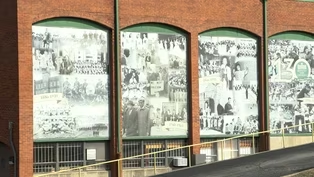
KSU Gets Largest Federal Financial Award in School History
Video has Closed Captions
Clip: S3 Ep19 | 1m 47s | KSU receives a record $7 million from National Science Foundation. (1m 47s)
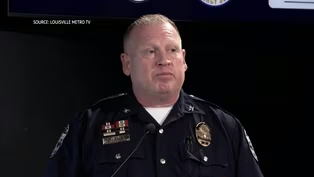
Louisville Expands its Crisis Call Diversion Program
Video has Closed Captions
Clip: S3 Ep19 | 2m 7s | Louisville expands program that diverts mental health crisis calls to trained counselors. (2m 7s)
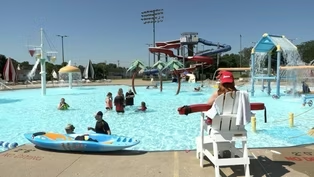
Program Carves Out Pool Time for People with Disabilities
Video has Closed Captions
Clip: S3 Ep19 | 4m 4s | Bowling Green Parks and Recreation offering Sensory Swim time. (4m 4s)
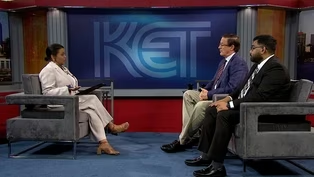
Study: Colorectal Cancer Deadliest for Appalachian Kentuckians
Video has Closed Captions
Clip: S3 Ep19 | 8m 49s | Study finds Appalachian Kentuckians are more likely to die from colorectal cancer. (8m 49s)

The World, and Kentucky, Celebrates Cricket This Summer
Video has Closed Captions
Clip: S3 Ep19 | 5m 15s | Kentucky Edition's June Leffler has this explainer on the game of cricket. (5m 15s)
Providing Support for PBS.org
Learn Moreabout PBS online sponsorship
- News and Public Affairs

Top journalists deliver compelling original analysis of the hour's headlines.

- News and Public Affairs

FRONTLINE is investigative journalism that questions, explains and changes our world.












Support for PBS provided by:
Kentucky Edition is a local public television program presented by KET