
June 28, 2023
Season 2 Episode 20 | 27m 29sVideo has Closed Captions
A federal judge blocks part of Senate Bill 150.
A federal judge blocks part of Senate Bill 150. An air quality alert is issued for the entire state. A look at some new bills taking effect tomorrow. Renee Shaw continues her interview with former Gov. Paul Patton. The largest solar project in the commonwealth is about to break ground. A music festival focused on women in eastern Kentucky.
Problems playing video? | Closed Captioning Feedback
Problems playing video? | Closed Captioning Feedback
Kentucky Edition is a local public television program presented by KET
June 28, 2023
Season 2 Episode 20 | 27m 29sVideo has Closed Captions
A federal judge blocks part of Senate Bill 150. An air quality alert is issued for the entire state. A look at some new bills taking effect tomorrow. Renee Shaw continues her interview with former Gov. Paul Patton. The largest solar project in the commonwealth is about to break ground. A music festival focused on women in eastern Kentucky.
Problems playing video? | Closed Captioning Feedback
How to Watch Kentucky Edition
Kentucky Edition is available to stream on pbs.org and the free PBS App, available on iPhone, Apple TV, Android TV, Android smartphones, Amazon Fire TV, Amazon Fire Tablet, Roku, Samsung Smart TV, and Vizio.
Providing Support for PBS.org
Learn Moreabout PBS online sponsorshipA look at two new laws addressing youth violence both in and out of the classroom.
You have done a great job of raising the child, but it was time to move out of the house.
Former Governor Paul Patton reflects on higher education reform more than 25 years later and where it goes from here.
We have a compelling, historic and unique opportunity in our own history to carve out a place in the emerging economy for our people.
A solar power project in eastern Kentucky is getting a big boost by a major automotive maker.
We are Appalachian women helping Appalachian women and see the Eastern Kentucky Festival that's putting women on center stage.
Production of Kentucky Edition is made possible in part by the KET Endowment for Kentucky Productions, the Leonard Press Endowment for Public Affairs and the KET Millennium Fund.
Good evening and welcome to Kentucky Edition for this Wednesday, June 28th.
We thank you for joining us.
I'm your host, Renee Shaw, coming to you once again from downtown Pikeville as we tie Kentucky this on the road.
Today, I had the opportunity to walk around downtown Pikeville.
It's a small, beautiful, quaint little town with an active Main Street area where there's lots of businesses.
And there's also a very colorful art exhibit called Umbrella Alley.
And you can see why I love this.
We also got to tour the campus of the University of Pikeville, which is home to the only College of Optometry in Kentucky.
You'll hear from DuPont's president, Dr. Burton Webb, tomorrow night on Kentucky Edition.
Later in tonight's program, though, we got part two of my interview with former Governor Paul Patton.
But first, today's news.
A federal judge has temporarily blocked part of Senate Bill 150, according to The Courier Journal, specifically the part of the bill that bans gender affirming care for trans youth.
The ruling means a win for the ACLU of Kentucky, which sued to block the bill from going into effect tomorrow.
It also names puberty blockers and hormone therapy remains accessible to Kentuckians under 18.
While the lawsuit plays out.
We'll have much more on this story with reaction tomorrow night on this addition.
A labor group is requesting an ethics investigation of Kentucky Attorney General Daniel Cameron for soliciting and accepting campaign donations from a drug treatment organization under scrutiny by his office.
The request is from the Kentucky State AFL-CIO, which has strong ties to Democrats.
The labor group is asking the state executive branch Ethics Commission to investigate, quote, circumstances surrounding the donations from executives with Edgewater Recovery Centers to Cameron's Republican campaign for governor.
This continues a back and forth over campaign finances and Kentucky's governor's race.
More on that coming up in my chat with public radio journalist Ryland Barton.
An air quality alert remains in effect for the entire commonwealth today.
The Kentucky Energy and Environment Cabinet says smoke from Canadian wildfires is causing hazy skies and poor air quality in some areas.
The air Quality Index, or AQI, is in the red in Lexington and Louisville today, meaning air quality is unhealthy for everyone.
Now, people with heart or lung disease, older adults and children are asked to take extra precautions.
Now you can track the air quality index in your area at air now dot gov.
All week we've been telling you about some new state laws that go into effect tomorrow.
Among those are school discipline bill.
House bill 538 requires school boards to adopt policies allowing teachers to remove disruptive and violent students from their class and principals to expel them for the remainder of the school year.
During the General Assembly, Senate Education Chairman Steven West said student misconduct is a problem plaguing school districts across the state.
We see that younger teachers coming into the profession may bail out early and not be able to continue in the profession because of these horrendous discipline issues that we're having.
A bill allocating money to reopen.
The Jefferson County Youth Detention Center in Louisville also takes effect tomorrow.
Another part of House Bill three requiring a 48 hour hold on juveniles accused of violent crimes will not begin until next year.
Some lawmakers voiced concern over that provision.
Others said it was necessary.
But we must be careful about detaining our youth, about putting our young people in jail every time we do it, and increases the risk not just to them and to their future, but also to the Commonwealth and to its citizens.
The public demands the people be held accountable for violent crimes.
The detention part of this bill has to do with violent felonies.
Another law in effect tomorrow, Senate Bill 229.
It strengthens reporting requirements when someone has reason to believe a child has been abused and neglected or is a victim of human trafficking.
Time now for a midweek check in of some major political developments in Kentucky with our friend Roland Martin, managing editor of Kentucky Public Radio.
Good to see you, Roland.
Good to see you, Renee.
So let's talk about there have been a lot of more information about campaign donations.
That drama continues to unfold.
And since last we spoke, there is more concerning Cameron getting involved in the FBI when it comes to the donations that were made to Governor Andy Beshear and the Kentucky Democratic Party.
A lot to tease through here.
Yeah, we know the campaign season is heating up when there's a lot of accusations over over campaign donations and a lot of threats to get the legal process involved here.
But over the last week, there is a revelation that Republican Attorney General Daniel Cameron solicited donations for his campaign from executives for a drug treatment organization that his office is also investigating.
This happened on a phone call, according to the Associated Press.
This involves a drug treatment organization called Edgewater Recovery Centers.
There is also some discussions about possibly having a fundraiser for Cameron's gubernatorial campaign.
The Cameron's campaign had returned the donations, but this is raising questions about what the appropriateness of that and if the donations were at all related to the investigation, that the office was also conducting of of that particular organization.
Last week, we had talked about the revelations that they had more than $200,000 had been donated to Governor Andy Bashir's campaign and the Kentucky Democratic Party, all linked to a single credit card of the of the mayor of London.
And Cameron has since asked for the FBI to look into that.
We haven't heard back yet on whether that's going to happen.
But yeah, so kind of a lot of ruckus and problems being raised over how people are donating to these particular candidates right now.
The candidates and campaigns saying that they had nothing to do with it.
But what we're going to be seeing, how this plays out now, and we should say the donations from that addiction recovery center with 6000.
Right.
As opposed to the $202,000 which has been returned.
Right.
70 $600, much, much smaller than the $202,000 that was donated to the governor's campaign and the Kentucky Democratic Party.
But I think that the problem there that Democrats are really raising is that that this particular organization was under investigation by the attorney general's office.
They say that those solicitations should have been happening in the first place.
Right.
So let's talk about Daniel Cameron a little bit more in terms of who could be his lieutenant governor, pick an awesome horn with the Lexington Herald-Leader, had a piece earlier this week that laid out some potentials, including the current House speaker pro tem, the current Senate majority caucus chair.
There's a lot of names on the list, long and short.
What do you know?
It feels it feels so much different this year, right?
Because normally a gubernatorial candidate announces their running mate when they're filing for office.
But now there's a change in state law.
They don't have to do that this year until August 8th.
Austin's article mentions first out a few names here, Agriculture Commissioner Ryan GROSS, who is the second place finisher in the in the Republican primary.
David Mead, the House speaker pro tem from Stanford and in South central Kentucky.
Also, Somerset Mayor Allen Keck, who is one of the contenders in the Republican primary, four for governor in Kentucky this year.
And, you know, it's really kind of made a name for himself throughout that campaign.
But there's no yeah, there's a lot of decisions to be made here on, you know, trying to shore up votes in certain parts of the state, whether or not, you know, you can kind of combine somebody with who has legislative experience to to to show that you have a connection with people who are already doing the lawmaking in the state house.
Another name that Austin had mentioned in the story was Senate Majority Leader Julie Raki Adams, who's from Louisville, where, you know, he's certainly the state's most populous city.
He'd really like to try and take as many votes as he can away from from Andy Beshear in in Louisville, a, you know, traditionally Democratic stronghold.
So a lot going on here.
But we got at least a month.
And that is kind of interesting.
August eight, it's just after Fancy Farm.
Yeah, he doesn't really have to do it by then, but maybe he would want to do that beforehand.
So yeah.
Speaker two Up there on the stage.
Well, I was going to say, wouldn't that be speaking offense and we'll talk about a minute, but wouldn't that be great.
Like announce of course the press would know because we know who the roster is.
But to have that be like the big reveal on fancy farm weekends.
It certainly could be.
And it's an we always talk about fancy farm being the kickoff to the fall election season and that would really go in stride with that.
Well, and we know just from what the political organizers sent out last week or earlier this week about who's going to be in attendance, we still haven't heard from some top Democratic contenders, the governor, the attorney general, Democratic nominee, Pamela Stephenson, the secretary of state, Democratic nominee, Buddy Wheatley.
But there are others that are down ballot Democrats who said they're going to be there, Sierra and Lo, the ag commissioner, Democratic nominee and others.
And Governor Bashir still hasn't even gone he hasn't gone to a fancy farm since being the elected governor yet granted.
That's right.
That were because of COVID.
But he hasn't been there as well.
So we'll see what happens there.
He's got time.
I think they like to have us all kind of wait it out.
Lot to follow.
We thank you, Roland Martin, for always doing it for us.
We appreciate your thanks for.
Yesterday, I sat down with former Governor Paul Patton and asked him to reflect on his time in Frankfurt.
One of his major accomplishments was reforming the state's higher education system That included severing the community and technical colleges from the University of Kentucky, giving focus to the state's regional universities and creating the Council on Postsecondary Education to oversee the higher ed system.
And part two of our interview, he talks about all of that and gives his opinion about the state of higher ed in Kentucky today.
I do want to talk to you about how you and your administration helped transform the higher education or postsecondary education landscape in Kentucky.
Talk to us about that legacy.
Well, of course, you know, in 1998, Kentucky made the most dramatic change in commitment to LBJ in his secondary education with the Kentucky Education Reform Act.
And it was revolutionary.
And it has changed that element of education in Kentucky.
But, you know, in today's world, that's just the foundation.
You can't live in the foundation.
You have to build the house.
And that's some kind of more career oriented education after high school.
And we didn't want some of that school to have to be two year.
Some of it would be one year.
And we wanted we didn't want to tell kids to you're about to go to college, but when you graduate, how do we say you are you everybody ought to go to college, but you ought to go to vocational school?
Well, medical schools, vocational school and lawyers and business.
And so all education practically today is vocational education or career orientation.
So we wanted we wanted David Postsecondary education.
And I think that was the correct change.
And so few things worked out as well as you expect them.
But our our Higher Education Reform Act, particularly involving the community colleges, has turned out better than we expected.
And that's very pleasing.
So many of our viewers perhaps, who have been around and watched Katie for a long time will remember when you were on Kentucky tonight with then University of Kentucky president Charles Worthington, A pretty good exchange of ideas, I'll put it that way back then.
We cannot have an effective and efficient, community based, regionally oriented workforce development institution unless both of them are under the same authority.
Now, that's my bottom line.
And and we certainly don't have that.
But if you touch your bottom line, Governor, then why don't you move the technical schools under the University of Kentucky Community College System?
How do you think Dr. Worthington perceives post-secondary education reform now?
Well, I can't speak for him, but I understood his position.
He had a background in the community colleges, but they had grown up u k ed had done a great job of raising the child, but it was time to move out of the house.
And of course, that was a difficult thing for him.
But it's worked.
And then I don't know of hardly anybody that doesn't recognize it was the right thing to do.
You know, we we found three studies that said it was time for the community colleges to become independent because they need to respond to the needs of the business community and their community and the need to actually do a difference in their needs in Bowling Green.
So going to be nimble.
A university by its nature, is slow to change, cautious.
So it was time for us to move on to a higher level.
And I think we've done that.
I think we've got a good education system in Kentucky today.
Now we're underfunding it.
It's going backwards.
But the time that time I left, all of us, I believe our elementary and secondary education program was ranked about 30 or 32 in the nation, getting closer to the average.
The middle, which was about all we could aspire to.
Now we're falling back strictly because of a decline in funding and then higher education and elementary secondary levels.
What would you say to policymakers, lawmakers in Frankfort, as they approach a budget session in 2024 about the investment that should be made in postsecondary education in Kentucky?
Well, you know, I would say you've got to look at where we need to be compared active in the United States economy.
And I'm we're not there.
We're going backwards.
As you know, there has been lots of conversation about should there be a public four year institution in eastern Kentucky.
Your thoughts on that?
Well, I was for that for when when the University of Fulton Bible College was it's bad shape.
We offered it to Governor Carroll for free and he's laughed at us.
That's not going to happen.
Well, I was early in my presidency here.
There was a movement for us to try to become a state university college.
But now, with this new leadership and there are professional schools, we couldn't have had a medical school or a college of optometry if we've been in the state system and we're now starting a dental school.
So we're going to be a university providing for Central Appalachia over to West Virginia and western Virginia.
This this part of the United States fell behind because we didn't have the early appreciation for the need for education.
Now, we were populated by three waves of labor that didn't need much education.
The first was agriculture, subsistence farming, and then after the civil war, it was timber harvesting.
And then beginning about 1900, it was coal mining.
All of those professions, at least back then, did not require a lot of education.
Coal mining does now, but it's much different than it was.
And so the result is we've got a good education system.
The Bible High School and the junior high schools and Fulton County Central School, Great Facility, School of Innovation, dedicated, dedicated staff and faculty.
But this society still does not really understand the need for education as much as other places.
And so it's more difficult to get our students focused on education because bluntly, too many of their parents don't have it and don't understand the need for the today's world.
That's my evaluation, and that's where I think the University of Chicago has a great future in contributing to the appreciation of education in Appalachia.
You can see my entire interview with the former governor online on Thursday at Katie dot org.
As Eastern Kentucky moves away from the coal economy, the region has an opportunity to help the country make the clean energy transition.
And Martin County, Kentucky's largest solar project, is about to break ground on top of a reclaimed coal mine.
Our Kacey Parker Bell spoke to two of the groups involved with the project about what it means to bring a new form of energy to Eastern Kentucky's economy.
We're living through a moment in history where economic forces are colliding with governmental incentives, and the result is, is that we're going to reimagine the economy.
And we can do that in such a way that includes bringing opportune to the forgotten places of America in a place where miners once unearthed the materials to power America's growth and new opportunities emerging and opportunity to power the next generation in a new way.
Industrial development of this country was powered by communities like Martin County and the coal miners that live there, and they sacrificed their lives, their bodies, their communities to make sure this country had the fuel it needed to expand into the industrial global behemoth that we are.
And paying back that debt, I think, is an obligation that the rest of the country owes these communities.
The Martin County Solar Project will sit on a former coal mine.
The 2500 acre project will create up to 200 megawatts of electricity, one complete enough energy to power about 33,000 homes.
The first phase of the project will supply half the total power output, which will be purchased by Toyota.
So our goal is to is to completely displace all of the power we're using with good clean energy.
Dave Afshar hails from eastern Kentucky and spent time working as a coal miner.
Now he works for Toyota manufacturing and is excited to bring new opportunities to places like where he used to work.
Being from eastern Kentucky again, having a legacy of, you know, I was a coal miner when I was a very young man for a while and seeing that economy, which what you might call the carbon fuels economy decline.
You know, we're very well aware of that.
And we certainly think that it's it's a responsible approach to to look at these communities that have been affected by the decline and the carbon economy and support where we can to have them join with the clean energy economy.
Savion, a solar developer working on the Martin County Project, is scheduled to break ground later this year and have the facility running by 2024.
When complete, the Martin County project will be the largest solar farm in the Commonwealth and it will produce more power than all of Kentucky's existing solar combined.
This isn't about old economy versus new.
This is about gravity and it's about planning for it.
And it's about understanding that we have a compelling, historic and unique opportunity in our own history to carve out a place in the emerging economy for our people.
For Kentucky Edition, I'm K.C.
Parker Bell.
Adam Eland, Eland, Renewables Founder.
Get you to keep an eye out.
He says additional announcements about new solar projects in Kentucky are coming this summer, and an AT&T logo that Bobby Osborne of the Osborne Brothers singing their version of Rocky Top.
He passed away yesterday.
According to has our community and technical college.
For years, Osborne taught at the college's Kentucky School of Bluegrass and Traditional Music and Lesley County, where he was born.
Osborne was a member of the Grand Ole Opry and the International Bluegrass Music Hall of Fame.
He was 91 years old, speaking bluegrass music to Eastern Kentucky.
Musicians saw the need for more female representation in the industry and took matters into their own hands as the festival grew out of that idea.
It became even more than they could have imagined.
More in our weekly Arts and Culture segment we call Tapestry and the Mountain Girl Experience is a three day event that is held here in Pikeville, Kentucky, where we celebrate the artistry, the creativity, the resilience and strength of Appalachian women.
And this is an event that is for everyone.
It's the mountain girl experience.
But that doesn't mean it's just for girls.
Yeah, it's definitely all genders, all genres of music.
It's for everyone.
And we we are just here to celebrate women.
Some people message sometimes are like, What's a mountain girl?
I'm like, Mountain Girl is a total state of mind.
Black Mountain Girls just get things done.
For us, it started out of how do we give Appalachian women who are we're in a disadvantaged region and opportunity that people away from here get are in bigger cities.
Playing music in a male dominated genre that bluegrass kind of is.
Sometimes there are not that many female musicians on the bill, and I thought it'd be cool to switch that up and maybe make an event where it's all female musicians.
You know, there may be male band members, but but we wanted to make sure that the women are in the lead up front.
The idea was just for a show and it somehow became this whole other thing.
I mean, we have a lot of workshops that go on, so we don't want to just have performance, but maybe help somebody get started on something like that on their own.
Lots of kids workshops.
On learning to play Appalachian instruments like dulcimer is learning to play rhythm instruments, learning to flat foot dance.
So we're trying to, you know, preserve our Appalachian culture as much as possible.
And then we have art as well.
And it's given women a lot of women, an opportunity.
They've told us they've never had an opportunity to showcase their art anywhere before.
We are just trying to provide different modalities for women to share their creativity, maybe to gain some confidence, to share their creativity if they haven't done that before.
Well, is the album new to the part of the event that I think that we're most proud of?
Is that we wanted to turn our passion for the arts into something that had a greater meaning.
So we've worked really hard to raise awareness for domestic violence.
It's one of the biggest issues that we face, and it's one of the most silent issues that we face.
And we are always making charitable donations to that because this is we don't make a profit here.
The profit that we do make goes right back into a turning point to help with domestic violence survivors and resources for them.
We have a legacy of strong art festival raised about $2,000 for turning point domestic violence services and Martin County and organizers are looking forward to growing further.
Coming up tomorrow, we go to Alice Park near Henderson, Kentucky, and western Kentucky following Churchill Downs decision to move its races to the track after a number of horse deaths this year.
Plus, these guys are flocking to the mountains of Perry County.
More on a new project that is using sheep and reclaimed coal mines to build a better economy in eastern Kentucky.
That'll do it for us tonight from downtown Pikeville for Kentucky Edition, which we hope will see you for again tomorrow night at 630 Eastern, 530 Central.
Thank you for watching.
Follow us all the way as you see on your screen, Facebook, Twitter and Instagram.
And until I see you again, take really good care.

Video has Closed Captions
Clip: S2 Ep20 | 3m 51s | The Mountain Grrl Experience addressed the need for female representation in bluegrass. (3m 51s)
Video has Closed Captions
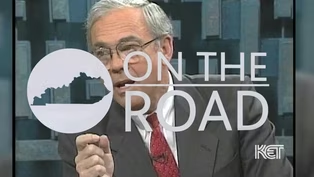
Clip: S2 Ep20 | 7m 33s | Gov. Paul Patton talks about his role in transforming higher education in Kentucky. (7m 33s)

Renewable Energy in Eastern Kentucky
Video has Closed Captions
Clip: S2 Ep20 | 3m 23s | Kentucky's largest solar project is about to break ground on top of a reclaimed coal mine. (3m 23s)
Providing Support for PBS.org
Learn Moreabout PBS online sponsorship
- News and Public Affairs

Top journalists deliver compelling original analysis of the hour's headlines.

- News and Public Affairs

FRONTLINE is investigative journalism that questions, explains and changes our world.












Support for PBS provided by:
Kentucky Edition is a local public television program presented by KET