Vermont This Week
June 28, 2024
6/28/2024 | 26m 45sVideo has Closed Captions
State pays $175k to man arrested for giving the middle finger to state trooper
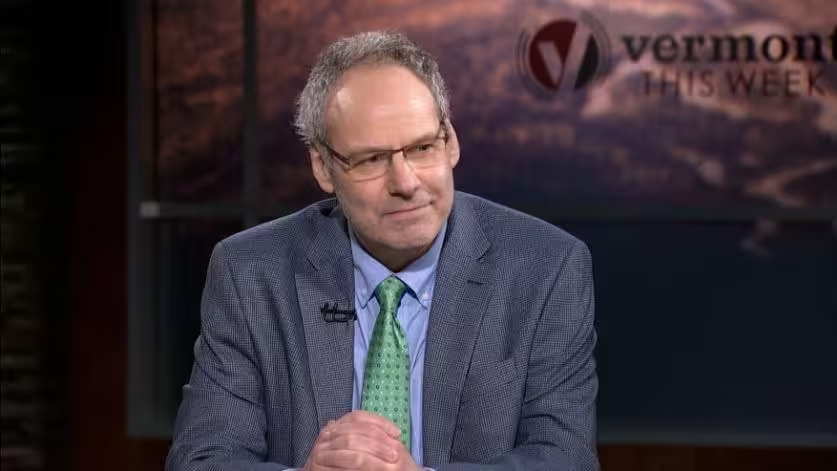
State pays $175k to man arrested for giving the middle finger to state trooper | $7M awarded to UVM's Center for Community News | School budgets | Panel: Mitch Wertlieb - Moderator, Vermont Public; Anne Wallace Allen - Seven Days; Lola Duffort - Vermont Public; Derek Brouwer - Seven Days.
Problems playing video? | Closed Captioning Feedback
Problems playing video? | Closed Captioning Feedback
Vermont This Week is a local public television program presented by Vermont Public
Sponsored in part by Lintilhac Foundation and Milne Travel.
Support provided by:


Vermont This Week
June 28, 2024
6/28/2024 | 26m 45sVideo has Closed Captions
State pays $175k to man arrested for giving the middle finger to state trooper | $7M awarded to UVM's Center for Community News | School budgets | Panel: Mitch Wertlieb - Moderator, Vermont Public; Anne Wallace Allen - Seven Days; Lola Duffort - Vermont Public; Derek Brouwer - Seven Days.
Problems playing video? | Closed Captioning Feedback
How to Watch Vermont This Week
Vermont This Week is available to stream on pbs.org and the free PBS App, available on iPhone, Apple TV, Android TV, Android smartphones, Amazon Fire TV, Amazon Fire Tablet, Roku, Samsung Smart TV, and Vizio.
Support the crew
Help Mitch keep the conversations going as a member of Vermont Public. Join us today and support independent journalism.Providing Support for PBS.org
Learn Moreabout PBS online sponsorshipA year long saga finally comes to an end with the state paying $175,000 to a man arrested for giving the middle finger to a state trooper back in 2018.
If we want to live in a free society, we have to ensure that we can speak openly to the police.
Plus, UVM Center for Community News gets a $7 million boost to help them expand.
And an update on school budgets as a July 1st deadline looms.
That and more ahead on Vermont this week.
From the Vermont Public Studio in Winooski, this is Vermont this week, made possible in part by the Lintilhac Foundation and Milne Travel.
Here's moderator Mitch Wertlieb.
Thanks for joining us.
I'm Mitch Wertlieb, it's Friday, June 28.
And with us on the panel today we have Anne Wallace Allen from seven days, Lola Duffort from Vermont Public and Derek Brouwer from seven days.
Thank you all so much for being with us today on Vermont this week.
We are coming to you one day after the first presidential debate.
For those of you listening or watching and don't worry, we're not going to talk about that.
We have plenty of Vermont news to talk about today on the program.
And Derek, I want to start with you, because this is actually a story that did go national that people found out about that you broke along with Liam.
Elder Connor is reporting for Vermont Public.
And this is about a man who just went for a morning cup of coffee, as he normally does, ended up getting arrested for some very strange circumstances.
And it took off from there.
What happened?
Who are we talking about and why was this case blown up so much?
Yeah, well, it's a really bizarre story, frankly.
But this is about a man who lives in St Albans named Gregory Bombard.
And it was on his day off.
He was driving to get coffee, as you mentioned, and he was pulled over by a trooper who thought that he had seen Greg give him the middle finger while they were passing in opposite directions down Main Street.
Now, there's no real evidence that he did, and Greg says he didn't.
So it appears to have been a misunderstanding.
But the officer, Jay, again pulled Greg over on the side of the road and came over to him and asked if he needed something.
And Greg was confused about what was going on.
And the trooper explained to him why he had pulled him over.
And Greg did something interesting.
He started he started asking questions of the trooper.
So even if I did give you the middle finger, what's the citation?
What's the crime here?
And the conversation was was a bit heated.
They went in circles.
And eventually, though, the trooper, after a few minutes, did go back to his cruiser and said, you know, have a good day.
And it could have ended there.
It could have ended there.
And it should have for everybody's sake, I think.
But but Greg, as he was pulling away, used some profanity toward the officer and and put his middle finger out the out the window for real for a few seconds.
And as soon as he did that, the trooper radio that he was going to arrest him for disorderly conduct on the grounds that he had engaged in tumultuous behavior in a public place.
So he pulled him over again and came over pretty upset the second time and said, get out of the car.
And he handcuffed them, searched him for weapons, had his car towed, and Greg was left with a citation for disorderly conduct that took almost a year to get cleared up.
And then he decided to pursue legal action from that point.
He did?
Yeah.
He waited a while, actually.
It wasn't until 2021 that he sued the Vermont State Police in the state of Vermont over his arrest, saying that the the stop and then the charge had violated his constitutional right to free expression.
So the First Amendment, he was hesitant to do so.
He said he didn't really want the attention.
He said that this giving him the middle finger was out of character for him, too.
So he wasn't exactly eager to be sort of a martyr for the First Amendment on this, but he had decided to do so and in the case lingered for for quite a while until until just this month.
But there are free speech issues here.
And the right ACLU got involved.
And here's what they had to say about it.
The First Amendment doesn't protect only speech that the police like and that we have a right in this country.
It's a fundamental constitutional right to express criticism with the government and its police.
Don't agree with that speech.
They're not allowed to abuse their authority to punish it.
So eventually, Derek, this case does get settled.
The Vermont State Police admit no wrongdoing in this.
Yeah, no.
Is doing admitted in the state police in the state of Vermont have not commented on this.
So we really don't know if they plan to change anything as a as a result of this other than $175,000 that they're giving out.
Now, the civil rights groups that represented Mr. Bombard had requested, they said, more training for officers and in a more codified policy at the Vermont State Police around First Amendment issues.
But the state didn't agree to either of those as part of the settlement.
You know, there are other layers to this story.
What I found remarkable about this was kind of the reaction.
There was so much overreaction around this entire story, the overreaction of the policeman involved, the overreaction perhaps of Greg Bombard, who, you know, admits that he probably shouldn't have given the finger to the officer at that point.
But also there were people then that started as the story went national, because it did get picked up by other outlets.
People started calling, making angry calls to the dispatchers at Vermont State Police.
What can you tell us about that?
Yeah, this is this is a wild turn that the story took on on the week of Christmas last year.
So the groups representing Greg had released the video of the arrest, the dash cam video on the Internet, and it went sort of viral.
And in the wake of that, people were writing in on Facebook, sort of heckling the trooper, but they also were calling in to the Vermont State Police Dispatch.
And on Christmas Day, nearly 100 people called in.
And on that day, the headquarters was closed.
It was a holiday.
So these calls were all getting routed to the emergency dispatch center, which was dealing with emergencies and overdoses and whatnot that day.
And I've listened to the recordings of those hundred calls, and some of them are frankly a little funny.
I mean, some people were clever, but others were were pretty mean.
And it seemed to make for a pretty miserable day for the people at the dispatch center.
Doing a serious job is dealing with overdoses and serious problem.
Exactly.
Yeah.
And and then again, this weird turn here, somebody in the dispatch center seems to have got it in their head that Greg, Mr. Bombard, was behind these calls and they actually decided to issue him a criminal citation again for disorderly conduct.
Really no evidence there.
There was no sign that he had called in.
And so this is on Christmas Day.
It's on Christmas Day.
And so a Franklin County sheriff's deputy shows up to Greg's house after Christmas dinner and very apologetically hands on this citation.
And I think I've seen the video of that, too, and seems to realize that Greg is surprised and doesn't really understand why he's there and that maybe this was yet another misunderstanding between the police and Mr. Bombard.
And and, you know, he he had to wonder if this was retaliatory in some way for all of the attention he had brought there on state police.
But it's hard to know.
Amazing story unrelated to the story I want to make this clear.
The Vermont Police Academy Job Task and Curriculum Analysis Report that is a long, fancy name for something that just came out was fairly critical of the Vermont police Academy.
What can you tell us about that report?
Yeah, this was a report that the Vermont Criminal Justice Council had commissioned.
There have been conversations for years now about what to do with our police training.
I mean, certainly think about the climate of of of law enforcement.
There are, on the one hand, calls for reform, police reform, which inevitably involves that type of training and the quality of training officers get.
But on the other hand, there has been a labor shortage and there are not enough police officers, too.
So there's a real tension, I think, at the heart of this.
But what this report found was really that the that the training that is offered right now is inadequate in certain ways, not so much that they're teaching the wrong thing, as I understand it, but that the way that the curriculum is structured and the quantity and hours of training, particularly for part time officers, is not there.
So, for instance, I mean, one thing they say is that a lot of the training is delivered through PowerPoint slides, which isn't unusual to me, but apparently is not best practice anymore.
So some of it is at that level.
But apparently Vermont is also a bit of an outlier and that we have a track to become a police officer that is much shorter than the traditional police academy and is a very condensed, classroom based program, but then has on the job training.
And that piece of the training in particular was called out as being inadequate.
And interestingly, the group that did this research found that there appeared to be like a boycott effort among police officers and agencies in the state that that have gone through this expedited track to not even participate in the surveys, to help understand whether this type of training was adequate as a kind of protest.
As a protest, is the implication here?
Yeah.
So I think there are some concrete suggestions.
And the Vermont Criminal Justice Council is already taking steps to beef up the training.
But I think beneath that, there are there are some tensions about how best to structure this.
And and underlying all of it is is a perennial problem with the Vermont Police Academy, which is that requests for more funding from from the state.
Thank you for catching us up on that story.
And.
WALLACE Allan, I want to turn to you now because you have a story in seven days.
It's actually some good news for a change.
And we're talking about local coverage.
You'll like Derek and Leon we're doing.
And apparently $7 million has been awarded to UVA's Center for Community News.
How did this come about?
Yeah, you're right.
It's good news for the local media, which we don't hear much of these days.
Local newspapers and local news outlets are struggling, and that has led to a drop in the amount of government coverage that people are seeing.
It just is sort of another factor, fraying communities and suppressing local engagement.
So the community news service at UVM, which is only a couple of years old, has tried to combat that by putting UVM students into community newspapers as much as it can.
And these are not journalism students because UVM doesn't actually have a journalism department.
It's just regular students who are edited by professional editors in the community.
And it's all led by Richard Watts, who's from the Center for Research on Vermont.
This is his idea, and he's actually expanded it to travel across the country to train other newspaper editors and universities in doing these partnerships where students are covering local meetings and writing local stories for local news.
So Vermont has already seen the benefits of this.
There's 35 students doing this now, although there's a lot of, you know, limitations to that.
For example, they all leave for the summer.
So they're in the communities where they have been reporting the news like Winooski.
There's a drop in coverage in the summer.
But Richard Watts has been and his staff have been applying for grants and they got 5 million from the Nate Foundation and another 2 million that was contingent upon getting that grant.
So that was a good news that they were able to announce this week.
And they're going to be able to triple the number of students who are covering local news for newspapers.
That has got to be a boon.
And, you know, hopefully some of those students go on to professional careers.
That's certainly the hope.
But just having that kind of coverage and getting them schooled in how to do this work is really important.
Yeah, you know, I asked him about that very thing, you know, why are these is the goal for these students to go into journalism?
And why don't you guys have a journalism department so they can be trained and take this, you know, as a career path?
And he said, you know, it is good if they do continue into journalism.
But he said it also produces engaged professionals in whatever career they go into.
They understand how journalism works and they've seen it from both sides so that they can work better with journalists and also just, you know, know the importance of it in their community and maybe contribute to it in other ways.
Yeah, I think that's the keyword community because you start to understand more about the community you live in.
When you start asking questions and going out and talking to people and you're a lot from professional work, right?
And you know, it's not that people don't want this news.
That's why that's not the reason why we're losing so many of these local newspapers.
It's because our revenue stream was classifieds and display ads and things that have been overtaken by Internet advertising.
People are hungry for local news, and there's a lot of nonprofits spending being poured into bolstering local news.
Now, there's the readers want it, they demand it.
There's people working for almost nothing, trying to, you know, delivering papers at 4:00 in the morning to make their local newspapers work.
Well, we're going to get back to some good news in a moment.
But first, we have to turn to some well, sort of bad news, Lola, before I guess you cover school budgets.
And I know this has been quite the year for school budgets, nearly one third failed first time around.
We know that a bunch of school budgets have not passed, although in a Richard finally pass their school budget on their third tries that right?
That is correct.
There was one vote this week, Richard, and they passed it on the third try after having cut about $900,000 from the spending plan they originally put before voters in March.
So they had to make some pretty deep cuts.
And Richard is already one of the lower spending districts in the state.
And that's going to be a theme of what I'm going to be talking about now.
The only school district left in Vermont that does not have a voter approved budget in hand is Barry.
And it looks like they're going to cross the finish line.
It's July 1st when the new fiscal year starts without a voter approved budget in hand, which is going to be very difficult for that district.
And they, too, are historically one of the lower spenders in the state and also need your community.
So, you know, I had heard over the course of the the this year this growing anxiety from the kind of school community that this rhetoric about school spending and higher taxes would be taken out disproportionately in communities that are actually already pretty frugal, but kind of more politically inclined to say no to government spending.
And so we have a situation right now where, yeah, the only place that is still without a voter approved budget is Barry.
And it's also the community that was the hardest hit by the floods a year ago, wondering about that.
Yeah.
And I mean, like a really sizable share of their student population has been rendered homeless by the floods.
Rendered homeless, yes.
They've got an interim suit and they've got an interim superintendent.
So if you you know, if it was if you were going to pick a school district that had to be in this pickle, in this situation, you probably wouldn't pick Barry.
Right.
Like they've they've dealt with enough.
How many votes that they had that failed as it been.
At least three, I believe this was their third.
Okay.
So as you said, July 1st is kind of the deadline.
When is the next vote scheduled for or has it been scheduled?
I don't believe it's been scheduled yet.
Given that you need like a 30 day warning, I don't think it would have been the last voted on June 18th.
So there's no way they could have scheduled a vote before July 1st, which is the beginning of the new fiscal year.
So, you know, they will almost certainly unless someone find some crazy loophole, get to July 1st without a budget.
And I hesitate to ask this question, but what happens if they can't come up with a budget that everyone wants to pass?
Well, in Vermont, you keep voting until you get a budget.
So they they are entitled by law to borrow up to 87% of their prior year's budget in order to maintain basic operations.
But you're basically borrowing in anticipation of taxes.
And and also a there's like a minimum tax rate that will be applied to the city until they're city and town, until there's a voter approved plan in place and they'll get their final tax rate.
But in Vermont, you don't get a budget until you get your voters to say yes.
No matter how long it takes it, it has at least once taken years.
So who knows how long it's going to take.
Of course, if they borrow, they will have to pay interest on that.
And that's kind of like digging a hole, isn't it?
I mean, it's exactly digging a hole.
Yes.
That that's very difficult.
Is it fair to say, Lola?
I mean, I'm just wondering about the tension here.
What what is keeping this budget from passing essentially?
Is there a way of summing it up?
Well, Barry Town, right.
So you have two communities in this very in a school district, Barry City in Barry Town.
Barry City has voted for the budget I think all three times, very narrowly.
And Barry Town by a much wider margins has voted it down.
Barry Town is the slightly wealthier, also slightly more conservative community.
But, you know, these two communities have never not historically gotten along super well.
And this is a somewhat unhappy forced marriage under Act 46.
And so, you know, there's there is a lot of there's some bad blood between the communities that we're seeing kind of bubble up in this situation.
And of course, the kids and the teachers are having to pay for that, right?
Yeah.
They're the ones who end up suffering the most.
There is a school consolidation story you're covering as well.
Washington Central Unified Union School District talking about consolidation.
What's happening there?
Yeah, that's right.
So the Washington Central Unified Union School District, that's quite a mouthful, which is all of the surrounding communities around Montpelier, but not including Montpelier.
So East Montpelier, Worcester, Callus, Berlin and Middlesex, they have you 32 high school and they have five elementary schools, I believe, right now.
And they're considering closing one or two or even three of them and consolidating their elementary schools.
The school board is really trying to pitch.
This is like our buildings are incredibly are operating under capacity, know roughly at 40, 50% right now.
If we put more of the kids into the same buildings, we could have fewer part time staff.
We could expand offerings for a less or the same amount of money.
Right.
We could do more with less.
And so that is kind of their pitch to the community.
I don't know that the community is buying it.
It's getting a lot of pushback as school consolidation usually does.
Is there any deadline on this or when it has to happen by or.
I believe they're trying to make a decision sometime in the fall and pretty soon.
So, you know, kind of in anticipation of building the budget for the upcoming year.
So not the one that's not not next school year, but the school year after that.
I did promise we get back to some some good news.
And you did a story that I find really kind of nice about a year out that's become a kind of gathering place for folks.
Where is this and how are they gathering around this year?
Yeah, this year it was initially at a campground in Marshfield where that is always traditionally the Onion River campground.
It's traditionally been a place where a lot of people actually lived in the summertime, and it has a very open and affirming vibe to people from all different walks of life.
And but it was washed.
The campground was devastated during the flooding.
It's right on route to in Marshfield, near the Plainfield line.
And the year it was washed down the Winooski River retrieved.
And it's made of basically sticks and a tarp.
And it was it's been reassembled at the North Prince Nature Center in Montpelier as a bipoc affinity space.
It's a pretty big space, about 17 feet across.
They built a platform for it, and it's going to have a new home as a place with a wood stove in the winter and just in general, a gathering place and a nice symbol for kind of recovery.
Really?
Yeah.
Yeah.
Could use that kind of news.
Also, you've been writing about in White River Junction, a theater company is going to have housing built for their actors and a lot of money came to help out with this, right?
Yeah.
I mean, as we all know, the housing crisis is still in force and it costs about half a million dollars to build one apartment these days, which is you cannot make up by paying the rent, but theater companies under their regional theater will employ, you know, 100 actors in the course of a year or visiting artists of different types.
And they also have staff and they are contractually obligated to house their visiting artists.
And so that's interesting.
I didn't know that.
Yeah.
And they've been using, you know, they've rented spaces, they own a couple of buildings where people have been able to live and they started raising money from their donors to buy a property right within walking distance and build some housing there.
And they actually have raised $8 million to do that.
They're going to build, I think it's 34 apartments.
And, you know, they've and in doing that, they're going to make the apartments that they used to rent from the community back available to the community again.
So the community is going to feel an additional 15 apartments back on the market when that project is finished.
That's pretty impressive to have a capital campaign raise that much money.
It is.
You know, a lot of employers want to build staff housing because this is going to be used for staff, too.
But it's you're right, unless you have those kind of donors, it's really, really hard to raise the money to build the housing.
And the thing is that this this new housing is not going to be going to appraise for as much as they spent on it.
So it's not something that anybody else can really do.
It really takes charitable donations.
Yeah.
We've been hearing about how hard it can be for a lot of these troops just to put on a production, you know, the cost around it and then, you know, various things that make that difficult.
But this sounds like, again, a good story to have that's coming out there.
So thank you for sharing that with us.
We do know that Montpelier businesses, though, have been hurting since the flood and you've been doing some reporting on that as well.
Yeah, I mean, Montpelier was hit really, really hard in the flood.
A lot of businesses were closed by the flood and the city, you can still see the empty storefronts where people just didn't come back.
Some restaurants, some restaurants and businesses haven't come back.
And another big restaurant, rabble rouser just closed.
It was kind of a coffee shop place.
So Vermont is I mean, Montpelier is struggling and the business owners have been sort of coming out in force since the flood, pushing for more state assistance, for more help.
One of the things they're saying now is that the loss of the state workers who used to work in all of those office buildings on State Street, a lot of them have gone remote or they're remote a few days a week.
Some of them are remote most of the week.
So they're not walking into town and having lunch or shopping for what they need.
And the business owners are, you know, saying that's one of the big factors that's hurting them.
The state says, well, we're not going to have them come back because it's a great selling point.
We're trying to hire people and this is a great selling point that they can work remotely.
So there so the downtown association is also advertising more than it has in the past and it's actually aiming in the Burlington area where they think people might want to come down and shop in Montpelier.
They're also going for Boston.
You know, they don't have a big budget because they're paid for by the businesses.
But there's some good news in Montpelier, too.
The tour busses seem to be venturing back and the Capital Plaza Hotel has reopened.
They were very badly damaged in the flood.
They had new owners who had just purchased the hotel four days before the flood there.
Their rooms are open again and they're full.
Some nights they told me that's important and that's a good landmark to have.
Yeah, for sure.
Oh, please let us go ahead.
You know, one thing I appreciated about your story was there seemed to be a recognition by business owners in downtown Montpelier that, you know, it's like no one's calling for state workers to come back, or at least that's not my impression based on your reporting.
And instead, there seems to be this recognition that we're going to need to adapt to this new reality.
Right.
And, you know, they were talking about housing and that kind of stuff.
And I think that's important, right?
That there seems to be this that conversation instead of how can we how can we get back what we lost?
Right.
They're saying, okay, the buildings are empty, so state it's up to you to convert them to housing, sort of put people in there because right now having a large number of empty buildings, 17 state buildings were damaged by the flood and they're all in various states of repair.
They're saying, you know, it's incumbent upon you state to do something about this and convert these buildings.
Okay.
I want to end on a story that was near and dear to my heart because I was filling in for Vermont Edition and got to speak with Sam Muse, who's a World Cup champion.
She also coached the first ever women's soccer match for Vermont Green FC.
We're seeing some video of that right now, an exciting game.
They played a team from Quebec and the women's team, you know, they weren't necessarily expected to win the game.
They led one nothing.
They gave up a late goal and then it went to penalty kicks.
And boy, did this crowd.
By the way, a record crowd at Virtu Field, 3000 people showed up for this game.
That is a record beating any attendance for even the brought the men's game.
And then Rashawn Purcell put home the game winner for Vermont Green.
I've seen you see the celebration there outstanding.
And this is an effort to get hopefully a full season women's team to the Vermont Green FC.
Incredible, incredible expectations that were exceeded I think there at Virtue Field.
So congratulations to Vermont Green FC and a great game all around for them winning it as well.
And we're going to have to leave it there for today.
Thanks to our panel again and Wallace Alan from seven days Lola to four from Vermont public and Derek Power from seven days and thank you at home for watching and of course listening as well.
Join us next week for a special edition of Vermont.
This week will be focused on the Vermont State Park system.
Going to be a great conversation there.
100 years old.
And we hope to talk to you about it then and see you then as well.
And.

- News and Public Affairs

Top journalists deliver compelling original analysis of the hour's headlines.

- News and Public Affairs

FRONTLINE is investigative journalism that questions, explains and changes our world.












Support for PBS provided by:
Vermont This Week is a local public television program presented by Vermont Public
Sponsored in part by Lintilhac Foundation and Milne Travel.