
June 28, 2024 - PBS NewsHour full episode
6/28/2024 | 57m 46sVideo has Closed Captions
June 28, 2024 - PBS NewsHour full episode
June 28, 2024 - PBS NewsHour full episode
Problems playing video? | Closed Captioning Feedback
Problems playing video? | Closed Captioning Feedback
Major corporate funding for the PBS News Hour is provided by BDO, BNSF, Consumer Cellular, American Cruise Lines, and Raymond James. Funding for the PBS NewsHour Weekend is provided by...
June 28, 2024 - PBS NewsHour full episode
6/28/2024 | 57m 46sVideo has Closed Captions
June 28, 2024 - PBS NewsHour full episode
Problems playing video? | Closed Captioning Feedback
How to Watch PBS News Hour
PBS News Hour is available to stream on pbs.org and the free PBS App, available on iPhone, Apple TV, Android TV, Android smartphones, Amazon Fire TV, Amazon Fire Tablet, Roku, Samsung Smart TV, LG TV, and Vizio.
Providing Support for PBS.org
Learn Moreabout PBS online sponsorshipAMNA NAWAZ: Good evening.
I'm Amna Nawaz.
GEOFF BENNETT: And I'm Geoff Bennett.
On the "News Hour" tonight: The U.S. Supreme Court issues major decisions on obstruction charges against January 6 rioters, federal regulatory power and homelessness.
AMNA NAWAZ: Analysis of key moments and the fallout from last night's presidential debate.
GEOFF BENNETT: And David Brooks and Kimberly Atkins Stohr break down the latest political headlines.
(BREAK) GEOFF BENNETT: Welcome to the "News Hour."
With just one day left in its term, the U.S. Supreme Court issued a trio of major decisions today.
AMNA NAWAZ: The justices upheld a law making it a crime for unhoused people to camp in public areas like parks, sidewalks and plazas.
They narrowed the scope of a law being used to prosecute the January 6 rioters and weakened the rulemaking powers of regulatory agencies.
"PBS News Weekend" anchor John Yang reports on the Supreme Court for us.
He's here now to break it all down.
John, good to see you.
JOHN YANG: Good to see you.
AMNA NAWAZ: So let's start with the case of Joseph Fischer.
This is a man charged with seven counts after storming the Capitol on January 6.
What aspects of his case did the justices consider here?
JOHN YANG: Well, Fischer challenged just one charge that was against him.
That was obstructing an official proceeding.
Because of the law, the way the law is written, his argument was it had to involve an actual document, a piece of evidence.
Now, the justices agree that it didn't cover storming the Capitol or confronting police officers inside the Capitol.
Chief Justice John Roberts said in the majority opinion that the way the Justice Department is using the law criminalizes a broad swathe of prosaic conduct, exposing activists and lobbyists to decades in prison.
It was a 6-3 decision, but not ideological.
Ketanji Brown Jackson was in the majority and Amy Coney Barrett wrote the dissent.
She said the majority did textual backflips to reach their conclusion.
AMNA NAWAZ: John, as you know, there are some 1,300 other January 6 defendants.
How might this ruling impact those cases?
JOHN YANG: It appears to be quite limited.
This is former Justice Department official Mary McCord: MARY MCCORD, Former Justice Department Official: That's because, first of all, only 346 of the more than 1,400 defendants charged for the riot on and the attack on the U.S. Capitol were even charged with that offense.
Of those, the vast majority are charged with another felony.
So whether they went to trial or whether they pleaded guilty, they could be resentenced to term, similar term of incarceration based on that other felony.
There's a very few number of people who either were not convicted or found guilty of another felony or it was only a misdemeanor.
And that -- those are the people who might get a resentencing.
JOHN YANG: Now, it's also one of the charges against former President Donald Trump.
But some are suggesting that may not have to be dropped because his case does involve documents, those fake -- fake elector ballots.
AMNA NAWAZ: Interesting.
So there's also a separate decision I want to ask you about in which the conservative majority upheld an ordinance in a small Oregon city that basically criminalized behaviors associated with homelessness, things like sleeping in public parks, et cetera.
So what were the key factors that they were considering in that case?
JOHN YANG: Well, the challengers said that these laws criminalized -- made it -- made -- or -- sorry -- they were punishing people for being homeless, for being unhoused.
And you can't punish someone for their status.
You can only punish them for their conduct.
The six conservative justices said that's exactly what these laws do.
They punish conduct, not status.
Now the liberal justices disagreed very strongly.
Listen to the opening lines of Sonia Sotomayor's dissent, which she read from the bench this morning.
She said: "Sleeping is a biological necessity, not a crime.
For some people, sleeping outside is their only option.
For people with no access to shelter, that punishes them for being homeless.
That is unconscionable and unconstitutional."
AMNA NAWAZ: John, what kind of reaction has that decision been getting from city leaders, mayors on the front lines of this issue, and also public housing advocates?
JOHN YANG: Well, a lot of the city and state leaders who've been struggling with this problem welcomed it.
Here is Seattle city attorney Ann Davison.
ANN DAVISON, Seattle, Washington, City Attorney: This decision will help with safety.
For us, we had a nexus with gun violence and encampments.
And so that was shown through our police data.
Now local decision-makers who understand the unique circumstances in their communities are able to make laws that are responsive to what their needs are, instead of following something that might be better for a town that's thousands of miles away.
JOHN YANG: On the other hand, housing advocates say this is just going to make things worse.
Here's former Housing and Urban Development Secretary Shaun Donovan.
He now runs the Enterprise Community Partners, which is a nonprofit trying to expand housing stock.
SHAUN DONOVAN, Former U.S. Housing and Urban Development Secretary: Criminalizing homelessness doesn't work.
In fact, it makes it worse.
In part, it's a game of cruel Whac-A-Mole.
If folks don't have a place to sleep, no home, no shelter, just moving them or putting them in jail, those tents, those encampments are going to turn up somewhere else.
But even worse, by arresting people, by fining them, you actually make it harder for them to find jobs, to find housing, the things that end homelessness.
AMNA NAWAZ: John, meanwhile, in another decision, the conservative majority overturned a decades-old precedent.
That decision effectively limits government agencies' authority to write rules.
It's kind of dry stuff here.
But help us understand the massive potential impact here and also why this has been on some conservative wish list for quite some time.
JOHN YANG: It's something called the Chevron deference.
It's called that because it first arose in a 1984 case dealing with Chevron.
It says that if a law is ambiguous the courts have to defer to the agencies' interpretation of that law.
Now, conservatives have hated this.
They have been gunning for this for a long time.
They call it the government always wins doctrine.
And today the chief justice, John Roberts, struck it down.
He said that the law requires judges to independently evaluate agency actions and that justices or judges shouldn't defer to the agencies simply because the law is ambiguous.
Now, this is, as you say, a big deal.
This has the most widely cited precedent in U.S. jurisprudence, the underpinning of about 17,000 federal regulations dealing with the environment, with drugs, with food safety, everything.
AMNA NAWAZ: Huge potential impact there.
John Yang, after a busy week at the Supreme Court, thank you.
So good to see you.
JOHN YANG: Thank you.
AMNA NAWAZ: Well, meanwhile, the Supreme Court has now swept aside longstanding legal precedent in its ruling today overturning that Chevron doctrine, majorly curtailing the power of federal agencies to interpret the laws they regulate.
The decision is expected to have far-reaching implications on everything from the environment to health care.
GEOFF BENNETT: For a closer look at the overturning of the Chevron precedent, we're joined now by Andrew Mergen.
He spent three decades as an attorney for the Department of Justice Environment and Natural Resources Division.
He now heads the Emmett Environmental Law and Policy Clinic at Harvard Law School.
Thanks so much for being with us.
Thank you Geoff.
GEOFF BENNETT: And, as Amna mentioned, the Chevron case is obscure, but has a huge impact.
It's basically shorthand for a longstanding tradition that says, if there's an ambiguous statute, the courts defer to the agencies and their interpretation of how to read that statute because the thinking has always been that the agencies have the expertise.
Today, the Supreme Court said, nope, that's no longer the case.
How big a deal is this?
ANDREW MERGEN, Harvard Law School: I think in the short term, it's a very, very big deal.
I think that we're going to see an enormous number of challenges to government regulations in the environmental area in food safety, in the health care, health care administration.
There will be many, many challenges.
And the lower courts and the Justice Department that defends those regulations are going to be very, very busy in the near term.
GEOFF BENNETT: Do we know how or if this ruling today will affect cases that were already settled under the Chevron precedent?
ANDREW MERGEN: It's an excellent question.
The chief justice, in the majority opinion, says that those decisions should not be up for review merely because they depended on the Chevron, on Chevron deference or the Chevron doctrines.
But Justice Kagan, in her dissent, says that's a very cold comfort.
And I tend to agree.
This is a very complicated question.
It's sometimes very hard to parse out exactly why courts upheld regulations.
And I fear that there will be many, many folks ready to test the limits here and to reopen past regulatory judgments and regimes.
GEOFF BENNETT: So this could affect everything from clean water, clean air, health care, gun regulations.
Give us a sense of the potential real-world impact?
ANDREW MERGEN: Oh, yes, I think it's very -- in the short term, especially, it's going to create an enormous amount of instability.
And I think that, again, I think we don't know how far reaching it's going to be in terms of unsettling established regulatory precedents in the clear air realm, in the preservation of clean water, a whole slew of environmental and health regulations.
My hope is that the agencies know how to promulgate these regulations in the absence of Chevron deference.
And so, going forward, I think they know what is expected of them.
But I tend to agree with Justice Kagan that the Chevron doctrine and Chevron deference promoted stability in the law and that there will be a lot of gamesmanship, as we have seen elsewhere, in terms of seeking out favorable courts to sort of upend the longstanding regulatory regimes.
GEOFF BENNETT: On this matter of the Chevron doctrine promoting stability within the law, conservatives over time came to loathe it because it was mostly Democratic administrations that used this doctrine to justify broad regulations.
And I have spoken to a number of business leaders who have said that it's not a good thing for economic development or business development when you have regulations that shift as a result of who controls the federal government.
What do you say to that argument?
ANDREW MERGEN: I think it's right.
I mean, I think that the business community is split on this issue.
I don't think that business interests are monolithic on this.
And we see this reflected in other environmental disputes, where some of the car companies are anxious to support EPA and others are skeptical.
One thing for sure is, though, is that if this decision allows agencies -- allows challengers to upend prior regimes, we're going to have a hard time knowing what the law is.
And for some folks, that may create opportunities, but for others, trying to plan for the future or trying to figure out what their -- how their manufacturing processes can meet environmental laws and things like that, it's going to be unsettling.
And I do -- I do think, as the Justice Department suggested in its briefing, that this has the potential to be, at least in the short term, very, very destabilizing for a whole range of stakeholders, not just people concerned about health and the environment, but also folks in business.
I do think that there is a real need for this kind of deference.
Justice Kagan points to some examples.
There are just so many things that judges just don't have the capacity to understand about amino acids or endangered species or manufacturing processes where it makes good sense to listen to the agencies and the expertise that resides in the agencies.
GEOFF BENNETT: In the roughly 45 seconds, the court reversing a 40-year precedent here, what does all of this say about the Roberts court's adherence to stare decisis, adherence to judicial precedent?
ANDREW MERGEN: I think that we have entered into a whole new era with the Roberts court.
We saw that certainly in the Dobbs decision and here as well, a desire to -- less sort of respect for stare decisis, and more of an appetite for risk in terms of sort of unsettling established law and sort of seeing what happens next.
And I think, to me, that is contrary to sort of traditional rule of law values.
GEOFF BENNETT: Andrew Mergen, thanks so much for sharing your insights with us.
We appreciate it.
ANDREW MERGEN: Thank you.
GEOFF BENNETT: In the day's other headlines: Iowa's Supreme Court is letting a law go into effect that bans most abortions after about six weeks of pregnancy.
The decision removes a lower court's temporary block on the measure, which was passed with only Republican support last year.
There are exceptions for rape, incest, or if the pregnancy endangers the life of the mother; 14 states now have near-total abortion bans, and three others ban abortions after six weeks.
The former police chief for schools in Uvalde, Texas, failed to identify the 2022 attack at Robb Elementary School as an active shooting.
That's according to an indictment unsealed today.
Pete Arredondo was arrested and released last night.
He faces 10 felony counts of abandoning or endangering a child.
The indictment said Arredondo slowed down the response when he directed law enforcement officers to evacuate the wing before confronting the shooter.
Security footage shows officers retreating as gunfire could be heard down the hall; 19 students and two teachers were killed.
In Iran, voters cast their ballots today for a new president.
The snap elections were called to replace the late President Ebrahim Raisi, who died in a helicopter crash last month.
Voters are choosing from a tightly controlled group of four candidates loyal to Iran's supreme leader at a time of growing frustration.
But voters are still making their voices heard.
AZAM FAKHIMI, Iranian Voter (through translator): Unfortunately, some people think that the president has already been selected, but we must vote.
If I don't vote, someone else would vote, and the candidate who is not the best might be elected, unfortunately.
That would harm the Iranian nation.
GEOFF BENNETT: A final result is expected this weekend.
If no candidate receives a clear majority, the top two finishers will advance to a run-off on July 5.
The Pentagon announced today that the temporary pier it built off Gaza has been removed once again amid rough seas and provided no timeline for its return.
The pier started operating in may to increase aid deliveries.
Just days later, it was damaged by rough seas and taken down for repairs.
The pier was reinstalled earlier this month, but humanitarian groups have since suspended distributions, citing security concerns.
That's left supplies piling up at a distribution point on the beach.
The Pentagon official said today that resuming pier operations could depend on freeing up that backlog.
SABRINA SINGH, Pentagon Deputy Press Secretary: If there's not enough room on the marshaling yard, then it doesn't make sense to put our men and women out there when there's nothing to move.
But we do need to see that marshaling yard open up to allow for aid groups to continue that distribution so that we can get more aid in.
GEOFF BENNETT: Meantime, the IDF released video today of tanks pushing further into Northern Gaza and troops operating in the southern city of Rafah.
Palestinian officials say tank shelling there killed at least 11 people today.
The Biden administration will expand temporary protected status to more than 300,000 Haitians already living in the U.S.
The program gives work permits and protections from deportation to those fleeing conflict or disasters.
The designation lasts six to 18 months and can be extended.
More than 260,000 Haitians are already in the U.S. under the program.
Ongoing gang and criminal activity has left Haiti increasingly dangerous.
The U.N. says more than five million Haitians are facing severe food insecurity and more than half-a-million have been displaced.
NASA said today that the first two astronauts to travel aboard Boeing's Starliner to the International Space Station will stay up there for a couple of weeks longer.
Engineers will use that time to investigate the craft's thruster issues, which have already delayed the return trip multiple times.
WOMAN: Lots of cheering here in the room.
Big hugs.
GEOFF BENNETT: Veteran astronauts Butch Wilmore and Suni Williams celebrated a successful docking with the ISS on June 6.
They were due to stay on board for only about a week.
And on Wall Street today, the Dow Jones industrial average lost 45 points, the Nasdaq fell more than 120 points on the day.
The S&P 500 also ended lower.
Still to come on the "News Hour": Democratic Governor Tim Walz of Minnesota reacts to President Biden's debate performance and the fallout within the party; and we fact-check some of President Biden's and Mr. Trump's claims from the presidential debate.
AMNA NAWAZ: Over a 90-minute presidential debate last night, there was sparring over top policy issues.
There were personal attacks.
There was even an argument about golf.
Former President Donald Trump repeatedly made false claims, and President Biden repeatedly struggled to dispel concerns about his age.
It's opened new concerns over the stakes of a possible Trump presidency, and it's sparked some discussion about whether Biden should be his party's nominee.
White House correspondent Laura Barron-Lopez has our debate digest tonight.
LAURA BARRON-LOPEZ: Tonight, the fallout from a debate full of fumbles and falsehoods.
Both candidates holding rallies in key swing states today to dominate the post-debate airwaves.
Former President Donald Trump claimed a victory in Virginia.
DONALD TRUMP, Former President of the United States (R) and Current U.S. Presidential Candidate: The question every voter should be asking themselves today is not whether Joe Biden can survive a 90-minute debate performance, but whether America can survive four more years of crooked Joe Biden in the White House.
LAURA BARRON-LOPEZ: Though praised by Republicans for his debate performance, Trump repeated lie after lie, including this one on abortion.
DONALD TRUMP: He's willing to, as we say, rip the baby out of the womb in the ninth month and kill the baby.
Nobody wants that to happen, Democrat or Republican.
Nobody wants it to happen.
JOE BIDEN, President of the United States: You're lying.
That is simply not true, that Roe v. Wade does not provide for that.
MAN: The president of the United States, Joe Biden.
(CHEERING AND APPLAUSE) LAURA BARRON-LOPEZ: For President Biden, a rally today in North Carolina to convince his base that he can see it through.
JOE BIDEN: I don't walk as easy as I used to.
I don't speak as smoothly as I used to.
I don't debate as well as I used to.
But I know what I do know.
I know how to tell the truth.
(CHEERING AND APPLAUSE) JOE BIDEN: I know how to get things done.
(CHEERING AND APPLAUSE) JOE BIDEN: And I know, like millions of Americans know, when you get knocked down, you get back up.
(CHEERING AND APPLAUSE) LAURA BARRON-LOPEZ: After his debate performance left many Democrats in a panic, no moment clearer than when the president appeared to lose his train of thought while talking about the national debt.
JOE BIDEN: Making sure that we're able to make every single solitary person eligible for what I have been able to do with the -- with the COVID -- excuse me -- with dealing with everything we have to do with -- look, if -- we finally beat Medicare.
LAURA BARRON-LOPEZ: Stumbles that happen so frequently that Republicans pounced.
Some in Congress introduced a resolution that would force consideration of the 25th Amendment to remove Biden from office.
REP. MIKE JOHNSON (R-LA): This is an alarming situation.
As I mentioned, our adversaries see the weakness in this White House, as we all do.
I take no pleasure in saying that.
I think this is a very dangerous situation.
LAURA BARRON-LOPEZ: Biden's sharpest attacks came when he took aim at one of Trump's biggest vulnerabilities with voters, his criminal cases.
JOE BIDEN: The only person on this stage that is a convicted felon is the man I'm looking at right now.
And the fact of the matter is, he is -- what he's telling you is simply not true.
LAURA BARRON-LOPEZ: And called out Trump's continued refusal to accept the results of this year's election.
DANA BASH, Moderator: President Trump, the question was, will you accept the results of the election regardless of who wins?
Yes or no, please?
DONALD TRUMP: If it's a fair and legal and good election, absolutely.
I would have much rather accepted these but the fraud and everything else was ridiculous.
JOE BIDEN: I doubt that you will accept it because you're such a whiner.
The idea, if you lose again, you accept it, and you can't stand the loss.
Something snapped in you when you lost the last time.
LAURA BARRON-LOPEZ: Democrats were divided on Biden's debate night, Vice President Kamala Harris hitting the airwaves to defend the president.
KAMALA HARRIS, Vice President of the United States: It was a slow start, but it was a strong finish.
LAURA BARRON-LOPEZ: Other Biden supporters, like Pennsylvania Governor Josh Shapiro, with more candor.
GOV.
JOSH SHAPIRO (D-PA): I acknowledge, now multiple times, Joe Biden had a bad debate night and he's got a burden on him to show people that he is still able to move forward in these debates and in prosecuting the case against Donald Trump.
LAURA BARRON-LOPEZ: Some opinion pages today, including The New York Times, urging Biden to bow out.
But Biden allies quickly called those discussions unhelpful.
GOV.
GAVIN NEWSOM (D-CA): You don't turn your back because of one performance.
What kind of party does that?
LAURA BARRON-LOPEZ: And President Biden's campaign said that the president is committed to debating Mr. Trump in September -- Geoff.
GEOFF BENNETT: Well, Laura, as you reported, a sense of panic set in among Democrats after President Biden's debate performance last night.
What are they saying today?
LAURA BARRON-LOPEZ: Well, it's not good for Democrats right now, Geoff.
Most Democrats that I spoke to said that they're worried.
And lawmakers, party operatives as well as Democratic Party leaders spoke -- that I spoke to, that you spoke to told us panic is an understatement.
They said things like: "The guy that we're nominating is just not capable of getting elected any longer."
Some also said: "It's going to require a ton of work to come back from this."
But then there were other Democrats, big leaders in the party, like former President Barack Obama, who posted on X: "Bad debate nights happen.
Trust me, I know, but this election is still a choice between someone who has fought for ordinary folks his entire life and someone who only cares about himself."
Obama ultimately saying that last night didn't change that.
But to put this panic in context, Geoff, I have never heard this level of panic before from Democrats across the board on and off the Hill about whether or not they think President Biden can win in November.
But no one is saying this on the record, Geoff.
No one is saying that they conceivably think that they can replace President Biden on the ticket.
And other major party leaders, like Majority Leader in the House Hakeem Jeffries, as well as Representative Jim Clyburn, are sticking by President Biden.
GEOFF BENNETT: Well, how are Biden campaign officials addressing all of this?
LAURA BARRON-LOPEZ: Biden campaign officials are essentially saying, look, we understand that it was not a good night for the president, but that it was one night, and that they said that any asks of him to step aside are ridiculous.
They also said that he absolutely will not be stepping aside from this race.
I also spoke to one of President Biden's campaign pollsters, Jef Pollock, who said that in their monitoring of voters in the aftermath of the debate, they saw no real movement based on the debate, that voters were in their partisan corners, and that, amongst undecideds, they saw that some undecided voters in focus groups did not respond well to Donald Trump's personal impacts, didn't respond well when Donald Trump was talking about January 6, and that also it was effective for President Biden when he was attacking Donald Trump specifically on the criminal cases that Donald Trump is facing.
The campaign also pointed to their fund-raising yesterday.
They raised $14 million from small-dollar donors on debate day, and they said that their best hour of fund-raising ever since Biden launched his campaign was in the hour right after the debate.
GEOFF BENNETT: Really?
Well, is replacing President Biden on the ticket, is that even a viable option?
Because he would have to make that decision and he would have to release his delegates.
LAURA BARRON-LOPEZ: Geoff, it's possible, but it's highly unlikely.
And if Democrats pursue this, here are the steps that it would take.
It's a difficult process that hasn't been used in decades.
The clearest path is if President Biden declines the nomination.
And at the convention, more than half of pledged delegates would have to reject Biden during the roll call.
So it's something that is certainly possible, but a lot of -- a number of Democrats that I spoke to said that they don't think that the party is at that point right now.
GEOFF BENNETT: As quickly as news cycles move these days, how much impact might one debate have on the race, based on your reporting?
LAURA BARRON-LOPEZ: Again, the reaction from Democrats is notable.
It's stark.
And one concern that Democrats have looking forward is downballot.
Is this debate performance from President Joe Biden going to impact Democrats downballot?
So far, they have been polling ahead of President Biden.
They have been running effectively on his record during his first term.
But will this hurt them as they continue running their races in difficult battleground states?
But President Biden today really sought to strike a contrast again and really tried to refocus the race on the stakes.
He called Donald Trump a genuine threat to democracy.
He pointed out that Donald Trump lied over and over during the debate, which as we all know that he did on immigration, on abortion.
And President Biden also said that what's at stake this election cycle is freedom, is democracy.
And so that's what we're going to see the campaign focus on in the weeks ahead, which is that extremism argument that they believe is very effective with not just their base, but also with undecided voters.
GEOFF BENNETT: Laura Barron-Lopez, our thanks to you, as always.
LAURA BARRON-LOPEZ: Thank you.
AMNA NAWAZ: For more on President Biden's debate performance and what's at stake this election, we're joined by Minnesota Governor Tim Walz.
He's a surrogate for the president's campaign.
Governor, welcome back to the "News Hour."
GOV.
TIM WALZ (D-MN): Thanks for having me, Amna.
Glad to be back with you.
AMNA NAWAZ: Let me ask you about some of the reaction to the debate, because former Senator Claire McCaskill, who I know you know and has long been a strong surrogate for President Biden, as have you, said after the debate that the president had one thing to accomplish.
That was to go out and to prove to people that he is up to the job at his age.
And, in her words, he failed at that last night.
Do you agree with that assessment?
GOV.
TIM WALZ: Well, I do agree he had a poor night.
I don't think that's for debate.
But what I do know is that the totality of the president's work, especially at the crisis time coming out of COVID and some of the things, as a governor, we're at the tip of that spear and we see it.
So I don't think you judge a person's - - their body of their work on one night.
I have done dozens of these myself.
They don't always go the way you want to.
I have confidence in the president because he's delivered.
And to be very candid, Amna, the thing that I was disappointed last night and quite concerned because of what Donald Trump said.
He was very articulate in his belief that he should deny women reproductive rights.
He was very articulate that he did nothing wrong with January 6.
That worries me, because a Trump presidency is something almost unfathomable.
And I think, when we saw a poor performance out of the president, that makes that a little bit more of a reality.
So I certainly won't defend the performance on this, but I will defend the record.
AMNA NAWAZ: I do want to ask you about former President Trump's performance in more detail, but back to President Biden for just a moment, because in terms of what's at stake, his record is one thing, as you and other of his surrogates have said.
But when voters are looking at the next four years ahead -- and, as you well know, some 44 percent of Democrats have already said they believe he is too old.
Doesn't that performance at a debate like last night's, doesn't that matter in proving to people he's up to the job for the next four years?
GOV.
TIM WALZ: Yes, I think it does.
I think now this puts a little more pressure on the president.
He's down in North Carolina today.
And I think one of the things I'm hearing from folks who are texting me is, why wasn't that guy there last night?
That's kind of the way things go, that you have the ups and downs.
The president made the case.
Look, he's not a young man, but he's an honest man, and he works hard for folks.
And he's got a team around him that are able to deliver.
We're right in the middle of massive flooding out here in Minnesota.
And his teams out here.
He took time Wednesday.
He wasn't preparing for the debate.
He was calling out here to see how the flood recovery was going.
So, yes, I think it's a valid point.
I'm not going to gloss over the fact that, look, this was not a great performance, but I'm still seeing the president do this job.
I'm still seeing him be responsive to crisis situations and putting out policies that are going to make life better for people, unlike Donald Trump that is horrifyingly misleading last night.
But more than that is just blatantly cruel in his policies.
So we see a Supreme Court decision in Iowa today restricting reproductive rights.
Donald Trump wants to expand that even more so.
So, yes, it's a concern.
But I am still confident in the president's ability, confident in those that are in his administration to move us in a positive direction.
Look, this is a binary choice, Donald Trump's Mad Max America and one where the wealthy extremists get everything, and the rest of us are left with the scraps.
I'm not interested in that.
And Joe can get us there.
AMNA NAWAZ: Well, I know a key part of the Biden mission and Biden campaign mission is to draw that stark contrast, not only between these two men's vision for America, but who they are personally.
As you noted, last night, former President Trump, he was calmer than usual.
He was confident.
He did deliver a steady stream of lies and baseless information that went largely unchecked.
So, to your mind, for viewers watching last night, do you think that contrast was clear?
GOV.
TIM WALZ: Well, I hope so.
It was terrifying to me.
You're right.
He was calmer.
And I will give him credit.
He was articulate and loud and forceful in his declarations that he is going to destroy women's reproductive rights.
He was clear that he sees nothing wrong with the attempt he made on our democracy.
He was clear that he has no intention of doing anything to help public education or working-class people.
So, he was articulate last night.
He was articulate in a terrifying message that he's going to put in.
And I think what most Americans -- you never hear Donald Trump talk about them.
You hear him talk about himself, how he's been wronged, how -- his list of grievances.
And at the core of this, when we decide in this binary choice, you have a decent man in Joe Biden who at times isn't able to articulate as clearly as he might want to, but has delivered time and time again.
They continue to underestimate him.
We're seeing the golden age of infrastructure.
We're seeing a resurgence of chip manufacturing.
We're seeing clean energy jobs and just the things that people are excited about.
And, look, I know Americans are smart enough to know inflation is a tough one, prices at the stores.
But they look around and understand that this is a global issue that Joe Biden has navigated better than any other world leader.
And so you see a Donald Trump more than happy to side with Vladimir Putin.
Those are going to be decisions that they're going to think about more than just one night in June and a bad debate performance.
AMNA NAWAZ: Governor, as you know, last night's debate has also sparked discussions on whether or not Mr. Biden should be the nominee moving forward.
And as you well know, there has been some polling over the last year that's shown there are other Democrats who would perform basically the same as Mr. Biden's polling against Mr. Trump in hypothetical matchups, among them, Michigan Governor Gretchen Whitmer and Vice President Harris.
Do you believe there are other Democrats who could defeat Donald Trump?
GOV.
TIM WALZ: Oh, yes, I think there's a lot of folks who could, just like Joe Biden has defeated him.
He's the guy who actually did it.
And I think he will do it again.
Our bench is deep.
We are not a -- look, we don't all wear red hats and chant in unison.
We have a lot of diverse ideas.
And these governors - - now, look, I'm biased towards governor, as the Democratic Governors Association chair.
But we have got leaders across the spectrum.
Inside the president's administration, there's fabulous folks.
And I think the American people understand that this president has delivered.
There's a lot of folks supporting him.
And we're out here making the case that look we need these policies to make sure in our states that we can deliver.
So it's a discussion that I'm not really, having now.
Those names you mentioned, I think one of them will be president in '28 after we get the president over the finish line here, finish out the work that he started and then hand that torch.
AMNA NAWAZ: Do you believe the President Biden should debate again in September?
And will he?
GOV.
TIM WALZ: Yes, I don't know if it -- I will tell you, I told my team I didn't want to debate.
It's really something when you sit on there.
I get in debates with folks about my military service.
I do 24 years, they do zero, and somehow they're the ones who are the heroes.
And so they're frustrating for candidates.
I don't think they're real life.
I think they're performative.
I think way too much emphasis is put on them, because it's the governing, it's the record, and it's the delivering of the things that make a difference.
So I'm in no rush to ever do them.
They're -- in this day and age, you can convey your message in a lot of different ways.
The debates, I'm not sure, are really that conducive to good governance.
AMNA NAWAZ: All right, that is Democratic Governor from Minnesota Tim Walz.
Governor Walz, thank you.
Good to speak with you.
GOV.
TIM WALZ: Thank you.
GEOFF BENNETT: Last night's debate may be the first time that millions of Americans have paid attention to the presidential campaign this year, and they heard a lot of claims that have been familiar refrains on the campaign trail, not all of them true.
To help put it into context.
We turn to Samantha Putterman of PolitiFact.
Sam, thanks so much for being here with us.
SAMANTHA PUTTERMAN, PolitiFact: Thanks for having me.
GEOFF BENNETT: So let's take some of these debate topics one by one, starting with the economy and inflation.
Donald Trump said that President Biden caused inflation and that the cost of food doubled and tripled and quadrupled, while President Biden says that Trump's proposed 10 percent tariffs would cost the average American $2,500 a year.
Help us understand what's true.
SAMANTHA PUTTERMAN: So, on Trump's claim that Biden inherited inflation, that's mostly false.
When Biden was inaugurated, inflation was about 1.4 percent, but that was shaped by the still weak economy during the pandemic.
As pandemic conditions improved, the economy accelerated, leading to inflation peaking at 9 percent about a year-and-a-half into his presidency.
That was the highest in about four decades.
But economists say that his relief plan did exasperate inflation, but he didn't single-handedly cause it.
And on Trump's claim that food costs has doubled, tripled and quadrupled, we found that to be false.
Food costs have risen faster under Biden, but the 21 percent increase is nowhere near what Trump claimed.
That would need to be about 300 percent, which is 10 times larger than what Trump said.
And Biden's claim about Trump's proposed tariffs costing Americans $2,500, we found that to be mostly true.
Economists expect that Trump's proposed 10 percent across-the-board tariff on foreign products will force consumers to pay more and ride around that range between about $1,700 and $2,500.
GEOFF BENNETT: Got it.
So let's turn to immigration.
Donald Trump said that President Biden has allowed in 18 million people and that they're coming from -- quote -- "prisons, jails and mental institutions."
President Biden says there are 40 percent fewer people coming across the border illegally.
What do we know about the situation on the southern border?
SAMANTHA PUTTERMAN: Right.
So Trump's claim about the millions of people coming from prisons and mental institutions, we found that to be our worst rating, Pants on Fire.
Data shows that officials have arrested a little over 100,000 noncitizens with criminal convictions from 2021 to 2024.
Not everyone was let in.
The data reflects the people that the government knows about, but it's inexhaustive.
So immigration experts did say that, despite these limitations, there's no evidence to support his statement.
And also we rated false his statement that Biden has allowed in 18 million people.
Immigration officials have encountered immigrants illegally around 9.7 million times under Biden's presidency.
While counting for got-aways, that number rises to about 11.4 million.
But encounters do not equal admissions.
Encounters represent events, not people.
So one person who tried to cross the border twice counts for two encounters.
And a lot of these also led to expulsions.
And on Biden, he was more accurate on immigration.
His 40 percent claim is mostly true.
DHS announced that encounters dropped by 40 percent to fewer than 2,400 per day in the weeks after Biden announced his policy on June 4.
GEOFF BENNETT: On abortion, Mr. Trump repeated a false claim that he's made before that Democrats, in his words, will take the life of a child in the eighth month, the ninth month, and even after birth.
Help us understand this, because willfully terminating the life of a newborn is illegal in every state.
SAMANTHA PUTTERMAN: Right, right.
So we did find this to be false.
Most elected Democrats who have spoken publicly about this, they have said that they support abortion under Roe v. Wade's standard, which provided access up to fetal viability, typically considered around 24 weeks of pregnancy.
And many of these Democrats have also said that they support abortions past this point if the treating physician deems it necessary.
So medical experts say situations resulting in fetal death in the third trimester are rare.
It's less than 1 percent of abortions that occur after 21 weeks.
And these cases typically involve fatal fetal anomalies or life-threatening emergencies affecting the pregnant women.
GEOFF BENNETT: You know, the CNN moderators last night did not provide real time fact-checking.
The network said that they didn't view that as their role.
Their role was to facilitate an exchange of ideas, and it was up to the candidates to challenge one another.
That was an approach that both campaigns agreed to.
What's the consequence when a torrent of lies and mistruths delivered with verve and vigor go unchallenged as they were last night?
SAMANTHA PUTTERMAN: Yes, I think that the consequences are quite high.
This was on the biggest political stage thus far in this presidency.
And, of course, I would say that fact-checking is important.
I understand the moderators wanted to make sure that the candidates got their say in and to not appear like they were unfairly interfering or favoring one side over the other.
But as journalists, it's also their job to hold powerful people accountable and check them when they are being inaccurate with the American people, especially during a high-stakes presidential election.
I don't think they could have fact-checked every false or misleading claim made last night, but they could have done their due diligence to correct for the record frequently false claims made on incredibly important topics like abortion, economy, and immigration.
The American people deserve to know when a presidential candidate is spreading falsehoods, especially on issues they will be voting on.
GEOFF BENNETT: That is Samantha Putterman of PolitiFact.
Sam, thanks so much.
SAMANTHA PUTTERMAN: Thank you.
GEOFF BENNETT: And you can find more debate fact-checks from PolitiFact on our Web site.
AMNA NAWAZ: For more on how last night's debate is shaking up the race for the White House, we turn to the analysis of Brooks and Atkins Stohr.
That's New York Times columnist David Brooks and Boston Globe columnist Kimberly Atkins Stohr.
Jonathan Capehart is away.
Great to have you here.
Good to see you both.
Let's jump right into the debate analysis.
And, David, you saw Laura's reporting earlier about some of the panic, as she phrased it, among Democrats right now.
Based on what you saw, is that panic warranted?
DAVID BROOKS: Yes, I think so.
I went back today and looked at the 2020 presidential debates with Biden, and he looks like a very different person.
And so this defeat by Biden was not like Obama's defeat with Mitt Romney in 2012, where he had a bad day.
This is about fundamental with-it-ness ability.
And so it certainly did raise the possibility that this guy can't just beat Joe Biden.
To win an election, you have to have a strategy.
And Biden has gone through several what I thought were plausible strategies.
Big plausible strategy number one, use fiscal stimulus to really turbocharge the election.
You get these working-class voters coming to your side.
It didn't work.
Second, really create a positive economy, so everybody's prospering.
Inflation.
And the third strategy was the State of the Union address really worked for Joe Biden.
So let's move up the debate, and he will prove that he's vibrant and young enough to beat this guy.
And that's the third failed strategy.
So I don't know if it's time for me or anybody to call for him to step down, but I want to see a strategy.
AMNA NAWAZ: Kim, we saw him almost a different person in North Carolina today, even last night, after the debate.
He has a new line.
He's saying: I don't debate like I used to.
I don't walk like I used to, but I do know how to tell the truth.
Is that kind of messaging now, is that enough to calm the concerns that are clearly spreading in Democrats right now?
KIMBERLY ATKINS STOHR, The Boston Globe: Well, I think it's too soon to know whether it calms the concerns.
Listen, I understand the concerns.
I was watching the debate like everyone else.
There were moments that were difficult to watch, gut-wrenching to watch too.
But it was still one day.
He was not that same person later on that day in Atlanta, and he wasn't, as you said, that same person in North Carolina.
But he also has an entire term of presidency to run on.In addition, even if he did not say -- yes, he missed a lot of key points.
I think it was a terrible performance by any measure.
I wanted -- I expected him to come out and make a clear layup on issues like abortion when Donald Trump was standing there lying about it, one of his many lies of that night, and he couldn't even manage that.
But I think that Democrats are very, very good at fretting.
That's what's happening right now.
I think it would be good to take a breath, sit back, look to see how it's landed, and if it's moved voters at all, before making big, sweeping calls for something that would be very difficult to do, which is to change horses on the last lap of the race.
AMNA NAWAZ: David, as Kim noted there, Mr. Trump once again repeated a number of lies we have heard before on things like immigration and abortion and on January 6,all issues that really do resonate with voters.
They went largely unchecked in the debate.
So if you were watching that debate as a cautious Republican or a curious independent, how do you feel about Trump today?
DAVID BROOKS: Yes, lies don't change votes.
I mean, this is Marine Le Pen.
You go up and down.
What changes votes is not facts.
It's beliefs.
And you can get your facts wrong as long as you tell the story people believe, and they will vote for you.
And so we care about the facts.
That's our business.
So we really care about it.
But it just turns out to be a political reality, if you tell the narrative they believe in, they will ignore the facts you tell.
And the narrative Trump believes in has a lot of resonance in this country.
The first is inflation is really hurting us.
The second is the system is broken and we need some guy who's just going to bulldoze the thing down.
And that's a simple story, but it has a lot of resonance with voters right now.
And Joe Biden, unfortunately, epitomizes, because of the career he's had -- and I think it's been one of the great careers in American politics.
And I personally think he's been a very successful president, but he's an insider.
And it's just tough to be an insider right now.
I don't -- in the -- Western Europe, all around the world, it's just tough to be an insider.
AMNA NAWAZ: I mean, Kim, he's had this record to run on, as you pointed out, as we have heard from his surrogates, as Governor Walz was telling me as well.
But there is the forward-looking voter right now, right, thinking about the next four years.
For folks who were dissatisfied, discontented with the candidates watching last night.
What do you think they took away from watching that exchange?
KIMBERLY ATKINS STOHR: Yes, I think that lies matter more than you may believe that they do in this case, especially given what he's lying about.
We have seen the former president lie about or not even agree to accept the results of the election, and lie again about fraud that was committed in the last one.
We know that Americans care about democracy.
They saw January 6, and they know that isn't true.
We know that Americans care about access to abortion.
And we saw Donald Trump lie and say, oh, everything's fine.
It was returned to the states.
Everyone loved it.
Of course, that is not the case.
There are people being airlifted out of states where abortion is banned.
Maternity mortality is going through the roof.
It is a health care crisis, and his lying doesn't make that any different.
So all those facts remain.
We also know that despite that lies -- despite those lies and despite the threat that Donald Trump poses, even if he got up there and drooled in front of the American people, the Republican Party would not be calling on him to step down.
He is the threat that is presented, and Democrats need to make that case and stop worrying about Joe Biden for one minute and focus on what the real job is, which is defeating Donald Trump.
AMNA NAWAZ: Is that contrast clear, the contrast that we know the Biden campaign wants to try to make?
Did you see that on the stage last night?
KIMBERLY ATKINS STOHR: No, he did not make - - Joe Biden did not make that contrast.
Like I said, I wanted him to come up and speak clearly about abortion, speak clearly about democracy, point out the fact that he won't accept the results of the election.
I really wished that was the first campaign -- the first debate question that was asked of Donald Trump, instead of the last, when a lot of people may have tuned out, because it was so difficult to ask.
He did not make that.
But just one day is not an entire campaign season, and there's plenty of time for him and his surrogates to make that distinction.
DAVID BROOKS: Yes.
I would say it's not just one day.
I mean, we came in here and The Economist and Nate Silver, a pollster expert, said Donald Trump has a two-thirds chance of winning.
To me, the crucial questions that Biden was trailing on before the debate were, who's a better manager?
And Trump was ahead by double digits.
Who do you trust in a crisis?
Donald Trump was ahead by double digits.
So that's like -- those are bad numbers for any incumbent.
And even -- obviously, abortion is a great issue for Democrats.
A lot of the things that Joe Biden has done in the economy have been great for workers, but competence, the economy, and who do you trust in a crisis, that's a real problem for Joe Biden, and that wasn't just one day.
AMNA NAWAZ: You think -- both of you think he should debate again?
Should there be another debate in September?
KIMBERLY ATKINS STOHR: Well, look, why not?
I mean, I don't think that debates matter as much as we feel like they do right now, but I don't think -- why not?
AMNA NAWAZ: Yes.
Why not?
David?
(LAUGHTER) DAVID BROOKS: I don't think they matter all that much, except for in the case your candidate doesn't look up for the job.
And then debates kind of do matter maybe.
AMNA NAWAZ: Why not?
Why not is the overwhelming thing.
I do want to ask you about the Supreme Court this week as well, a big week, and a lot of big decisions, more to come.
Just today, David, they overturned the centuries- -- or decades-old, rather, precedent, the Chevron decision, which basically weakens federal regulators.
How do you look at that?
And what does it say about this court?
DAVID BROOKS: Yes.
I will let you do the legal stuff.
I will try to do just public policy.
So, but the way I look at it is, Congress passes a law.
AMNA NAWAZ: Yes.
DAVID BROOKS: And they're vague.
They don't have explicit direction to what to do.
Congress loves to punt power to somebody else, so they don't get blamed.
So who should be in charge of interpreting the laws?
And, traditionally, it's been the agencies, the FTC, whatever it is, the EPA.
And the court seems to be grabbing some of that power and saying, no, it should be the courts a little more than the agencies.
Now, I have problems with the agencies because they do get kind of partisan.
But there's a thing in the White House called OIRA, which regulates the regulators.
And when you have got a strong person there making sure the regulations make sense, the advantage the agencies have is those people actually are experts.
And judges may be plenty smart, but they're covering the waterfront.
They're not experts on some greenhouse gas.
And so I kind of like it when the agencies do it, as long as there's strong oversight.
AMNA NAWAZ: Kim, the only one with legal expertise at the table, we should say, please weigh in.
KIMBERLY ATKINS STOHR: Yes, I think it's a bigger power grab by the courts than even that.
This is a groundbreaking change in precedent here.
You are giving courts and judges, not just the SCOTUS, but all up and down the federal judiciary, a tremendous amount of power.
Remember the mifepristone case?
That began with one judge who was picked purposely to try to toss out FDA approval of a drug.
That is not what judges do.
That is not what the principles of separation of power hold.
And the Supreme Court today, just because they wanted to, overturned the precedent, which is also important.
We need to trust in our precedents.
We need to be able to rely on them.
And less and less, the Supreme Court is allowing people to do it.
This was a big, big case.
AMNA NAWAZ: There's also, Kim, another big case ahead.
We know that Monday will be the last day of their term, and there's the case involving former President Trump's claim of immunity from prosecution for trying to overturn his 2020 election loss, that we're expecting that decision on Monday.
How are you looking at that?
KIMBERLY ATKINS STOHR: Yes, with a caveat that nobody knows what's going to happen, I am expecting this court to find some level of immunity for a president, not absolute immunity, like Donald Trump is asking for.
The fact that it's taken this long, I expect that there are going to be a lot of strong dissents that are going to be issued that the justices might still be working on.
And you will see that, and then the case will be remanded down.
I think the top line of this, we don't know how it will play out in his trial, but I think it makes it all but impossible that a trial happens before the election.
AMNA NAWAZ: David, what about you?
DAVID BROOKS: Yes, in the oral arguments, I noticed they were trying to parse the distinction between the president's official duties and his private duties and what would deserve immunity.
I just find that ironic, because Donald Trump tried to erase that distinction and tried to make the whole office part of his private fiefdom.
And so I don't see how he can claim immunity when he treated the whole office as his little playground.
And so it's a bit of divine justice, if they don't grant him all the immunity he wants.
AMNA NAWAZ: And, of course, other big cases ahead as well.
Weigh in for us and tell us what we should watch for next week.
KIMBERLY ATKINS STOHR: Yes, there are also big cases that involve the regulation of social media.
There are two states that tried to claim that Facebook and other platforms are discriminating against conservative voices and they tried to regulate it from their statehouses.
You have the government saying, no, that's not how this works.
So the Supreme Court still has yet to weigh in on that, which will have big, big repercussions for the First Amendment and speech.
AMNA NAWAZ: Big repercussions, big cases to follow.
We will have to have you back and talk about it some more.
Kimberly Atkins Stohr, David Brooks, always great to see you both.
Thank you so much for being here.
KIMBERLY ATKINS STOHR: Thank you.
DAVID BROOKS: Thank you.
GEOFF BENNETT: Online right now, our weekly digital show takes a look at the big week in politics, including last night's first presidential debate of 2024.
You can find that and more on our YouTube page right now.
AMNA NAWAZ: And be sure to tune in to "Washington Week With The Atlantic" tonight.
Jeffrey Goldberg and his panel will examine the key takeaways from last night's high-stakes presidential debate.
GEOFF BENNETT: And on "PBS News Weekend": the growing impact of climate change on family planning in Bangladesh.
AMNA NAWAZ: And before we go tonight, a note of thanks to a longtime member of our WETA production team.
GEOFF BENNETT: Our senior director of production center operations, Jim Schneider, one of the key people responsible for making sure this broadcast makes it to the air every night, is retiring today after two remarkable tours of duty overseeing technical production here at the "News Hour."
AMNA NAWAZ: Jim, we want to thank you for making everything that we do better, for always finding a solution to whatever challenge is thrown your way.
And we know we have thrown quite a few challenges in your direction.
(LAUGHTER) AMNA NAWAZ: But your calm, your expertise and your good humor, most of all, will be very, very sorely missed.
GEOFF BENNETT: He's certainly one of a kind.
And that is the "News Hour" for tonight.
I'm Geoff Bennett.
AMNA NAWAZ: And I'm Amna Nawaz.
On behalf of the entire "News Hour" team, thank you for joining us, and have a great weekend.
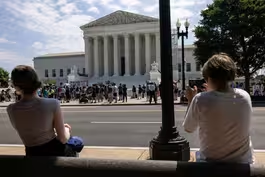
Breaking down the latest decisions from the Supreme Court
Video has Closed Captions
Breaking down Supreme Court decisions on Jan. 6 cases, homeless camps and agency power (6m 17s)
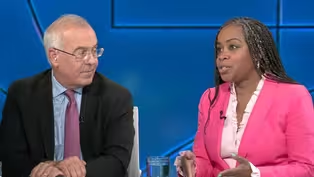
Brooks and Atkins Stohr on the debate shaking up the race
Video has Closed Captions
Brooks and Atkins Stohr on the debate shaking up the race for the White House (11m 19s)
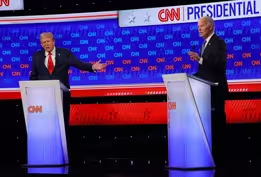
Fact-checking the claims Biden, Trump made during the debate
Video has Closed Captions
Fact-checking the claims Biden and Trump made during the debate (5m 14s)
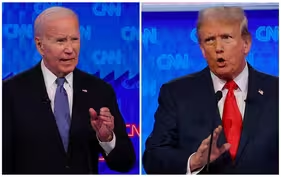
The fallout from a debate full of fumbles and falsehoods
Video has Closed Captions
The fallout from a debate full of fumbles and falsehoods (8m 55s)
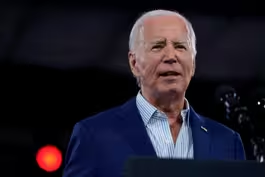
Minnesota Gov. Walz on Biden's debate performance
Video has Closed Captions
Minnesota Gov. Walz on Biden's debate performance and Democratic concerns (7m 35s)
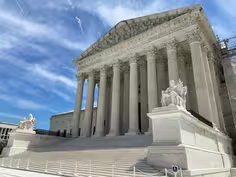
Supreme Court decision curbs federal regulatory power
Video has Closed Captions
The far-reaching implications of the Supreme Court's decision curbing regulatory power (6m 31s)
Providing Support for PBS.org
Learn Moreabout PBS online sponsorship
- News and Public Affairs

FRONTLINE is investigative journalism that questions, explains and changes our world.
 New Episode
- News and Public Affairs

Today's top journalists discuss Washington's current political events and public affairs.
 New Episode
 New Episode
 New Episode

 New Episode
 New Episode
 New Episode
 New Episode
Support for PBS provided by:
Major corporate funding for the PBS News Hour is provided by BDO, BNSF, Consumer Cellular, American Cruise Lines, and Raymond James. Funding for the PBS NewsHour Weekend is provided by...