
June 29, 2023
Season 2 Episode 21 | 27m 52sVideo has Closed Captions
Reaction to a SCOTUS ruling changing college admission standards.
Reaction to a SCOTUS ruling changing college admission standards, Bullitt County is joining Appalachian HIDTA, Churchill Downs' spring meet wraps up this weekend at Ellis Park, a conversation with UPike's president, and the role sheep could play in reviving Eastern Kentucky's economy.
Problems playing video? | Closed Captioning Feedback
Problems playing video? | Closed Captioning Feedback
Kentucky Edition is a local public television program presented by KET
June 29, 2023
Season 2 Episode 21 | 27m 52sVideo has Closed Captions
Reaction to a SCOTUS ruling changing college admission standards, Bullitt County is joining Appalachian HIDTA, Churchill Downs' spring meet wraps up this weekend at Ellis Park, a conversation with UPike's president, and the role sheep could play in reviving Eastern Kentucky's economy.
Problems playing video? | Closed Captioning Feedback
How to Watch Kentucky Edition
Kentucky Edition is available to stream on pbs.org and the free PBS App, available on iPhone, Apple TV, Android TV, Android smartphones, Amazon Fire TV, Amazon Fire Tablet, Roku, Samsung Smart TV, and Vizio.
Providing Support for PBS.org
Learn Moreabout PBS online sponsorshipLocal reaction to a US Supreme Court ruling that changes college admission standards across the country.
They say, Well, you're private, you must be expensive or not.
Look how a small private college in Appalachia is making higher education within reach and helping to move the region forward.
Before there was Kentucky Fried Chicken, there was Kentucky Spring lamb, the role this flock of sheep could play in reviving Eastern Kentucky's economy.
I just want it to be able to spread, not just in not just in the good hazard, but I want it to spread all through eastern Kentucky and maybe one day the entire state.
And how one group is using art to create community.
Production of Kentucky Edition is made possible in part by the KET Endowment for Kentucky Productions.
The Leonard Press, Endowment for Public Affairs and the KET Millennium Fund.
Good evening and welcome to Kentucky Edition for this Thursday, June 29th.
I'm Renee Shaw.
Thank you so much for spending some of your Thursday night with us.
Another landmark ruling by the nation's highest court today.
The United States Supreme Court struck down affirmative action in college admissions.
The ruling means race cannot be a factor, forcing institutions of higher education to look for new ways to achieve diverse student bodies.
And a63 decision.
The court struck down admissions plans at Harvard and the University of North Carolina, the nation's oldest private and public colleges.
Respectfully writing for the conservative majority, Chief Justice John Roberts said the two programs violate the Constitution's equal protection clause.
U.S. Senate Minority Leader Mitch McConnell called the decision long overdue and a statement he said, quote, Now that the court has reaffirmed that common sense position, students can get a fair shot at college and the American dream on their merits.
The leader of Kentucky's land grant institution also reacted.
University of Kentucky President Eli CAPELOUTO said that while the ruling means race cannot be a consideration for admissions, quote, it appears we can consider an applicant's discussion of how race has affected their life.
This afternoon, we spoke to Aaron Thompson, president of the Kentucky Council on Postsecondary Education.
He said today's ruling was not surprising and said Kentucky will continue to support underrepresented students within the confines of the new law.
But the way I see it is we're going to continue doing everything that's legally able to do to help all of our students, no matter what their backgrounds are, no matter what their race may be, no matter what their ethnicity or what their socioeconomic status, whatever the case may be.
We're going to do this not as a zero sum game.
We're going to do it.
Not let other people have their stuff.
That's not what this is about.
This is really giving all of our students an equal opportunity to participate in education, to get the quality and relevant education they need.
You'll hear more from a law professor about this ruling tomorrow night on Kentucky Edition.
Here in Kentucky, reactions are pouring in, following a different court ruling.
Yesterday, we told you about a federal judge temporarily blocking part of Kentucky's hotly contested Senate Bill 150, which was the sweeping measure affecting LGBT, TCU plus youth.
The ruling came one day before the bill was set to take effect.
It means Kentucky's transgender youth can continue to receive puberty, blockers and hormone therapy while the lawsuit plays out.
The ACLU of Kentucky sued to block the ban.
They call the ruling a win, but add it's only the first step.
The injunction, however, is a great relief to families who have trans children, particularly those who are already on puberty blockers or hormone therapy, because they know then that they will not have to detransition or more, in a more extreme case, move their family from the state of Kentucky so that their children can get the care that their doctors agree is appropriate for them.
The conservative leaning Family Foundation had a different reaction.
Executive Director David Walls called the preliminary injunction, quote, an activist ruling.
So this is a highly politicized medical, medical industry that is pushing this.
And, you know, it's always unfortunate when we see judges put on a medical hat when they simply just have law degrees.
But even deeper than that, the actual underlying legal arguments here, it is extremely well-established and constitutional to protect children from bodily harm.
That is about as basic as it gets.
The ruling is also being discussed on the campaign trail, as you can imagine, with both candidates for governor weighing in.
Governor Andy Beshear was asked about it today during a weekly press conference.
Well, a federal judge ruled what I believe the parents parents have the legal right to make important and sometimes difficult medical decisions for their kids, that a parent should always be trusted to make medical decisions for their children, not government.
Now, this is one where I believe in the rights of parents being a parent to do what's right for their kids.
I certainly believe that Daniel Cameron doesn't.
Meanwhile, Republican Attorney General Daniel Cameron called the decision misguided and said it, quote, tramples the right of the General Assembly to make public policy for the Commonwealth and, quote, The Republican candidate for governor made several campaign stops in southern Kentucky yesterday before the news broke about the ruling.
His talking points included fighting the opioid epidemic, getting more Kentuckians into the workforce, and his criticisms of Governor Andy Beshear.
It comes as a labor group calls for an ethics investigation into campaign donations from a drug treatment organization that the attorney general's office was investigating.
As soon as we found out that there was an investigation underway, we stopped any planning of any fundraiser when they contributed to our campaign.
We refunded those donations, and I'm recused from any investigation as it relates to Edgewater, and I want to juxtapose that.
So my approach has been to review, refund and recuse.
I want to contrast that with what Andy Beshear did, which was review a point and then reward.
Cameron is referring to his request for the FBI to look into London Mayor Randall Wells donations to the Andy Beshear campaign and the Kentucky Democratic Party.
Both groups returned the money.
Cameron's campaign says it also refunded 70 $600 in donations from executives with Edgewater Recovery Centers.
Other parts returning back to Senate Bill 150 did go into effect today.
That includes the portion allowing teachers to use a student's gender pronoun given at birth, even if that means ignoring the student's wishes.
Other bills that are now law include House Bill 547.
It gives public school employees the right to share their religious beliefs while at school and participate in prayer.
Some legislators question the need for the bill, while others said it was necessary.
The reason I oppose this legislation is because we don't really need it.
You can do so now in your private time, your private space.
You can wear what you want, to identify whatever religious calls you want.
House Bill 547 is a bill that protects teachers, coaches, faculty and staff religious freedoms in the public schools and ensures the religious freedoms to express their faith.
Another new law, in effect, addresses the teacher shortage under House Bill 319 out of state.
Teachers can get certification to teach in Kentucky, and those with a college degree and real life experience in a subject can get a temporary teaching certificate.
It also simplifies the job application process by creating a one stop statewide job posting portal and expands the teacher scholarship program.
The bill also requires school districts to perform exit interviews on staff as they leave and then report that data to the State Education Department.
Bullet County, in other news, is joining Appalachian Hitter, which stands for high intensity drug trafficking area.
It's a federal program that supports local law enforcement agencies in tackling the substance abuse epidemic.
Senator Mitch McConnell was on hand for the announcement this morning.
The Senate minority leader contacted the White House Office of National Drug Control Policy about bullet counties inclusion in the program in April.
A number of counties in Kentucky are under Hyde.
It's a huge problem in our state, as you know.
And we've been searching for ways to actually have an impact on it.
And educator designation work.
There are hard designations to earn.
Bullock County's inclusion in 38 counties in the Commonwealth now fall under the Hite banner.
Churchill Downs Spring Meet wraps up this Sunday.
Except it's not.
At Churchill Downs.
Earlier this month, racing moved to Alice Park in Henderson.
It's in response to a safety review that's underway following a number of horse injuries and deaths.
Our Laura Rogers has more on the extended season of horse racing in western Kentucky.
Hi.
Well, being a horse trainer is kind of like living in the circus.
You know, we we bounce around from place to place.
But this June trainer, Jason Barclay, hasn't had to travel very far from his hometown of Evansville, Indiana.
It's been handy for us being that we were already here, not have to ship, and it's easier on our horses.
Instead of a two hour commute to Louisville, he's 20 minutes away from Henderson, Kentucky.
Good for the local community.
And, you know, the locals, they get to see better horses, bigger name riders, bigger trainers.
For us to have this additional added dates in the month of June.
It's absolutely new and uncharted territory, but I think we're doing a really good job.
12, 13 and 14.
The spring meet moved to Ellis Park as Churchill Downs Inc. conducts a top to bottom review of all safety and surface protocols.
Tracks been good, so far.
It's been a really safe meet and you know, we've all been pretty happy with it.
Barclay, a third generation horse trainer, says he is satisfied with current safety measures in place and calls the recent rash of equine injuries and deaths a case of bad luck.
But I think, you know, as a whole, we do as much as we can for these horses.
And day in, day out, you know, they're treated like family.
I think it's not just in my barn that's in all the barns from a high standpoint and a Kentucky horse racing commission, obviously, we have the highest standards and we will always adhere to those standards.
Having an extended period of summer racing has proved beneficial to the local economy.
We're still hearing from some of our local hotels and restaurants and things like that that they're seeing big numbers for their hotels just for the last weekend.
I think a lot of the hotels in the area were sold out.
Presley says on weekends, the track sees an average of 3 to 4000 people a day, which is what we need.
This is a great opportunity.
You know, I think a lot of people to this area are very familiar with Ellis Park.
But I think this has been an eye opening experience for a lot of people to be able to come out, enjoy a day at the races.
Ellis Park seats just 6000 people.
That's compared to 165,000 at Churchill Downs.
Barkley calls the atmosphere laid and easy going, but the commitment to safety remains top priority.
We put the horses first, and I think it's important that the you know, everybody knows that we aren't just here for the money.
We're here for the love of the horses.
The Ellis Park summer meet officially begins July 7th and runs through late August.
For Kentucky Edition, I'm Laura Rogers.
All this week, we've introduced you to the interesting people, places and things that make Appalachian Kentucky so very special.
The campus of the University of Pikeville, You Pike for short, is nestled right into the beautiful Appalachian mountains where outdoor recreation is plentiful.
The private university embraces what they call purposeful innovation that helps build the region's prosperity.
It's home to the only College of Optometry in Kentucky, and the Osteopathic Medicine Program educates future doctors on caring for underserved and rural areas.
And to come, a dental program made possible by a multimillion dollar anonymous donation.
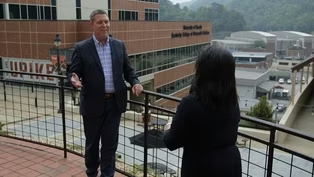
During our visit to Pikeville this week, I talked with UPI President Berton Webb about the history and future of you.
Pike.
So tell us about you, Pike, for sure.
What kind of institution is it and how it's grown since you've taken over as president?
Well, sure.
The University of Pikeville has been here for a long time.
We were founded in 1889 by Presbyterian missionaries who came out of Michigan, in Ohio, and they settled here because this was the furthest inland port on the Ohio River.
So they thought this was a good place to start an academy school, which was really an advanced high school.
It's interesting, if you look back at that curriculum, it included calculus and Latin, which we don't even know.
We teach calculus, but we don't teach a lot of Latin anymore, even in the college setting.
And the school since then has grown quite a bit.
You know, gradually we evolved into an associate's degree granting institution and then became accredited by the Southern Association of Colleges and Schools and started granting bachelor's degrees in the 1960s.
And since then, you know, the college has had its ups and downs, like the region has growth and sometimes smaller numbers of students.
But then in the 1990s, we really began to hit our stride with the opening of the Kentucky College of Osteopathic Medicine in 1997 that graduated first class in 2001.
And really, the institution hasn't looked back since we began growing from about 500 to 600 students.
And today we are at about 2400 students.
And where do they come from?
Are they region specific?
Well, most of our undergraduate students, I'd say roughly half, come from this region, from predominantly eastern Kentucky.
But we really do attract students from all over Kentucky, Virginia and West Virginia.
But then the other half of our students come from all over the United States, like many schools that are smaller, liberal arts based colleges.
We have about 50 to 60% student athletes.
And so those athletes are recruited from everywhere.
I'd say we have a significant number of students from Atlanta and also quite a few from Florida who make their way up here to play football or baseball or basketball.
And then, of course, several international students who come to study here as well.
Well, talk to us about you have the osteopathic medicine facility.
Mm hmm.
The dental school, which we probably haven't heard a whole lot about.
Yeah, it's brand new.
So osteopathic medicine, of course.
1997, they've been around for several years now and have graduated around 2000 graduates who serve all over Appalachia.
And then our optometrist school was next.
The optometry school opened in 2020 or excuse me, graduated their first class in 2020.
They opened four years before that.
And they've graduated several classes now and are very strong and doing really well.
We are blessed and in one regard with the optometry college because Kentucky has one of the broadest scope of practice for optometrists in the nation.
So we have students from all around the United States who come here because they can learn to do things that they can't learn in their home state, but that someday might be legal in their home state as laws begin to change.
So it's a it's a big advantage for us to have that here in the Commonwealth.
And then, of course, the dental school, which you mentioned just a moment ago that was started just this last year with a major gift, a $25 million gift, which has allowed us to move that project forward much more quickly than the medical school or the optometry school began.
So that's been a really good addition to our portfolio.
Are these students who are graduating from these very distinctive colleges, are they living and working and serving in Appalachian or underserved regions?
So we have been number one or number two in rural serving medicine for the last ten years or so.
And when I say number one or number two, that's not just among osteopathic schools, that's osteopathic and allopathic schools.
So all of medicine were number one or number two in serving rural America.
That is at the core of our mission.
And most of our students go into primary care, which is the largest need for medical students in the United States.
And so we're meeting the need, both in terms of rural medicine and also in terms of primary care.
The optometry college is a little new.
We don't have those stats quite as well nailed down, but most of those students do end up going to rural medicine, which is fantastic.
We think that's important for us and they take care of some of Kentucky's neediest people.
Well, we do know that Kentucky as a whole has some severe health challenges, and a lot of that does reside in the Appalachian eastern Kentucky region.
How have you seen you?
Pike Try to elevate the health status of not just Appalachia, Kentucky, but across the state.
You know, we I could show you cluster maps that would indicate exactly where our graduates practice and our medical school school graduates tend to cluster around Kentucky, specifically Eastern Kentucky, West Virginia and Virginia.
So we have definitely impact the way medicine is delivered here in the most rural and most needy parts of the Commonwealth of Kentucky.
But I could take it one step further, and that's by talking about our nursing program.
When when I arrived here almost eight years ago, the nursing program had around 30 students in each class.
And we're now approved for over 80 students in each class.
And we're running three cohorts of classes and not just one.
So it's a program that's grown dramatically that's in part due to a great partnership that we have with the local hospital, Pikeville Medical Center.
And and that program has just exploded over the last few years with the needs that are found here in Eastern Kentucky and, of course, throughout Kentucky.
Where next do you want to take up like.
Ooh.
Good question.
So, you know, we're always looking at program development, trying to figure out what the next need will be in the region.
And then, of course, trying to figure out how to meet that need to the very best of our ability.
So there are a variety of educational programs that we're looking at.
Most of them in the health care space, some of them in agriculture.
And and some areas like that as well.
So we're taking a look at all of those things and trying to identify specifically what do we need to do next so that we position the people of Eastern Kentucky in a way that they will be ready for the next boom in the economy.
Tuition.
Let's talk dollars and cents.
Sure.
How much does it cost a typical student?
And I'm sure there's financial aid and other supports they can get, but on average.
So our tuition has been just under $30,000 a year for a very long time.
But like most colleges, we have a discount rate.
It's the scholarship that people get when they come, if they've graduated from high school, and that's about 50%.
So that takes it down to $15,000, much more manageable for most people.
We've been cheaper than the University of Kentucky for a very long time, and that gets lost a lot because institutions like the University of Pikeville, who have found a way to provide a high quality education at a lower price point, sometimes get lost in the mix because they say, well, you're private, you must be expensive.
We're not.
Look, thank you.
We appreciate your time.
Thanks.
Thousands of acres of land in eastern Kentucky are being taken over by sheep.
The large scale sheep grazing project in Perry County is placing flocks on reclaimed land that has been surface mined.
The goal to have a positive impact on the land and the economy in the region.
There is a transition that's occurring across the coalfields of eastern Kentucky from a coal based economy to something else.
The Southeast Kentucky Sheep Producers Association, or Sex Spa, is promoting the sheep industry.
We have a large scale open range sheep grazing project here in Perry County, Kentucky, as a proof of concept or a demonstration to show folks that it's very possible, it's economically feasible to graze sheep and goats and so forth on open range surface mines.
About a dozen sheep farmers in eastern Kentucky have contributed to this large flock that we have here.
We have a full time herder who stays with the sheep, 24 seven, and he guards against predators.
And he puts the sheep up at night into a night corral, and he provides them with water.
And he sees to their movements, you know, from one green pasture to the next.
I'm pretty much the coordinator and the herd manager.
I manage the flock and fellows.
It works for me.
Most of the time.
There's no more than two watching over the flock, but we have the three guard dogs that watch over the flock too.
And then we have a herding dog that helps to bring the sheep, move the sheep from one spot to the next.
I've been working with Patrick Angel for probably a good three or four months, and then he came with this to me probably two months ago, and I got that offer and I was like, Yeah, I'll stay here day and night watching to see.
I'm a retired from strip mining CO.
I actually worked on this job here about 15 years ago, 20 when we were stripping it and I would like to see some sustainable income come back to people here.
One of our greatest assets is so much land around us right now that's not being utilized.
And I feel like if people could learn this, they could start taking care of their self more.
Raising sheep is not for everybody, and it's certainly not a silver bullet for the socio economic woes of the mountain.
People.
But it could possibly be one of the many silver buckshot that we find that will help the people make the transition from a coal based economy to something else.
Next steps after this project is to double in size and to go to other locations and keep telling people what the productivity potential is here.
Before there was Kentucky Fried Chicken, there was Kentucky Spring LAMB.
Kentucky was known for the lambs that came out of the steep slope mountains of eastern Kentucky.
And so we're hoping that the large scale sheep operations that we have here on these reclaimed surface mines will provide the supply that will meet the demand for Kentucky Spring.
LAMB In the future.
Eastern Kentucky is also known for its culture, from music to storytelling, the region has produced some of the country's most memorable art.
Now, an organization in Hazard is helping develop a new generation of artists.
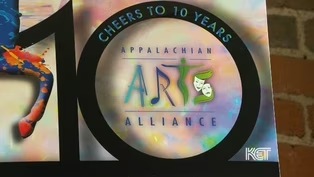
The Appalachian Arts Alliance oversees much of the city's art culture, from murals and theater to music and dance.
Our Kacey Parker Bell shows us how art is changing this Eastern Kentucky community.
Eastern Kentucky is not the dark, dreaded wasteland that a lot of people have to have the image in their head of.
You know, there's a vibrant, exciting, thriving community here.
How do you share something you love?
The main thing is not to miss anything.
For the three person team at the Appalachian Hearts Alliance, you work to inspire a community.
Having it right here where people can can be in the community that they work in, that they live in.
And having the opportunity to learn and play here has just made it a more seamless community.
Tim Dayton, executive director for the Arts Alliance, says they took off during the COVID pandemic.
They were one of the first to reopen their doors and the community was starving for a place to express themselves.
Now Hazard's downtown is growing, and Deaton says the arts are two things.
People didn't really understand how the arts can influence and allow you to create a community.
Their programs range from theater.
I know you say that one line over here to music and the reason I think it's important to, you know, be exposed to some culture, even if that's just taking a ballet class for a little kid, you know, for a semester.
This summer, a group of kids are working to put on a play from the ground up over just a week.
So when I was about 21, I was ready to to move away.
I was I didn't feel like there is anything here.
Lindsey Branson grew up in Perry County.
She moved away to pursue a music career but moved back and found a home in Hazard.
I just love being able to work in Appalachia and be the person that younger me wish she could have had growing up.
The feeling is the same for the whole staff.
Deaton returned after pursuing his dreams in New York.
Just the mountains called me home.
I wanted to be back here with my family and with my people.
And so providing an opportunity to the next generations that I never had the opportunity to learn and to find a craft that you're interested in and actually craft that and hone in on those skills before you take that next step into later education.
It would have been a landmark for me.
The staff pursued what they believed to be their biggest dreams, but found that what they really wanted was back home, helping the next generation learn life's lessons through art.
We have a rich, rich heritage, a rich culture, and we're not going to let it die.
I just want it to be able to spread, not just and not just in the good hazard, but I want it to spread all through eastern Kentucky.
And maybe one day the entire state.
For Kentucky Edition, I'm K.C.
Parker, Bo Noah.
And we've got more great stories about eastern Kentucky tomorrow night at 630 Eastern, 530 Central on Kentucky Edition.
I'm Renee Shaw.
Thank you for watching tonight.
And I'll see you right back here again tomorrow night.
Video has Closed Captions
Clip: S2 Ep21 | 13m 14s | President of University of Pikeville Burton Webb, PH. D. talks with Renee Shaw. (13m 14s)
Video has Closed Captions
Clip: S2 Ep21 | 2m 59s | Appalachian Arts Alliance is helping develop a new generation of artists in Hazard, KY. (2m 59s)
Providing Support for PBS.org
Learn Moreabout PBS online sponsorship
- News and Public Affairs

Top journalists deliver compelling original analysis of the hour's headlines.

- News and Public Affairs

FRONTLINE is investigative journalism that questions, explains and changes our world.












Support for PBS provided by:
Kentucky Edition is a local public television program presented by KET