
June 30, 2023
Season 2 Episode 22 | 28mVideo has Closed Captions
The U.S. Supreme Court strikes down President Biden's student loan debt forgiveness plan.
The U.S. Supreme Court strikes down President Biden's student loan debt forgiveness plan. Nominees in a special election for a state House seat are finalized. More new laws are now in effect. Renee Shaw talks with the CEO of Pikeville Medical Center. How recreational economies are impacting eastern Kentucky.
Problems playing video? | Closed Captioning Feedback
Problems playing video? | Closed Captioning Feedback
Kentucky Edition is a local public television program presented by KET
June 30, 2023
Season 2 Episode 22 | 28mVideo has Closed Captions
The U.S. Supreme Court strikes down President Biden's student loan debt forgiveness plan. Nominees in a special election for a state House seat are finalized. More new laws are now in effect. Renee Shaw talks with the CEO of Pikeville Medical Center. How recreational economies are impacting eastern Kentucky.
Problems playing video? | Closed Captioning Feedback
How to Watch Kentucky Edition
Kentucky Edition is available to stream on pbs.org and the free PBS App, available on iPhone, Apple TV, Android TV, Android smartphones, Amazon Fire TV, Amazon Fire Tablet, Roku, Samsung Smart TV, and Vizio.
Providing Support for PBS.org
Learn Moreabout PBS online sponsorshipThe US Supreme Court delivers decisions on gay rights and President Biden's student debt relief plan.
We have reaction to the rulings.
Let's help you by allowing these fantastic HIV kits to get into people's hands, he said.
A new law is giving new hope and a fight against HIV in Kentucky.
We provide those services because it's the right thing to do.
The nonprofit Pikeville Medical Center has nine centers of Excellence, including a nationally top ranked heart care center.
The hospital CEO talks about the unique health needs of eastern Kentucky.
I think of our region being blessed to just naturally have a lot of these things that people now more than ever seem to be looking for and how adventure tourism could be the future of Eastern Kentucky's economy.
Production of Kentucky edition is made possible in part by the KET Endowment for Kentucky Productions, the Leonard Press, Endowment for Public Affairs and the Cette Millennium Fund.
Good evening and welcome to Kentucky Edition.
On this Friday, we made it June 30th.
I'm Renee Shaw.
Thank you for kicking off your weekend with us.
Major news from the US Supreme Court today.
And a63 decision.
The nation's highest court ruled the Biden administration overstepped its authority in trying to cancel or reduce student loan debts for millions of Americans.
The court held that the administration needs Congress's endorsement before undertaking such a costly program.
The ruling effectively kills the president's $400 billion plan announced last year.
According to the Kentucky Center for Economic Policy.
More than 600,000 Kentuckians would have qualified for the program.
Erin Clara from the Kentucky Higher Education Assistance Authority had this advice for people who will now have to start making loan payments.
Now is a really critical time to get in touch with those borrowers.
Have them get in touch with their loan servicer, explore different repayment plans, and set up those automatic transfer type situations and get ready to make payments on those student loans.
The average borrower in Kentucky has about $33,000 in student loan debt.
Claire says the U.S. Department of Education is looking into creating a 90 day safety net where interest will accrue on loan accounts, but there will be no penalties for delinquency.
Senate Minority Leader Mitch McConnell of Kentucky reacted to today's ruling.
He said, quote, The president cannot hijack 20 year old emergency powers to pad the pockets of his high earning base and make suckers out of working families who choose not to take on student debt, end quote.
Today, the Supreme Court's conservative majority also ruled a Christian graphic artist who wants to design wedding websites can refuse to work with same sex couples.
The decision is a defeat for gay rights.
The court ruled 6 to 3 on Friday.
Four designer Laura Smith.
Despite a Colorado law barring discrimination based on sexual orientation, race, gender and other characteristics.
Justice Neil Gorsuch wrote for the court's six conservative justices that the First Amendment envisions a United States where people are, quote, free to think and speak as they wish.
Smith had argued that the Colorado law violated her free speech rights.
Her opponents warned a win for Smith would allow a range of businesses to discriminate against customers.
David Walls with the Family Foundation released a statement following the ruling saying in part, quote, Today's decision is a milestone victory for the free speech and religious liberty rights of all Americans.
The U.S. Supreme Court has rightly reaffirmed that the government can't force people to promote something that is not true and say a message that they don't believe.
End quote.
Time now for a review of the major Supreme Court of the United States rulings that have come down in the last couple of days.
Usually, this is the Inside Kentucky politics segment, but so much has happened today and yesterday with SCOTUS rulings.
We brought in an expert to help us understand how all of these rulings affect you.
Josh Douglas, law professor at the University of Kentucky, is with us.
Thank you for being with us.
Thanks, Renee, for having me.
It's been a busy couple of days, hasn't it?
Sure has.
Well, we kind of anticipated this.
You know, we were always in June waiting for these rulings to come down, and they did in March.
And these last couple of days.
Let's start with what happened today.
Student loan plan by President Biden, the Supreme Court.
All of these are six three decisions which I'll let you comment on in a moment.
Effectively strikes that down, correct?
That's right.
And it's really a kind of a technical, administrative ruling.
But the question is, did Congress authorize the president to take this action?
And the court found that it did not.
Right.
And so what are the concerns now?
I mean, now we know that loan repayments will resume in October, but the interest will begin accruing in September.
This is a lot for the millions of student loan recipients who had been deferred.
This from since the start of the pandemic.
Yeah.
I mean, I think this case, perhaps maybe even more than some of the others, will have a real world impact on people.
And so, you know, there's a silver lining for those who oppose the decision.
It's that the Supreme Court's going to be casting even more light and more scrutiny.
And I think, you know, the transparency about what goes on at the court can only be a good thing.
So moving on to the other case that we learned today, I call it religious liberty may not be what others call it, six three ruling again.
This involves a Colorado graphic design artist who have refused to do a wedding website.
You said that this was infringing upon her free speech rights and this seemed the court seemed to favor 6 to 3.
Yeah, the court found that this was essentially a compelled speech.
So Colorado has an anti-discrimination law that says that you can't discriminate against someone based on a protected status, including the status of being in a same sex relationship.
And this woman, Laurie Smith, created a business in which she was going to make wedding websites, but said explicitly she would not make a website for a same sex couple getting married.
Of course, same sex marriage is constitutional, as the court had found a few years ago.
And so she was afraid that Colorado would find her in violation of the anti-discrimination law.
And she said that it that violation would be an infringement on her free speech rights that is basically compelling her to speak by making a website.
And today, by a63 ruling, the court agreed.
So are there other concerns that this could also filter down to other ethnic and racial minorities?
I think that's right.
I mean, the dissenters point this out that, you know, who's to say that someone couldn't discriminate against an interracial couple and claim that it's their free speech, that they're being compelled to speak through whatever services they are providing?
And I do think, you know, there's a fear, a slippery slope.
And the question is, is there a limiting principle here to say that you couldn't claim any sort of expressive purposes in the services you're providing?
And so I don't want to do it for this group or this person based on my free speech rights, though, religious liberty is sort of underlying this.
That's what this website designer said she was doing was obvious because of her religion.
But the court focused on the free speech aspect and the compelled speech component of what they found to be compelled speech as opposed to the religious liberties.
Affirmative action on Thursday said the Supreme Court ruled that colleges and universities cannot use race as a basis for admission, but there could be some caveats here.
Yeah, this one is a little confusing in some ways because the court didn't explicitly overrule its decades of precedent.
And for decades the court had said that trying to achieve diversity in the classroom, in an undergraduate and university setting that is is a compelling interest that states have a good enough reason to try to achieve diversity in the classroom.
And the court didn't explicitly overrule that.
It said a very narrow ruling.
But I think it's really hard to figure out how universities could use race in their admissions.
Under the ruling, they the new affirmative action ruling.
You know, Chief Justice Roberts in the majority said this doesn't mean that a university can't ask a student to write an essay about their own personal experience.
And that could include there, you know, how racism impacted their lives.
But it's also not clear how the university can use that in a way that can credit that personal experience.
So it's kind of a massive a decision.
But the bottom line is that some universities were considering race, among many other factors, in trying to achieve educational benefits of diversity.
And those universities can no longer do so.
What Doctor Eli CAPELOUTO sent out a statement and other universities have responded, saying that to the point that Chief Justice Roberts was making, that perhaps there is a narrative that can be applied and the admissions part that can relate to how race has been an impact on that person's educational experience journey.
But to your point, it's like it's hard to imagine how that is deciphered out and not a race based admission.
But what about class socioeconomic status?
What does it do when it comes to that kind of consideration?
Well, those things technically are considered race neutral because they don't they're not considering race explicitly.
You're not saying this person is of particular racial or ethnic background, and therefore they automatically have a diversity component.
Instead, we know that socioeconomic status and race are correlated.
You know, just based on statistics.
So it remains to be seen whether a university could do things like look at an applicant zip code to see the, you know, demographics of the area in which they live or socioeconomic status in general.
I think there's a lot of mitigation to come over the way in which universities can use race or proxies for race in their admissions.
And again, Chief Justice Roberts left a strange door open about what we can look at essays.
But under the rule he lays down, it doesn't seem like you could use that essay in a way to credit a person's diverse experiences when thinking about their admission.
And some are already saying and calling foul and saying, what about legacy admissions?
Admissions based on alumni, offspring and children who get perhaps some preferential treatment and admissions to higher ed institutions?
Absolutely.
And Harvard has a long legacy of legacy admissions and people are criticizing that.
Harvard wants to keep its legacy admissions and also use race as one factor among many.
Now, after the decision, Harvard can no longer do so.
Yeah.
A lot to break down.
A lot to still understand.
And we thank you.
And we know you've been cramming to understand this and of course, help us to do the same.
Thank you.
Josh Douglas, as always, good to see you.
Thanks again.
The nominees to fill State Representative Lehman Swan's Allemagne Swan seat have been chosen.
Swan, who represented the 93rd District and Lexan Lexington, died in May.
The Fayette County Democratic Party announced they selected Adrianna Campbell as their nominee.
Campbell is an administrative assistant at Fayette County Public Schools.
She will face off against Republican nominee Kyle Whalen.
Whalen ran against Swann for the seat in 2022.
The special election will be held on November 7th, the same day as the 2023 general election.
Governor Andy Beshear, a Democrat and Secretary of State Michael Adams, a Republican, have teamed up to implement a state law aimed at protecting domestic violence victims.
Beshear and Adams signed emergency regulations guiding the implementation of Senate Bill 79, which strengthens an address confidentiality program.
The law took effect yesterday.
It allows people fleeing domestic abuse to shield their home address from the public record without a court order.
Kentucky has one of the nation's highest rates of domestic violence.
At home, HIV testing kits are now legal in Kentucky under another new law that took effect Thursday.
Before House Bill 349, it was a felony for organizations to distribute the tests.
To celebrate the new law.
Kentucky's HIV is not a crime.
Coalition gave away free HIV self-test kits in Lexington and Louisville.
Those at the event said the new law will save lives and help curb the spread of the disease.
And even as recently as last year, 2021, we saw a spike in HIV cases right here in Kentucky.
So you saw people get together.
Organizers, activists, health care, professional scientists, Democrats, Republicans, urban rural legislators come together and say, let's fix this.
And they did.
By passing landmark legislation that is not only going to decriminalize HIV, destigmatize HIV, but is going to keep us healthier by allowing these HIV kits to go into people's hands.
And we hope that other states are going to follow our lead here in the Commonwealth of Kentucky to not just erase outdated HIV laws, but to modernize them and make certain that we are supporting people living with HIV and AIDS in real ways and not finding further ways to stigmatize them as these outdated HIV criminal laws have done.
House Bill 349 also removes felony penalties for people who donate organs, skin or other human tissue while being HIV positive.
As we wrap up our week long look at the eastern Kentucky region, I talked with the president and CEO of Pikeville Medical Center earlier this week to learn about the innovative health care work going on there.
Pikeville Medical is the single largest employer in eastern Kentucky with more than 3000 workers.
The nonprofit serves 450,000 people with basic and advanced health needs.
The region's poor health standing presents some unique challenges.
Hospital CEO Donovan Blackburn talked to us about their Nine Centers of excellence, which includes their Heart Institute that aims to put the region on a healthier course.
When you look at specifically Eastern Kentucky, I use who we are.
We offer almost every service that a UK or EU avail offers.
You know, there's three medical schools in the state of Kentucky.
You Pike has one of them.
We have a relationship with that medical school as along with our optometry school and soon to hopefully be dental school.
So when you look at what we're offering, we're all from all the same services, but things like our specialty services such as endocrinology or rheumatology, those services did not exist ten, 15, 20 years ago.
I have r.A.
I travel to Lexington all the time now.
I've got great physicians here.
So the reason that's important is that the financial stability of rural hospitals without protection is that those are services that aren't profit makers for us.
We provide those services because it's the right thing to do.
If we don't have financial stability, then those are the services we end up cutting first.
So those are, again, our citizens within eastern Kentucky.
They're denied access to care that end up back in central Kentucky, which is already overburdened.
You saw you just announce a $2 billion expansion project and try to create more beds because those higher level of care that's needed, they're running out of beds also are transferred to them or they're transferred to hospitals like ours.
So it is very, very fragile right now in where I think well, not just think the numbers prove that we would go without this financial stability.
So each rep has played a huge role in who we are and what we're becoming.
The recruitment of talent of specialists.
Is that much more of a challenge for you because of the region?
It absolutely is.
For two reasons.
One, because of the region we're in, it's hard to convince somebody that's graduating in New York or Chicago to come to rural eastern Kentucky.
But there's also when you look at and you mentioned earlier the you know, there is a crisis right now in the US, hands down a crisis.
Now we created a new product and that's what I call the product because that's what it is.
And that's what I do.
So four years ago, I created a program called Project Heart, which is an acronym for Health Care Education around regional training.
So when you look at me, I have a thousand nurses and I'll come back to your point of doctors because they kind of correlate.
So when you look at nurses, I have a thousand right now.
Becker's reports that by 2025 that the nation will have 45, 450,000 nurse shortfall.
In Kentucky, a recent study that was done to shows that we currently have 3000.
And if you look at a projected 20, 35, if nothing happens, we're we only gain 100 nurses.
So there is a this is a huge issue and it impacts our finances also because of the traveler.
When you look back at April last year, a good example at the number of travelers I had to have in my organization, those travelers cost me $3.8 million a month more and every hospital was going through this.
So now that again, the travelers are going down because the demand of COVID is kind of impact us.
But we're still have we still have nearly 100 travelers in our organization.
So what is that traveling nurses?
Just traveling nurse travelers.
It's our own internal terms.
So we know what we're talking about.
I apologize.
But we also have travelers in other positions as well.
Really?
So lab techs, respiratory, you know, because there is a huge national shortage.
And when you live in eastern Kentucky and there lies the problem.
So I've had multiple meetings in Frankfort.
And what Project Heart did.
So if you look back four years ago, three years ago, I have a thousand nurses, a national attrition rate and health care was about 17% at the time.
So at any given time, I need about 150, 270 nurses in Pikeville.
We have two nursing schools, the University of Pichel and A and U.
Between the both of them, they were producing 80.
And if you look at the success rate of the boards, only producing actually 60.
So I need 150 and then all of a sudden that's before COVID.
Right.
So now the crisis hits.
So realizing that that was coming work with my federal and state partners, that said, we've got to do something.
I want to launch something different.
So we create a program on the project card.
We have multiple leaders and I'll leave somebody out if I start mentioning.
Sure, but the bulk of them are in higher ed.
So we went from we partner with UK, a partner with Galen College of Nursing or partnered with KCTCS with the Big Sandy Campus, a partner with National University.
So National University and Galen are actually buildings on my campus now.
We actually built them nursing schools.
So we worked with Big Sandy and you and a couple of others to where we now have the for the first time, a allied health program in eastern Kentucky.
So we have lab techs, we have respiratory, we have rad techs all these positions.
So why that's and then we've created scholarship opportunities where the hospital's actually paying students while they're in high school.
So we have a workforce innovation center that we just launched.
We have all these high school students that come to us.
We actually get as far down as the kindergarten where we do these sessions, and as a result, we pay them to go to school with a commitment that as they graduate that they will come to work for us.
And if we choose not to hire them, then they can go to work for my competition.
But they still get the economic benefit.
Next week you'll hear Donovan Blackburn talk more about the challenges facing rural hospitals and how Pikeville Medical was able to rebound from multi million dollar losses during the COVID pandemic with help from the federal government.
That's coming your way next week on Kentucky Edition.
From campgrounds and ATV trails to kayaking and rock climbing, outdoor recreation activities are the main attractions in eastern Kentucky.
Kentucky Edition caught up with several organizations who believe these recreational economies could play a vital role in the region's future.
We're currently working on constructing an ATV trail system that will span 18 Eastern Kentucky counties.
We view this as an economic development project.
Of course, tourism is the vehicle that's going to take us where we want to be.
But you can just imagine folks coming in hopefully, hopefully from other states every weekend and spending their money locally in any of these 18 counties.
I think it could provide a huge economic boost to our eastern Kentucky counties.
Tourism is a $60 billion a year industry in Appalachia.
So just just the Appalachian Territory, you know, 90% of that goes to three places.
So like Eastern Kentucky right now is not getting enough of that.
Of that $60 billion.
So like, how do we how do we stand out?
It's a competitive market place.
And I think the way that we stand out is by coming together as much as we can as one unified eastern Kentucky region.
I think recreation, economy, I think you've got to have hills, you've got to have mountains, you've got to have rivers, you've got to have streams, you've got to have beautiful overlooks.
You've got to have all these things that that people want to go outside and see and and do.
I think of our region being blessed to just naturally have a lot of these things that people, now more than ever seem to be looking for.
We have board members that represent each county.
So what we have done is we've tried to locate folks in those counties that were that actually that route at a lot just to see where everyone is currently riding and what they're doing.
We try to get those trails mapped just to take a look at them, just so we can see whose property they're riding on.
And then we go from there to try to reach out to property owners to see if we can get them on board with the license agreement to work with us.
I honestly think that the impact to communities and what can come like, we're re in the next 3 to 5 years as some of these big time attractions continue to get off the ground.
And really that that solidify Eastern Kentucky as a legitimate destination, a legitimate tourism destination place that you can come to.
The rivers didn't go away, but because of the floods, you know, Red River Gorges is still there, even though that was an area that that was spared from the flood.
So I think, if anything, the recreation economy presented an opportunity to bounce back quicker from flooding because, you know, just by nature, those types of assets weren't in a position to to be really impacted severely by floods.
We live in a beautiful region that I think it's easy for us to just under appreciate it because we see it every day.
But I think it's time that we, you know, we take advantage of that.
Adventure tourism is going to be the way to go.
According to the U.S. Bureau of Economic Analysis and 2021, outdoor recreation made up 2% of Kentucky's gross domestic product.
The Louisville Orchestra recently completed their first stop in the State Wide in Harmony Tour in eastern Kentucky.
Our Kelsie Stark sat down with the music director, Teddy Abrams, to learn more about the experience there.
Everyone in Kentucky has a relationship with music.
It's one of the things we do best.
We do music.
We do obviously horses, bourbon.
It's like American heritage.
Things come from Kentucky and but but music is the one that's internationally known.
So I said, What can we do with our music to get folks throughout Kentucky to find that commonality just to even be together?
It's on a personal relationship level, even even more than music.
The music comes next.
But the idea of people from Louisville being with people from the east or from the west or from the south, just spending time together, that's not happening enough.
And it's not happening in situations where we're not already angry.
It's not about voting day.
It's not about, you know, arguing in a political debate.
It's about just spending time as human beings with each other.
Because, again, music is designed to do that.
That's the whole point.
It's a language we already all speak.
We're on the same page.
You can see Kelsey's full interview with Teddy Abrams on our new program Inside Louisville, premiering Sunday, July 9th at 12 noon, 11 a.m. Central on KCET.
They're firing up the 4th of July fun all around Kentucky.
And our Toby Gibbs has a look at the festivities.
And tonight's around the commonwealth happening this week as the 2023 Owen County Fair.
From this Saturday to the next, they'll have pageants, livestock shows and more.
Tuesday night is family fun night, so be sure to check it out Saturday through Tuesday in Morgantown as the Green River Catfish Festival.
Among the carnival games and rides, they'll also be hosting fishing tournaments with big prizes, as well as kayaking and belly flop challenges.
Get down to Great River for all the fun scottsdale's fireworks in the park event is starting.
But don't fret, you haven't missed the big show.
The fireworks will be going off at 9:00.
The event also has inflatables, food trucks and a concert by Mojo Thunder kicking off at 730.
It's the perfect way to kick off a patriotic weekend.
London will also be lighting up the skies this Saturday with their red, white and blue event.
It's Southeast Kentucky's largest fireworks display, but attendees can also enjoy live musical performances by all.
Kentucky Home State Park is celebrating its 100th anniversary this Saturday In Style stopped by the party in Bardstown for live music vendors, inflatables and more.
They're even setting off fireworks to celebrate this historic milestone.
The fourth fest and Praise in the park is the largest three day outdoor music festival in the region and it kicked off today in Madisonville.
Headliners include Clay Walker, Vanilla Ice and Matthew West.
There will be food trucks, a beer garden and kids activities.
So there's something for everyone to enjoy.
Keep your eyes to the sky in Campbellsville this Saturday.
The Murakami hot air balloon glow is happening at the Taylor County Fairgrounds.
Bring the family down and enjoy music, games and a petting zoo before watching the giant balloons take off at 630.
And that's what's happening around the commonwealth.
I'm Toby Gibbs.
Thank you, Toby Gibbs.
A lot of great things happening around the commonwealth as we celebrate the upcoming 4th of July holiday.
Thank you so much for being with us on Kentucky Edition this week on the road from people and will be in western Kentucky soon.
Thank you for watching.
I'm Renay Shaw.
Have a great weekend.
We'll see you Monday night.
Video has Closed Captions
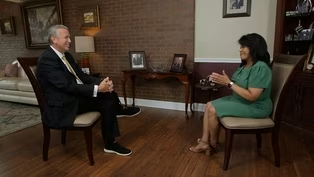
Clip: S2 Ep22 | 39m 19s | President and CEO of Pikeville Medical Center Donovan Blackburn talks with Renee Shaw. (39m 19s)
Providing Support for PBS.org
Learn Moreabout PBS online sponsorship
- News and Public Affairs

Top journalists deliver compelling original analysis of the hour's headlines.

- News and Public Affairs

FRONTLINE is investigative journalism that questions, explains and changes our world.












Support for PBS provided by:
Kentucky Edition is a local public television program presented by KET