Vermont This Week
June 5, 2026
6/5/2026 | 26m 46sVideo has Closed Captions
Burlington clears officers who used force on activists
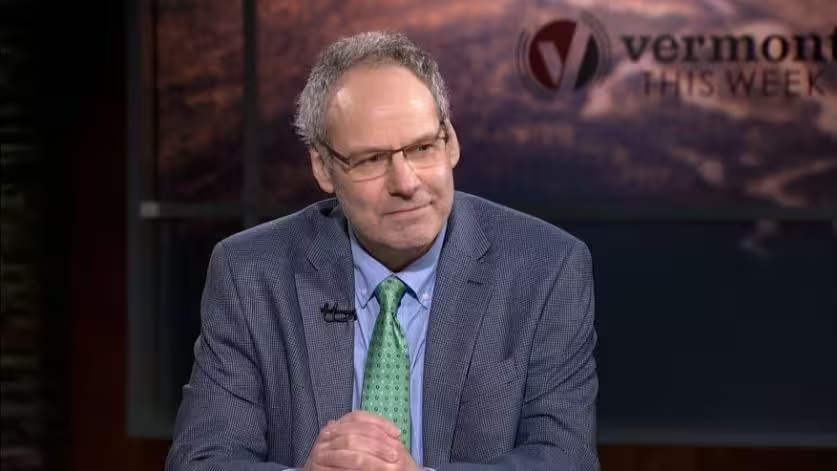
Burlington clears officers who used force on activists | House Republicans quash effort to unmask ICE agents in Vermont | The role of Migrant Justice in the state | Moderator - Mitch Wertlieb; Derek Brouwer - Vermont Public; Lucy Tompkins - Seven Days; Shaun Robinson - VTDigger.
Problems playing video? | Closed Captioning Feedback
Problems playing video? | Closed Captioning Feedback
Vermont This Week is a local public television program presented by Vermont Public
Sponsored in part by Lintilhac Foundation and Milne Travel.
Support provided by:


Vermont This Week
June 5, 2026
6/5/2026 | 26m 46sVideo has Closed Captions
Burlington clears officers who used force on activists | House Republicans quash effort to unmask ICE agents in Vermont | The role of Migrant Justice in the state | Moderator - Mitch Wertlieb; Derek Brouwer - Vermont Public; Lucy Tompkins - Seven Days; Shaun Robinson - VTDigger.
Problems playing video? | Closed Captioning Feedback
Where to Watch Vermont This Week
Vermont This Week is available to stream on pbs.org and the PBS app.
Support the crew
Help Mitch keep the conversations going as a member of Vermont Public. Join us today and support independent journalism.Providing Support for PBS.org
Learn Moreabout PBS online sponsorshipBurlington clears officers a used force on anti ICE activists.
And some advocates are expressing disappointment with the findings.
Look at the videos.
Any neutral, objective observer can tell you that choking people, that throwing people to the ground, that is not objectively reasonable.
That is not proportional.
It's clear that there were actions there that were totally unwarranted.
Plus, House Republicans quashed last ditch efforts to unmask Ice agents in Vermont and a look at how migrant justice built a movement both on and off the farm.
All that and more ahead on Vermont This Week.
From the Vermont public studio in Winooski.
This is Vermont this week, made possible in part by the Lintilhac Foundation and Milne Travel.
Here's moderator Mitch Wertlieb.
Thank you for joining us.
I'm Mitch Wertlieb.
It's Friday, June 5th, and with us on the panel today, we have Derek Brouwer from Vermont Public, Lucy Tompkins from Seven Days and Shaun Robinson from VTDigger.
Thank you all so much for being here.
All right.
We're going to dive into really interesting show today.
A lot of it's going to have to do with immigration in Vermont.
And I want to start, Derek Brower with you, because you were writing recently about Burlington, and offers is there and we saw this at the top of the show, that chaotic moment back in March when Ice agents, came to downtown Burlington.
There was a lot of activity there.
They, south Burlington, and they were looking for, someone, to detain.
A lot happened there.
There was some violence.
And I want to start by mentioning that, you know, we showed you that clip there at the top.
There is much more video in your article.
We didn't show that at the top here because there was a lot of cursing.
There was a lot of, frankly, violent activity.
So we wanted people to be prepared for that.
But if you do want to see that, go to Vermont public.org and check out the article and there's much more video there, tell us, so why is it that, officers who were involved in this incident in March were cleared on, use of force activity?
Yeah.
I mean, it's essentially from how I read the, the police chief's finding, which was, supported by, Mayor Mulvaney Stanek as well.
Essentially, by that point in the conflict, protesters had become activists who were trying to block ice, vehicles from leaving the scene.
And that, in their view, is an act of impeding law enforcement, which is criminal behavior.
And so that opens the door to, you know, a wider, array of tools used by police to try to clear the crowd.
And within that context, they determine that some of the things you saw at the top of the show, pulling people to the ground, there were some instances of pepper spray being deployed as well, that those were reasonable given the circumstances, and there's no discipline warranted.
Who exactly was reviewing all this footage and making these decisions?
Yeah, there was, several hairs of review, that go into it, especially in Burlington.
There was a supervisor within the department who first wrote a report that then went to the police chief.
Who issued, his own finding.
The mayor, as I said, reviewed it as well.
But then Burlington also has a citizen police commission.
This is an advisory volunteer board that, independently looked at, the evidence as well.
And interestingly, that group, put out its own report, disagreeing on a couple counts with, the rest of the city, saying that, in fact, they thought some of the officer's activity was was unjustified, but that wasn't enough to bring any kind of, penalty against any of these officers in their mind, even those who dissents a little bit.
Well, the that board doesn't have the power to, to do that, that that really rests with, the, elected and appointed city officials.
So, can they make recommendations?
Do they have any kind of is there any opinion given there?
Yeah, that was their opinion that it was that it was, without justification in two instances.
And so that, that finding is, is included, for the chief to review.
And he ultimately, makes the final decision in this case, it was interim Chief Sean Burke.
I also noted in your article, Derek, that the mayor was saying that moving forward, there may be some changes in the way Burlington Police operate it.
It seemed a little unclear.
Yeah.
I mean, I think it's important to note, too, that, the Burlington Police, they actually played the the smallest role of la enforcement on scene that day.
They were really came in, right when the raid began as, as a form of, like, crowd control at the outermost layer.
But then as it, as the conflict escalated, they took a more active role and ended up, being involved in some of the, the uses of force that have circulated most widely online and have been most widely, publicly criticized.
So the force has found itself facing more public scrutiny than, than I think they even anticipated when they were, called to, to assist that this would happen.
So I think the mayor was speaking in part to that.
And, and her letter, but she did as well.
She said that, you know, though the officer's actions were justified, that, the, you know, they failed the stress tests that Ice put on local law enforcement that day and that, her, her ministration is going to be looking at reviewing protocols related to how, how police interact with Ice.
If this happens again in the future.
And there's also a nod to some, more specific training potentially around crowd control techniques.
Very interesting.
I appreciate that update.
And, Sean Robinson, I want to turn to you now because, sort of related to this whole effort, something was happening at the state House.
There was a bill that was trying to get push through that dealt with ice agents specifically, and whether or not they should be unmasked when they're out, in the field, in place like Vermont doing their thing that never even got voted on.
What what happened there?
Yeah.
It's been a pretty long and winding road for this bill.
And you're right, it's very related to what Derek was just talking about in the video at the top of the show.
We saw a o some of the officers in there.
So this bill came out of the Senate originally, and when it did, it included a provision that a lot of activists have been pushing for this year, which was largely barring federal law enforcement agents like Ic from wearing masks in Vermont.
Now that bill went over to the House next to get additional review and there was a lot of discussion there about the constitutionality of this provision.
You know, can a state law tell federal officers what they can and can't do?
And the House as, as the pass this version of the bill, they took out the piece dealing with federal agents and just focused in on creating a model policy for state and local law enforcement.
So now we've got two versions of the bill, right?
The House version, the Senate version.
It goes to a conference committee to work out the differences.
And the conference committee comes back with a bill that puts back in the ban on federal agents, wearing masks.
They they kind of set out a provision where it would take effect in a year, from from passage to allow for some additional legal review in other states if other states passed a similar version.
So now we have this compromise version of the bill.
But the problem now, like so many things at the end of the session, is time because the conference committee voted out this bill or approved this version of the bill.
Last Thursday, the last day of the session now is one day later on Friday.
So in order for, the House and the Senate to take up this compromised version of the bill, they have to vote to suspend their rules of procedure that dictate, you know, the timeline for when bills can come up on the floor, come up for a vote, etc.. Now, in the House, a rule suspension requires a three quarters approval vote.
And that's a pretty high bar, right?
You know, Democrats have a majority, but they don't have three quarters, certainly not after the 2020 election.
We've just got a straight so that's a high bar, right?
And I should say rul suspensions are pretty common.
At the end of the session.
There were a lot this year.
It's how they get through some of these big bills, like the education overhaul bill that we've talked a lot about on the show.
At the end, but in this case, as you mentioned, Republicans were not on board with this bill in the House.
So the Republican caucus did not lend their support.
You know, to give Democratic leadership enough votes to suspend the rules to allow the bill to come up for a final vote, with that masking, party put back in, as you were saying?
Yes, exactly.
You know, and it seems like for those who may be thinking, well, I can't believe this didn' even come up for a vote again, I think it's worth repeating that it probably didn't have the teeth anyway.
Because you can't, make state law that's going to supersede federal law when it comes to thi sort of thing.
Right, exactly.
There was some real, concerns about the constitutionality.
One of my colleagues spoke with, Professor in California who studied a version of the bill in California, who I think was pretty clear in his comments to, said, digger, you know, that this is on this is unconstitutional.
Now, on the other side of that, right.
You have a lot of Democratic and progressive lawmakers saying, well, you know, we don't care.
We have a moral imperative to do everything we can as legislators to, you know, push back against what we see as overreach by law enforcement.
And, you know, let the courts duke it out.
Right.
They say we're a separate branch of government.
Let's do what we can do.
And at least it would have been a symbolic gesture on their part had that gone through.
All of this brings us now to this fascinating, feature story in seven days, Lucy Tompkins, the you wrote about dealing with the origins of and where they are toda for the group Migrant Justice.
For those who, in a very general way, if you can.
I know it's a complex story, but for those who may not be aware of migrant justice, what is this group?
When was it founded?
What is their mission?
Yeah.
So, migrant justice formed in, after the death in 2009 of a migrant farm worker.
Tragic accident.
Yeah.
Tragic accident.
He got his clothing stuck in a, in a machine that scrapes manure, in barns and was strangled to death.
And at the time, migrant workers, mostly from Mexico were kind of just starting to, come to, to Vermont to work on dairy farms.
But their presence wasn't super widely known.
And they kind of lived largel kind of confined to the farms, but this worker's death sparked, kind of bigger conversations around the conditions that workers are working and living in.
There was one, one man named Brendan O'Neil who was teaching English to migrant farm workers who sort of helped the in the early days start to organize conversations, between farm workers and assemblies to gather, start gathering them, you know, off farm to talk about issues that they were facing and how maybe they coul organize to make some changes.
So that's a very simplified version of how they started.
But, over the years, they had some big successes getting, you know, laws passed in the legislature, the, a driver's license bill that allows people to get driver's permits in Vermont regardless of immigration status.
They also helped pass the, the fair and impartial policing policy that we have today, which limits collaboration between local law enforcement and federal immigration agents, which is coming up a lot these days.
And conversation, and and yeah, over the years, their main campaign is is improving working living conditions for for farm workers and the milk with milk TV program.
Sure.
Yeah.
Milk with dignity is has been the sort of big focus in recent years, which is which is about pressuring companies that buy Vermont milk, to impose a set of minimum working and safety and living standards and pay standards on the farms that supply their milk and in return, right, the, the, there's a premium paid to those farmers who take part in the program right.
For their milk.
Yeah.
That's right.
So that's the kind of incentive for farmers to, to join on.
And I spoke to in this reporting, I spoke to a few farmers who, one of whom said that the that that premium she gets has been really helpful for her financially.
Dairy farmers are struggling these days.
And, that's helped her to pay her her employees a competitive wage.
She's also been able to build new housing for farm workers as part of the program.
But she also and I think, you know, a handful of dairy farmers kind of share this feeling, felt like the, the migrant justice campaigns portrayed dairy farmers as more exploitative than they are or, you know, maybe overblown.
How bad the conditions are on on farm.
So she had some complaints while acknowledging that the program has also been helpful for her in some ways.
Yeah, that was such an interesting part of your article because it struck me that these groups need each other.
Migrant justice needs to have the support and the help of these small farmers who are willing to take part in things like milk with dignity.
But at the same time, if they're if they are making those farmers feel as though they're part of the problem, they may.
And, I'm just guessing that you spoke with some farmers who are worried about this.
They may be more reluctant to sign on if that's ho they're going to be portrayed.
Yeah.
Yeah, I think that's true.
Yeah.
But I really wanted to take a look at the at this group and, and how they started because of, of March 11th what we've been talking about.
Right.
Because they under I mean, immigration enforcement has always been something that they've contended with as a group because the people that they're organizing and working with are undocumented and, you know, are vulnerable to, to immigration enforcement.
But with unde this administration there, the I think there's a much broader focus on, on immigration enforcement.
A lot more people in Vermont are wanting to get involved and are aware of what's happening.
And Migrant Justice has sort of leveraged that collective, anger to bring people kind of on board to their own campaigns.
And, on March 11th, Migrant Justice sent out, text blasts to their Rapid Response network, which is, a group of people that they've trained to, you know, show up to the scen of, of Ice enforcement actions and protest or document, as a way of, you know, keeping track of what's happening, but also maybe preventing, people from being detained.
So they were really kind of the reason that that so many people showed up on March 11th and that it became, such a, such a public you know, big for the story was huge.
And what's amazing to m is that this group starts out, you know, around 2009, 2010, as you were saying, dealing with immense challenges.
But in some ways, their challenges are bigger now than they ever had been because of all the reasons you pointed out.
At the same time, their influence has grown so much.
I mean, Derek Brower, you've seen, them be successful at the at the state House and what Lucy was talkin about in getting bills passed, getting legislators on board here, even some farmers, I believe, have testified to the legislature saying, we need these workers are our farm is going to go under, right?
Yeah.
I mean, I've I've seen migrant justice is one of the most remarkable stories of organizing and activism in modern Vermont history.
I mean, it's this is a this is a group in Vermont that is so isolated who they've managed to organize, who, who doesn't speak the language.
And as you mentioned, Lucy is so vulnerable to to, you know, even even entering public life and they've managed to build and sustain, that base of, of activism, over what is it now?
Their third, almost their third decade.
They're going into.
So it's, it is amazing.
And just as a reporter going to, you know, court hearings related to these Ice detention to see day after day how many, activists they get to show up to their events, time and time again and some and some of these, some of these campaigns, as you mentioned, of like they've gone on for years and had very little progress in some of that time, I think, of the campaign to, to get Hannaford to join milk with dignity.
I mean, that has been, you know, sort of pressure.
Yeah.
Yeah.
And and yet they still get people to show up outside of Hannaford, shopping centers to, to protest.
So it's really just remarkable from an organizing standpoint.
Yeah, it's quite remarkable.
And, Lucy, I'm curious, when you were speaking with folks like Will line back and some other officials from migrant Justice, what do they say abou the challenge facing them now?
Because again, like I said before, in some ways I think they be really terrified for the people they're trying to help.
But do they see this as a challenge that they're rising to?
I think they do.
I mean, the challenge for them is, you know, balancing being in the spotlight with, not with, you know, also trying to not invite, more risk for themselves or the people that they're, you know, rallying in support of.
But they their tactic has definitely been to step into the middle of it and, you know, hold, hold rallies at the courthouse, march, be loud.
Organize these rapid response trainings.
I think they're trying to make what's happening as visible as possible and to, you know, be kind of on the front lines of it.
Yeah.
And again, I really urge people to go to seven days and read your feature article on that, because if you ever wanted to find out what this group is all about, and especially how relevant they are now, it is contained in that article.
Derek Brower, let me ask you this.
You know, Sean was telling us about the masking issue.
The bill did not get through there.
The way Ice is operating in Vermont.
I mean, what what do we know about that now?
What are people worried about?
I mean, what can we expect as we move ahead?
Sure.
Yeah.
I started looking into ICE's footprint in Vermont, in response to the March 11th raid.
I was curious whether to what extent was what we saw unfold that day.
Representative of ISIS, broader, tactics in the state.
You know, and and it turns out it largely was and using, you know, court records as well as, some Ice data that was able to analyze, you know, you can see that the, the sorts of arrests they're conducting where the person they actually apprehend is not who they were initially seeking.
Such as what happened on March 11th is actually becoming, fairly common.
And, and, the majority of those cases, the folks that are arresting, don't have a criminal background, either pending criminal charges or criminal record, which, runs counter to what Ice says it's doing.
They, they they, pointed to a statistic saying claiming that 70% of their people they arrest have criminal backgrounds.
But that was the last fiscal year that includes before Trump was was in office as well.
So it's, you know, been chipping away to try to get as much of a sense of how ice functions in the state as possible, given the fact that this is an extremely opaque agency.
Right.
But I think, you know, one of the other things I found, and this builds off some reporting.
Reporting Lucy has done previously, is that Ice actually is not making a lot of these arrests themselves in the state.
And in Vermont in particular, they're able to rely on their partner agencies.
Most specifically, Customs and Border Protection, to, to carry out some of those arrests in the interior.
Do we know why they're not making the arrest that much themselves?
Well, the the biggest reason seems to be they they don't have very many people in Vermont.
One of the things we learned from March 11th is they only have a handful of agents who work here, out of their, Saint Albans field office.
And that could be strategic, in part because they know they can rely on Customs and Border Protection.
But, it, you know, it's it is it is certainly handy for them to have this, this large partner agency with, with, in some cases more experience and expertise to, to lean on.
Yeah.
I think it's a misconception that, Border Patrol can only operate up near the border.
They do have heightened, powers within 100 miles of the border, but they can detain, do immigration arrests anywhere in the country.
So that's why we've seen under this administration, Border patrol has been deployed to like Los Angeles and, you know, Minnesota.
And and here in Vermont, they have led some targeted raids on construction and roofing crews, much bigger raids than than what we've seen Ice do.
It's interesting that they seem to be operating a little more under the radar than Ice is.
I wonder if that's intentional.
I have any ideas why you, I mean, they probably none of them want to bring a lot of attention to to the detentions.
But yeah, I'm not I'm not sure.
Yeah.
I think also in part, ice has become a symbol, for, immigration enforcement in the country.
And I found some cases in my reporting in which it has been reported as Ice arrested somebody.
But when you when you look at the, at the data and the court records, it was actually Border Patrol agents who conducted that, that arrest.
So there's some misunderstandings, I think, that have helped just, fuel the sense that it is ice in Vermont.
And actually, it's it's ice and it's other federal partners.
There's so much going on.
I'm glad you guys are all covering it.
We're going to talk about some things that happened as the legislature adjourned, last week.
There were some updates that we have, dealing with things like property tax, buy downs.
Sure.
So what do we know about that?
What are the what do they end up, hitting on there?
Yeah.
So one of the big debates this year in the state House was kind of over the both the size and off of a timeline that lawmakers would settl on, and also that the governor would be okay with for doing this property tax by now and again this year.
And when we say buy down, that means, you know, using existing state money to reduce the amount that needs to be raised from the property tax to pay for schools.
So where they settled at the end of last week in the yield bill, was using about $100 million in one shot in the upcoming fiscal year to reduce the average property tax, increase that's projected over the same time period.
The percentage people care a lot about the percentage rate.
It's 3.5% is where that buy down will get us to 3.5% average increase rates.
Right.
And they should say that's an average rate.
So folks will see a different increase in reality.
Right.
But that's the statewide average.
That's a lot less than the 12% projected average increase that folks might remember from the projections from the administration last December.
Of course, education spending also came in a little bit lower ultimately than we thought.
So, Charles, not a perfect comparison, but three and a half is still quite a bit less know.
Of course we'll all be watching for is are they going to have to do it again next year.
Exactly.
And that's right.
That's an important point to remember too, about the property tax by now is the reason why we needed 100 million to do it this year is that we did it last year too.
And I think it's about half of the amount that we're buying down for the upcoming fiscal year.
You know, accounting for the fact that we use a similar amount to do the same thing for the current fiscal year.
I have a suspicion we'll be talking about this again.
We will see some other updates.
Vermont has become the first state in the country to pass a law banning the highly toxic herbicide paraquat, which studies have linked to Parkinson's disease.
The legislation gives farmers a lot of lead time.
Paraquat won't be totally banned in the state until December 31st of 2030.
In the interim, farmers will need special permission from state regulators to use the herbicide road salt salinity levels are on the rise in waterways all around the state.
Lawmakers this year tried to target the main culprit, the road salt that's used to melt ice and snow during Vermont's long winters.
Governor Scott, though, said liability protections were not robust enough, and he vetoed that legislation over concerns it would lead to costly legal bills for municipalities and private companies.
And Governor Scott also vetoed a bill that would have regulated data centers in the state.
In his veto message, Scott said he shares some concerns Vermonters have about data centers, but feels existing Vermont law already provides substantial regulatory authority to prevent harmful impacts.
And he saw the bill as, quote, an unacceptable precedent which will have much broader consequences for economic opportunity and long term competitiveness in Vermont.
I want to talk a little bit about that, data, that data, privacy bill, though, the data center bill, because there were a lot of concerns over that, you know, Vermonters personal information, whatnot.
But the governor thinking it just didn't feel like it rose to the to the level where he wanted t go ahead and sign that.
Right.
Yeah, I, I would expect thi issue is going to not go away.
And I think we're, we're going to see some some big fights and Vermont towns in the years ahead over, over this.
Yeah.
And I think to Derek's point, I, you know, I heard from Democrats in the state House last week who said we're going to make this veto a campaign issue this year.
They said, you know, we know that my constituents have these really deep fears about AI, right.
And what the bill to this technology will mean.
And they said, you know, we're going to use this against the governor when we campaign this year.
So I imagine we're going to be hearing about it.
And we do want to make a differentiation between the AI and of course, the data center, two different, bills on that.
Yeah, absolutely.
I doubt the center and the data privacy bill.
Yeah.
It gets a little confusing.
Yeah, on that front.
But, Sean, let me ask you this, now that, you know, things have adjourned, for the session, you know, you were watching so much drama there at the state House, as folks are leaving now, what?
What struck you as being, remarkable about this session?
And what's goin to look differently next year?
Yeah.
I mean, for what's goin to look differently next year?
There's going to be a lot o new faces in leadership roles.
I tallied up this this this week, and far as I can tell, there's going to be more than 30 House members, leaving, at the end of this year.
There's going to be three senators.
And a lot of those folks have leadership roles.
Obviously at the top we have the speaker and the pro tem leaving, but a lot of committee chairs are also stepping back as well.
Anytime you have such a big change in leadership, it means that there's going to be a longer runway for things to get started next year.
Right?
So I for sure it's going t look very different next year.
I appreciate the update on that.
I'm afraid that's all we have the time for.
Do you want to mention the, jazz festival Burn Discover Jazz Festival kicking off?
I'm excited about Jason Moran coming and, go out and see some great music.
Thank you to our panel this week, Derek Brewer from Vermont Public, Lucy Tompkins from seven days and Sean Robinson from Vtdigger.
I'm Mitch leave.
Join us again next week for Vermont this week.
Thanks for
 New Episode
- News and Public Affairs

Top journalists deliver compelling original analysis of the hour's headlines.

- News and Public Affairs

Today's top journalists discuss Washington's current political events and public affairs.
 New Season


 New Episode

 New Episode



Support for PBS provided by:
Vermont This Week is a local public television program presented by Vermont Public
Sponsored in part by Lintilhac Foundation and Milne Travel.