
June 6, 2024 - PBS NewsHour full episode
6/6/2024 | 56m 45sVideo has Closed Captions
June 6, 2024 - PBS NewsHour full episode
Thursday on the NewsHour, 80 years after the Allied invasion, world leaders converge on the beaches of Normandy to mark the D-Day anniversary. Dozens are killed by an Israeli strike on a United Nations school in Gaza. Plus, Attorney General Merrick Garland fires back against Republican attacks on the Justice Department.
Problems playing video? | Closed Captioning Feedback
Problems playing video? | Closed Captioning Feedback
Major corporate funding for the PBS News Hour is provided by BDO, BNSF, Consumer Cellular, American Cruise Lines, and Raymond James. Funding for the PBS NewsHour Weekend is provided by...
June 6, 2024 - PBS NewsHour full episode
6/6/2024 | 56m 45sVideo has Closed Captions
Thursday on the NewsHour, 80 years after the Allied invasion, world leaders converge on the beaches of Normandy to mark the D-Day anniversary. Dozens are killed by an Israeli strike on a United Nations school in Gaza. Plus, Attorney General Merrick Garland fires back against Republican attacks on the Justice Department.
Problems playing video? | Closed Captioning Feedback
How to Watch PBS News Hour
PBS News Hour is available to stream on pbs.org and the free PBS App, available on iPhone, Apple TV, Android TV, Android smartphones, Amazon Fire TV, Amazon Fire Tablet, Roku, Samsung Smart TV, and Vizio.
Providing Support for PBS.org
Learn Moreabout PBS online sponsorshipAMNA NAWAZ: Good evening.
I'm Amna Nawaz.
GEOFF BENNETT: And I'm Geoff Bennett.
On the "NewsHour" tonight: Eighty years after the allied invasion, world leaders converge on the beaches of Normandy to mark the anniversary of D-Day.
AMNA NAWAZ: Dozens are killed by an Israeli strike on a United Nations school building in Gaza, as cease-fire negotiations continue.
GEOFF BENNETT: And Attorney General Merrick Garland pushes back against Republican attacks on the Justice Department.
(BREAK) GEOFF BENNETT: Welcome to the "NewsHour."
President Biden is in Normandy, France, today to mark 80 years since the D-Day landings ushered in the bloody final chapter of World War II.
But, today, he also pointed to the urgent threats once again raging in Europe, this time in Ukraine.
AMNA NAWAZ: And while the specter of that brutal war haunts Europe now, it was for the hundreds of veterans of the longest day that these ceremonies were most poignant.
Both Mr. Biden and French President Emmanuel Macron extolled the uncommon valor of ordinary men and women who accomplished the extraordinary some 80 years ago.
Today, we are as from D-Day as D-Day was from the height of the American Civil War.
But the history made on those bluffs above the wide beaches of Normandy feels closer still.
Here's Malcolm Brabant in Northern France.
MALCOLM BRABANT: Eighty years ago, these veterans counted their life expectancy in minutes, yet here they were back at Omaha Beach 100 years old or thereabouts.
Among those greeting President Biden, who was 18 months old on D-Day, was 99-year-old Staff Sergeant George Mullins, of the 101st Airborne.
He landed on Utah Beach in a glider and fought through Europe for 11 months until he reached Hitler's eagle's nest in Berchtesgaden, Germany.
The president drew on the heroism of the Greatest Generation and the liberation of France to implicitly warn against the isolationism of Donald Trump and to send a message to Russia's President Putin.
JOE BIDEN, President of the United States: The struggle between a dictatorship and freedom is unending.
Here in Europe, we see one stark example.
Ukraine has been invaded by a tyrant bent on domination.
MALCOLM BRABANT: The audience was unaware that Ukraine's President Zelenskyy was in Normandy.
JUSTIN TRUDEAU, Canadian Prime Minister: It's the Ukrainian president (OFF-MIKE) right now.
Thank you very much.
(LAUGHTER) MAN: You are the savior of the people.
VOLODYMYR ZELENSKYY, Ukrainian President: No, no, no.
You, you saved Europe.
JOE BIDEN: The United States and NATO and a coalition of more than 50 countries standing strong with Ukraine, we will not walk away.
(APPLAUSE) MALCOLM BRABANT: Invoking the veterans' courage and sacrifice, the president said it would be a betrayal of their example to abandon Ukraine.
JOE BIDEN: Remember, the price of unchecked tyranny is the blood of the young and the brave.
MALCOLM BRABANT: France's President Emmanuel Macron concentrated on the valor of America's warriors, 11 of whom were awarded the Legion of Honor, the French equivalent of a knighthood.
EMMANUEL MACRON, French President Here you come to join your efforts with our own soldiers, and to make France a free nation.
And you are back here today, at home, if I may say.
MALCOLM BRABANT: One-hundred-and-one-year-old engineer Calvin Shiner from Texas, first invaded Italy, then France, carried on through to Germany, and, in the dying months of the war, he worked on reconstruction.
The abiding message from this historic day was that every man had a tale to tell and we have a responsibility to pass it on.
This cemetery possesses a story of valor kept secret for decades.
Here lies Sergeant Eugene Fuller who tried to neutralize a German howitzer shelling Allied-held beaches.
He hid close by and radioed the gun's position to American planes.
Their bombs fell short and Fuller was killed a week after he displayed true gallantry during the landings and beyond.
As you can see from the gravestone, Eugene Fuller was not the sergeants real name.
He took an alias, or a nom de guerre, to protect himself, just in case he was captured by the Nazis and tortured.
His real name was Eugen Von Kagerer-Stein.
And the cross on the grave might lead you to believe that he was a Christian, but he wasn't.
He was an Austrian Jew who belonged to a secret group of commanders called X Troop, made up of scores of Jews who escaped from Hitler's Third Reich and sought vengeance.
This band of predominantly German and Austrian Jews was transformed into a fearsome commando unit by Captain Bryan Hilton-Jones, a tough mountaineer.
Earlier this week, in North Wales, Hilton-Jones, daughter, Nerys Pipkin, unveiled a plaque commemorating X Troop.
NERYS PIPKIN, Daughter of X Troop Commander Bryan Hilton-Jones: They were selected out of over 350 applicants for their intelligence, their knowledge, their fluency of German, and their absolute hatred of Hitler.
KIM MASTERS, Daughter of X Trooper Peter Masters: For men like my father, the motivation was that this was a personal war.
MALCOLM BRABANT: X Trooper Peter Masters revealed his comrades' exploits in a book called "Striking Back."
His daughter is Kim Masters, editor at large of "The Hollywood Reporter."
KIM MASTERS: My father wanted nothing more than to fight Germans, and D-Day was the big one.
MALCOLM BRABANT: Eighty years ago, on D-Day, inspired by the lone piper Bill Millin, whose legendary courage was commemorated today, X Trooper Peter Masters waded ashore.
He had a bicycle on his back and was ordered to pedal several miles through hostile territory to Pegasus Bridge, a key allied objective taken earlier by British paratroopers.
KIM MASTERS: My father had the hero's story, and it was really important to him to send the message that Jews didn't go, as he would put it, like lambs to the slaughter, that they fought back.
This group of men in the British army undertook a very hazardous duty.
They had a battle to win.
I mean, they were fighting not only for the world, but for themselves.
MALCOLM BRABANT: Balcombe in Southern England is where Fuller lived with his wife and young son before D-Day.
Villagers are constantly reminded of the horrors of war.
Their community hall contains unique frescoes depicting the trenches of World War I.
In Remembrance Corner of the parish church, Sergeant Eugene Fuller's true identity can be found.
Until now, his story wasn't common knowledge.
But, finally, this coming Sunday, the congregation will learn that Eugen Von Kagerer-Stein fought back.
Today's anniversary has been the emotional highlight for thousands of World War II enthusiasts who've flooded the battlefields with their vintage vehicles and uniforms.
But Brent Mullins, who heads the museum of the American G.I.
in College Station, Texas, is troubled by what he perceives as saber-rattling over Ukraine.
BRENT MULLINS, Museum of the American G.I.
: It's as if the politicians haven't learned a thing about diplomacy and brinksmanship.
And I'm afraid, just like in all the previous wars, that the United States is going to be drug into it.
("TAPS" PLAYING) MALCOLM BRABANT: "Taps," the bugle call that signals lights out, on a day that will live in the memory for eternity.
For the "PBS NewsHour," I'm Malcolm Brabant in Normandy.
GEOFF BENNETT: In the day's other headlines: Communities across several states are surveying the damage from severe storms and tornadoes that swept through late Wednesday.
In a suburb of Detroit, a tornado that struck without warning killed a toddler when it knocked a large tree into a bedroom.
In Eastern Ohio, a separate twister toppled trees and tore buildings apart.
Officials there said the damage is unprecedented.
RICH PIERCE, Frazeysburg, Ohio, Fire Department: Houses that are missing their roofs, missing walls, some just a complete loss, they're just laying in piles, vehicles being moved to the yard next door across the street.
Just it is almost like a movie, things that we haven't seen in this town.
GEOFF BENNETT: And in Maryland a driver caught the moment a twister ripped through an intersection.
Those storms left a trail of destruction and injured at least five people.
A federal judge ordered Steve Bannon to report to prison by July 1 to serve a four-month sentence for his contempt of Congress conviction.
That means the former Trump adviser could be behind bars during a large part of the run-up to the November election.
Bannon said he would take the case to the Supreme Court, if needed.
He was convicted in 2022 of two misdemeanor counts of contempt of Congress for defying a subpoena from the House committee investigating the January 6 Capitol attacks.
The jury in Hunter Biden's criminal trial heard testimony from Hallie Biden today.
She's the widow of Hunter Biden's late brother, Beau Biden.
Hallie and Hunter Biden were romantically involved after Beau's death, and she disposed of the gun at the heart of the case.
She told jurors today about Hunter Biden's drug use as well as her own.
But she said she never saw him using drugs around the time he bought the gun.
Hunter Biden has pleaded not guilty to three felony charges accusing him of failing to disclose drug use when purchasing the weapon in 2018.
Meantime, President Biden said in an interview with ABC News that he would not pardon his son if he's convicted.
Ukrainian drones struck an oil refinery and fuel depot overnight just inside the Russian border.
The attacks came as Kyiv ramps up strikes inside Russia, even as Moscow escalates its own offensive on Ukraine's northeastern region of Kharkiv.
President Biden, in that same interview with ABC News, also said Ukraine's use of U.S. weapons would remain limited to defending Kharkiv.
And he made it clear that Russia's capital is off-limits.
JOE BIDEN, President of the United States: They're authorized to be used in proximity to the border when they're being used on the other side of the border to attack specific targets in Ukraine.
We are not authorizing strikes 200 miles into Russia.
We're not authorizing strikes on Moscow, on the Kremlin.
GEOFF BENNETT: Separately, France is set to provide Ukraine with fighter jets to help the country defend itself against Russian attacks.
Voting in the European Unions parliamentary elections kicked off today.
The Dutch were the first of the 27-nation bloc to cast their ballots.
Exit polls suggest that the anti-immigration Party for Freedom is making large gains.
Far right movements are expected to perform well across Europe.
The E.U.
elections are the world's second biggest democratic exercise, behind only India.
Nearly 400 million voters will select 720 members of the European Parliament.
Results will be announced on Sunday.
The European Central Bank cut its key interest rate for the first time since 2019 today, amid signs that efforts to control inflation have proven successful.
The benchmark deposit rate was cut from a record 4 percent down to 3.75 percent.
It follows similar moves by Canada, Switzerland and Sweden.
The U.S. Federal Reserve has been reluctant to cut rates though, with inflation still running above the fed's 2 percent target.
On Wall Street today, stocks closed mixed.
The Dow Jones industrial average see nearly 79 points to close at 38886.
The Nasdaq fell nearly points.
And the S&P 500 ended virtually flat.
And for SpaceX today, it was the fourth time's the charm, as its Starship rocket completed its first successful test flight.
Three prior attempts ended in explosions.
The world's biggest and most powerful rocket blasted off from Texas early this morning.
The hourlong flight ended with a successful splashdown in the Indian Ocean.
NASA has ordered two starships for moon-landing missions planned for later this decade.
SpaceX hopes to use them to transport tourists to the moon and eventually Mars.
Separately, Boeing's Starliner capsule docked with the International Space Station today after a brief delay due to thruster problems.
That means there are now two U.S.-made crewed spacecraft docked at the ISS, Boeing's Starliner and the SpaceX Dragon capsule Endeavour.
Still to come on the "NewsHour": the neighbor at the heart of Justice Alito's flag controversy accuses him of lying about what happened; the author of a new book discusses his chronicling the Allied invasion of Normandy through oral history; and a public artist captures time and place in his sculptures.
AMNA NAWAZ: Today, Israeli missiles struck a U.N. school building where displaced Palestinians have been sheltering since the October 7 attack.
Israel says it killed Hamas militants there.
But Palestinians in the building say the victims were mostly women and children.
Nick Schifrin has our story.
And a warning: Some of the images in this piece are disturbing.
NICK SCHIFRIN: The classroom, that became a shelter is now shattered.
Two Israeli munitions hit their target, a room designed for the displaced, where they slept and where many have lived for months.
Outside the local hospital, a mother's grief.
Frial Zedan lost her 17-year-old son, Mahmoud.
FRIAL ZEDAN, Mother (through translator): There's nothing here but people, just people trying to live.
Why are you doing this to us?
NICK SCHIFRIN: Mahmoud's sister, Seham, is inconsolable.
SEHAM ZEDAN, Sister (through translator): Why would they bomb the school?
Why would they bomb any school?
Where do we go?
There's no place to go to where they don't drop missiles down on us.
Where do we go?
NICK SCHIFRIN: In another family, too young to understand why, old enough to mourn.
Palestinian health officials affiliated with Hamas say a dozen victims were women and children.
But the Israeli military said, and informed the U.S. in a private briefing, that the classroom had been taken over by 20 to 30 Hamas and Palestinian Islamic Jihad militants who had participated in the October 7 terrorist attacks, planned -- quote -- "imminent attacks," and turned the three classrooms in the U.N. school into their command-and-control.
Israel said it dropped small bombs that did not damage nearby rooms, or kill civilians.
And, in a briefing, Rear Admiral Daniel Hagari displayed the names of Hamas members who'd been killed.
REAR ADM. DANIEL HAGARI, Spokesperson, Israeli Defense Forces: Hamas hopes the international law and public sympathy will provide a shield for their military activities, which is why they systematically operate from schools, U.N. facilities, hospitals, and mosques.
NICK SCHIFRIN: Today, State Department spokesman Matt Miller called on Israel to be transparent.
MATTHEW MILLER, State Department Spokesman: Even if the intent is what the IDF has said publicly, that they were trying to use a precision strike just to target 20 to 30 militants, if you have seen 14 children die in that strike, that shows that something went wrong.
That said, these are all facts that need to be verified.
And that's what we want to see happen.
NICK SCHIFRIN: Back in the hospital, Samia Al-Maqadmeh cradles her son Imad, who was rescued from the rubble.
IMAD AL-MAQADMEH, Wounded in Airstrike (through translator): What did we do?
There are no armed people in the school.
There are children who play, like us, children.
Why did they bomb us?
I want to know why.
Where should we go?
NICK SCHIFRIN: Israel said it has struck five U.N. facilities being used by Hamas as shields in the last month alone.
The U.N. said today that, since the war began, 180 of its buildings have been struck, killing, Amna, more than 450 of the displaced.
AMNA NAWAZ: Nick, this leads us all to wonder, what is the status of those cease-fire talks?
I know you have been reporting on those previously that, in the first phase, it would halt the war for six weeks, release 30 or so hostages.
Where are those talks?
NICK SCHIFRIN: A senior administration official and regional officials tell me that Qatari and Egyptian mediators have met with Hamas in the last 24 hours.
The administration official I spoke to called the talks -- quote -- "constructive" and say a formal response to that Israel-backed President Biden-announced plan could come in the next few days.
But behind the scenes, diplomats from the region and analysts are very pessimistic, in part because of the public statements that both sides are making.
Hamas continues to demand the transition in that three-phase plan from phase one to phase two include a permanent guaranteed cease-fire, something that, of course, that we have been talking about Hamas has been demanding for a long time.
And the deal only has an Israeli commitment to maintain a temporary cease-fire so long as talks continue.
And, on the other side, Israeli Prime Minister Benjamin Netanyahu continues to say that his demand is the -- quote -- "elimination of Hamas."
So, the public divide continues.
But a U.N. diplomat tells -- goes further, telling me that both sides appear to be more interested in blaming the other side for a failure in the talks than actually making any progress.
And some U.S. officials are increasingly worried that Netanyahu wants to wait or wants the war to continue until the U.S. elections, because he believes that he can get a better deal under President Trump.
And these officials are worried that Hamas thinks it's winning and see no interest or reason to make a deal.
But the U.S. is continuing to try and keep diplomatic pressure.
Today, the White House released a statement from 16 countries, many of whom -- many of whose citizens are hostages still -- quote -- "There is no time to lose.
We call on Hamas to close this agreement that Israel is ready to move forward with and begin the process of releasing our citizens."
And the U.S. is also trying to get through a U.N. Security Council resolution that would back these principles in the hostage deal.
But it's not clear Israel is behind that either.
AMNA NAWAZ: Sobering update.
Nick Schifrin, thank you, as always, for your reporting.
GEOFF BENNETT: Thank you.
AMNA NAWAZ: For months, former President Donald Trump and his allies have claimed, without evidence, that the Biden administration has weaponized the Department of Justice to pursue prosecutions against him for purely political reasons.
But, as Laura Barron-Lopez explains, the presumptive Republican nominee has also suggested that a second Trump term could see an escalation of those prosecutions.
LAURA BARRON-LOPEZ: Amna, Donald Trump first called for his political enemies to be locked up during his 2016 campaign.
Now he's forecasting plans to enact such threats if he returns to the White House.
Last night, FOX News host Sean Hannity asked Mr. Trump to respond to criticism that he would seek retribution against his opponents.
DONALD TRUMP, Former President of the United States (R) and Current U.S. Presidential Candidate: It has to stop, because, otherwise, we're not going to have a country.
Look, when this election is over, based on what they have done, I would have every right to go after them.
And it's easy, because it's Joe Biden, and you see all the criminality, all of the money that's going into the family and him.
LAURA BARRON-LOPEZ: To discuss the rule of law and how a future President Trump could upend it, I'm joined by Ryan Goodman, a professor at NYU law who previously served as special counsel at the Department of Defense.
Ryan, thank you so much for joining us.
There's been no evidence of President Biden weaponizing the Justice Department, and some of these prosecutions, we should note, are state prosecutions, not federal.
What are the implications of Trump's comments to FOX News?
RYAN GOODMAN, Former Department of Defense Special Counsel: I think there are very serious implications, because the president of the United States is the commander in chief, but is also the top executive for the Justice Department, and has enormous power.
So this is not just a kind of an idle threat.
And we know from the first Trump administration that he, in fact, did try to make good in the threats by, for example, asking his attorney general, Jeff Sessions, to investigate and prosecute Hillary Clinton.
So I think it's a very real concern for politicizing and weaponizing the Justice Department.
LAURA BARRON-LOPEZ: And when he asked Geoff Sessions to do that, Sessions refused, according to Robert Mueller's report.
So what's to stop President Trump from doing that again, potentially successfully, if he has a second term?
RYAN GOODMAN: At some level, there might be very little to stop President Trump from doing that again.
We only found out, as the public, from the Mueller report years later what he had tried to do with Jeff Sessions.
Even at the time, Jeff Sessions was recused from the very investigation itself with respect to Hillary Clinton.
So Trump was saying, please unrecuse yourself and do this.
So there was an additional safeguard that time around.
And President Trump, according to The New York Times, was also directing Attorney General Barr to go after the investigation of the investigators, which ended up with nothing.
It was actually an embarrassment, no other word for it, for special counsel John Durham.
So I think that's when he had a more pliant attorney general.
And we only discovered that by a New York Times 2023 article about how Trump had driven Attorney General Barr and John Durham to do that, years later.
So I do think that the forces that stood up against him in the past are not going to be the same, when he has learned much better how to utilize the levers of power.
LAURA BARRON-LOPEZ: Right.
He could install loyalists across all of these agencies, not just the Justice Department.
I also want to ask you about comments from Stephen Miller, former senior adviser to then-President Trump.
And he's still close to Trump.
And he said on FOX after the New York verdict: "Is every Republican DA starting every investigation they need to right now?
Every facet of Republican Party politics and power has to be used right now to go toe to toe with Marxism and beat these communists," using common slurs that Republicans do now for Democrats there.
Other Trump allies have called for Manhattan district attorney Alvin Bragg to be jailed.
What are they essentially calling for here across the board?
RYAN GOODMAN: So it's quite extraordinary.
Mr. Miller himself, I imagine, will have a senior position in a second Trump administration if there is one.
They're calling for state-level attorney generals and local-level district attorneys to just indict people on the basis of politics.
It's not as though Mr. Miller is actually citing criminality or actual crimes being committed.
So it's just really extraordinary what he's saying rhetorically, but I don't think it's pure rhetoric.
And the comparison with what Alvin Bragg has done in New York, I think, is stark.
The way I look at the Alvin Bragg case is, as a district attorney, what choice did he have?
He was actually handed basically a case that the Southern District of New York said Michael Cohen was guilty of having acted on behalf of Individual 1, but they hadn't charged Individual 1.
And in the plea agreement, Michael Cohen pleads to falsifying business records as part of the Trump Organization.
So that's a very different crime base that Alvin Bragg was going off on.
And what Stephen Miller is saying is, there's hardly a word for it other than, like, retribution and political retribution.
But this is really where he's at.
I don't think there's any way to otherwise interpret his words.
LAURA BARRON-LOPEZ: There's also been a lot of threats against judges, jurors, law enforcement.
From your perspective, as someone who served in government, what kind of damage has this already done to the judicial system?
And what's at stake for the U.S. justice system in this election?
RYAN GOODMAN: So I think that our country is unfortunately entering a very dangerous period in which there are heightened threats of political violence, and there have been skyrocketing threats against election officials, for example, as well.
And it's just extraordinary to see how a former president of the United States has been placed under multiple gag orders in order to protect the judiciary, jurors, and witnesses.
And I think he's giving a license to other people to try to do the same.
So, in fact, in New York, he stopped doing it.
But then surrogates seemed to be picking up the exact messaging that he had instead left to them to do.
LAURA BARRON-LOPEZ: Ryan Goodman of NYU Law, thank you for your time.
RYAN GOODMAN: Thank you.
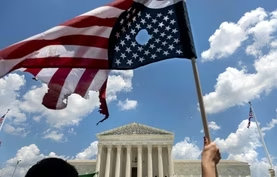
GEOFF BENNETT: A former neighbor of Supreme Court Justice Samuel Alito said that, in her words, at worst, he's just outright lying about his account of a neighborhood dispute that led to hoisting an upside-down American flag at his Virginia home.
The inverted flag is associated with the effort to overturn President Biden's 2020 election win.
Justice Alito has been in the spotlight over flying controversial flags at his homes, as first revealed by reporting from The New York Times.
Our Lisa Desjardins joins us now.
So, Lisa, what's new here in this account?
LISA DESJARDINS: Some important details about the timeline are new, but I also want to talk about why this matters, of course.
Justice Alito is currently sitting on two cases about January 6, one about former President Trump's involvement in January 6.
These cases, of course, could determine a lot about our future here.
And, also, Justice Alito has defended himself as saying his wife hoisted the flag.
He said he will not recuse himself.
It is solely up to him, by the way.
And he's used this burden of proof.
He has said that, under the Supreme Court's ethics code, what matters is if someone who is impartial, who is able to look at all of the circumstances involved, if they think that he could be fair, then he should not recuse.
So the circumstances matter, because Justice Alito himself said they would.
Now, here's how he described what happened in a letter to Judiciary Chairman Dick Durbin.
He wrote: "A house on the street displayed a sign attacking my wife personally, and a man berated her in my presence using foul language, including what I regard as the vilest epithet that can be addressed to a woman."
Now, a couple of details in this.
He's saying that's why his wife flew this flag, which can be a sign of distress.
We know now from the neighbor who was involved that it was actually the woman who used that word about other women.
And she says that the timeline was completely wrong.
I want to take us through that timeline now, because it's important first.
We started January 6.
As you say, that is when we saw upside-down flags flying as the Stop the Steal movement attacked the Capitol, moved inside to try and stop the presidential election count.
Soon after that, Alito's neighbors put up a sign that said, "You are complicit."
They say it wasn't just about him, but about people in general.
Alito's family took that as being about them.
January 17 is when we know an upside-down flag was flying at the Alito home, according to The New York Times.
Now, the important piece here is Alito said, well, that was flying because of the confrontation.
But now we know there is evidence that February 15 is actually when that confrontation happened, after that upside-down flag had been flying.
Here's what the neighbor said to CNN.
EMILY BADEN, Neighbor of Justice Samuel Alito: At best, he's mistaken, but, at worst, he's just outright lying.
The interaction that happened on February 15 is the one that they're using as an excuse for why they flew the flag.
And I really want to hammer home the fact that that happened on February 15, and their flag went up two or three weeks before that.
LISA DESJARDINS: So, the question is -- this sounds like it's a minor thing about the timeline, but it's a very big deal over exactly why this flag that was about something that attacked our democracy was flying over a Supreme Court justice's home.
GEOFF BENNETT: So, Lisa what role does Congress have in all of this?
Because there are questions about whether or how Congress could ever impose a tougher code of ethics on the Supreme Court.
There are questions about the Senate Judiciary Committee.
Will they hold a hearing?
Will they call Justice Alito or Chief Justice John Roberts to the Hill to account for all of this?
Walk us through all of that.
LISA DESJARDINS: There are very loud calls among Democrats, including some on the Judiciary Committee, not just to call the justice, but to perhaps subpoena him.
I spoke with the head of that committee, Dick Durbin, this week.
And he said the problem is they don't have that power.
Under the rules of the U.S. Senate right now that was agreed to in this closely divided Senate, in order to issue a subpoena, a committee can do it by majority vote, but they can't take any action unless at least two Republicans come to that meeting.
So the thinking is, Republicans could simply boycott that meeting.
It wouldn't happen.
They cannot issue subpoena.
They cannot enforce it on the floor, which would also take 60 votes.
It's important because constitutional check and balances aren't the question here.
It's Senate rules that are preventing this kind of oversight.
Now, they could have a hearing they could call other people.
Dick Durbin has said he's doesn't think there would be much reason to that to do that at this point.
But he has said he thinks that Alito should recuse.
And here's what Durbin said this week on the Senate floor.
SEN. RICHARD DURBIN (D-IL): Displaying the upside-down American flag and Appeal to Heaven flag creates the appearance that Justice Alito has already aligned himself with the Stop the Steal campaign.
He cannot credibly claim to be an umpire calling balls and strikes in these cases.
LISA DESJARDINS: Durbin's committee is working on an investigation, not just of Alito, but of all Supreme Court justices.
And I'm told they had hoped to release it soon.
But all of this with Alito means now there's new things to investigate, and they don't know when they will release it.
GEOFF BENNETT: Lisa Desjardins, thanks so much.
LISA DESJARDINS: You're welcome.
AMNA NAWAZ: As we have noted, today marks the 80th anniversary of D-Day.
And, for most, the Allied invasion of Normandy is an event in history.
But a new book transports us back eight decades ago, hearing directly from those who lived history.
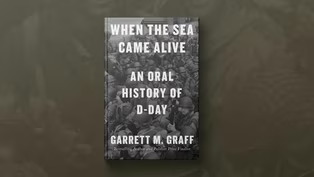
Garrett Graff is the author.
And I spoke with him recently about "When the Sea Came Alive."
Garrett, welcome back to the "NewsHour."
Thanks for being here.
GARRETT GRAFF, Author, "When the Sea Came Alive: An Oral History of D-Day": It's a pleasure.
AMNA NAWAZ: So, this is now the work of 18 months that you spent assembling what's the largest, most comprehensive compendium of first-person testimonials from this historic day and event.
You have compiled oral histories before, like your wonderful book on 9/11, in particular.
Why did you think this format was necessary now for this story?
GARRETT GRAFF: This is a moment where we have, for all intents and purposes, every first-person memory that we are going to have of D-Day.
And so, for me, this was a moment to try to retell the story of D-Day in the voices of the participants themselves as this event slips from memory into history, and to try to make it come alive for a new generation that are not as familiar with the story of D-Day.
AMNA NAWAZ: "When the Sea Came Alive," tell me where that comes from and why you chose that as the title.
GARRETT GRAFF: So, the title actually comes from a German defender at Omaha Beach, and it's his reaction to waking up that morning in the bunker and looking out at what is all of a sudden to him this sea packed with the Allied ships as the invasion arrives off the coast of Normandy.
And I think to me what the title captures in some ways is the audacity of this operation.
This is, in many ways, I think the most audacious human endeavor we have ever seen and probably may ever see in the rest of history as well, a million Allied combatants on the move on D-Day, the largest armada in the history of the world, 7,000 ships crossing the channel overnight in -- completely surprising the Germans.
Right up until the last minute, the secrecy of this event holds.
AMNA NAWAZ: There are stories from voices who are forever etched in history, Churchill, Eisenhower, and the likes.
But, honestly, some of the most compelling lines and stories come from people whose names we have never heard of before.
There's Private 1st Class George Alex, who is a paratrooper, dropped into Normandy just six hours ahead of the invasion.
You quote him here in that moment, saying: "Yes, I was afraid.
I was 19 years old, and I was afraid."
And there's Sergeant Alan Anderson, and he shares this about preparing for the invasion.
He said -- quote - - "The Army was prepared to accept 100 percent casualties for the first 24 hours.
It was interesting that we all turned and looked at each other and said, well, it's tough that you have to go."
How did these men in the testimonials that you read from them think about their place in an operation of that kind of scale and scope, as you described?
GARRETT GRAFF: We look back and we view D-Day as this amazing, historic triumph of heroism and courage and bravery.
When you hear from the soldiers crossing the channel on the night of June 5, the paratroopers flying across the channel that night, there's not a lot of heroism or bravery or courage that they're feeling in that moment.
They're lonely.
They're scared.
They're wondering if they're going to make it through to the end of the next day.
AMNA NAWAZ: There's a story you tell about a man named Waverly Woodson Jr.
He was a Black medic on Omaha Beach.
Why is his story important here?
GARRETT GRAFF: Waverly Woodson is, to me, one of the most fascinating characters of this book.
He is a medic with the only Black combat unit that lands on D-Day and is wounded before he even gets to shore and spends 30 hours on Omaha Beach treating the wounded before he is evacuated himself.
He's one of what turns out to be a small handful of Black soldiers in World War II who are considered for the Medal of Honor, but amid the systemic racism of the segregated military in that moment, not a single Black soldier in World War II receives the Medal of Honor.
And it's only been this week for the 80th anniversary that he has been awarded a very long overdue Distinguished Service Cross, which is the nation's second highest award for combat valor.
AMNA NAWAZ: Garrett, it's also astonishing to weigh what this entire generation, the Greatest Generation, carried with them for 80 years and, in many cases, never talked about.
There's one line from a member of the 3rd Canadian Division, a Lieutenant Reg Weeks, who you quote in here.
He says: "The thing I remember is that the people who had not been killed, the people who had gone ashore ahead of me, there was a look in their eye which I have never seen repeated under any circumstances."
This is not a generation known for talking openly about this, right?
GARRETT GRAFF: When you go back through the history and the archives, so much of these oral histories were actually gathered between the 40th and the 50th anniversaries of D-Day, 1984, 1994, which was the moment that I think the nation, thanks in part to Ronald Reagan's famous speech at Pointe du Hoc in 1984, really reckoned with the legacy that this generation delivered for us, the way that these people, these 19-year-olds, these 21, 22-year-old sergeants leading them into battle saved democracy.
AMNA NAWAZ: There is a parallel a lot of people see between that time in history and what we're living through now.
Did you see any of those parallels through what you researched or did the people you talk to see that?
GARRETT GRAFF: Absolutely.
I thought a lot about, in researching and writing and editing this book, this modern moment, and both in terms of what's going on in Europe and the fight that Europe is in right now about the future of European democracy and then also our fight here at home.
And this is a year that we're going to spend a lot of this year talking about what America is and what it isn't.
And I think one of the ways that we can define that is what America is willing to fight for.
AMNA NAWAZ: The author is Garrett Graff.
The book is "When the Sea Came Alive: An Oral History of D-Day."
Garrett, thank you so much for being here.
GARRETT GRAFF: My pleasure.
GEOFF BENNETT: It has been said that public art is a reflection of how we see the world, the artists' response to our time and place.
Tonight, Pamela Watts of Rhode Island PBS Weekly introduces us to an artist who has often combined those concepts literally.
The story is part of our arts and culture series, Canvas.
PAMELA WATTS: Time flies.
For tens of thousands of drivers who travel every day on Route 95 in Providence, you can't miss the mischievous worker about to roll a clock right off the roof of the former Brown & Sharpe Manufacturing Company.
Foundry Clock Man is just one of the whimsical works of modern metal art created by contemporary sculptor Peter Diepenbrock.
PETER DIEPENBROCK, Sculptor: The sort of metaphor of it is, why is time so dominating in our lives?
Time is totally dominating.
You think about how we are obsessed with time of day, seasons, retirement.
There's all these ways of chunk -- dividing life up into time chunks.
It's a rejection of that.
PAMELA WATTS: Diepenbrock constructs most of his stainless steel pieces here in his home studio in Jamestown.
His is a curiosity shop of fanciful, quirky objects, hand-crafted items, as well as many maquettes, artists' preliminary models.
Diepenbrock's recent piece of public art is a almost-10-foot-tall rabbit springing to life.
PETER DIEPENBROCK: The gesture is kind of a skating, a flying bunny, which is sort of inspiring hopefully to young people to live lightly in your own life.
PAMELA WATTS: It's called Ostara, translation, a celebration of new beginnings.
PETER DIEPENBROCK: Life is so serious right now.
The world is in such crisis, it seems like everywhere you look, that we could use a little more humor and a little less dark subject matter.
PAMELA WATTS: Constructing these structures has allowed him to be the architect of his own career.
PETER DIEPENBROCK: At the core of it is, I love making stuff.
And so its kind like, well, what could I make today?
PAMELA WATTS: A native Californian, Diepenbrock discovered that love of making stuff in his father's woodshop at age 5, and continued when he graduated from Rhode Island School of Design, RISD, in the mid-'80s.
He has been successfully self-employed ever since.
He has a cottage industry of metal tabletop giftware, all with humorous personalities.
But, in 2002, Diepenbrock's art took a serious turn.
PETER DIEPENBROCK: A friend stopped by and said: "Peter, do you know about the 9/11 Memorial competition?"
And I applied to that and won the competition.
And that is what started the public art practice.
PAMELA WATTS: As you first enter the Rhode Island Statehouse, you pass Diepenbrock's prestigious commission.
He had only five months to create it.
PETER DIEPENBROCK: The reference was 9/11, so there's nine layers of glass, and then the 11 is represented by what looks like the towers.
But if you just see them graphically, 9/11 is embedded three-dimensionally.
It was going to weigh 4,000 pounds, and they had to reinforce the structure of the Statehouse from below.
It was intense.
I mean, I can't even tell you how intense it was.
PAMELA WATTS: Another of his heavy metal sculptures can be found on the University of Rhode Island campus.
Torsion III twists like the curl of an ocean wave.
One of his recent works is drawing the public's eye in a new direction.
This aerial mobile is the centerpiece of the lobby at Hasbro Children's Hospital.
PETER DIEPENBROCK: The idea was to kind of create this arrangement of floating discs of glass and color that would turn and project those colors all around the room in slow motion.
PAMELA WATTS: Like a rainbow.
PETER DIEPENBROCK: Yes, or a disco ball, but with -- a little less jazzy, and the idea being recognizing that it's a high-stress environment.
If there's a metaphor there, it would be, what would healing look like?
PAMELA WATTS: These days, he's been trying his hand at Plexiglas kinetics, how a piece revolves, has motion, movement, and balance.
A work in progress?
PETER DIEPENBROCK: Yes, I don't think it's working.
(LAUGHTER) PAMELA WATTS: Outside his studio are sculptures privately commissioned or just freeform pieces, each with a story that he hopes will bring a community together.
PETER DIEPENBROCK: What I do love about public art as a category is, it demands the whole spectrum.
So you have to be able to write about it, you have to be able to speak about it, you have to be able to represent it and model, you have to transition it, you have to translate it, engineer it, actually build it, deliver it as a complete piece that's going to last for a couple hundred years.
PAMELA WATTS: For the "PBS NewsHour," I'm Pamela Watts in Jamestown, Rhode Island.
AMNA NAWAZ: And we will be back shortly for a Brief But Spectacular take on how to create cultures of growth.
GEOFF BENNETT: But, first, take a moment to hear from your local PBS station.
It's a chance to offer your support, which helps to keep programs like the "NewsHour" on the air.
AMNA NAWAZ: For those of us -- those of you staying with us, the on-again/off-again diplomatic relations between the U.S. and Cuba have made it much harder for Cuban musicians to travel to the U.S. for this summer's music festivals.
Special correspondent Mike Cerre report from Havana in this encore report for our arts and culture series, Canvas.
MIKE CERRE: Since the broad-based success of the 1999 Buena Vista Social Club film and album celebrating Cuban musicians, there has been a succession of virtuoso Cuban musicians, like Roberto Fonseca, who have regularly played major music festivals and venues throughout the U.S. ROBERTO FONSECA, Musician: United States is a great and important platform for young musicians.
MIKE CERRE: But changes in U.S. visa procedures are making it more difficult for this current generation of Cuban musicians, like Rodrigo Garcia Ameneiros and his wife, Tania Haase Solorzano.
They have spent much of the past year trying to get visas to play at festivals and schools in the United States they have been invited to.
RODRIGO GARCIA AMENEIROS, Musician: No, we don't have a guarantee, and we are trying to, but, yes, it's hard to process.
MIKE CERRE: Like most Cuban jazz musicians, Rodrigo and Tania are classically trained graduates of Cuba's national music schools they attended from elementary school through college.
They have spent the majority of their lives preparing for professional music careers and joining the ranks of Cuba's world-class musicians.
RODRIGO GARCIA AMENEIROS: Eight years or 10, we start in the school, like a career.
At that age, you are not thinking in a career.
But we had that... TANIA HAASE SOLORZANO, Musician: Opportunity.
RODRIGO GARCIA AMENEIROS: Yes, opportunity, but, also, it's like a responsibility.
MIKE CERRE: During the last week of the Trump administration in 2020, the U.S. shut down its embassy in Havana, accusing Cuba of state-supported terrorism.
Since then, most Cuban musicians now have to travel to a third country with a U.S. embassy just to apply for a visa.
BILL MARTINEZ, Immigration Attorney: It's devastating, emotionally and otherwise.
It's - - the toll is at so many levels.
MIKE CERRE: Immigration attorney Bill Martinez helped get the original Buena Vista Social Club musicians into the U.S. for their celebrated Carnegie Hall debut in 1998.
He continues helping them and other Cuban musicians work through their visa application nightmares.
BILL MARTINEZ: The big change is that administrative processing, which happens after the consular interviews, is causing long delays and sometimes resulting in the cancellation of tours.
MIKE CERRE: And is it predictable?
Do you know, when you apply for a visa, how long it's going to take?
BILL MARTINEZ: You can never know.
It's absolutely unpredictable.
MIKE CERRE: At this year's annual Havana International Jazz Festival held every January for showcasing Cuban and other international artists, American music promoters were struggling to book Cuban performers for their upcoming festivals due to visa issues.
KEVIN BALL, Festival Booker: You have to have the visa in order to get the booking.
When they get the booking, you have to -- it's kind of like a double-edge sword, right?
It's like, what came first, the chicken or the egg?
MIKE CERRE: Kevin Ball and Lonnie Smith (ph) represent jazz festivals in North Carolina and Texas.
Rodrigo's uncle and teacher, pianist Aldo Lopez-Gavilan, started playing major summer music festivals like this one in Napa Valley in 2017 after the Obama administration started normalizing relations and travel protocols with Cuba.
But most of them were reversed by his successor, and the Biden administration has done little to lift the new restrictions during an election year.
RODRIGO GARCIA AMENEIROS: If you are coming tomorrow and you tell me, can you be in San Francisco next week to work, of course not.
(LAUGHTER) RODRIGO GARCIA AMENEIROS: We have to do it with a lot of time.
MIKE CERRE: While they waited indefinitely for their visas, American audiences could only see them perform in Old Havana's tourist restaurants, which have also been impacted by the added U.S. restrictions on Americans and foreigners traveling to Cuba.
Their band is paid in cash and in meals, which have become even more valuable this year due to the government's latest round of food price hikes and rationing.
RODRIGO GARCIA AMENEIROS: We know a lot of cases of musicians going out of the country, not because they don't want to be here.
Because it's pretty hard to get a job.
MIKE CERRE: Most of the cast for last year's off-Broadway musical revival of the Buena Vista Social Club film were Cuban musicians who had previously left their country for professional reasons.
According to the U.S. Customs and Border Patrol, nearly a half-a-million Cubans are believed to have migrated to the U.S. in just the last two years due to their declining economy.
RODRIGO GARCIA AMENEIROS: Our proposal at this moment is to live here in Cuba and to go and just return at the end.
I think that's about love to the family, to our home, and also to our country.
MIKE CERRE: As headliners at this year's Havana International Jazz Festival, Rodrigo's mother and Tania's extended music families joined them on stage to honor Cuba's rich musical history and culture they are dedicated to preserving.
RODRIGO GARCIA AMENEIROS: This concert is about the history of the country, talking about loss, how we suffer sometimes with immigration.
It's a place to be happy and also to cry together.
TANIA HAASE SOLORZANO: We are always hoping that it will be better for all of us.
RODRIGO GARCIA AMENEIROS: Yes.
I mean, think, I think that the restrictions are just stopping the interchange between one and the other people.
A lot of culture is being stopped.
MIKE CERRE: After intensive lobbying by festival promoters and government officials on both sides of the process, Rodrigo and Tania received educational and cultural visas to salvage some of their American invitations, as long as they don't get paid to perform in the U.S. For the "PBS NewsHour," I'm Mike Cerre in Havana, Cuba.
AMNA NAWAZ: Professor Mary C. Murphy is a social psychologist whose new book, "Cultures of Growth," explores what specific traits can make individuals and teams successful.
Tonight, in this encore broadcast, Murphy shares her Brief But Spectacular take on how to create cultures of growth.
MARY C. MURPHY, Author, "Cultures of Growth: How the New Science of Mindset Can Transform Individuals, Teams, and Organizations": Cultures of genius are really problematic.
If you Google the word genius, you're going to see a lot of Einstein.
You might see some Thomas Edison or Steve Jobs.
You might even see Elon Musk.
They're all white.
They're all male.
You don't see women.
You don't see people of color, LGBTQIA people.
You don't see people with disabilities.
And so what we see over and over is that these cultures of genius really focus on who fits that narrow mold.
And it has consequences.
I grew up in San Antonio, Texas, as part of a bicultural, Hispanic, working-class family.
I think that, in American culture, we all like to think that we are independent agents, but I think we underappreciate how much the world shapes us and how much the cues in the environment tell us, are we valued, are we respected?
Do we have what it takes, or don't we?
And we all have the power to create these environments around us.
And we have to do that.
As a researcher, I focus on how our environments and the cues within them shape our motivation and our engagement.
And I figure out how we can recreate these environments.
The fixed mind-set holds that talent and ability and intelligence are relatively fixed traits.
You either have them or you don't.
You're a math person or you're not.
You're a creative person or you're not.
And the growth mind-set is often seen as the opposite.
It holds that we have universal potential.
The book I wrote is called "Cultures of Growth."
The work that we have been doing has really shown us that mind-set is not just a quality of our minds.
It's also a feature of groups, teams, schools and companies and that, when we can build these inclusive cultures of growth, we will create environments where everyone thrives.
How I know I'm in a strong culture of growth is that I see people collaborating, and they're excited when new and novel and innovative ideas come from anywhere.
Sometimes, all it takes is for other people to see who we really are and what we're capable of.
My name is Mary Murphy, and this is my Brief But Spectacular take on how we create cultures of growth.
AMNA NAWAZ: And you can watch more Brief But Spectacular videos online at PBS.org/NewsHour/Brief.
GEOFF BENNETT: And that is the "NewsHour" for tonight.
I'm Geoff Bennett.
AMNA NAWAZ: And I'm Amna Nawaz.
On behalf of the entire "NewsHour" team, thank you for joining us.
Former neighbor disputes Alito's upside-down flag account
Video has Closed Captions
Clip: 6/6/2024 | 5m 7s | Former neighbor disputes Alito's explanation of upside-down U.S. flag flying at his home (5m 7s)

How Trump could upend the rule of law in a second term
Video has Closed Captions
Clip: 6/6/2024 | 6m 25s | How Trump could upend the rule of law and pursue political prosecutions in a second term (6m 25s)

Israeli strike on UN school in Gaza kills dozens
Video has Closed Captions
Clip: 6/6/2024 | 5m 22s | Dozens killed in Israeli strike on UN school building in Gaza (5m 22s)

Rhode Island artist explores why time dominates our lives
Video has Closed Captions
Clip: 6/6/2024 | 5m 17s | Rhode Island artist's massive work explores why time dominates our lives (5m 17s)

Veterans, world leaders gather for 80th anniversary of D-Day
Video has Closed Captions
Clip: 6/6/2024 | 8m 3s | Veterans, world leaders gather in Normandy to mark 80th anniversary of D-Day invasion (8m 3s)
'When the Sea Came Alive' provides oral history of D-Day
Video has Closed Captions
Clip: 6/6/2024 | 6m 41s | 'When the Sea Came Alive' provides oral history of invasion from D-Day veterans (6m 41s)
Providing Support for PBS.org
Learn Moreabout PBS online sponsorship
- News and Public Affairs

FRONTLINE is investigative journalism that questions, explains and changes our world.

- News and Public Affairs

Amanpour and Company features conversations with leaders and decision makers.












Support for PBS provided by:
Major corporate funding for the PBS News Hour is provided by BDO, BNSF, Consumer Cellular, American Cruise Lines, and Raymond James. Funding for the PBS NewsHour Weekend is provided by...