
June 8, 2024 - PBS News Weekend full episode
6/8/2024 | 24m 10sVideo has Closed Captions
June 8, 2024 - PBS News Weekend full episode
Saturday on PBS News Weekend, as global temperatures rise, American schools struggle to beat the heat and avoid putting students’ learning and health at risk. Then, a growing humanitarian crisis in Congo as escalating violence threatens millions in the central African nation. Plus, what people can do to protect themselves from harmful smoke as wildfire season kicks off.
Problems playing video? | Closed Captioning Feedback
Problems playing video? | Closed Captioning Feedback
Major corporate funding for the PBS News Hour is provided by BDO, BNSF, Consumer Cellular, American Cruise Lines, and Raymond James. Funding for the PBS NewsHour Weekend is provided by...
Support provided by:

June 8, 2024 - PBS News Weekend full episode
6/8/2024 | 24m 10sVideo has Closed Captions
Saturday on PBS News Weekend, as global temperatures rise, American schools struggle to beat the heat and avoid putting students’ learning and health at risk. Then, a growing humanitarian crisis in Congo as escalating violence threatens millions in the central African nation. Plus, what people can do to protect themselves from harmful smoke as wildfire season kicks off.
Problems playing video? | Closed Captioning Feedback
How to Watch PBS News Hour
PBS News Hour is available to stream on pbs.org and the free PBS App, available on iPhone, Apple TV, Android TV, Android smartphones, Amazon Fire TV, Amazon Fire Tablet, Roku, Samsung Smart TV, and Vizio.
Providing Support for PBS.org
Learn Moreabout PBS online sponsorshipJOHN YANG: Tonight on PBS News Weekend, as global temperatures rise, American schools struggle to beat the heat and avoid putting students learning and health at risk.
Then a growing humanitarian crisis in Congo, as escalating violence threatens millions in this central African nation.
WOMAN (through translator): Bombs are still falling in a camp here and in other camps, several people have died, and we live here with fear.
JOHN YANG: And as wildfire season kicks off, what you can do to protect yourself from harmful smoke.
(BREAK) JOHN YANG: Good evening.
I'm John Yang.
There's jubilation in Israel tonight after the military took four hostages safely out of Central Gaza, the daylight operation was the largest rescue mission of the war so far.
Israeli army video shows some of them running to an awaiting helicopter.
The four had been held since October 7, when they were kidnapped by Hamas at a music festival.
They were taken to a hospital to be checked over and reunited with their families.
ORIT MEIR, Mother of rescued hostage: Thank you for bringing my son to me, to us.
I'm so excited I could hug him today.
JOHN YANG: The rescue operation came amid an intense Israeli air and ground assault on the Nuseirat refugee camp, at least 210 dead Palestinians were taken to local hospitals, according to a health official.
In France for a state visit, President Biden said the United States would work to free all the remaining hostages, including eight Americans.
Russia and Ukraine exchanged more drone attacks overnight, Moscow based officials said at least 28 people were killed in the partially Russian occupied regions of Kherson and Luhansk.
People searched through rubble for belongings and public events were canceled for the rest of the weekend for days of mourning.
In Normandy, France today, D-Day commemorations gave way to a wedding day.
World War II veteran Harold Terrence married his sweetheart Gene Swirling.
The groom is 100 years old.
The bride only 96.
Well wishers witnessed the Florida couple's wedding, which isn't legally binding because they're not French citizens.
On D-Day, Terrence was in Britain repairing planes returning from France so they could rejoin the battle for their wedding night, the couple was invited to the Elysee Palace state dinner with President Biden and French President Emmanuel Macron.
And the man who took one of the most iconic photos of Earth has died.
Former Apollo astronaut William Anders never landed on the moon, but he was on the first manned flight to orbit it in 1968 that's when he captured the image that became a symbol of the environmental movement.
Anders died Friday when the small plane he was piloting alone crashed into the water northwest of Seattle.
He was 90 years old.
Still to come on PBS News Weekend, what's behind the spike of violence in the Democratic Republic of Congo and how wildfire smoke can affect your health even hundreds of miles away.
(BREAK) JOHN YANG: Last month, even before summer began, smoke from Canadian wildfires triggered air quality alerts in the upper Midwest and Great Plains and at the same time, fires in Mexico affected air quality along the Gulf Coast from Texas to Florida.
It all brought back memories of last year's record setting fires in Canada that set a haze of smoke drifting over the Midwest and east coast.
Smoke from wildfires hundreds of miles away is still ahead threat.
A recent National Bureau of Economic Research analysis says it contributes to nearly 16,000 deaths a year.
Laura Kate Bender leads the Healthy Air Campaign for the American Lung Association.
Laura Kate what is in wildfire smoke that makes it so hazardous?
LAURA KATE BENDER, American Lung Association: One of the main components of wildfire smoke that's so dangerous is fine particle pollution.
These tiny bits of stuff can get deep into your lungs, and if they're small enough, they can even get into your bloodstream when they cause a host of health harms.
There's a bunch of other harmful chemicals and wildfire smoke too, particularly if it's burning houses, cars and other things from built structures.
JOHN YANG: Is it just as dangerous if the fire is hundreds of miles away, or if the fire is down the street?
LAURA KATE BENDER: Neither is safe.
It can change the composition.
It can change the mix.
But the fact remains that people, whether close to the fire or far away, should both take precautions.
JOHN YANG: What are the health threats?
What can wildfire, inhaling wildfire smoke bring on?
LAURA KATE BENDER: What people might experience during the smoke event is they might have burning eyes, a burning throat, coughing or wheezing.
If you have asthma, COPD or another lung disease, you could actually have an exacerbation.
People can have heart attacks and strokes, and it goes all the way up to premature death.
So there can be some really serious health consequences.
JOHN YANG: Premature death from illness brought on by the smoker from the trauma breathing in the smoke at the moment?
LAURA KATE BENDER: We know that particle pollution itself can cause premature death from both short term and long term exposures, and we know that wildfire smoke can exacerbate existing lung and heart disease and cause some of those health impacts that can send you to the hospital or even cause premature death.
JOHN YANG: What should people do to protect themselves?
LAURA KATE BENDER: People can take steps before, during and after a wildfire.
Before, you should get in the habit of checking your air quality.
Airnow.gov is a great place to do it.
It's also on weather reports.
People can also prepare now, for example, if they think they're going to get smoke this summer again, they might want to buy an air cleaner, a device that they can use that doesn't add pollution to the air, that just filters it.
And then, in the event of a fire, people should stay out of the smoke.
If you're in your home, you can run that air cleaner in a closed off room to create as much of a clean space as possible.
You can make sure your air conditioner, if you have central AC, is recirculating, not pulling air in from the outside.
You can readjust your plans.
If you have exercise outdoors plans that day, for example, that would be a good day to move that indoors.
JOHN YANG: Even if you live hundreds of miles away from where wildfires are likely to take place.
These are precautions you should be taking?
LAURA KATE BENDER: Absolutely if smoke is in the forecast.
You know, I think myself and many others experienced after thinking of wildfires as more of a West Coast problem.
Here in the DC area, we had days with hazardous levels of air pollution, and I, as someone with asthma, absolutely changed my routine to make sure that I wasn't exercising outdoors on those days.
JOHN YANG: Mentioned people with asthma.
Are there other any other populations who need to be particularly careful?
LAURA KATE BENDER: Wildfire smoke can impact health for anyone.
But if you are an older adult, if you are a child, if you're pregnant, if you spend a lot of time outdoors, either working or exercising, or if you have an underlying condition like a lung or a heart disease, those are some of the things that can put you at greater risk of health harm.
JOHN YANG: It can affect anybody.
But is there evidence that any groups are disproportionately affected?
LAURA KATE BENDER: Unfortunately, we know, as with so many air pollution issues, that communities of color and low income communities tend to be at greater risk.
JOHN YANG: Why is that?
LAURA KATE BENDER: Unfortunately, histories of redlining, other practices that have left people with polluting sources close to their neighborhoods that creates a lot of overlapping risk factors.
We also know that people might be more likely to work outdoors, be less likely to have central air conditioning or a car that they can keep the windows closed and the AC on.
And so there's a lot of factors that could put people at greater risk of not just exposure, but also health harms from those exposures.
JOHN YANG: And I know the American Lung Association has ideas or suggestions about what can be done to mitigate these dangers and the fires themselves.
What would the Lung Association like to see done?
LAURA KATE BENDER: For individuals, everybody can and should take steps to protect themselves.
We have resources at lung.org/wildfire.
Folks can also use the website I mentioned earlier, airnow.gov to look up their air quality.
Policy makers at every level also have a role to play.
Number one, we know that climate change is making wildfire risk worse, so continued action on climate change, implementing the policies we have to clean up our cars and our power plants and doing more will help make this problem less likely to get worse in the future.
One more policy recommendation is the use of prescribed fire.
It's a tough trade off, but we know that prescribed fire under the right circumstances, can help make catastrophic wildfires less likely.
JOHN YANG: Controlled fires sort of burning away the underbrush.
LAURA KATE BENDER: Yes, and there's steps that we can take to make that less risky for lung health.
It's an unfortunate trade off, but it can help make lung health better over the long term under the right circumstances.
JOHN YANG: Laura Kate Bender of the American Lung Association, thank you very much.
LAURA KATE BENDER: Thanks for having me.
JOHN YANG: In the Democratic Republic of Congo, local officials say suspected Islamist rebels killed at least 38 people in an overnight attack in an Eastern village.
It's the latest in a spike of violent clashes that began in February.
Since 1996 fighting in the region has led to about 6 million deaths.
Ali Rogin has more.
ALI ROGIN: Two prominent rebel factions in the region are the March 23 Movement, or M23 and the so called Allied Democratic Forces or ADF, neighboring Rwanda has been accused of supporting M23 which the government denies.
And the ADF is a militia group affiliated with the Islamic State and are blamed for the latest attack.
They are just two of the more than 120 groups operating in the region, vying for interests, including control over the country's rich reserves of metals and rare minerals.
Civilians have been caught in the middle, and the Congolese government has often failed to protect them.
According to the United Nations, the violence has displaced 5.7 million people across the provinces of North Kivu, South Kivu and Ituri.
Tjada D'Oyen McKenna is the CEO of Mercy Corps, a nonprofit group providing humanitarian aid on the ground.
Tjada, thank you so much for being here.
This is an extremely complex conflict, but what are some of the root causes behind the violence that we're seeing now?
TJADA D'OYEN MCKENNA, CEO, Mercy Corps: The root causes you mentioned some of them this control.
This is a vastly mineral rich country in a lot of ways, so control of those illegal mining inter-ethnic groups, but also just lots of proxy wars between other actors, other countries, surrounding countries, ethnic groups.
At this point there have been so many splinterings of conflict groups that the numbers just ballooned to over 120 we believe.
ALI ROGIN: You just recently visited this region.
What is different about this conflict now?
Has it gotten worse?
TJADA D'OYEN MCKENNA: I recently was in Goma, which is the largest area in the north Cuba province.
And since January, over 700,000 more people have been displaced into Goma.
And what's particularly happening now is that the rebel groups have choked off all access to Goma, so they're surrounding areas 10 to 15 kilometers, just outside of the city, and they've choked it off so food prices have gone up.
It's made it hard for things to go in and out, and they are now that their weaponry has gotten so sophisticated that they're able to send bombs and other things into displacement camps where people that they've been displaced.
So it's just this real level of concentrated fear and threat that people are facing right now.
ALI ROGIN: What stuck out to you the most?
TJADA D'OYEN MCKENNA: The thing that stays in my mind as I talk to the people, and even as I talk to my own staff, as I mentioned, we've had staff, staff members are kind of they're subject to this violence.
They have family that are displaced.
It's just the incredible resilience of people.
I met a woman who's like sewing little doilies and table things and trying to sell her wares on the street.
Like people want better for their children.
They want to get back to normal, and they very much are talented and want to be able to live productive lives.
And just the incredible resilience of the people of the DRC really blows me away.
ALI ROGIN: And where are most of these people who have been displaced coming from?
Are they from internally are they from other country?
TJADA D'OYEN MCKENNA: It's almost it's almost all internally displaced people.
One of my colleagues said at one point he was hosting up to 50 relatives who had been displaced.
And so you'll often hear stories of people who've like moved.
They started with relatives, and they've moved to a camp, and there are campus full, and so now they're an area outside of a camp.
So it really is people just forced to flee their homes looking for a way to survive.
ALI ROGIN: I want to play a bit of sound from a mother of six who was displaced by the conflict.
AMINATHA KASOLE, Displaced Congolese Mother (through translator): Bombs are still falling in a camp here and in other camps, several people have died, and we live here with fear.
May God help us so that the war ends and people return to their respective areas.
ALI ROGIN: Can you tell us a little more about the conditions and the perils that people in these camps face?
TJADA D'OYEN MCKENNA: These are very crowded places, very little electricity, really tough access to water, clean hygiene, the poverty, just because people have now been forced from their livelihoods, also just makes people they're hungry.
They don't have access to running water.
It's not safe, and particularly women and children are feeling the brunt of being in these crowded conditions.
ALI ROGIN: Why is it that women and children are the most vulnerable here?
TJADA D'OYEN MCKENNA: Think this happens in situations of chaos, right?
You have a lot of people that are forced into very crowded, crowded situations amongst people that they may not know, women having to leave their homes for work and economic opportunities.
It's just very easy for them to take -- get taken advantage of in terms of gender and based violence, and they're really, you know, it's everyone, right?
It could be someone who is your neighbor in a displacement camp, or someone you go into the city to try to get work or try to get food, and unfortunately, they seem like easy targets.
And Tthey're just being really taken advantage of.
ALI ROGIN: At this point, do we know of -- have there been many reports of instances of violence?
TJADA D'OYEN MCKENNA: Yes, many.
And in fact, when you visit these areas, the women and the men are talking about it and talking about and I also, like in groups, you'll see women, really that are children or girls.
You'll see a lot of pregnant young people, and you know that that's what's happening, but they are actively talking about it and feeling just very vulnerable and very taken advantage of in this moment of time.
ALI ROGIN: And how about the Congolese government?
What has their role been, and how effective have they been in addressing the violence?
TJADA D'OYEN MCKENNA: The Congolese government has not been as effective as it should have been.
We desperately need them to come to the peace talks that are being organized through Angola in Luanda.
We definitely need them to come to some kind of ceasefire or truce with these rebel groups.
But clearly, the people we'd meet in the camps would say that they're not doing enough.
You know, as long as people are displaced and as vulnerable as they are and just feeling like they have nowhere to go, they're going to feel like the government's not doing enough.
ALI ROGIN: And there have -- there has been some political flux in recent months.
Has that affected the ability of the Congolese government to address this effectively?
TJADA D'OYEN MCKENNA: Certainly, obviously, like any instability does not help the situation at all, and so just it's another factor that is pulling at them and preventing people from really addressing what's going on.
ALI ROGIN: What fundamentally needs to change to stop this violence long term?
And what is the role of the international community?
What is the role of humanitarian organizations in achieving that?
TJADA D'OYEN MCKENNA: We need a real coming together of a peace process with pressure to bear on neighboring countries, all the parties to this war like really need to come together, and political and diplomatic pressure has to be put on everyone to do their part, to do this.
We also need to just help people in the humanitarian situations they're facing.
On top of all this violence, we've also we've also seen record rainfall in some areas, droughts and others, all related to climate related disasters.
So we need to get basic infrastructures back up and running help support people, but really this peace process so that people can return to their homes and have a chance of living productive lives.
ALI ROGIN: Tjada D'Oyen Mckenna, CEO of Mercy Corps, thank you so much for being here.
Thank you.
TJADA D'OYEN MCKENNA: Thank you for talking about this.
JOHN YANG: From rising seas to more intense storms and droughts, climate change has brought about sweeping changes.
Now add education to that list.
Studies show that in more places in the country, there are more days in the school year hotter than 80 degrees than there were in 1970 and schools that can afford air conditioning are left to struggle with overheated classrooms, which researchers say pose both academic and health risks.
Anna Phillips was one of the reporters who looked into this for The Washington Post, where she covers climate change.
Anna just to be clear, we're not just talking about summer term.
Here are we?
ANNA PHILLIPS, The Washington Post: Oh no, definitely not.
We're talking about a problem that starts in the late spring when kids are taking state exams, for example, and becomes even more of a problem when they come back in the fall, when you start to see some really high temperatures setting in that would not typically have happened, but are now becoming very common.
You're getting heat waves in September and October in parts of the country that never experienced them before, or maybe very unusually for those parts of the country, and they have really no means of dealing with them, because their schools were built with that air conditioning.
JOHN YANG: In your story, you talk about the schools in the north in particular that didn't have to worry about this.
What are some of the examples of what you found?
ANNA PHILLIPS: Yeah, so you can pretty much draw a straight line across the country from New York and Philadelphia all the way out to the West Coast, and you're looking at a part of the country where most schools were built without air conditioning.
Many of these schools are very old.
Some of them are on the Historic Register.
They don't have the electrical capacity or the kind of infrastructure to put air conditioning in easily.
And so you're seeing places like Philadelphia, Baltimore, Detroit.
These are places that have had to close schools early and send kids home because the buildings have gotten so hot that it's not safe to keep kids in there and they're not learning.
What teachers are telling us is that it's just unbearable in some of these schools, that the temperatures are reaching into the high 80s, low 90s, that kids are throwing up, that their asthma attacks are being worsened by the heat, that they're spending all day in the nurse's station, and that it's an incredibly difficult environment.
JOHN YANG: What about in the south, where I would imagine that air conditioning was more usual, especially in the Deep South?
ANNA PHILLIPS: Yeah, so we don't typically think of the South as having this problem, because most schools do have air conditioning, but what's happening is a confluence of things where many of the air conditioners that are in place are very old.
You know, I talked to one superintendent in Arizona who's dealing with air conditioners that were put in in 1997 and the climate has become much more extreme.
You're seeing these longer lasting and more frequent heat waves, and the air conditioners they have just can't keep pace.
JOHN YANG: I mentioned when the introduction I'm talking about 80 degree days that's outside.
What about inside the classroom?
ANNA PHILLIPS: When it's 80 degrees outside, and you're an old brick school building, for instance, like you would see all over the northeast, what you're going to find that the temperature inside can reach into the low 90s or the mid-90s.
And we know that because in many instances, teachers actually have thermometers in their classrooms, and they have taken pictures, and they have posted them on Twitter, and they have, you know, alerted their unions to this, and parents, for sure, are paying attention and are very unhappy about this.
So we know that that these temperatures are not simply uncomfortable.
It's not like kids are a little bit sweaty.
These are not temperatures we would ever expect kids to learn it.
JOHN YANG: And is there evidence that any groups of students are being disproportionately affected by this?
ANNA PHILLIPS: Yes, the research shows that black and Latino students in particular suffer more learning loss when they experience hotter days in schools that are not air conditioned.
This is especially true in the US.
And the same researchers who have looked at this question have also found that there is something that makes this trend go away, and that is installing air conditioning.
JOHN YANG: And how easy is that for schools?
ANNA PHILLIPS: It's really not as simple as it sounds.
When you have these old school buildings, it's not like you can just put a window air conditioner in the classroom and walk away.
Many of these schools weren't built with enough electrical capacity to handle air conditioners.
If you install air conditioners throughout the building and try and operate them, they just won't function.
There's not enough power to serve them.
So that's one big problem.
The other problem is the money, which is incredibly hard to come by in many of these school districts.
We're talking about multimillion dollar, if not billion dollar, facilities campaigns.
There are plenty parts of the country where residents don't have much money and can't do that, or they're in a part of the country where the tax base maybe the city's population is declining, or it's getting older, and voters are not inclined to support paying more for that.
You also have kind of a perception problem, which is that people don't always recognize exactly how much hotter it's gotten.
And they often think of their own childhoods and they think, well, you know, I was in school.
It was a little uncomfortable during the spring and the fall, but we got by.
There's just not quite a recognition of how much worse it's gotten.
JOHN YANG: Anna Phillips of The Washington Post, thank you very much.
ANNA PHILLIPS: Thank you.
JOHN YANG: And that is PBS News Weekend for this Saturday.
I'm John Yang.
For all of my colleagues, thanks for joining us.
See you tomorrow.
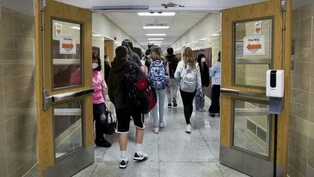
As temperatures rise, more schools struggle to beat the heat
Video has Closed Captions
As temperatures rise, schools without AC struggle to keep students healthy and learning (5m 26s)
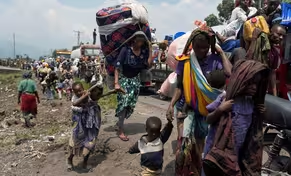
Escalating conflict in Congo fuels humanitarian crisis
Video has Closed Captions
Escalating conflict in Democratic Republic of Congo fuels growing humanitarian crisis (7m 44s)
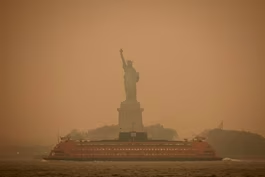
The hazards of wildfire smoke, even hundreds of miles away
Video has Closed Captions
Wildfire smoke is hazardous even hundreds of miles away. Here’s how to protect your health (5m 22s)
Providing Support for PBS.org
Learn Moreabout PBS online sponsorship
- News and Public Affairs

FRONTLINE is investigative journalism that questions, explains and changes our world.

- News and Public Affairs

Amanpour and Company features conversations with leaders and decision makers.












Support for PBS provided by:
Major corporate funding for the PBS News Hour is provided by BDO, BNSF, Consumer Cellular, American Cruise Lines, and Raymond James. Funding for the PBS NewsHour Weekend is provided by...