Living St. Louis
June 8, 2026
Season 2026 Episode 11 | 27m 38sVideo has Closed Captions
Snake Road, Liv Ciera, Game Nite, Libraries Tornado Recovery, Red Tails Aviation Program.
Come along as we visit Snake Road in the Shawnee National Forest, known for its biannual reptile and amphibian migrations, the Game Nite store, the reopened Julia Davis and Cabanne branch libraries, and a program that introduces students to aviation. Plus, an interview with Liv Ciara of St. Peters, MO, runner-up on the latest season of The Voice.
Problems playing video? | Closed Captioning Feedback
Problems playing video? | Closed Captioning Feedback
Living St. Louis is a local public television program presented by Nine PBS
Support for Living St. Louis is provided by the Betsy & Thomas Patterson Foundation.
Living St. Louis
June 8, 2026
Season 2026 Episode 11 | 27m 38sVideo has Closed Captions
Come along as we visit Snake Road in the Shawnee National Forest, known for its biannual reptile and amphibian migrations, the Game Nite store, the reopened Julia Davis and Cabanne branch libraries, and a program that introduces students to aviation. Plus, an interview with Liv Ciara of St. Peters, MO, runner-up on the latest season of The Voice.
Problems playing video? | Closed Captioning Feedback
Where to Watch Living St. Louis
Living St. Louis is available to stream on pbs.org and the PBS app.
Providing Support for PBS.org
Learn Moreabout PBS online sponsorshipWelcome to Living St.
Louis.
I'm Brooke Butler.
You know, here in Francis Park, it's one of those places you can really feel city pride.
Whether it's the beer garden or the festivals or maybe even a game of pickleball.
Especially seeing the friends of Francis Park, the volunteers who ensure this is a space St.
Louis can feel proud of.
When I'm here, I feel community.
You're probably thinking, "Yeah, there are lots of places in St.
Louis like that."
Exactly.
Our stories today of course follow that same theme about our community, ensuring others feel safe, supported and prepared for what comes next.
On this Living St.
Louis, a quiet gravel road in Southern Illinois becomes an unusually welcomed crossing of paths between snakes and curious hikers.
A St.
Peter's teen hits a national high note reflecting on her run of The Voice and what comes next.
We visit a neighborhood game shop where it's more than just board games, it's building a community.
In North City, two storm damage libraries reopen with a new purpose.
And a local flight program is lifting students into aviation careers through hands-on experience.
It's all next on Living St.
Louis.
♪♪ - Our first story comes with a bit of a trigger warning.
It's all about snakes, something most hikers probably wouldn't wanna encounter on a nature trail.
But as Veronica Mohesky tells us, for one park, it's actually what attracts some visitors.
For a few months, every spring and fall, a certain road in the Shawnee National Forest has to be closed to vehicles to allow for the safe passage of snakes.
So the closure started back in 1972 and most likely what was happening is there were vehicular collisions during certain times of the year when snakes are more active.
So by closing the road it prevented a lot of those mortalities and continues through to this day.
The road is open for foot traffic, for visitors to view the snakes and to enjoy a beautiful hike.
That's Mycha Scoggins, a wildlife biologist with the National Forest.
But why did the snake cross the road?
Well, to get from the bluffs to the swamp.
So snakes are cold-blooded creatures.
They depend on temperature.
And so come wintertime, they need to go into kind of a state of hibernation to ride out that winter.
So they'll go and seek shelter in the bluffs, under the rocks.
And then when the ground temperature starts to warm in the spring, that's what signals them to wake up.
Once it hits those temperatures, they will emerge from the rocks, make their way across the road and into the swamp.
And that's where they'll spend most of their summer, hanging out, feeding, making babies.
And then in the fall, the snakes return to the bluffs as the temperatures decline.
These bluffs provide an important habitat for the snakes.
The geological formations at Shawnee National Forest aren't very common in Illinois, and they influence the biodiversity of the area.
The Shawnee is situated in a really neat spot in the Midwest.
So it's kind of where all these areas merge.
So we get a lot of overlap of, you know, southern species, we're just at the very tip of there.
The northern species, we're at the very tip of their range.
So we get a lot of species diversity here.
Scoggins took us to Snake Road, otherwise known as Forest Road 345, in early April to see if we could find any snakes on the move.
About how many snakes could we expect to see here today?
It'll depend.
Obviously snakes are very temperature dependent and it is a little earlier in the day still.
Hopefully we can see a couple.
I mean one or two would be a good start.
As the day goes on it tends to ramp up a little bit and on hotter days you're going to see more snakes.
Okay.
There are 22 species that can be recorded on Snake Road.
Obviously, some of those species are much more commonly seen than others.
There are some that we might only see one every couple years.
And then there are snakes like the cottonmouth that is highly abundant and we see pretty much daily.
So there are, we could see some venomous snakes today?
Yeah, there are three species of venomous snakes out on the road.
One is gonna be cottonmouth, also commonly known as a water moccasin.
There is the copperhead and then the timber rattlesnake.
With that being said, it is important to keep a distance from the wildlife, for your safety and for theirs.
We do not want to disturb them in any way if we can avoid it.
But most of the time, if you remain a respectful distance away from the snakes, they're pretty calm.
They'll see you, they'll notice you, they might stop for a bit, and then once you just kind of sit there and hang out and don't pose a threat, they'll continue on their way.
I spotted a snake pretty soon into our walk, but it was a little camera shy.
Skoggin said it was most likely a cottonmouth.
I think one of the biggest misconceptions people think of when they hear snake road is, you know, there's just thousands of snakes all the time squirming around, and that is absolutely not true.
There's many days that I go out there and I don't see a single snake.
There are big days that we call them that you might see 20, maybe 30 snakes on the road.
And we weren't the only ones searching for snakes that day.
Since 2023, the Shawnee National Forest, in partnership with the University of Illinois Extension, has recruited volunteers to collect data on Snake Road.
And basically what we're just doing is we're trying to figure out the species that are out there, the abundance or their population size.
Is it an adult or is it a baby?
What species is it?
How big is it?
And it also helps us monitor if there's any injured or dead snakes.
It's still pretty new, the data itself, but I think it's going to teach us a lot in the future.
Luckily, one of the volunteers found another snake for us to see.
So this is a plain-bellied water snake.
They are the second most common species we find here on the road, and they are most commonly confused with the venomous cottonmouth.
They have an all-dark back and then a plain yellow belly that you can often see underneath of their chin.
One of the easiest ways to tell them apart is venomous snakes tend to have that elliptical pupil, whereas non-venomous snakes will have a round pupil.
And then that yellowing is really going to be your biggest telltale that it's a plain-bellied water snake.
Scoggins says though some people are afraid of snakes, we should remember they are a vital part of our ecosystem.
They are responsible for keeping a lot of other species in check, including amphibians and rodents.
Those are their two big main resources of food.
And so without snakes, we would probably have an overabundance of both of those.
And Snake Road has offered a really neat opportunity for people to be able to experience snakes in a way that you wouldn't normally in the woods.
I just think it's a great way to be slowly introduced.
We've actually had a lot of volunteers that have started with us who were not fans of snakes.
They wanted to learn more and this was kind of how they did that for themselves.
And a lot of them now are big advocates for the snakes out there.
Two St.
Louis public libraries have officially reopened just one year after the May 16th tornado tore through parts of the city.
The Cabanne and Julia Davis branch represent more than just repaired buildings.
It's a sign of resilience and community building.
There is still a visible trail of destruction in North St.
Louis City as cleanup and recovery efforts have been slowly taking place.
But the Penrose and Academy neighborhoods are seeing a light through the dark tunnel of devastation and uncertainty with the celebration of the reopenings of their St.
Louis public libraries.
The historic Julia Davis and Cabanne branch have made a complete recovery after being wrecked by the force of the EF3 tornado on May 16, 2025.
At no point did we ever think about not reopening these locations.
They're so critical to the communities that they serve and to the broader St.
Louis region.
So as soon as they went down, it felt like we were missing, you know, an important part of who we are.
The Julia Davis branch is a staple in the black community with a rich history behind it.
It was named after the St.
Louis educator and historian, Dr.
Julia Davis, who taught in the St.
Louis public schools for almost 50 years.
In 1941, Davis created a major African American research collection at this library to archive and preserve African American history and culture.
One of the many library workers that was there the day the tornado hit is Dominique Newton.
He's the assistant manager of this branch and he recalls the events that took place here just a year ago.
So it started off as a normal day and one of the staff members noticed that the clouds were just forming.
You know, we're already kind of on edge knowing that the tornado was coming and then once we seen that, the signals started going off on our phones and our weather alarm and we all took shelter.
Some of the damages that this location sustained were all the windows being completely broken, large debris lodged into the front part of the building and water damage to the carpet and some broken equipment.
Through all of this, there were no casualties amongst staff and customers.
The good thing is we do a lot of safety training at all of our locations.
Everyone knows exactly where to go, exactly what to do.
And throughout the city, you know, it was a citywide event.
All of our staff were able to make sure that our customers in the buildings, as well as the other staff, were in safe locations.
- The Cabanne Branch has an older architecture.
It was built in 1907 by Andrew Carnegie.
He was a wealthy businessman who funded the construction of libraries across the United States and the world.
This location has had its upgrades and renovations over the years that was destroyed by the tornado.
But one of the major pieces of destruction revealed something beautiful.
When the tornado rolled through, it pushed open a window, it got underneath the roof, and created a whole bunch of positive pressure in the, we'll call it the attic, which then blew out the drop ceiling for that building.
So the ceiling came crashing down in that location, which was extremely terrifying.
When the tornado rolled through and knocked out that ceiling, it exposed the original clear story for that building with significant architectural features that we have been able to renew.
We fixed it all up.
It's painted.
It's absolutely beautiful.
And we're really excited about folks coming in who have been in that building before and experienced it as it was, experiencing it now.
The Julia Davis branch has added even more features and resources that the community can come and enjoy.
As a regional library, it's a hub for resources and a lot of activities that happen around the community.
It's the largest creative experience of all the St.
Louis library locations, with eight 3D printers, a computer lab with various editing softwares, and two recording rooms underway.
It's been tragic being closed and to see how much the community needs these facilities.
So we are thrilled to open the door and see people come in.
I remember when we opened this building in 1993.
I've been here a long time, we've got some more things to do here.
But we can open the doors and we were anxious to get people in.
So we did it.
libraries are hugely important in the United States.
And it's wonderful to see this kind of support.
And I just hope it goes on.
We're thrilled to be part of the community and to be open again.
Come out and see us.
Our next story is about something becoming more common, seeing people in our region step into the spotlight.
Whether it's American Idol or The Voice, we're seeing more talent represent the Midwest.
Olivia Moses sat down with one of those rising stars.
At just 16 years old, St.
Louis native Liv Sierra returned to The Voice for redemption.
♪♪ After a year of hard work, she earned two chair turns and won as runner-up on the 29th season of The Voice.
She joined me in the Nine PBS studio to speak on her journey.
Thanks so much for being here today, Liv.
Thank you for having me.
So just to start, like, how does it feel to be runner up of Season 29 of The Voice?
There's so many moments throughout The Voice journey where I've had to, like, just take a moment and like live in the moment because like I didn't get a chance to last season and it took so much work and so much kind of like mental strength to to be where I am now.
And I just have to take a moment like just to like be really proud of myself.
It's really it takes a lot of guts to kind of go back after you got turned away.
You were actually quoted saying like rejection as redirection.
Talk about that a little bit.
Yeah, it was it was crazy because I had worked so hard.
Like, even though I didn't get a chair turn in season 28, I had walked off the stage and I was like, listen, I was on TV.
I got to hug Nile Horn, Snoop Dogg, et cetera.
Like I got to hug all these amazing people.
I got to give them all suckers.
Like that alone was such a special experience.
But the fact that I left the stage feeling happy with what I had left and then the producers called me back and they're like, you know, you're not done here.
Your time is not over here.
And we want you to come back.
It was really special, but also very, very, it was a big task.
I saw them turn and I immediately glued my eyes shut.
I said, if I open my eyes and I look at these people, these two legends turn for me, I will collapse.
So I then, I open my eyes, but I focus on the audience, because I already got in a chair turn at that point.
So I was like, let me show them that I can perform at this point, and I can still have that vocal connection.
And then afterwards I did break down a little bit.
Thankfully they cut a lot out of it, because I was crying.
You can't help but be emotional, right?
Exactly, exactly.
It's such a big moment for you.
Yeah, and what's special is that they said exactly what I had been working on.
From the moment you started singing, we could really hear that connection.
And from that point on, it gave me the motivation to tell myself that if I really work on something, I can improve.
And I really did improve throughout the season.
Did you know what team you wanted to be on?
Were you gunning for Team Kelly?
Oh yeah.
She was my top choice.
She's so incredible and she's so experienced in the sense that we both kind of started out in the same, the same kind of, yep, she started out young on another TV show, singing TV show, and throughout the coaching process she kept tying into that and giving me tips on how to deal with that and being overwhelmed with everything that's going on around you because you know we both grew up in not smaller towns but just kind of like like sheltered and you haven't been out there and to do that when you're young is a big big task and she gave me so many tips on how to handle that and how to really deal with that but to also realize that I am here for a reason and I have to accept that I'm here for a reason so I can really show the audience what makes me different.
I have to talk about your parents a little bit because you're so young and it seems like they support you in this choice that you've decided music is your the path that you want to follow.
What's it like to have your parents kind of support your your dream?
It's really special.
They kind of knew.
I have a feeling they were probably waiting for it.
Yeah, they're probably waiting for the moment.
Yeah, but eventually when that moment came and I was like okay it started with my dad's band and I was like 13 12 13 years old I came up to my parents and I was like okay well actually my dad offered me to step in and do a show with him and I was like I was just about to ask it was like the perfect timing and so from that moment on I was like this is really really cool and really special and having such a great support system like that for my friends my family and also for my school as well from St.
Dominic it's really special and it's really motivating because anytime you kind of doubt yourself at any time you tend to pick yourself apart you have to remember that the people that support you really want the best for you I remember when I first auditioned for the voice my mom signed me up without me knowing she's like yeah you have your audition for like tomorrow's like okay but it was it was really I was like okay so she wants me to take this risk so I have to take this risk to stand up for my hometown and show that even though I'm from the Midwest like so many people can you know achieve their dreams out of it like Ruby Lee she was a contestant a few seasons ago she also got runner-up and and people like Chapel Roan and she grew up in Kansas City or no Springfield I think Springfield yeah yeah so people like that like it gives me that motivation that I can do that as well and I can achieve those dreams as well and you know I'm always working I'm always improving but you know one day I hope to show that people from Missouri people from wherever they can really become anything they want to become a question though like are you worried at all that this was like the peak of your career or do you feel like this is just the beginning well literally and one of my songs the beginning the last I'm so glad that's at the very end of my EP because like one of the last lyrics is this is just the beginning that has been my mantra this entire experience to the voice like I every time I would grow more throughout the voice and anytime I was writing my songs I would just tell myself if you think that this is good now this is just the beginning like I can't I'm open to anything in the future stay tuned because like I said this is just the beginning this is just the beginning for Liv Ciara yeah thank you so much thank you game night is what's called a friendly local game store while they do sell product they also serve as a third space somewhere where your friends family or even just strangers you meet there can all play your favorite games together and today is their gamer garage sale a major event they hold where independent merchants small local vendors and even charities are welcome to participate in one of their busiest days my name is Elizabeth Fox and I'm the owner of Game Night.
I'm Dave Lesneski and my position is general manager of Game Night.
Game Night to me is a store where people come be themselves.
It's a fun family environment.
People can be themselves, not worry about being judged or looked down upon in any way for enjoying their hobbies.
For us it's about the community and having our fellow gamers being able to come to a place that, you know, they feel welcome just to play their game, no judgment or anything like that.
So, with new friends and everything.
Most popular played games, Warhammer is a big one for us.
Agreed, and Magic the Gathering of course.
Magic the Gathering and then Star Wars Unlimited is pretty big here as well.
I would say definitely Dungeons and Dragons is a huge thing here.
We have our Ventures League on Tuesday nights, and we get a ton of people for that.
Our sale does start from just a community member that was in need.
Unfortunately, it was due to a passing of one of the community members, and his family needed a way to pay the bills, and he had a lot of the hobby stuff.
So we said, "You know what?
"Come in, you guys can have this entire part of the store, "and then just sell what you can and get the money for it."
And it just kind of blew up from there because everyone wanted a piece of it.
They're like, "I have stuff I want to get rid of."
And you can always find those hidden gems for your collection that you just don't know where to go otherwise.
So the vendors that we pick for our garage sale vary.
So we have a little bit of everything.
We have some vendors that do 3D printing, some that have board games, some that have card games, miniatures, things like that.
Just that way, there's a little bit for everyone.
There's a few vendors that we have here that come here frequently.
They're the first to sign up every month and they just enjoy having that second form of income.
We have a charitable company that we work with that comes in and they're here for every garage sale.
Meeples for Peoples.
Meeples for Peoples and they're here pretty religiously for it as well.
My name is Joey Jackson.
I am the director of Meeples for Peoples.
So Meeples for Peoples, what we do is we donate games to communities around the country.
That can be schools, libraries, hospitals, prisons, retirement communities, and we just donate games wherever people could use them because games really do help people with learning activities, interactions, all kinds of stuff.
But we love when we get to come here.
It's a good opportunity.
We get donated a lot of games that are not good to donate to like schools or anything like that because they're too big or too heavy.
So this is a good way for us to raise money and also offload some of the stuff that's really hard for us to donate.
My name is John R. Miller.
At the Gaming Garage sale, I'm here to basically empty out my basement full of games, hopefully getting them a new home for players to actually enjoy them.
I just have way too many.
To me, a friendly local game store balances between a business and a place that's open to people, where it becomes, you hear the term a lot of times, but it is a safe place where you can come in, meet people, you can be a shy person, you can be an outspoken person, just somewhere where you can come in and say, I want to play a game, and hopefully someone will be there to play with you.
This is what people call their third place, so like a second home after work.
I feel friendly is simply just a place where you can go and not be judged, feel comfortable, it's like a second home, where you can meet people with similar interests, similar likes, similar mindsets, and just really feel welcome.
Like Cheers, you know, where everyone knows your name.
Our final segment takes us to the skies.
From Nine PBS's most recent special Flight Check, Kara Vaninger tells us about the next generation of aviation experts and how they're preparing for takeoff.
Spirit Airport is also home to the Red Tail Cadet Program, a six-week immersive course that teaches students from the Ferguson Florissant School District how to fly.
That was a no-brainer, the Red Tail Cadet Program, and the history of those aviators who were in situations where people didn't think they could make it, kind of like Ferguson.
Frustrated by the negative cloud surrounding Ferguson, Pastor Anthony Myers decided to create a transformative experience for its young people.
He connected with the owners of Elite Aviation, John and Donna Tipton, and together they created the program, naming it in honor of the United States' first black military pilots.
We know that the stack is going to be right off our wing.
Yeah.
We keep following this river all the way down.
I mean, they're here six weeks, flying planes every day.
And we start ground school or information sharing about, you know, a couple of months ahead of time for four weeks.
So it's intense.
It's not a scale down program.
It's not an abbreviated program.
Either you can do it or you can't.
And these kids can do it.
I didn't think I was going to get into the program, but I applied anyway and I got in, made it through each part and I've done really well with it.
I flew a plane before I drove a car.
Now that I've experienced it and I've done it, I just want to continue.
I want to continue flying.
Beautiful.
Fly runway heading to 8-11.
Mentors from the industry support the cadets as they go through this challenging program, while also encouraging them to be a team and hold each other accountable.
You know, we've all competed to get to this spot and get to be a cadet in the first place.
It's no longer just an "I."
You know, it's a "we" thing.
It's a team.
They walk out of this program and they have a different concept of what they can do.
And there's no wall that's going to stop them.
Nobody's going to tell them you can't do this.
They did something that most people never can do.
Gives you a little different confidence level when you're looking at other things in life, right?
I want to go to college.
I'm going to study medicine, pre-med for surgery.
That's the track I want to do.
But I'm also going to continue getting my private pilot license and I want to get my instrument flight rules part of the license, which means I'll be able to fly in the clouds.
I'll be able to fly at night.
At one point, their world was this big.
Now it's this.
We've got cadets who are working at Boeing right out of high school.
We've got two in the military, one in the Navy, one's a Marine.
The sky's the beginning.
That's a playground.
It really is.
My parents would love to see this.
I'm immensely proud of the spirit of St.
Louis Airport and the true gem it is to this region.
But one of the favorite things in my 38-year career is the Red Tail Cadet Program.
It's so satisfying because it's a group of people coming together and doing this.
And when Anthony had that vision, you know, these kids in Ferguson grew up in the shadow of an international airport.
Most of them have never been on an airplane.
They've become ambassadors, the leaders that walk back into the school districts and say, "Let me tell you what I did this summer."
You know, first day of school, they're in their jumpsuits high-fiving third graders because their posters are in their schools.
And so that's who kids ought to want to be.
- Thinking about final.
- All right.
- You'll surprise yourself, 'cause I surprised myself.
- And that's Living St.
Louis.
To watch the full half hour on all things St.
Louis Aviation, check out FlightCheck on the PBS app or on Nine PBS's YouTube channel where you can also watch all of our other great segments, including the making of this David Francis statue.
And as always, tell us your story ideas at Nine PBS.org/LSL.
I'm Brooke Butler, thanks for joining us.
♪♪ - Living St.
Louis is funded in part by the Betsy and Thomas Patterson Foundation and the members of Nine PBS.

Game Nite Hosts “Gamer Garage Sale”
Video has Closed Captions
Clip: S2026 Ep11 | 4m 8s | Game Nite provides a community space for local gamers to learn new games, make friends and more. (4m 8s)
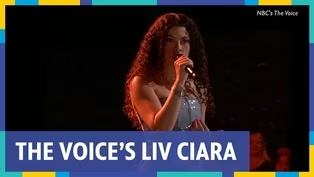
Interview with Liv Ciara, First Runner Up on Season 29 of The Voice
Video has Closed Captions
Clip: S2026 Ep11 | 5m 40s | Liv Ciara discusses her time on The Voice and what's next for her music career. (5m 40s)
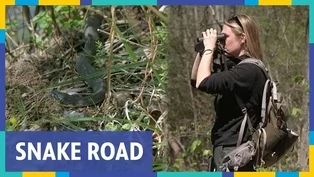
Searching for Snakes on the Shawnee National Forest's "Snake Road"
Video has Closed Captions
Clip: S2026 Ep11 | 5m 56s | Snake Road closes to allow snakes to migrate between their winter and summer habitats. (5m 56s)
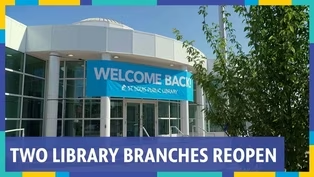
St. Louis Public Libraries Reopen a Year After May 16 Tornado
Video has Closed Captions
Clip: S2026 Ep11 | 4m 23s | The library recently celebrated the reopening of two branches damaged during the May 16 tornado. (4m 23s)
Providing Support for PBS.org
Learn Moreabout PBS online sponsorship











Support for PBS provided by:
Living St. Louis is a local public television program presented by Nine PBS
Support for Living St. Louis is provided by the Betsy & Thomas Patterson Foundation.