Austin InSight
Juneteenth in Austin
Season 2026 Episode 230 | 27m 15sVideo has Closed Captions
As we mark Juneteenth, hear from those who’ve shaped and safeguarded Austin’s Black history.
This week, Austin InSight celebrates Juneteenth. Hear from community voices as we reflect on and honor Austin’s Black history and how it’s shaped the Austin we know today.
Problems playing video? | Closed Captioning Feedback
Problems playing video? | Closed Captioning Feedback
Austin InSight is a local public television program presented by Austin PBS
Support comes from Sally & James Gavin, and also from Daniel L. Skret.
Austin InSight
Juneteenth in Austin
Season 2026 Episode 230 | 27m 15sVideo has Closed Captions
This week, Austin InSight celebrates Juneteenth. Hear from community voices as we reflect on and honor Austin’s Black history and how it’s shaped the Austin we know today.
Problems playing video? | Closed Captioning Feedback
Where to Watch Austin InSight
Austin InSight is available to stream on pbs.org and the PBS app.
Providing Support for PBS.org
Learn Moreabout PBS online sponsorship- Coming up on "Austin InSight," as Texas marks Juneteenth, this episode we're hearing from some who've shaped and safeguarded Austin's Black history.
"Austin InSight" starts now.
- [Narrator] Support for "Austin InSight" comes from Sally and James Gavin and also from Daniel L Skret.
(upbeat music) (upbeat music continues) - Hi there, and thanks for joining us.
I'm Laura Laughead.
This week we celebrate Juneteenth, the day in 1865 when word finally reached Texas slaves were free.
We'll reflect on and honor Austin's Black history and how it shaped the Austin we know today.
While Juneteenth on its own is significant, it was also just the beginning.
Decades of progress followed, through the Reconstruction era, separate but equal, and Jim Crow, and later the civil rights movement and integration, and all the historic firsts and achievements of the past 60 years.
But that progress hasn't come without setbacks, including the erosion in recent years of the Voting Rights Act.
Just this month the US Supreme Court cleared the way for Alabama to use a congressional map lower courts had found to intentionally dilute the votes of Black voters.
That decision followed a landmark case from Louisiana earlier this year, in which the Supreme Court made it substantially more difficult to pursue challenges to voting maps, arguing racial discrimination.
And even right here in Texas, claims of racial gerrymandering were unable to derail a rare mid-decade redistricting by Republicans seeking to fulfill a demand from President Trump to create five more Republican seats in Congress.
Joining us now to talk about some of those developments and the impacts they might have on Texas voters is Harris County Commissioner Rodney Ellis, also a former state senator and civil rights attorney who has spent decades fighting for voting rights in Texas.
Commissioner Ellis, thanks so much for being with us this week of Juneteenth.
- Thank you for having me.
- So to start off, Juneteenth is of course about freedom, and we all know the work didn't end in 1865.
When you think, though, about what Juneteenth means today in 2026, what comes to mind?
- Well, it reminds me that the struggle continues.
You know, in Texas it's a unique holiday.
We're celebrating freedom for enslaved people two and a half years after Emancipation Proclamation was signed.
But look, we were still glad to get it, but it also points out that we still have a very long way to go.
You know, Texas was one of the key flash points on all sorts of creative schemes, mean-spirited schemes that keep African Americans from being able to vote.
And obviously, although it started there, it also disenfranchised women.
It disenfranchised whites who were not part of the elite.
It disenfranchised Latinos.
And in a state where we have the largest number of registered African Americans, almost 3 million, the largest number of Latino, Hispanic registered voters, it's always a challenge to get them out.
And you come up with these schemes that hold people of color back, it really hurts all of us in our state and in our society.
- And now let's talk about that Supreme Court ruling, Louisiana v Callais.
Many voting rights advocates, including yourself, have said it essentially guts what's left of the Voting Rights Act.
You issued a statement on your website saying in part quote, "The Supreme Court has betrayed America to enable an extremist power grab by silencing communities of color, especially Black voters, and diluting our political power" end quote.
For those of us who aren't lawyers, can you explain in simple terms what that ruling did and now what that means?
- That Supreme Court decision essentially gutted the most important provision of the Voting Rights Act.
The Voting Rights Act was intended to empower people of color who've been left out of the mainstream.
And for them to go in and say, you could use the argument, "Oh, this is just partisan gerrymandering."
It essentially guts it.
Preclearance was gutted by a previous Supreme Court decision.
So really we're coming to an era where we're going through the, we've ended the second Reconstruction, and now we're going into a period in which you're gonna significantly reduce the number of people of color who hold public office all throughout Texas and in America.
It means that you come up with this cycle of continuous redistricting, and people will use any excuse under the world other than admitting what it really is, is you wanna keep African Americans and Latinos from being able to exercise that political right to vote.
- And now let's laser that focus a bit more on Texas specifically.
You brought up earlier, Texas certainly has a complicated history with redistricting and voter access.
But what in your view does this ruling here specifically mean for Black Texans?
- I think what it does is invite the legislature after it has already gotten rid of two Black Congressional seats.
If they decide they need more house seats in the State House, or in the Senate, they'll just go back and redistrict every session.
I mean, it's ridiculous.
We have very little time to focus on other issues that matter.
And Texas has had issue of doing that, back when Tom DeLay was the leader on the Republican side in Congress in 2003.
You had the recount going on in Florida, if you remember that, from the presidential race.
And then you had the recall going on in California, and then you had the re-redistricting, mid-decade redistricting going on in Texas.
And now following the whims of the Trump administration because the White House is afraid that they're gonna lose the United States House of Representatives because their policies were so out of touch with working class Americans.
The president directed Republicans in Texas, Governor Abbott and others, "Go get me five congressional seats."
And that's what they did.
The Democrats in the House broke the quorum and it led to a mad scramble around the country, in California, I mean, it's ridiculous.
We'll have more and more political infighting, but the net effect is you're gonna have fewer African Americans holding public office in Texas and in America, because of what the United States Supreme Court has done.
And I'm proud that it was a Texan being pressured by Martin Luther King and the civil rights movement.
It was LBJ who passed the Voting Rights Act, used his political skill to do that.
And I'm sure that it's a big disappointment to him, to his family, to his legacy, to really roll back the clock to where we used to be.
- You've spent your career authoring legislation on voting access here in Texas.
When you see these decisions, what do you think then is the future of voting rights here in Texas and in America?
- I hope that people in Texas and in America are offended.
The civil rights movement didn't happen just because Black people and their allies were protesting.
It's because they touched the conscience of America.
Everything that we believe in.
You know, we've had a awful history as it relates to race relations.
You know, the people who were enslaved, who built this country, really never got their due.
I mean, the people who enslaved them were paid for giving up people that they enslaved.
But the people who were enslaved really never got a chance to really participate in the American dream until that civil rights movement came around and LBJ's legislation.
It always has been stacked against the underdogs in our society.
During the civil rights movement, it was a lot of luck, but something touched the conscience of the American people.
And I hope that happens in Texas and around this country as we go into this fall election cycle.
- This conversation on voting rights is such an important one, one that feels as urgent as ever this Juneteenth, and it's far from over.
Harris County Commissioner Rodney Ellis, thank you so much for sharing your insights with us.
- Thank you for covering it.
It's an important issue.
(upbeat music) - An Austin nonprofit is hitting the streets this week for what's become a Juneteenth tradition.
It's part bike ride and all history lesson, a reflection on Black history in Austin from Juneteenth right up to today.
The Black History Bike Ride host events throughout the year.
But the Juneteenth ride is especially meaningful.
Its significance is captured in a new documentary, "Cycles of Resilience," that just had its Austin premier.
- [Speaker] We are Austin, we are Austin's history.
- There are just very fascinating stories that makes this a more beautiful place to live, once we know them.
- There's a history here, you can access it, and it can give you strength.
- Such a powerful message there.
And we wanna hear more about it from Talib Abdullahi, the founder of the Black History Bike Ride, and executive producer of this new documentary.
Talib, thank you so much for sharing your story with us.
- Yes, thank you for having me here.
- So first off, this year in particular, 2026, more than 160 years since June 19th, 1865, do you have any specific feelings or themes that you're highlighting or reflecting on for this year's ride?
- You know, our mantra recently has been movement is freedom.
And that really, I think connects to a lot of the historical narratives we talk about on Juneteenth, around Juneteenth, about emancipated people finding their way, creating their own communities, and kind of, you know, creating their own destinies in this country we call America.
And it really connects to our modern effort to kind of lead a grassroots initiative to educate people about Black history and our community here in Austin.
So we go out, we ride bikes and we have fun and we reflect on the important and really powerful people that really blazed a trail so that we get to enjoy education in the way that we do.
- And it's such a great idea.
I love this idea of this bike ride as a history lesson.
Can you tell us a bit more about how it came to be?
- Yeah, so in June of 2020, amidst all of the George Floyd protests, I attended several of the protests and connected with the friends there.
And you know, there was just a lot of discourse about what was happening to the Black community and how, finally, after many instances of many Black individuals suffering at the hands of different folks, and in seeing it, you know, seeing these protests everywhere, I realized, in a lot of the conversations I was having with people that not enough people understood the really rich fabric of Black history that exists in Austin.
So my thought was just to say, "Hey, we can kind of go on a fun bike ride in a couple different locations around town and really explore and tell a really rich history of Black Austin."
And so that was a small idea and I thought we'd have just a handful of people show up and we had almost 300 or 400 people at the very first ride.
So since then, we really knew that this is something we have to keep doing because we have a spotlight and we have an opportunity to, I'd say like, do some really good work in our city.
- And that's a testament to the interest and the need for something like this.
And your new documentary "Cycles of Resilience," great title, is centered around last year's Juneteenth ride.
What is it that you hope the audience will take away from it?
- You know, I think one, we created the documentary thanks in part to some support from the city of Austin, but we created it as a way to educate and go even deeper into some of the topics that we cover on the bike rides.
I'm kind of the historian on many of the rides, although we do bring in some guest speakers a lot.
But we were able to like interview so many different community members, historians, professors, to weigh in.
And so in that sense, like, we hope that people learn that, you know, there's not just one way to learn about histories.
Like, you can do it on a bike, you can do it on a walking tour, you can do it on Wikipedia, which is what I do sometimes.
But we hope that people, you know, start to think of how they can engage with their own histories in their cities.
- And the bike ride is a lot about history of course, and what has happened.
But what about what is happening?
There's a line in the trailer that references displacement and points out that Black people are leaving Austin now.
What, as you see it, should we as a community be doing about that right now?
- There's a lot that can be said, but I think in, you know, in our own way, with the Black History Ride, we're creating a way to celebrate Juneteenth and highlight Black history and Black culture in a way that I think is crucial and we need more of in the city.
And I do think, you know, as Austin is one of the largest metros with a declining Black population, it's worth noting out that there are many numerous orgs that are trying to make sure that there are safe spaces and great meetups for people around town, like Where Y'all At, Third Spaces, Art Is Cool.
There are many different organizations that are doing really good work.
So I think those orgs, just like ours, have almost grown even more in the last five or six years.
So I think it's on us to one, support and acknowledge that although the numbers are decreasing, or they have been, we're still here, we're still, you know, preserving our histories and preserving our culture and community in the way we know best, which is typically just to meet up.
(Talib chuckling) - Indeed, and that seems radical, meeting up in like the digital age, but it is so important, and we are so grateful for people like you who are keeping this history alive and in conversation.
Talib, thank you so much for sharing your story with us.
- Amazing.
Thank you for having me.
- And if you wanna learn more about the Black History Bike Ride or their new documentary, you can find them at BlackHistoryBikeRide.com.
You can also catch their previous documentary, "The Route to Emancipation," which previously aired on Austin PBS.
It's streaming at pbs.org.
(upbeat music) Ahead of our next story focused on Juneteenth, a quick Austin history lesson.
Before a 1948 US Supreme Court decision banned racial discrimination in land use covenants, segregation was so entrenched and pervasive in Texas and across the American South that it occurred in life and even in death.
That is, cemeteries were commonly separated by race.
This year, Austin officials have taken steps to honor the historic significance of one East Austin cemetery where Black Austinites are buried, Bethany Cemetery.
Our local government reporter, Sam Stark, shows us the efforts to preserve it.
(calm music) - [Sam] Sue Spears walks me across the Bethany Cemetery grounds.
- She was enslaved and she had three kids by her enslaver.
- [Sam] Passionate about keeping the stories of some of Austin's first Black residents alive.
- The stories need to be preserved.
- [Sam] Sue Spears is the president of the Bethany Cemetery Association.
A lifelong Austinite, she had no idea of the rich history beneath the cemetery surface until she was confronted with it as an adult.
In the 1990s, the cemetery was an overgrown lot of shrubs and trees.
It sat across the street from her children's school.
- Being on the PTA, there was some safety concerns that the children were walking through the trail to get to the neighborhoods.
- [Sam] Spears started researching who owned the property.
- That's when we came across that it was actually, you know, a historical cemetery.
(calm music) - [Sam] Bethany Cemetery is the resting place for dozens of historic Austinites, many of whom were enslaved during their lifetimes.
It opened in the 1800s after a small portion of land designated for Black people at the Oakwood Cemetery filled up.
More than 20 years after Spears rediscovered it, the cemetery is unrecognizable.
- It's been a really long road.
It was a lot of bringing different groups in the community together to help with cleanups.
- [Sam] Spears has worked tirelessly to make Bethany's historical significance known across the community.
Still it lacks a key designation that would protect it from development.
Historically, a large share of Austin's Black residents lived in East Austin, but rapid development and gentrification have pushed many out.
- Our history in this area is slowly being erased, and so it is vital that we protect the stories and we protect the history of, you know, the foundation of East Austin.
- [Sam] The Bethany Cemetery is moving toward a historic landmark status, a change that would alter its zoning and help preserve the site's historic integrity.
In practical terms, it would put guardrails in place to protect the cemetery from development, even as developers plan new construction around the property.
- The moment that we understood that this cemetery needed the assistance to protect the history and these people, I think the city of Austin could have moved quicker.
- [Sam] Javier Wallace grew up near the cemetery without realizing its significance.
While founding his company, Black Austin Tours, he discovered his ties to the space ran far deeper than he knew.
- My third great grandparents are buried in Bethany Cemetery.
The Crenshaw family and the Callahan family, formerly enslaved people.
There's just so much that we have there, and people have to know that story.
- [Sam] Wallace laments that Bethany was largely forgotten, even as other historic cemeteries in Austin received sustained investment over the years.
- It's such an empowering space because I know that those individuals who were more than likely born into enslavement, that they survived that institution.
- I think it's important because it will allow me to, and the other people that live in Austin, to know how significant the African American community once was, here in Austin, and that it's not forgotten.
- And Sam is joining us now here in the studio.
Sam, what's next for this effort?
- Yeah, Bethany Cemetery is still making its way through the historic designation process.
Once that is complete, it will put guardrails to protect the space from future development in and around the property.
Now it just needs to go through one final step, which is getting approved by the Austin City Council.
Sue Spears said that vote is likely to come at the July 23rd City Council meeting.
- Sam, thank you so much for your reporting.
(upbeat music) Meanwhile, a bittersweet goodbye for a historic Black-owned institution.
It seems like we've been saying goodbye to a lot of old Austin places lately, and now we're saying it to beloved restaurant Hoover's Cooking, which has been serving up soul food in East Austin for nearly 30 years.
- Love you man.
Love you.
- Love you man.
All right.
All right, see you.
- See you.
- [Laura] For the community, Hoover's is much more than just a restaurant.
It's been a gathering spot to bridge gaps around a taste of home.
- Pretty good.
Thanks.
- All right.
All right.
- While it's always hard when a business closes its doors, this time it's actually a second act.
Owner Hoover Alexander announced he's retiring after 50 years in the restaurant business, but not without a final celebration this week.
(upbeat music) We previously spoke with Hoover Alexander with a look back at his long career.
We're joined by the man himself, Hoover Alexander.
Hoover, thank you so much for being with us.
- I'm so glad to be with you guys.
Thank you so much.
- So I know a lot of thought went into this decision.
It's never an easy one to retire and close doors, but what led you to this decision?
- And you know that I'm actually borrowing from a friend the transition that I'm calling, or folk are calling retiring, I'm actually calling a rewiring.
And so I'm looking at, and I have, you're right, thought about this for a long time.
It really comes down to thinking about things that I've missed out on, just being all consumed in this restaurant business, looking for quality of life, and things that have been ringing real true to me, making me think about this over several months.
One is the lifecycle of my mother, 94 years old.
And she's my first food inspiration, by the way.
And the lifecycle of the restaurant and my own.
And so all of that kind of stirred into me wanting to again, have that balance of life, still wanting to keep the brand alive to a lesser degree in the community.
So that's my rewiring, my transition that I'm going through right now.
- First take us back to the beginning of Hoover's Cooking.
Why did you start Hoover's Cooking?
And we read that you wanted to be a sort of bridge in the community.
Can you elaborate on that?
- That's really correct.
I call it divine strength of putting, where I ended up being on Manor Road because I am a native, a product of East Austin, and Manor Road was a dividing line socioeconomically and racially.
And so to be there and be a part of the bridge is just something I think I was really designed and designated to be.
- And you've truly had a front row seat to history, from your days at the Night Hawk to spending the last 30 years on the east side with Hoover's, you've seen Austin change quite dramatically.
What feels the most different to you today?
And on the other end, what do you hope never changes?
- You know, I really try to keep a balance of respecting, honoring, loving, appreciating the history of Austin, of East Austin, particularly, that I grew up in, but also want to keep my eyes gaze forward down the road of life.
So I appreciate some of the things and I miss some of the things, the comradery and the sense of community that was in East Austin growing up.
And that was a byproduct of segregated days, when there was a lot of Black entrepreneurship, you know, because they had to have the businesses because there were no other choices.
And so for me, I have taken that, and remembering that, to try to encourage entrepreneurships of all colors, to be an entrepreneur, not because you have to, but because you want to.
And try to frame that passion that has kept me going through tough days and long days, but really connecting to and appreciating what the shoulders that I've, you know, that we stand on.
- [Laura] Your last day of regular business was May 31st, followed by a final celebration this week.
- That's right.
- What has the community's response to that meant to you?
- I have been so overwhelmed, truly, by this surge of business.
I'm really blown away.
And sometimes you don't realize, you know, just living your life, doing what you do, to how you have affected people, how you have created positive, wonderful, beautiful memories.
Some of them have been shared with me in tears of joy and grief, understanding that, you know, this may be the last go round.
And some of the stories that they have shared with me have been just so heartfelt, so touching.
You don't realize, you don't remember some of the things that, you know, you hear, that I've heard, that they say, "Hey, you did this," or "This is something memorable."
And to know that just, not just feeding their stomachs, but you know, feeding their souls, their spirits, has been a part of my spiritual journey that's been really, really powerful.
These expressions of love over the last few weeks.
My mission ain't done.
One of the phrases that I've said, you know, it's like, "Raise your forks, lower your swords and differences."
And for me, that speaks to my ongoing intention to bring folk together.
Let's sit across the table, and let's explore what we have in common, I think is so much more important these days with the divisiveness in our society.
So I think that I want to be able to contribute my part to our community, to be able to bring folk together through food and through sharing stories.
- And while we're so sad to see Hoover's close its doors, thank you so much to you, Hoover, for everything you've done for this community in your career.
And we wish you the very best in your retirement.
- Thank you.
And again, I'll punctuate by saying, I ain't done yet, so stay tuned.
- And we will be here in the front row seat waiting for that.
Hoover Alexander, owner of Hoover's Cooking, thank you so much for joining us and sharing your story.
- I'm honored, my pleasure.
Thank you.
(upbeat music) - As Austin turns the page on one chapter, we're especially lucky to have traditions like the Austin African American Book Festival still going strong.
The festival is celebrating 20 years of championing Black literature and community.
I spoke with founder Dr.
Roz Oliphant to hear what she's most excited about at this year's festival.
- We have really grown the Kids Zone.
The Austin African American Book Festival Kids Zone has grown to a full day.
This year and the last couple of years we've had a featured author as well as activities all day.
Not only that, we really focus on indie authors.
We've been doing that for quite some time.
We have an Indie Author Showcase.
We have an opportunity for independent authors to have table spaces.
We give these authors an opportunity to connect with established authors, national authors, other authors.
So it's a great networking opportunity.
We are real proud of our independent author showcase.
- The Austin African American Book Festival is Saturday, June 27th from 10:00 AM to 4:00 PM at the George Washington Carver Museum & Library.
You can see our full interview with Dr.
Oliphant on the Austin PBS YouTube channel and in the PBS app.
That's also where you'll find full episodes of "Austin InSight" each week.
That's our show.
Happy Juneteenth and thanks again for watching.
We'll see you next time.
(upbeat music) (upbeat music continues) (upbeat music continues) - [Narrator] Support for "Austin InSight" comes from Sally and James Gavin and also from Daniel L Skret.
(cheerful music)
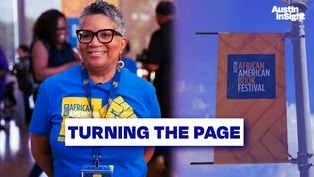
Full Interview: Austin African American Book Festival celebrates 20 years
Video has Closed Captions
Clip: S2026 Ep230 | 7m 27s | Austin African American Book Festival Founder Dr. Rosalind Oliphant talks about the 2026 festival. (7m 27s)
Providing Support for PBS.org
Learn Moreabout PBS online sponsorship New Episode
- News and Public Affairs

Top journalists deliver compelling original analysis of the hour's headlines.

- News and Public Affairs

Today's top journalists discuss Washington's current political events and public affairs.

 New Episode

 New Episode


 New Episode


Support for PBS provided by:
Austin InSight is a local public television program presented by Austin PBS
Support comes from Sally & James Gavin, and also from Daniel L. Skret.