
Kaitlyn Wojtowicz; Caitlin Connors; Col. Patrick Callahan
8/20/2022 | 26m 35sVideo has Closed Captions
Kaitlyn Wojtowicz; Caitlin Connors; Col. Patrick Callahan
Steve Adubato welcomes Kaitlyn Wojtowicz, Vice President of Public Affairs, Planned Parenthood Action Fund of NJ, to examine Gov. Murphy's decision to expand access to abortions; Caitlin Conners, Southern Regional Director, Susan B. Anthony Pro-Life America, sits down to explain her pro-life stance; Colonel Patrick J. Callahan, Superintendent, NJ State Police, discusses gun legislation.
Problems playing video? | Closed Captioning Feedback
Problems playing video? | Closed Captioning Feedback
Think Tank with Steve Adubato is a local public television program presented by NJ PBS
Kaitlyn Wojtowicz; Caitlin Connors; Col. Patrick Callahan
8/20/2022 | 26m 35sVideo has Closed Captions
Steve Adubato welcomes Kaitlyn Wojtowicz, Vice President of Public Affairs, Planned Parenthood Action Fund of NJ, to examine Gov. Murphy's decision to expand access to abortions; Caitlin Conners, Southern Regional Director, Susan B. Anthony Pro-Life America, sits down to explain her pro-life stance; Colonel Patrick J. Callahan, Superintendent, NJ State Police, discusses gun legislation.
Problems playing video? | Closed Captioning Feedback
How to Watch Think Tank with Steve Adubato
Think Tank with Steve Adubato is available to stream on pbs.org and the free PBS App, available on iPhone, Apple TV, Android TV, Android smartphones, Amazon Fire TV, Amazon Fire Tablet, Roku, Samsung Smart TV, and Vizio.
Providing Support for PBS.org
Learn Moreabout PBS online sponsorship- [Narrator] Funding for this edition of Think Tank with Steve Adubato has been provided by Atlantic Health System.
Building healthier communities.
Rutgers University Newark.
Community FoodBank of New Jersey.
MD Advantage Insurance Company.
Summit Health a provider of primary, specialty, and urgent care.
The New Jersey Economic Development Authority.
Horizon Blue Cross Blue Shield of New Jersey.
Here when you need us most, now and always.
Robert Wood Johnson Foundation.
Working for a more a healthier, more equitable New Jersey.
And by Wells Fargo.
Promotional support provided by NJ.Com.
Keeping communities informed and connected.
And by Insider NJ.
[MOTIVATIONAL MUSIC] - Hi, I'm Steve Adubato.
Complex issue, Roe versus Wade.
Two different perspectives on it on this show.
First up, Kaitlyn Wojtowicz and she's Vice President of Public Affairs at Planned Parenthood Action Fund in New Jersey.
Good to see you, Kaitlyn.
- Good to see you, Steve.
Thanks so much for having me.
Is abortion legal in New Jersey in spite of the Supreme court decision on Roe versus Wade?
- Yes.
Abortion is legal and available in New Jersey thanks to a bill that was passed by the legislature and signed by Governor Murphy back in January of this year.
- Got it.
Kaitlyn, there are many who question, who argue that even those who call themselves pro-choice, who also argue for reasonable limitations.
Question, should a woman or anyone, a girl, age irrelevant here in this question.
Well, it's not irrelevant.
I wanna ask it this way.
Should an abortion be legal in every state of the union at any stage of a pregnancy including into the eighth into going to the ninth month?
- So I think what's really important when we talk about abortion being safe, legal, and accessible throughout the country and here in New Jersey is that every pregnancy is different and every person's circumstances are different.
And so what we try to highlight is that when a person is making the decision to have an abortion that it should be between them and their medical professional, determining what is best for themselves, their health, their families and their life.
And that what we really want is that government or politicians are not making the decision that really should be left up to the person who is pregnant and to their medical professional or their doctor to make... - With no limits?
Kaitlyn, with no limits meaning eighth, ninth month, just the decision of the woman who is pregnant and her physician, that's it?
Government has no role that late in the term of the pregnancy?
- What I would say is that there are regulations that govern abortion just like other procedures.
And when we talk about abortion later in pregnancy what often comes up or what is often said in the media by those who are anti-choice is simply not how abortion care or medical care actually works.
When someone is making the decision later in pregnancy to have an abortion, it is often a really hard decision.
It is a wanted pregnancy and their health, the health of the fetus, their life is at stake and they are making a really hard decision.
It is not someone who wakes up and just says that they are deciding to have an abortion that day.
So we wanna bring back the patient and the compassion into the conversation.
- But the circumstances do matter.
The medical issues understood.
If there is no medical issue, woman just decides that's what she wants to do.
And in New Jersey, I wanna understand something, the law in New Jersey as it relates to late term pregnancy it say is different in Ohio where there was a 10 year old girl who was raped by a 29 year old man and she had to go to Indiana for an abortion because she was pregnant for six weeks and three days, that is different than the New Jersey law as codified as it may be under Governor Murphy and the legislature.
What exactly is the law in New Jersey?
- So in New Jersey, someone has the right based on the freedom of Reproductive Choice Act to have an abortion and that is the law in New Jersey.
- At any stage?
- In consultation with their medical professional and medical ethics, and guidelines, someone is able to make that decision, but I will also just really wanna highlight is that when someone is choosing or has to make the difficult decision to have an abortion later in pregnancy it's because of a fetal abnormality because there is a medical or health issue.
It is not something where someone is suddenly making this decision lightly.
It is often because of a really gut wrenching decision that they have to make.
And I really just wanna highlight that that this is not something that is made lightly.
- I understand, but also, Kaitlyn, Governor Murphy is attempting to expand New Jersey's laws around the right to have an abortion.
And there are many including Democrats, leaders in the democratic party legislature are saying, no, what is he looking to do?
And what do you believe that opposition's about?
- That's a great question.
And I would love to talk about that because- - You got a minute, go ahead about a minute.
Go ahead.
- So what we would love to see happen in New Jersey it's not just that abortion is legal but it is accessible because for too many New Jerseyans and too many people across this country, while abortion might still be legal despite the US Supreme Court decision it is financially inaccessible.
So what we would like to see happen is mandating insurance coverage without cost sharing or copays, ensuring that everyone regardless of their insurance status, their immigration status, their family status is able to access the care that they need and deserve because abortion is healthcare and healthcare is a human right.
- I wanna be clear, for someone who does not have legal status as a citizen, the government should pay for that abortion?
- We believe that anyone who is here in the state of New Jersey should be able to access healthcare.
And so we believe that everyone should be able to make the decision for their healthcare that is right for them and their families and their lives.
- But the governor's initiative has not been voted on.
And there is opposition just to be clear, significant, within the democratic caucus in both houses.
- So there is a bill currently, the Reproductive Equity Act which is S2918, A4350, which would like I just said, mandate insurance coverage without cost sharing or copays, ensure that there's coverage for folks who are lacking a pathway to insurance or there is uncompensated care funds for them as well as several other protections.
And we at Planned Parented Action in New Jersey fully support this bill.
- Kaitlyn, I wanna thank you for joining us.
We appreciate it.
- Thank you so much, Steve - Stay with us, we'll be right back.
To watch more Think Tank with Steve Adubato, find us online and follow us on social media.
- We're now joined by Caitlin Connors Southern regional director for the Susan B. Anthony pro-life Americ organization.
Good to see you, Caitlin.
- Hey, thank you so much, Dave.
I appreciate the opportunity.
- Thank you.
Let me ask you, you've been quoted as saying that the Supreme court decision on Roe versus Wade is not the end, but quote, just the beginning.
What do you mean by that?
- Yeah, absolutely.
Well, it's hard to overstate what the Dobbs decision has done for the pro-life movement.
So for the past 50 years the pro-life movement has been working to enact pro-life legislation that will save lives.
And because of Roe versus Wade decided by judges on elected judges in 1973, none of those laws were hardly ever able to go into effect and to save those lives.
So essentially the will of the people was not upheld.
And so now with the Dobbs decision states are now able through the democratic process the people who elect their representation to go to their state houses and pass pro-life legislation that will save lives and promote wellbeing of mothers as well into law in their states.
And so you're right, the movement now just really gets its beginning, for the last 50 years, the effort has been to try to save as many lives as we can along the way.
And now that we're able in many states to do that now the goal of the movement, well, has always been the goal of the movement, but also now in a more tangible way we're able to really get the work done of this movement which is to love both mom and baby, to support both mothers as they are facing unplanned pregnancies and giving them authentic choice for life.
So the heart of this movement has always been about empowering women.
And now we are finally able to get to that point where that work can truly begin.
- And so I wanna understand something- "protecting women".
Protecting.
How about protecting girls?
For those who question, which there is no longer any questioning, that there was a 10, there is a 10 year old girl in Ohio who was raped by a 29 year old man.
She was pregnant for six weeks and three days.
And in the state of Ohio, she was three days over the limit of being able to have a legal abortion.
More than 50 states will likely even outlaw that.
This 10 year old girl who was raped by a 29 year old man had to go to Indiana to get a legal abortion.
What should have happened in a case like that?
- Well, first off it has to be said that rape, any sexual violence is abhorrent and should be prosecuted to the fullest extent of the law.
So that perpetrator should be behind bars for the rest of his life, as far as I'm concerned.
And I think as a society, we should really be focusing on that crime and how we need to be protecting women and girls in this horrific situation of this 10 year old girl from perpetrators like that.
Unfortunately, I- - Hang on one second, one second but once one second, once it happens - Right?
- What should have been afforded to her and her in terms of protecting her- a 10 year old girl raped by a 29 year old violent criminal.
If you had your way and you were in control of the laws around abortion would she have not have been able to go to any other state and get an abortion?
- Well, I'm not in charge of the laws- lawmakers are.
And so in some states there are exceptions for rape and incest.
In some states- - You believe there should be an exception for rape and incest.
- I, personally, believe that all life is sacred.
I believe that abortion is not an answer.
It does not solve problems.
It only continues problems.
It actually hurts women.
I believe that abortion only compounds the trauma that women face in these horrific situations.
So, no, I, I personally believe that all life is sacred.
I also believe though, we should be asking questions towards the other extreme, which is the Democrat party's platform of abortions throughout all nine months of pregnancy, taxpayer funded.
This is a horrific situation that we're talking about here.
I don't take it lightly.
I unfortunately know people who have been victims of sexual assault.
And so, I am so very, my heart goes out in the situation.
I don't believe abortion helps her situation.
It doesn't take that crime- - The ten year old girl, should she have been forced in your view?
Forget about making laws, but as a, as a leader in this field and as a woman do you believe that that 10 year old girl who was raped should have had to carry that fetus to term?
- So I believe, again, all life is sacred.
I don't believe that terminating the life of her child, even though the situations around it were horrific, the punishing that child for sins of another person or for the crimes of another person is not justice.
I'm not in any way undermining the horrific situation that it is.
- No, I know, you're not.
Clearly, you're not.
Clearly, you're not doing that.
And I appreciate that.
But one, one more quick question on government control.
Many of the folks in the pro-life movement- I'm not saying this is you- but many of them argued against government mandates around COVID, around vaccines: government mandate around masks: government mandate.
But in this case, it would be a government mandate that that young girl, that 10 year old girl or any woman regardless of rape, incest, whatever the situation is, that the government is saying not your body your choice.
Your body, our choice.
Is that a fair assessment?
- I, no, I don't think it's quite fair.
One.
We are one issue organization.
We focus on life and protecting life.
So, no, we don't have any sort of stance on COVID protocols, but to your point, when we're talking about abortion we are talking about two lives.
We are talking about two bodies.
The government's primary function is to protect life.
And so, therefore, we believe strongly that it is the government's role in order to help protect those lives.
And so at the state level now, through the Dobbs decision, states will finally be able to enact those laws and not have a choke hold over a decision made in 1973 based on very outdated science by unelected judges who were mandating law for all 50 states.
Now, the people's voice will be heard on their stance on abortion policy and can be enacted in those states.
I do want to thank you, Caitlin, for joining us.
We appreciate it and wish you all the best.
- Thank you so much.
To watch more Think Tank with Steve Adubato, find us online and follow us on social media.
- We are honored to be joined by Colonel Patrick J. Callahan who is the superintendent of the New Jersey State Police.
Superintendent, good to see you.
- Great to see you as well, Steve.
- Colonel, let me ask you this.
Guns.
Gun safety, gun violence.
The conceal weapon- the decision by the courts.
We're not looking for you to talk about politics.
We're looking for you to talk about law enforcement and safety.
What do you believe the impact of the decision of the Supreme Court to strike down the New York law regarding concealed- having a concealed weapon, making it more accessible to people, what do you think the impact would be, particularly in New Jersey?
- Well, I think we're gonna see- I think, for one, as the overseers of that process, we're gonna see a tremendous increase in the volume of those permit to carry applications.
I think it's- again, there's been estimates out there from- I've heard various numbers up to, including 200,000 in one year in the past, because of that "justifiable need" piece.
I think last year we might have received 550 applications, of which half were approved.
We're gonna see that skyrocket, and we just wanna be prepared with not only staffing- certainly from a technological standpoint we want to be prepared for that influx and then the impact for those that receive them.
We have just some concerns with now a lot more guns being accessible in various settings throughout the state, which gives us concern.
- Colonel, there's a fair number of people- And, please, let's put up the website for the state police so that people can find out more about what they do and why they matter on so many levels.
But let me ask you this, Colonel.
For people who say, "You know what, if more people had guns out there, there'd be more people to stop the bad guys."
Go ahead.
- Yeah, I've heard that argument before, Steve, and I think- - I'm sure you have.
There's no law enforcement officer in the state or country, who are highly trained, that wants to draw their weapon, point it at somebody, let alone use it.
So you take somebody, an average citizen, arguing over their parking spot, arguing over a seat in a movie theater.
And I said it recently, a few weeks ago.
My very first day as a Jersey trooper was a road rage incident where a legally licensed gun owner had it in the trunk, unloaded, traveled as he should be.
Got into an argument.
They both pulled over.
That driver went to his trunk, loaded a .45, and shot that other motorist, luckily who lived.
But that wasn't access- that weapon wasn't right in his console.
That was in his trunk.
Think of what happens now in altercations where people's behavior changes, from my opinion.
I didn't do a social, you know, a social study on this, but people act differently when they're armed.
And that's my greatest concern, that somebody- an incident that might end with a hand gesture or maybe even a minor physical altercation or a couple of coarse words, now ends with a trigger being pulled and somebody being dead over a senseless, senseless act.
- We're speaking with Colonel Pat Callahan.
You saw him virtually every day with Governor Murphy and the Commissioner of Health Judy Persichilli, and a whole range of other government officials.
Pat, let me ask you about that.
That experience of being there with the governor, the commissioner of health, and others every day, particularly early on in the pandemic, for a long time, what has been the biggest impact for you, personally and professionally, from that experience?
- You know, it is- I always reflect on it as exhausting and energizing at the same time.
It literally, up until, including today- there's not a day goes by that I'm not on the phone with the Commissioner of Health Judy Persichilli.
- Well, by the way, you did not- I heard you speak at an event recently.
You did not know her very well before the first press conference.
Is that fair?
- That is- that's fair.
Well, before- well, January 20, when we had that passenger coming into Newark Airport, in short order, the commissioner and I got to know each other.
That first press conference, I think, was in early February, maybe.
So we had had about six weeks together in our, you know, all of our mitigation efforts and what we were trying to wrap arms around.
But I certainly- I consider her one of my closest colleagues now, and I hope she's- - But at the time, one second, Pat.
I'm sorry for interrupting.
At the time, I think she wondered what you knew about healthcare and you wondered what she, what?
(laughs) - Yeah, that's what we- we laughed that when we hung up on that first call, she said, "What does he know about public health?"
And I said, "Well, what the heck does she know about emergency management?"
And soon we came to respect one another's roles tremendously, and that continues to today.
And it was, perhaps, the greatest convergence of all time of public health and public safety and the New Jersey State Police's role in emergency management.
We call it "all hazards", Steve.
And whether that's a natural disaster, a terrorist attack, a blizzard, or a pandemic, the state police serves as the- not as the lead, but as the support system that coordinates all that recovery and response.
- Let me follow up on a different question, very different question.
The relationship between law enforcement and the community, particularly communities of color, continues to be a critically important issue.
The George Floyd murder on camera only exacerbated that situation, and highlighted it in so many ways.
And the state police have had a history, well before you became the leader, of racial profiling.
Can you comfortably and confidently say that racial profiling does not take place in the state of New Jersey, as it relates to the state of police?
As it relates to the state- - Wholeheartedly.
- I wholeheartedly can assure, not only New Jerseyans, but those traveling through here, of that.
I was a young trooper on the road when we entered into that consent decree.
We have mechanisms in place from risk management from a motor vehicle stop data.
Who was stopped, their race, their gender, the reason, the outcome, were they asked out of the car, were they patted down?
The amount of oversight, not only from body-worn cameras and cameras on the dashboards- the amount of oversight and comparing troopers' stops with other troopers on their squad, and is one trooper above the upper control limit?
Why is this trooper stopping more Hispanic males?
And then the amount of protocols that go into that.
It is a robust system.
It was one, certainly, that came about from that tragedy on the turnpike.
I had the honor to sit down with those four young- they were four young black males- - I remember.
- and it was a matter of reckoning and reconciliation.
And I will be with them in Orlando for the national NOBLE conference next week, Steve, to sit with those four gentlemen again and explain our story to the nation.
Morale among your ranks - not particularly high these days.
What's the message you would send out there to those who say, "I would've loved to have been a cop.
I would've loved to have been a trooper or go through the process of seeing if I qualify, but it doesn't feel like the right profession for me right now."
You say what to them?
- Yeah.
Well, I do disagree that the morale is low, at least in the state police.
I can't speak- - You disagree that, morale in state police, not low?
- I don't think so.
Not from- I'm out- - Do you think it's different in local- I'm sorry, Pat.
Do you believe it's different at local law enforcement level?
- I don't- you know what, it's hard for me to say and speak for other chiefs or other law enforcement agencies, Steve.
- But not where you are.
- I look at tomorrow.
163 brand-new troopers are gonna be sworn in tomorrow.
Men and women that, regardless of the scrutiny and the national narrative about law enforcement and community and accountability and transparency- I'm comforted by the fact that we still have young women and men that are willing to raise their right hand and go out there in what I think is the most noble profession on the face of the earth.
And I let them know that.
That when you raise that right hand and take on this responsibility, that that integrity and that 101 years, at least in the state police, of service, people are watching, and they should be watching, 'cause we're held to a higher standard.
And those that make that choice to have low morale or put their feet on the floor and say, "This is gonna be a lousy day," they're probably gonna be right.
But the same holds true for those young men and women that say, "I'm gonna go out today.
I'm gonna serve with compassion and according to the Constitution."
And that's what I get to see.
And I know the negative stuff makes the news, but I get to see positive interactions every single day from my position, and it's pretty special.
- For those of us who believe in the rule of law and appreciate the role that law enforcement plays, I wanna thank you and your colleagues for your service every day.
Colonel, thank you so much.
- Thank you so much, Steve.
Take care.
- Yeah.
I'm Steve Adubato, way more importantly, that is Colonel Pat Callahan, superintendent of the state police.
We'll see you next time.
- [Narrator] Think Tank with Steve Adubato has been a production of the Caucus Educational Corporation.
Funding has been provided by Atlantic Health System.
Rutgers University Newark.
Community FoodBank of New Jersey.
MD Advantage Insurance Company.
Summit Health The New Jersey Economic Development Authority.
Horizon Blue Cross Blue Shield of New Jersey.
Robert Wood Johnson Foundation.
And by Wells Fargo.
Promotional support provided by NJ.Com.
And by Insider NJ.
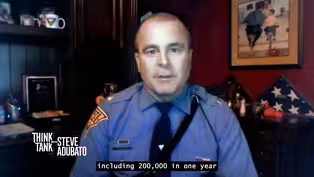
Colonel Callahan Discusses Gun Control Laws
Video has Closed Captions
Clip: 8/20/2022 | 11m | Colonel Callahan Discusses Gun Control Laws (11m)
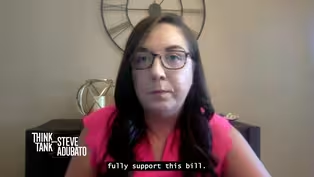
Keeping NJ a Safe Haven for Reproductive Health
Video has Closed Captions
Clip: 8/20/2022 | 8m 5s | Keeping NJ a Safe Haven for Reproductive Health (8m 5s)
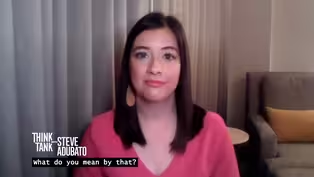
The Pro-Life Stance of Roe v. Wade
Video has Closed Captions
Clip: 8/20/2022 | 8m 17s | The Pro-Life Stance of Roe v. Wade (8m 17s)
Providing Support for PBS.org
Learn Moreabout PBS online sponsorship
- News and Public Affairs

Top journalists deliver compelling original analysis of the hour's headlines.

- News and Public Affairs

FRONTLINE is investigative journalism that questions, explains and changes our world.












Support for PBS provided by:
Think Tank with Steve Adubato is a local public television program presented by NJ PBS