
Kamal Bell
11/13/2023 | 27m 23sVideo has Closed Captions
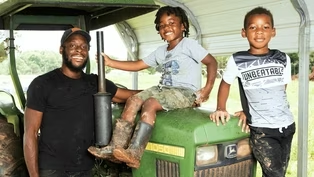
Meet Kamal Bell, founder of Sankofa Farms.
Follow Kamal Bell, founder and CEO of Sankofa Farms. At Sankofa, Bell grows leafy greens and vegetables for communities in food deserts and provides opportunities for young men to engage in agriculture-focused STEM. In a conversation with his parents and son, he shares his journey of becoming a farmer and creating positive change in his community.
Problems playing video? | Closed Captioning Feedback
Problems playing video? | Closed Captioning Feedback
Making North Carolina is a local public television program presented by PBS NC
PBS North Carolina and Making North Carolina appreciate the support of NC Idea & Venture Asheboro.
Kamal Bell
11/13/2023 | 27m 23sVideo has Closed Captions
Follow Kamal Bell, founder and CEO of Sankofa Farms. At Sankofa, Bell grows leafy greens and vegetables for communities in food deserts and provides opportunities for young men to engage in agriculture-focused STEM. In a conversation with his parents and son, he shares his journey of becoming a farmer and creating positive change in his community.
Problems playing video? | Closed Captioning Feedback
How to Watch Making North Carolina
Making North Carolina is available to stream on pbs.org and the free PBS App, available on iPhone, Apple TV, Android TV, Android smartphones, Amazon Fire TV, Amazon Fire Tablet, Roku, Samsung Smart TV, and Vizio.
Providing Support for PBS.org
Learn Moreabout PBS online sponsorship[piano intro] - [Announcer 1] This program was made possible by.
[lively upbeat music] ♪ [lively upbeat music continues] - [Announcer 2] Heart of NC is dedicated to lifting up cultural experiences in Randolph County, like hearing homegrown bluegrass music at the Sunset or Liberty Theaters, taking home pottery from internationally renowned artists in Seagrove, the pottery capital of the country, learning NASCAR's legacy at the Petty Museum, and feeding giraffes at the largest natural habitat zoo in the world.
Heart of NC wants you to know all Randolph County has to offer.
Experience Randolph, the heart of North Carolina.
[lively classical music] [lively classical music continues] - [Kamal] You know what that is?
- [Khalil] Chard.
- Okay, what's this?
It start with a K. - [Khalil] Kale.
- All right, and you know what these are.
- Peppers.
- Okay.
Which one of these do you like to plant the best?
- [Khalil] Chard and pepper.
- Why do you like the chard?
And why do you like the chard, and you like peppers or the kale, which one?
- Kale.
- Why do you like these two?
- Because chard is yellow and pink, and I think it's beautiful.
And I like the kale because it tastes very good.
- [Kamal] Okay, okay, okay.
I can dig that.
- [Khalil] Why'd you name the farm Sankofa?
- So Sankofa means to remember your African ancestry as you move forward in life.
So I named it because I wanted us, because we're African people here in America, I wanted us to have a connection back to our history and to know that the only way that we solve problems is if we use our African ancestry and center and make the things that are important to us a priority.
That's why I chose Sankofa.
So now when we look at our history and our family, your kid's gonna be like, "Papa Khalil, why did Papa Kamal name the farm Sankofa?"
And then you'll say, "It's because he wanted to create something for his people."
That's why we named it Sankofa.
- Hello and welcome to "Making North Carolina," a series exploring entrepreneurs as they pursue invention, creation, and impact in their communities.
This episode features Kamal Bell.
Kamal is a Raleigh-Durham-based food activist and farmer with a zeal for teaching young folks the values of local food production.
I am Paula Bell.
Yep, [laughs] that's my son.
Join me and Eugene, Kamal's father, to learn how Kamal got where he is now and where he hopes to go in the future.
I really thought Kamal was going to be a veterinarian when he went to college because as he grew up, we had Madagascar hissing cockroaches, five hamsters at one time.
He had five cages on his dresser with hamsters, one in each cage.
He had a couple of lizards, and we had to go buy crickets for the lizards, and then we had a couple of turtles.
And we had a gerbil, and he had attitude.
So I was thinking, "Okay, this guy's going to A&T," which is a agricultural school, that he would become a vet.
But his second semester, he said, "Ma, know what I want to do."
I said, "What?"
He said, "I want to be a farmer."
I said, "Okay, whatever you decide, we'll support you," but I didn't think that was gonna last very long.
But he surprised me.
He surprised us.
He became a farmer.
- Yeah, I thought from what, maybe like first grade, second grade, all the way until my freshman year in college that I was gonna be a veterinarian.
And I thought that was what I wanted to do until I started reading more and finding out more about how I can give back to the community.
That's when I'm just like, "You know what?
I think I can do that and touch more people being a farmer."
I think that's more viable than anything.
- [Khalil] What's your most favorite thing you like on this farm?
- I like when y'all come.
One day I want all the whole family to come out here, and we have a big party at the farm and have fun and enjoy ourselves.
That's what I want one day.
- I thought you were gonna say, "I want the whole family to come here and help us, and we can make them be farmers."
- You don't have a choice.
[relative chuckles] You're already doing that.
You're already a farmer, and Aday's gonna be a farmer.
- Oh yeah.
- And Mommy's gonna be more here on the farm more too, so.
- [Khalil] Wait, wait, but don't I have to carry him?
- [Kamal] No, when he gets older, he'll come to the farm.
- Where's he gonna be when we go to the farm together?
- He's gonna sit on there with mommy.
- But what happens if, well, if Mommy gets too tired of holding him?
- You are gonna hold him.
[wind blowing gently] - Kamal was so accustomed to making As and Bs, mostly As, at the R.N.
Harris Elementary School, which was basically like a magnet school.
The culture was always African-centric, but when we went to Immaculata, yes, that was a culture shock to him as well as to myself because people were, oh, you could see how they tolerated you.
And when Kamal did not make his As and his Bs that he was so accustomed to, that was a culture shock to him.
Our aspect of them going to that particular school was we're in this world.
We have to be part of the community.
So you learn how to accept people and learn their ways.
- Those experiences from like Immaculata, Cardinal Gibbons, what it really showed me is that why can't we create a space that centers Black people's needs, and then we take care of things that affect Black people and how we move forward?
So essentially like everything is built around the idea of a food system.
Like all civilizations, no matter how they start, are built off the idea of how can we feed ourselves.
So for me, that's the first step in us solving things that take place in our community.
- And so that was the best education we could give them to become cultural aware of individuals, which made it easier for them when they moved to the high school, which was Cardinal Gibbons, which was really different.
And there were things that went on there that they didn't tell me about until after they graduated.
And it's a good thing they waited to tell me.
- I remember one time I was playing basketball, and there was a coach there.
I don't wanna say his name, but we were at a practice, and I wasn't good at first.
Like, people would kind of like question my intelligence because I didn't think like everybody else.
I think differently than other people.
We were going over these plays at Garner Row, and the guy... Like, I messed up on a play, and in front of everybody, and this is probably why I don't take stuff personal.
He was like, "It was a mistake.
You shouldn't be here.
It was just a complete mistake."
It was basketball practice in front of the whole team.
And I'm just sitting there like looking at him.
Everybody's looking at me, see how I'm gonna react.
So I'm looking at him like, "Dang, you really just like sitting in front of everybody trying to embarrass me."
But it kind of taught me that for me to be different than everybody, it come at a cost 'cause the majority of people think the same.
Like, a large percentage of people think the same.
So whenever that happened, they... You gonna sit down right here?
When that happened, that was something that just kind of stuck with me.
And there were other things.
Like, there was a time where a kid was using the N word, and he was using it toward another Black student.
And I approached him about it, and I didn't like...
I asked him why he said it.
I asked him about what he said.
I didn't like the answer he gave, so I punched him in the face.
But it kind of taught me that anytime I face like racism, it's not always a physical altercation that needs to happen.
It's more of a mental game.
So I was just like, for me, it just taught me that if I want to get specific results out of life, I need to be the one to initiate that process.
- Well, when he came to me with the idea that he wanted to be a farmer, I thought it was great.
Everything we need comes from the Earth.
And it finally dawned on me that, you know, that's what life basically begins from.
It's farming.
And he said he was gonna buy some land.
I was like, "Well, how you gonna get this land?
And he told me, and I said, "Wow, this guy is serious."
And so we pretty much went from there.
- I don't think my parents had ever heard this story 'cause when I was going through the thing with the USDA, it was like reminiscent of what I went through in middle and high school, where there was an agent in Granville County that was over district that we go through.
And they have a farm service agency, and the whole idea behind the farm service agency is to get younger people into farming who had a agricultural background, who had experience in farming.
So by this time, I had already interned with a Black farmer, and I put all this together in an application.
I had found another agent to help me put my application together.
So after I get this application together, and I present it to him, he's like, "This is one of the best well-put-together applications that have ever come across my desk."
And then three days later, he denied me the loan.
So then I had to appeal it, which had to go, the civil rights attorney from the USDA had to get involved, and it had to go to Washington, D.C. And then we had the appeal meeting, and I called the office to let them know, could we move it an hour up.
And they never called me back to verify it, but something told me to get to the office on the time I suggested.
So when I got to the office, they were already sitting down waiting to have the meeting without pushing the meeting up.
So he was trying to get me to miss the meeting.
Yep, but so I got there early.
I still got there like at 8:50, and I tore him up in that meeting, I tore him up.
It was so bad that the civil rights attorney in the USDA was nodding his head agreeing with me.
But those experiences at Immaculata and like Cardinal Gibbons showed me that like, I can't fight fire with fire all the time, so I need to... And we had to think around, and we did.
That's how we got the property.
And it's interesting.
I think like the conversation, like how we're describing things, it sounds like the idea of what we had to do with integration.
It's like the things that we were talking about 60 years ago, 70 years ago, when we actually get into in depth about our experience, we're talking about the same exact thing.
- Mm-hm.
Things haven't changed that much.
- They haven't.
- Just a different face.
- Yep.
- Well, the important thing is, I guess, that we continue to try to go forward and what better way than to use your farming experience 'cause as I said earlier, for the most part, everything we need comes from the ground.
And whatever it is he's trying to achieve, I hope he'll get there.
I think it's...
I don't know if I have anything within my [laughs] intellect, right, that can describe how good I feel about it.
- It is undescribable.
I've been out there a couple times and helped out and played in the dirt, sun, and moved rocks, and I worked in the vegetation, but I just enjoy eating the vegetation, the tomatoes and the lettuce and all.
So it just makes you feel good to see the progress and hear about the progress.
And different people have had some of his honey, and it does have a nice taste.
You know, I think it's the best honey in the world.
- [Khalil] What do you think about bees?
- I like the bees a lot.
I think that they're really cool.
I think they're a good teaching tool to tell like little kids like you.
They change so often and move, and I think that's really, really cool.
I think that if I could start the farm all the way over, I would start with bees, for sure.
- [Khalil] Well, I like bees too because they fly around and make swarms.
- [Kamal] Oh.
Yeah, I like catching swarms too.
That is another part I like about the bees.
- [Khalil] What else do you like to do?
- [Kamal] Do interviews and talk to you.
I like to do that on the farm.
- Me too.
- And what else?
I like to drive a tractor too.
Driving the tractor's pretty cool.
I like driving a tractor for sure.
- [Khalil] I wanna ride on it one day.
- [Kamal] When you get older, I'll teach you how to drive it, but not right now.
- [Khalil] No, ride on it, like when you're driving, ride on the back.
- What happens if I make a quick turn, and you fall off?
So it's not safe right now for you to ride on, but hopefully one day, we'll get a real, real nice John Deere tractor, and we can both ride in there, and we can drive around or drive the farm one day.
- [Akeem] Can I join on, Daddy?
- Yeah, you can come too, Akeem.
- When I went out there initially, right, and saw the land, he said, "Dad, this is the land I bought."
And I said, "Wow, you got a lot of work here," you understand?
But he kept at it, and he's made progress.
- We're just getting started.
But in that, we're always gonna be able to feed people, teach kids entrepreneurship, teach 'em the trades and the skills we need to be self-sufficient within our communities.
We could literally benefit off of our system ourselves.
But if we have to depend on people outside of our community to solve issues, how can we keep our money?
How can we keep it in our community?
And we know the stronger a dollar circulates in a community, the stronger the community is economically.
So I think those are just my goals, like self-sufficiency where we can keep and be in charge of as many processes as we can so that we can build up, and we can empower ourselves.
And our empowerment doesn't mean that we're not working with any other group.
It's just that we can come to the table now.
My one goal is that African Americans can get in control of their destiny.
- For the most part, everything we need comes from the farm.
- That should probably be the title of this.
[all laugh] - Yeah.
And I grew up up north on concrete.
And one day I was out at his farm, and I thought to myself, "Nobody would ever imagine that I would be here, even myself."
I even had to ask myself, "What the hell am I doing out here?"
[laughs] - We gotta keep it here, gotta keep that- - I said, "What in the hell am I doing out here?"
you know?
But I found it quite enjoyable.
- So for me, college was like a reintroduction back into the Black community.
But as I started to talk about my ideas, like my freshman year, I pretty much kept to myself.
My sophomore year is when I started to learn more about Black history.
I then started to read more of like Marcus Garvey, Elijah Muhammad, Martin Delany, Ronald Neffer, just read all like variety of books.
And literally like at one point in college, my GPA got to like a 2.3 at that time 'cause I would go to the library.
Instead of me doing my work, I would go read in the Black study section, and then I would start having friends I'm telling about my ideas about the Black community.
Everybody says like, "What was your GPA?
And I'm like, "Oh, it's a 2.3," and nobody would listen to me.
They're like, "Oh, well, I ain't listening to you.
Like you can't even get out of college."
So I'm like, "Oh, okay."
If you give me like any like little inch of doubt, I'm going to run with it.
I'm gonna run.
And I'm like, "Well, if y'all are going talk about my GPA, I'm gonna get my GPA up.
But y'all need to learn how to defend your perspective, and I'm going to address it, like why don't y'all do more for the Black community?"
So I get my GPA up.
I start knocking out As and Bs.
I think from that point on, I might've gotten like two Bs and maybe one C from that point on.
And I ended up getting that thing to a 3.16.
I graduated with a 3.16.
I graduated with honors, matter of fact.
And then during that time, before I graduated, of course, I became the president of the Black History Club.
And that's really when I started to like come into my thing of like being able to articulate how I view things.
And people didn't always like how I did it.
It probably came across a little harsh, but that time really just made me buckle down.
And I would always have in the back of my head, "2.3 GPA.
All right, I got you."
And also during this time, like people are asking like, "What do you wanna do after you graduate?"
And everybody's thing is like getting the bag and getting a six-figure job.
So when I tell 'em I wanna be a farmer, the running joke became, "You're gonna be a poor-ass farmer."
That was the running joke.
Like, what you gonna do?
You gonna grow food?
That was the running joke.
Everybody had that joke.
And what really helped like, push the Black History Club like over to like the next, to like it being like, I guess it was like a household name on campus after a while, is we're just consistent with like pushing out information showing up in programs.
I remember one time we were walking through the student union, and somebody... We were walking by, and somebody was like, "That's the Black History Club."
Like they were whispering it.
I'm just like, people usually don't do that unless you're an athlete, or you're in a fraternity or sorority on campus.
So that, when I heard that, that's when I knew.
I'm like, "All right, like we're making strides."
So as I start to like come into like this new, I guess, version of myself, I always wanted to make sure that like we stayed true to Black people because what I started to see is that a lot of people didn't give a care about Black people at a Black institution.
And then we started seeing that there wasn't an understanding or collective consciousness about Black history.
Like we started asking people about Black leaders, and not saying these people aren't leaders, but like a Black leader's like a Fannie Lou Hamer or like a Mary McLeod Bethune.
Like, those are Black leaders that led people, Black people, to do constructive things.
People start saying Oprah and Michael Jordan.
Not saying there's anything wrong with those individuals, but when we're talking about like community development and being unapologetic about Blackness, these other people built systems to cater toward helping Black people.
So when I started to learn about that, I was just like, all right, the farming, the education, that's why we work with students.
All these things are going hand in hand.
- Why did you add programs with kids on the farm?
- So I added programs with kids on the farm because I wanted the things that I'm teaching people to last longer.
So when I teach it to kids, they grow up with the information, and they can use the information how they wanna use it.
So like, you're gonna learn all the stuff, and then when you get older, you're gonna teach your kids how to do it, and they're gonna teach their kids and teach their kids, and our whole family's gonna know how to farm.
So I learned about food deserts, and I'm just like, well, if every time we get hungry, or we want a quick snack, we get some Lay's potato chips, or we get something unhealthy.
What can we do in place of this?
I'm like, you know, we're gonna do dehydrated fruit, and that's gonna solve the problem.
So we started doing dehydrated fruit, and I would start vending at a lot of Black events in Greensboro, and people would like tell me that they love these chips.
So whenever I would go to these events, people were like, "Hey, do you have a farm?"
So I would tell 'em like, "Oh, we don't have a farm yet, but we're gonna acquire one."
So then I remember going back to the event like three years later after we acquired the farm.
It's literally the same exact, it was the same crowd every time.
And I announced that I had a farm, and everybody was just looking at me, and I was just like, I reiterated a like, "Yeah, we have a farm," and everybody just looked at me.
And that's when I knew that there's so much more going on in our community, and throwing fresh fruit at the problem isn't gonna fix it.
So we just set out to do educational things to build community with people, to understand people's thought processes.
So all these events culminated like during that college experience, my time in Greensboro, to help us with our programming at Sankofa.
Like, you realize that on one end that there are issues that exist in your community, and there's a system that creates those issues.
But the other part of it is a mindset that's in place too that has to be addressed, and that's the thing that... That's why I like working with the youth, I think will benefit us long term.
And that's why I like...
The reason I like the fact that my parents are on this, this is first time they've ever been on camera with me talking, is because now their kids get to see it.
Now their kids' kids get to see it.
I didn't get to see their grandparents, or I didn't get to see them on film with their parents talking about perspectives.
But now we're passing down this information, and it's gonna stick in our family, and the people are gonna see it.
Like our kids' kids' kids are gonna have access to who their great-great-great grandparents were.
And I think that's even more, like the idea's gonna be passed down now.
So like there's a shirt that somebody says it like, "What kind of ancestor will you be?"
They get to see it.
So it's not like they get to think about it anymore.
They get to see this in real time.
- Yeah, and I think we really can't express, you know, the emphasis that we need to put on this food production.
When I was growing up, I mean, there was fruit, vegetables everywhere, but now everything is so commercial and commercialized that we're actually, we don't know what we're eating.
- Yeah, not enough people producing it either.
- Right.
- The food system's so disjointed that you don't know.
Like, we're getting food literally shipped thousands of miles away.
So just like, I think the emphasis has to be on like, on more local food systems and us working in our community.
So I think the food system, we have to be committed to building a better one.
We have to, and it's gonna take all of us to do it.
- We're getting sicker and sicker.
Everything is on the rise, and yet people can't get into their mind that we're gonna have to eventually, if we wanna stay here, go back to the farm.
- Go back to the farm.
- That's gonna be a must.
- Go back to the farm is gonna be- - Because your survival is gonna actually depend on it.
And they're building more and bigger hospitals, and all they do is wait for us.
And I can tell you, you don't wanna be in there with that cold steel [laughs], so you can make a choice, cold steel later [chuckles] or good food now.
- That's true.
[Eugene laughs] And I don't know if like, if we learned anything from COVID, but we're not far away from distribution lines being completely destroyed.
And I think in, economists, like everybody in the food system knows it that's looking at it, and it's just about how do we create stronger local food systems.
We need more youth in farming.
- [Paula] Everything we need comes from the Earth, the water, the food, the shelter.
We are so proud of Kamal and the leadership he demonstrates within our family and the numerous other families he has empowered.
We know he will only continue to increase the scope of his influence and pass these tools down through generations.
This has been an episode of "Making North Carolina."
Join us next time as we continue to explore the brilliant minds that live all around us.
[lively classical music] [lively classical music continues] [lively classical music continues] [lively classical music continues] [lively upbeat music] ♪ [lively upbeat music continues] - [Announcer 2] Heart of NC is dedicated to lifting up cultural experiences in Randolph County, like hearing homegrown bluegrass music at the Sunset or Liberty Theaters, taking home pottery from internationally renowned artists in Seagrove, the pottery capital of the country, learning NASCAR's legacy at the Petty Museum, and feeding giraffes at the largest natural habitat zoo in the world.
Heart of NC wants you to know all Randolph County has to offer.
Experience Randolph, the heart of North Carolina.
Video has Closed Captions
Preview: 11/13/2023 | 30s | Meet Kamal Bell, founder of Sankofa Farms. (30s)
Providing Support for PBS.org
Learn Moreabout PBS online sponsorship













Support for PBS provided by:
Making North Carolina is a local public television program presented by PBS NC
PBS North Carolina and Making North Carolina appreciate the support of NC Idea & Venture Asheboro.