
Karen Millican; Sen. John Burzichelli; Keith Strudler, PhD
1/24/2026 | 27m 57sVideo has Closed Captions
Karen Millican; Sen. John Burzichelli; Keith Strudler, PhD
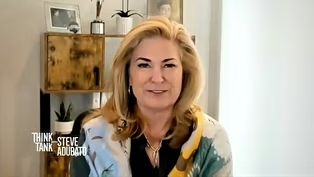
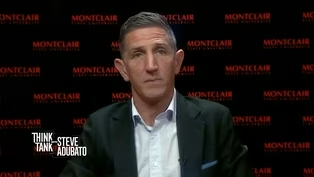
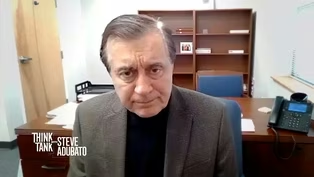
Karen Millican, Chief Commercial Officer of JoyDew, explores how to empower young adults on the autism spectrum. Sen. John Burzichelli of the 3rd Legislative District, discusses the importance of public media in New Jersey. Dr. Keith Strudler, Dean of the College of Communication and Media at Montclair State University, discusses how the changing media landscape impacts the next generation.
Problems playing video? | Closed Captioning Feedback
Problems playing video? | Closed Captioning Feedback
Think Tank with Steve Adubato is a local public television program presented by NJ PBS
Karen Millican; Sen. John Burzichelli; Keith Strudler, PhD
1/24/2026 | 27m 57sVideo has Closed Captions
Karen Millican, Chief Commercial Officer of JoyDew, explores how to empower young adults on the autism spectrum. Sen. John Burzichelli of the 3rd Legislative District, discusses the importance of public media in New Jersey. Dr. Keith Strudler, Dean of the College of Communication and Media at Montclair State University, discusses how the changing media landscape impacts the next generation.
Problems playing video? | Closed Captioning Feedback
How to Watch Think Tank with Steve Adubato
Think Tank with Steve Adubato is available to stream on pbs.org and the free PBS App, available on iPhone, Apple TV, Android TV, Android smartphones, Amazon Fire TV, Amazon Fire Tablet, Roku, Samsung Smart TV, and Vizio.
Providing Support for PBS.org
Learn Moreabout PBS online sponsorship- [Narrator] Funding for this edition of Think Tank with Steve Adubato has been provided by Valley Bank.
The Russell Berrie Foundation.
Making a difference.
South Jersey Industries.
The parent company of South Jersey Gas, and Elizabethtown gas.
New Jersey Board of Public Utilities.
Providing New Jersey residents tools to save money on energy costs.
Congress Hall.
A Cape Resorts property.
Holy Name.
New Jersey Manufacturing Extension Program.
New Brunswick Development Corporation.
And by IBEW Local 102.
Lighting the path, leading the way.
Promotional support provided by NJBIA.
We put business at the center.
And by New Jersey Globe.
[MOTIVATIONAL MUSIC] - Hi everyone, Steve Adubato.
We kick off the program as part of our "Making A Difference" series.
Organizations, nonprofits who make a difference in the lives of people every day.
With Karen Millican, who is Chief Commercial Officer at an organization called the Joy Dew Foundation.
Karen, great to have you with us.
- Thank you.
- You got it.
Website is up, what is the organization and who do you help every day?
- So, JoyDew is an organization that's focused on people who are on the spectrum, young adults primarily.
And what we focus on is providing a whole life solution for them.
A lot of people that are on the spectrum are really struggling, especially after they leave high school, to really be able to have work that's meaningful, to be able to be in a community of people that really understand them.
And as their parents age, oftentimes they struggle to be on their own and need housing as well.
So, we try to help them with all the different areas that they may need in order to be successful in life.
- You're talking about the autism spectrum, just to be clear.
- Yes.
- So help us on this.
First talk about the challenges as it relates to employment.
What are those challenges?
- So, a lot of people that are on the spectrum may have challenges in communication.
Some cases, they're not speaking at all.
In fact, a large percentage are not speaking.
And then they have other issues that sometimes can make it difficult to work in a corporate environment or traditional business environment.
For example, they may have stemming behaviors that are distracting to other people or they may need special kinds of accommodations.
They often have sensory sensitivities that make them very sensitive to light or sound or other things that could be challenging for them.
And so, what we try to do is help to, first, get them trained into jobs that are really matching their gifts because they also have incredible gifts, many of them.
To try to figure out what they're best at and to train them up in those areas.
And then once they're ready, we get them employed.
Typically it's in high tech jobs in a lot of different areas and they work inside our location for other organizations in order to be able to do the work.
- We're talking about people dealing with autism 21 and over, correct?
- Correct.
- Let's talk about housing, because the information the producers shared with me about your organization is that you focus on housing design.
What is the connection, Karen, between housing design, the design of someone's place where they live, their home, their apartment, whatever we're talking about, and autism?
- So, for people that are on the spectrum and that need to be in a different type of housing situation when they leave home, oftentimes they struggle with a few different things.
First is many of them also have motor planning challenges because of their brain is literally wired differently than ours.
And that can affect other things.
In some ways it's great because they can be brilliant and be able to do a lot of things that other people can't do, but sometimes it'll affect their gait when they're walking and they'll tend to bump into things or they'll have fine motor pet challenges that are, make it hard for them to work with small switches, things like that.
So when you're designing a home, you wanna make sure that you make it, you know, clear walkways and rounded corners and all the things that make it easy for somebody who has motor planning challenges.
But you also wanna be able to let them customize it to themselves.
So, some people are really sensitive to light, for example, and certain types of light are real problems.
So you don't want, for example, fluorescent lighting.
- Right.
- And then, they need to be able to dim it and make it the comfortable brightness for themselves.
Certainly insulation's a big deal.
You wanna be able to not hear everybody else that's in the home all the time because that can be a real challenge.
But I think the main thing about housing that people really need to think about is they oftentimes are gonna need what I would just call support inside the home.
So, in addition to the physical space, you really need the right staff there who know how to work with people on the spectrum because they do have different needs, and each individual is different, that's why they call it a spectrum, but there are common things that they need assistance with and you really need to have great staff who really care about that and are able to work with them.
- Speaking about caring, why do you care so much?
Why is this work personal for you?
- For me, the founders of this organization, Moish and Anat are longtime friends of mine.
We actually started a software company together 25 plus years ago.
And I watched their boys growing up.
And I have to tell you, it was so powerful for years.
They're both non-speaking, both have motor- - Go back a little bit again.
- Yeah.
- Moish Tov is the father of two artistic sons, now 28 and 31.
- Mm-hmm.
- You experienced, you saw those young men?
- Yes, I saw them.
I saw one of them born and I watched them grow up.
And I have to tell you that, honestly, when they were young I didn't know anything about autism.
And I don't even know that they were diagnosed necessarily initially, but I saw that they were gonna have a lot of challenges because they were both non-speaking, one was deaf, they both had motor planning challenges.
They had a lot of the stemming behaviors and things that people see.
And so, I loved them so much.
I mean, we spent lots of time together, but I really didn't know what was inside them truly, 'cause they weren't able to fully communicate.
And it was when one of them turned about 14 I think it was, iPads had come out and people were discovering that a lot of people on the spectrum can use an iPad to type where they can't use a keyboard because of this issue with switching gaze, which is a common issue.
So, for the first time, especially when they have their elbows supported with what's called facilitated communication technique, they can type for the first time.
And it was amazing.
I mean this kid wrote a five page letter.
It was like a college person wrote it, yep.
You know, four syllable words, so eloquent.
And it was so exciting to get to know him as a person.
It was also heartbreaking to hear from him.
Like, what he had been through was just awful, honestly.
And so, it was at that time that Moish and Anat decided to dedicate their lives to working with these young, you know, young adults, 'cause there were so many others that were in the same situation who, you know, wanted to be able to do something with their lives and they needed a place that could understand them and allow them to do that.
So, for me personally, to watch them develop and then to be able to be a part of this organization has just been a gift, honestly.
- The organization is the JoyDew foundation.
The website has been up, check it out, find out more.
It's an important organization making a difference every day.
Karen, thank you so much for joining us and we thank our friends at Valley Bank for connecting us.
Appreciate it.
- Yeah, thank you.
Thanks, Steve.
- You got it.
I'm Steve Adubato, stay with us.
We'll be right back.
- To watch more Think Tank with Steve Adubato, find us online and follow us on social media.
- We are honored to be joined by the Honorable State Senator John Burzichelli, who is represents the third legislative district.
Senator, good to see you.
- It is good to be with you.
I appreciate this time.
- You got it.
Tell everyone where the third district is, Senator?
- It's in New Jersey.
- It's in the - I'm up in the north.
Where are you?
- We are tucked in the genteel south.
Just in the shadow of the city of Philadelphia, covering a good portion of Gloucester County, all of Salem County, and a number of towns in Cumberland County.
- I just had a conversation on a different program it'll air with your colleague Senator Zwicker, Andrew Zwicker.
You and Senator Zwicker and some of your colleagues on the Senate Oversight Committee held a very important hearing recently on the future of public media, public broadcasting, public media in the state.
Why the hearing and what did you take from it, senator?
- Well, Steve, as usual, you pack a lot into a couple sentences of a question.
You know, with traditional media, meaning print media, just almost non-existent, it's hard.
I always remind people, when I arrived at the state house in 2002, you were there before I was.
Press row had 27 reporters on it.
Now not only are there not 27 reporters, there is no press row.
So, you know, the ability to communicate out of the state house is really challenged and people are starting to find different ways to get information.
And we have to adapt.
You know, the traditional model, what was NJTV, NJ Network, I get confused, there were a couple different variations.
The experiment with WNET - I shouldn't say experiment.
The relationship didn't pan out the way everyone had hoped it was.
Donald Trump, you know, accelerated that with his slashing of PBS money from the federal side.
So from our standpoint, we have broadcast license and the legislature knows that communication is paramount.
People have to know what their government is doing, ideally.
So I know the outgoing Murphy administration has done an RFP to hire a consultant.
They won't hire that consultant, but the RFP, request for proposal, is in the works.
And that'll be from the administrative side.
From our side, it's very clear.
We need to get the state house fully wired.
Probably have to establish something that looks like a statewide C-SPAN as a backbone of information flowing out and then draw the nonprofits in to fill out the day as far as content goes.
- Sure, along those lines- - Including yourself, by the way.
- Well, thank you Senator, appreciate that.
But I want to make this clear to folks, and in some ways it's inside baseball and some ways it's who we are.
The Caucus Educational Corporation, our not-for-profit media production company, 15 years ago, in 2011, partnered with WNET.
They were the leaders.
It was WNET who took on a 15-year commitment to operate public broadcasting in the state.
First as NJTV, then as NJ PBS.
But as the senator so well stated, that's gonna end, because WNET is opting not to respond to the RFP.
Mostly for financial reasons.
- Correct.
- And by the way, we'll do an in-depth interview with WNET Group President and CEO Neal Shapiro, our longtime colleague, to talk about the future of public media.
But senator, here's the question.
What do you believe, and I asked your colleague Senator Zwicker this, the same question.
What do you believe the state's responsibilities, 'cause as a leader of this organization, I raise money 24/7.
You have to raise private money.
But do you believe there's a state responsibility here, senator, to support public media?
- Oh, I think that there is, and there's also sources of revenue generated from the previous assets of New Jersey Public Broadcasting.
And frankly, if you go back when the Christie administration made the move that they moved, we lost that vote in the Senate by one vote, if you recall.
- Yes.
- One senator went sideways.
That $332 million that was gained from selling the bandwidth or whatever the term is, was supposed to be put in an account, and that money was supposed to be reserved for the preservation of public broadcasting in New Jersey.
We're in such financial straits, that money never made it there.
So frankly, public broadcasting could have lived off the interest of the $332 million, to a great extent.
So the question is, do we replenish some of that, a $6 billion surplus, does something go back in?
'Cause there's got to be some funding.
And I use the term "backbone content" and I think that is a variation of the federal C-SPAN.
'Cause people enjoy looking at committee hearings.
We as legislators like them because your grandmothers can see them, mothers can see them, it's not there's any vanity involved.
But people are attracted to that stuff.
And every one of our hearing rooms was supposed to be wired under the N-E-T deal.
That didn't happen.
And, you know, I'm a big fan of Neal.
He was there when we needed him, 'cause no one else wanted to do it.
- That's right.
- And then you guys filled in, admirably so.
So yeah, it is imperative that we support public media.
- Let me ask you this, senator.
Explain to folks why, this is interesting, because trust or distrust, if you will, in the media, again, I'll try to separate public media, but the truth is, all of us engaged in media.
If we have a president who calls us the enemy of the people, let's just start, that that's a challenge.
That's not an opinion, that's a challenge.
- Correct.
- That being said, there's a level of cynicism about those of us in media and also about those of you who lead in government.
What do you think, without being too self-serving on my end, senator.
What can public media and should public media do to frankly shed more light on how the legislature actually works or doesn't work as it relates to important issues that matter in people's lives?
- Well, look, you know, it's about gaining public trust, and, you know, everything old is new again.
And at a given point, someone's gotta just start talking about news and events and not worrying about being in the show business lane that has evolved.
That, we've all seen.
And by the way, back to supporting public media, you know, Steve.
You know, we're underwriting Netflix.
So we support and underwrite a lot of things in the public interest.
So, but as far as regaining trust, just gotta start becoming more matter of fact in my mind.
You know, I don't wanna go back to Walter Cronkite, but you know, that stuff worked.
And then it became entertainment.
Go back and look at the Motion Picture Network.
It was all talked about in an Academy Award-winning picture.
News becoming entertainment.
And that's where this thing got off the rails, 24/7 you gotta gotta be talking to people.
You gotta be more sensational than you were in the previous story.
And the news got lost in the entertainment.
I mean, look, I was in committee hearing the other day, I went in to sub the committee hearing and as I told people, I went to a senate committee hearing and a school board meeting broke out.
I mean, because, you know, was that good television?
It would've been if there were cameras in the room.
- So interesting, because when I was talking to Senator Zwicker about this, we're talking about clicks, you know, on our phone.
And listen, everybody wants, we love when people follow our stuff, but let's just be honest with each other.
Some of the ways it takes for people to gain clicks, the so-called influencers, they're not having meaningful dialogue with members of the state legislature about issues that matter.
And final question along those lines, senator.
Number one issue, you believe the new governor, Mikie Sherrill and the state legislature, you and your colleagues in the senate and the lower house assembly need to deal with, what is that issue and why, senator?
- Well, first of all, I never call the assembly the lower house, having spent 20 years there myself.
- I spent two, I should not have called it the lower house.
- No.
- Go ahead.
- You know, and I remind people, was there 20 years and then was thrown out by 23,000 angry people who I never met.
So I always tell people, I served as a mayor, served in the assembly for 20 years, and no indictments.
You know, I should have got a sash or something leaving the building.
- That's right.
- Overall, the catch term you're hearing, which is the right term, is affordability.
I mean, it's almost like a word transparency.
It means something different to everyone you talk to about it.
But expenses, I mean, look, our pension payment's gonna be seven billion.
The anchor program costs us three billion.
State of New Jersey is coming.
These are all huge numbers.
And, you know, holding this thing together is a challenge.
People's expectations of the government continues to grow, and, you know, we continue to try and serve it.
- You're listening to State Senator John Burzichelli from the third district, and one of the many committees he serves on is the Senate Oversight Committee.
We'll keep talking about the future of public media in future programs.
Senator, thank you so much for joining us.
- Thank you, Steve.
- You got it.
Stay with us, we'll be right back.
- To watch more Think Tank with Steve Adubato, find us online and follow us on social media.
- Hey folks, we have our good friend Dr.
Keith Strudler, the Dean of the College of Communications and Media at Montclair State University back with us.
Dean, good to see you.
- It's great to be here.
- You got it, by the way, before you go any further, we'll put up the website for Montclair State University.
And also after that our website will come up, SteveAdubato.org.
Check out the in-depth interview that I did, a two-parter on "Think Tank" with Dr.
Jonathan Koppell, the President of Montclair State University, about a range of issues.
Hey, Keith, let me ask you this.
PS, to disclose, Keith and I talk about media offline all the time.
What is the role, as you see it, of Montclair State University in particular, and higher ed overall in the future of media/public media in the state of New Jersey and the nation?
- Look, I think, and we're obviously well aware of some of the challenges that are acute here in New Jersey with public media, which are maybe particularly acute here, but are not, you know, certainly isolated to us across the country with stations, networks, states are trying to figure out a sustainability plan.
Look, I think we're pretty clear at Montclair, and I think it's consistent with what we've considered from our inception, which is we believe that we are a leader in sustaining and growing and coming up with the future plan for how public media should operate in the future.
And we think that we will have a significant role in ensuring that public media's sustained in a couple of ways.
One is certainly in conceptualizing the operations of what comes next.
And that's something obviously we're all having a lot of conversations about how.
- As you do, Keith, lemme bring folks into this.
I'm sorry for interrupting.
To be clear, what the dean is talking about is WNET, our longtime partners in New York, the PBS flagship station for 15 years, since 2011, have operated the New Jersey Public Television Station.
It is in fact that location, if you will, the license to it is owned by the state of New Jersey.
But the operator is an outside entity.
That is what the dean is talking about.
And that ends, WNET will no longer operate NJ PBS as of July 1st, 2026.
Keith, pick up your point, I'm sorry.
- Sure, and so we know that we're going to be an important part because of our facilities, because of the expertise we have here on campus, our faculty and in places like the Center for Cooperative Media that, you know, their lifeblood is figuring out a sustainable path forward for journalism in a world in which people no longer consume news in the same way.
So we want to be integral and central to that conversation about operating, you know, kind of what comes next.
But on top of that, and I think this is really important, is we also want to make sure that we are central to figuring out, one, how there's a collaborative process so that we are hearing voices across the state.
And I think one of the things that's gonna be essential to the future of public media, which is very much what the center does, is figuring out how we're connecting with communities and connecting with storytellers across the state.
And I think that's integral.
And second, if there's going to be a future of public media, which we all know is essential, there needs to be a plan by which we are training the next generation of storytellers, journalists, filmmakers, sports media experts, to be engaged in that process.
So there needs to be both kind of a top down and a bottom up process by which we are working with kind of the next talented group of storytellers, but also we're hearing the voices of people that come through places like Montclair State to understand what is it that they want and they need.
So if we tell them this is what we're giving you, and they're telling us we're on TikTok all the time, then there's a disconnect that's not gonna be sustainable.
And so I think it's important, essential, vital that we are listening to the next generation.
- So, Keith, let me ask you this, and again, you and I keep talking about this.
This is part of our larger Media Matters series, and Keith and I talk about an initiative that I created a while back.
We've been talking about doing a course at Montclair State on media leadership and innovation.
But is it all ultimately here, Keith?
I mean, we're doing this, this is gonna be on broadcast, it'll be on digital outlets, but do you believe ultimately that it all winds up here?
- You know, I wish I were smart enough to be able to give you, because then I'd be investing differently.
Right, right?
It's easy to say that, but I think, I don't know, you know.
To tie yourself.
- Is it a hybrid, Keith?
Will it always be a hybrid?
- Yeah, look, people are, people, until they don't, people are gonna have TVs in their houses.
What they use them for, you know, we'll have to figure out.
But there is still the communal process of consuming media on large devices in your living room.
I don't think that's going away, but I do think the way, A, we know that, you know, we all get the message on Sunday when it keeps telling us that we consume media another 42% higher than the week before.
And you're like, how did I spend six hours a day on this thing?
Right?
So we know that this is the primary way in which people are consuming information.
I think it's more important though, beyond thinking about the device itself, thinking about the way in which they want to get that information.
- Meaning?
- So it might mean.
- Meaning?
- They probably want smaller chunks of information.
They want them in ways that are more easily digested and understood.
They probably want them on multiple platforms, including platforms that we once thought, you know, were not utilitarian for news consumption.
So I think it's perhaps less about the actual device that they're using, although the phone obviously is, you know, is the thing.
Although look, I mean, how many times have you talked to someone and they're like, oh yeah, I'm coming to you from my watch?
Right?
That's why it's like, it's the phone right now.
It might be something else in the future.
- But here, Keith, lemme push back a little bit on this.
So I think we've known each other long enough and you've seen this and which was what we did with President Koppell, it was two, and it's one hour of programming, two half hours.
Again, you check it out on our "Think Tank" series.
But here's what I'm trying to get at.
I think about long form podcasts.
I think about long form interviews like that.
And I go, first of all, no disrespect Keith, I have no interest in doing a three minute back and forth with Keith Strudler, the Dean at the College of Communication and Media at Montclair State.
Let's do it fast, let's get it.
Like, I don't even know what that is.
So my question is, where's the place for long-form substantive dialogue?
How the hell, how do you, how the heck do you do that in three minutes?
- So I, look, again, that is the billion dollar question, but I think, I don't think it's a binomial, right?
And obviously often your three minute piece leads to your 30 minute consumption, right?
And you're right, people have, look, and I know Joe Rogan's kinda the poster child, but Joe Rogan figured out how to get people.
- It goes on for hours.
Keith, it goes on for hours.
- Hours.
And by the way, not for nothing.
I just watched, to talk a little bit about my consumption habits.
I watched three hours of Charlie Sheen talking about the different abuses he has put his body through, three hours.
That's a story that could have been told in 10 minutes, but it was, you know, like it was pretty good over three hours.
You are right that there is an appetite for longer form work, right?
I just don't know that it looks the way that we thought it did.
But I do know that to get that audience, you need to be able to chunk your information in a way that draws people in.
You know, and Steve, you know, we both have kids.
My kids are sports fans.
My kid, like it was a few years ago when he told me he never watched a full basketball game, but he watched it in this like 45 minute compressed version where they basically turned a two-and-a-half hour game into a 45 minute highlight reel.
Something we have to consider.
- It works when I'm looking at the NFL, what's it called?
Red Zone, I don't know, it's called something Zone.
You can see every game on Sunday in about 10 minutes.
It may not work for meaningful substantive public policy conversation, which ain't gonna get you a lot of clicks.
Nevermind.
See, Keith, you got me on my soapbox.
I said I wasn't gonna get there.
- Yeah.
- Before I let you go, your students, how many students in the College of Communication and Media at MSU?
- About 2000 students in the college.
You know, obviously really fast growing, amazing work, just I'll brag for them just a little bit.
Nominated again for two Student Emmy Awards, the College Television Awards in news.
In news, Steve, in news.
And recently won two Edward R. Murrow Awards in the student division.
And we are one of two universities.
Another's a one I happen to have a particular interest, one of two universities in the country that won two of those.
And so they're doing, look, our students do amazing work.
We are training the future, but as we say, we're listening to them about how we can help reach them differently.
- And then interesting as we wrap up, Keith Strudler, the dean, mentioned Edward R. Murrow, the great Murrow.
I always wonder how he would've done on TikTok.
That's another issue.
But that's that Dr.
Keith Strudler, who's the Dean of the College of Communication and Media at my alma mater, Montclair State University.
Good to see you, my friend, we'll talk soon.
- Absolutely, have a great one.
- You got it, I'm Steve Adubato, that's the dean.
We'll see you next time.
- [Narrator] Think Tank with Steve Adubato is a production of the Caucus Educational Corporation.
Funding has been provided by Valley Bank.
The Russell Berrie Foundation.
South Jersey Industries.
New Jersey Board of Public Utilities.
Congress Hall.
Holy Name.
New Jersey Manufacturing Extension Program.
New Brunswick Development Corporation.
And by IBEW Local 102.
Promotional support provided by NJBIA.
And by New Jersey Globe.
- (Narration) Healing is never just about medicine and technology.
It has to go further than that.
It has to combine science with humanity.
It has to be our best medicine, combined with large doses of empathy, kindness, dignity and respect.
It has to be delivered by people who love what they do and who they do it for.
Holy Name.
Great medicine, soul purpose.
Empowering those on the autism spectrum via social support
Video has Closed Captions
Clip: 1/24/2026 | 8m 29s | Empowering those on the autism spectrum via social support (8m 29s)
How the changing media landscape impacts the next generation
Video has Closed Captions
Clip: 1/24/2026 | 10m 39s | How the changing media landscape impacts the next generation (10m 39s)
Sen. John Burzichelli discusses public media in New Jersey
Video has Closed Captions
Clip: 1/24/2026 | 9m 43s | Sen. John Burzichelli discusses public media in New Jersey (9m 43s)
Providing Support for PBS.org
Learn Moreabout PBS online sponsorship
- News and Public Affairs

Top journalists deliver compelling original analysis of the hour's headlines.

- News and Public Affairs

FRONTLINE is investigative journalism that questions, explains and changes our world.












Support for PBS provided by:
Think Tank with Steve Adubato is a local public television program presented by NJ PBS