State of Affairs with Steve Adubato
Keith Strudler; Sadaf Jaffer
Season 8 Episode 6 | 27m 43sVideo has Closed Captions
Keith Strudler; Sadaf Jaffer
Montclair State University’s Director of the School of Communication and Media, Keith Strudler, Ph.D., examines the future of modern journalism and discerning misinformation on social media. Then, Sadaf Jaffer, Ph.D., Former Assemblywoman (LD-16), discusses her decision to leave the NJ Legislature and the rise in Islamophobia and anti-Muslim hate since the start of the Israel–Hamas war.
Problems playing video? | Closed Captioning Feedback
Problems playing video? | Closed Captioning Feedback
State of Affairs with Steve Adubato is a local public television program presented by NJ PBS
State of Affairs with Steve Adubato
Keith Strudler; Sadaf Jaffer
Season 8 Episode 6 | 27m 43sVideo has Closed Captions
Montclair State University’s Director of the School of Communication and Media, Keith Strudler, Ph.D., examines the future of modern journalism and discerning misinformation on social media. Then, Sadaf Jaffer, Ph.D., Former Assemblywoman (LD-16), discusses her decision to leave the NJ Legislature and the rise in Islamophobia and anti-Muslim hate since the start of the Israel–Hamas war.
Problems playing video? | Closed Captioning Feedback
How to Watch State of Affairs with Steve Adubato
State of Affairs with Steve Adubato is available to stream on pbs.org and the free PBS App, available on iPhone, Apple TV, Android TV, Android smartphones, Amazon Fire TV, Amazon Fire Tablet, Roku, Samsung Smart TV, and Vizio.
Providing Support for PBS.org
Learn Moreabout PBS online sponsorship- [Narrator] Funding for this edition of State of Affairs with Steve Adubato has been provided by The Fidelco Group.
New Jersey’s Clean Energy program.
Lighting the way to a clean energy future.
PNC Foundation.
PSEG Foundation.
Robert Wood Johnson Foundation.
Working for a more a healthier, more equitable New Jersey.
And by Delta Dental of New Jersey.
Everyone deserves a healthy smile.
Promotional support provided by New Jersey Monthly.
The magazine of the Garden State, available at newsstands.
And by Insider NJ.
[INSPRATIONAL MUSIC] - Hi everyone, Steve Adubato.
We kick off the program with a compelling, important conversation about media and democracy with Dr. Keith Strudler, who is Director of the School of Communication and Media at Montclair State University, my alma mater.
Good to see you, Doctor.
- It's a pleasure to be here.
- You got it.
Hey, Keith, do this.
I'm pretty sure we're like-minded about this, that the future of our representative democracy, and our graphic will come up, simply called "Media Leadership & Democracy," that our representative democracy in danger, by any reasonable standard, and that the role that we in the media play is critical to democracy's future.
Just elaborate from your perspective.
- Look, I end up talking to a lot of perspective students and their families about the value of a college education and the kind of things that they should be learning and studying, and I don't think it's an exaggeration to say that there's kind of two really critical areas that are gonna determine the fate of humanity, for lack of a better word, and one is obviously everything that's happening with AI and STEM and the development of those technologies, which is gonna change the workforce and so forth, but the other is really our ability to understand mis- and disinformation, to communicate effectively, to understand truth from fiction.
I think it's not in any way an exaggeration to say that both the trained people that work in this field that are ethical, that understand the foundations of media, communication, journalism and democracy, and also to educate a wider public that understands the difference between truth and fiction and how media works, is, you know, the fate of the planet is on the line.
I'll throw global warming in there as third, for those of you that wanna study that, as well.
- Oh yeah, that global warming thing.
- Yeah.
(both chuckling) - Hey Keith, how about this?
So I said to you right before we got on the air that two of our executive producers, I met at Montclair State, I was teaching a course in journalism and media 15 years ago.
Best of the best.
But the media and journalism initiative at the university is dramatically different today than what it was then.
The curriculum's different, the orientation is different, the world is different.
What is it today, the School of Communications and Media at Montclair State?
- So, boy, I mean, I could spend probably the rest of our time just kind of talking about what the school is and what it's evolved into- - How's it different than traditional media and journalism that I taught all those years ago?
- Well, first of all, I think anyone...
There are fewer walls between the silos of storytelling than ever before, so, you know, when you were teaching here there were pretty strict walls between different forms of journalism, certainly between film and television.
- That's right.
- The PR people were over there, right?
The reality is everyone is kind of engaged in some form of storytelling using various tools, working with different audiences.
So if you're gonna be working in this business now, you're gonna have different kinds of relationships with people that you used to think of almost as your enemies, right?
And you are going to have to be able to- - Those PR people?
- Yeah, absolutely.
I mean, the people that study PR, they are effective storytellers that are using the same platforms that journalists are using.
You know, not that long ago, there was a big war over who owned social and it was really between the PR folks and the advertising folks.
Like, "It's PR," "It's advertising," and that was when everyone proclaimed that advertising was dead and journalists were like, "We don't even wanna touch that."
The reality is there are countless platforms now that we all need to figure out how to use to reach audiences, to tell stories.
And so, regardless of which program you're in, you're gonna need to learn the foundations of storytelling and the foundations of using the correct technological tools to do so.
So everyone needs to use how to... You know, it used to be like, "I'm not a cameraperson," right?
"I don't touch the technology."
Or, "I'm not a writer.
I'm not gonna do that.
I'm just in the control room."
The reality is, if you're gonna work in this business you need to be able to understand how stories are told and developed and how to use the tools to engage your audience.
- Well said.
I'm gonna followup on that.
So we're a not-for-profit production company, but highly entrepreneurial.
Affiliated with public broadcasting, but the folks at PBS, they're their own entity and they have their own challenges, but we're partners and colleagues with them.
However, the one thing we have in common, Keith, is that both entities, those of us who lead organizations, not-for-profit media organizations, public broadcasting, we're constantly dealing with the economics of our industry.
There are layoffs everywhere, there are media platforms closing like that.
They opened up a year ago, big announcement, all these new hires, digital, gone.
Question, of all the skills and tools, I'm obsessed by the question of leadership, media leadership, what is the place and the role for media leadership, meaning, in this case, understanding the economics of producing, putting out there, promoting, and paying for important content?
I know that's a loaded question, but I deal with it and think about it every day, Keith.
- Well, I'll give you kind of the easy first answer for that, and that is that this year we launched a co-taught class with the business school on the economics of the media business, which focuses exactly on everything you just talked about, which is what's the economics of streaming media, how does social media get paid for.
One of the things that I think is different today than certainly, you know, in our days, to date ourselves a little bit, you know, we didn't worry too much about who paid our bills and we just needed- (Steve chuckling) - Right, it was like, "There's a salary and there's someone who's gonna pay."
You need to understand who's producing content- - That's right.
- How it gets paid for.
And that was really a foreign concept to all of us.
You know, there was a day not long ago- - With a separation, church and state?
- Yeah.
And newspapers, if you had to print, you were literally printing money.
If you were in the newspaper, there was no end to this, right?
And you can blame whoever you want.
You know, first it was Craigslist and then it was the internet, but you absolutely need to know exactly how media's getting paid for, how your business is going to operate, and so we are much more intentional now on ensuring that students have the opportunity to learn media management, and media management not in the kind of traditional sense but really understanding the economics and the business and the synergies between kind of the corporations that oversee media, who are not inherently the bad guys anymore but are the people that might be facilitating the ability to do journalism.
- So interesting.
Again, I am fascinated by this whole concept of media leadership.
You'll see the graphic coming up, "Media Leadership & Democracy," the conversation with Dr. Keith Strudler, who is Director of the School of Communications and Media at Montclair State University.
It'll be one of many interviews we do, many segments.
Keith, let me jump into this.
TikTok.
I know as we tape this towards the end of March 2024, things are moving all over the place here.
We don't know what's gonna happen.
Why is the future of, quote, "TikTok" relevant to the role of media in a representative democracy, where people need to know what the heck is real and what ain't?
- Yeah, so I mean, there's a lot in that question and some of it is just this notion of literacy and being able to understand misinformation and disinformation, which is a huge challenge with, look, we're dealing with a population now that is natively kind of working with phones and social media, so the students that we have now and the young people that you're gonna be hiring soon, these are people that never grew up without social media and never grew up without a production tool in their pocket, right?
We come into it with a sense of cynicism, right?
With like, "Well, that's social and that's TikTok but I'm gonna watch Steve's show, I'm gonna watch nightly news, I'm gonna get my real information- - I'm gonna watch PBS.
- I'm gonna watch PBS, "NewsHour," right?
I'm gonna- - We've very high-minded, Doctor.
(chuckles) - Absolutely.
Absolutely.
We love PBS.
But the reality is these students have grown up thinking that they're getting their news and information from places like TikTok and Instagram and so forth and so there is this whole, you know, there's a whole process that we need to go through, which really needs to, I mean, to put it on universities is a lot, Really needs to be part of secondary education, which is helping students to understand what is real and what isn't and how social media operates, how algorithms operate, why you're getting fed what you're getting fed, understanding why your feed looks very different than other feeds.
Look, I had a conversation yesterday, it was an agency executive who is, you know, they're obviously very aware of what could happen with TikTok 'cause their clients love TikTok as a way to use influencer marketing.
It's a very effective sales tool for young people.
But the reality is each one of these social platforms, whether it's TikTok or Instagram, and then some of their affiliated, anything in the Meta platform, and obviously Twitter, which has its own issues, they all operate using different algorithms and with different kind of motivations, so it's not even as easy as understanding, and I'll get to the initial question, kind of how social works and mis- and disinformation works.
The reality is, the question of TikTok really deals with understanding how TikTok operates and its motivations and how influencers get to young people and how young people continue to get fed information.
- But let me, this is so interesting on so many levels.
I know I'm blowing past the breaks because this is important but let me try this, so very often when we go out to funders or perspective underwriters they'll ask, "How many?
What are the ratings?"
The ratings are what they are.
But again, more and more, a part of media leadership in my mind is taking your content and obviously everyone has to do this, having it on so many different platforms, and so we look at those metrics, if you will, right, Doc?
But here's, let me throw this at you and connect it back to democracy, the future of our country, a free people, a representative democracy, a republic.
As some people will say, "Adubato, it's not a democracy, it's a republic."
I'm like, "All right, we're gonna that conversation.
I'm not doing that now."
Here's the question, numbers, if I, this conversation about media leadership, we'll put it all over the place, I don't know how many people are gonna be willing to watch any of it or all of it, if I were to interview a white supremacist who said the most vile, outrageous, hateful, racist things, I guarantee you the numbers would be off the chart.
Here's the question, how would I be doing anything meaningful as it relates to promoting and protecting our representative democracy?
- Well, you wouldn't, but that's not how the platforms are set up.
They are not built on, you know, look, with all due respect to Facebook and Meta and all these other companies, they don't have as their singular goal to save democracy, their goal is to generate revenue and to feed information- - Is it any goal?
It's not their singular goal, is it any part of the equation at all?
- You know, they would suggest that opening up a platform for a wide range of voices and that they have people that monitor content, but the reality is a lot of the things that you talk about, things like hate speech, the platforms are in many ways specifically set up to encourage that kind of dialogue.
The algorithms continue to feed you that information and we become thirstier and thirstier and thirstier for it, so the more you look at it, the more you're gonna get.
So the reality is there's, and I don't wanna set up a kind of a dire kind of perspective of how the world's gonna end, but the reality is there is, as much as I believe in free information, free press, and the idea of restricting or limiting TikTok is a little disarming because we start to say, "What does that mean?"
but we have to get a better handle on how information is getting disseminated and how we prepare people to get it.
- We have literally just scratched the surface.
We're talking with Dr. Keith Strudler, who is director of the School of Communications and Media at Montclair State University, our series, "Media Leadership & Democracy."
Dr. Strudler, I promise we will have you back with other colleagues in academia and in the media to talk about this because regardless of how many likes we get, we know it's important.
Thank you, Keith.
We appreciate it.
- I appreciate it as well.
- You got it.
Stay with us, we'll be right back.
(grand music) - [Announcer] To watch more State of Affairs with Steve Adubato, find us online and follow us on social media.
- We're now joined by Dr. Sadar Jaffer, who is a former member of the state assembly and opted to leave by choice, unlike some of us back in the mid-eighties who were voted out of office.
I have no idea who that might be.
You didn't even know that, that I got voted out of the legislature, right?
- I did not.
- (laughs) That's how I got this job.
Way more importantly, you left the legislature and there's so many issues I wanna talk to you about.
You left the legislature for several reasons, some of them personal, I'm sure.
How much of it, of you leaving by choice, was a product of the nasty, ugly, hateful political environment we're living in these days?
Please, doctor?
- Yeah, I'd probably say like 30 to 50%.
I think, you know, when you make a decision that big, there are any number of reasons that motivate it.
Certainly the type of hate and attention and attacks I get as a Muslim elected official, as a Muslim in the public eye, are very disturbing to deal with, and especially with a young child, putting her through that.
Not only directly being afraid for her safety, but also what impact does it have on her to know that her mother is going through that.
And I think when she was younger, it felt like it was over her head, you know?
But as she gets into being a little bit more understanding what's going on in the world around her, I didn't want her to feel that fear, or to feel, to kind of bear the brunt of the type of hate that I get.
- You know, first of all, thank you for your candor about it when I'm sure it must have been a difficult decision.
You're the first Muslim woman to hold a mayoral position in the country.
Is that accurate?
- Yes.
- And one of the first two Muslims to serve in the state legislature in New Jersey.
Curious about this.
October 7th, 2023, the Hamas attack, the massacre, if you will, in Israel.
To what degree did that incident, that incident, that horrific massacre and the subsequent war between Hamas and Israel, that has gone on and continues to go on, to what degree does that affect you as a public person, a former public person, but more importantly as a person of color, as a Muslim?
- Yeah, absolutely.
As someone who has always stood for peace and against all forms of hate and all forms of violence, it's traumatic and horrifying to hear about and to learn about, and to know, that any innocent people are killed.
And, you know, my heart breaks for all the people who were killed on October 7th, their families, their loved ones, and also for all of the people who have been killed in the Israeli military's decimation of Gaza.
As a mother, again, my heart breaks, especially for 13,000 children, probably more.
The count is hard to keep up.
So many stuck under the rubble.
And seeing videos of children literally taking their last breaths is shattering.
And certainly knowing that our government is providing those weapons and is providing diplomatic cover and vetoes every call for ceasefire at the UN, it's very, very hard to accept the role that our government is playing in this ongoing violence of the ongoing massacres.
- The other piece of the equation are the hostages that were taken on October 7th.
Does that reality of those hostages being held and those families in Israel suffering, does that in any way impact your thinking on the actions of Israel?
And by the way, for some folks who are wondering, "Hey, Steve, aren't you a New Jersey based operation?"
Well, New Jersey is one of the largest Palestinian, one of the largest Jewish populations in the nation.
Those hostages, your thoughts as to how it impacts how you see this ongoing war and the devastation going on in Gaza and the death and destruction, over 30,000, like you said, I don't even know how you can get an accurate count of human beings who've lost their lives.
Go ahead, please.
- Yes, absolutely.
I think all hostages should be freed.
All Palestinians who are kept in administrative detention without any trial, should be released.
Many children are in Israelis administrative detention as well.
And certainly any hostages that are kept, and all hostages that are kept must be released.
It's not acceptable to take hostages.
I think it's interesting because in Israel, many of the hostage families are also calling for a ceasefire because the Israeli military has also killed many hostages because you're bombing the place where the hostages are being kept.
And actually there were three hostages, Israeli hostages, who were waving white flags, who were killed by Israeli military.
So I don't think that what Israel is doing is helping anyone or protecting anyone.
That the government has said the hostages are not their priority.
So, you know, I stand in solidarity with everyone who wants peace, including many, many Israeli human rights organizations like B'Tselem, Parents Circle, Combatants for Peace, who are all calling for an end to this onslaught, which isn't helping save those hundred or so hostages that are still missing.
Or, you know, the hundred plus people, a hundred plus Palestinians, who are being killed every single day.
- Dr. Jaffer, let me ask you this, to Muslims, to Palestinians, who do not roundly criticize and call October 7th what it was, an absolute massacre, including women and children.
For those who either can't and or won't call it what it was, what did you say to them?
- I don't think there are many people like that.
I think- - You don't?
I think that the frustration for certain people comes from the fact that Palestinians and Muslims are always called upon to condemn anything that is done by anyone who shares our identities.
Whereas, if you had an Israeli guest on this show, or if you had a Jewish guest on this show, would you demand that they condemn the Israeli military's actions in Gaza?
- W, I'm sorry.
Would I demand?
Would I?
Sorry if I interrupt.
Would I demand?
No, would I ask?
Yes.
- Well, that's not common.
I think it's often very, very common to ask Muslims, Palestinians to condemn things, whereas when the violence is enacted on people who share our identities, whether, when on it's on Muslims or it's on Palestinians, I can't speak for Palestinians since I'm not one, but that seems to be ignored and considered perfectly acceptable by far too many people in our country, in our media, and our society.
- To what degree do you believe that Islamophobia is, and again, the statistics are what they are, but we're talking about people's lives.
How much worse is it since the incidents of violence, prejudice, et cetera, toward Muslims?
How much worse is it since October 7th?
- It's pretty bad.
You know, we- - How do you see it?
How and where do you see it?
- Well, there was a 6-year-old child, Wadea Al-Fayoume, who was stabbed to death by his landlord, someone who knew him, who was so radicalized by the news that he killed a child.
- Stabbed 26 times in October of 2023.
Muslim, I'm sorry for interrupting, Muslim college student was hit, struck in a hit and run in UC Berkeley in November of '23.
Three college students of Palestinian descent were shot in Vermont during Thanksgiving.
One is a paraplegic now from the waist down.
23-year-old Palestinian American was stabbed near UT Austin in February.
And those are just some.
- Right.
Yeah, so those are the very violent, devastating incidents.
And then beyond that, so many experiences that people have had just out and about being yelled at or having hostile comments said to them on campus or wherever it may be.
So I think that community is definitely feeling afraid.
- And real quick on this, because, if we could, New Jersey lawyer, Adeei Mangi, nominated by President Biden to be on the United States Circuit Court of Appeals Third Circuit being blocked by many Republicans in Congress.
I'm not sure why, not on the credentials.
Do you believe that's based on his background?
- Yes.
We've seen this whenever and oftentimes when a Muslim goes up for any sort of a confirmation that these questions about dual loyalties, or just, you know, assumptions that people make about anyone from a Muslim background come up.
And it's unfortunate that some of our country's elected officials think it's okay to display their prejudice in this way.
- Before I let you go, I need to, I'm struggling with this.
You ever see people say they, they're picking sides as if, on college campuses you see this as well, picking sides.
What is so difficult and challenging about acknowledging what happened in, what happened on October 7th was horrific and Hamas is a terrorist organization and what they did was unimaginable.
And what is going on in Gaza right now and so many people being killed every day, being denied food and water and medical care, that it's horrific and inhumane.
Why is it one or the other, pick sides?
- I don't personally think that it has to be.
I think that- - For many it is though.
For many it is.
- I don't think so.
(laughs) Maybe it's because I, you know, I'm connected to human rights activists, and I think most people of conscience think it's wrong to kill innocent people.
And whether that's done by an organization like Hamas or whether that's done by a military or a government, it's wrong.
I think there is a particular responsibility that states have because they have so much more power, they have so many weapons that can actually not just kill people, but blow up an entire university, blow up every single university in Gaza, blow up every hospital in Gaza.
We do hold governments to a higher standard than an organization or a terrorist group because they have more responsibility.
And certainly as a government that we provide the weapons to, we should demand that they abide by human rights law and not kill so many innocent people.
- Sadar, could you come back and continue this conversation with us?
And I would like to try, it's, I wanna have some other folks in the conversation on our series, "Think Tank," with different perspectives.
- Sure.
- With not having people believe that they've gotta, quote, pick sides as opposed to what is... - Right.
Nevermind, I'll get off my, it's not my place to say.
I can't thank you enough for joining us.
Wish you and your family all the best, and thank you for your service in the state legislature when you were there, thank you.
- Absolutely.
Thank you so much for having me.
- I'm Steve Adubato.
Thank you so much for watching.
We'll see you next time.
- [Narrator] State of Affairs with Steve Adubato is a production of the Caucus Educational Corporation.
Celebrating 30 years in public broadcasting.
Funding has been provided by The Fidelco Group.
New Jersey’s Clean Energy program.
PNC Foundation.
PSEG Foundation.
Robert Wood Johnson Foundation.
And by Delta Dental of New Jersey.
Promotional support provided by New Jersey Monthly.
And by Insider NJ.
Hey, kids, PBS Kids and Delta Dental want you to have a healthy smile.
So here are some tips for you to remember.
Number one, eat plenty of crunchy fruits and vegetables.
Number two, brush your teeth after eating sugary snacks or drinking sodas.
And number three, drink lots of water to wash away food particles.
When your teeth are happy, all of you is happy.
From PBS Kids and Delta Dental.
Have a healthy smile.
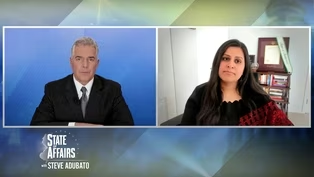
Former Asw. Jaffer and her decision to leave NJ Legislature
Video has Closed Captions
Clip: S8 Ep6 | 13m 38s | Former Asw. Jaffer and her decision to leave NJ Legislature (13m 38s)
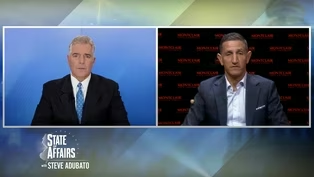
Modern Journalism and Discerning Misinformation Online
Video has Closed Captions
Clip: S8 Ep6 | 14m 3s | Modern Journalism and Discerning Misinformation Online (14m 3s)
Providing Support for PBS.org
Learn Moreabout PBS online sponsorship
- News and Public Affairs

Top journalists deliver compelling original analysis of the hour's headlines.

- News and Public Affairs

FRONTLINE is investigative journalism that questions, explains and changes our world.












Support for PBS provided by:
State of Affairs with Steve Adubato is a local public television program presented by NJ PBS