
KEL Equine Productions
4/1/2010 | 29m 58sVideo has Closed Captions
Mark McDonald heads to Riverton to speak with Mark Luthin of KEL Equine Productions.
Mark McDonald heads to Riverton to speak with Mark Luthin of KEL Equine Productions.
Problems playing video? | Closed Captioning Feedback
Problems playing video? | Closed Captioning Feedback
Illinois Stories is a local public television program presented by WSIU
Illinois Stories is sponsored by CPB, Illinois Arts Council Agency, and Viewers like You. Illinois Stories is a production of WSIU Public Broadcasting.
Support provided by:


KEL Equine Productions
4/1/2010 | 29m 58sVideo has Closed Captions
Mark McDonald heads to Riverton to speak with Mark Luthin of KEL Equine Productions.
Problems playing video? | Closed Captioning Feedback
How to Watch Illinois Stories
Illinois Stories is available to stream on pbs.org and the free PBS App, available on iPhone, Apple TV, Android TV, Android smartphones, Amazon Fire TV, Amazon Fire Tablet, Roku, Samsung Smart TV, and Vizio.
Illinois Stories
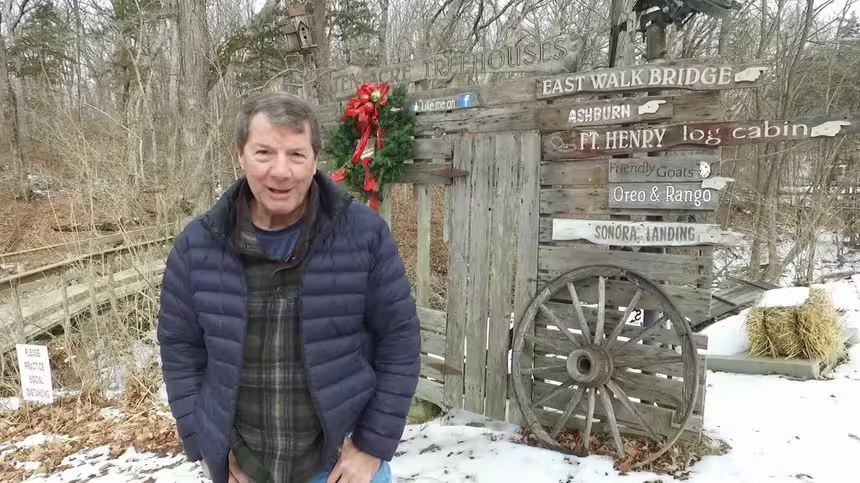
Join Mark McDonald as he explores the people, places, and events in Central Illinois. From the Decatur Celebration; from Lincoln’s footsteps in Springfield and New Salem to the historic barns of the Macomb area; from the river heritage of Quincy & Hannibal to the bounty of the richest farmland on earth.Providing Support for PBS.org
Learn Moreabout PBS online sponsorship(bright upbeat music) - [Narrator] Illinois Stories is brought to you by The Corporation For Public Broadcasting, Illinois Arts Council Agency, and by the support of viewers like you.
Thank you.
(soft upbeat music) - Hello, welcome to Illinois Stories.
I'm Mark McDonald in Riverton, where they're getting ready to head 'em up and move 'em out here.
KEL Equine Productions is getting ready to go down to I think it's Louisiana.
We're gonna talk to Karl Luthin here in just a few moments about their upcoming trip.
But what they do here, with this production company is provide, studios, everything they need to make period movies.
And we're gonna see some of those wagons and saddles and all the things that go into some of these Westerns and Civil War movies and all those kinds of things.
And you'll be amazed, at what this local company provides Hollywood.
Karl Luthin and it's odd that here you are a veterinarian, and you get into this remarkable sideline, and you've been doing it for 30 years.
- And they say, "But you live in Illinois."
(Mark laughs) Which immediately tells me that they don't live in Illinois and I go, "Yes, but this is a hub."
And it's 1,000 miles to the East Coast, it's 1,000 miles to Georgia, it's 1,000 miles to Texas, it's 1,000 miles to Montana, and we aren't gonna get any shows in California because there's plenty of people out there that can do 'em.
So this is a very central location here for us to move in any direction, even Canada.
- Yeah.
- So for shows, and stuff.
And what we're doing here now is that there is going to be a Warner Brothers production, based on the comic book "Jonah Hex".
- "Jonah Hex"?
- "Jonah Hex", it was a 1950s-60s comic book series, ran for about 7, 8 years I think.
Anyway this character floated between Civil War, and 1870s during this time period of this comic book, and this particular part of the script they have for this one I think starts out in 1872, and then there's flashbacks to the Civil War.
- That's how your gear- - Josh Brolin- - Comes into play?
- Is gonna be the star in it.
- Who is?
Who is?
- Brolin.
- Oh yeah, Brolin, yeah, sure.
- Anyway, so these are some of the vehicles that they have rented from us and we will send down to Baton Rouge, Louisiana, for the show, and the show starts in April and I think it ends sometime in June.
- [Mark] Okay.
Let's take a quick look at these.
'Cause these are fascinating.
- Basically, these are Civil War period vehicles.
This is what's called the limber, and the limber of course has a tong attached on it, it's laying there on the floor.
This is an ammo box and there will be 54 rounds of ammunition in there if this was pulling a canon.
And this particularly, this is a universal vehicle, this is like a bobcat, it does everything.
- Okay.
All right.
- This is a mobile forge.
Here's your firebox, here's your vice for holding your shoes.
The bellows is inside.
There's a bellows handle on the other side.
We'll show you another type of bellows- - So that's what a blacksmith would use in the field?
- This is your blacksmith's shop.
- Okay.
- Underneath here in the back are flat rods of steel, the coal box is on the back, this one's already covered, getting ready to ship.
One of the interesting things about the American Civil War, is that the keg shoe was invented, and they came in kegs hence the word keg shoe.
Up until then all horse shoes were flat steel, had to be heated, rounded, had to have all the holes punched in 'em, took time.
And men in the North invented, a ready-made shoe, which meant the Union cavalry, the Union Army, with all their supply wagons, could turn out many more horses re-showed every day, as opposed to what a Confederate blacksmith could do.
So we could put more horses back in the field faster.
One of the little minute reasons why the Civil War turned out the way it did.
The second vehicle here is an army freight wagon.
- Now that's the blue one we're looking at?
- Right.
This is the color that they were, with red wheels.
What we do is we buy the running gears, these are farm wagon running gears.
Usually sell the farm box that was on it, and we rebuild them with these type boxes which is very typical of the type of box that was used during the Civil War.
Of course they've rented chicken coops from us and these are groups and turkey coops up here.
They're already loaded.
These are the bows for the wagon, and it will be shipped out.
- When you say the bows.
These are the bows right here.
So the wagon had to go over the top, right?
You put a canvas top on it or something like that?
- Yeah this particular canvas.
And they wanted a particular canvas.
This is headquarters company baggage wagon.
There's a very, very good picture in Miller's Encyclopedia, of one of these set up for real in probably 1863, '64.
- So you have to do a lot of research because when they tell you what they want you have to have a picture in your mind, don't you?
- I have a tremendous library of books.
I think we spoke earlier I said, "I don't really wanna read anything.
I wanna look at a picture, of it."
(chuckles) And fortunately Matthew Brady, took tons and tons of pictures.
So we have 'em and the Brady's came out with his TV series here I feel good, great many more pictures came available that were stored away in libraries, that nobody had seen for 100 years.
So it helps us do all this.
Now the third vehicle here, this is what's called the battery wagon, and this is the supply wagon for a battery of horse artillery.
And it would attach to a limber like this one down here, got the big ring, universal toy for polling things.
And when you open this up, it opens up on the side.
It would have leather, spokes, hubs, might have shoes, blankets, sickles in size for cutting weeds, buckets, blankets.
Basically it is the supply wagon, for a battery of horse artillery.
- Now I mentioned earlier that you've been doing this for about 30 years.
In the course of that 30 years you have collected, trailer loads of stuff to outfit movies.
- Right.
- And you've got 'em here and you've offered to show us through those.
So what I'd like to do is go through some of those right now.
- (laughing) We gonna go through all this stuff- - Yeah, through all this stuff.
Let's go, let's go.
(Karl laughing) - [Karl] Okay.
- Karl, this is what?
Trailer number one?
- This is the number one here.
(Mark laughing) This is the one that goes off.
This is a road unit.
We will hook up semi up to this, and we'll haul it down the road.
You've seen a little bit, there's four more just like it.
They're all basically set up about the same, saddle racks in here, bridles and stuff.
As equipment comes in each night, the extras are the re-enactors will stand at the back of the trailer.
They will hand stuff in, bridles go on the rack saddles, go on the racks here.
So it's set up so it can be easily worked, in the morning 5:30, six o'clock in the morning, daylight they'll come.
We'll hand out the saddles, we'll hand out the blankets.
Everything will be- - [Mark] Now we're looking at as you just walk in.
We're looking at the right side.
Now what's on the right side?
- Okay, this side here is the bridles, and the all the tack here, is basically Civil War.
We can supply the props, and that would be the saber belt, the holster, the cabin sling, for about 75 men.
So, these saddles on the right-hand side here, are Indian War, they're McClellans.
There's a particular scale, the '72 and '74, which was used for this time period.
The saddles here on the left side, these are Civil War.
Of course these are already set up with their blanket rolls already on 'em.
The saddlebags are off right now.
These would just have been whatever came in from the last movie that we used these on at the time, and there they're stacked.
And of course you can see the saddle racks are all out of order.
At some point a lot of times these are numbered, because a specific man gets the same saddle every day 'cause it fits his horse.
So it saves time from the getting saddles in the morning, they come in at evening and he says, "I'm number nine."
You slide number nine and number nine, "I'm number three."
You slide number three in number three.
So that in the morning he goes three, another guy goes eight, another guy goes 22, and you hand them their wig 'cause it's already set up for their horse.
And so we're trying to get everybody on set, as quickly each morning.
The whole premise of the movie is that the director does not.
We don't want the director to wait for us.
The director doesn't want, when he wants to do it, you have to be sitting there as pawns on the chess board, for him to move right on to the next scene or for whatever you're doing.
And part of the reason why we continually get rehired to do this is because we try to, keep our people and our equipment and our horses, on set at the right time to do whatever scene we're supposed to be doing.
- Now let's talk about some movies that you've worked on.
Give me some name movies that, some of this- - I tell you I ask people I'd say, "How old are you?
How far back you wanna go?"
(mark laughing) "Blue and Gray, North and South, Getting Spurg, Last of the Mohicans."
Other time periods would be "Secondhand Lions, Foreign Away, Cold Mountain".
- [Mark] Wow!
- If it's a period movie, we've been involved in some way.
The earliest thing we can do period wise with the equipment we have on hand, is "Genghis Khan" which is about 1220.
There's kind of a gap there we can do "Crusaders", but we don't do the "Medieval Knights" the real armor, mostly the British have that.
And if they do want it they import it from England.
We just don't deal with that part at all.
- Kind of a relief, isn't it?
Not to have to go.
(laughs) - Well yeah.
I would hate to go into it.
And they've been doing it for a long long time.
So they have all this stuff anyway.
It's just like we've done these periods for a long long time.
"Last Samurai", we send all this stuff to New Zealand.
- Oh my gosh!
- "Bury My Heart at Wounded Knee", the first two episodes of "Far and Away", we sent all this stuff to Canada.
So I mean, it depends upon where you're at, who you're with, and what they need for the particular project.
Mostly more than anything else we're really involved with doing French and Indian war, revolutionary war, a little bit of war of 1812 but not a whole lot.
There isn't a whole lot to do with outside of the Battle of New Orleans, Mexican War, Alamo.
Alamo was big.
I think we've done the Alamo six, seven times now.
And then of course one of three Civil War, and the earliest latest time period we can do is World War II German Cavalry.
- [Mark] Let's take a look at this tack that you've got here now.
Is this from the Civil War era?
- [Karl] This could be any time.
This all was used in "John Adams".
- [Mark] Oh, you did the HBO movie?
"John Adams" too?
- That's right.
And this was all in his carriage shop.
We were very proud of it.
They filmed it so dark, you don't see anything.
It's all hanging on the walls.
(Mark laughing) And as it came out I went, "What happened to all of the nice pie.
We polished all this brass harness, and none of it showed at all."
Paul Giamatti was John Adams.
- Oh, that was a great movie.
- Did a fantastic job.
- The series, actual series of- - Oh yeah.
Yeah it went away.
Well, originally it was 12 episodes and then they cut it I believe to the seventh.
And I think in condensing it they really got, there was all kinds of.
I didn't think it would do well because it was, they took the entire revolutionary war out which of course is what we really do.
And we went, "What happened to the war?"
But it was the politicians.
So it worked out very, very nicely and the dialogue was fantastic I had all kinds of people come and say, "This is really good."
- Before we leave this there's something I wanna show.
When you get on a movie set, you've got a workshop back here because you have to make stuff and fix stuff 'cause it's always getting banged up and broken, and there might be something you don't have to have that you need?
- Right now, it's kind of a mess.
Of course you need boxes because we're shipping.
So a lot of times.
Okay a lot of times we're just renting to a movie.
We have a show in Kansas City that if it goes to summer, with saddles and stuff, we'll box saddles up and we use boxes over.
And we'll just ship 'em to Kansas City.
Okay here is a egg crate, you see the eggs.
That is your styrofoam egg container that you buy at the grocery store every week and we cut the lid off, we turned it upside down, (Mark laughs) and we'll fill that up.
There's a little containers on top there.
And at a distance on a movie set it'll look like this fully we'll put a little straw in between them, and bingo there you are.
- I feel a lot of tricks right there.
- But vices, leather cutting tools, we've got an air conditioning unit with we put in, we've got a little heater that we put in, if you'll notice here there's a plastic wall that we can put across.
We (laughs) choking later.
We'd say take a number.
We'd say take a number and if we like you we'd let you in.
If it's 110 then you say and the air conditioning is very good in here.
You're gonna be on set every day.
So you might as well be as comfortable as possible.
Quite often you're sitting around doing absolutely nothing, because they're filming something you've already send all the stuff out for, and they don't need you on set, so you're just kind of twiddling your thumbs.
The one day on Alamo, it was seven eight o'clock in the evening, and finally they come in with the last four or five horses.
And we said, "What happened today out there?"
They said, "The horse wouldn't stand still on the bridge."
There were 17 takes, because the horse wouldn't stand still.
- Was it your horse?
- No, no, (Mark laughs) it wasn't one of my horses.
I said, "Why didn't you use one of my horses?"
'Cause there was Paul Giamatti, when they called for "John Adams."
They said he's kind of afraid of horses, Karl.
And we need somebody that's really safe.
So we sent this one horse, and it turned out to be super in fact at the end of the show, the Wrangler said he said that Giamatti's were few in his family were in the area, sometime later in the week could they come by and just go riding?
And Doug who was Doug Sloan was the Wrangler on it.
He said, "Well, just keep in mind."
He says the horse lives in Illinois, not in Virginia so, (Mark laughs) so yeah it worked out nicely for us.
So we were real pleased.
So anyway, there's four more just like this.
This one's semi loaded right now 'cause it came in from a show a year ago and we just left everything in here.
If we were sending this out to a show, we would take everything out of here that wasn't being rented to that movie, because they want all this shelf space for whatever they've gotten their property part.
This is an additional truck, along with maybe two, three, four other prop trucks they already have on set that they either own, or they've rented and they've already built this and, they can just rent it from us ready made.
- Well Karl, these vehicles aren't going, but you have them under cover to keep 'em out of the weather so that they're ready to go at a moment's notice.
What are we looking at here?
- Okay basically the blue wagons of course are just like the one that's on the trailer.
They're all army freight wagons here.
This is a springboard, this running gear here is a broke down running gear, just to keep it out of the weather because everything is wood, and everything that's wood eventually rots away.
The vehicle here is a springboard.
Now we've got another project in Kansas City, this summer and they said, "We possibly need some vehicles, for some refugees."
Which refugees means people that are not very wealthy.
That wagon definitely looks like something for somebody that's not very wealthy.
So and we have a couple more that are just like it, and we'll send them pictures and if they like them, they'll cut a deal with us and we'll send them to 'em sometime later.
The carts here, we found that along the East coast in the 16, 1700s, there weren't any roads, and so a single horse cart, was of much more value than, a wagon 'cause it could get through the rough terrain and the poor terrain in that area.
And of course if you, pan down here, there's a number of more carts here which we can use for different time.
This would have been used at the Alamo, that one there would have been used at the Alamo.
The one probably there would have been used in Alamo.
This is a French and Indian war revolutionary war battery wagon.
This is an earlier version of the other battery wagon that you saw on the flatbed.
That was a Civil War which would be 1860.
This is 1750 to 1790.
And we've done a lot of research to make sure these things come out the right proportion.
There would have been a spare wheel on the back of it also.
Say so anyway.
- A step over these tanks here.
- Yeah move around the tanks.
- And I understand that we're getting ready to take the lid off one up here or take the canvas off one- - Right.
- The top?
- If you would guys let's pull, pull the top on this one.
(top cover shuffling) This is a French, caisson.
It's an entirely different style than anything else that we have here.
You'll notice this is the limber box, and then the battery wagons on the back but you notice it's all attached.
Say, I'm assured that at some point, during the use of these things, this broke.
Which is why they came up with the version that you see on the other vehicles, with the hook in the back, with the tong, because at some point in the rough terrain, these fell apart and these broke.
This would have been your armored box, and then if you wanna come over to this side here, will that open up good?
Now that one's okay.
There's nothing in it.
Show the other box.
(lid thuds) These are two of the fellows that work for us.
This is George Shaw and, Jerry Hopgood.
This is the bottom where all the supplies would have been for the battery.
This would have been French and Indian war revolutionary war, Napoleonic War.
Napoleon at Waterloo.
- And again what I think what's fascinating about this.
There are none of these left anymore.
You gotta build these to specs that you can only find in photographs or descriptions.
Right?
- My understanding is they found two of these in Canada, at a dairy farm, with the tops off, and the guy was using them as manure wagons.
And they were originals, and one is now in a museum and I'm not sure where that is.
The other one is at West Point.
They're the only two originals that anybody knows of that I've heard of, - Yeah.
- Left in yet but we're talking, we're talking 1750.
- Wow!
- And this guy was using them as manure carts.
- I hope you took a lot of pictures because that's not gonna last forever.
- I know.
Well, they were totally restored.
They were totally restored.
- Hey, take a walk with me over here because you I found this interesting.
I find this pile of junk over here and it looks like, oh, you just didn't have anything.
You didn't have any where to go with this stuff.
But there's a reason, why you've got this stuff piled up over here.
- Well basically, when you have a battle in a movie, of course you have to have the aftermath.
If they do have an aftermath which would be a follow-up scene, we're not gonna let them burn or blow up one of these good freight wagons over here.
(Mark laughs) But this is what's called battlefield debris and of course you can see some of it's already been burnt from some previous movie, but we'll load all this stuff up and they'll pay for that.
We can run it to 'em.
And of course they burn it a little more occasionally they'll throw more stuff on, but they'll scatter this all over the battlefield, the wounded and the dead, the people will be laying out there, little smoke pots will be gone, everything else, and when it's all set and done, we pack it all back up again and we bring it home, we throw it in the pile, (Mark laughs) and maybe two years from now, we run it again.
You know?
So people all look at these old wagons they've got out in their yard and they go, "That could be battlefield debris on the other movie I saw."
(Mark laughing) - Well Karl there's not much call for a German ambulance, but every once in a while?
- This was all put together for a couple of movie projects several years ago.
And then we said, "Hey they're doing world war II reenactments."
And surprisingly even the German Reenactors didn't know they were still using horses in the second World War, and so now we do this once or twice a year.
They don't call them reenactments, they call them remembrances and that's because a lot of our veterans both American and German, are still alive, and they come to these things.
And of course they sit down and talk with you though, we've got a field kitchen unit and the one little fellow came and he said, in a very very distinct German accent, he says, "I ate out of one of these a lot of times."
So I mean these were real people using real equipment.
And we try and duplicate this stuff as best we can.
You see almost these vehicles, there's pictures from vehicles that are in museums.
And based off the pictures in the museum pictures we build the vehicles that go with it.
- What about this one next- - So the second vehicle here, this is a European, farm wagon.
The wire mesh on the back, we will cover with straw and then throw a tarp over it, and it'll give you the appearance of having an entire load of straw but yet whatever we're doing, we didn't have to bust 15 bales of straw or 15 bales of hay, to make it look like a load of hay.
And we usually put a canvas tarp over it first then put the straw, then put a period tarp for what'll take.
This could be 1600.
This could be, a Napoleon.
This could be, 1814 someplace in France, or Belgium just as easily the style of the vehicle, says what it is.
But if the weather gets bad because it's already covered with the tarp, you can always pull the tailgate and jump inside and while everybody else is looking for some place, - [All] To get out of the weather, - You're sitting inside going, "He, he, he."
(Mark laughing) So anyway, the other vehicle here is a chuckwagon, and we've used it on several movies.
- Yeah that looks familiar.
- And- - You'd see that in a Western from the 1800s when- - Oh yeah.
Yeah.
We were out at, Longhorn one night and they have a long painting on the wall with two of these open from the back, and I'm sitting there and everybody says, "Why are you staring at that picture?"
I said, "I'm looking to see the kinds of bags and cans that they were using, inside the chuckwagon unit."
And then we go out and we buy and remember the old potato chip cans they were- That's what they stored everything in something similar to that.
And just like I said, I do a really good job of reading pictures.
If I can look at a picture of something I can figure out what to do to make a duplicate of it or to come up with the stuff, or where it was at or what it was used for.
So pictures library is a tremendous source for information for us.
- Well George, when Karl needs something you're the guy that he comes to the building.
- [George] Yes, that's right.
(Mark laughing) Yeah, I've built this one here.
This one here, about this last fall.
- You built this last fall?
- This is set dressing.
It's made out of pine, where versus the real ones that are made out of oak, it makes them a lot lighter, a lot easier to handle.
- Set dressing.
Now people that aren't in the movies are familiar with the movies wouldn't really know what that is but- - No.
- But that's not one that you're actually gonna be used to like to be pulled by horses.
- It's set in the background just for, looks I'd say.
- Yeah.
- Yeah.
But it's gotta be tough enough that you can move it around from set to set right without it falling apart.
- And they'll hold down the road is probably the worst on him.
- Yeah.
- The bouncing and stuff.
- But you make some that are not set dressing too?
You make some that actually used, and so those have to be stronger and heavier.
- Oh yes.
Yeah, they're made on oak.
- Yeah.
What would this be used for?
This piece that we're looking at?
What would it be?
- This here's a limber called the limber.
It carries your ammunition balls in the box.
- And now you're talking about back here.
This box back here.
- This box here yes.
- This carries ammunition?
- Yeah, that Cannonballs.
- Okay.
Would this be Civil War period?
- Yes.
It wouldn't be.
- Okay.
- And then this is called a caisson, and you got the two boxes over there for the britts, and that's where they carry the powder.
So they can't carry them together, for some reason.
And this is all set dressing, and those boxes over there.
The original ones weigh about 100 pounds a piece.
- Now they're stacked on top of each other right now?
- Yes they are.
Yes they go on here.
- And those are made of plywood?
- These are made of plywood.
- But the real thing?
- Real ones are made of Oak.
- Yeah.
Yeah.
- And they got dividers in 'em, and they weigh about 100 pounds a piece.
And, it is much easier for us to use pine.
- Sure.
- 'Cause it's it's light and it's easy to hammer.
- Yeah, moving and you gotta be concerned about how how easy something is to move around especially on a movie set.
Right?
- All right.
Right.
- because you gotta move it pretty quick and get it.
- Yeah.
A lot of times, you have help, sometimes you don't.
So if it's light, you can do it by yourself.
- What about the wheels?
- The wheels, we have to buy those.
- You buy those, huh?
- Yes.
- And, that's a specialty I guess.
Huh?
Making wheels?
- Yeah.
I wished I knew how to do it but, I don't.
- Yeah.
The Amish know how to do it.
- Yes, the Amish.
Amish gonna do not too far from here.
So you've got a source.
- No, it's about an hour.
- You got to source.
- Yeah.
- Yeah.
- And, slightly buy all the wheels I'll make the rest of it.
- Yeah.
- Except for the metal work, - Yeah.
- And Jim Lynch does all the metal work for us.
- Yeah.
It's interesting because you weren't a carpenter work.
Were you?
- No, I was not.
- You were a truck driver?
- Yes.
For 30 years.
- Wow!
Did you always have this ability?
- Well, I always liked working with wood, and this gives me the opportunity to do it, and I enjoy it.
- Yeah, do you go out on the movie sets too?
- Yes, I do.
- Yeah.
Is that fun?
- It's enjoyable.
I don't wanna say it's fun fun but it's enjoyable.
- It's work, isn't it?
- And I get to stay on a couple of them now and then, but most times we just go into the set, unload and then come back, and then go back and pick up.
- Jerry Hopgood, one of the things that you're gonna do on the set of "Jonah Hex" is set up, a blacksmiths shop for 'em.
That's what they've determined they want you to do.
And so you're kind of pretty well prepared here, aren't you?
You've got it.
You're working on it.
- Yes we are.
Yeah.
We built this thing here from scratch, and we built for what they wanted, and, it was quite a project to put together 'cause it's dismantles, in order to move it from one place to another place.
- Yeah.
- But it does have a hood to it, which they suspended down from the ceiling part, and of course the bellows here we used a hand, to pump it down, the air comes through, gets this hot cold stuff.
- And this would control that right if this thing were operating this is how'd you control the bellows.
Right?
- Right.
- And there must be a trick finding a part like that.
I mean, that looks ancient to me.
- It is ancient, Karl bought that, years ago at a sale, and he brought it home, and, we figured out how to make it usable.
And this is how we came out with it.
- This is so neat.
You guys really have to think of everything, don't you?
- Even right on the set.
(Mark laughing) - That's right, sometimes you have to- - Yeah.
- Improvise right there, don't you?
- Yeah.
it's just we take our own tools with us and we manufacture whatever they need.
- How many years you've been working in the movies for Karl?
- Oh, wow.
I'd say, my gosh!
Back in the 80s I started.
- Not kidding?
- Yeah.
- So 20 some years?
- Yeah, I've been working with him that long.
- Wow!
- It hadn't been for him, I wouldn't have been able to do anything.
I retired as a funeral director of business, and got into this and Karl got me involved in, the next thing you know, I'm riding horses, doing this and doing that, getting wagons ready, driving down, it was Karl.
- Having it's fun, isn't it?
- It's great.
It is one of the greatest things I've ever done in my life, to meet the people, and do the things that you wanna do.
And you're part of history.
And I actually learned from this thing, of what they do, back in that era, and how they survive is beyond me I don't, but the people really, they get into this thing, really heavy.
- Did you have a favorite movie that you've worked on?
- Yes there is.
- Which one?
- "Gods and Generals."
That was one of the greatest things I've ever did.
Karl put me in charge of doing all the wagons.
We had about 26 wagons, and we had to play some, not just in one area, but he had other areas to do it in.
They had a hospital we were used for the ambulance, we had to get down there and do that, come back on the battlefield.
That was really good because, he had to move the wagon, either turned upside down, or else she had to make it look like it's been exploded.
And then we went to Harper's Ferry, that was really exciting.
There was a lot of explosion, there was a lot of, people, (Mark laughing) these stunt men's are crazy.
And we had a lot of things and Karl was with us a lot, but he gave me the full range, of being in charge of all the wagons to be in place.
So but "God's and Generals" was my favorite.
- Yeah.
- It was, I took a lot of pictures of it.
And a matter of fact, I met one of the guys, Jeff Daniels.
- Oh yeah, the actor.
- Yeah.
Jeff and I come real good friends.
So I took a picture of Jeff, in this section, and I walked up to him.
You're not supposed to go talk to these guys.
This is one of the no no.
But lunchtime I went up to him.
I had this 8 by 10, made up of him, and I was up there and I wrote on the back, told him I was the wagon master, and so on so on, and I gave it to him.
That picture, ended up, in the movie, poster.
The great big movie poster.
- Is that right?
That was for you.
- Yeah.
- I know you're a photographer too.
- No, no I didn't.
No, no.
(Mark laughing) No.
I take a lot of pictures, with Karl.
Been with him on a lot of these, documents series, "Nauvoo with the Mormons."
They're really different people, and they're fun to be with, but these documents series are really good.
I really like those a lot.
- Well Jerry, I wanna thank you for sharing all this with us and you're gonna have a good time on this trip I think.
- Oh yeah, yeah, yeah.
We're gonna be going here pretty quick.
And Karl's kept a lot of, contact with people and, he knows a lot of people believe me he does.
But meeting these people, which was fun.
It really is.
- Thank you.
- You bet?
- Word is that this'll be the year of the Comic Book Hero in Hollywood.
If the shooting schedule holds up, you're gonna expect to see "Jonah Hex", in the movie theater sometime later this year.
(soft upbeat music) With another Illinois Story in Riverton, I'm Mark McDonald.
Thanks for watching.
(bright upbeat music) - [Narrator] Illinois Stories is brought to you by the Corporation for Public Broadcasting, Illinois Arts Council Agency, and by the support of viewers like you.
Thank you.
(bright upbeat music) (classical music)

- Arts and Music
The Best of the Joy of Painting with Bob Ross
A pop icon, Bob Ross offers soothing words of wisdom as he paints captivating landscapes.













Support for PBS provided by:
Illinois Stories is a local public television program presented by WSIU
Illinois Stories is sponsored by CPB, Illinois Arts Council Agency, and Viewers like You. Illinois Stories is a production of WSIU Public Broadcasting.