
Ken Quattro/Robin Seymour
Season 4 Episode 9 | 26m 46sVideo has Closed Captions
Ken Quattro/Robin Seymour | Episode 409
Ken Quattro is a fine art historian with a taste for comic books. A report on Rebel Nell, a Detroit-based social enterprise that makes jewelry out of graffiti. The legacy of Robin Seymour, and a performance from the Marygrove Partnership. Episode 409
Problems playing video? | Closed Captioning Feedback
Problems playing video? | Closed Captioning Feedback
One Detroit is a local public television program presented by Detroit PBS
Ken Quattro/Robin Seymour
Season 4 Episode 9 | 26m 46sVideo has Closed Captions
Ken Quattro is a fine art historian with a taste for comic books. A report on Rebel Nell, a Detroit-based social enterprise that makes jewelry out of graffiti. The legacy of Robin Seymour, and a performance from the Marygrove Partnership. Episode 409
Problems playing video? | Closed Captioning Feedback
How to Watch One Detroit
One Detroit is available to stream on pbs.org and the free PBS App, available on iPhone, Apple TV, Android TV, Android smartphones, Amazon Fire TV, Amazon Fire Tablet, Roku, Samsung Smart TV, and Vizio.
Providing Support for PBS.org
Learn Moreabout PBS online sponsorship- Hey One Detroit, I'm Christy McDonald and here's what's coming up this week on Arts and Culture.
Author, Ken Quattro and his new book on the untold stories of black comic book artists called "Invisible Men", how they face systemic racism and opened doors for the future generations.
Plus the story behind Detroit made Rebel Nell jewelry and the women who create it.
Then celebrating the life of Detroit DJ, Robin Seymour.
It's all coming up on One Detroit Arts and Culture.
- [Announcer] From Delta Faucets to Behr paint, Masco Corporation is proud to deliver products that enhance the way consumers all over the world experience and enjoy their living spaces.
Masco, serving Michigan communities since 1929.
- [Male Announcer] Support for this program provided by the Cynthia & Edsel Ford fund for Journalism at Detroit Public TV.
The Kresge Foundation.
Community Foundation for Southeast Michigan.
- [Female Announcer] The DTE Foundation is a proud sponsor of Detroit Public TV.
Among the state's largest foundations committed to Michigan focused giving.
We support organizations that are doing exceptional work in our state.
Visit DTEFoundation.com to learn more.
- [Male Announcer] Business leaders for Michigan, dedicated to making Michigan a top 10 state for jobs, personal income and to help the economy.
Nissan Foundation.
Ally.
The Fred A. and Barbara M. Erb Family Foundation and viewers like you.
(upbeat music) - Hey One Detroit, I'm Christy McDonald.
Thanks so much for joining me.
This is One Detroit Arts and Culture.
The show that gives you your fix for all the music, theater and cultural events we are missing in Detroit right now.
Coming up on the show this week, One Detroit's Will Glover catches up with Michigan author, Ken Quattro.
He's known as the comics detective and he has a new book out called "Invisible Men", the trailblazing Black artists of comic books.
Ken shares how he found out about these untold stories of Black comic book artists from the 1930's to the 1950's and how they're influencing comics today.
Also ahead remembering the DJ that launched 1000 Hits, Robin Seymour.
And then you'll hear the story behind Detroit made Rebel Nell jewelry who are changing their lives because of it.
And then we'll take you to Marygrove for a performance with SKilSet Movement.
It's all coming up.
But we're starting off with Michigan author, Ken Quattro and his book 20 years in the making.
Ken is well-known as a comic book historian.
He was a consultant on the 2017 film, "Professor Marston and the Wonder Women", but it's his new book on the untold stories of Black comic book artists that is getting a lot of national attention.
And shining a light on talented men who face systemic racism.
Will Glover has more.
- So with this book, "The Invisible Men", you set out on a journey that A, took a while and B, I'm assuming you found out some things that you may or may not have been expecting.
So let's start with Mr. Samuel Joyner.
Could you tell us a little bit about who he is and how he helped you get started down this road?
- I've been writing about comics and comic books for probably going on 50 years back to the early 1970's, So I've been doing this a long time.
I've written many articles and stuff and I was going to be writing about a particular artist named Matt Baker.
Any research I could find out, any articles, any reference to it all only came up with two things.
If Mr. Baker died young, he died when he was 37 and he was Black.
And at the time 20 years ago, a lot of people considered him the only Black comic book artists of all time.
Back in the 1940's and 1950's, which to me seemed really odd.
Just statistically, that didn't make sense to me.
So for years, I was trying to track down information about Matt Baker and I kept asking everyone.
Finally I came across somebody who just casually mentioned have you spoken with Mr. Samuel Joyner, who was retired Black cartoons from Philadelphia.
He'd done most of his work for the Philadelphia Tribune.
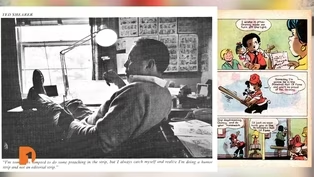
Well, Mr. Joyner wrote me this beautiful four page letter, detailed letter talking about meeting not only Matt Baker, but he met Eastern's Campbell, he met Ted Shearer and these different artists, Jay Jackson and I'm going like, what, wait a minute.
I mean, who are these people?
Like some of the names were vaguely familiar but nobody had I ever come across with ever actually physically met these people.
Not only do you write me this letter but he included black clippings, newspaper clippings and photocopies of articles.
And it was like a starting point for me on saying like, Oh, okay I will start researching some of these men.
Well, will I started the loan places where I would start my research being in newspaper archives.
There was nothing, and this is something I've been doing for years.
And so I looked at my regular sources.
I could find anything.
Well, Donald Dudley said, well, what about black newspapers?
Well, unfortunately, very few libraries secure black newspaper archives.
They were considered disposable.
Nobody, very few places at the time had black newspaper archives.
So I started trying locating, fortunately the internet existed at that time.
So I started these wide searches, libraries all over the country trying to find any library that had any black newspapers.
What the white media can covered is that these men were respected artists almost every single one of these guys I covered "Invisible Men" was respected, classically trained fine artist, or they'd been schooled in art and everything.
Every single one of them.
And which was unusual because most comic book artists of the 1930s and forties were self-taught white guys in New York they couldn't find a job and they were the lowest.
It was the lowest rung of crucial art.
Well, that's why what's this book to...
If he knows what each one of the profiles, I talk about not just the man in his career but the entire history of a man.
I sometimes, I go back generations.
So you get an idea of where these people came from.
It's not just a snapshot of a year or two at a time.
We have a tendency in life to look at people in a microcosm and say like, oh they did this for... this is what he was.
He was an artist for two or three years on comic books.
Like over Elmer Stoner is a perfect example.
Elmer Stoner was an established, classically trained fine artist of the Harlem Renaissance in 1920s.
Established artist.
He became a crucial artist.
He's one of the very few blacks to break over into the white media.
And he worked almost exclusively in white media.
But in comic books, he was basically ignored.
He wasn't a real flashy artist or anything like that.
in what it was like these guys didn't put a lot of effort in comic book art.
It was a way to put food on the table and that's the truth.
It really was.
I mean, a lot of it was half work, like we need a comic book story eight pages long.
How quick can you get it to me?
I'll get it to you in two days.
Okay.
As an artist, I can tell you, that's almost impossible.
If you're reading, you'll put a lot of work into it.
So you're not seeing the best of these men, but we have a tendency in our society to look at just the tiniest part of a person's life and not look at the entirety of the life.
We define people in the most narrow ways.
And what I do again with this book is try to give a wider view of a person's life.
- So that said, where can people go?
If they want to get their hands on a copy of the "Invisible Men?"
- I'm glad you asked.
It's literally everywhere, but you can go on Amazon.
It's sold through a couple times already.
I also prefer people go to their local comic book shop probably helped some of these guys out because a lot of them were having a tough time right now.
And like I say, I think it speaks to a lot of people.
It shows a human experience.
What so many people have experienced.
Like I said, these men are inspirational.
You don't care who you are, you should be inspired by their stories.
- And for more on Ken's work, just head to our website, oneDYetroitpbs.org.
You may have seen Rebel Nell jewelry for sale at the DIA or in Royal Oak or in Ann Arbor.
It's made from graffiti and by the hands of women who are changing their lives.
Take a look at how rebel Nell's founders have made the deliberate decisions in their business to benefit others In this story from Detroit Performs.
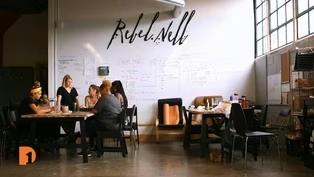
(downbeat music) - [Female narrator] One of our number one rules at Rebel Nell is that you never fall in love with the top layer.
It's really what's underneath that's important.
- Graffiti is just paint over, painted over, painted over and you have these layers and everyone has these layers.
And once you peel them back you see different sides of people, different backgrounds, different things that they've been through.
- Whoever touched it, had her own mind and train of thought when she put it together.
So each piece is uniquely different.
And I think that's our style.
- Rebel Nell started in around March of 2013, where I was living in Detroit was right next door to COTS.
COTS is an amazing organization here in the city which is abbreviated for the Coalition on Temporary Shelter.
It's a women and family only shelter.
And I would have conversations with the women.
I learned that these are incredible women who so often left challenging situations in search of a better opportunity.
And even if it meant going to the shelter and this was my sort of like aha moment.
And they asked my business partner at the time, I said, what if we could provide all the wraparound services sort of a teach a woman to fish concept.
And then what if we could come up with a product that we could employ them that we could sell that would then provide all the wraparound services and then really the concept for Rebel Nell was born then.
My business partner and I Diana had... we both had some jewelry making background.
And so we thought, what if we could create some Detroit centric jewelry that would really pay tribute to the city that we live in and also become something cool to wear.
And then it wasn't until a run on the Dequindre cut when I saw some graffiti on the ground.
And yeah, that was the light bulb moment for the jewelry.
- With every piece of jewelry I create, I put love, energy, affection.
- [Amy] The evolution of Rebel Nell so much credit is with the actual design team.
And taking their thoughts and considerations into how we've changed or evolved our process.
They're really to be credited for the quality that it is today.
- You actually have creative control.
So you can choose your piece of graffiti.
And it's all about the person who's making it because each one is different and it's based on our personality.
- We start off with metal sheet, we try our shapes on it.
After we cut that out and we put our graffiti on and that's another part that I'm not able to say that how we get that graffiti to pop so beautiful but we get it on there as pretty as we can get.
And then we actually cut shape, glue, bind.
Then after we get all that part process we put this resin on it, which makes it shine.
Then we say in our edges, clip our piece make the back polishes, pop it.
And then we drill this hole in it to put the chains on or do our earrings.
We do French Hook Earrings, Poshmark Earrings which is home with the ball and they also dangle.
The Signature Pendants.
This is a large piece.
We have medium pieces.
And then we have really small pieces.
- [Amy] You're wearing a piece of Detroit.
There's a piece of history that we've done a great job of being able to encapsulate and preserve.
And most of the time it's on silver or brass depending on, your price point, your interest.
But you certainly will have a piece that will last you that you could pass down for generations to come and share in that piece of Detroit.
My true mission of why we do Rebel Nell is to provide a transitional opportunity for the women that we hire.
We are looking for women who have a desire to change their situation, can work well with others and a willingness to learn.
One of the things I've learned about running Rebel Nell and interacting with all of our incredible employees is just seeing how broken the system really is.
And especially the challenge is if you're single mother and trying to maintain a job, right?
and you don't have that support system.
- I ended up at COTS because unemployment said they overpaid me four and a half thousand dollars.
They garnish me for all of my income taxes including the unemployment which I was receiving which led to my homelessness.
- Brenda is a blessing for this planet.
There's nobody who has had a more optimistic and positive attitude even when life hands her a lot of challenges.
And we've experienced quite a few of those with her.
And just to see her put on that face of perseverance.
- Sometimes just the thought of where I come from and to where I'm going, could bring a tear to my eye but it's a positive tip.
- [Amy] Michelle, she is the like little spark plug that we have here at Rebel.
She's hilarious.
She's gonna go very far.
This is just a stepping stone for her.
- I seriously am a lot better now than I was.
- We have this TEA program which is to teach, educate, and achieve.
I didn't consider a low credit scores, fixing my account, what kind of accounts I could have, secure loans and all those kinds of things were taught to me through the TEA program.
I'll be working on home ownership which is another thing that the TEA program like working here just opened my eyes to a lot.
So I'll be a homeowner really soon.
- They really helped me become more self-sufficient and like leave me on the correct path and stay on it.
Like, this is more like a family setting more than anything.
And that's why I love it here.
- We also think that the women we employ are really rebelling against what life's dealt to them.
And we're dealing with graffiti which is rebellious in and of itself.
And we also wanted to pay tribute to a woman who was a trailblazer before us, Eleanor Roosevelt and everything she stood for, her nickname that her dad gave her was little now we think she is certainly worthy of a stronger nickname.
And that's how we came up with Rebel Nell.
- Everybody who does graffiti art throughout the city of Detroit before they had these projects was considered Rebel.
People do look at me who went through homelessness, all she was rebellious.
She didn't follow the rules.
She didn't do what she was supposed to do to get there.
So when I get that graffiti, I get the change into some awesome that you never knew somebody that was a Rebel could do something so great.
- When you look forward to going to work.
That's when you know, you found, your next like if you come in and we're just happy.
- We're cousins.
I tell everybody that that's really what I say.
We are all cousins here.
And we share food, ideas, thoughts is a plus.
- [Female narrator] I know that most of the purchasers understand how special piece of Rebel Nell really is.
And again, going back to not only because one of a kind and through the cross-section of graffiti, but also because of the woman who made it and what that really is doing to make a difference is really powerful.
It stands that you believe in empowering women, stands for you believe in promoting equality and making a difference in this world.
- We show people that where women transitioning out of homelessness and we can do this.
It's never too late to focus on your dreams and do what ever it is you feel like you want to do.
- If you grew up here in Detroit chances are Robin Seymour narrated your musical memories as one of the most popular DJs, starting back in the 1950s.
He's known as the DJ that launched a thousand hits.
He passed away in April of 2020, but his role in Detroit broadcasting history won't be forgotten.
♪ Roll over Beethoven ♪ And dig these rhythm and blues ♪ - [Male narrator] Oh, yeah.
That was a real mover.
Chuck Berry, Hey, by the way Chuck Berry is coming to the Riviera theater in three weeks.
Tell you more about it later.
- He always had kind of a youthful kind of verve.
He always hounded younger than he was.
And he had that effervescence to his voice, he get too excited.
- [Male Announcer] For the best in pop tune favorites.
- He could listen to a record and say this guy is going to be great or this girl's going to be great.
- I a good music sense.
Let me put it to you that way.
- No, he definitely had an ear.
Occasionally he'd be wrong, but not very often.
- He always was good at picking out Who is gonna be good and who wasn't.
But we always laugh because he couldn't have been that great.
Because when you were at Elvis Presley, he said, this guy's going to bomb.
And that was not the case.
- I mean the records that we were playing.
I mean, I'll give you an idea.
I don't even know what happened to them.
I remember playing a record by an artist called Bull Moose Jackson ♪ I love you, ♪ Yes I do.
And probably the first record by a black person that was ever played on a radio station in Detroit.
Other than I think the only other station there was WJLB.
but I dug it, It was a sound.
- He knew you liked the song.
It didn't matter.
what color their skin was to groove on the music.
- To be able to ship beyond what they were playing in those days, the Frank Sinatra's and the Tony Bennet's.
And to move that into, it think it was called race music at the time it was black artists and they're on the radio.
Oh my goodness.
This is unheard of.
- [Male Announcer] Here's a young man having a ball, Little Willie John from our city of wheels to do his big move and hit, "Fever".
- And I would go into play a Johnny Cash.
And then we play a little Richard, nobody ever heard of him.
Dearborn station playing little Richard records?
- That was during those times kind of a bold move.
- So he was getting RnB in, he was slipping it in before any other dis track in Detroit.
♪ You give me fever.
That was just revolutionary thing to do.
And incredible gift to listeners of Detroit.
It really started to become more and more calm and it's rock and roll came in.
He was the guy.
- Fred North.
He used to get a lot of flack when he'd go down to the DAC the Detroit athletic club, these guys would say, Hey I hear those black records all the time that are being played on your station.
Now what's going on Fred.
He was coming back to me and say, Robin could you sort of lighten up a little bit?
He didn't care but he was a little bit felt funny about that.
These good old, straight lace white dudes down at the DAC really tried to give him the knife.
Fred to his feeling would say, this is making us money.
Obviously this is what people wanna hear.
So go for it kiddo, go for it.
♪ Bop bopa-a-lu a whop bam boo - [Male Announcer] As one of today's top tones, Little Richard's "Tutti Frutti."
- He felt real close to the audience.
So, I also think that he was one of the first guys to really want the opinion Of the kids.
- [Male Announcer] You know every afternoon, we take the flyer of the day Robbins flyer of the day.
We think he's gonna go on and become a great big hit.
"Why do fools fall in love."
- Kids would come up and sit there on the floor in the other city hall and they dance and do their homework.
- Well, the thing that Robin was able to do, he was able to gain the trust of his audience.
♪ Why do fools fall in love?
And that's a very hard thing to do in a very delicate thing to keep.
But once you get it, you can lead your audience to places that maybe they don't even want to go or they don't even know about.
- You pick out your own records.
You'll either start or fell on what you can bring to the audience.
And I was young enough to be close enough to the teenage kids, to still be thinking like them.
- And that segment was part of a documentary here on Detroit public television.
So head to onedetroitpbs.org for more on the career of Robin Seymour.
we always like to end the show with the performance.
And we've had a lot of music these last few weeks.
So tonight we have dance for you from the set moving studios in Detroit.
It was performed at Marygrove as part of our partnership with the Conservancy to bring performances to you.
While we have to distance at home.
These young dancers not only perform with grace and technical proficiency, the versatility and dedication will take them far.
Enjoy it.
And I'll see you next time.
(Gentle music) ♪ It's not simple to say ♪ Most days I don't recognize me ♪ ♪ These shoes and this apron ♪ That place and its patrons ♪ Have taken more than I gave 'em ♪ ♪ It's not easy to know ♪ I'm not anything like I used to be ♪ ♪ Although it's true ♪ I was never attention sweet center ♪ ♪ I still remember that girl ♪ She's imperfect but she tries ♪ ♪ She is good but she lies ♪ She is hard on herself ♪ She is gone but she used to be mine ♪ ♪ And you're not what I asked for ♪ ♪ If I'm honest I know I would give it all back ♪ ♪ For a chance to start over ♪ And rewrite an ending or two ♪ For the girl that I knew ♪ Who be reckless just enough ♪ Who can hurt ♪ But Who learns how to toughen up when she's bruised ♪ ♪ And gets used by a man who can't love ♪ ♪ And then she'll get stuck and be scared ♪ ♪ Of the life that's inside her ♪ ♪ Growing stronger each day ♪ 'Til it finally reminds her ♪ To fight just a little ♪ To bring back the fire in her eyes ♪ ♪ That's been gone but it used to be mine ♪ ♪ Used to be mine ♪ She is messy but she's kind ♪ She is lonely most of the time ♪ ♪ She is all of this mixed up and baked in a beautiful pie ♪ ♪ She is gone but she used to be mine ♪ (crowd cheering) - [Female Announcer] You can find more at onedetroitpbs.org or subscribe to our social media channels and sign up for our One Detroit Newsletter.
- [Female Announcer] From Delta faucets to Behr paint, Masco corporation is proud to deliver products that enhance the way consumers all over the world experience and enjoy their living spaces.
Masco serving Michigan communities since 1929.
- [Male Announcer] Support for this program provided by the Cynthia & Edsel Ford fund for journalism at Detroit public TV.
The Kresge foundation.
Community foundation for Southeast Michigan.
- [Female Announcer] The DTE foundation is a proud sponsor of Detroit public TV among the state's largest foundations committed to Michigan focused giving.
We support organizations that are doing exceptional work in our state.
Visit DTEFoundation.com to learn more.
- [Male Announcer] Business leaders for Michigan.
Dedicated to making Michigan a top 10 state for jobs, personal income and a healthy economy.
Nissan foundation.
Ally.
- [Male Announcer] The Fred A. and Barbara M. Erb Family foundation.
- [Male Announcer] And viewers like you.
(tense music)
Video has Closed Captions
Clip: S4 Ep9 | 6m 2s | Ken Quattro | Episode 409/Segment 1 (6m 2s)

Marygrove Partnership Performance
Video has Closed Captions
Clip: S4 Ep9 | 3m 23s | Marygrove Partnership Performance | Episode 409/Segment 4 (3m 23s)
Video has Closed Captions
Clip: S4 Ep9 | 7m 27s | Rebel Nell | Episode 409/Segment 2 (7m 27s)

Video has Closed Captions
Clip: S4 Ep9 | 4m 32s | Robin Seymour | Episode 409/Segment 3 (4m 32s)
Providing Support for PBS.org
Learn Moreabout PBS online sponsorship
- News and Public Affairs

Top journalists deliver compelling original analysis of the hour's headlines.

- News and Public Affairs

FRONTLINE is investigative journalism that questions, explains and changes our world.












Support for PBS provided by:
One Detroit is a local public television program presented by Detroit PBS