
Ken Quattro/Thornetta Davis
Season 4 Episode 23 | 26m 46sVideo has Closed Captions
Ken Quattro/Thornetta Davis | Episode 423
Thornetta Davis, Detroit Blues & R&B singer on working during the pandemic. Will Glover talks to Ken Quattro, a comic book enthusiast and historian. Artist Sabrina Nelson creates and describes her exhibition Why You Wanna Fly Blackbird. And the Detroit Youth Choir performs Katy Perry's "Roar." Episode 423
Problems playing video? | Closed Captioning Feedback
Problems playing video? | Closed Captioning Feedback
One Detroit is a local public television program presented by Detroit PBS
Ken Quattro/Thornetta Davis
Season 4 Episode 23 | 26m 46sVideo has Closed Captions
Thornetta Davis, Detroit Blues & R&B singer on working during the pandemic. Will Glover talks to Ken Quattro, a comic book enthusiast and historian. Artist Sabrina Nelson creates and describes her exhibition Why You Wanna Fly Blackbird. And the Detroit Youth Choir performs Katy Perry's "Roar." Episode 423
Problems playing video? | Closed Captioning Feedback
How to Watch One Detroit
One Detroit is available to stream on pbs.org and the free PBS App, available on iPhone, Apple TV, Android TV, Android smartphones, Amazon Fire TV, Amazon Fire Tablet, Roku, Samsung Smart TV, and Vizio.
Providing Support for PBS.org
Learn Moreabout PBS online sponsorship- Hi, I'm Christy McDonald and here's what's coming up this week on One Detroit arts and culture.
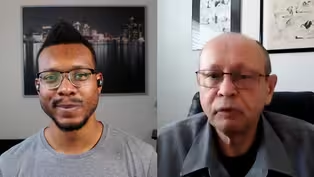
Ken Quattro and his new book on the untold stories of black comic book artists called "Invisible Men".
How they face systemic racism and open doors for the future generations.
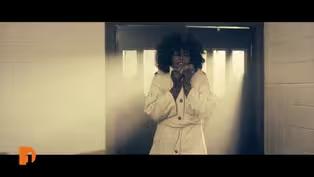
Plus Detroit's queen of the blues Thornetta Davis on her collaboration with actor Jeff Daniels that went viral.
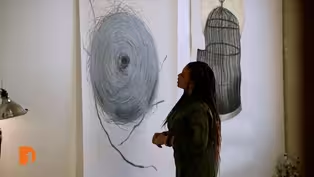
Then the work of artist Sabrina Nelson.
And the Detroit Youth Choir with a performance at Marygrove.
It's all coming up on One Detroit.
- [Announcer] From Delta Faucets to Behr Paint, Masco Corporation is proud to deliver products that enhance the way consumers all over the world experience and enjoy their living spaces.
Masco, serving Michigan communities since 1929.
- [Announcer 1] Support for this program provided by the Cynthia & Edsel Ford Fund for Journalism at Detroit Public TV, The Kresge Foundation, Community Foundation For Southeast Michigan.
- [Announcer 2] The DTE foundation is a proud sponsor of Detroit Public TV, among the state's largest foundations committed to Michigan focused giving.
We support organizations that are doing exceptional work in our state.
Visit DTEFoundation.com to learn more.
- [Announcer 3] Business Leaders for Michigan.
Dedicated to making Michigan a top 10 state for jobs, personal income, and a healthy economy.
Also brought to you by, the Fred A. and Barbara M. Erb Family Foundation and viewers like you.
(upbeat music) - Hi there, I'm Christy McDonald and welcome to One Detroit arts and culture, thanks so much for joining me.
We started the show during the early days of the pandemic last year as a way to connect people with musicians, artists and cultural events that they loved and were really missing.
It's a way for us to get our arts and culture fix until we can all gather together again.
So coming up on the show, One Detroit's Will Glover catches up with Michigan author, Ken Quattro.
He's known as the comics detective and he has a new book out called "Invisible Men" the trailblazing black artists of comic books.
Ken shares how he found out about these untold stories of black comic book artists from the thirties to the 1950s and how they're influencing comics today.
Plus you will meet artist Sabrina Nelson and see her exhibition on the power of black motherhood, loss and transformation.
And then you can't help but be inspired and entertained by the Detroit Youth Choir, they'll perform for us at Marygrove it is all just ahead.
But we're starting off with Detroit's own queen of the blues Thornetta Davis has been making music here in Detroit for over 30 years.
And like a lot of artists, COVID brought her live performances and promotions to a halt.
But her recent collaboration with actor Jeff Daniels went viral and she tells me how the song "I'm America" stretched her creatively in new ways.
♪ Well my baby up and left me ♪ Did me a favor when he did ♪ Had he been lying all along ♪ But I know I wanted to keep ♪ I guess he wasn't mine anyway ♪ ♪ So I'm not sad to see him go ♪ Cause he was no good anyhow ♪ And he stand up on my door ♪ And I believe, I believe ♪ Everything gon be all right ♪ Everything gon be all right now ♪ ♪ Everything gon be all right ♪ I believe, I believe What has this last year been like for you as a musician?
- Wow, well, it's definitely been a crazy experience because I haven't been able to get out and perform.
There was so many things we were gonna do this past year.
Me and my band were gonna do a lot of traveling I think the week of the cancellation of everything all over the country, we were going to Austin, Texas and we were going to perform down there a number of gigs for the South by Southwest Convention and they canceled that immediately.
- You've worked with everyone from Etta James to Gladys Knight, to Bob Seger, I always feel like you have been in that arena in terms of working with artists but still pushing your name out there.
- Yeah, I was always behind the scenes singing in the background and always wanting to go forward and do my own thing so I've managed to do both.
I never did go on tour with those famous people but I managed to sing on their records which helped lift my career up to do what I needed to do.
This past four years I released an album called "Honest Woman" and "Honest Woman" was something that I had in place or had been working on for 20 years.
Finally got it out, started winning all these great awards for it, and then pandemic hits.
And I was looking forward to touring all over the world.
When those things happen, you get scared you start wondering what's gonna happen and I thank God for the internet because that did start to help me when people ask me to do certain of performances recorded.
- About a month ago, we heard a recording of you and Jeff Daniels singing this song called "I am America".
Tell me about how that song came into being and your collaboration with Jeff Daniels that everyone knows is an actor but likes to sing a bit and perform as well.
- Well, I got a call and from Jeff's people and asked me would I be willing to perform with them on a song that he's putting on his album?
And I was excited.
I didn't know to what capacity I just thought I'm singing with Jeff Daniels.
And so when they sent me the music and I noticed that it only had the hook and one of the verses in, I had to write the rest of it.
And I said, okay, this is good, this is a stretch for me, but I'm gonna enjoy this.
And I wanted to speak on what I'd been feeling as far as what's been going on in the world, what's been going on in this country, what we've experienced all of us, but what I've experienced in my life as far as being a black person in this country.
And so I wrote the words, give me my freedom, all I wanna do is breathe, and all of these things that have not been happening in this country for hundreds of years.
And I wanted to put it in this song.
♪ I will rejoice, I'm America ♪ When you can hear my American voice ♪ ♪ Oh yes, give me my freedom ♪ Give me my freedom - When did you hear it for the first time and what was the reaction?
- The first time I heard it for the public is when my Twitter started blowing up.
(Christy laughs) I had no idea they were to use it for the ad campaign which I'm glad they did that too.
But I'm like, why is my phone blowing up?
And I went to it it was like nine o'clock at night.
And people were liking me and following me all of a sudden on my Twitter page.
And so I went to the reason why and I'm like, whoa, you put it on this commercial with the two senators down in Georgia.
- It's the intersection of what you just said is speaking your truth, activism, everything colliding in one way, and you said even stretching yourself into places maybe musically that you hadn't been before.
- I wanted to write a song speaking on the things that have been going on as far as the police brutality and people making peaceful protest and having the president at that time answer with more violence.
And I'm like, how does this work now?
Why can't we just be at peace?
I'm just looking forward to better days happening.
I got a song called "I Believe Everything's Gonna Be All Right" and a lot of things happened this last year that had me struggling with that belief.
And I believe God gave me that song to help others keep the faith.
♪ I believe, I believe everything gon be all right ♪ ♪ Everything gon be all right now ♪ ♪ Everything gon be all right ♪ I believe, I believe, I believe ♪ ♪ Did my cry to the evening ♪ Joy gon come ♪ Did my cry to the evening ♪ Joy so come ♪ Did my cry to the evening ♪ Joy will come in the morning light ♪ - Turning now to Michigan author, Ken Quattro and his book 20 years in the making.
Ken is well-known as a comic book historian.
He was a consultant on the 2017 film "Professor Marston and the Wonder Women" but it's his new book on the untold stories of black comic book artists that is getting a lot of national attention and shining a light on talented men who face systemic racism Will Glover has more.
- So with this book, "The Invisible Men" you set up on a journey that a, took a while and b, I'm assuming you found out some things that you may or may not have been expecting so let's start with Mr. Samuel Joyner.
Could you tell us a little bit about who he is and how he helps you get started down this road?
- I've been writing about comics and comic books for probably going on 50 years back to the early seventies.
So I'm doing this a long time, I've written many articles and stuff.
And I was going to be writing about a particular artist named Matt Baker, any research I could find out, any articles any reference to it all only came up with two things.
Mr. Baker died young, he died when he was 37, he was black.
And at the time 20 years ago, a lot of people considered him the only black comic book artist of all time back in the 1940s and fifties which to me seemed really odd.
Just statistically, that didn't make sense to me.
So for years I was trying to track down information about Matt Baker and I kept asking everyone, finally I came across somebody who just casually mentioned have you spoken with Mr. Samuel Joyner who was retired black cartoonist from Philadelphia.
He'd done most of his work for the Philadelphia Tribune.
Well, Mr. Joyner wrote me this beautiful four page detailed letter talking about meeting not only Matt Baker, but he met James Campbell, he met Ted Shearer and these different artists, Jay Jackson, and I'm going like, what?
Wait a minute.
Who are these people?
Like some of the names were vaguely familiar but nobody had I ever come across that actually physically met these people.
Not only do you write me this letter but he included lax clippings, newspaper clippings and photocopies of articles.
And it was like a starting point for me, I'm saying like, oh, okay I will start researching some of these men.
Well Will, the places where I would start my research being in newspaper archives, there was nothing.
And this is something I've been doing for years, I looked at my regular sources but couldn't find anything.
Well it dawned on me, I said, well what about black newspapers?
Well, unfortunately, very few libraries carry black newspaper archives.
They were considered disposable.
Nobody, very few places at the time had black newspaper archives.
So I started trying locating fortunately the internet existed at that time.
So I started these wide searches libraries all over the country trying to find any library that had any black newspapers.
What the white media has never covered is that these men were respected artists almost every single one of these guys I covered "Invisible Men" was a respected, classically trained, fine artist or they'd been schooled in art in everything, every single one.
Which was unusual because most comic book artists of the 1930s and forties were self taught white guys from New York, they couldn't find a job and it was the lowest rung of crucial art.
Well, that's why what's this book too.
If you notice with each one of the profiles I talk about not just a man in his career, but the entire history of a man, I sometimes I go back generations.
So you get an idea of where these people came from.
It's not just a snapshot of a year or two a time, we have a tendency in life to look at people in a microcosm and saying like, "Oh they did this for, this is what he was.
He was an artist for two or three years on comic books."
Like Elmer Stoner is a perfect example.
Elmer stoner was established, classically trained fine artist of the Harlem Renaissance in 1920s, established artist.
He became a crucial artist.
He's one of the very few blacks to break over into the white media, he worked almost exclusively in white media.
But in comic books, he was basically ignored.
He wasn't a real flashy artist or anything like that.
It wasn't like these guys to put a lot of effort into comic book art, it was a way to put food on the table and that's the truth, it really was.
A lot of it was like, we need a comic book story eight pages long, how quick can you get it to me?
I'll get it to you in two days.
Okay, as an artist I can tell you that's almost impossible, if you read it, you'll put a lot of work into it.
So you're not seeing the best of these men, but we have a tendency in our society to look at just the tiniest part of a person's life and not look at the entirety of the life.
We define people in the most narrow ways.
And what I do again with this book is try to give a wider view of a person's life.
- So that said, where can people go if they wanna get their hands on a copy of "The Invisible Man"?
- I'm glad you asked, it's literally everywhere but you can go on Amazon.
It's sold through a couple times already.
I also prefer people go to their local comic book shop and probably help some of these guys out because a lot of them were having a tough time right now.
And like I say, I think it speaks to a lot of people it shows the human experience, what so many people have experienced.
Like I said, these men are inspirational.
I don't care who you are, you should be inspired by their stories.
- This next story comes to us from our show on Detroit Public Television called Detroit Performs.
It's about artist Sabrina Nelson and her work capturing the essence of black motherhood, loss and transformation.
(soulful music) - I think my medicine is art, my language is art.
I think the term artist means to be responsible for what's happening in the world, how you see it, how you record it, how you make things that are a result of what you are trying to say whether it's a question you're answering or a story you're trying to tell, or here's something I need to make because it's just embedded in me like I have to make something.
Detroit is embedded in who I am, I've been here all my life since the rebellion in 1967 that's when I was born.
And so everything around me becomes a part of the story I'm trying to tell, or the question I'm trying to ask.
My superpower is being able to visually communicate how I feel about what's happening in the world.
Nina Simone says, "If you're gonna be an artist, it's your duty to reflect what's happening in the world."
And in the world that I live in from the time I can remember remembering, there's always trauma and hurt and pain, and I'm not always talking about that but you can't ignore it.
And on this day, I think about the lives that are lost, that are constant coming at me through different mediums.
And so I'm thinking about homicides and deaths of young people and how I'm affected by it.
But I'm talking about death where people aren't considered people like you don't matter, you're not important, so I'm just gonna take your life.
I don't care how old you are, I don't care who you belong to.
And when that person is missing from our communities, not just the blood family is affected, we are all and we should all be concerned.
A life is a life, a human is a human.
And so in this work, I'm talking about that pain.
The name of the exhibition is "Why You Wanna Fly Blackbird?"
And I got it from a Nina Simone song who talks about black women like how dare you try and be happy in your life?
How dare you not expect pain?
Pain is gonna come.
You have to move through it and you have to live, but pain will be here.
I didn't want the colors to be so seductive that it draws you in as pretty, like I don't like the idea of my work being pretty.
I want it to be impactful, I want it to be deeper than just what you see, and I wanted it to be large enough to have some girth to it.
So these particular pieces are very large drawings.
They're also reliquaries, if you will.
So they talk about like the body, the housing of the bodies that we have, like the home, and then what it's like to have a nest with no eggs in it.
Thinking about the empty nest of children who never returned, I don't care how old they are they never can return.
So I'm just talking about the darkness in that and expressing it with the most eloquence that I can.
The cages will represent empty homes that can be the home that they lived in, that can be the community that they lived in, how do you deal with that?
That room that's empty.
And so when we lose these people that are not treated with value out of our communities, how do you deal with that?
So Lavonne is helping me on the dresses because I wanna make dresses that will hang from the ceiling, just above the patrons heads but the bird cages will be the empty rooms underneath the dresses.
And so I'm asking him to help me figure out how I'm gonna make the dresses which are made out of Japanese rice paper so that they can be sheer enough that the bird cages can go underneath them and the patrons can see them with the lighting, and hopefully they have the impact that's in my head and in my heart.
I want people to pay attention to it and to be more empathetic with others lives, if you see something happening and you can do something about it, why wouldn't you?
And so when I look at the homicide rates across the country, they're incredibly high for African-American, indigenous and also Latin American children.
And so this is all I can say and do about it.
I want someone to know that I care, even though they're not my children, I care that they're missing, that they're gone, that somebody should think about doing something about it.
The motion of movement when I'm making these things like when I did the nest here, the motion of drawing and drawing and drawing that obsession of movement and what it feels like to do that these movements that we do over and over become very much ritual.
Maybe these are all prayers visually to say I'm sorry that your life is gone, but I wanna say that you meant something that you were important.
Every artist wants someone to look at their work for a long time, and I didn't wanna make it so obvious and obtruse where it's like you see people getting killed, but I think the work and the drawings and some of the paintings that I'm using can be seductive.
So I want people to make sure that they walk away with knowing that I'm in a world, I am affected by it, and don't just listen to the news and be in the world and not really take part in what's happening, think about what your voice is and what your superpower is and see what you can do to help.
I wanna say something that's important, and I want to leave this world with something that someone's learned from me.
My work might be central to draw you in and then it's gon slap you a little bit, and that's what I hope I show.
(soulful music) - And for more stories from Detroit Performs and all of the stories that we're working on each week, just head to onedetroitpbs.org All right, it's time for a little inspiration, a little bit of fun.
I'm going to leave you with a performance.
The Detroit Youth Choir singing Katy Perry's "Roar" it was recorded at Marygrove.
Enjoy it and I'll see you next week, take care.
♪ I used to bite my tongue and hold my breath ♪ ♪ Scared to rock the boat and make a mess ♪ ♪ So I sat quietly, agreed politely ♪ ♪ I guess that I forgot I had a choice ♪ ♪ I let you push me past the breaking point ♪ ♪ I stood for nothing, so I fell for everything ♪ ♪ You held me down, but I got up ♪ ♪ Already brushing off the dust ♪ ♪ You hear my voice, you hear that sound ♪ ♪ Like thunder, gonna shake the ground ♪ ♪ You held me down, but I got up ♪ ♪ Get ready 'cause I've had enough ♪ ♪ I see it all, I see it now ♪ I got the eye of the tiger, a fighter ♪ ♪ Dancing through the fire ♪ Cause I am a champion, and you're gonna hear me roar ♪ ♪ Louder, louder than a lion ♪ Cause I am a champion, and you're gonna hear me roar ♪ ♪ Oh-oh-oh-oh-oh ♪ Oh-oh-oh-oh-oh ♪ Oh-oh-oh-oh-oh ♪ You're gonna hear me roar ♪ Now I'm floating like a butterfly ♪ ♪ Stinging like a bee, I earned my stripes ♪ ♪ I went from zero, to my own hero ♪ ♪ You held me down, but I got up ♪ ♪ Already brushing off the dust ♪ ♪ You hear my voice, you hear that sound ♪ ♪ Like thunder, gonna shake the ground ♪ ♪ You held me down, but I got up ♪ ♪ Get ready 'cause I've had enough ♪ ♪ I see it all, I see it now ♪ I got the eye of the tiger, a fighter ♪ ♪ Dancing through the fire ♪ 'Cause I am a champion, and you're gonna hear me roar ♪ ♪ Louder, louder than a lion ♪ 'Cause I am a champion, and you're gonna hear me roar ♪ ♪ Oh-oh-oh-oh-oh ♪ Oh-oh-oh-oh-oh ♪ Oh-oh-oh-oh-oh ♪ You're gonna hear me roar ♪ Oh-oh-oh-oh-oh ♪ Oh-oh-oh-oh-oh ♪ You're gonna hear me roar ♪ Oh-oh-oh-oh-oh ♪ You're gonna hear me roar - [Announcer 4] You can find more at onedetroitpbs.org or subscribe to our social media channels and sign up for our One Detroit newsletter.
- [Announcer] From Delta Faucets to Behr paint, Masco corporation is proud to deliver products that enhance the way consumers all over the world experience and enjoy their living spaces.
Masco, serving Michigan communities since 1929.
- [Announcer 1] Support for this program provided by the Cynthia and Edsel Ford Fund for Journalism at Detroit Public TV, the Kresge Foundation, Community Foundation for Southeast Michigan.
- [Announcer 2] The DTE Foundation is a proud sponsor of Detroit Public TV among the state's largest foundations committed to Michigan focused giving.
We support organizations that are doing exceptional work in our state.
Visit DTEFoundation.com to learn more.
- [Announcer 3] Business Leaders for Michigan, dedicated to making Michigan a top 10 state for jobs, personal income, and a healthy economy.
Also brought to you by the Fred A. and Barbara M. Erb Family Foundation and viewers like you.
(upbeat music)
Video has Closed Captions
Clip: S4 Ep23 | 6m 36s | Artist Sabrina Nelson | Episode 423/Segment 3 (6m 36s)
Video has Closed Captions
Clip: S4 Ep23 | 6m 2s | Ken Quattro | Episode 423/Segment 2 (6m 2s)
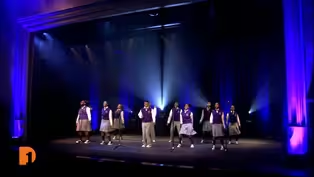
Performance: Detroit Youth Choir - Roar
Video has Closed Captions
Clip: S4 Ep23 | 2m 47s | Performance: Detroit Youth Chior - Roar | Episode 423/Segment 4 (2m 47s)
Video has Closed Captions
Clip: S4 Ep23 | 6m 28s | Thornetta Davis | Episode 423/Segment 1 (6m 28s)
Providing Support for PBS.org
Learn Moreabout PBS online sponsorship
- News and Public Affairs

Top journalists deliver compelling original analysis of the hour's headlines.

- News and Public Affairs

FRONTLINE is investigative journalism that questions, explains and changes our world.












Support for PBS provided by:
One Detroit is a local public television program presented by Detroit PBS