One-on-One
Ken Zaentz; Michael Maron; Roz Chast
Season 2024 Episode 2706 | 27m 58sVideo has Closed Captions
Ken Zaentz; Michael Maron; Roz Chast
Ken C. Zaentz, President and CEO of Alzheimer's NJ discusses the importance of treating Alzheimer's caregivers with compassion; Holy Name Medical Center President Michael Maron talks about end-of-life care for both patients and their families; Roz Chast, Cartoonist at The New Yorker & Author of 'I Must Be Dreaming', talks about her fascination with dreaming and the humor behind her illustrations.
Problems playing video? | Closed Captioning Feedback
Problems playing video? | Closed Captioning Feedback
One-on-One is a local public television program presented by NJ PBS
One-on-One
Ken Zaentz; Michael Maron; Roz Chast
Season 2024 Episode 2706 | 27m 58sVideo has Closed Captions
Ken C. Zaentz, President and CEO of Alzheimer's NJ discusses the importance of treating Alzheimer's caregivers with compassion; Holy Name Medical Center President Michael Maron talks about end-of-life care for both patients and their families; Roz Chast, Cartoonist at The New Yorker & Author of 'I Must Be Dreaming', talks about her fascination with dreaming and the humor behind her illustrations.
Problems playing video? | Closed Captioning Feedback
How to Watch One-on-One
One-on-One is available to stream on pbs.org and the free PBS App, available on iPhone, Apple TV, Android TV, Android smartphones, Amazon Fire TV, Amazon Fire Tablet, Roku, Samsung Smart TV, and Vizio.
Providing Support for PBS.org
Learn Moreabout PBS online sponsorship- [Narrator] Funding for this edition of One-On-One with Steve Adubato has been provided by The Russell Berrie Foundation.
Making a difference.
New Jersey’s Clean Energy program.
Lighting the way to a clean energy future.
The North Ward Center.
New Jersey Sharing Network.
The Turrell Fund, a foundation serving children.
Robert Wood Johnson Foundation.
Working for a more a healthier, more equitable New Jersey.
Delta Dental of New Jersey.
Everyone deserves a healthy smile.
PSEG Foundation.
And by Seton Hall University.
Showing the world what great minds can do since 1856.
Promotional support provided by Northjersey.com and Local IQ.
Part of the USA Today Network.
And by Meadowlands Chamber.
Building connections, driving business growth.
- This is One-On-One.
- I'm an equal American just like you are.
- The way we change Presidents in this country is by voting.
- A quartet is already a jawn, it’s just The New Jawn.
- January 6th was not some sort of violent, crazy outlier.
- I don't care how good you are or how good you think you are, there is always something to learn.
- I mean what other country sends comedians over to embedded military to make them feel better.
- People call me 'cause they feel nobody's paying attention.
-_ It’s not all about memorizing and getting information, it’s what you do with that information.
- (slowly) Start talking right now.
- That's a good question, high five.
(upbeat music) - Hi everyone.
Steve Adubato here.
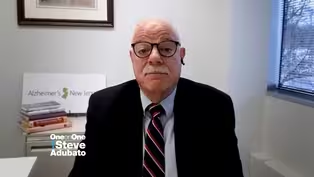
We kick off the program with a very, very important conversation with Ken Zaents, who's President and Chief Executive Officer of Alzheimer's, New Jersey.
The website will be up right away.
Ken, good to see you.
- You too.
Thanks for having me on.
- You got it.
Ken, as we put the website up and also the hotline will be coming up after that, describe the organization and who you're primarily out there to help.
- Sure.
So we are a New Jersey incorporated local community-based organization, and we provide primarily services, programs and services for families that are impacted by Alzheimer's disease in the state of New Jersey.
We're not affiliated with a national organization, so our board and our staff are totally committed 100% to serving the needs of New Jersey families that are impacted by, as you already said, what it is a pretty charitable disease.
- So help us understand something.
My dad dealt with dementia for a long time past, a little over three years ago.
Dementia, is the umbrella term Alzheimer's and dementia.
Do I have it the wrong way?
- So the umbrella term is dementia.
So if you have Alzheimer's disease, you have a form of dementia.
So Alzheimer's disease is dementia, but it's a specific type of dementia.
And then there are many others.
There's vascular dementia, there's frontal temporal dementia, just to name a couple.
So the umbrella is dementia.
- And my sisters and I and others who connected to our family watched my mom who watches One on One every night, hey mom.
And she was my dad's primary caregiver.
And the impact on her was, and I imagine still is, extraordinary.
Talk about the caregivers of those who are dealing with Alzheimer's - And Steve, that's primarily where we concentrate on our work through support groups education.
We have a respite care and wellness program that teaches caregivers about the importance of getting time off for themselves.
It's an extremely stressful job, and caregivers oftentimes take it all on themselves, not necessarily with any help.
So one of the things that we try to impress on caregivers is there is help available.
It's such a challenge.
There are so many changes that the two people in a relationship are experiencing.
So caregivers need support.
And the hard part too is that so much of the expense of caregiving is born by caregivers because we do not have a system that, an insurance system that pays for the long-term care needs of families who are doing all this care primarily in their home.
- Why don't we?
- Well there's Medicare, but Medicare was never designed to be a system for a long-term illness.
Medicare will pay for, if someone has dementia and because of that, they're confused and they fall and they break their hip.
Well, Medicare will pay for the broken hip, but Medicare was not designed as a system to pay for the services that that family may have needed to prevent that fall like a home health aide or sending someone to adult day services.
Those, I guess you would call them, quality of life services that can make life so much easier for caregivers.
You're on your own.
It's private pay.
- And Medicare's never responded to that need.
It's always so interesting.
Someone says it wasn't created for that.
But so many things change and so many of us who are evolving and pivoting, you think, well, why wouldn't the federal government do that?
I don't want to get into a big policy discussion with you, but there's never been a pivot, there's never been an adaptation, there's never been a revision to deal with long-term care, correct?
- Correct.
- Okay.
- Do this for us.
While the hotline is up, right now, the website is up, someone calls the hotline, who's on the other end, Ken, and what specific help are they getting?
Then I wanna talk about the scholarships that you have for caregivers, please.
- Sure.
So if someone calls us, they will get one of our trained staff members who know the disease, who know the community resources.
They'll get someone that's compassionate, they'll get someone that cares, and most of all, they'll get someone that listens.
And in those helpline calls, depending on the nature of the call, we talk about community resources.
Sometimes we just talk, because that's what the caregiver needs.
And we try to probe, because a lot of times the caregiver will call for a specific question and by the end of the call, and it could be 15 minutes, it could be an hour, it depends on the need, that caregiver will come away with answers to questions that they didn't even know they had.
So that's really what we try to do when someone calls our helpline, - What are the scholarships for caregivers?
What does that mean?
- So as part of our respite care and wellness program, we wanna educate caregivers about the importance of getting time off for themselves.
And through an application process and through the generosity of our donors, we have money that's available annually so that caregivers can get up to a thousand dollars in a "scholarship" so that they can access a licensed respite care services in the community.
So it may be having some money to pay for adult day, it may be having some money to bring a home healthcare aid into the home.
It's really meant to be a starter.
It's meant to be, the scholarship is meant to be part of the education process to get caregivers to try these services without having to worry about spending their own money, at least not at first.
- And as we wrap up, I just wanna put some things in perspective.
16.6% of the New Jersey population over 65, age is not the only determining factor, but as a primary risk factor for cognitive decline.
According to the Alzheimer's Association, one of nine, one in nine people over 65 years of age are affected by Alzheimer's.
Wow.
Hey Ken- - It's a huge issue for our state, Steve, and that's kind of why we've concentrated our services right here in New Jersey.
- Yeah.
Hey Ken, I wanna thank you and your colleagues for the work you do every day as a not-for-profit organization making a difference for a lot of folks who often feel very isolated as caregivers.
Thank you, Ken.
- Thank you, Steve.
Thanks for helping us spread the word.
- You got it.
Stay with us, we'll be right back.
- [Narrator] To watch more One on One with Steve Adubato find us online and follow us on Social media.
- Folks, let me lead into this segment.
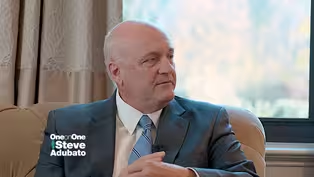
It's an interview that I did with Mike Maron, the President and CEO of Holy Name Medical Center at a place called Villa Marie Clair.
It is connected to Holy Name, one of our underwriters, but Villa Marie Claire is all about end of life, how people live those final days in their life.
How family members who care for them deeply need help, and that's what this organization does.
Mike talks candidly and openly about his own personal experience with his mom, end of life issues.
These are important issues, can't escape them.
An important conversation, check it out.
- Mike, thanks for joining us.
- Thanks for having me.
- This place, Villa Marie Claire, I mean, we've talked about it for so many years.
We talked to.
Dr. Vialotti as well.
I thought I knew.
I thought I had a sense of what it was just by talking about it and seeing pictures.
It's different.
The feel as soon as you walk in is powerful.
Talk about that.
- Yeah, many people have commented on it from when we opened in 2011 for the first time right to today.
When you walk through these doors, there is an energy, a spirit that resides here that makes this place special.
And that is probably the most important ingredient to everything.
So all the beauty that you see around it, the intention inside and outside is to amplify that spirit.
So for those of us that are too busy, too tuned out to pay attention to it, hopefully the surroundings will amplify it enough where you feel it and know that it's real.
- Mike, it's interesting.
We're taping this right before Thanksgiving 2023.
It was just a few weeks ago, it was the third anniversary of my dad passing.
And he passed during COVID.
You lost your mom very recently.
- Yes.
- So we've gone through this, like so many others.
Talking about end of life, dealing with end of life issues and this place.
Talk about that.
- Sure.
When you look at end of life, it is a fact that none of us can escape, right?
We're all destined.
At some point, our lives here are gonna end.
And the question becomes how do they end, in what fashion?
What are those last days like?
So this isn't, this whole place is not about dying.
It's about living.
It's about enjoying.
It's about bringing family and friends together to unite for one last time.
While that time is, we know, coming to an end, it's meant to really live them to its fullest capacity.
To keep people comfortable, to keep them engaged with their family and friends.
Not that they're sedated and stunad.
And so to make those last moments, whether they're days, hours, weeks, as meaningful and rewarding as possible for everybody.
- How do you do that, Mike?
- We do it by the staff, first and foremost, that are here.
They're tremendous.
We do it through the surroundings.
We do it through celebrating with food.
We have some incredible chefs here, and food is a big part of comfort.
The environment's a big part of comfort.
Bringing in all the natural beauty of outdoors between, if you will, those elements of life, earth, air, fire, water.
You'll see water features everywhere, fireplaces everywhere, music everywhere, food everywhere.
This is the sustenance of life.
What we're hoping here is the current generation of people, the survivors, the family, the friends, the community that come to visit, they're the ones we really wanna impact.
You know, New Jersey ranks dead last out of the 50 states as ranked by the Dartmouth Atlas when it comes to spending in the end of life.
- Because?
- The medical profession.
- The establishment, right.
- The establishment, yeah.
Today, the statistic sadly has not changed.
1/3 of all the people that get referred to the Villa die before they get here.
The second third, 'cause we wait so long to make the decision.
And so we send out teams of staff and they do all the assessments and they do the intake.
They expire before they can even leave where they are to come here.
The second third die within 24 hours.
The final third stay for about six weeks.
That middle third, 24 hours of exposure here, most consistent and loudest feedback we get from that group, "Why didn't I know about this sooner?
Why didn't anybody tell me this was an option?"
We should have been here weeks ago.
That's what we wanna try to impact 'cause now all those people going forward, when they know others or themselves who are gonna be impacted by end of life, they now are smarter and wiser to say, "There is an alternative.
There is a better way to do this."
- Mike, we actually had Senator Paul Sarlo on recently, who's been here, understands, appreciates end of life issues.
A big policy question, a human question, in the state legislature.
Senator Joseph Vitali, the chair of the Senate Health Committee, very involved with Senator Sarlo and others.
Do you believe, Mike, that there should be any changes in public policy as it relates to end of life issues, A, and B, the impact that has on societal attitudes?
- I think changing attitudes in education is important.
Is there a policy where you can change, you could help pay for it better, right?
So I think from a policy standpoint, helping support ventures like the Villa Marie Claire.
- End of life care.
- End of life care, right?
Think about it.
This is one of the misnomers, and I went through this with my own family and you have to put it in context.
So my mother recently passed away here, 93 1/2, beautiful long life.
I actually thought we were getting her in early and I was trying to set the stage and use her an example of how it should be.
And it turned out she was only here for two weeks and expired.
So early in my mind, and I'm a more educated mind, wasn't early enough, right?
So we can change by educating, by helping pay for it and supporting it so that there is more venues like the Villa.
- You want more competition.
- Yeah, absolutely.
Absolutely.
The other is this, is where I started going.
So home care and home hospice many tout as that's the holy grail.
Everybody wants to die at home.
Yes and no.
And there is a comfort level at home.
Having been through this personally, that's often- - My dad died at home.
- Yeah, but it's hard, right?
Because home hospice, same thing, you don't get a nurse 24 hours a day.
You get a nurse for a couple hours during the day.
And what happens those other 22 hours?
- [Steve] It's on family.
- It's on family.
And you're not being the son or the spouse or the daughter.
You're being the caregiver.
Realize that at some point, especially those last several weeks, you don't wanna be the caregiver.
You wanna be in your primary relationship with whoever that is.
- The son, the daughter, the brother, the sister, - The spouse, whatever.
Parent often, right?
We see that all too often these days, yeah.
- I have one final question, Mike.
We've known each other a long time.
Professionally rewarding is one thing.
Personally rewarding is another.
Why is it so personally rewarding?
- Because here, it all started with friends and family.
The whole idea of the Villa was born out of a priest who was a very good friend of mine, Father Joe Kukura, who you may have met.
Joe was in healthcare.
He was a well-known beloved priest.
Young, came down with cancer.
Moved in with very, very close friends of his, close friends of mine now, very, very close.
And they had to convert their dining room into a patient room.
And they did it for as long as they could, and they couldn't do it anymore.
And they called me and they said, "Can you help?"
Villa didn't exist.
So what did we do?
We took Joe and we brought him to Holy Name at the hospital and I took a semi-private room and we took the extra bed out and we put in couches and furniture and we tried to make it as warm and homelike as we possibly could and we moved Joe there and he had visitors out the wazoo coming to the hospital.
And it was as nice and as warm a parting as you could possibly have for a man who was just beloved at every level.
And when the sisters who had this property since the 1930s, Sister Maureen Collins was the provincial at the time, and she called and she said, "We can no longer support the Villa Marie Claire.
If we were to give it to you, what would you do with it?"
And I asked Dr. Mendelowitz, I said, "What would you do?"
He said, "Easy, hospice.
We turn it into an inpatient hospice."
- Thank you, Mike.
- [Narrator] To watch more One on One with Steve Adubato find us online and follow us on Social media.
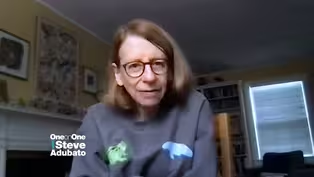
- We are pleased to welcome Roz Chast, who is the author of this compelling, interesting, gotta get this book, "I Must Be Dreaming".
Roz, great to have you with us.
- Oh, thanks for inviting me, - Roz, I'm an obsessive reader, but this book is so different from any other book I've ever read.
You're brilliant.
I'm sure people say that to you all the time.
The cartoons, excuse me, the illustrations and the writing, you did it all.
- That's what I do.
Yeah.
(chuckles) - But let me ask you this, 'cause I'm actually gonna ask people to go to, if we can show the graphic on page 10 of the book, why dreaming is so great.
Why is dreaming so great?
- Well, there's a lot of reasons.
For one thing, it's free.
Anybody can do it.
Everybody does do it.
And, this stuff that we make up when we go to sleep has always fascinated me since I was a little kid.
I didn't really understand what it was.
Every night, every single person, we do this odd thing that we call dreaming, but we don't really know what it is or why we do it.
And I think it's great because it's interesting and also it's a mystery.
A mystery of daily life.
- Roz, the other thing is, you're very upfront about the fact that you suffer from anxiety.
What is the connection between your anxiety and your work, your art?
- I think for me, it's probably humor and anxiety.
I don't know, they're kind of like peanut butter and jelly.
There's something, there's some connection there.
I'm not the most analytical person you've ever met, but I think there's a lot of things that if they weren't funny, I would probably just wind up like ripping off all my clothes and run screaming down the street.
- And you do not have dreams about that, do you?
- I have certainly had dreams where I haven't had clothes on.
I think everybody does.
That's a very common dream thing.
- Yes it is, yeah.
The other thing about you that is fascinating to me is when you were growing up, you were not allowed to read comics as a child.
- Yeah, - Because?
- Well, my mother was an assistant principal, my father was a teacher.
To them comics were for morons.
They were for people that did poorly in school, that didn't care about school, that were maybe kind of stupid.
And they were just bad.
They were just like junk books.
And my parents did not believe in that, especially my mother.
And she used to brag about being in school and taking comic books away from children.
So, go figure.
- Yeah.
I'm curious about this.
As a cartoonist, as an artist, how early on did you realize that you had a gift and a talent in this area?
- I always loved to draw from the time I was... Before I could write, like many kids.
Most kids, they draw.
I think when I was probably around five or six, you know how one kid is gonna be the fastest runner and one kid is good at math and one kid is the prettiest.
And, I was always the kid who drew.
So I never really thought like, "Oh, I have a talent."
It was just like, I'm the kid who draws.
- In 1978, you joined the New Yorker, you're on board there.
- Yeah.
- And how big a thrill was that?
- It was a shockaroo.
It was as much of a sort of shock as it as it was a thrill, 'cause I never really thought that was where I was going to be.
I thought if I were very, very fortunate, I would be a cartoonist for the "Village Voice", which published Jules Feiffer and Mark Allen Stamaty and Stan Mack.
People whose work I adored.
And, it was somewhat narrative and it was very personal and their styles were very idiosyncratic.
And, I didn't draw gag cartoons with the boardroom or the cocktail party in the line underneath.
That's not what I did.
So when they hired me, I was gobsmacked.
- Semi lucid dream.
Team, could we put up semi lucid dream?
- Talk about that.
- Well, lucid dreaming.
I have a feeling that your listeners probably know what lucid dreams are.
It's a dream where you're kind of aware that you're dreaming, but you keep dreaming.
I don't have them very often, but I've certainly had enough of them to remember them and think, "Oh yeah, that was one."
And, this one was, I come out of the grocery store and I have my grocery bags and I'm looking for my car.
And not only can I not find my car, but suddenly it's like, everything looks unfamiliar.
It's like, oh, even the grocery store that I just left looks very different.
And I don't know what parking lot I'm in.
This looks completely different.
And then I realized that I also, on top of everything else, I have somehow lost the frozen turkey that I bought.
And then I suddenly have this insight that I'm dreaming and that everything is completely fine.
And this is just a dream.
I haven't lost the car and everything like that.
But then I think, but I still have to find the frozen turkey.
I still haven't found the frozen turkey.
- That's in real life.
You haven't found the frozen turkey.
- That is what?
- In real life, not just the dream?
- Oh, no, no, no.
In the dream, I haven't found the frozen turkey.
So like, I'm aware that I'm dreaming and the fact that everything looks unfamiliar and that I can't find my car, it's no big deal.
But somehow, even though I'm aware that that's a dream, the frozen turkey part- - Oh my gosh, there's a lot going on here.
Dare I ask Nubbins.
My kid was sitting on my lap and I noticed his fingers were nubbins.
- Yes.
- What's nubbins?
I got a minute left.
Go ahead.
- Yeah.
I realized that there were no fingers there.
It was just nubbins.
And then I realized that mine were nubbins and I could make everything sort of...
I was dreaming and that I could make the fingers get smaller and bigger by will.
And I turned to him and I said, "Ha ha ha, we have sleepy hands."
- Roz, my dream that is recurring, I never shared this, that there's a math test in high school and I've absolutely not studied for a second.
I don't know if I knew there was a test or just didn't care that there was an exam.
And I'm sitting there and know absolutely nothing.
And when I wake up, I'm very grateful.
I know this.
I'm gonna go see a therapist and find out what's going on there.
I must be dreaming.
Roz, quick before we go.
Do you know what that is?
Do you know what that's about?
- What is about?
- My dream.
That I'm not prepared.
- All I know is that that's an extremely common.
I hate to tell you, but that is an extreme- - I'm very common, - Very common dream.
We all have that dream of being back and taking a test or you don't know.
I'm back in high school all the time in my dreams.
Sometimes it's even a lucid dream.
You would think that at some point I would realize, I would have an epiphany and I would not have that dream again.
But no.
- Not probably gonna have it tonight.
I must be dreaming.
Roz, well done, congratulations.
That's the book.
- [Roz] Thank you.
- Thanks, Roz.
- Thank you.
- What are you dreaming about?
See you next time.
- [Narrator] One-On-One with Steve Adubato has been a production of the Caucus Educational Corporation.
Celebrating 30 years in public broadcasting.
Funding has been provided by The Russell Berrie Foundation.
New Jersey’s Clean Energy program.
The North Ward Center.
New Jersey Sharing Network.
The Turrell Fund, a foundation serving children.
Robert Wood Johnson Foundation.
Delta Dental of New Jersey.
PSEG Foundation.
And by Seton Hall University.
Promotional support provided by Northjersey.com and Local IQ.
And by Meadowlands Chamber.
(light music) - The New Jersey Board of Public Utilities, in partnership with utility companies throughout the state, can help you save money and create a more comfortable home through Comfort Partners, a free program that helps income-eligible customers reduce their utility bills through cost-effective measures that save energy, including lighting, hot water heaters, large appliances, heating and cooling improvements, insulation, and much more.
Learn more at NJCleanEnergy.com/CP.
The New Yorker Cartoonist Reveals Humor Behind Her Cartoons
Video has Closed Captions
Clip: S2024 Ep2706 | 9m 55s | The New Yorker Cartoonist Reveals Humor Behind Her Cartoons (9m 55s)
Holy Name President Highlights Villa Marie Claire Facilities
Video has Closed Captions
Clip: S2024 Ep2706 | 10m 28s | Holy Name President Highlights Villa Marie Claire Facilities (10m 28s)
Treating Alzheimer's Caregivers with Compassion
Video has Closed Captions
Clip: S2024 Ep2706 | 8m 9s | Treating Alzheimer's Caregivers with Compassion (8m 9s)
Providing Support for PBS.org
Learn Moreabout PBS online sponsorship
- News and Public Affairs

Top journalists deliver compelling original analysis of the hour's headlines.

- News and Public Affairs

FRONTLINE is investigative journalism that questions, explains and changes our world.












Support for PBS provided by:
One-on-One is a local public television program presented by NJ PBS