
Kentucky-born Journalist Talks Career Path
Clip: Season 4 Episode 381 | 6m 43sVideo has Closed Captions
Renee Shaw sits down with journalist Michael Collins.
From Whitesburg to Washington, D.C., journalist Michael Collins has covered the White House and the nation's most historical and memorable events. Renee Shaw sat down with Collins to talk about his decades-long career path and notable assignments.
Problems playing video? | Closed Captioning Feedback
Problems playing video? | Closed Captioning Feedback
Kentucky Edition is a local public television program presented by KET
Kentucky-born Journalist Talks Career Path
Clip: Season 4 Episode 381 | 6m 43sVideo has Closed Captions
From Whitesburg to Washington, D.C., journalist Michael Collins has covered the White House and the nation's most historical and memorable events. Renee Shaw sat down with Collins to talk about his decades-long career path and notable assignments.
Problems playing video? | Closed Captioning Feedback
How to Watch Kentucky Edition
Kentucky Edition is available to stream on pbs.org and the free PBS App, available on iPhone, Apple TV, Android TV, Android smartphones, Amazon Fire TV, Amazon Fire Tablet, Roku, Samsung Smart TV, LG TV, and Vizio.
Providing Support for PBS.org
Learn Moreabout PBS online sponsorshipFrom the mountains to the beltway that describes the path of Kentucky born journalist Michael Collins, who hails from Whitesburg in eastern Kentucky.
Over his decades long career, he's covered the white House and some of the nation's most historical and memorable events.
For longtime viewers of Wkyt, you may remember him as a frequent guest on our Friday night Journalism Roundtable program, Comment on Kentucky.
I caught up with him yesterday to talk more about his career path and notable assignments.
That is tonight's Reporter's Notebook.
You've been a Washington based reporter for more than 20 years.
You've covered the white House.
You're now a national correspondent for USA today.
Talk to us about your journalism journey.
Well, as you said, I started, working for the Kentucky Post, in, coming to Kentucky.
Covered various things.
City Hall, etc.. Eventually moved to Frankfort, as the Frankfurt bureau chief covering the governor in the legislature.
I was there during the Patten years, and, after a number of years, six years, I believe it was, I moved to Washington to become the Washington correspondent for the Cincinnati Post and its sister paper, which was the Kentucky Post.
And then ten years ago, I moved to the USA today.
And I've done various things with USA today.
I spent six years as a white House correspondent.
I covered, Donald Trump's first term in office and all four years of Joe Biden's, term in the white House.
And I'm now a national correspondent on the paper's investigations and storytelling team.
And what that means is that we are able to take, various issues and look at them very in depth, you know, explore various angles and the stories that we do tend to take a little bit longer than the content pieces that I did when I was covering the white House.
And, you know, I had to write multiple stories a day.
So it's kind of a, welcome break.
I was going to ask, which do you prefer?
Do you prefer the more long format, in-depth pieces, investigatory in nature, or having to do the daily grind of writing 3 or 4 or maybe more stories a day?
I think I prefer what I'm doing now, but, you know, I have to say, sometimes when there is, you know, a breaking news of a band and people or, you know, out there in the thick of it, I sometimes I find myself that kind of missing that.
Missing that pace.
Certainly.
Well, talk to us about maybe some of your most, I don't want to say favorite, but the kinds of things that you're getting really to probe deeper now.
And why do you think it's important to really settle in and do that kind of work that does require more time.
It does require, more skill, more tenacity.
And perhaps when you're up against some friction to still keep going at it.
Well, I think it's important because, you know, in this day and age, you know, everything seems to be, soundbites.
We seem to live in a soundbite culture where, you know, the, you know, the 32nd, clips that are going to make, you know, that national news and, and it's those are important.
But I think it's really important sometimes to step back and take a look at an issue which I think is happening, you know, what is being done about it, what it means, etc.. And in terms of the kinds of stories that I've written, a couple come to mind.
Last year I did a piece, on a soldier from Ukraine who had, lost his leg, one of his legs, and, you know, the war in Ukraine.
And he came to New York to be fitted with a prosthetic.
He was here for a number of weeks, I think it was six weeks.
It might have been even longer.
But anyway, I. I interviewed him, and part of his, stay here was to not only be sitting with a prosthetic leg, but he had to go to physical therapy because he had to get it was, you know, a very high, high tech, computerized, kind of static.
And he had to get used to, using it.
So I, you know, I followed him to the physical therapy one day, I sat down and did a long interview with him about his life and, you know, the war and, you know, the loss of the leg and what it means for them.
He had been a soldier for, he'd been in the military for all of his adult life.
And so now he's facing the possibility that, you know, that career is over.
So he's not unlike dealing with the loss of, you know, his leg.
He's having to figure out what comes next in his life.
Another, story that I did last year.
I spent the five days in Montreal working on some pieces about tensions between the US and Canada over President Trump's, tariffs.
And, you know, his suggestion that Canada should become the 21st state.
I was actually there on Canada Day, which is the day that Canadians celebrate the birth of their country.
So I went to multiple, Canada Day events.
And then later I talked to a number of, business owners about how these tariffs are affecting them.
And one of the really fun stories I did, and this is actually one way that Kentucky angle, we discovered that, bars and restaurants in Canada are have, decided to fight back against, the president's tariffs on what they're doing.
They have moved in a US made food products, whether it's fruits, vegetables or whatever, from those from their shelves.
And they've also, removed US based, us made wines and spirits like Kentucky bourbon.
Now, what's interesting about that is, it is affecting the way the bars are making cocktails for example, if you're making an old fashioned and which is typically made with bourbon or rye, and you can't use Kentucky bourbon, then you've got to figure out something else to put it in.
And so they're using Canadian, whiskey.
So what we what we did, we went to multiple bars in Montreal.
I've had them make us an old fashioned, each one with a different Canadian whiskey.
And then we compared them just to see what the taste was like.
So that was a fun way to tell a very curious story.
Yeah, that's not a bad gig to get, Michael.
I tell you.
It was tough.
But, you know, sometimes you just had to buckle down into it.
Sign of a good journalist.
I'll have more with Michael Collins tomorrow as he discusses the recent white House Correspondents Dinner and how his colleagues in attendance reacted.
We'll have that tomorrow night on Kentucky Edition.
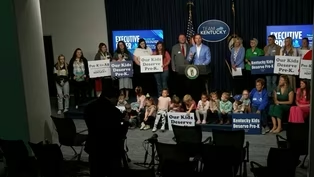
Beshear Launches Pre-K for All Pilot Program
Video has Closed Captions
Clip: S4 Ep381 | 1m 8s | Gov. Beshear launches a Pre-K for All pilot program in two Kentucky counties. (1m 8s)

Record Amount of Unclaimed Property Uncovered
Video has Closed Captions
Clip: S4 Ep381 | 4m 23s | Kentucky's Treasurer has a message for Kentuckians. (4m 23s)
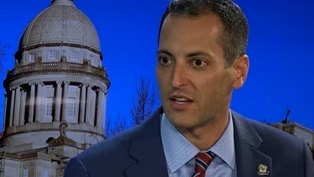
Renewed Calls for State Rep. Grossberg to Resign
Video has Closed Captions
Clip: S4 Ep381 | 55s | A woman says the Louisville Democrat sexually assaulted her in 2005. (55s)
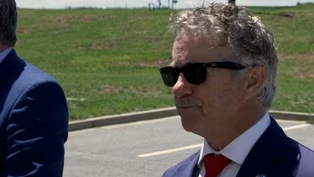
Sen. Paul Discusses U.S. Senate Race
Video has Closed Captions
Clip: S4 Ep381 | 2m 35s | Paul said Daniel Cameron has "best articulated" a message that he can support. (2m 35s)
Providing Support for PBS.org
Learn Moreabout PBS online sponsorship New Episode
- News and Public Affairs

Top journalists deliver compelling original analysis of the hour's headlines.

- News and Public Affairs

Today's top journalists discuss Washington's current political events and public affairs.




 New Episode




 New Season
Support for PBS provided by:
Kentucky Edition is a local public television program presented by KET