
February 20, 2026
Season 4 Episode 327 | 26m 29sVideo has Closed Captions
Democrats say major changes are needed to the GOP-crafted two-year state budget.
Democrats say the state should invest more in its two-year budget plan. Lawmakers advance multiple measures related to elections. The first bill to gain final passage this session is signed into law. Kentucky's federal delegation reacts to the U.S. Supreme Court ruling on President Trump's tariffs.
Problems playing video? | Closed Captioning Feedback
Problems playing video? | Closed Captioning Feedback
Kentucky Edition is a local public television program presented by KET
February 20, 2026
Season 4 Episode 327 | 26m 29sVideo has Closed Captions
Democrats say the state should invest more in its two-year budget plan. Lawmakers advance multiple measures related to elections. The first bill to gain final passage this session is signed into law. Kentucky's federal delegation reacts to the U.S. Supreme Court ruling on President Trump's tariffs.
Problems playing video? | Closed Captioning Feedback
How to Watch Kentucky Edition
Kentucky Edition is available to stream on pbs.org and the free PBS App, available on iPhone, Apple TV, Android TV, Android smartphones, Amazon Fire TV, Amazon Fire Tablet, Roku, Samsung Smart TV, LG TV, and Vizio.
Providing Support for PBS.org
Learn Moreabout PBS online sponsorshipmusic >> That's what the Republicans want, is for people to suffer.
And their plan involves making poor people do co-pays.
[MUSIC] >> Lawmakers task passing a two year budget.
Democrats ask more money for Kentuckians health insurance.
>> In order to purchase things in order to rent equipment or cars a hotel, you have to show a photo I.D.
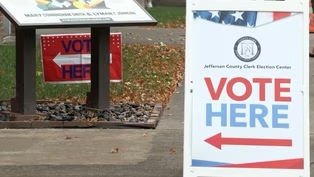
>> Lawmakers look to tighten the state's photo ID rules for voting.
[MUSIC] >> When you read the words common schools and figure that out, it's not a shocker.
[MUSIC] >> And we'll talk about the state Supreme Court's ruling on charter schools as we go inside Kentucky politics.
[MUSIC] >> Production of Kentucky edition is made possible in part by the KET Millennium Fund.
[MUSIC] .
>> Good evening and welcome to Kentucky Edition for this Friday, February the 20th, I'm Renee Shaw, and we thank you for kicking off your weekend with us.
The must do and the biggest task facing the Kentucky General Assembly this year is crafting a two year state budget.
Kentucky House Republicans unveiled their proposed budget about three weeks ago.
State Representative Jason Petrie called it a starting point and a bare bones document guaranteed to change before crossing the finish line, but without any official revisions.
So far, Democrat's public employees and some Republicans say something's got to give our June Leffler has more.
As we kick off tonight's legislative update.
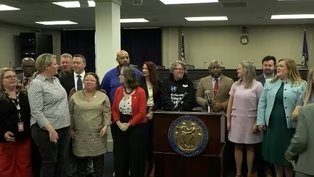
>> Today, House Democrats proposed an additional $2 billion to the current Republican spending bill, House Bill 500.
>> The Republicans budget proposal is wrong for Kentucky.
The majority so-called starting place has held back $1 billion of general fund revenue at a time when Kentuckians desperately need the help.
This morning, House Democrats filed seven amendments to House Bill 500 into a spending plan that helps meet the moment and lifts up all of Kentucky's families rather than pushing them down.
>> That includes hundreds of millions of dollars for Medicaid, rural hospitals, the Affordable Housing Trust Fund, SNAP K through 12 education, and public employee and retiree benefits.
These line items reflect more of what Governor Andy Beshear proposed earlier this year.
>> That's what the Republicans want is for people to suffer, and their plan involves making poor people do co-pays.
So the House Democrats were not for that.
We have the money to fully fund Medicaid, and we intend to see it be done.
>> For the first time ever, we have a Republican budget proposal that threatens to impose a 5% annual cap on the state's contribution to the Kentucky Employees Health Plan.
The state's personnel cabinet issued a warning that this could mean premium increases of up to 78% and with reduced coverage.
Teachers, bus drivers, state troopers and other public servants will pay dramatically more and receive less coverage.
>> We've all been told Republicans have funded education at record levels, but when indexed to inflation, we're actually spending less than we did 20 years ago.
The House Democrats proposal increases SEEK funding, raises the per student amount over two years.
Better funds school transportation and delivers a meaningful educator and support staff pay raise.
>> Some Republicans say they want more from the budget bill to state, Representative Patrick Flannery wrote on Facebook, quote, I wanted to communicate my position on House Bill 500.
In its current form, I would be a no vote.
As a legislator and spouse of a teacher, I am on this plan with my two daughters.
I am confident that necessary changes will be made as this session progresses.
Lawmakers have wrapped 31 days of the 60 day session for Kentucky edition.
I'm June Leffler.
>> Thank you.
June.
So where would the $2 billion come from?
Well, Democrats say the Republicans spending plan leaves more than a billion general fund dollars unused.
And they suggest that they dip into the budget reserve trust fund or rainy day fund, which could fund Medicaid.
Or they propose raising the state income tax on the wealthiest Kentuckians.
There was lengthy debate today in the Senate chambers about election fraud.
Since the year 2020, Kentuckians have needed a photo ID to vote.
There are few exceptions to that law.
Well, today, lawmakers debated whether to further restrict the types of identification that can be used to cast a ballot.
Our Emily Sisk breaks down the argument as we continue our legislative update.
>> Should Kentucky voters have to show a photo ID in order to cast a vote?
Senator Lindsey Tichenor says yes, and her Senate bill 154 would make that a requirement.
The Oldham County Republican explained the rationale behind her legislation.
>> You have to show a photo ID in a variety of places across the state in order to enter buildings, in order to purchase things, in order to rent equipment or cars a hotel, you have to show a photo ID.
>> Senate Bill 154 would restrict voters from using their Social Security card or EBT card as identification, since these methods don't have a photo.
State Board of Elections data showed that in the 2024 general election, nearly 1000 voters used their Social Security card and about 70 people used their food stamps card to vote.
The Senate minority whip argued there was no proof that any of these voters were fraudulent.
>> It makes it harder for people to vote, even though the sponsor, the senator from Oldham, acknowledged in committee that we have no evidence that any of the thousand people who voted using these means of identification in the last election did so fraudulently.
>> The Senate President spoke in favor of the bill, reminding lawmakers of past instances of voter fraud, saying it happens more often than folks might realize.
>> I can remember the day when one of our own members wore an ankle bracelet on this floor.
Having pled to a voter fraud federal offense.
>> A Carter County Republican said.
Until the General Assembly paves the way for easier photo ID access, she couldn't support the legislation.
>> We need to do better in providing the opportunity for ID to the citizens in rural Kentucky.
>> Senator Webb was the only Republican to vote against SB 154.
It passed with a vote of 31 to 7.
Another measure that passed off the floor was Senate Bill 80, a bipartisan effort to restore former inmates voting rights.
The legislation would form a constitutional amendment for Kentucky voters to accept or decline.
>> This amendment provides for automatic restoration of voting rights after the completion of the sentence, and probation for most felony offenses.
>> These individuals are working class people.
There are business owners.
They are taxpayers.
>> Senate Bill 80 passed with a vote of 35 to 3 for Kentucky edition.
I'm Emily Sisk.
>> Thank you Emily.
And Senate Bill 80, which has bipartisan sponsorship, says that anyone convicted of election fraud, violent or sexual felonies or felony against a child would not be eligible to have their voting rights automatically restored.
The first bill to clear this legislative session has now been signed into law.
Governor Andy Beshear signed Senate Bill 172.
It allows utility companies to spread out expenses to help customers avoid some high monthly energy bills.
On social media, Governor Beshear said he was glad the bill passed with bipartisan support, adding, quote, now there's an opportunity to do even more that the General Assembly passes my $75 million proposal to help At-Risk Kentuckians afford their utility bills.
End quote.
The governor is also reacting to the Kentucky Supreme Court's decision to strike down a Pro-charter schools bill.
As we reported yesterday, the state's highest court unanimously ruled that the 2020 bill that created a funding mechanism for charter schools that it violates Kentucky's constitution.
Governor Beshear said, quote, taxpayer dollars should stay with our already underfunded public schools and now they will.
This is a win for our kids and our future.
End quote the full Senate has passed priority legislation to reform home construction in Kentucky.
More on our look back at legislative stories.
We haven't yet reported from the week that we call postscript.
Senate Bill nine aims to ease the housing shortage by creating areas with fewer upfront costs for housing developers.
Republican Senator and Senate Majority Caucus Chair Robbie Mills is that bill's sponsor.
The first part of the bill would create districts where infrastructure costs, like water lines and pump stations, can be financed over time, potentially lowering housing prices and speeding up construction.
The second piece of SB nine would allow local governments to negotiate incentive payments for developers to attract them to build in certain areas.
Both provisions are voluntary and don't cost the state any money.
Also this week, a program created to help juveniles out of the court system could be eliminated under a new bill, the Family Accountability Intervention and Response, or what's called Fair Teams Program, was created in the year 2014.
The goal was to reduce juvenile court involvement through early intervention and enhanced case management.
Speaking before the Senate Judiciary Committee just yesterday, Senate Education Chair Stephen West said the program, though well intentioned, is not meeting that goal and that's why he's introduced Senate Bill 162 to eliminate it.
>> I will tell you, as education chair, we've worked a lot on discipline in schools and over the past 5 to 6 years, my number one complaint from superintendents has been fair teams.
>> 68% of the public offense charges that we took in in Hardin County last year happened at the school.
And so I just want you to know that that that's what the schools and you know, this that's what the schools are dealing with.
Eliminating the fair teams is not to fast track, but to make our process more nimble so that we can see these cases earlier.
It does not eliminate the option for diversion that is still appropriate for many, many students.
Unfortunately.
Specifically students who the school deems are beyond control of the school.
Those oftentimes those students are also going to be beyond control of fair team.
>> Senate Bill 162 passed out of committee by a vote of 7 to 0, with one past vote.
Today was the 31st day of the 60 day session.
We're more than halfway past the midpoint and will review the session thus far and look ahead at what lawmakers have to do for the rest of the way that comes up tomorrow or actually Monday night on Kentucky.
Tonight, some key legislators will join us, and we hope that you'll send in your questions and comments.
Again, that's Monday night at eight eastern, seven central right here on KET.
We have Kentucky reaction tonight after the U.S.
Supreme Court today struck down President Donald Trump's tariffs.
The president used an emergency powers clause to impose tariffs on countries throughout the world.
It was the centerpiece of his economic policy.
The court ruled, 6 to 3 that the U.S.
Constitution did not give the president the power to set and change tariffs, because taxation power clearly belongs to Congress.
U.S.
Senator Rand Paul posted this to social media.
He says, quote, the Supreme Court defended the Constitution by rejecting the use of emergency powers to impose taxes.
Tariffs are taxes, and the power to declare them belongs to the Congress.
This goes beyond this case.
No future administration, including a socialist.
One can use emergency powers to get around Congress and tax by decree, end quote.
This is from U.S.
Senator Mitch McConnell.
He says, quote, as a matter of policy, the empty merits of sweeping trade wars with America's friends were evident long before today's decision.
Kentuckians whose livelihoods depend on auto manufacturing, agricultural commodity markets or demand for bourbon whiskey understand this painful reality better than most.
End quote.
Congressman Morgan McGarvey, a Democrat from Kentucky's third congressional district, blasted the tariffs for their Kentucky impact.
He wrote, quote, from Bourbon getting wiped off Canadian shelves to Louisville families paying $1,300 more just for everyday goods and services.
Kentuckians have been footing the bill for this president's reckless, ego driven trade war.
End quote from McGarvey.
McGarvey also called for the white House to pay back billions to small businesses and families affected by the tariffs.
Reacting to the Supreme Court's decision today, President Trump pledged to impose a new global 10% tariff under a different law that's never been used to apply terrorists before.
Kentucky's sixth district congressman and U.S.
Senate candidate Andy Barr says he fully supports Trump's decision.
At least one of his challengers, former Kentucky Attorney General Daniel Cameron, said the Trump administration still has several tools to enforce tariffs and secure Fayette fair trade deals.
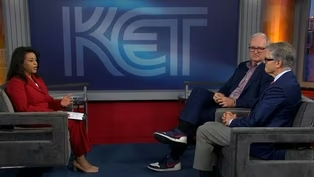
[MUSIC] Time now to go inside Kentucky politics with our two faves, Bob Babich and Trey Grayson, to get caught up on the week's news.
And we got a lot of news to get into in about eight minutes.
So let's let's hit the pedal here.
Kentucky Supreme Court.
Let's start there first.
On Thursday, they said a measure that was passed in 2022 that would have made public dollars go for nonpublic education.
They said that's unconstitutional because it violates this kind of common schools concept.
Tell us about that.
>> Well, legislators passed a charter school law, which we were one of the last states in the country to pass one.
Charter schools allow entities, usually public schools, but sometimes other entities, to charter, educate kids and usually have a little bit less oversight reviews.
But you have to report back your results, Supreme court said.
That is outside.
That is not a public school, even though most other state supreme courts have ruled otherwise.
And so they struck it down, and it was a unanimous decision, which was kind of striking.
>> Did you find that surprising, that it was unanimous?
>> Yeah.
I mean, I thought they probably would strike it down.
The trial judge struck it down in this court seems inclined to very narrowly interpret or maybe, I guess, broadly interpret that part of the Constitution, again, different than other states.
To me.
What's going to be interesting about this is the reaction to the of the legislators, to the court.
I don't know that it will see much this session, but in the future, this might mean Partizan elections, redrawing districts.
There's a lot of frustration among legislators with the Supreme Court for striking down legislation that's been passed.
>> Yeah.
What do you think about this, Bob?
And is that really solved?
The whole are we done with this issue, or could there be other creative ways to get at?
>> You would think so, Renee, at least for this period of time, we put it to the voters.
We've been to the court unanimous decision.
You read the words common schools and figure that out.
It's not a shocker, but there are people angry about it, and they may react to it and change the system to try to get a better outcome.
>> And we know that in Congress, you have, you know, the beautiful bill made some provisions for scholarship tax credits or school vouchers.
>> Or so.
A couple of years ago, this court struck down a scholarship tax credit program in Kentucky under similar when I say court, the Kentucky Supreme Court for similar reasons.
House Bill one, which was filed this week, is an attempt to opt in under the HR one one big beautiful bill provision, which creates a federal tax credit.
But the states have to opt in.
It'll probably set up a court fight as well, maybe not in the Kentucky courts, but in the federal courts, because it says the secretary of state can make the decision.
Which would it be cool to get real power like that.
>> To run again?
>> Yeah.
So it gives the Secretary of State the power to opt in, because I think there's some concern, rightly, that Governor Beshear, who's running for president, would not opt in.
And so this gives the power to the secretary of state.
And my guess is that will create some litigation there as well.
>> Yeah, it's day 31, the day that we tape this program.
And we have not seen a House Bill 500 get a floor vote to even get discussion beyond the budget review subcommittees and some testimony.
Right.
But there seems to be a lot of conversation about the proposed cap on health insurance, right.
Which could result in premiums spiking 78% or a reduction in benefits.
Is that the crux of why this bill is hung up right now?
What's going on with it?
>> So I think that appears to be a big part.
There was a good story.
I think the Herald-Leader wrote about this.
The challenge is the state health care plan as a whole.
The costs are going through the roof.
And so just like employers are trying to figure out how much do we pay and how much do we ask our employees to pay?
Same thing with state government.
And this initial draft of HB 500 has drawn the ire of state employees, retirees, and usually the personnel cabinet secretary wrote a letter.
Not that the administration weighing in, but that the cabinet secretary or a cabinet usually doesn't get involved in those kinds of things.
Wrote in.
My guess is they'll have to fix that to get the bill advanced, because there's a number of Republicans that right now say, I'm voting no on HB 500.
Now we know it's going to be amended, right.
But they're going to.
>> This is the first draft.
And Jason Petrie, who's the budget chair, said that.
>> Right?
Yeah.
But I think they're going to have to fix this sooner than they maybe would have thought, as opposed to trying to fix something, say, at the conference committee version.
>> Right.
What do you think.
>> Senate members say their email boxes are full.
Hundreds even breaking a thousand up to 2000 emails a day from employees who are writing over and over again saying, this is wrong.
Keep probably 5 or 6 years ago actually produced a surplus.
It was.
>> And this is the Kentucky employee health insurance plan, right?
>> Yeah.
Here we are with that not working now.
And it's not working for anybody, not just public employees.
But everybody's rates are going up.
It seems, everywhere every year.
But Monthly a point of contention, right.
>> And it could lead to quite a bit of attrition in the state workforce if this were to go as is.
>> Yeah.
If you don't I mean, at the end of the day, whether you get a salary, you have salary and then you have things that cost money that come out of your salary and you pay for a share of your health care.
So if your share of your payment, health care payment goes way up, it's like getting a pay cut, right?
>> Right.
So another measure that got some attention this week.
House Bill 534 kind of sweeping elections measure.
The Kentucky County Clerks Association testified against this bill.
And this deals with all kinds of things.
>> Yeah, it's there's some campaign finance stuff in there.
There's some things related to judicial.
But the part that got the headlines today was the part where the clerks weighed in.
There are a couple of ways this bill, and actually leans into some of the things we're seeing in other states.
So nationally, some of the stories in election administration involve the citizenship issue and how to ensure Kentucky citizens are not allowed to vote.
They're not allowed to register to vote.
How do we make sure that those lists are accurate and that people aren't doing that?
And so this bill proposes to ask the state board to match data with the federal what's called the save service, which is not a database, but it's a collection of interactions that individuals have had with the federal government where citizenship status is revealed.
So there were some questions, technical questions about how that might work.
Should it?
Should it work?
The second one was there was an emergency clause.
Bill goes into effect April 15th.
>> And the May.
Primary is the 19th.
>> Yeah, I mean, we're we're in the studio and, you know, four weeks later talking about elections, but people are already voting via absentee, right?
There's also some questions about some language that would phase out some of our current voting systems and how well that grandfather clause worked.
And then the last one, and this is, I think, where the clerks were most concerned, was an idea of allowing ballot images to be made public out of transparency.
Transparency is normally a good value, but in elections, particularly in Kentucky, we have some concerns that if ballots became public, vote buyers could take advantage of that, or you could figure out how somebody voted.
We've seen in other states that some of these images have been able to do that.
So balancing transparency to increase trust with elections but making them more vulnerable.
The bill sponsors expressed concern.
Knott expressed willingness to address these issues.
So we'll see how this plays out.
It cleared committee, but there's going to be some work before it goes to the floor, let alone to the.
>> Two former secretaries of state sitting here.
Bob Babich, what do you think about this bill?
Is it a good idea and is it even needed?
>> Well, there's a lot there.
And as Trey says, it will probably be changed a bit.
But one provision is that a judicial candidate running, instead of saying I'm a conservative could say I'm a Republican.
We really don't permit candidates to identify their political party, although most of us can find that out or most of us are aware of their party.
So when you get a unanimous decision by the state Supreme Court, I think it confirms that they're doing their job and doing it effectively.
But that's an interesting turn and an interesting discussion and something that has that kind of sizzle takes over from some of the more academic questions in the bill.
>> Yeah.
Final point 30s Andy Beshear book, go and Do Likewise How We Heal a Broken Country.
Lots of media blitzkrieg this week.
Been on CNN just yesterday with Pamela Brown.
He's actually running for president, although he's not saying he's.
>> He's running for president.
Presidential candidates write books.
Nobody reads the books.
But you write the book, you get the title.
He's got a good title.
He'll talk about the book.
People really don't read these books, but it's what you do when you run for president, which is what our governor is doing.
>> You know, the the disease of division in our country is so great that to put a book together on how to change that will have some audience.
It will be reviewed, it will be noted, some pieces pulled out and used or used not so fairly, but the book only underscores that, in fact, he is a candidate 100%.
>> Yeah, we saw it coming, right?
>> Yes we did.
>> Well, thank you all for always seeing all the things coming.
Appreciate it.
Have a good weekend.
[MUSIC] Colder weather is about to make a comeback.
Womp womp.
But don't let that stop you from enjoying all Kentucky has to offer this weekend and beyond.
Our Toby Gibbs has tonight's look at what's happening around the Commonwealth.
>> Head to Bowling Green and leave Earth this weekend as the Hardin Planetarium presents Planet Quest, Discovering Worlds Around Other Stars, a program exploring how scientists find planets beyond our solar system, and what those discoveries might tell us about the possibility of life elsewhere.
The presentation looks at how far the search has come since the first confirmed discovery in 1992, and what may still be out there.
The event is free.
It's a performance where tradition meets innovation, as Jubilee and Joy green and Beethoven takes the stage Saturday at the Appalachian Center for the Arts.
[MUSIC] The program pairs a contemporary work by composer in residence Brittany Jay Green, inspired by memories of church music and family rhythms with Beethoven's Symphony Number nine.
[MUSIC] Joined by the Lexington Singers, the performance connects voices across time, culminating in the familiar strains of ode to Joy.
[MUSIC] Join the Hive at Mar Park Arboretum as it hosts its annual beekeeping orientation, welcoming new and returning participants to its Bee program.
A seminar includes an overview of Hive management and what to expect during the upcoming season, along with a look at the role native plants play in supporting pollinators.
[MUSIC] It's an exhibit where the artwork is small in scale, but not the creativity.
The tiny Art show exhibit and sale is taking place at the Arts Center of the bluegrass.
The show features miniature works on canvas along with other creative media like mosaics, ceramics and photography, all for purchase.
[MUSIC] The sale takes place this Saturday.
It's your chance to get an up close view of some of Kentucky's flying predators, as the Audubon Museum hosts Raptors of the region, a program focused on birds of prey native to the area, naturalists share what's known and still unknown about these hunters of the sky, with several live raptors featured during the presentation.
[MUSIC] The program is designed for all ages.
[MUSIC] This is one choir that doesn't need pews, just a stage.
The Choir of Man brings its national tour to the EKU Center for the Arts in Richmond, setting its performance inside a pub where singing, storytelling and live music drive the action.
The production blends contemporary and classic songs with movement and spoken word, creating a communal concert style experience complete with a working bar on stage.
[MUSIC] And that's what's up around the Commonwealth.
I'm Toby Gibbs.
[MUSIC] >> Thank you Toby Gibbs.
Join Bill Bryant and a panel of Kentucky reporters for comment on Kentucky.
In about an hour, they'll talk about Governor Andy Beshear, his new book, the court decision against funding charter schools, and the continuing General Assembly session that's happening in Frankfort.
All of that is coming your way at eight eastern, seven central, right here on KET.
It's been good to be with you this week, and we hope to see you again on Monday night at 630 eastern, 530 central on Kentucky edition, where we inform, connect and inspire.
We hope that we can connect with you all the ways you see on your screen, social media channels, Facebook and Instagram.
Send us a story idea by Public Affairs at Keturah.
That's by email, and look for us on the PBS app that you can download on your phone and smart devices.
Have a wonderful weekend to come and I will see you right back here on Monday night.
Take good care.
Bill Looks to Restrict Identification Used to Vote
Video has Closed Captions
Clip: S4 Ep327 | 3m 8s | Lawmakers debate bill that further restricts what forms of ID can be used to vote. (3m 8s)
Bill Would End Juvenile Court Intervention Program
Video has Closed Captions
Clip: S4 Ep327 | 1m 33s | Lawmaker says program to reduce juvenile court involvement is not working. (1m 33s)
House Democrats Unveil Amendments to Republican Budget Plan
Video has Closed Captions
Clip: S4 Ep327 | 3m 41s | House Democrats deliver their budget proposals in response to Republican budget plan. (3m 41s)
Video has Closed Captions
Clip: S4 Ep327 | 8m 35s | Renee Shaw discusses local political headlines with Bob Babbage and Trey Grayson. (8m 35s)
Providing Support for PBS.org
Learn Moreabout PBS online sponsorship
- News and Public Affairs

Top journalists deliver compelling original analysis of the hour's headlines.

- News and Public Affairs

Today's top journalists discuss Washington's current political events and public affairs.












Support for PBS provided by:
Kentucky Edition is a local public television program presented by KET