
February 25, 2026
Season 4 Episode 330 | 26mVideo has Closed Captions
Kentuckians react to President Trump's State of the Union Address.
Vastly different reactions to President Trump's State of the Union Address. Kentucky's two-year budget bill passes out of committee. A state senator wants stiffer penalties for school officials who use public resources for political purposes. A proposal to help inmates receive job training while behind bars.
Problems playing video? | Closed Captioning Feedback
Problems playing video? | Closed Captioning Feedback
Kentucky Edition is a local public television program presented by KET
February 25, 2026
Season 4 Episode 330 | 26mVideo has Closed Captions
Vastly different reactions to President Trump's State of the Union Address. Kentucky's two-year budget bill passes out of committee. A state senator wants stiffer penalties for school officials who use public resources for political purposes. A proposal to help inmates receive job training while behind bars.
Problems playing video? | Closed Captioning Feedback
How to Watch Kentucky Edition
Kentucky Edition is available to stream on pbs.org and the free PBS App, available on iPhone, Apple TV, Android TV, Android smartphones, Amazon Fire TV, Amazon Fire Tablet, Roku, Samsung Smart TV, LG TV, and Vizio.
Providing Support for PBS.org
Learn Moreabout PBS online sponsorshipmusic >> You've seen nothing yet.
We're going to do better and better and better.
This is the golden age of America.
[MUSIC] >> Some agree, some don't.
Reaction ahead to last night's state of the Union address.
[MUSIC] >> I just think it could have some arbitrary application and interfere with one's First Amendment rights.
[MUSIC] >> How should the state limit a school district's involvement in politics?
[MUSIC] >> The short term rentals were creating noise and crime nuisances in residential neighborhoods.
[MUSIC] >> But one Kentucky city doesn't like a bill in Frankfort that aims to limit regulations on short term rentals.
[MUSIC] >> What they will do in this program will mimic the work day once they are released.
>> And while teaching prisoners a trade helped them and help you when they rejoin society.
[MUSIC] >> Production of Kentucky edition is made possible in part by the KET Millennium Fund.
[MUSIC] .
>> Good evening and welcome to Kentucky edition for this Wednesday, February the 25th.
I'm Renee Shaw and we thank you for winding down your Wednesday with us.
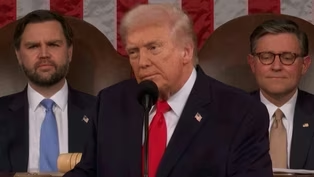
There are vastly different reactions tonight to President Donald Trump's State of the Union address last night, with Kentucky Republicans agreeing with the president's message of renewed American greatness and the state's Democratic governor saying things are getting worse.
Here's part of President Trump's message.
>> Our nation is back bigger, better, richer and stronger than ever before.
[APPLAUSE] You've seen nothing yet.
We're going to do better and better and better.
This is the golden age of America.
>> Here's reaction from the Republican Governors Association.
Quote, every day President Trump is delivering on his promises and reversing the disastrous effects of Biden era policies by bringing down costs, unleashing the economy and securing the border.
He's made it clear that our nation's best days are still to come.
Governor Andy Beshear, who is chair of the Democratic Governors Association, had a different take on his message.
He said while prices continue to rise and Americans struggle to pay their bills, this president remains solely focused on bringing chaos and division to our nation instead of helping families get ahead.
Trump's big, ugly bill is ripping away health care and food assistance.
His reckless tariffs are driving up costs and his administration's dangerous immigration tactics are creating an American body count.
We have comments from three Republicans running for the U.S.
Senate in Kentucky.
Congressman Andy Barr said, quote, with President Trump back in the white House, the state of our union is strong and the great American comeback is underway.
Together, President Trump and I delivered the largest working families tax cuts and border security law in history.
Former Kentucky Attorney General Daniel Cameron said, quote, because of his America First agenda, America is growing again, prosperity is returning, and the American Dream is alive and well for hardworking families.
But there's more work to do.
President Trump needs strong allies in the Senate to deliver on his ambitious agenda.
I'm ready to help turn those priorities into lasting results, and candidate Nate Morris said this to say, quote, we are turning the page on chaos and decline in getting this country back to common sense strong borders, safe streets, energy dominance, an economy that rewards hard work instead of punishing it.
When I am in the U.S.
Senate, there will be no question where I stand.
I will fight to advance President Trump's agenda and help deliver the results the American people voted for.
End quote.
Now, moving on to Frankfort news.
State lawmakers have now subpoenaed the Beshear administration in order to get budget information they say is necessary to create a new.
Two year state budget.
The co-chairs of the Legislative Oversight and Investigations Committee subpoenaed the Kentucky state budget director, the secretary of the Personnel Cabinet, and the Deputy secretary of the Personnel Cabinet.
Lawmakers say they want Kentucky Employee health plan Actuary report studies and recommendations related to the health plan for the years 2023 to 2028.
House Speaker David Osborne says the legislature acted because it lacked necessary data to craft a responsible, informed spending plan.
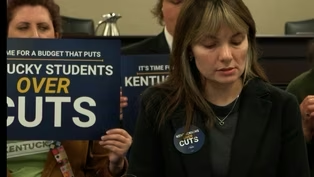
This morning, advocates in the health, education and agriculture community voiced their concerns with the proposed state budget, saying lawmakers are putting tax cuts over the needs of Kentuckians.
Our Mackenzie Spink brings us the criticisms raised and the changes advocates want to see in the budget.
This as we start our legislative update.
[MUSIC] >> The Kentucky Together Coalition says the state budget slashes funding to vital services at a time when federal changes and rising costs already put Kentucky families at risk.
Advocates are particularly concerned about the effects of budget cuts on teachers.
>> So if we have frozen funding, gutted transportation, no raises, no preschool investment, and then on top of it all, a possible 78% Health increase health insurance premium increase on every teacher, bus driver, school employee and retiree.
In the Commonwealth.
>> Several changes to Medicaid are on the table for Kentucky.
Cuts to Medicaid from the federal level will be implemented over the next few years.
And House Bill two, which passed committee yesterday, could change eligibility standards in the state.
Health advocates say now isn't the time to cut the state's Medicaid funding.
>> They simply cannot afford a system that starts asking for $20 co-pays per visit, or to be put on hold when they have to call the cabinet for assistance, because the state won't have any funding to support the needed manpower to handle basic support and application assistance.
>> Potential cuts to Medicaid could impact those with disabilities to an even greater extent.
>> There are some situations that are very daunting, I think, and scary for the disability community and throughout Kentucky.
With these, Medicaid costs can be very costly.
And sitting in a $50,000 wheelchair on a $500 cushion.
And that's actually kind of moderately priced for some medical durable medical equipment that people with disabilities and who receive Medicaid rely upon.
One thing that we say in the disability community, in everything that's going to be said here today, it may not impact you directly, but you're a tab.
You're temporarily able bodied because you're only an accident or diagnosis of someone with a disability.
You might need the services that we're talking about today.
>> With some of the cost of the SNAP program, also known as food stamps.
Shifting from the federal government to the state.
Farmers want lawmakers to know that cuts to Snap could affect their bottom line.
>> Last year at Franklin County Farmers Market, food access programs that support food security for limited income community members that we're administering on our own accounted for $88,000 of total revenue for local vendors.
But we can expect that impact to immediately decrease by approximately 20% if Snap is not sufficiently funded in this budget.
>> Jason Bailey of the Kentucky Center for Economic Policy, a progressive leaning think tank, says the reason these services aren't being funded more is because lawmakers are too focused on hitting benchmarks to lower the state income tax even more.
>> Why would lawmakers want an enormous rainy day fund to climb further to 4.4 billion?
When Kentuckians are harmed by the spending cuts and freezes?
Already described today that this budget contains.
There is only one reason, and that would be to try to hit the triggers in law for more individual income tax over the tax cuts over the next two years.
If lawmakers prioritize more tax cuts over investments in Kentuckians, the benefits go overwhelmingly to the wealthy.
>> Bailey endorsed House Bill 13, a Democrat sponsored proposal that would create a flat 6% tax rate for Kentuckians making over $300,000 a year.
A poll from his organization found that 67% of Kentuckians would support such a measure.
For Kentucky edition.
I'm Mackenzie Spink.
>> Thank you.
Mackenzie.
Now, just before our broadcast tonight, the House Appropriations and Revenue Committee took up a new draft of the two year state budget.
State Representative Jason Petrie, who is chair of the budget panel, started the meeting by outlining the overall budget cuts being proposed.
He then went on to list areas of the budget that are not being considered for cuts.
>> The cuts just broad based percentage cuts 4% in FY 27 and additional 3% in FY 28, with the following being exempted.
Exempted from the cuts percentages, veterans affairs Enoch and judgments.
SEEK Lars list.
School facilities.
Construction.
County cost.
Medicaid benefits.
Behavioral health.
Family resource centers and volunteer services.
Juvenile justice.
Department of corrections, community services, and local facilities.
Department of corrections.
Adult correctional facilities.
Department of corrections.
Local jail support and post-secondary performance fund and along with the 2% salary increment across the executive branch for elected and unelected.
There would likewise be a increase for law enforcement related, and I believe the same is true on fire.
But right now, cleft incentives would go up 2% and 2%.
Also.
>> An amended version of House Bill 500 advanced out of committee tonight.
Its next destination is the House floor.
The Kentucky Education Association issued a statement applauding changes to the budget plan.
While they say they want teacher pay raises and full day kindergarten funding.
They're happy with some of the concessions.
It says, quote, thanks to strong advocacy from Kia and educators across the Commonwealth, the current version of House Bill 500 now includes funding increases for SEEK and student transportation from the last biennium.
Budget house leaders also resolved language that would have caused monthly health care premiums to rise by as much as $500 for educators, state employees, and retirees, end quote.
And we'll have more on the budget tomorrow.
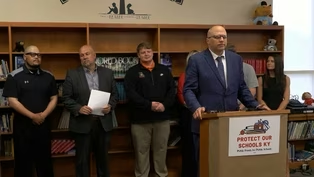
There is still some fallout from the 2024 election over the state school choice ballot measure that failed school officials took heat, then over claims they spent public resources to oppose the measure.
As our June Leffler reports, a state senator wants stiffer penalties, so that doesn't happen again.
>> It's already illegal for public resources like dollars or working hours of public employees to be spent on political issues, but such infractions could result in a $500 fine or a class A misdemeanor on the third offense.
Under Senate Bill 59.
>> This proposed provision to include criminal penalties is not about punishing honest mistakes.
It is about ensuring accountability and deterrence.
When public institutions knowingly misuse tax dollars to influence voters, they undermine both public trust and the fairness of the electoral process.
>> Many school teachers and administrators publicly opposed amendment 2 in 2024, which would have paved the way for public dollars to go to private schools, though teachers unions can get political.
School districts cannot.
>> We saw newspaper articles, social media such as Facebook posts advocating against the ballot measure.
>> In the run up to that vote, Attorney General Russell Coleman issued a warning to school officials but did not pursue any charges.
>> You referenced op eds in your preface to the bill.
I would just ask, just because someone's getting paid with state dollars, would that prohibit them from exercising the First Amendment, resourceful opinion or expertise on the matter?
>> They they can speak on their own time if it is truly their own time.
And I think it would be a high burden of proof, probably to prosecute them for criminal offense.
I think in most instances there wouldn't be a problem in in Northern Kentucky, there was an article in Lincoln KY and other publications.
It had 11 superintendents speak out against the this amendment, and I think that was over the line.
I think that's an example where they they actually were in violation of this statute.
>> What if they collaborated outside of school?
Time to come up with that.
I value my input from my superintendents.
I defer to them a lot of times on education issues and like to hear from them.
And I want to know their opinion.
I just think it could have some arbitrary application and interfere with one's First Amendment rights.
>> The Senate Appropriations and Revenue Committee approved Senate Bill 59, in an 8 to 3 vote.
Two Republicans and one Democrat opposed the measure for Kentucky edition.
I'm June Leffler.
>> Thank you.
June.
Senate Bill 59 now heads to the full Senate for its first floor vote.
A Shelby County Republican is teaming up with the Kentucky Community and Technical College System in hopes of creating a prison education system.
The lawmaker says if more inmates can receive job training, they'll be less likely to reoffend, and it can also help out Kentucky's workforce.
Our Emily Sisk explains the details of House Bill five.
>> It saves Kentucky money.
It prevents crime, and it fills jobs and workforce needs.
>> Kentucky Community and Technical College System President Ryan Quarles laid out the bottom line of House Bill five, which would establish a prison education system in partnership with Kctcs and the state Department of Corrections.
Selected inmates could receive job training and certification while serving out their sentence.
>> HB five is not a soft on crime initiative.
It does not shorten sentences or reduce accountability.
>> Bill sponsor Representative Jennifer Decker says the bill is about reducing the number of inmates who re-offend after their release.
Kentucky currently has about 12,000 state prisoners.
Data shows that 95% of those inmates will be released.
>> They're going to be our neighbors.
So you got to ask, you ask the question, who do you want to be, your neighbor?
Do you want someone who's had opportunity to benefit from our programing and get a job?
>> Kctcs will offer training in areas like advanced manufacturing, welding, carpentry and more.
Inmates who are chosen to participate would be moved to a facility at Northpoint Training Center in Boyle County, which is in central Kentucky.
>> What they will do in this program will mimic the work day once they are released.
>> The Kctcs president said they've already identified more than 302nd chance employers who would be willing to hire former inmates.
Those employers could conduct job interviews prior to a prisoner's release.
HB five received bipartisan support from lawmakers in the House Judiciary Committee.
>> If an ex-con is going to come to my house, I hope it's with my permission, and it's to fix my HVAC or build a cabinet.
So I love this bill.
I love this idea.
>> While HB five doesn't include any appropriations request, it's estimated the new facility would cost $42 million.
The legislation passed out of committee with a vote of 19 to 1.
It now heads to the House floor for consideration there for Kentucky edition.
I'm Emily Sisk.
>> Thank you, Emily.
President Carroll said if the legislation is successful, he hopes to kick off the prison campus program next fall.
One lawmaker wants to make sure those trying to lose weight don't end up losing their lives.
Republican State Representative Vanessa Grasso of Georgetown announced today that she has filed a bill to strengthen state oversight of GLP one compounded drugs.
Those are non-fda approved alternatives to popular brand name weight loss drugs.
House Bill 729 requires anyone buying, storing, compounding, dispensing or administering prescription drugs to comply with federal regulations and gives the state the authority to enforce those regulations.
The bill is named in honor of Jimmy Wilson, a Kentucky woman who experienced acute liver failure and underwent an emergency liver transplant after getting injected with a compounded weight loss medication.
Wilson spoke about the experience at today's announcement.
>> There is no way to fully describe what it feels like.
One moment you're healthy, the next you're facing conversations about survival.
But the experience has also reshaped my perspective.
It has redefined how quickly health can change and how much patients rely on strong safeguards throughout the health care system.
My hope is that fewer families ever have to experience such a sudden, life altering medical crisis, and that we continue strengthening the systems that are designed to protect patients across Kentucky.
>> Representative Grossell points out that the bill does not regulate medical practices or alter a practitioner's scope of practice in any way.
Opponents of anti-lgbtq+ legislation say enough is enough.
Dozens of Kentuckians gathered today at the state capitol for the annual Fairness Rally to encourage lawmakers to reject bills they say would take away their basic human rights.
>> We watch, as so many of our elected leaders try to chip away our rights one by one.
They act like they can legislate us away.
And yet here we are.
And today we make our voices heard.
No matter where we are in the state, we shouldn't live in fear of harassment or being fired from our job, from being kicked out of our homes, or especially from being denied basic medical care because of who we love or who we are.
>> I wanted to be here because we're living in a time where people feel attacked by their own federal government, along with parts of our state legislature.
So I'm here to stay.
I stood with you before.
I stand with you now, and I will stand with you in the future.
>> Tune in tomorrow for more coverage of the Fairness Rally on Kentucky edition.
Short term rental properties have sprung up across the state, usually through companies like Airbnb and Vrbo.
Many cities had to work quickly to determine how to regulate these properties.
A Western Kentucky senator filed a bill to limit local regulations on Short-Term rentals, and some city leaders aren't happy about the legislation.
Our Emily Sisk is back, as she caught up with the Covington reporter to learn how the city could be impacted more.
In our Reporter's Notebook segment.
[MUSIC] >> Joining us now is David Rotenstein, a reporter with the Northern Kentucky Tribune who has done extensive reporting about the presence of short term rentals and Senate Bill 112, which has to do with how cities regulate short term rentals.
David, we want to open up by asking you, what have you found in your research and your reporting about the presence of these short term rentals or maybe Airbnbs, specifically in Covington?
Just how prevalent are they?
>> Sure.
Thank you for for inviting me, Emily.
So in the in the reporting that I've done, which began in late 2025, I've been looking into how Covington regulates short term rentals and what the impacts to Covington's neighborhoods are by the short term rentals.
Through an open records request, I received a table that shows the city having 100 and 136 active short term rental licenses.
Out of those, 136, 42 of those are host occupied, meaning that the the host actually lives on site and manages the property.
And then the remaining 93 are non host occupied.
>> So to talk about Senate Bill 112, because this has to do with, like I said, how cities regulate these short term rentals.
It kind of takes some of the authority away from local governments and makes it easier for these types of properties to exist.
There's less regulations, and you were actually able to speak with the sponsoring senator, Craig Richardson, a Republican from Hopkinsville, about this bill.
What did you learn from him about his mission or his purpose behind the legislation?
>> What Senator Richardson's bill proposes to do is, is assert the property owners rights.
In other words, it's a property rights bill.
He wants to eliminate the regulation of all short term rentals, except for issues that revolve around health and safety.
He thinks that the way that cities like Covington regulate short term rentals is an infringement on individuals property rights.
>> Just to get a better picture for this.
How would a bill like this play out in a city like Covington?
What kind of restrictions does does Covington have right now on these short term rentals that this bill could take away?
>> So Covington experienced an explosion of short term rentals during the Covid pandemic.
And in the couple of years after after the Covid lockdowns ended.
Covington took a deep look at how the short term rental market was playing out in the city and what the neighborhood concerns were towards the short term rentals.
The short term rentals were creating noise and crime nuisances in residential neighborhoods.
They were adding to an already precious supply of on street parking in these residential neighborhoods.
And they were eroding the the stock of available housing in Covington's neighborhoods.
Covington laid out a neighborhood by neighborhood set of restrictions on the number of short term rentals per neighborhood, and the number of short term rentals on specific block faces let's say in the Mainstrasse neighborhood, which is the the Main Street area, the the number of short term rentals would be limited to to say, three per block face.
>> So based on all of that, lots of work that's gone into making those regulations, it seems like city leaders, especially in Covington, are pretty averse to this legislation.
To Senate Bill 112, I know you've spoken to some of them.
What is the basis of their argument against this bill?
>> So first off, it erodes and strips the local government of control over things that are happening in happening in a city.
So when you when you place a blanket law like this across the entire Commonwealth, you're treating Covington the same way.
You're treating Florence, Paducah and many other different communities that have different populations, different economic settings.
And the concerns that I've heard from community leaders and from city officials is stripping that local control would introduce some of the same problems that the city faced right after the Covid pandemic, when they were first battling the the the infusion of short term rentals.
The other thing that that Covington leaders expressed concern about is the cost.
So there's a back end cost.
The the cost to study and then regulate short term rentals, which is something that's already been paid.
And then a potential future cost that cities like Covington will face if they have to revise their zoning codes to, to deal with the limitations placed by this, by this bill.
>> Well, it's certainly a very complex issue.
There's many entities at play here with the legislation and then what's currently going on in the cities.
We know that we'll keep following this.
And and we appreciate your in-depth reporting and the series that you've been doing about it.
David Rottenstein with the Northern Kentucky Tribune.
Thank you so much for breaking this down for us.
>> Thank you for having me.
>> And thank you, Emily.
Senate Bill 112 has not yet been assigned to a committee.
A spokesperson with the Senate Republican Caucus told us that Senator Richardson is still working on the bill.
We'll have more coverage of the presence of short term rentals in the coming days, as we talk with those in favor of and against the bill.
[MUSIC] Coming up tomorrow on Kentucky edition.
Highlights from Governor Andy Beshear weekly news conference and three Kentucky counties face uncertainty as emergency medical service providers announce job cuts.
Those stories and more when you join us again tomorrow night at 630 eastern, 530 Central on Kentucky Edition, where we inform, connect, and inspire.
We hope that you'll connect with us all the way as you see on your screen through the social media channels, Facebook and Twitter.
We invite you to send us a story idea, or just give us a shout out by email at Public Affairs at Keturah.
Look for us on the PBS app that you can download on your smart devices.
And of course, you can stream online on demand some great content at Keturah.
I'm Renee Shaw and I look forward to seeing you right back here again tomorrow night.
Take good care.
Bill Seeks to Limit School District Involvement in Politics
Video has Closed Captions
Clip: S4 Ep330 | 2m 50s | Bill calls for stiff penalties for schools using public money to oppose political issues. (2m 50s)
Group Says State Budget Slashes Funding to Vital Services
Video has Closed Captions
Clip: S4 Ep330 | 5m 56s | Kentucky Together coalition says lawmakers putting tax cuts above needs of Kentuckians. (5m 56s)
Local Reaction to State of the Union Address
Video has Closed Captions
Clip: S4 Ep330 | 2m 34s | Kentucky state leaders react to President Donald Trump's State of the Union Address. (2m 34s)
Measure Creates Prison Education System
Video has Closed Captions
Clip: S4 Ep330 | 2m 42s | Bill sponsor says job training for prisoners benefits them and the state. (2m 42s)
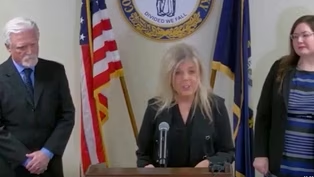
New Bill Targets GLP-1 Compound Drugs
Video has Closed Captions
Clip: S4 Ep330 | 1m 36s | Bill strengthens prescription drug safety and drug compounding oversight. (1m 36s)

Video has Closed Captions
Clip: S4 Ep330 | 5m 57s | NKyTribune reporter David Rotenstein on bill limiting regulations on short-term rentals. (5m 57s)
Providing Support for PBS.org
Learn Moreabout PBS online sponsorship
- News and Public Affairs

Top journalists deliver compelling original analysis of the hour's headlines.

- News and Public Affairs

FRONTLINE is investigative journalism that questions, explains and changes our world.












Support for PBS provided by:
Kentucky Edition is a local public television program presented by KET