
February 13, 2026
Season 4 Episode 322 | 26m 29sVideo has Closed Captions
A bill on religious liberty in medical care passes its first floor vote in Frankfort.
A bill on religious liberty in medical care advances in Frankfort. Kentucky's Secretary of State says county clerks need more money. A look back at deadly flooding that hit the commonwealth one year ago.
Problems playing video? | Closed Captioning Feedback
Problems playing video? | Closed Captioning Feedback
Kentucky Edition is a local public television program presented by KET
February 13, 2026
Season 4 Episode 322 | 26m 29sVideo has Closed Captions
A bill on religious liberty in medical care advances in Frankfort. Kentucky's Secretary of State says county clerks need more money. A look back at deadly flooding that hit the commonwealth one year ago.
Problems playing video? | Closed Captioning Feedback
How to Watch Kentucky Edition
Kentucky Edition is available to stream on pbs.org and the free PBS App, available on iPhone, Apple TV, Android TV, Android smartphones, Amazon Fire TV, Amazon Fire Tablet, Roku, Samsung Smart TV, LG TV, and Vizio.
Providing Support for PBS.org
Learn Moreabout PBS online sponsorship>> And now, for some people, this is the third time they've started over.
[MUSIC] >> We'll look back at floods from a year ago that killed 24 people.
[MUSIC] >> Every single day.
All day, every day.
I have people encouraging me to do it and I'm looking at it.
>> What could be next for Kentucky Secretary of State Michael Adams?
[MUSIC] And how instruments from the past are inspiring stories from World War Two.
>> Production of Kentucky Edition is made possible in part by the KET Millennium Fund.
[MUSIC] .
>> Good evening and welcome to Kentucky Edition for this Friday the 13th, a day before Valentine's.
I'm Renee Shaw, and we thank you for kicking off your weekend with us.
A Religious Liberty in Medicine bill passed its first floor vote in Kentucky Senate today.
As our June Leffler reports, Republicans and Democrats disagree on whether Senate Bill 72 would protect health care workers or harm patients.
More about this as we kick off tonight's legislative update.
[MUSIC] >> A physician in the Senate says fellow nurses and doctors need more say on the job.
>> By simply saying, we value your dedication, your hard work and your professional knowledge.
We respect your individuality, your vision and your value.
>> Under Senate Bill 72, health care workers could refuse to offer any medical care except emergency or sexual assault services for religious, ethical or moral reasons.
If a hospital or clinic resists, the nurse, doctor or other professional could pursue civil damages.
While some agree this bill would safeguard quality medicine from corporate greed, others questioned which patients might be turned away.
>> Could any physician in the state of Kentucky then say, under protection of this bill, that I have a strongly held moral or ethical belief that blacks are inferior to whites, and based upon that, strongly and sincerely held moral and ethical beliefs as defined in this bill, refuse non-emergency treatment to blacks patients.
>> Hypothetical questions can only be given hypothetical answers, neither of which are deemed accurate.
>> This bill now opens the door to law, protected discrimination.
I can't go there, Mr.
President.
I will never go there.
>> Just this past summer, in the state of Tennessee, that there was a young woman who was pregnant and she was not married to her partner and her doctor, upon learning that she was not married to her partner, said, I am not comfortable providing prenatal care to you because you are not married.
And that violates my Christian beliefs.
>> That story has been reported nationally, but there's no confirmation that the doctor did or could have invoked Tennessee's new medical conscience law.
In that situation, the state's leading LGBTQ rights group also says this bill could prevent care for gay and transgender patients.
But Republicans say the law asks what is the procedure, not who is the patient.
>> Procedure being done to a short white guy or a tall black guy?
It doesn't matter.
You disagree with that procedure.
You're not saying it because he is of certain persuasion.
>> Just because a physician or professional relies on a sincerely held belief and they choose not to treat.
I think someone usually in that health system will take up the slack, and those people will be provided services.
>> They shouldn't be forced to participate in surgeries for sexual assignment, but make no mistakes.
If this does start happening, and we do have residents in this state that are denied basic health care because of this bill, we're going to need to take another look at that, because I don't I don't think that's what we want.
>> The vote was strictly along party lines, passing Senate Bill 72 by 28 to 5 for Kentucky edition.
I'm June Leffler.
>> Thank you.
June and other legislative news a new bill that seeks to modernize Kentucky's mental health laws is heading to the House floor.
More in our look back at legislative stories we haven't yet reported on from the week that we call postscript.
On Thursday, the House Standing Committee on Health Services voted to pass House Bill 485, which amends two parts of the current law dealing with mental health.
One involves the involuntary hospitalization of those suffering from a mental health illness.
Under current law, courts either have to hospitalize or release the individual once they're evaluated.
The sponsors of House Bill 45 say it gives judges more options, including ordering them to go to outpatient treatment, take their medication or follow up with their doctor.
The other law deals with the involuntary commitment of those found incompetent to stand trial for certain violent crimes.
Among the changes in the bill, revising the criteria for involuntary commitment and adjusting the timelines for evidentiary hearings.
Speaking in favor of the bill today, Kirsten Russell of Louisville, who's mentally ill brother, killed her mother in 2018.
Russell says multiple hearings have forced her and her family to continually relive the tragedy.
>> The years that have followed since this tragedy, my family and I have endured the grueling legal process we never fathomed because he was found incompetent to stand trial in a criminal court, we had to go the route of civil commitment.
What this has entailed is evidentiary hearings every six months, with him being able to choose to have a jury once a year if he wants one, which he does.
I have taken the stand each time to identify his voice on the 911 call, in which you hear him asking my mom, whom he had already killed, what her address is to say this is a form of torture is an understatement.
We are being victimized each and every time we have to go to court and face him and relive the worst day of our lives.
>> The bill sponsors say it was a collaborative effort that involved judges, prosecutors, defense attorneys, mental health practitioners and advocates, and the state health cabinet.
The bill now advances.
[MUSIC] Kentucky's top election chief has an item or two to add to state lawmakers to do list in the remaining 32 days of this year's legislative session one a pay raise for county clerks and two outlawing the impersonation of elections officials.
In part two of my interview with Kentucky Secretary of State Michael Adams, he talks about those priorities and what political posts the term limit official is eyeing next.
First, we pick up on the possible impact of artificial intelligence in our elections.
Let's talk about AI, since we're talking about it in so many other spaces and sectors.
What are the opportunities or threats to election security as we understand AI now and how it could evolve?
>> So AI is is a tool.
You know, it's like the internet or anything else.
There's going to be a lot of good and a lot of bad that comes from it.
It's not inherently benign or inherently malignant.
The trick is, can you get the best out of it?
Bigger states than ours, with bigger budgets, honestly, than ours, are already using AI in a positive way to automate functions, to be able to have smaller offices with fewer staff and perform more services.
With AI, like chatbots, you think of AI as being, you know how in the movie 2001, but it can be a chatbot.
It's just that simple for us.
We've run the numbers, and right now we don't think that the current cost of AI is worth accepting because the savings isn't isn't going to counteract it.
That may be a different decision for my successor.
Someday the cost may drop.
It's like big screen TVs.
They're super expensive and now everyone's got them, right?
>> Right.
>> Yeah.
So right now we're not we're not using it, but it's not because we're afraid of it.
It's just it's too expensive right now.
But there is a sunny side to it.
The darker side of it is, of course, the deepfakes.
And I have asked the legislature, and I'm continuing to ask the legislature to make it an election offense to impersonate, whether it's the secretary of state or a county clerk, any election official, and put out false information about our elections.
I'm sure you remember two years ago someone put out a deepfake robocall of Joe Biden that was very convincing with the president at the time saying, don't vote in the New Hampshire primary.
Save your vote for November.
That's the kind of mischief that could really impact low information voters and change an outcome.
So I think it's really important that we get that done.
>> Yeah.
What pieces of legislation are you either advocating for or maybe playing defense on that the General Assembly is considering at this particular point.
>> So this has been a relatively quiet session generally and on elections as well.
I'm not complaining.
I've had six really busy sessions with election legislation.
The biggest thing for me, I'm not asking for more money for myself, but I am asking for more money for the county clerks, the funding formulas that we have in the law were written 40 years ago, and it's dollar amounts that are set by statute, and they just don't reflect the cost of running elections in the 21st century.
If you want more security, you have to spend a little more money to make sure that you have that.
So I have asked that the clerks get that money.
This is not a good session asking for money.
Money's really tight right now.
But my biggest priorities are, number one, funding for the clerks to hire poll workers and to rent locations.
It's getting harder and harder every year.
And of course, the deepfake technology bill as well.
>> Open primaries for it or against it.
>> I've been for it for years really from from almost day one.
To me, it's absurd that we have independence, the fastest growing voter bloc in Kentucky even close.
We have them out registering Republicans in in many months.
And they're taxpayers and and they are not allowed to vote in elections.
That's crazy.
And the primaries are becoming more and more important because increasingly because of polarization, we have red places getting redder and blue places getting bluer, and the primary becomes the general.
So we should we should welcome our voters into that process.
What I've proposed, not formally, but I've said in media interviews, is it might be a big ask to just change the law that dramatically right now.
Maybe what we ought to do is make it voluntary and let the parties decide.
If you want to have an open primary, it's your party's decision and your party can decide.
We're not going to force it on you.
My guess is one of the two parties would do that, and the other party would see that happen and say, we should do that too.
It's in the it's in both parties interests to compete for voters.
Neither party has a majority of voters.
Republicans have 48% now, which is better than it used to be.
But it's not a majority.
Nobody can win unless they pick off voters who aren't part of their own comfort zone.
>> There's always concerns about the interlopers, right, who have nefarious actions to do detriment to particular nominee or possible nominee.
>> Look, I wouldn't have wanted Democrats voting in my primary Steve would be the secretary of state right now if that had happened.
I'm not for mischief.
I'm not for letting D's vote in our primaries and vice versa.
I'm not for that.
>> So when we talk about open primaries, what's the working definition of that?
>> Letting independents pick which party they want to vote in.
That's what New Hampshire does when you vote for president.
New Hampshire, if you're a Republican, you get to vote in the Republican primary.
Democrats get to vote in their primary.
Independents can decide which one they want to vote in.
And both parties actively encourage the independents to come join them and be part of their process.
Pay attention to their candidates.
Get invested.
Right.
It helps them in the general election, right?
>> Because some people think when they think of open primaries, oh, well, I'm a Republican, but I really do want to have a say in who's going to be the Democratic nominee for U.S.
Senate.
Let's just say.
>> I really yeah, I don't want gamesmanship.
And states that have fully open primaries don't even have Partizan registration.
I'm not advocating that.
I'm advocating is that independents are growing quicker than anybody else.
They're they're politically detached, and whichever party supports them is going to win the election.
So let both parties court them.
>> As you mentioned, this is your seventh go round.
So this means, you know, you're a term limit.
>> The hang of it.
>> You're getting the hang of it.
You're just settling in.
Get your groove right.
So now that you're just getting your groove, what are you going to do after this?
>> I haven't decided yet, but I'm considering a lot of different options.
>> What are the options you're considering?
>> Retirement is an option.
I'm looking at running for governor as well, but right now we have a Senate race going on.
I won't make any decisions until at least this primary is over in May.
>> Why?
Governor, as a consideration.
>> Honestly, I don't think I am a good fit for anything else right now.
I think my style of approach of of being a rational, intelligent person and being fact based is State office is a better fit for that than federal right now.
>> What do you think your chances are in a primary against a James Comer, perhaps?
>> I think they're pretty good.
I won't know until I pull it, which I'll be doing later this year, but I think every single day, all day, every day, I have people encouraging me to do it.
And I'm looking at it.
>> Yeah, well, perhaps many people would think that if you can survive the primary, you'd have a pretty good shot in the general because you have been bipartisan and moderate by most measures.
>> Yeah.
And I'm the only person talking about state issues.
I've got this lane all to myself.
No one else even talks about it.
They talk about the outrage of the day on social media or whatever.
And I think Kentucky voters have shown that they want an adult in the room, in the state capitol, in the center office, and they don't have a lot to pick from right now.
>> But do you think, should you get to that point, that you would have to get into the culture war conversations and things that you haven't had at this point to engage in?
>> I think voters want authenticity, and I think that's why they like President Trump.
They see him as sui generis and authentic.
I'm a different personality type than he is, but I'm authentic and I'm the only person who's not a bootlicker and thinking for myself and be my own man.
I think voters like that.
>> Well, thank you, Secretary Michael Adams, thanks so much.
Good to talk to you.
Thank you.
[MUSIC] This weekend marks a somber anniversary.
It will be one year since deadly widespread flooding hit the state.
Our Toby Gibbs takes a look back at the disaster.
>> We just got hit by one of the most significant natural disasters we've seen in our lifetime.
And that's after seeing a lot of significant disasters.
>> Heavy rains began pouring down on the state starting the evening of February 14th, not letting up until two days later.
The National Weather Service issuing a rare high risk for excessive rainfall warning, with widespread rainfall totals ranging from two inches to more than six inches in some areas, the heavy rainfall combined with melting snow, pushed preliminary crests on dozens of river sites to historic levels.
All of Kentucky's 120 counties reporting flooding, people forced from their homes on both ends of the state.
>> Throughout the day, the water kept getting higher.
It came up to about 40ft.
I was definitely surprised.
I really couldn't believe it when we saw it.
>> We noticed that the water was extremely high as far as closer to the house, and it was at the point that if we didn't leave shortly after, we wouldn't be able to get in or out.
So we kind of sort of grabbed what we could grab and loaded it up and left.
>> The disaster claimed 24 lives, including that of a mother and her child in Hart County.
>> Car got stuck, ended up being swept away into the tree line.
>> Our community is devastated.
Really devastated by this.
>> More than 1000 rescues performed, hundreds of roads closed, almost 20,000 structures damaged or destroyed.
>> We're seeing of homes that are on the riverbank that have collapsed and fallen in major water lines that didn't collapse before, collapse now, and pulled out and shut down entire cities because the water line was fell out.
>> Some eastern Kentucky counties still trying to recover from devastating floods in 2021 and 2022.
Underwater.
Again.
>> This storm is much more extensive than the July 28th, 2022 flood event as far as Pike County.
This was different than even that storm because this involved both the Tug Fork and the Levisa Fork of the big Sandy, both exceeding cresting well past flood stage.
>> It's really difficult to have this happen to us now, because we have just almost recovered from the previous flood to do it all over again.
>> And now for some people, this is the third time they've started over, some of them in the same place, and unfortunately some of them have moved every time.
It is a huge impact on the mental health of our survivors.
>> Despite the devastation.
>> We've kind of made the hashtag Breathitt strong because this is our third time and we will come back from this and we hope to come back stronger, better prepared.
And we've kind of said it from day one.
We want to build Breathitt back better.
>> For Kentucky Edition.
I'm Toby Gibbs.
>> Thank you.
Toby Gibbs coming up on Monday, hear from one woman who survived two flood disasters in eastern Kentucky, and the help she and others are getting to move out of harm's way.
[MUSIC] Violins of Hope brings together the healing power of music with the painful stories of World War Two, made up of 100 instruments that were owned and played by victims of the Holocaust.
It's a memorial to all those who were lost, and an educational experience to help the audience learn from the past, hear the stories behind the strings.
In our Arts and culture segment we call tapestry.
>> We never intended it to be what it is today, but in the past few years, especially when we started doing lots of educational programs and looking and seeing what's going on in the world today, cultures, history, education is more important than what people think.
Usually when we learn about the Holocaust, it's about the numbers and the fights and the battles.
And I mean, can you grasp what does it mean 50 to 70 million people dead in a matter of six years?
Probably not.
But you can relate to a story of a person that you heard his name, and he was going from point A to point B to point C with his family, or without surviving or dying.
It's something you can understand.
It can be your next door neighbor, your cousin or family from a different place, or someone from down the road, but it brings it closer to us.
It makes it, in a way, a bit more reality than just the numbers.
[MUSIC] >> I think in a way it reframes the music in a different way that maybe they haven't thought about before, like music, maybe as a means of survival, or music as a way of maintaining one's dignity or.
As a way to resist.
[MUSIC] >> It's really interesting to see these these instruments with their own unique stories about where they came from and the amount of history between each instrument.
Because normally what you hear from the instrument is what you think of the instrument.
But behind these instruments is an actual story, like where they came from, who was owned by them.
That doesn't really get translated among a lot of other instruments.
You don't really get to see that side of them.
>> It makes history come alive for them.
You know, like they've they've studied World War Two, the Holocaust, you know, and their social studies classes.
And they come to me and they play on their instruments.
But to put that together in this very real way, I think it's very impactful and brings that history to life.
>> We are not going to have survivors for much longer.
Those who are still alive, most of them were kids during the war.
It's a different type of memory and experiences, and these instruments are telling the stories of their owners about what happened to them, what was going on in the world, different stories from different places of different people, different experiences.
And this is something that we all have to learn not to make the same mistakes again.
>> The violins for Hope concert, in conjunction with the University of Kentucky Symphony Orchestra, is tomorrow night at 8 p.m.
Eastern Time with an educational pre-concert lecture at 630.
Well, enjoy the milder weather by enjoying some of the great activities on tap all across Kentucky.
Our Toby Gibbs has the list and this week's Around the Commonwealth.
>> The life of well known human rights activist and Holocaust survivor John Rosenberg is taking center stage in Prestonsburg.
The one man play, Stumbling Stones The John Rosenberg Story, traces his life from the Holocaust to his arrival in Kentucky and the founding of the Appalachian Research and Defense Fund, or Apple Reed.
The performance coincides with the 55th anniversary of the Legal Aid Organization.
[MUSIC] It's Love in the Wild in Henderson this Valentine's Day, as the John James Audubon State Park hosts a sweethearts hike, take a naturalist led one mile hike while hearing nature's love stories.
The event is free and open to all ages.
[MUSIC] The Muhammad Ali Center is throwing open its doors this Saturday for a community free day celebrating Black History Month.
[MUSIC] In addition to free admission to the center, there will be an intergenerational panel discussion and a Black History Month film series screening of The Woman King with a post-film discussion.
Looking for a trip back in time?
[MUSIC] Head to the Mary Todd Lincoln House as it hosts a President's Day family event with games and hands on activities inspired by the Lincoln family.
[MUSIC] The event is free.
This Valentine's Day.
The love story has a soundtrack.
The band exile opens its 2020 tour schedule with a Valentine's Day show at Renfro Valley.
The band will perform songs from its six decade career that crosses both pop and country charts, including its best known song, Kiss You All Over.
History makes its way out of the attic for the Beringer Crawford Museum's new exhibition, opening this Saturday.
Treasures from the attic 250 Years of Fashion and Furniture looks at how everyday objects reflect work, style and daily life across generations, encouraging visitors to examine construction details, fabrics and tool marks as historical clues.
In celebration of the 100th anniversary of Black History Month, Berea College Hutchins Library's Special Collections and Archives is inviting the public to explore its black history holdings, with exhibits and programs highlighting underrepresented stories from Madison County and Appalachia.
[MUSIC] Archive tours each Friday give visitors hands on access to materials.
[MUSIC] This event is all about getting a grip and holding on for dear life.
[MUSIC] See the nation's best bull riders in action.
As the Professional Bull Riders Association brings its Pendleton Whiskey Velocity Tour to Rupp Arena.
40 riders start the event tonight, with the field narrowing as the weekend continues.
[MUSIC] And that's what's happening around the Commonwealth.
I'm Toby Gibbs.
[MUSIC] >> Thank you.
Toby Gibbs comment on Kentucky is coming your way.
In about one hour, Bill Bryant and a panel of Kentucky reporters will talk about Governor Andy Beshear, nation media blitz and the race for the U.S.
Senate and the week in Frankfort.
That's all coming your way at 8:00 eastern, seven central, right here on KET.
And then on Monday night, we want to invite you to join us for Kentucky tonight at 8 p.m.
eastern, where we talk about education again.
The education commissioner, Doctor Robbie Fletcher, will be among the guests.
So you don't want to miss that conversation on Monday.
But in the meantime, we hope you have a great weekend, a lovely weekend this Valentine's Day weekend.
And then come back to us Monday night at 630 eastern, 530 Central on Kentucky Edition, where we inform, connect, and inspire.
We hope that you'll subscribe to our Kentucky Edition email newsletters and watch full episodes and clips online on demand at ket.org.
You can also find us on the PBS video app that's on your mobile device and your smart TV that you can download there.
We always encourage you to send us a story idea by email.
The address on your screen Public Affairs at Keturah and look for us on the social media channels Facebook and Instagram to stay in the loop.
Have a great weekend to come and we will see you right back here again Monday night.
Take really good care.
[MUSIC]
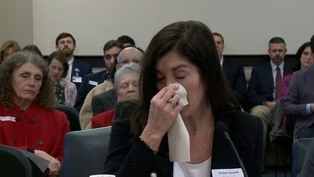
Bill Seeks to "Modernize" Mental Health Statutes
Video has Closed Captions
Clip: S4 Ep322 | 2m 25s | House Bill 485 would update state statutes on mental health. (2m 25s)
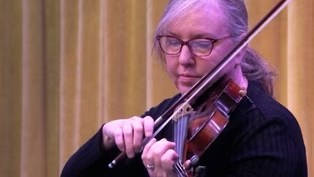
Instruments From the Past Helping Tell Holocaust Stories
Video has Closed Captions
Clip: S4 Ep322 | 3m 38s | Violins of Hope uses instruments to shares stories of World War II Jewish musicians. (3m 38s)
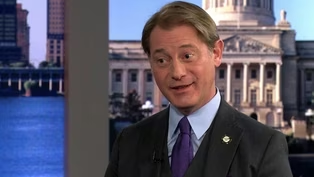
Kentucky Secretary of State Outlines His Legislative Asks
Video has Closed Captions
Clip: S4 Ep322 | 7m 39s | Secretary of State Michael Adams says he wants to see payraises for county clerks. (7m 39s)
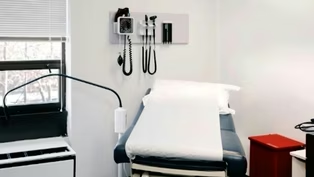
Religious Liberty in Medicine Bill Advances in Frankfort
Video has Closed Captions
Clip: S4 Ep322 | 3m 33s | Bill allows providers to deny services based on religious beliefs. (3m 33s)
Providing Support for PBS.org
Learn Moreabout PBS online sponsorship
- News and Public Affairs

Top journalists deliver compelling original analysis of the hour's headlines.

- News and Public Affairs

FRONTLINE is investigative journalism that questions, explains and changes our world.












Support for PBS provided by:
Kentucky Edition is a local public television program presented by KET