
April 14, 2026
Season 4 Episode 364 | 26m 31sVideo has Closed Captions
Lawmakers override dozens of vetoes on day 59 of the Kentucky General Assembly.
Lawmakers override Gov. Beshear's line-item vetoes of the state's two-year budget bill, priority education legislation and the General Assembly's attempt to cut costs and implement federal changes to Medicaid. Also, what's next for the Senate impeachment trail of a Fayette County judge.
Problems playing video? | Closed Captioning Feedback
Problems playing video? | Closed Captioning Feedback
Kentucky Edition is a local public television program presented by KET
April 14, 2026
Season 4 Episode 364 | 26m 31sVideo has Closed Captions
Lawmakers override Gov. Beshear's line-item vetoes of the state's two-year budget bill, priority education legislation and the General Assembly's attempt to cut costs and implement federal changes to Medicaid. Also, what's next for the Senate impeachment trail of a Fayette County judge.
Problems playing video? | Closed Captioning Feedback
How to Watch Kentucky Edition
Kentucky Edition is available to stream on pbs.org and the free PBS App, available on iPhone, Apple TV, Android TV, Android smartphones, Amazon Fire TV, Amazon Fire Tablet, Roku, Samsung Smart TV, LG TV, and Vizio.
Providing Support for PBS.org
Learn Moreabout PBS online sponsorshipmusic >> The only thing more satisfying than passing a good bill once is to pass it twice.
>> Republicans in Frankfurt worked to overturn gubernatorial vetoes as the 2026 session enters its final days.
[MUSIC] >> We should prioritize stability and results, not broad, uncertain overhauls.
>> Change is coming to the Jefferson County Public School Board as an overhaul plan gets a final okay.
>> In many cases, it is a matter of life or death.
[MUSIC] >> And critics of a Medicaid bill say it will have dire consequences in Kentucky.
[MUSIC] >> Production of Kentucky edition is made possible in part by the KET Millennium Fund.
>> Good evening and welcome to Kentucky edition for this Tuesday, April the 14th.
I'm Renee Shaw coming to you from our KET studios in the Capitol Annex in Frankfort.
We thank you so much for joining us.
State lawmakers are back in Frankfort for day 59 of the Kentucky General Assembly regular session.
They're coming off a ten day veto period.
And today they quickly got down to business, overriding dozens of Governor Andy Beshear vetoes.
That includes the governor's line item veto of House Bill 500, the more than $31 billion, two year state budget bill.
In his veto message, Governor Beshear repeatedly said the budget bill includes unfunded mandates.
He also vetoed several sections that he says would place financial limits on the state's ability to respond to natural disasters.
Some Democrats in the House shared those same concerns.
>> We really love to criticize the executive branch when they're not doing things the way that this General Assembly has has envisioned that they should be doing it.
But when we don't fund things appropriately, they have to make hard choices.
And so just flipping through here, we have unfunded mandate upon unfunded mandate, and that's on top of ones that have been going on for years.
And the Kentucky Commission on Women has never had an appropriation up.
So there are all of these pieces that we want our executive branch to continue to be able to operate, but we're not funding them.
That money comes and that operational cost comes from somewhere, and it takes away from the other services that we also want our executive branch to perform.
>> But the part I'm concerned about is not funding disaster relief and forest fire relief.
Few years ago, we had devastating tornadoes in western Kentucky, and the state sent help out of our budget.
But this budget has constrained what we can send for disaster relief.
>> In response, Republican leadership said the governor's explanations for many of his line item vetoes in House Bill 500 are flawed, and they contend the state budget passed by the General Assembly reflects a, quote, disciplined approach to government spending.
>> Well.
>> Remind everyone that, as we have said in the past, that if we don't specifically line items, something, it is believed that it is in the base.
There is enough money there to cover the cost of that program or whatever it is that we are putting in, and no additional funding is needed.
The governor continues to quote Fletcher versus the Commonwealth incorrectly, as as we have pointed out many times on this floor, Fletcher versus the Commonwealth, again, was when this General Assembly left without passing a budget, the Supreme Court said when in that case, that the governor could just not use money to pay for things, it had to be appropriated.
However, in that same opinion, they went on to say that if the General Assembly leaves here passing a budget, that it is his requirement to follow the law as it is written by the General Assembly to the best of his ability, with the money that he has given.
The lady from Jefferson spoke about previous disasters.
I would remind everyone that those recovery efforts that were done a few years ago were paid for with cash.
For the first time in this state's modern history, over $1 billion, which we inherited.
The budget when we came in would have broke us because there was no money in the budget reserve trust fund.
This state is in a great position now.
>> The House voted strictly along party lines to override all but six of the governor's 88 line item vetoes in House Bill 500 late this afternoon.
The Senate did the same, but not before members of both parties shared some of their frustrations.
>> As I look at the vetoes that have been offered line by line in certain areas, in fact, some vetoes apparently we agree with.
I find a lot of unfunded mandates.
I find reductions, and I find arguments that suggest that this creates unintended, potentially at least unintended consequences.
>> The chairman of the House Appropriations Committee said, tell us what's in the base.
I'm talking to the public now.
Press here.
Tell us what's in the base.
Governor, do you want.
The response was, no, we're not going to tell you.
Give us the documents.
No, we're not giving you the documents.
We were told, oh, wait a minute, you all didn't fund that.
That wasn't a priority.
Guess what?
It's in there.
Now you know what the priority is.
>> With most of the governor's vetoes of House Bill 500 having been overturned in both chambers, the state's two year budget bill is now finalized and will go into effect on July 1st of this year.
Now, in other news, the Senate's priority education bills are on track to become law.
Our Mackenzie Spink explains the changes soon to come to Kentucky's two largest public school districts.
>> Senate Bill one takes away operational powers from the Jefferson County School Board and gives them to the superintendent.
Supporters say this change is necessary to turn around the district's performance.
A similar bill passed in 2022, but was overturned last year by the Kentucky Supreme Court for singling out Jefferson County.
This year's bill outlines why Jefferson County is a special case.
But in his veto message, the governor said the bill still violates the Kentucky Constitution.
>> As the governor has pointed out, the bill is special legislation that violates section 59 and 60 of the Kentucky Constitution by applying only to the Jefferson County School District and treating it differently from all other public school districts in Kentucky, the governor has rightly cautioned that these changes create unnecessary disruption without clear benefit, and we should prioritize stability and results, not broad, uncertain overhauls.
>> Senate Bill four targets both Jefferson and Fayette County school boards and goes into effect immediately.
It shrinks the Jefferson County School Board from seven members to five, which is the same number of school board seats in other districts.
The bill also prevents school employees who work 100 days out of the year from being on the board.
>> The bill would reorganize the Jefferson County Board of Education by changing its membership from seven members to five and diminish representation of voters.
I might point out that in that legislation also designates the precincts by which those districts will be organized.
The bill also improperly targets large school districts by prohibiting people from serving on these boards if they are employees of any school district in the Commonwealth and work more than 100 days per year.
Of course, our dedicated teachers and school employees work more than 100 days per year, and this would effectively keep harm.
I'm sorry, effectively keep them from from serving on these boards of education effectively.
>> This measure would prohibit Fayette County School Board Chair Tyler Murphy from continuing to serve because he teaches in another district.
The Senate and the House overturned the governor's veto largely along party lines for Kentucky edition.
I'm Mackenzie Spink.
>> Thank you.
Mackenzie, on the higher education front, House Bill 490 makes it easier for universities to fire professors, even those with tenure, for financial reasons.
It, too, was finalized by state lawmakers today who overwhelmingly voted to overturn the governor's veto.
In other policy matters, House Bill two is Kentucky's attempt to cut costs and implement federal changes to the Medicaid program.
Governor Andy Beshear vetoed the priority bill, but state lawmakers are reaffirming their action to see it become law.
Our June Leffler explains.
>> Democrats say low income Kentuckians will have to jump through more hoops to prove they still need state sponsored health insurance under House Bill two.
>> In many cases, it is a matter of life or death.
>> Changes include more frequent paperwork and community engagement or work requirements.
>> Kentuckians will have to undergo those.
The six month eligibility checks it sets up in.
It really results in people having to work twice as hard to.
To stay enrolled in Medicaid.
>> Life tends to be messy at times, and sometimes when you are working or you lose your job in transition, there are a lot of things that happen that make some some of what we are offering very, very difficult.
>> A State fiscal note bears these concerns out.
The bills cost analysis finds that community engagement requirements would kick nearly 14,000 people off Medicaid expansion over the next two fiscal years.
More frequent eligibility requirements would do the same for nearly 19,000 people in fiscal year 2028, though these changes would save the state $47 million.
But these changes also largely reflect new federal rules already coming down the pike.
Governor Andy Beshear vetoed House Bill two for these requirements and other reasons.
His administration is responsible for administering the program and says the state legislature left Medicaid $2.8 billion short to implement such changes.
House Bill two sponsor says the state Department of Medicaid Services, or DMs, needs new guidelines.
>> I think we demonstrated time and time out that there's a lack of oversight, a lack of accountability, a lack of responsibility from the DMs in terms of maintaining the waiver and the Medicaid program.
>> The House and Senate voted today along party lines to override the governor's veto and keep House Bill two, as is.
The bill came after much negotiation with the Senate, delaying when changes would go into effect for Kentucky edition.
I'm June Leffler.
>> Thank you.
June.
One of the later changes to House Bill two, a pilot program to help those who do end up losing their Medicaid coverage.
That's estimated to cost $10 million over two years.
In other news, the Kentucky General Assembly also acted on a handful of measures related to gun rights and crime that the governor struck down.
Our Emily Sisk runs down the latest on those bills.
>> House Bill 312 would lower the age requirements for concealed carry a weapon from 21 to 18.
The governor vetoed this piece of legislation, saying those under the age of 21 would be allowed to carry concealed deadly weapons, but not legally able to purchase them.
A Louisville Democrat backed up the governor's stance.
>> You have to be 21 years old to purchase a firearm from a licensed dealer.
The caveat there is a licensed dealer.
You can own it at 18, you can't have purchased it, but you can own it.
And now we're telling people you can conceal carry.
If we're following the numbers, we're not going in the right order.
And this doesn't make sense.
I will also remind this body, as well as other individuals, that our young people's brains are not fully formed until about age 25 or 26.
>> Despite objections from members of the minority party, the House overrode the governor's veto on HB 312.
The Senate did the same with Democrat's, making similar arguments for why the veto should stand.
>> The governor's absolutely right to say that we're going in the right direction by reducing crime and by reducing violence, and we should not allow 18, 19 and 20 year olds to have these guns concealed that risk.
The progress we have made in this state.
>> This is one of the worst bills we're going to pass this session.
It will cost lives.
And I will will beg the members of this body to consider that.
>> Another bill related to gun rights is House Bill 78.
This measure would keep a gun manufacturers and sellers from being sued for crimes involving firearms.
A Frankfort Democrat said she didn't believe the legislature should be shielding gun manufacturers from legal action.
>> This bill risks stacking the legal system against victims instead of protecting them when someone is harmed.
Our laws should not make it harder for victims and their families to seek justice.
Accountability matters, fairness matters, and public confidence in our justice system matters.
>> The Republican supermajority in both the House and Senate overrode the governor's veto of HB 78, and it will go into effect immediately.
Lawmakers also acted on a measure related to the Department of Corrections and the death penalty.
Senate Bill 251 would no longer require the Kentucky Department of Corrections to enforce administrative regulations when it comes to the death penalty.
Supporters of the bill say this measure would help Kentucky move toward resuming executions, but the Senate minority floor leader sided with the governor, saying the legislation bypasses established legal procedures.
>> As outlined in the veto message.
This bill risks undermining effective oversight and introduces changes that would weaken accountability.
We should be strengthening, not diluting, the systems that protect the public.
>> The Senate overrode the governor's veto of SB 251 on a 32 seven vote for Kentucky edition.
I'm Emily Sisk.
>> Thank you.
Emily.
The House now will also have to consider overriding the governor's veto of SB 251 before it can become law.
We could be days away from Judge Julie Goodman's impeachment trial in the Kentucky Senate.
The House voted to impeach her in March on claims of judicial misconduct.
Now she's a judge in the Fayette Circuit Court.
Last night on KET Kentucky Tonight, we talked about how the Senate could try Judge Goodman even though the session is supposed to end tomorrow.
>> We are not in any way going to preclude ourselves from starting sometime after the 15th.
>> Okay, so does that mean the session adjourns?
>> It adjourns.
If we go forward, it adjourns only to the aspect that we cannot consider any more legislation.
But the Senate can stay in session as long as it takes to do an impeachment hearing.
>> But the House would be adjourned.
>> They would.
>> We had no choice but to adjourn on midnight, April 15th.
That said, our prosecutorial committee that will prosecute the impeachment will remain and prosecute.
And I will tell you that they they are fully prepared to to remain in prosecute the impeachment.
>> So last week, there was a press release sent out from the Senate majority's office that mentioned several dates, and it would start on the 16th and 17th.
And then the judge Goodman could make her defense some days after.
And then by April 24th, there seemed to be almost a conclusion that could be rendered at that time.
Are you still sticking to that schedule.
>> At this time?
We are, but we also know because of work that we've been doing on the budget and other things, to conclude the session, we may have to delay that a few days.
>> And you can decide.
That's right.
And is there a time limit by which you'd have to determine that you need to be back in session?
I mean, is this open ended.
>> It I think 115 years ago, the last impeachment trial in the Senate lasted a little over 30 days.
>> Right.
>> Okay.
And it can start as late as June, July, August.
>> We can stay in session for this sole and singular purpose.
>> Is there still pay during that time?
>> It is.
And we have calculated it.
>> How much is it?
>> Around $30,000 a day.
>> Okay, so let me ask this.
>> I knew you would ask that topic.
>> You know me, sir.
Now you can see the entire discussion about the impeachment trial that could be happening.
And more questions I asked about that and the entire show about the Kentucky General Assembly.
It is online on demand at KET dot Johnny Nash KY tonight.
Well, we are now just five weeks away from the May 19th Kentucky primary as voters pick Republican and Democratic nominees for the U.S.
Senate, the U.S.
House, the Kentucky General Assembly, and local offices.
And here are some important dates that you need to keep in mind to vote in that primary.
You need to register by next Monday, April the 20th.
If you need an absentee ballot, you need to request that by May 5th.
Early voting will take place May 14th through the 16th, and the primary itself is on May 19th.
You can register or check your registration status online at.
Go vote.ky.gov.
[MUSIC] The longtime leader of the Kentucky Hospital Association is out and it's not clear why.
And a country store museum in western Kentucky will soon be open for tours.
Our Toby Gibbs has those stories and much more.
And our Tuesday look at headlines around Kentucky.
>> Nancy Galvagni is no longer CEO of the Kentucky Hospital Association, and the organization isn't saying why she left.
She'd been there more than four decades, the Kentucky Lantern reports the k h a did not publicly announce her departure, but confirmed it when asked.
Galvanize departure comes about a month after Senate President Robert Stivers criticized the k h, a saying its leader had an annual salary of around $1 million, which he called outrageous.
[MUSIC] The lantern says that's comparable to hospital association CEOs in other states.
The Courier Journal says a UPS facility in Louisville will close June 2nd.
The bluegrass UPS facility at 11101 Bluegrass Parkway has 65 employees.
That includes 24 full time and 21 part time union workers and 20 people in management.
UPS says it will try to put as many workers as it can into other jobs.
[MUSIC] The closing comes after UPS revenue declined during the 2025 fourth quarter.
[MUSIC] From w e EKU radio.
The Trump administration's Environmental Protection Agency says it will lift Biden era rules on coal ash disposal sites.
Kentucky has 20 of them.
They're filled with ash from coal burning power plants, environmental and health advocates say looser rules will help coal companies create more pollution and hurt people's health.
[MUSIC] They're vowing to sue to prevent the easing of the rules.
A preserved 1930s country store in Murray is reopening for tours.
The Penny Grocery Museum, off Poor Farm Road, is covered in vintage signs for Coca-Cola, Sundrop and other products.
[MUSIC] The Hoptown Chronicle says Johnny Jingles was the store's longtime owner.
He died in January.
His son Hunter took over and says he plans to open it back up for tours this summer so people can enjoy the old country store experience firsthand.
[MUSIC] With headlines around Kentucky.
I'm Toby Gibbs.
>> Thank you so much Toby Gibbs.
Even taking a short break from your smartphone can reverse years of brain damage.
And that's according to a new study.
The study, published by the National Academy of Sciences, involved more than 400 participants with an average age of 32.
They were restricted from internet access on their smartphones for 14 days, researchers say.
In just two weeks, the participants showed improvement in their sustained attention that was equivalent to reversing ten years of age related cognitive decline.
Two mental health experts we spoke with at Lumara Health Care in Kentucky say the results are not surprising.
More about that in today's medical news, as they give tips on how to detox from your smartphone.
[MUSIC] >> What I find to be the most significant is that age related cognitive decline, which is really talking to like our memory, our attention span, being able to focus and be task oriented, it's kind of those things that you might see in the elderly, like harder to keep up with things.
I think that that really shows up in our therapy practices.
And I think that it's reinforcing a lot of things that we're seeing here lately when it comes to social media, because we're not learning to sit with some discomfort.
It's that endless scrolling.
And it really highlights the fact that just like when you're riding a bicycle or you're exercising, like if you don't do it every day, you kind of lose your muscles, right?
And so when you're not using your brain every day with critical thinking, you kind of lose that skill and you have to relearn it.
>> If we're on our social media, if we're on our smartphones a lot, you know, we are going to be missing out on the real world and we're not going to be really present, and we're not going to be using those critical thinking and problem solving skills because, you know, we have just the next thing at our fingertips to just scroll over to.
But I would say that what's significant for me is that this is a high impact behavioral factor.
It's a behavioral intervention that they're studying.
And I think that just shows that some of the things that we do do in therapy, and some of the things that we do recommend from a medication standpoint, you know, it's not just medications that can help with mental health problems.
It's our behaviors, it's our lifestyle.
And I think that that's so important that, you know, looking at, okay, like, what does this behavioral intervention tell us about how our lifestyle affects the way we feel and the way we function?
We're seeing studies on, you know, two year olds who've been just exposed to like passive screen time where they're watching TV or they're watching, you know, a video screen.
We're already seeing changes in the white matter of those children who do, you know, have the screen time versus those who don't, there are structural changes.
There's actually a decrease in the white matter if you have more, if those kids have more than two hours a day, and then later on those, those same children will are more likely to have some learning impairments or cognitive delay.
>> I think one of the things that we can do is that all of our phones allow us to set parameters.
We can set, like on iPhones.
You can set a focus time where you're not getting.
We get about 63 notifications a day, and most of them are meaningless notifications, but it draws our attention onto our phone.
And once we're on it, we're in all of the different apps, right?
And so even turning off notifications, setting a focus time.
Most phones also allow you to select how long you can spend on a specific app.
But I think also just if I want to get on the internet, I'm going to use the computer.
Or when we're at dinner, I'm going to set my phone someplace completely separate so that I have to make an effort to go get it.
If you use it as your alarm clock, set it across the room on something instead of right there next to you in bed.
So the first thing that you do in the morning isn't get on your phone.
It's just building habits on habits we already have.
>> A school librarian is getting kids excited about reading by making it a game.
>> It has had such a broad impact.
It has really gotten students on board who were not as enthusiastic about reading before.
>> How a strong culture of reading is in the cards at this Bowling Green elementary school.
Learn about it tomorrow night on Kentucky edition, which we hope that you'll join us again for at 630 eastern 530 central, where we inform, connect and inspire.
We hope that you'll connect with us all the ways you see on your screen.
You can get our email, newsletters and watch full episodes and clips at ket.org.
Look for us on the PBS video app on your mobile device and smartphones.
Send us a story idea at the email address on your screen.
And of course, follow us on the social media channels.
Thanks for watching.
I'm Renee Shaw and I will see you right back here

Lawmakers Override Governor Vetoes as Session Nears End
Video has Closed Captions
Clip: S4 Ep364 | 4m 50s | Frankfort Republicans work to overturn gubernatorial vetoes in final days of 2026 session. (4m 50s)

Senate Moves Gun Measures Forward after Governor Veto
Video has Closed Captions
Clip: S4 Ep364 | 3m 39s | Kentucky lawmakers take up gun rights and crime measures vetoed by governor. (3m 39s)

Senate Priority Education Bills on Track to Becoming Law
Video has Closed Captions
Clip: S4 Ep364 | 2m 56s | Plan to overhaul the Jefferson County School Board gets final approval. (2m 56s)
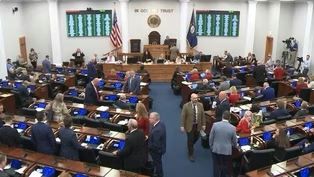
State Lawmakers Renew Push for Cost-Cutting Medicaid Bill
Video has Closed Captions
Clip: S4 Ep364 | 2m 43s | Critics of House Bill 2 say it will have dire consequences in Kentucky. (2m 43s)

Study: Short Smartphone Break Reverses Cognitive Decline
Video has Closed Captions
Clip: S4 Ep364 | 4m 2s | Study finds 2-week smartphone break equivalent to reversing 10 years of cognitive decline. (4m 2s)
Providing Support for PBS.org
Learn Moreabout PBS online sponsorship
- News and Public Affairs

Top journalists deliver compelling original analysis of the hour's headlines.

- News and Public Affairs

Today's top journalists discuss Washington's current political events and public affairs.












Support for PBS provided by:
Kentucky Edition is a local public television program presented by KET