
September 8, 2026
Season 5 Episode 50 | 26m 32sVideo has Closed Captions
Debate continues about the health of Kentucky's rural hospitals.
Dr. Oz weighs in on the debate about the health of Kentucky's rural hospitals, Gov. Beshear weighs in on the controversy surrounding Flock cameras, a new ad in Kentucky's 6th Congressional district race, we take you to a naturalization ceremony at an international festival in Louisville, and meet a high school student behind a new app that can help people with dementia.
Problems playing video? | Closed Captioning Feedback
Problems playing video? | Closed Captioning Feedback
Kentucky Edition is a local public television program presented by KET
September 8, 2026
Season 5 Episode 50 | 26m 32sVideo has Closed Captions
Dr. Oz weighs in on the debate about the health of Kentucky's rural hospitals, Gov. Beshear weighs in on the controversy surrounding Flock cameras, a new ad in Kentucky's 6th Congressional district race, we take you to a naturalization ceremony at an international festival in Louisville, and meet a high school student behind a new app that can help people with dementia.
Problems playing video? | Closed Captioning Feedback
Where to Watch Kentucky Edition
Kentucky Edition is available to stream on pbs.org and the PBS app.
Providing Support for PBS.org
Learn Moreabout PBS online sponsorshipgovernor cannot use the money as was promised in the Grant, it will be taken back by the Federal Government.
[MUSIC] >> Kentucky was awarded over $200 million to boost rural health care.
So what does the governor's plan to use it?
>> I want to make sure that that at the national or the state level, we don't get just caught up in the all good or all bad.
And we actually listen to folks on the ground.
[MUSIC] >> Governor Beshear gives his take on the controversy over the flock camera program.
[MUSIC] >> I am very thankful and blessed that finally and officially, the US citizen.
>> It was a monumental day at the Muhammad Ali Center for these new American citizens.
[MUSIC] >> I've learned so many things in terms of web design.
Also.
And just general interactions with senior citizens.
>> Yeah.
And that is how great.
>> And meet our high school senior who's learning a whole lot about business outside the classroom and is giving back at the same time.
[MUSIC] >> Production of Kentucky edition is made possible in part by the KET Millennium Fund.
[MUSIC] >> Welcome to Kentucky Edition for this Tuesday, September the 8th.
I'm Kelsey Starks.
Thanks so much for joining us.
Kentucky has missed the target set by the state budget that would allow for another cut to the state's income tax.
This is the second year in a row, and the third time in four years that this has happened.
On Friday, the state budget director sent a letter to the Republican chairs of the Legislative Budget Committee, saying the state's general fund revenue was more than $1 billion less than the trigger threshold required to cut the tax rate from three and a half to 3% in 2028.
The system of fiscal triggers was established by the Republican led legislature in 2022.
The goal then was to allow lawmakers to lower the state's income tax rate while preventing state revenues from dropping too quickly and creating a financial crisis.
Well, there continues to be a lot of debate about the fate of Kentucky's rural hospitals, Republican U.S.
Senate candidate and Kentucky's sixth district congressman Andy Barr, is at odds with Governor Andy Beshear over how money from the Rural health Transformation Program can be used on Friday.
Barr was joined in Lexington by Doctor Mehmet Oz, the country's Medicare and Medicaid services administrator who runs the program.
Our Mackenzie Spink was there.
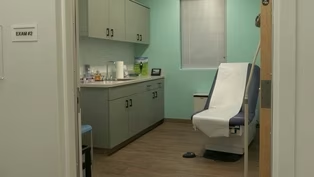
>> In a public letter to Governor Andy Beshear, Congressman Andy Barr called on him to use recently awarded funds from the Rural Health Transformation Program to support the 35 rural hospitals.
The governor was concerned would close as a result of changes to Medicaid funding.
Beshear responded that federal guidelines prevent those dollars from going directly to fund struggling rural hospitals.
The nation's top Medicaid official, doctor Mehmet Oz, says they can.
The Medicaid website lists ten approved ways states can use the Rural Health Transformation funds, including workforce retainment and recruitment efforts for rural hospitals.
>> So to use this money correctly, you have to re-envision the way we create a healthy experience for folks in rural America.
Now, we don't want this money going to building new buildings.
That doesn't seem to deal with the problems.
We don't want it to go paying old debts back.
We want this money going to support hospitals and clinics and providers who are out there desperately trying to make a difference.
We need more doctors and nurses, hospitals and clinics are critical to that process.
We want to fund institutions, hospitals in particular, to have moderate infrastructure and information technology, get them to talk to each other.
>> The Rural Health Transformation Program will distribute $50 billion over the next five years to boost rural health across America.
Kentucky has received $213 million this first year.
According to the governor's office.
The state will use this money to address chronic disease.
Women's health, behavioral health, oral health and improving emergency response in rural areas.
>> The goal was to get the money to governors because people trust governors to use the money correctly.
More they trust anybody else, but if for whatever reason, the governor cannot use the money as was promised in the Grant, it will be taken back by the federal government.
>> Governor Beshear's most recent letter to Congressman Barr says the state is predicted to lose $21.
In Medicaid funding because of cuts signed into law by President Trump threatening the jobs of Kentucky health care workers.
Administrator Oz and Representative Barr argue that the changes to Medicaid funding saved the program and aren't cuts at all.
>> I inherited a program when the president appointed me to this position that was looking at an additional $5.4 trillion of spending over the next decade, $5.4 trillion would have bankrupted Medicaid.
We did save Medicaid because there were billions of dollars of waste, fraud, and abuse plaguing the system.
And what we said was, we're going to check eligibility.
We're going to make sure that individuals who receive Medicaid dollars are eligible beneficiaries, not illegals, that they meet the statutory criteria.
And this idea that the governor here in Kentucky and others around the country, the critics of the president, the critics of our law are saying that somehow this is a cut is wrong.
The reality is that Medicaid spending over the next ten years after enactment of our bill will grow by $250 billion.
So I don't know in what universe these politicians can claim that that is a cut.
>> The new Medicaid requirements for work reporting and determining eligibility will begin at the end of this year for Kentucky Edition.
I'm McKenzie Spink.
>> Now, Congressman Andy Barr, Democratic challenger in the U-S Senate race, is also weighing in on this topic on social media.
Charles Booker's team posted this quote.
Andy eligible for funding isn't the same as this.
Money can save our rural hospitals.
Kentucky got $212 million while your bill cuts $911 billion in federal Medicaid funding.
Stop pretending one pot of money replaces the health care funding.
Your bill puts at risk, end quote.
Governor Andy Beshear is now weighing in on the controversy over automated license plate readers.
Last week, state lawmakers heard from those for and against the camera system, including the maker of the flock camera.
That's the system most widely used in the U-S.
Several cities in Kentucky have ended their flock.
Camera programs or put the programs on hold, citing concerns over misuse.
Now, when asked during his weekly press briefing about his thoughts on the automated license plate readers, Beshear said it should be left to individual communities to decide, but that the right policies need to be in place if they are used.
>> I believe that these are decisions that should be hyper local and that we should be listening to even neighborhoods and what they think about them.
You know, neighborhoods can make very different decisions, but they should be the ones on the ground floor getting to say, we don't like them because we've seen abuses and we're worried about privacy or some neighborhoods saying we just had too much crime.
And we believe that this could be a method to decrease it.
I want to make sure that that, you know, at the national or the state level, we don't get just caught up in the all good or the all bad.
And we actually listen to folks on the ground about what their circumstance is.
I will say this.
We have seen flock cameras solve some crimes and even prevent some crimes, but we have also seen numerous abuses around the country that cannot continue the right policies have to be in place.
The right supervision has to be in place.
The right audits have to be in place.
And if they are not, then no, there should not be a flock camera without the right system.
But even with the right system, I think this is a really local decision where people should be heard, where local government should hold these hearings, where decisions can truly be made by a community where they feel empowered, and that in the end, is is our job as as a government.
>> State lawmakers are considering legislation that would require law enforcement to get a warrant before searching flock cameras.
Democratic candidate Zach Dembo has launched his first television ad of the general election.
Dembo is running for Kentucky's sixth Congressional District seat against Republican and former state Senator Ralph.
In his ad, Dembo says if elected, he'll put country over party fight corruption in Washington and make sure Kentuckians have quality, affordable health care.
>> For me, country has always come before party.
It's why I volunteered for the Navy and prosecuted violent criminals for the Department of Justice.
And it's why I'm running for Congress today.
I'm Zach Dembo and I won't play politics.
>> Demos opponent Ralph Alvarado responded to the new ad on social media, posting, quote, when you say violent criminals, Zack, you.
Are you referring to the police officers you tried to put behind bars?
You know, the ones federal jury acquitted after hearing the evidence, end quote.
Alvarado claims Dembo unfairly targeted law enforcement officers during his time as a prosecutor, including two former Kentucky state troopers who were federally indicted for use of excessive force against a suspect but later acquitted by a federal jury.
Investigators have released new details in the death of a soldier at Fort Knox.
Army Staff Sergeant Deonte Davis died last week.
According to the Military Times, officials say equipment fell on Davis while he was working in the motor pool.
That's where military vehicles and machinery go for maintenance.
Davis was from Daytona Beach, Florida.
He was a bridge crew member assigned to the 19th Engineer Battalion and had been stationed at Fort Knox since 2024.
State Senator Matthew Deneen released a statement following the news saying, quote, Davis was a decorated service member who took his duties seriously and served our nation with distinction.
His willingness to put on the uniform and dedicate himself to something greater than himself speaks to the kind of person he was.
Staff Sergeant Deonte Davis was 33 years old.
More local newspapers go under and dozens of dachshunds are up for adoption.
Our Toby Gibbs has a look at some stories making headlines around Kentucky.
>> Tara Wolf says it's planned data center in Hancock County will create 300 jobs and generate more than a half $1 billion in local taxes over 20 years.
The Owensboro Times says pace Raley, Tara Wolf's vice president of project development, made those predictions during a Chamber of Commerce event last week.
Tara Wolf is building the center at the site of an old aluminum smelter.
[MUSIC] Two Northern Kentucky newspapers have stopped publishing the Northern Kentucky Tribune says the Bracken County News and the Falmouth Outlook ended operations in late August.
Their sister publications.
The papers say they hope to start publishing again in the near future.
[MUSIC] The outlook says the cost of printing, postage and other expenses made the operation unsustainable.
[MUSIC] The Bourbon County Citizen reports one of its longtime reporters is getting the 2026 Al Smith Award for Public Service.
Ivan Rice has been covering sports for the newspaper for 43 years.
He is the first person of color to win the award.
The Al Smith Awards dinner is October 22nd in Lexington.
The McCracken County Humane Society plans Wiener Palooza for September 19th with 130 dachshunds available for adoption.
[MUSIC] The Paducah Sun reports the adoptions are now possible with the resolution of a case involving Suzanne Aulds, a woman convicted of 105 counts of inhumane treatment of animals.
The Humane Society has held the dogs for more than a year as evidence in the case.
With headlines around Kentucky.
I'm Toby Gibbs.
[MUSIC] >> Boaters are being warned about a popular lake in southeastern Kentucky.
According to the U.S.
Forest Service, at Daniel Boone National Forest.
Water levels at Laurel River Lake are currently ten feet below normal for this time of year.
That could cause potential safety risks by making water access, walkways and boat ramps steeper than usual and potentially unusable.
The Forest Service also advises that some marinas may not be open due to the low water level, and advise boaters to check with marinas before heading to the lake.
In other weather news, weeks of hot, dry conditions have led to burn bans in several western Kentucky counties.
Emergency management officials have issued burn bans for Baron Edmonson Grayson, Logan Ohio, Metcalfe Monroe Simpson and Warren counties.
Officials say under the ban, outdoor burning is strictly prohibited.
That includes campfires and bonfires and burning leaves, brush and yard debris.
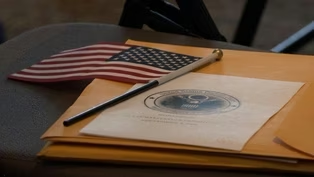
[MUSIC] 74 people from 22 different countries became U.S.
citizens last week in Louisville.
The naturalization ceremony at the Muhammad Ali Center took place against the backdrop of World Fest, an international festival showcasing the cultures and communities that shape the city.
>> Today is very like.
I can't even put it into words.
Emotional.
You know, important.
I'm very happy.
>> However, many forms, interviews and tests stood between you and this room.
You've made it.
So take a deep breath.
You've made it.
You're an American citizen.
Congratulations.
[APPLAUSE] >> For some, the journey started with excitement and hope.
For others, it began with uncertainty.
Sacrifice, hardship or tears.
Despite how unique each of your journey is, the qualities that brought us here together.
Are remarkably similar.
>> It feels like America, like a lot of different people, different countries, all gathered in one place.
>> Many of you spent night with little sleep, studying for tests, learning a new language, walking long shifts, holding two jobs, or balancing work, family and other responsibilities.
[APPLAUSE] You have sacrificed a lot, but you adapted and you persevered.
>> It's been a long journey.
It's been two years, so I feel great.
You know, like growing up here, I've been I spent like 23, 23 years here, 24 now.
You know, it's crazy because being born here is what changes everything.
So I was just a year apart, you know?
But now finally, 23 years, I'm finally a citizen.
>> I am very thankful and blessed that finally and officially as a US citizen today, and I'm very excited that what's going to be opportunity that I can get being a citizen.
And I can finally vote.
And >> Be able to be.
>> Involved.
>> Moore citizenship is not a finish line.
It's an invitation.
Our country will now be shaped in part by you.
So vote volunteer, join the PTA, the local board, the neighborhood association.
Start a business coach.
The team, share your food, your music, your language, your ideas.
Our communities do not need you to leave who you are at the door.
They need all of you.
I have one small ask of you.
Turn around you to a person sitting next to you who you've never met before.
Shake their hand and tell them, congratulations, my fellow Americans.
>> 15 people out of that cohort were also granted name changes.
[MUSIC] People living with Alzheimer's or other dementia may not remember what they had for breakfast that day, but they can often recall memories from long ago.
That's because Alzheimer's disease first affects the part of the brain that handles short term memory, and that's the research behind a new app created to help spark those memories locally.
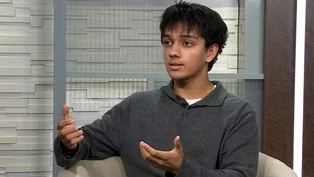
I sat down with the founder of this platform earlier today, who's a local high school student.
[MUSIC] And Todd is a high school senior who has developed the app Derby days for patients in memory care facilities and their caretakers.
So tell us first how you had the idea for this is from your volunteer work, right?
>> Yeah.
So I'm interested in being a doctor.
And so I've been volunteering in hospital settings since like freshman sophomore year.
And I'm a senior now.
So as I was volunteering in the, you know, those general hospitals, I saw a few memory care residents, like residents with early onset dementia and things like that.
And so that really sparked my interest in memory care specifically.
So like dementia and Alzheimer's.
And then since then, I started volunteering in memory care centers and at all the various memory care centers that I volunteered at, I saw a really big contrast in the type of activities that they had.
Some were super engaging and others, others not so much.
And so I started doing some research.
You know, how can I make sure that all the residents at these centers have something that connects with them?
And so that's how Derby Days was born.
>> So this whole idea is hyper local.
And so tell us why, how it works and why it's focused on those local memories.
>> Yeah.
So the whole concept behind it is this thing known as reminiscence therapy.
And that's tapping into a residents long term memory rather than their short term memory, which is usually fragmented.
And so their long term memory is actually intact.
A lot of the times.
And so by mentioning things that happened way back, like the Kentucky Derby at this time, or another Louisville specific thing at this time that can actually bring back some of their memories and prompt conversation, which, you know, will make Louisville residents feel like they belong and feel like they can have a conversation, that they're actually a part of.
>> So there's kind of three different activities on this site that you can do with these patients.
So explain what they are and why each of them are different and important in their own way.
>> Yeah.
So the first one is just a set of games.
That memory care residents can play with the staff members, right?
So they can play in a group setting.
And it includes things like matching landmarks, doing word searches, where the words are Louisville specific things.
And then after you match the words, there's a conversation question regarding that word.
And so it's mostly games like that that are meant to spark conversations through actually playing those games together.
Right.
And so the second one is a chat bot that a memory care resident can interact with.
And it has that actual specific residents background information through a staff member typing that information in.
Right.
And so the last activity is actually just a sort of time capsule.
And this came from the idea that when I was volunteering at a lot of memory care centers in the past, I saw that a lot of residents had these little boxes or capsules outside of their rooms with pictures from their lifetime.
Right.
And I thought that we could digitize that and put it online so that a staff member or even family members of the resident could upload pictures that related to them whenever they wanted.
And so by being able to access that, they could, you know, see those in a much more personalized and efficient way.
>> Yeah.
Like going through old photo album.
Exactly, spark those memories and conversations.
So important.
Yeah.
So tell me why, how this could be adapted for use in other communities.
>> Yeah.
So I'm a senior right now, which means I'm going off to college next year.
And the whole plan of this has been, you know, since this is a hyper local thing to Louisville, as I go off to more places, I can volunteer in memory care centers there, learn what specifically their residents resonate with, because that's how Memory Derby day started here, right?
It's that I started volunteering as a general memory care volunteer and talked to them about what specifically they resonated with.
And based on that, I added those activities, features, and games to the website.
>> This is already being used in five different memory care centers here in Louisville.
What sort of the feedback that you've heard from them as you see residents using your platform?
>> Yeah.
So the derby days you see today is not the derby days.
That was their a year ago or even one month ago, right.
It's constantly improving.
We're constantly redesigning.
It's actually this term.
We're co-designing with the residents.
So whenever I go to a new center, I talk to the residents, I show them the app, and then I ask, you know, what is missing?
And that's how our most recent feature, the word search was added, right?
Because I remember there was this resident Anne that I talked to.
I showed her all the games and she really wasn't finding anything from them.
Right.
And so she told me that she was super into word searches.
And I'm like, that's the next feature.
So now word searches are in there.
And that's how the process works.
I've learned so many things in terms of web design.
Also, and just general interactions with senior citizens.
>> Yeah.
>> And that is how great businesses all develop.
Is that constant adapting and learning.
So what's the biggest thing you feel like you've learned from this process?
>> Definitely how big the gap is between what you think is a finished product and what's actually a finished product, right?
Because when I first created the website, I was like, wow, this is, this is going to be awesome.
This is going to help so many people.
And, you know, it has helped people, but there's always, always ways to improve and ways to make it better.
>> Yeah.
And it will continue to.
Thank you so much for your time.
Thank you.
We appreciate it very much.
We're going to keep an eye on that one.
Derby days is a free platform.
You can access it at derby Dash days dot vercel.app.
[MUSIC] A 100 mile bike race, and making the model T here again is Toby Gibbs with a look at things that happened this week in Kentucky history.
[MUSIC] >> Governor John Helm died September 8th, 1867, after just five days as governor, Lieutenant Governor John Stephenson took over.
Helm had also been governor for part of 1850 and 1851.
During the bicycle craze of the late 19th century, Clifton Dodd won a bike race from Lexington to Covington on September 8th, 1896.
Dodd covered the 100 miles in six hours, seven minutes and 56 seconds.
Happy birthday to Wendell Ford.
Born in Owensboro on September 8th, 1924, he served as governor from 1971 to 1974 and as a U.S.
Senator from 1974 to 1999.
He also served as Senate minority and majority Whip.
[MUSIC] Colonel Harland Sanders was born September 9th, 1890, in Indiana, but he would move to Kentucky and become famous for his Kentucky Fried Chicken.
The Ford Motor Company opened a plant in Louisville on September 12th, 1915.
The plant covered two and a half acres as 53 employees made 15 cars a day.
Most were Model T's 19 year old Venus Ramey, born in Somerset, won the Miss America pageant on September 9th, 1944.
Although she was born in Kentucky, she had moved to Washington, D.C.
and was Miss District of Columbia when she won the Miss America Crown.
She would later move back to Kentucky, and that's what was happening this week in Kentucky history.
[MUSIC] I'm Toby Gibbs.
>> Well, the Bluegrass State has inspired countless writers and novelists.
>> If you are from Kentucky, if you love Kentucky, no matter what you're writing about, you can't possibly step aside from those Kentucky roots.
>> This fall, books and the barons will be a celebration of those Kentucky roots and influences while benefiting a museum that's preserved its story for decades.
You'll see that story coming up tomorrow night, right here on Kentucky Edition.
And we do hope you'll join us again tomorrow night at 630 eastern, 530 central for Kentucky Edition, where we inform, connect and inspire.
Be sure to subscribe to our newsletter at ket.org and follow us on social media.
We'll see you again tomorrow.
Have a great night.
[MUSIC]
Video has Closed Captions
Clip: S5 Ep50 | 4m 30s | Barr, Beshear spar over rural health funds as Dr. Mehmet Oz visits Kentucky. (4m 30s)

More Local Newspaper Stop Publication
Video has Closed Captions
Clip: S5 Ep50 | 2m 3s | Some local newspapers fold and it's a dachshunds dash in Headlines Around Kentucky. (2m 3s)
New Citizens Take Oath at Louisville WorldFest Ceremony
Video has Closed Captions
Clip: S5 Ep50 | 3m 44s | More than 70 immigrants become U.S. Citizens at Louisville ceremony. (3m 44s)
Student's App Helps Spark Memories for Dementia Patients
Video has Closed Captions
Clip: S5 Ep50 | 5m 59s | Local student develops app to help dementia patients reconnect with memories. (5m 59s)
Providing Support for PBS.org
Learn Moreabout PBS online sponsorship New Episode
- News and Public Affairs

Top journalists deliver compelling original analysis of the hour's headlines.
 New Episode
- News and Public Affairs

Today's top journalists discuss Washington's current political events and public affairs.

 New Episode

 New Episode
 New Episode
 New Episode

 New Episode
 New Episode
Support for PBS provided by:
Kentucky Edition is a local public television program presented by KET