
February 10, 2026
Season 4 Episode 319 | 26m 29sVideo has Closed Captions
Lawmakers are scrutinizing state spending as a new two-year budget bill is crafted.
Lawmakers scrutinize executive branch spending while crafting new two-year budget, why Kentucky's university professors say state lawmakers are once again attacking tenure, a new report looks at the actions of FCPS' superintendent, and the state makes another appeal to the Trump administration for federal help following yet another deadly storm.
Problems playing video? | Closed Captioning Feedback
Problems playing video? | Closed Captioning Feedback
Kentucky Edition is a local public television program presented by KET
February 10, 2026
Season 4 Episode 319 | 26m 29sVideo has Closed Captions
Lawmakers scrutinize executive branch spending while crafting new two-year budget, why Kentucky's university professors say state lawmakers are once again attacking tenure, a new report looks at the actions of FCPS' superintendent, and the state makes another appeal to the Trump administration for federal help following yet another deadly storm.
Problems playing video? | Closed Captioning Feedback
How to Watch Kentucky Edition
Kentucky Edition is available to stream on pbs.org and the free PBS App, available on iPhone, Apple TV, Android TV, Android smartphones, Amazon Fire TV, Amazon Fire Tablet, Roku, Samsung Smart TV, and Vizio.
Providing Support for PBS.org
Learn Moreabout PBS online sponsorship>> What do we spend on food, lodging and other stuff?
>> As state lawmakers craft a new state budget, they examine how your money is being spent.
[MUSIC] >> The language in all sections allows for a faculty member to be removed by the board for bona fide financial reasons.
>> A bill in Frankfort would make it easier to fire professors.
But is it needed?
>> We're at a critical point right now, but we have got to do the right thing by working people and pass this legislation.
[MUSIC] >> And one state lawmaker has a plan that they say will help the Kentucky worker.
[MUSIC] >> Production of Kentucky edition is made possible in part by the KET Millennium Fund.
[MUSIC] .
>> Good evening and welcome to Kentucky edition for this Tuesday, February the 10th, I'm Renee Shaw, and we thank you for spending some of your Tuesday night with us.
As state lawmakers continue to draft their version of the state budget.
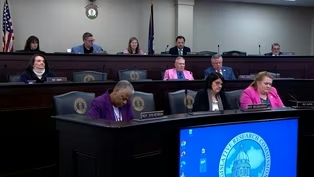
The House Appropriations and Revenue Committee is taking a closer look at the spending habits of all three branches of government.
Today, the Budget Committee reviewed transactions from the executive branch that the auditor's office considered, quote, points of interest.
Our Mackenzie Spink tells us what areas are getting the spotlight and why it matters to the state budget.
She has more.
As we kick off tonight's legislative update.
[MUSIC] >> House Appropriations and Revenue Chair Representative Jason Petrie is taking a magnifying glass to particular areas of spending that may not be well tracked or well justified in the state's purchase tracking system.
>> How much do we spend as state government on advertising?
Not federally required, not legally required, but just advertising?
What do we spend on out-of-state travel?
What do we spend on in-state travel?
What do we spend on food, lodging, and other stuff?
>> The information presented by the auditor's office today was not part of an official audit, but a review of the purchase tracking system.
The auditor's council says out of state travel was an area with some hard to track purchases.
>> On out-of-state travel.
The state executive branch for fiscal year 25 spent almost $7.5 million, about at least over $398,000 was spent using Agency and American Express card.
Sorry.
What's interesting about the Amex cards is the level of detail that's attached to Amex.
Card use by agencies is very little.
Sometimes you only see some sort, like a flight receipt or something like that.
It's difficult to know what the flight was actually for.
>> The presentation also included a deep dive into the governor's travel expenses, including hotel rooms and meal expenses.
>> Some other interesting expenditures that we saw here were was a $7,600 limousine that was rented in Germany, a $4,600 car rented in Switzerland.
You'll notice some meal expenditures here.
And then one interesting thing was that it appears that while in Washington, DC, there were two traffic tickets accumulated that were charged to Kentucky taxpayers.
>> Spending by the Department for Community Based Services was also reviewed.
Dcbs is currently under investigation by the auditor's office for its use of office buildings to shelter foster children.
>> One I'll highlight is the $481,000 that was paid to a single vendor for emotional injury evaluations.
What's interesting about this one is that this is over $400,000 more than almost every other vendor for these same types of services, and $339,000 more than the next highest vendor.
>> Chairman Petrie says he does not pass judgment on any of the expenditures discussed today, but that the stewardship of taxpayer dollars is worth talking about while the budget is open.
>> The money that the government the state receives is tax revenue.
And if you get a group of just regular people in a room and you start running down through these expenditures with them, what do you think they're going to say and what are you going to feel in response?
And what are you going to think in response?
It's just a good time.
Second moment when we're looking at what's in the base, well, let's look at certain codes that are in that base and what's going on.
>> House Bill 500, which details the current budget proposal and the spending report by the auditor's office, are available online through the Legislative Research Commission for Kentucky edition.
I'm Mackenzie Spink.
>> Thank you.
Mackenzie.
Now turning to news in higher education.
Some university professors and campus workers say state lawmakers are once again attacking tenure, which is a competitive process and status that keeps professors on the job permanently.
House Bill 490 allows universities more discretion to fire employees for the sake of cutting costs.
Our June Leffler explains.
>> The language in all sections, allows for a faculty member to be removed by the board for bona fide financial reasons, including, but not limited to, financial exigency, low enrollment in a particular program or major or misalignment of revenue and costs in a particular college, department or major.
>> Do our universities not already have this created on their own?
Is it necessary?
>> Some of the universities do implement this.
It's actually in their faculty handbook passed by their faculty senate.
It's at at University of Louisville and then also at WKU.
But it is generally not, you know, the same across all the universities.
>> United Campus Workers of Kentucky opposes the, quote, anti tenure bill, saying in a statement, quote, it is yet another attempt to weaken faculty job protections.
It also opens the door to further politicization of our universities.
Institutions are constantly facing some form of financial pressure, and this bill creates a ready made pretext for arbitrarily removing faculty, either for political reasons or under the guise of budgetary concerns.
One Republican also pushed back.
>> I just simply believe that is a policy that should be withheld within the Board of Regents.
Which university and college?
Thank you.
>> The House Post-secondary Education Committee approved House Bill 490, though four lawmakers abstained from voting.
The committee also considered changes to tuition waivers.
These allow students to go to a public college for free that includes the children of police officers or firefighters who die in the line of duty, as well as foster children and senior citizens.
House Bill 490 mandates these students fill out a free application for federal student aid, which is also referred to as Fafsa.
>> On these waivers, it would require for anyone to receive a waiver.
They're required to fill out a Fafsa, and if they're eligible for a Pell Grant, which makes automatically eligible for a Cap grant or Cctg grant, those funds would be used, and then the tuition waiver would be about half the cost.
>> Students would need to use any eligible federal grants before expecting universities to cover tuition.
The bill's sponsor had initially proposed denying senior citizens a tuition waiver, saying this aging cohort likely won't be reentering the workforce.
>> Even if we straighten them out.
They could have audited the class, but they're back in.
The only thing I did is I made it consistent across every waiver group requirement to complete a Fafsa.
>> This did not convince one Louisville Democrat.
>> But I really think it's short sighted of us not to just say, if you're 65 and up and this is something that you're interested in, go for it.
And I think it would save us money and health care costs.
It would make for happier, healthier, more engaged seniors.
And so that's that's my concern about the bill.
>> With a single no vote, House Bill 497 did pass and heads now to the House floor for Kentucky edition.
I'm June Leffler.
>> Thank you.
June.
These tuition waivers are in state law with universities footing the bill.
That's why during the committee hearing, State Representative Lisa Willner, who you just heard, called the waivers an unfunded mandate.
Now, turning to K-12 education, Senate Bill one, the top bill in the Senate, if passed, would require the Jefferson County School Board to hand over some of its powers to the Jefferson County Superintendent.
Republican supporters of the bill say the change would mean better quality education for children in the district.
The superintendent, Doctor Brian Yearwood, testified a couple of weeks ago that he didn't want or need the additional authority, and he said he didn't think the bill was about student achievement on Kentucky tonight.
Last night, I asked Senator Stephen West, who is chair of the Senate Education Committee, to respond to that.
>> There's a lot of politics in Frankfort, but there's a lot of politics in Jefferson County school system as well.
And, you know, when you have your employer sitting next to you in the committee meeting, the vice chair of the board, you know, maybe your answers are a little maybe different than maybe you think behind closed doors.
So he has a line to to walk, a tightrope to walk in his position.
I will say I've been very pleased with Doctor Yearwood.
He's saying all the right things.
He's made some very difficult decisions early on, trying to right the ship and get their budget in order.
So so we're very pleased with what he's done so far.
And, you know, it's hard to believe that that we're trying to tell him, hey, we're trying to give you more power to do all the good things you say you want to do.
Right?
But he does have a political tightrope to walk.
>> My biggest concern about Senate Bill one is that, you know, there are no justifications for doing what they did.
They have all these findings, Renee.
But but where do they come from?
You know, other than maybe, you know, looking at some reports or, you know, reading the newspapers, there was there's there's really been no thorough, detailed investigation as to what's causing these problems with JCPS.
Now, as you recall from that meeting, I asked doctor, I asked him a question.
Doctor, would you would you believe these problems are being caused by the structural governance of JCPS?
Because that's what one of the findings said.
He said there's nothing about the structural governance that's creating these problems.
These problems do exist.
He didn't deny that.
He said they're very real.
But it's not because of the way the structural governance is created.
>> We talked in depth about other education bills now being considered in the Kentucky General Assembly.
You can see that comprehensive discussion about Kentucky education policy and proposals online on demand at Keturah.
Tonight.
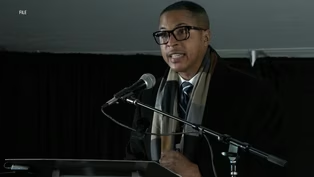
Now, Fayette County School Superintendent Demetrus Liggins is responding to a new report finding he failed to fully comply with school board policy.
An outside firm was tasked with investigating ligands.
The firm says Liggins violated board policies by not keeping the board appropriately informed of the district's financial situation.
The report was requested by the school board after the state's second largest public school district found itself facing a $16 million budget shortfall last year.
The report also found no evidence to suggest Liggins intentionally withheld information from the board, and that he did not retaliate against an employee who allegedly raised concerns about the district's finances.
In a statement, Superintendent Ligon said the report reflects what he's already said publicly.
Quote, as superintendent, I relied too heavily on the leaders and teams working in the area of budget and finance every day, when I should have been asking sharper questions and demanding more comprehensive detail, end quote.
It does go on to say that I take full responsibility and commit to ensuring full alignment with board policy and the board governance manual moving forward.
End quote.
A Franklin County Circuit Court judge has denied a motion to dismiss the Kentucky student Voice team's lawsuit against the state.
The Kentucky Student Voice team filed its lawsuit in January of last year, claiming that the state had failed to fulfill its constitutional obligation to provide adequate public education.
One month after the filing, the Kentucky Attorney General filed a motion to dismiss the case.
Now that motion has been denied, the lawsuit can proceed.
>> While this ruling is only the first step in a longer legal process, we know that it affirms to us three essential things.
The first one is that we as students, have the right to have our voices heard within the court system.
Second, the state legislature and its leaders are accountable for the conditions within our public schools today.
And third, the constitutional rights promised to us by the landmark 1989 Rose State Supreme Court decision are not being adequately upheld.
>> The Kentucky Student Voice team has released a book entitled Why Kentucky Students Are Suing the State, aiming to educate Kentuckians on the details of the lawsuit and the constitutional obligations they feel are not being met.
In 2017, the Kentucky General Assembly passed a right to work law that allows workers to opt out of joining a union if a business has one.
Backers say it was needed to make Kentucky more competitive so it could attract business and new jobs.
Critics say that law hurt unions and as a result, hurt Kentucky families.
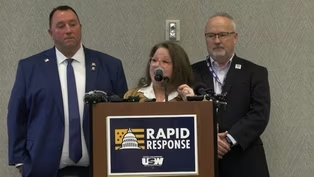
Today, State Representative L3 Adrielle Camuel of Lexington, who is a Democrat, introduced a bill that would repeal it.
>> Working people in Kentucky are being squeezed and the people in power know it.
Wages aren't keeping up, costs are out of control.
And while families are struggling to make ends meet, the wealthy and well-connected are consistently getting tax breaks by politicians in both Frankfort and Washington.
This is not a coincidence.
It's by design, and it's the result of deliberate policy choices.
They passed House Bill one so-called right to work.
It was their number one legislative priority that year.
Then they repealed the prevailing wage.
Then they banned public employees from striking, and then they blocked unions from using our own union dues to advocate politically.
>> So what it does is it drives down.
It just weakens our labor unions.
It drives down wages.
It drives down the opportunity for them to be able to secure benefits and things like that.
And so what you see is a it's it's a little bit of a vicious cycle of, you know, big corporations that get tax breaks, right.
And then they don't pay their workers enough to make a living wage.
And so then our tax dollars also go to supplementing workers who don't make enough money to make ends meet.
And so we're we're kind of bookending big corporations on both sides while our workers are scraping by to make ends meet.
>> Kentucky doesn't have a worker shortage.
We have a wage problem.
We have a system that rewards the wealthy while ignoring the work.
And repealing right to work is the first step in fixing that.
HB 585 is legislation designed specifically to repeal Kentucky's right to work law and to protect workers.
It's to protect workers freedom to join together in strong unions.
So this bill is about the dignity of work.
It's about fairness.
>> We've got to get back to making sure that we value not just the work that's being done, but the people who are doing it.
We're at a critical point right now where we have got to do the right thing by working people and pass this legislation and actually make Kentucky a worker friendly state, one that provides a fair wage, one that provides better benefits, and one that also creates safer working environments.
>> A companion bill was filed earlier this month by freshman State Senator Gary Clemons, a Democrat from Louisville.
In other news, Governor Andy Beshear is asking President Donald Trump to declare Kentucky's latest winter storm as a major disaster.
The storm dumped nearly a foot of snow in northern Kentucky and produced crippling ice in central and southern Kentucky.
At least 21 Kentuckians died as a result.
The storm also knocked out power to more than 75,000 customers across the state.
Kentucky's entire federal delegation has signed a letter supporting Governor Beshear's request.
The letter says, in part, quote, hundreds of homes and businesses have been impacted and critical infrastructure has been severely damaged.
President Trump issued three major disaster declarations in Kentucky just last year alone.
[MUSIC] Humana is joining the Kentucky Community and Technical College System to become an Education First employer.
Making the announcement last week, Humana said it's partnering with Jefferson County or Jefferson Community and Technical College to help advance the nursing workforce.
In Kentucky.
>> Nurses are the heart of our health care system.
Nurses are consistently voted the most trusted profession, but those who are aspiring to enter the profession can face challenges.
It's not easy to have this educational journey.
It shouldn't be easy, but it's really hard to balance it with many other things that life brings your way.
Demanding coursework, social barriers, family needs, and other needs can stand in the way of many earning their nursing degrees.
So Humana is proud to partner with GTC by investing $125,000 in educational scholarships and even more importantly, in a support fund that can help to meet those needs.
This partnership is more than just training nurses.
It's about empowering, caring individuals who can make a lasting difference in Kentucky's communities and helping these individuals to recognize and address the social challenges that they may face with their patients.
So together, Humana and GTC are helping to build a nursing workforce that's not only skilled but also deeply, also deeply empathetic.
They're prepared to deliver compassionate, highly skilled, high quality care to those who need it most.
>> The Humana Scholars Program will initially be offered at the campus in Louisville, with hopes of expanding to the other CTCs campuses in the future.
Louisville School is helping stitch together America's story.
After being selected to participate in a national art project.
Walden School is the only school in Kentucky to take part in the National Scroll a Thon, a collaborative large scale art project to celebrate America's 250th birthday, Walden School students rolled strips of fabric into scrolls, creating two larger scrolls.
The school keeps one.
The other will be part of a masterwork that will go on display at the Kennedy Center exhibition.
More than 2 million visitors are expected to view the exhibition this summer.
And of course, KET is celebrating America's 250th birthday.
You can learn more online at ket.org.
Capitol Reins PR 50 heart disease is still the number one killer of women, but many don't recognize the warning signs.
That's because women experience very different symptoms during a heart attack than men.
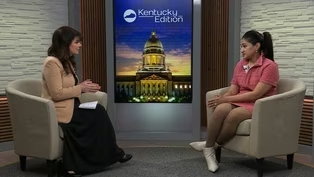
Our Christie Dutton spoke to the director of the UofL Health Women's Heart Program, who says knowing the symptoms and taking them seriously can save your life.
More about this in today's medical news.
[MUSIC] >> Doctor Marin Shetty is here from UofL Health and we're talking about women's heart health.
Why is heart disease the number one killer of women?
Still?
>> That is a great question and thank you for having me.
I think two things.
Number one, we're not really doing a good job when it comes to awareness.
And that's why I go red for women is such a huge initiative.
But secondly, all these recent diagnostic and therapeutic strategies that we've developed for heart disease, they were done by men, for men.
So they work in men, not so much in women.
So now we really have to focus on getting answers to get the best outcomes for the women.
>> Okay.
So how are women different from men?
How are the symptoms of heart disease, different.
>> Symptoms of heart disease actually are very different in terms of presentation.
So men have the classic chest discomfort.
Feel like the elephant sitting on the chest.
Women we present more subtly, we may feel nauseous, anxious, maybe just the sense of unease for several days.
You know, fatigue that is not usual, a pain that goes from the chest to the jaw or to a tooth radiating between the shoulders.
We have all of these nonspecific symptoms.
But that's why I always say, if your body is telling you that something's not right, seek help, okay?
>> Because those symptoms do sound kind of general to a good to a lot of different things or just, you know, being a woman or go or the hormonal changes.
So talk about what are some risk factors that are specific to women.
>> We all know the big three.
So cholesterol, diabetes high blood pressure and then smoking of course.
But there are some risk enhancers now that we know are very specific to women.
Three of those start directly in pregnancy gestational diabetes, hypertension during pregnancy and preterm delivery.
So those are three.
Then cholesterol is not the only cause of plaque formation.
It's also inflammation.
And because autoimmune diseases are more seen in women.
So things like lupus and rheumatoid arthritis, they can be risk factors for heart disease.
Also breast cancer therapies.
So chemotherapy or radiation directly to the chest.
And lastly depression and anxiety because the mind body axis is the is the real thing and stress definitely affects the heart.
>> Okay.
So outside of having a heart attack you know, what do we need to do before that to prevent that.
Or is there any screening.
>> There absolutely is screening.
So there's something known as a coronary artery calcium score.
It's a low dose CT almost like an x ray of the chest.
No contrast.
It's about $99 out of pocket.
And what it does is it almost takes a photograph of your heart.
And it can look for calcified plaque in the blood vessels that supply the heart.
And you detect it way before you may have symptoms, so that you can institute the preventive therapies that you need to prevent that heart attack, maybe ten, 20 years down the line.
>> So anybody can get this.
Anybody can.
Men, women, anybody.
>> Anybody can get it.
We usually recommend that you do it if you're between 40 to 70.
Because if you're younger than that then usually you don't have that calcified plaque.
But anybody can get it.
>> Just a CT scan, no side effects or.
>> You know, there's always this minimal risk from the radiation, but that's more cumulative over years.
But otherwise no because there's no contrast given.
So no damage to the kidneys okay.
>> That's really good to know.
Tell me, what is the biggest misconception women have about their heart health?
>> It's a very interesting question.
I think that they don't really understand the consequences of it.
There were a group of investigators who went to the community and asked them, what do you think is the number one killer of women?
And most women said that it's breast cancer, though actually breast cancer takes maybe 1 in 30 women, but heart disease takes 1 in 3, so they don't really understand the burden that is heart disease.
So that's why I always saw my patients know your numbers.
And if you're at risk, let's sit down, make an action plan and learn how to mitigate those risks.
>> Okay.
This is all very good information.
Thank you.
Thank you for helping us raise awareness about women's heart health.
Thank you, Doctor Shetty for being here.
>> Thank you.
This was a pleasure.
>> February is Black History Month, and tomorrow we talk to a louisvillian who is dedicated to preserving it.
>> The greatest part of America is when black people and white people came together.
That's what made America the beacon in the hills.
>> Explorer.
Kentucky's Black history at Roots 101, Louisville's African American History Museum tomorrow on Kentucky edition, which we hope you'll tune in for again at 630 eastern, 530 central, where we inform, connect, and inspire.
We hope that you'll connect with us all the ways you see on your screen through the social media channels, Facebook and Instagram.
To stay in the loop, send us a story idea by email to Public Affairs at Keturah and look for us on the PBS app.
Thank you for joining us tonight.
I'm Renee Shaw, and I'll see you right back here
FCPS Superintendent Responds to Investigation Finding
Video has Closed Captions
Clip: S4 Ep319 | 1m 12s | Investigation find FCSP superintendent failed to 'fully comply' with school board policy. (1m 12s)
House Committee Scrutinizes Executive Branch Spending in Review
Video has Closed Captions
Clip: S4 Ep319 | 3m 43s | Committee reviews spending habits of Kentucky’s three branches of government. (3m 43s)
Lawmaker Looks to Repeal "Right to Work" Law
Video has Closed Captions
Clip: S4 Ep319 | 2m 55s | Lawmaker says "Right to Work" law hurts Kentucky families. (2m 55s)
Recognizing Heart Disease Symptoms in Women
Video has Closed Captions
Clip: S4 Ep319 | 5m 1s | Warning signs of heart disease differ in men in women. (5m 1s)

University Professors Say Bill Threatens Tenure
Video has Closed Captions
Clip: S4 Ep319 | 3m 41s | Bill lets Kentucky universities cut staff more easily by expanding firing discretion rules. (3m 41s)
Providing Support for PBS.org
Learn Moreabout PBS online sponsorship
- News and Public Affairs

Top journalists deliver compelling original analysis of the hour's headlines.

- News and Public Affairs

FRONTLINE is investigative journalism that questions, explains and changes our world.












Support for PBS provided by:
Kentucky Edition is a local public television program presented by KET