
October 14, 2026
Season 5 Episode 76 | 26m 30sVideo has Closed Captions
Congressman Andy Barr discusses a bill he says gives the Kentucky hemp industry "a lifeline."
Congressman and Senate hopeful Andy Barr meets with hemp producers to talk about the bill he calls “a lifeline for the Kentucky hemp industry." A northern Kentucky senator hits the road to shore up support for an amendment to limit pardon powers. Mason County gives the green light to a planned hyperscale data center. Inside the country's only nature-based playground centered around Black history.
Problems playing video? | Closed Captioning Feedback
Problems playing video? | Closed Captioning Feedback
Kentucky Edition is a local public television program presented by KET
October 14, 2026
Season 5 Episode 76 | 26m 30sVideo has Closed Captions
Congressman and Senate hopeful Andy Barr meets with hemp producers to talk about the bill he calls “a lifeline for the Kentucky hemp industry." A northern Kentucky senator hits the road to shore up support for an amendment to limit pardon powers. Mason County gives the green light to a planned hyperscale data center. Inside the country's only nature-based playground centered around Black history.
Problems playing video? | Closed Captioning Feedback
Where to Watch Kentucky Edition
Kentucky Edition is available to stream on pbs.org and the PBS app.
Providing Support for PBS.org
Learn Moreabout PBS online sponsorshipmusic >> Only power that exists in our justice system that has no check and no balance on it, is the power to pardon.
[MUSIC] >> Voters will soon decide whether to limit a governor's pardoning power.
[MUSIC] >> One thing we could do is put the party back in political party.
[MUSIC] >> One expert has some ideas to get young people to the polls.
[MUSIC] >> I think that representation is so important, and it's a huge piece of this park.
>> And we head to Sankofa Sanctuary in Louisville, a one of its kind park based on black history.
[MUSIC] >> Production of Kentucky edition is made possible in part by the KET Millennium Fund.
>> Good evening and welcome to Kentucky Edition for Wednesday, October 14th.
I'm Marvin Bartlett.
Thank you for joining us.
Changes are coming to the American hemp industry unless Congress passes new legislation, a federal provision signed in 2025 changes the legal definition of hemp and criminalizes intoxicating hemp products such as gummies and seltzers, some within the hemp industry, worry about the burden this would put on hemp producers to reformulate and relabel established products.
Congressman and Senate hopeful Andy Barr sponsored the bipartisan Lawful Hemp Protection Act, which he says would be a lifeline for the Kentucky hemp industry.
Yesterday, he visited the Kentucky Heritage Hemp Company in Nelson County to tour the production facility and meet with Kentuckians about the future of the state's hemp industry.
In the face of sweeping changes.
>> I introduced with several colleagues a bipartisan bill, the Hemp Protection Act, that would be a lifeline for the Kentucky hemp industry, give certainty and stability for the future of Kentucky hemp and do a number of other things provide the first ever, ever real federal framework regulatory framework to protect kids, to level the playing field with other industries like the distilled spirits industry.
Get rid of bad actors.
But provide opportunity and a future for Kentucky farmers.
You know, we've been looking for substitute crops for a long time since the decline of tobacco production in Kentucky.
That was such a signature crop signature industry for Kentucky farmers.
And and with this legislation, we're creating more opportunities for Kentucky agriculture producers.
What we're trying to do is promote Kentucky farmers and Kentucky, Kentucky producers.
And at the same time provide that regulatory framework for framework for consumer protection that is required to give the the American people confidence in in the maturity and the safety of this industry.
And that's really ultimately, if you think about it, that's what we want.
That's what farmers want.
They want certainty, predictability.
They want to be viewed as a responsible and mature industry that will have, you a future.
And this creates a bipartisan regulatory framework with labeling requirements, FDA oversight, three tier system like the Alcohol and Distilled Spirits industry, safety for kids, making sure synthetics and foreign products are not permissible, and making sure American made Kentucky made hemp products are available for the for consumers.
>> The hemp law in place now expires December 11th.
Governor Andy Beshear is calling on the U.S.
Department of Agriculture and Congress to make sure people don't go hungry as a result of changes to snap the Supplemental Nutrition Assistance Program.
The program is often known simply as food stamps.
The governor says President Donald Trump's budget plan has caused thousands of Kentuckians to lose access to the program.
The governor's letter went to Secretary of Agriculture Brooke Rollins, and the entire Kentucky congressional delegation.
In the letter, the governor says, quote, we should be fighting hunger, not causing it.
Yet the president's cruel and unnecessary changes to snap are causing more than 80,000 Kentuckians and millions of Americans across the country to face hunger.
Come November, Kentuckians will have more on the ballot than just candidates.
They'll also have a constitutional amendment.
Amendment one relates to a governor's power to give pardons.
And if that power should be limited around election season, a Northern Kentucky senator has worked for many years to get the amendment on the ballot.
Our Emily Prince caught up with him in Corbin to learn more about the measure.
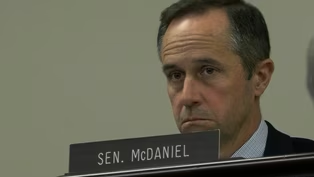
>> State Senator Chris McDaniel is touring the Commonwealth, including a stop here in Corbin to explain why he wants Kentuckians to vote yes on amendment one.
If it passes, the amendment would limit the governor's power to give last minute pardons.
McDaniel said he saw the need for the change after Governor Matt Bevin gave a slew of pardons back in 2019.
>> Some for crimes as heinous as, rape, murder and many, many others.
>> Bevin issued more than 400 pardons during his final days in office after losing the 2019 election to Andy Beshear.
Bevin later told The Washington Post he was a believer in second chances.
McDaniel said one of the former governor's pardons hit close to home for a friend who knew Debbie Pooley.
Pooley was murdered in northern Kentucky in 1987.
>> He kidnaped Debbie, drove her around, raped her multiple times, ultimately murdered her and threw her body into a field.
The previous governor issued a pardon to the man who committed this crime, and ultimately, that pardon allowed for him to end up in front of the parole board, where he stood to walk free.
>> McDaniel said.
The man was ultimately not granted freedom by the parole board after pleas from Pooley's friends and family.
But the state lawmaker said he wants to prevent situations like that from happening again.
He's worked for seven years to get this amendment on the ballot.
So what exactly would it do?
>> What amendment one simply does is from 60 days before a gubernatorial election until the time of the swearing in of a new governor, the power to pardon ceases to exist.
So voting yes on amendment one would force a governor if they wanted to issue a pardon, to do it more than 60 days before an election.
>> I asked McDaniel what would prevent a governor who is headed out of office for making controversial pardons before the 60 day cutoff?
>> If the governor takes certain actions, then the party has to account at the ballot box, and I think that the voters would view some of the pardons we saw last time very unfavorably for the party of the governor.
>> Not everyone is on board with amendment one, however.
Senate Minority Caucus Chair Reggie Thomas was the only senator to vote no on the bill during this year's legislative session.
He said it's important for the governor to be able to address wrongful convictions or other faults of the criminal justice system through pardons, and he said current and future leaders shouldn't pay the price for bevin's decisions.
>> I just think it's wrong.
There's no reason to do that.
You had one bad apple in Matt Bevin.
You know, Matt Bevin certainly used that power incorrectly, but you've had a whole host of governors before.
Matt Bevin who, who, who used the pardon power wisely and humanely.
>> The Lexington Democrat also believes governors must deal with more pressing policy matters in the beginning of their term, and they can give more thought to pardons in the final days of their role.
For those reasons, Thomas says he'll be casting a no vote on amendment one.
>> I'm urging everyone to vote no on on amendment number one.
Let the that the pardon power remain with the governor.
>> McDaniel, however, says the judicial system has layers of checks and balances for a reason.
>> Only power that exists in our justice system that has no check and no balance on it, is the power to pardon.
>> McDaniel said.
Amending the state constitution is not something he takes lightly, but he believes amendment one will pass in November in Corbin for Kentucky edition.
I'm Emily Prince.
>> McDaniel is also making stops in Bowling Green, Louisville, Lexington and other cities to drum up support for amendment one.
We have big data center news today out of Mason County.
Yesterday, the county judge executive revealed meta is the company behind a planned hyperscale data center.
Meta is the owner of both Facebook and Instagram.
The Kentucky Lantern reports meta will invest billions of dollars in the nearly 3000 acre project.
It will pay millions of dollars to the county and to local schools, and will receive a 40 year tax break.
A group called We Are Mason County says people should have been told before now that meadow was behind the project.
Kentucky's measles numbers just took a big jump.
Details in tonight's look at medical news.
[MUSIC] Kentucky now has 157 reported cases of the measles this year.
The big jump was in Laurel County, which just reported 56 cases of the measles since August.
The biggest number in any one county that tops Christian County's 45 and Trigg County's 25, according to KY t TV in Lexington, the Laurel County cases are linked to several large households with no public exposures.
Kentucky had 13 cases of measles in all of 2025.
[MUSIC] Yesterday, we reported on a new Tufts University analysis showing Kentucky was among the states showing a downturn in young voter registrations.
The report compared the number of young people registering to vote in the 2026 midterms to the 2022 midterms.
25 out of 42 states showed an increase.
Kentucky was one of the states that showed a double digit loss.
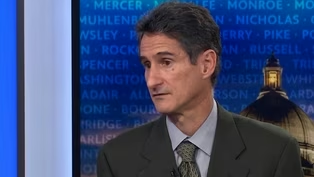
University of Kentucky political science professor Stephen Voss said the decrease does not necessarily mean young people in Kentucky are becoming less engaged politically.
We ask him what he thought it would take to increase the number of young voters in Kentucky.
>> I wouldn't say Kentucky's been atypical over the long span in terms of engagement of young voters.
You know, young voters, especially respond to all the the flurry of campaign activity and the efforts to get them mobilized.
You know, if you go back even half a decade, we would see was more efforts to get young people registered to vote because the candidates had the money to spend to get young people registered to vote, and they hoped for their support.
We're not seeing as much of that intense activity to get young voters on the rolls by these outside campaigns, by the national parties.
You know, the funny thing about young people in politics right now is it's polarized.
You know, I'm faculty advisor for the College Democrats and the College Republicans at UK campus.
They are larger than they used to be.
And those folks are very engaged.
They're doing phone banking.
They're doing canvasing, knocking on doors.
But in terms of the rank and file students, what we're seeing is a shift toward disgust with politics.
They're tired of team Red versus Team Blue and a feeling like their futures are doomed.
And they say they're independent.
They say they don't like the political system.
I think we're seeing a little bit of the dropping out of just the regular, normal voter, at least among young people, parties put a lot of energy and resources into trying to get people engaged politically.
That's one of the main things political parties contribute to the system, is all the investments they make to try to educate people about their choices and bring people into politics.
It's a healthy process, and parties are essential in that way.
What the parties have not been successfully doing is offering people choices they feel good about more voters these days are voting to either stop the Democrats or stop the Republicans, than they are to elect either of them.
I mean, the number one way you get more people participating in politics is by making more people want to participate in politics.
You give them choices that are relevant to them.
And then they care about voting.
What we've seen lately is an increase nationwide, if not in Kentucky, in youth engagement, the increase youth engagement is not necessarily the healthiest thing, though, because this has gone along with a high pessimism among young people.
Depression, a sense that their futures are doomed.
Being politically engaged is, as we're seeing it right now, is more a warning sign.
It's a flashing light on the dashboard, not a sign of a healthy democracy.
Insofar as young people are are afraid of the future about the country, economic life or about the environment, it's still hard to to really appeal to young voters about the issues they care about.
It's hard to come up with solutions that they're going to believe would make a difference.
So even though we know which issues young voters say worry them, it's not so obvious how to offer them policies or proposals that would lessen that worry and get them on board.
One thing we could do is put the party back in political party.
It was a lot easier for people to get engaged with politics when it was fun, when it was surrounded with festivals and sort of the political equivalent of tailgate parties.
When you intellectualize politics and just make it, he said.
She said disputes over over mistakes made in a speech.
It's quite natural for a lot of young people to say, yeah, that's not my sport.
I'd rather go watch college football.
You know, the each party has issue positions that can appeal to younger voters, and they'd love to have young voters swinging to them based on those issues, rather than responding to the ones that the other party has.
But you know, what I see, especially with the young activists coming up through the university, is that the politicians are really excited to get them involved.
They really enjoy both Democrats and Republicans working with and cultivating young people who are engaged in politics.
I just fielded my largest group of interns from UK to go to the state legislature last year for the session, and it was a nicely balanced Partizan team.
It was almost half Democrat, half Republican, and both sides came back with stories of receiving really great support from the legislators and the government relations firms with which they worked.
You know, when you're when you're getting late in life and you're involved in politics, helping cultivate young future politicians or young future activists is one of the real gratifications of being involved in political life.
>> Voss also says most reforms intended to make voting easier, like automatically registering voters, don't equate to an increased turnout for elections, he says.
Even if voting is convenient, people won't do it if they aren't interested in the candidates or the issues.
[MUSIC] Paying for college can be one of the biggest financial decisions your family can make.
In a recent KET, Education special, we broke down the cost and how to navigate the process of getting financial aid with a panel of experts.
We also heard from a current college student who told our Laura Rogers about his experience with the financial aid process.
What he says students and parents can start doing even before senior year of high school.
>> Wiley Stratton is a senior at Bluegrass Community and Technical College, and I know you have to be getting excited, as you'll be graduating in May.
>> Yes, yes, yes I will.
>> You have almost made it.
Congratulations.
>> Thank you.
Thank you so much.
>> When you were first looking into where you wanted to pursue post-secondary education, how did finances come into play in making that decision?
>> I mean, that's the number one thing you look at.
You know, some schools, you look at the brand name and then you look at the price, you know, and with housing these days, prices are rough.
>> Right?
And so it's not even just tuition, like you say, housing and other materials.
>> Groceries.
>> Absolutely.
Are you able to commute to be CTE?
>> Yes, I do commute.
>> When you were first looking into college and the pricing, did you get sticker shock at what you saw?
>> It's surprising, you know, being on your own for the first time in your life, you're like, oh, this is how much this costs.
Oh, okay.
You know, and I worked a job in the summer at the pool.
I worked every day, saved up money.
Still not enough for some of these bigger schools, you know?
And it's so amazing to have a, college close to you, a community close to you that you can commute to.
You know, you can, you can keep the life that you have now, you know, and you can pursue the dreams that you want.
And it's affordable and it's, it's, it's easy.
>> You say you're studying film.
>> I am, yes.
>> You're able to pursue that, that line.
>> Of dream.
Yeah, exactly.
>> And that's such an exciting field of study.
So let's talk about how you found the financial aid sources that worked for you and going to be CTC.
>> Oh yeah.
Definitely.
I'm not going to sugarcoat it.
I was a little lost going into senior year.
I got senioritis in high school and high school.
Yeah, high school and the school kind of implemented this new policy where they had a college coach come in and help the students.
Brittany Foley was one of those people that came in.
She helped me.
She guided me and she she said, you know, invest in yourself.
You know, college is like an investment for the business.
The business is yourself.
And I feel that's the best decision I could have made.
>> Do you recall who Brittany Foley, the agency that she worked with?
>> Oh, yes, KHEA perfect.
They were invaluable.
>> What would you say was some advice that you received that really proved helpful in this process?
>> When you're young, you're always looking for somebody to tell you the right path.
You know, there really is no right path.
You have to find it for yourself.
But it's so helpful having someone show you the map, you know, at least, or actually point you in a direction that you think you could go.
And I think just the most important lesson, the most important would be staying true to where do you want to go?
What do you want to do?
You know, doing what you do every single day is what you should be doing.
And I think BCTCKHEA, they've helped me understand and navigate that.
>> Looking back over your the college planning process and the affordability, where would you say the majority of your financial aid did come from?
It's my understanding you were able to piece together various sources and kind of it all came together to help you afford it.
But where would you say the majority came from?
>> Probably keys.
Money.
Yeah.
AP classes that I've taken over the course of high school and dual credit classes.
You put a lot of hard work in those classes, and it does pay off, you know, keys, money.
It helps seeing that $2,500 and support past work that you did do in high school actually helps for the future.
And that is so relieving as a college student.
>> And that helps when you have good academics in high school.
Oh yeah.
Right.
You needed good grades to qualify for that money.
>> Oh yes.
Yes, definitely.
>> So what would be some of the advice that you would share with families who are navigating this process right now?
>> Keep up on the grades.
The grades matter.
The Kentucky scholarship was not a waste of time.
I, I think back to school and I am so grateful that I, I put my time in the academics and instead of some other things, you know, go see the places, go tour the colleges, be invested in in the environment and the environment will invest in you.
That's what I believe.
And I've had that come back to me almost tenfold.
I feel like the community at Bctc is very strong.
It's very personable and I love it there.
>> Well, we appreciate getting a student's perspective on all of this.
Thank you so much.
Wiley Stratton.
He is a senior that will be graduating in May, and we wish you the very best on your future plans.
>> Thank you.
Thank you.
>> And you can see the full Education Matters special by going to ket.org.
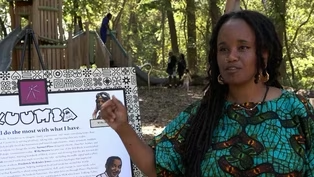
[MUSIC] Chickasaw Park in Louisville is home to the country's only nature based playground centered around black history.
The Sankofa Sanctuary opened this summer, and the creators from the play Cousins Collective, a Louisville nonprofit, say the park provides families a peaceful space to connect with culture and community.
>> Metro United Way donated $160,000.
They're ready for K Alliance for us to build a children's playground, and we were able to partner with Jefferson Memorial Forest and Metro Parks for a ten year lease in the Chickasaw neighborhood.
The Chickasaw Park that is the only Olmsted Park in the nation that was created for black folks during segregation.
So this park has a lot of history and has been a place where our children and families can play for so long.
>> Sankofa means to go back and get it.
So getting back to our roots, and as you can kind of see through here, it goes through a timeline of history, of black culture, but starting starting from where our ancestors were.
>> You know, it's very important for our children to know that their history does not begin with slavery.
So going back to the continent of Africa, precolonial Africa, you know, looking at Timbuktu and Mansa Musa, Imhotep, we wanted our children to know that they have a rich and a rich past and a rich future, that they come from an international people.
And that the world really belongs to them.
>> A traditional playground tells you exactly how to play with it, whereas out here, nature you can be anything, do anything.
And it really encourages children and adults to use our play and imagination and then being a part of nature, seeing ourselves as a part of the land and a piece of the land, will we respect it better when we see ourselves as a part of nature?
>> Each of the play features focuses on a different communal value a pillar.
The first is Umoja, where we talk about birth.
So we want our kids to know that they are born to a people and to a place.
And that's really great too, because we know that black people in general can often feel divorced from the land.
And there's so much that goes into that.
Redlining, you know, lack of access to buying property.
So for our kids to come to a place and say that this is my park and to see maybe their actual footsteps or footsteps that represent, you know, them is huge.
Everyone from this whole park is from Kentucky, but it's really exciting to learn about Samuel Plato, who built the West Over neighborhood, which is in Chickasaw, and the West neighborhood, was the first single unit family homes for black folks in Louisville.
And we have Plato's Playhouse to honor him.
And then we have Willa Brown.
We have the zip line here honoring her.
She was a famous aviator, and she taught the Tuskegee Airmen.
Then we have Garret Morgan, Garret Morgan built the traffic light.
So we have a traffic light here for him.
And then Frederick McKinley Jones innovated in speaker technology.
So we have the talking tubes here for him.
>> A lot of people really love the park because there's not a lot of natural play spaces that are accessible to folks that are in the West End.
A lot of those spaces, you have to go kind of further out to, to find.
And the system that's just right here and then learning more about the history and the purpose of what the park is a lot.
We've got a lot of really good feedback and people keep coming back.
>> We know that when families have access to experiences like this, that it helps to prevent or bounce back from aces.
Adverse childhood experiences.
And we know that adverse childhood experiences down the line can contribute to physical illness, to violence, to addiction, to all the things that we say as a community that we are against.
And so the experiences that we give the child, if we're able to stop and intentionally parent to support parents and come together as a community the way we are meant to, then we will see so much more healing.
We'll see our community thriving.
We'll see strong adults, right?
But it takes valuing the vulnerable in our community.
>> The Olmsted Park Conservancy recently donated money so Sankofa Sanctuary can add more play features and permanent signs.
The new additions will be ready by next Juneteenth.
Open enrollment for Medicare starts tomorrow.
We'll have some answers about that process on Kentucky edition.
Join us for that tomorrow night at 6.30 eastern, 530 central.
Thanks for being with us.
Make the rest of your evening a good one.
 New
NewKentucky Voters to Decide Limits on Governor's Pardon Power
Video has Closed Captions
Clip: S5 Ep76 | 4m 16s | State senator tours state to advocate for amendment limiting gubernatorial pardon powers. (4m 16s)
 New
NewLouisville Playground Offers Sense of History
Video has Closed Captions
Clip: S5 Ep76 | 4m 23s | Nature-based playground centers around Black history. (4m 23s)
 New
NewWhat Could Be Behind the Decline in Young Registered Voters
Video has Closed Captions
Clip: S5 Ep76 | 5m 36s | Political science professor talks about ways to get more young people politically engaged. (5m 36s)
Providing Support for PBS.org
Learn Moreabout PBS online sponsorship New Episode
- News and Public Affairs

Top journalists deliver compelling original analysis of the hour's headlines.
 New Episode
- News and Public Affairs

FRONTLINE is investigative journalism that questions, explains and changes our world.
 New Episode
 New Episode
 New Episode
 New Episode
 New Episode
 New Episode
 New Episode
 New Episode
Support for PBS provided by:
Kentucky Edition is a local public television program presented by KET