
June 16, 2026
Season 4 Episode 409 | 26m 31sVideo has Closed Captions
Extreme drought leads a Kentucky city to declare a state of emergency.
Extreme drought leads a Kentucky city to declare a state of emergency, a new Kentucky law that taxes prediction markets is being challenged in court, meet the acting superintendent of FCPS, an update on Sen. McConnell's health, and Louisville-based Yum! Brands sells off a slice of its portfolio.
Problems playing video? | Closed Captioning Feedback
Problems playing video? | Closed Captioning Feedback
Kentucky Edition is a local public television program presented by KET
June 16, 2026
Season 4 Episode 409 | 26m 31sVideo has Closed Captions
Extreme drought leads a Kentucky city to declare a state of emergency, a new Kentucky law that taxes prediction markets is being challenged in court, meet the acting superintendent of FCPS, an update on Sen. McConnell's health, and Louisville-based Yum! Brands sells off a slice of its portfolio.
Problems playing video? | Closed Captioning Feedback
Where to Watch Kentucky Edition
Kentucky Edition is available to stream on pbs.org and the PBS app.
Providing Support for PBS.org
Learn Moreabout PBS online sponsorship[music] >> That's the only source of water supply we have for the entire county of city and county.
>> A Kentucky city declares an emergency as water levels run low.
>> Our school system is exceptional.
>> How?
Fayette County Public Schools new acting leader plans to convince the community that that's true.
>> It's very promising going forward.
[MUSIC] >> And Kentucky attacks a growing problem from the air.
[MUSIC] >> Production of Kentucky edition is made possible in part by the KET Millennium Fund.
>> Good evening and welcome to Kentucky Edition for Tuesday, June 16th.
I'm Kelsey Starks here in our KET Studios in Louisville, filling in tonight for Renee Shaw.
Well, extreme drought conditions have led a Central Kentucky city to declare a state of emergency.
The ongoing drought has lowered water levels in the lake that supplies liberty and Casey counties.
Drinking water.
You can see on this map that Casey County is in the dark red, meaning extreme drought.
The mayor of liberty, Sam Haddad, made the emergency declaration at a special meeting last night.
He spoke to us today about the crisis.
>> The lack of rain.
It's been going on since almost end of summer last year, actually.
So the rainfall has been way below average and could not keep up with the consumption.
And now we're the lake is down significantly.
It's almost 15ft low at this point.
So it's very critical.
That's the only source of water supply we have for our entire county, city and county.
And we we had to declare emergency so we can decrease the amount of water used.
At the same time, we can seek help and to find other sources of water supply.
We're trying to conserve and decrease the amount of water consumed by every individual.
Basically an outside outdoor.
They cannot water the the yard.
They cannot.
A swimming pool, full swimming pool, no pressure washer, things like that.
So things which require a large amount of water they cannot do basically.
And the sprinkler for flowers and for any vegetable garden, things like that.
They have to do hand watering.
Basically, they have to do it to minimize the amount of water we can, we can use basically for that purpose.
The only source we have right now except hoping and praying for more rain.
The other source will be we have green River goes through liberty, and that's the only way we can think about feeding into lake from the river.
But of course we have to have Frankfort.
We already contacting Frankfort and Division of Water, Division of Environment and all departments in Frankfort to help us on that subject, to come down and study and look and see what we can do and how we can do it.
Also, resources for that takes a lot of financial resources, which we do not have as well.
So we need expertise and resources to finish that project and complete that idea and feed into the lake to help sustain life and existence in this community.
We are working on Second Lake.
We had since I took over a mayorship and three years ago we went after fund for New Lake, and we finally managed to have $9 million for New Lake.
And we have engineer on on the project and we're in the early phases, but we're going to take some time and hopefully get the second leg.
Of course, we will have secure water supply for and definitely.
>> Casey County officials will hold a fiscal court meeting tonight where they are expected to declare a state of emergency for the entire county.
A new Kentucky law that taxes prediction markets is being challenged in court.
The Kentucky General Assembly passed House Bill 904 earlier this year.
The omnibus sports Wagering bill includes a first in the nation excise tax on prediction markets like Kelsey and Polymarket.
Prediction markets allow customers to wager on whether real world events like election results or War outcomes will or won't happen.
The lawsuit, filed by a coalition of prediction market companies, says Kentucky's 14.25% tax is higher than on wagers at horse tracks.
Disincentivising prediction Markets in Kentucky.
Kentucky Attorney General Russell Coleman vowed to fight the legal challenge.
Quote, you can bet our office will defend these statutes and the people of our Commonwealth from out of state companies that seek to cancel Kentucky sports betting laws in any courtroom.
The attorneys with the AG's office are the odds on favorite to win.
Well, as we've told you, Fayette County Public Schools is under new leadership.
Former Superintendent Demetrus Liggins was placed on administrative leave last week following financial turmoil in the district.
Our Emily Prince heard from the new acting superintendent today and asked how he plans to help turn the school system around.
>> Acting Superintendent of Fayette County Public Schools doctor Bill Bradford addressed the media today.
He told me he feels the district's two greatest challenges are its fiscal health, but also its culture.
He explained how he hopes to tackle those issues.
>> That's something that was really important to me, is that I become as fluent in budget management and of our current budget standings as is the CFO.
>> The acting superintendent, pledging to spend a considerable amount of time with the district's interim chief financial officer.
Last year, Fayette County Public Schools revealed a $16 million budget deficit.
Since then, the district has cut more than 100 jobs.
>> Our school system is exceptional.
I understand that there have been distractions as of late that have caught attention that doesn't demonstrate exceptionality.
>> One of those distractions could be the behavior of Superintendent Demetrus Liggins.
Liggins, who has been in the hot seat due to the district's finances, sent an email to the Fayette County Board of Education saying he was ready to leave his job, but then said he was not resigning.
Liggins has since been placed on paid administrative leave.
Tuesday's media briefing did not allow for any questions about personnel other than Bradford.
>> It's extremely important to me that we refresh the sense of value that Fayette County Public Schools has for the community of Lexington and within Fayette County.
>> Bradford said.
His professional experience sets him up for success in this new position.
He began his career with NFCPS working as a high school Spanish teacher.
Bradford then advanced to principal and assistant superintendent positions in northern Kentucky before returning to Fayette County.
He has served as assistant superintendent in the district since 2024.
Bradford said his focus is to build back trust with people across Fayette County, as well as state legislators.
>> Being as visible as I can in places where I can develop what I mentioned before, which are those relationships.
>> I asked Doctor Bradford if he'd be interested in being considered for the permanent superintendent position.
He said right now he's only focused on the role at hand, but he would make that decision as time goes on.
For Kentucky edition.
I'm Emily Prince.
>> Bradford said the school board will meet next week, and his team will present a financial report of the district.
At that time, U.S.
Senator Mitch McConnell of Kentucky remains in a Washington, D.C.
hospital.
His office still isn't saying why he went to the hospital Sunday morning.
It's the latest health problem for Kentucky's senior, who was in the hospital for flu like symptoms in February.
A spokesman for McConnell put out this statement last night.
Quote, Senator McConnell is fully engaged with staff on Senate business and Kentucky matters and is very appreciative of the outstanding care he is receiving, end quote.
Senator John Thune, the Senate majority leader, says McConnell wants to return to the Senate, but Thune says he will defer to McConnell's staff about when that will happen.
The 84 year old McConnell is retiring after seven terms in the Senate.
High school students, who hope to be the first in their family to get a college degree are on campus this week to get a head start.
Western Kentucky University is hosting a free camp for teens to get a sense of campus life and academics.
Laura Rogers was there for today's session.
>> CR synthesized WEKU has always served a large number of first gen students.
>> Doctor Don winters teaches English and criminology at WKU, her alma mater.
>> I got here in 2002 where research on first gen students was relatively nonexistent.
I had a lot of obstacles because I did not have that familial knowledge of navigating college.
>> Winters would go on to earn multiple degrees, including a doctorate in educational leadership.
>> It's more about curiosity and grit, determination.
>> She's sharing that message with today's first generation college students through w k US first gen initiative.
>> We're trying to connect them to more customized resources.
>> It's like seeing myself at a younger age.
>> Sen Loon is a WKU junior and first gen student, serving as a counselor to these students who have their sights set on college.
>> I think college has been helping me be more independent and figuring out what I really am into and who I really am.
>> Her family immigrated to the United States from Burma when she was eight years old.
She's now pre-med.
>> I did grow up in a rural area with not much help with health care, and so when I got to America, I just thought that being a doctor would be the most way to help people.
>> The first gen camp allows them to really be exposed to resources, mentors, faculty members, people within different academic colleges.
>> Peter Ong is also a first gen student aiming for med school, sharing his advice with those who want to follow in his footsteps.
>> So we have the first gen advocates.
There is a place for them to really find a community immediately if they do come to WKU.
>> He says the college experience is about more than earning a diploma.
>> I from just academics, there's things to get involved in clubs, intramurals, organizations, whether that's service or student government.
>> More than 4000 Hilltoppers identify as first generation students.
That's more than 30% of the student body.
>> Being the first, it feels really good.
It is hard.
It can be hard at times, but I'm making it through.
>> The four day camp includes workshops, campus experiences, team building, and guidance on financial aid and admissions.
>> They get to kind of see what it's like as an actual first generation college student while you're in college.
>> We want them to see themselves as college students.
We want to plant that seed.
>> For Kentucky edition.
I'm Laura Rogers.
>> Leaders of Kentucky's community and technical college system say community is more than just part of the name on a special Kentucky tonight.
Last night, our guests talked about how their schools are dealing with the needs of their communities.
>> Post-Pandemic.
It was truly horrible.
Horrible.
On health care.
A lot of nurses and techs were leaving that industry, that sector.
And so hospital came to us.
Owensboro Regional Hospital came to us and said, you know, we need more nurses.
We took our program from 50 students in 21 to 150 students.
And so we responded with a 300% increase to make sure they had the workforce they need.
Our our community responded to that.
You know, they were able to come in and get nursing degrees and have a very, very much a family sustaining wage, a career that they could be proud of.
So we see instances like that.
We're a rural area that is dependent on agriculture as well.
And another example is an area where we felt the need that we needed.
The veterinarians in the area said we need a vet tech program.
So we established the first two year vet tech program in the state, and that has helped draw students from all over the Commonwealth.
And it's been hugely successful and it's been growing as well.
>> Luckily, we have a really good relationship with our K12 partners, so we just have an excellent relationship with all the superintendents and administration at those K-12 institutions.
And so we're able to put students on pathways at an early age.
So really starting working with them in middle school, high school, all the way on, on up to make sure that they are in a track that will help them have a viable career and be able to provide for their families and hopefully stay in Eastern Kentucky.
That's important.
So we have to be very strategic in what pathways we're promoting, because we want to make sure that the jobs are there once they finish.
So we're really focusing on that, focusing on health care, focusing on trades related skilled trades.
There's tons of opportunity in the skilled trades.
So really working with students that way and then reengaging the adults, really working with adults who are out there who maybe want a better job, and maybe they want to come back and learn a new vocation, get into a new career.
So stressing affordability, stressing all the options that we have for assistance at our colleges, whether it be academic assistance through tutoring or whether it be helping with nonacademic barriers, we have a success zone at CTC, for example, where when a student walks in, no matter what their age, we just start working with them.
And do you need transportation assistance, child care assistance, food pantries?
>> See the full program online on demand at ket.org/ky tonight.
[MUSIC] In business news, Pizza Hut is getting a new owner.
Its current owner, Louisville based Yum Brands, says it's selling the pizza chain to two companies.
Long Range Capital, a private equity firm, will buy Pizza Hut's operations outside China.
Yum China Holdings will buy Pizza Hut's operations inside China.
The entire deal is worth $2.7 billion.
This comes at a time of declining sales for Pizza Hut.
There are new rules in one Kentucky town for vape shops, and there's disagreement in Louisville about how to spend millions in opioid settlement money.
Our Toby Gibbs tells us more in this look at headlines around Kentucky.
>> Mayor Craig Greenberg wants to use $8 million in opioid settlement money to fund Louisville's 911 call center jail and some other services now paid for with tax dollars, Louisville Public Media reports.
Some local advocacy groups oppose that.
They want the money to go directly to help people struggling with addiction.
The Louisville Metro Council will have final say on the budget.
[MUSIC] From the Northern Kentucky Tribune.
The Southgate City Council voted unanimously for regulations concerning vape shops.
Among the new rules, vape shops have to be at least 1200ft from schools, daycares, playgrounds and anything else youth related and vape shops have to be 600ft from each other.
Unaccompanied minors can't shop at vape shops and the shops can't sell alcohol.
[MUSIC] 200 people turned out in McCracken County for two educational meetings about nuclear energy.
The county is the future home of two uranium enrichment facilities global laser enrichment and general matter.
Wkms says the goal of the meetings was to give people a base level knowledge of the science behind nuclear energy.
Their worries of fierce basketball rivalry could get two fierce on three reports.
Brownsville Edmonson County will forfeit its games against Litchfield Grayson County this upcoming season.
Two Edmonson players Braden Wright and Jonah Massey just announced they're transferring to Litchfield.
Superintendent Brian Alexander says there have been ejections during games in the past, and the transfers could take the rivalry to a new level, so out of caution, the school will forfeit the games.
The schools will still face each other in football.
[MUSIC] With headlines around Kentucky.
I'm Toby Gibbs.
[MUSIC] >> In 1996, the Montgomery County Medical Society met to address the growing number of people in the community without health insurance.
Well, that same year, the post clinic of free doctor's office in downtown Mount Sterling started seeing patients in the old Post Office building, hence the name coming up on its 30th year anniversary.
Their mission to serve those in need remains the same.
Here's more from Kentucky Edition's Clayton Dalton.
[MUSIC] >> In the middle of a neighborhood in downtown Mount Sterling, you'll find the Post Clinic.
They offer routine physicals, lab work, X-rays, vaccinations, and more, all free of charge.
In 2017, they added dental services.
>> We were able to find a dental office and we had some equipment that was donated, so we were able to start a free clinic here in town one day a month, and our clinics were full, and we saw that we were meeting a certain need, but we couldn't provide the care for all the the demand that we were receiving from the patients.
>> The patient pool continued to grow and they quickly realized their facility couldn't meet the needs they were seeing.
But with local, state and federal dollars, the dream of a new facility became reality in 2024.
>> It's a state of the art building, with four medical exam rooms and four dental rooms.
It has a negative air flow to protect people from infectious diseases, and we have an air circulation every ten minutes.
>> Having dentists and physicians under one roof offers patients a level of care that's uncommon in traditional health care settings.
>> We're here because we want to be here, and so many times we see with patients on the medical side that come in for medical but have an abscessed tooth, well, we're able to do that extraction for you and work hand in hand.
And then on the flip side, someone comes in to have an extraction done, but their blood pressure is out of control because they haven't had the money to go and be on their medications, say, in six months.
So we funnel it back to the medical and the most time with the medical, we can get them in the same day so that in a month they're on that medication and now they can have their dental procedure done.
>> We're not just looking at the teeth or a tooth, we're looking at the whole person.
And so the fact that this clinic is positioned where it's positioned and the fact that it can have a large array of dental services provided is crucial for this community.
When you look at free dental services.
And here we are in the in the gateway area, you know, we're right at the foothills of Appalachia.
There are many, many underserved populations in this part of the state.
>> Recently, the clinic expanded to offer denture services, meeting another critical need in the community.
>> We have a denture program now that we didn't have in the past.
That's very efficient.
We're making a what would be called digital dentures.
And it's it's been effective and we're providing another service there that patients, many of our patients throughout the years come to us because they've not seen a dentist for years.
And there's not a whole lot of care that we can provide other than just removing their teeth.
They end up what we would call edentulous without teeth.
And so there's a big demand to have those replaced, both for esthetics and for function so that they can live their lives, you know, much better.
>> Darla Ruger came to the clinic to address some tooth sensitivity.
She says the post clinic is an incredible community resource.
>> In today's economy, everything is so expensive and they are here to provide free service for you.
And if you need something more, they will get you in touch with what you need and help you through that.
The first time I came and every time since, what impresses me is just how much they really care for people.
They don't make you feel guilty about anything that you haven't done.
They are just there to serve you.
>> More than anything I see with the patients that come is a level of gratitude they have that we're actually looking at all of these different things.
A dentist that's looking at more than just the teeth, it seems strange to them, but that's just what we're trying to have be the normal here in the clinic.
>> For Kentucky edition, I'm Clayton Dalton.
>> Tanya Kendrick says her next goal for the clinic is to expand pediatric dental services, citing dental problems as one of the top reasons students miss school.
[MUSIC] Well, it's sometimes referred to as the vine that ate the South.
Kudzu is native to Asia and was brought to the U.S.
to help control erosion.
But the fast growing, invasive plant can smother just about anything that gets in its way.
So now the Kentucky Department of Fish and Wildlife Resources is piloting a project that attacks kudzu from the sky using drones.
>> Kudzu is a is a very aggressive, exotic plant that grows.
You know, some people say a foot a day.
And unfortunately usually grows in areas that aren't readily accessible by equipment like tractors, four wheelers, that kind of stuff.
So this is kind of the idea of like, how do we do this?
How do we make it?
So someone's not trying to walk through two foot deep, three foot deep vegetation with a backpack sprayer, trying to treat the treat the kudzu and take care of it.
So we thought, well, drones is something that's come into the landscape of treating crops, that kind of stuff.
Over the past five, ten years.
We said, well, why?
Why don't we try this on, on kudzu and see how well it works?
So we got about eight different projects lined out, and I think it ended up being five different counties going from Whitley County up to Lee County in the southeastern part of the state, and said, let's try this.
Let's try different sized projects with different chemicals that are labeled to treat kudzu with aerial application and see which one works best.
So last year we did that and we had, you know, pretty good results.
When you're looking at the site from from a far distance, you got a really good control, but █you still, if you walk through it, you can see young sprouts of kudzu coming up through it and you know, they're a foot or so long right now realizing that by the end of the summer that it'll probably need to be treated again.
And we see that this will probably need to be done.
At least two treatments.
And then, you know, a little spot treatments later to get under control and then to continue to watch as you go.
It's pretty impressive with aerial application of you're treating use only five gallons per acre.
So if you take a five gallon bucket of, of mixture and imagine that covering a football field.
So they go up and they have specialty nozzles to make big droplets.
They fly as close as they can to keep to, to help not have drift.
And they just fly low and they spread it.
So, you know, so they can usually do, I think it was somewhere between 5 and 6 acres for every flight.
If we want to move forward with this, one of the limiting factors is, is actually drone operators in the eastern half of the state.
Because at this point, most of the drone operators are around our heavily ag areas trying to do, you know, cover crops, fungicide, sprayings, you know, spraying out to hayfields, doing that kind of work.
And we don't have very many to the east to actually be able to bid on these projects.
And that's actually something right now.
My biologists down the southeast is working with local conservation districts to try to come up with a way to get the funds to get some drones, or the idea of getting pilots down in that part of the state to actually to make this a more readily available resource to landowners in the southeast.
>> Interesting.
Stewart says to his knowledge, Kentucky is the only state piloting a drone project for attacking kudzu.
Well, we do hope you'll join us again tomorrow night at 630 eastern, 530 central for Kentucky Edition, where we inform, connect and inspire.
You can subscribe to our email Newsletters and watch full episodes and clips@ket.org.
You can send us a story idea.
You can find us at public affairs@ket.org.
You can always follow us on social media to stay in the loop as well.
Thank you so much for joining us tonight.
Have a great night.
 New
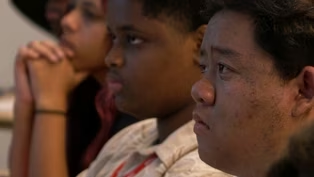
NewFirst‑Gen College Hopefuls Get Early Start at WKU Camp
Video has Closed Captions
Clip: S4 Ep409 | 2m 43s | WKU hosts free camp giving first‑gen college‑bound teens a preview of campus life. (2m 43s)
 New
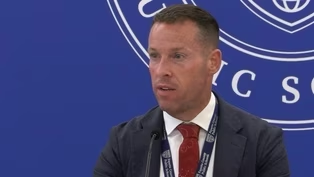
NewNew Leadership Steps in at Fayette County Public Schools
Video has Closed Captions
Clip: S4 Ep409 | 2m 53s | Acting superintendent outlines plan to stabilize Fayette County schools after financial turmoil. (2m 53s)
 New
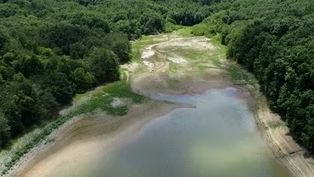
NewState of Emergency Declared in Liberty
Video has Closed Captions
Clip: S4 Ep409 | 2m 52s | Extreme drought conditions drop water levels at lake that supplies drinking water. (2m 52s)
Providing Support for PBS.org
Learn Moreabout PBS online sponsorship New Episode
- News and Public Affairs

Top journalists deliver compelling original analysis of the hour's headlines.
 New Episode
- News and Public Affairs

Today's top journalists discuss Washington's current political events and public affairs.
 New Episode
 New Episode
 New Episode

 New Episode
 New Episode
 New Episode
Support for PBS provided by:
Kentucky Edition is a local public television program presented by KET