
February 4, 2026
Season 4 Episode 315 | 26m 29sVideo has Closed Captions
Kentucky's Senate president calls closure of the BlueOval SK plant a "quagmire" for the state.
Kentucky's Senate president calls closure of the BlueOval SK plant a "quagmire" for the state. A bill that could clear the way for cigar bars advances. U.S. Sen. McConnell checks himself into the hospital. A data center developer looking to build in Kentucky files a lawsuit.
Problems playing video? | Closed Captioning Feedback
Problems playing video? | Closed Captioning Feedback
Kentucky Edition is a local public television program presented by KET
February 4, 2026
Season 4 Episode 315 | 26m 29sVideo has Closed Captions
Kentucky's Senate president calls closure of the BlueOval SK plant a "quagmire" for the state. A bill that could clear the way for cigar bars advances. U.S. Sen. McConnell checks himself into the hospital. A data center developer looking to build in Kentucky files a lawsuit.
Problems playing video? | Closed Captioning Feedback
How to Watch Kentucky Edition
Kentucky Edition is available to stream on pbs.org and the free PBS App, available on iPhone, Apple TV, Android TV, Android smartphones, Amazon Fire TV, Amazon Fire Tablet, Roku, Samsung Smart TV, and Vizio.
Providing Support for PBS.org
Learn Moreabout PBS online sponsorshipmusic >> There is an obligation that this committee has to the taxpayers of the Commonwealth that we want to ensure is honored.
>> A Kentucky electric vehicle battery plant has closed.
What happens to the 250 million the state loaned the project?
>> I've got a unique perspective on how the executive branch and legislative branch interact in state government to the federal government.
>> Candidate for Congress says his Frankfort experience would help him in Washington.
[MUSIC] >> Once this approval occurs, then the design for the facility starts.
>> And debate and discussion over plans for a data center in southern Kentucky.
[MUSIC] >> Production of Kentucky Edition is made possible in part by the KET Millennium Fund.
[MUSIC] .
>> Good evening and welcome to Kentucky Edition for this Wednesday, February the 4th, I'm Renee Shaw, and we thank you for winding down your Wednesday with us.
The closure of the Blue Oval SK plant in Glendale meant layoffs for workers and disappointment for state lawmakers.
The Kentucky Senate president has described the situation as a, quote, quagmire for the state, which invested hundreds of millions of dollars into the venture.
But as our June Leffler reports, a state economic official told state lawmakers today that the situation is under control.
More in tonight's legislative update.
>> Kentucky put up $250 million for the Blue Oval venture, with the goal of creating 5000 jobs, but if production ceases and all workers are laid off.
>> There is no argument and there is no question about the messaging we have provided.
You shall repay to the state $250 million, and we have had it, and we've always had it in a written, legally binding document.
>> That money offered as a loan came with these stipulations.
>> The guaranteed threshold in the loan agreement was to have 2500 jobs.
They also had to have an hourly compensation of $26.41 per hour, and the first threshold of having 5000 jobs was to be achieved in 2030.
And as you also see, we calculated escalating wages to be part of the compliance, not just a set beginning wage, but actual escalating wages.
>> But Kentucky's economic development secretary says he's not asking the companies to pay up quite yet.
>> Ford Motor Company has a far better Rolodex than I do, and Ford Motor Company has internal operations that they can bring more jobs and more investment.
I want to make sure that that Rolodex and that technical knowhow and that global business and, if you will, the carrot and stick approach that we have been laying out.
The carrot is let's keep working together, but the stick is you have to repay us.
And if not, and you don't create more jobs, then you're going to repay, maybe even on an accelerated basis.
>> That thinking may be paying off, though the Glendale based EV plant will close, Ford has promised to use that facility for another venture energy storage for data centers.
>> Despite all the investment that has been made, Ford has agreed to invest $2 billion to install additional equipment, different kinds of equipment to enter the energy storage solutions business.
And that's a 2100 plus job commitment that they have made.
>> This testimony came before the Senate Appropriations and Revenue Committee today.
>> You've been a tireless advocate prior to this, even being a project that existed.
And then through the project and then you were very diligent in in jumping on the bad news that we got to try to mitigate the impact.
So we do appreciate that.
And I know that your efforts are certainly ongoing.
I think the committee remains open, and Ford has been a good partner to the Commonwealth for a long time, and their secondary and tertiary impacts are well known.
And we expect that that relationship will continue.
But there is an obligation that this committee has to the taxpayers of the Commonwealth that we want to ensure is honored.
>> One part of the initial investment that's still up for discussion, what to do with the training site?
The facility is on Elizabethtown Community and Technical College's campus for Kentucky Edition.
I'm June Leffler.
>> Thank you.
Jim.
1600 workers at the Blue Oval SK plant are set to be laid off on February the 14th.
As we have reported lots of times, Kentucky faces a housing shortage.
The state has more than 200,000 housing units short, and the problem is expected to get worse over time.
We talked about it on Monday nights.
Kentucky tonight.
Part of the discussion focused on Senate Bill nine, a bill announced Monday by State Senator Robbie Mills, a Republican from Henderson and the Senate Majority Caucus chair.
That bill would create areas with fewer upfront costs for housing developers.
It would allow infrastructure costs like water lines and pump stations to be financed over time, potentially lowering housing prices and speeding up construction, our guest said.
Building more homes is just one part of the solution.
>> Yes, we know we need supply, but people are concerned about whether or not they can afford it.
They are terrified out there.
I mean, back in the day when I was growing up, my parents used to say things were sky high and things are sky high.
Everything is up from utilities to groceries to health care and housing.
And guess what has not increased over the years?
Wages.
What people are taking home.
So that's why I'm saying yes and I love I agree with Wendy.
I totally support Senator Mills and Rep Whitten as well, but I think we also need to make sure that what we're building people can afford in a way to do that.
I think Wendy was talking about with with some of the dollars in the Kentucky Housing Corporation, you can make sure that whatever you're building goes to a certain group of people that can actually afford it.
And listen, people think affordability, you ask three different people, you're going to get three different answers of what affordability is.
But I will tell you what it is not.
It is not $1,600 for a one bedroom apartment.
That is not what affordability is.
And I think we need to start using real numbers when we're talking about that to.
>> We have a really significant generational divide around affordability in this country and in this state.
What I mean by that is that younger households who are just renting their first house or trying to buy their first house, are facing a far steeper climb than those of us who might have bought a home a long time ago, and that that divide is getting broader and broader.
The average, excuse me, median age of a first time home buyer in the United States is now 40 years old.
That is stunning.
That means families who are starting to have children aren't even considering it because they can't afford it.
And the amount they are spending.
The median homeowner in the US spends 47% of their median income to afford homeownership.
>> A lot to learn during that discussion, which was broad and wide and looked at all aspects of the housing picture.
You can see it online on demand.
It is streaming there at Keturah KY.
Tonight, most incarcerated Kentuckians undergo supervised reentry for six months prior to finishing their sentence.
Similar to parole, the inmate is monitored for good behavior and given resources to reduce the likelihood they'll wind up back in jail.
A state senator wants to ban repeat violent criminals from this program, saying it could prevent more violent attacks.
>> Mr.
president, Jordan Wells was shot in Louisville on March 30th, 2024.
He died on April 20th, 2024 at only 23 years old.
Jordan's death could have been prevented if these provisions, supported by Senate Bill 48 to the Mandatory Reentry Supervision statutes, had been enacted.
Senate Bill 48 updates the statutes regarding mandatory reentry supervision to prohibit inmates from qualifying for mandatory reentry supervision if the inmate had previously been convicted of two or more offenses that would classify him or her as a violent felon.
Under Chris 439 .3401 or that individual had been recommitted to prison for a violation of probation, shock, probation, parole, or conditional discharge.
>> People convicted of a capital offense are already not eligible for this kind of parole.
Senate Bill 48 passed unanimously in the Senate on Tuesday.
A lawmaker in the House says he'll file similar legislation, an amended version of a bill designed to criminalize the act of grooming received unanimous support in the full House today.
Representative Mary Ann Proctor, a sponsor of House Bill four, says the measure will make intimate or secret relationships with minors a felony.
The bill does not prevent a child's parent or guardian from having age appropriate conversations about sexuality, a House floor amendment adopted today adds siblings and some volunteers to the list of people who can also have those discussions.
House Bill for now, heads to the Senate for consideration there.
While some Kentucky communities want more nonsmoking laws, a House bill looks to make provisions for cigar bars.
State Representative Chris Lewis of Louisville spoke about House Bill 194 yesterday, explaining what the bill does and does not do.
>> This is not about smoking cigars in a regular bar, your local bowling alley, a restaurant or in any other public place that doesn't currently allow smoking.
If you don't want to be exposed to cigar smoke in a public place where smoke free laws currently exist, nothing in this bill changes your ability to maintain that separation.
What the bill does is to create a narrow exemption that will allow for the smoking of cigars and inside of what is very tightly defined as a cigar bar.
In order to meet the definition.
>> And Representative Lewis measure, cigar bar is required to have 25% of its gross revenue come from the sale of cigars and pipe tobacco.
No other tobacco products like cigarettes or vapes, may be used.
The business must also maintain a valid drink license, and only those age 21 and older are permitted to enter.
One Democratic lawmaker raised a question about future implications of the bill.
>> If a municipality local government doesn't already doesn't have a cigar bar in the.
If this passes, would they then be able to?
Would the entity then be able to pass a nonsmoking ordinance, or does this bill prevent that?
>> This doesn't prevent any municipality from creating a new smoke free ordinance, but it would not allow them to ban a cigar bar.
>> The bill passed the House on a vote of 69 to 24 yesterday, and it's now in the possession of the Senate for consideration there.
A similar measure came out of the House last year.
It died before getting a vote on the Senate floor.
Some health professionals are voicing their opposition to the bill.
The American Cancer Society's Cancer Action Network released a statement saying, quote, we strongly urge the Senate to reject House Bill 194, which will expose more people to the toxic compounds and chemicals in secondhand smoke, and tie the hands of our local elected leaders to protect the health and safety of residents in their community.
End quote.
Now, on the National Front, the U.S.
Senator, Mitch McConnell of Kentucky is in a Washington, D.C.
hospital with flu like symptoms.
Senator McConnell's office says he checked himself into a hospital after feeling ill over the weekend.
A spokesperson says his prognosis is positive.
He's grateful for the excellent care they say he is receiving, and looks forward to returning to Senate business.
McConnell was in the hospital for five days in March of 2023 after falling, suffering a concussion and breaking a rib.
Today, state Senator Robert Stivers, the Kentucky Senate president, praised McConnell for the impact he's had on Kentucky.
>> I do not know or nor will I ever know that I will see anybody, Republican or Democrat, that will be as influential for this state.
As Addison Mitchell.
McConnell has been over the last 40 years.
>> McConnell is 82 years old.
He is not seeking reelection this November after serving seven terms in the U.S.
Senate.
A former state senator is making a bid to return to elected office in Kentucky.
But this time it's not Frankfort.
But Washington Ralph Alvarado served in the Kentucky State Senate for about eight years, and most recently was the health commissioner for Tennessee.
Now he has his sights set on the open sixth Congressional District seat being vacated by Andy Barr, who's running for retiring Senator McConnell's seat.
In part two of my interview with Alvarado, we talk about his Republican bona fides and his position on Covid vaccinations that political opponents could use against him.
>> Obviously, people were dying.
And, you know, I worked in nursing homes.
I saw almost 20% of my folks pass away because of Covid, and it was bad for the elderly.
We knew that that was a very vulnerable population.
But when there were younger people that were involved, we knew that kids were not affected nearly as severely as that.
So people can go back and watch my tape.
I questioned when the Department of Education wanted to come in and start masking kids under the age of five.
I said, The Europeans have looked at this.
It hasn't provided any benefit.
Under the age of 11.
It didn't have any benefit.
High school there was.
It looked like there might have been some in terms of reduction of disease.
So we were learning as we went.
There were recommendations that came down.
We know that we wear masks to prevent transmission of disease.
If a surgeon is going to be working on your abdomen, you want him to wear a mask.
You don't want him sneezing or coughing into your abdomen for risk of transmitting an infection.
If a dentist is working on your mouth, you want him wearing a mask.
Why?
It prevents him from transmitting anything into your mouth or you don't.
None of us would want that, so the same thing would apply.
At the time, we thought that would help reduce transmission.
There was a lot of theories on it.
Once we started getting past that, I think it got to the point.
Some people felt comfortable wearing them, some did not.
And I remember encouraging publicly that people could either, you know, don't don't judge someone on whether or not they want to wear a mask or not at that point to do that, when vaccines first came out, that was the first opportunity we had for prevention.
And I thought the fact that it got brought out as quickly as it did was a tremendous accomplishment of the Trump administration.
And so we recommended that to happen.
But as we go now further along, people, there's also natural immunity.
I remind everybody, there was a joint Senate joint resolution that I proposed recognizing natural immunity to be equal to vaccination.
And so we wound up passing that out of the Senate.
The House never took it up.
I don't know why it didn't have a chance through.
But many countries had recognized that if you already had the infection, at least for a year, you had immunity to to a new infection.
It would count as being vaccinated.
I was proud of the fact that I got I got awards when I was in the state Senate for people defending medical freedom.
And so for me, I think I'm an individual who's always had that position in that stance.
But to act as though we were supposed to know what we know now, again, there's things that we learned moving forward that as we evolve on that, again, vaccine Covid vaccines are available.
When I was commissioner, we lumped that into all the other respiratory vaccines.
We told folks they're available, they're recommended for people that have they're vulnerable and have high risk.
Go talk to your provider and see if it's right for you.
And that's the approach that we take now.
So it was a bad time.
I don't want to go back and live back in 2020.
It was a rough year, 2021.
None of us want to relive those moments, to relive a plague for the world.
I'd rather move on and learn from what we've learned from those things and evolve.
And so I always tell people it's it's available.
It's, you know, it can still be recommended, but it's something you have to decide with your provider.
>> I've read where you had pledged to align with Donald, President Trump's America First agenda as you kicked off your congressional campaign.
And there are even other critics and those in the Republican ranks who believe that the president's actions when it comes to Venezuela, when it comes to the pursuit of Greenland, are the opposite of America.
First, what do you view as America first?
And is President Trump getting it right and doing what he said he would do?
>> Yeah, I think I think America first is is considering he's working for the American people first, I often use the example that we have the nicest house on the block.
America is the most beautiful, the best country in the world.
You have the nicest house.
It's the biggest mansion.
It's very, very nice.
Our neighbors houses may not look as well.
Our neighbor's houses might have sick kids, kids that don't have clothes.
They don't.
They're not being fed.
But we have a kid who's sick at home.
We have a kid who probably needs a little bit better food.
Our roof is leaking, one of our windows is broken, the fence is down, the yard needs to be mowed.
You know, a hole in the floorboard.
Instead of saying, hey, I'm going to take what I've got and go fix up everybody else's houses, fix your own house first, fix the flooring, do all those things.
And then if you're generous and we have friends that are out there, go and help your neighbors and see what you can do there.
So I think there's a responsibility for that.
There's also a responsibility for safety.
And so part of America first is making sure that people at home are safe and they feel secure.
I think the president's done a tremendous job with that.
Right?
I mean, he's trying to rebuild the economy.
He's trying to make sure that the economy is something that's going to be solid so that Americans can live the American dream.
He's worked very hard at reducing gas prices already.
Housing prices.
He's hoping.
>> Gas prices are not $1.99 per gallon, as he has asserted.
>> Well, it depends on where you're at.
There are some places that are below $2 in the country, but there's there's several.
There's much cheaper than it was.
You have to admit, if you go back and compare the price of gas from where it was a year, year and a half ago to where it is today, it's markedly reduced.
But again, to your point, it's got to be something that we're going to say, hey, we can say the stock market's doing better.
That's great.
The average citizen needs to feel that really at home.
So if you're going to go buy groceries or buy groceries, more affordable.
Is my housing more affordable?
People need to feel that impact.
And again, it would be nice to snap your fingers after four years of bad policy to try to improve it and turn it around.
The president is working hard to try to make that better.
And it's been it's only been a year.
What I.
>> Tell people, he said on day one that he alone could fix it.
>> Yeah, and I think he's doing that.
But you have to give him at least some time and some patience to make that happen, because it's in four years of destruction.
To say we're going to rebuild something in a year would be nice, and that would be the ideal.
But he's also trying to make a lot of those things happen.
>> Do you believe that you are the MAGA candidate in the sixth district Republican primary?
>> I think I mean, yes, I mean, as far as MAGA candidate America first, Kentucky first.
I mean, that's my focus on things is I want to bring that same philosophy.
I think the president needs allies for a lot of what he's wanting to get accomplished.
So we want to focus on, again, things that are going to, you know, bring bring a lot of investment into the state, someone who's going to be able to defend our values, our industries nationally.
Obviously, we are very heavy on bourbon, our horse industry.
We have great universities in our in our state that we're very proud of.
We want to make sure that our veterans are taken care of.
I think Congressman Barr, who's obviously preceded in this role, I think he's laid down a great blueprint of what a congressman should be and look like and sound like for the district to help with constituent services.
He's had one of the best in the country.
I pledge to continue that, to try to have veteran services, to make sure our veterans can navigate a complicated system to help take care of that.
And then at a time when we're in a point of transition on health care to bring again, new ideas, I've got a unique perspective on how the executive branch and legislative branch interact in state government to the federal government, how those Grant systems work, what works, what doesn't.
A lot of ideas on how to restructure health care, because just putting money in and taking money out doesn't fix the problem.
We have to find a new way, develop some trust back into the system.
Trust our providers, trust our patients, trust our states to do the system well.
>> A couple of weeks ago, I interviewed another contender in the GOP primary for the sixth Congressional District, sitting State Representative Ryan Dodson.
You can find that interview along with Ralph Alvarado, on our website at Keturah.
Craig Greenberg and more candidate conversations are to come on Kentucky Edition.
Primary election day is May 19th.
[MUSIC] Members of a southern Kentucky community have concerns about a data center coming to town.
They're pushing back and the developers have now filed a lawsuit.
Our Laura Rogers has more from Simpson County.
>> I've seen a lot of changes in my lifetime here.
>> Those changes could include a new data center and Simpson County.
But judge executive Mason Barnes says many residents aren't sold on the idea.
>> They really would prefer not to have the data center here at all, but they most definitely want there to be certain guidelines and restrictions.
If they are allowed to locate here.
>> That would come in the form of a conditional use permit, which would give local government more control over how the data center would operate.
>> They don't believe that the county has the ability to implement that ordinance, and we believe we absolutely do have that ability.
>> That stinky Lanco, who purchased the land once home to a mulch operation close to Franklin's Exit two on I-65.
>> The problem with that spot is just just like the whole area of Kentucky, we're a very coarse topology.
Everywhere you see a dip in the ground, there's a likelihood that that could eventually be a sinkhole that goes into a cave system.
>> Kelly Bush serves on the Franklin City Commission.
He's opposed to the project.
>> Everybody thinks we're going to get all this tax revenue from it, and that's just not the case.
Well, it's going to bring in jobs.
Well, that's just not the case.
We do not understand the long term effects on the community, our health or the environment from these types of facilities.
>> Bush is worried about how the facility will generate power.
The plan is to use on site natural gas turbines.
>> And from my understanding is that each of these turbine generators is going to sound like a jet engine taking off.
>> Any noise would have to be attenuated or reduced at the property line as per the city ordinances.
>> John Henning is a consulting engineer on the project and says he understands residents concerns.
>> We're not at the phase of designing the full project yet, so a lot of the concerns that the residents are bringing up at this stage, we haven't even begun the design to address, but those are all items that will be addressed.
>> Keelan Cole has now filed a lawsuit against Simpson County challenging the ordinance.
They say county government doesn't have the legal authority to impose conditions on developments within Franklin city limits, which has its own rules.
>> I feel like I have an obligation and a responsibility to look out for our community, to be sure we're protecting our citizens.
Our environment.
>> Ultimately wants to build three 200,000 square foot facilities.
They say each would represent a more than $1 billion investment and employ up to 200 workers, with estimated tax revenue contributions of more than $17 million.
>> I just think it makes absolutely no sense to allow this type of activity to come and not place some sensible, reasonable conditions upon their activity.
>> And I've no one personally who has said that if they end up getting development and plans and continuing to go forward with it, they will move.
>> Lifelong Franklin resident Jasmine Bud started a petition that has collected more than 1500 signatures from people who do not want the project to proceed.
She's not the only one getting feedback.
>> I've got people calling my cell phone, my political number or texting me on Facebook on messenger.
>> Many of those same residents have showed up to public meetings about the project.
Council for Keelan Cole has said the best way to get the answers people want is to approve the application and move the project forward into the full development plan process, which will include numerous investigations, studies and assessments to make sure the project meets all requirements.
>> Ultimately, both the developer and the community and the council want to make sure that the land is protected, the residents are protected, and that's the that's the end goal for everyone.
>> For Kentucky Edition, I'm Laura Rogers.
>> Thank you so much, Laura.
The Planning and Zoning Commission will meet tomorrow night for more discussion on the development plan.
Simpson County Fiscal Court has asked them to put the project on hold until pending litigation litigation is resolved.
Louisville's vacant Humana building will soon be converted into one of the city's largest hotels.
Mayor Craig Greenberg announced the 26 story building will be renovated into a 1000 room convention center, hotel Louisville Business First reports.
Louisville based companies has signed a letter of intent to purchase the property and the property immediately behind it, with plans to renovate it into what would be the city's second largest hotel.
It comes just a week after the announcement that a J.W.
Marriott hotel is coming to the former Brown and Williamson Tower, just blocks away.
Humana, Louisville's largest publicly traded company, consolidated its headquarters and moved out of the building last year.
[MUSIC] The shop and share goods drive is this Saturday.
It benefits victims of domestic violence and it has some big name supporters.
>> None of us can replace everything these survivors have lost, but each of us can provide at least one thing they need.
>> Learn more about how it works and how you can get involved.
Tomorrow night on Kentucky edition, which you know is at 630 eastern, 530 central where we inform, connect and inspire.
Connect with us all the ways you see on your screen, especially through the social media channels, Facebook and Instagram.
To stay in the loop, send us an email at the email address on your screen and look for us on the PBS app that you can download on your smart devices.
I'm Renee Shaw, thanks for watching and I'll see you tomorrow night.
Have a good one.

Community Pushing Back Against Data Center
Video has Closed Captions
Clip: S4 Ep315 | 4m 15s | Debate and discussion over plans for a data center in southern Kentucky. (4m 15s)
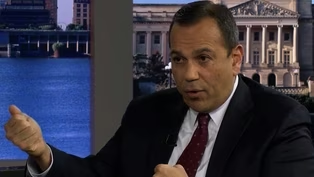
Ralph Alvarado on His Republican Bona Fides
Video has Closed Captions
Clip: S4 Ep315 | 7m 33s | Congressional Candidate says Frankfort experience would help him in Washington. (7m 33s)

What's Next for Shuttered BlueOval Plant
Video has Closed Captions
Clip: S4 Ep315 | 3m 33s | State's economic development secretary questioned by lawmakers about BlueOval. (3m 33s)
Providing Support for PBS.org
Learn Moreabout PBS online sponsorship
- News and Public Affairs

Top journalists deliver compelling original analysis of the hour's headlines.

- News and Public Affairs

FRONTLINE is investigative journalism that questions, explains and changes our world.












Support for PBS provided by:
Kentucky Edition is a local public television program presented by KET