
April 23, 2026
Season 4 Episode 371 | 26m 31sVideo has Closed Captions
A Kentucky Supreme Court ruling addresses open records laws.
A ruling by the Kentucky Supreme Court limits what's subject to the state's open records laws, UK's Athletics Director is walking away from a new and controversial position, a candidate in Kentucky's 5th Congressional District is up with his first ad, and what you need to know about new guidelines aimed at lowering cholesterol.
Problems playing video? | Closed Captioning Feedback
Problems playing video? | Closed Captioning Feedback
Kentucky Edition is a local public television program presented by KET
April 23, 2026
Season 4 Episode 371 | 26m 31sVideo has Closed Captions
A ruling by the Kentucky Supreme Court limits what's subject to the state's open records laws, UK's Athletics Director is walking away from a new and controversial position, a candidate in Kentucky's 5th Congressional District is up with his first ad, and what you need to know about new guidelines aimed at lowering cholesterol.
Problems playing video? | Closed Captioning Feedback
How to Watch Kentucky Edition
Kentucky Edition is available to stream on pbs.org and the free PBS App, available on iPhone, Apple TV, Android TV, Android smartphones, Amazon Fire TV, Amazon Fire Tablet, Roku, Samsung Smart TV, LG TV, and Vizio.
Providing Support for PBS.org
Learn Moreabout PBS online sponsorshipmusic >> He's.
He's stepping down as University of Kentucky athletics director.
But Mitch Barnhart's plans for a new job just changed.
>> Dirty air is just dangerous to public health.
[MUSIC] >> A new report says Louisville's air quality is getting worse.
[MUSIC] >> We know that it's not just about a number, but it's about timing.
And it really does matter.
>> And what's changed in the fight against high cholesterol?
[MUSIC] >> Production of Kentucky edition is made possible in part by the KET Millennium Fund.
[MUSIC] >> Good evening, and welcome to Kentucky Edition for this Thursday, April the 23rd.
I'm Renee Shaw.
We thank you so much for spending some of your Thursday night with us.
The plan was for Mitch Barnhart, the longtime UK athletics director, to become an executive in residence for the UK Sports and Workforce Initiative at a salary of $950,000 a year.
But some Kentuckians didn't like the size of that paycheck.
Others wondered about the job duties.
Among the critics, Governor Andy Beshear today UK announced Barnhart won't be taking the new job when he retires June 30th.
Here's a statement from UK President Eli Capilouto.
Quote.
Mitch Barnhart came to me earlier this week to share his concern that the discussion surrounding his future role leading our sports workforce initiative has become a distraction from the work of our university.
Mitch and his family care deeply about this institution and our state, and they want the focus to return to the work that matters most for our students and the Commonwealth.
End quote.
Barnhart had this to say in a statement, quote, we were very excited about beginning the Workforce initiative, developing a new program, and pouring into the next generation of leaders in sports.
Work has already begun on the initiative, but recently it has become apparent that now is not the right time, and we would never stand in the way of what we deem best.
End quote.
The governor also criticized UK for the hiring of U.S.
District Judge Gregory Van Tatenhove as the new law school dean, despite a lack of support from the law school's faculty.
We're counting down to Kentucky's 2026 primary election.
It's getting closer and closer.
A Republican candidate in the fifth Congressional District just released his first ad, and it's not.
The long serving incumbent.
Kevin Smith's ad starts off thanking his opponent.
>> We thank Hal Rogers for 46 years in Washington.
>> I'm Kevin Smith.
My family has called Eastern Kentucky home for eight generations.
>> Kevin Smith will fight to bring jobs and opportunity home.
>> One phrase.
>> Smith is running against Congressman Hal Rogers, the 88 year old dean of the House, is seeking his 24th term.
Both candidates have been invited to appear on Kentucky tonight on May the 11th.
But before that, we'll hear from Republican and Democratic candidates running in Kentucky's sixth congressional District.
That's coming up this Monday night on Kentucky tonight at eight eastern, seven central, right here on KET.
If public officials do government business on personal cell phones, their messages are not subject to the state's open records laws.
That's the ruling today by the Kentucky Supreme Court.
[MUSIC] The case involved the Kentucky Department of Fish and Wildlife Commission and a nonprofit called Kentucky Open Government Coalition.
In a 4 to 2 ruling, the court ruled individual commission members aren't considered a public agency under Kentucky's constitution.
Therefore, texts and emails in their possession can't qualify as public records.
The ruling goes on to say that should someone suspect an agency is trying to subvert open records laws by using personal devices, the answer, quote, is not to pressure a governmental department to make the individuals working on its behalf give up their private devices and their accounts.
But for the speaker to file a civil lawsuit.
In his dissenting opinion, Justice Nichols said if the public can be kept in the dark by what their government is doing simply by officials communicating on private accounts and devices, quote the essential policy of the Open Records Act to ensure free and open examination of public records would be eviscerated, and the entire open record system could devolve into chaos.
Now back to what's happening in Washington.
Congressman Thomas Massie of the fourth Congressional District here in Kentucky says the Constitution's Fourth Amendment is not an option.
He's a co-sponsor of the Surveillance Accountability Act.
The bill requires local and federal government agencies to obtain a warrant supported by probable cause, before they can conduct surveillance on American citizens.
Massie says over the years, the government has been gradually taking away Americans right to privacy.
>> For instance, the Bank Secrecy Act, the Right to Financial Privacy Act, the Patriot Act all of these have great sounding names, but all of them created so-called loopholes in the Constitution, Foreign Intelligence Surveillance Act, not a euphemism but misnamed because it's got foreign in it.
It's used to go after Americans secret applications of the Foreign Intelligence Surveillance Act, and finally the third party doctrine.
This is very troublesome.
It's been expanded.
It was a ruling.
It's based on a ruling of the Supreme Court that allowed it was a 6 to 3 ruling.
I think it was a bad ruling, but it's been expanded.
And its interpretation to include things like doctor's appointments, records, bank records, phone records to who you texted, all the metadata flock cameras, for instance.
Now.
And if you think about collecting information on bank records, that means you can get your gun records.
And this was done.
This is not something I've imagined.
This is something that I learned about.
Thanks to whistleblowers on the Judiciary Committee.
>> In addition to requiring a warrant for a search, the bill, if passed, would prohibit warrantless facial recognition scanning by federal and local law enforcement agencies in public places, including schools and places of worship, and it would restrict the use of automated license plate readers, such as flock cameras, to create citizen databases of citizens without a court order.
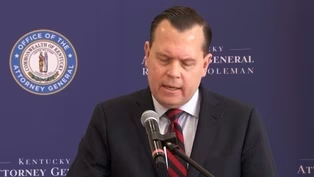
More than 100 organizations across the state are getting grants to support families impacted by drug addiction.
The Kentucky Opioid Abatement Advisory Commission just handed out more than $30 million in the fight against the state's drug epidemic.
>> I'm proud to announce that earlier this week, Kentucky's Opioid Abatement Advisory Commission awarded more than $34 million to organizations.
It is our largest funding distribution to date, and we are grateful and excited to see those dollars going to organizations focused on saving lives and helping to rebuild families for the first time.
For the first time, we're funding research and innovation.
I'm excited about this.
It includes one of the six organizations to receive first ever research grant dollars, the Kentucky Alliance for Recovery Residences.
Now, this is a mouthful, but they are working to sustain statewide recovery housing outcomes.
One of those, one of those critical nodes in recovery that especially in our rural areas, that that housing is a tremendous deficit, a real a real limiting factor to recovery.
>> Our vision is to see the city of Lexington become a city for God.
That's a place where everyone has the opportunity to flourish.
How we do that is we connect leaders.
We unify the body of Christ, and we mobilize people all to solve problems in our city.
Two of the ways we live that out are through youth empowerment, led by Marcus Patrick and Fatherhood Initiative led by Jared Sloan.
>> The amount of access that our young people have, even in schools, to vapes and drugs and gummies is unprecedented.
And so this money helps us just kind of build our arsenal of what we can take into schools, take in to communities to help combat the issues that our young people face.
>> We are honored to steward recovery resources that help fathers rebuild, excuse me, rebuild their lives, reconnect with their children, and restore what addiction has tried to destroy.
This funding is going to allow us to expand our services to more fathers, in more recovery centers, and to bring Doctor Raymond Levy's Recovery Fathers in Recovery curriculum to life.
>> I worry about the environment in which we're raising our kids.
It is a no margin of error environment.
It is a no margin of error environment in terms of the substances where one pill, one bad decision, one bad call, and they can lose their lives.
And it takes collaboration like this.
It takes community like this to mitigate the size and the metastasizing threats that we're facing.
>> The commission awarded more than $3.6 million from the new Research and Innovation grant.
[MUSIC] Only a few Kentucky counties have a woman in charge.
Could that change this November?
And the long time leader of a Louisville college is stepping aside.
Our Toby Gibbs has details in tonight's look at headlines around Kentucky.
>> Susan Donovan will retire as Bellarmine University president in 2027.
She's been at the helm since 2017.
[MUSIC] According to The Courier Journal, she will retire as her contract ends in the summer of 2027.
[MUSIC] In a statement, Board of Trustees Chair Donald Kelly praised Donovan for her leadership, saying it emphasized student success and mission driven excellence.
The board says it will launch a comprehensive search for Donovan's successor.
[MUSIC] The Hoptown Chronicle reports that of Kentucky's 120 counties, only eight judge executives are women less than 7%.
That could change in 38 counties.
At least one woman is running to become judge executive.
The number of women judge executives is down from 1998, when nine held leadership positions.
But the number is twice what it was four years ago.
[MUSIC] [MUSIC] From the Commonwealth Journal, a radio network executive is urging the Pulaski County Fiscal Court to take steps to preserve a civil war burial ground and a watershed.
[MUSIC] Doctor David Carr spoke to magistrates at a recent fiscal court meeting.
He urged magistrates to recognize and conduct an official survey of a north south watershed near the Kentucky Highway 39 corridor.
And he's urging protection for the unmarked graves near a Civil War battle site, where as many as 290 soldiers died in battle on March 13th, 1863.
[MUSIC] They're fired up in Danville with the restoration of a historic wood fired kiln, the Advocate Messenger reports.
The Art center of the bluegrass just celebrated the inaugural firing of the Japanese style kiln built into a hillside, the kiln was first built in 1993, but stopped being used in 2005.
Artists and volunteers led restoration efforts.
Artists are making hundreds of ceramic pieces, with temperatures in the kiln reaching about 2400 degrees.
[MUSIC] With headlines around Kentucky.
I'm Toby Gibbs.
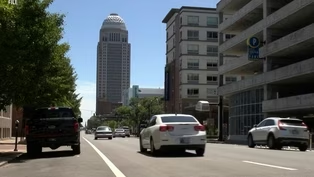
>> Every year, the American Lung Association releases its state of the air report.
This year, Louisville's air quality has gotten worse.
The Derby City ranks 22nd for having the most polluted ozone.
Up seven spots from last year.
The Lung Association and University of Louisville break down this report and its health implications in tonight's Medical news.
[MUSIC] >> We now rank 22nd worst in the nation with an F grade for our level of ozone pollution here in Louisville, ozone pollution is often thought of as smog, and it's created by the combination of extreme heat, sunlight, and certain emissions like vehicle emissions and factory emissions.
>> It's really Louisville's overall environment that contributes to bad air quality.
So it's a combination of geography.
So where we sit, we sit in the Ohio Valley and you think of valleys.
It's a basin, right?
And everything flows down and gets stuck.
We don't have a lot of tree canopy, so those trees can't filter the pollution.
And they also can't buffer the heat.
So the more pavement you have, the hotter it runs, which we just talked about accelerates ozone.
>> Unfortunately, this year, state of the air report and those that have come before in recent years report worse ozone and and mixed results for particle pollution.
And this is partly due to the negative forces of hotter, drier conditions caused by climate change.
Dirty air is just dangerous to public health.
It causes people to suffer both those those more immediate and then longer term and even and potentially fatal medical problems, including heart attacks and strokes.
And I mentioned asthma, things of that nature.
>> What we study here a lot, and what other people kind of sometimes forget is that it's these low levels over a long, long terms that can lead to a lot more chronic diseases.
So we're talking about heart attacks.
We're talking about stroke, we're talking about diabetes.
We're talking about premature death.
And those don't take those huge, huge, high levels.
It's just, you know, it's longer decades and years of exposure over time that increase your risk for those.
As a clinician, I can't give a pill to someone and take away the effects of air pollution, right?
There is no treatment.
This really requires participation from everyone, right?
And so we have to think about no idle zones.
We have to think about the choices we make.
Health systems can be involved, policymakers and the public.
>> We can take advantage of things like light colored roofs and porous pavements and more green spaces to reduce that urban heat that interacts with emissions, to create ozone.
And those things help to improve environmental health.
And and we also have the ability to interact with our local governments and encourage them to choose zero emission vehicles for their fleets and, and ensure that we have access to charging stations and, and get our electricity from cleaner sources.
Generally.
>> I think a lot of people think of cleaner air as just an environmental policy, but really I've started to think of it as preventive medicine.
And I would really like that idea to get out there.
Like, this isn't an environmental policy.
This is really preventive medicine for everyone.
>> Now, here's a reaction from Congressman Morgan McGarvey, who represents Louisville in Washington.
He says, quote, this is unacceptable.
And it's only going to get worse as the Trump administration keeps rolling back clean air protections.
Every Louisville deserves safe, safe, clean air.
We have to hold polluters accountable for poisoning our air, end quote.
The American Heart Association estimates that 1 in 4 U.S.
adults has high cholesterol, which increases the risk of heart attack and stroke.
New cholesterol guidelines aim to lower bad cholesterol by recommending earlier screenings and interventions.
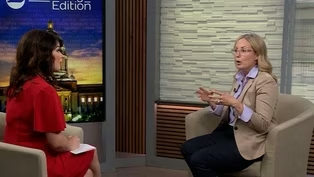
Our Kristy Dutton spoke to a physician assistant in cardiology to break down what's changed and why it matters.
This.
As we continue our look at today's medical news.
[MUSIC] >> Katrina Hancock from Norton Heart and Vascular Institute is here.
We're talking about the new guidelines, which really puts an emphasis on early screening, early intervention.
But let's talk about cholesterol just baseline.
Give us a baseline information of what is bad cholesterol.
Why do we need to worry about it?
>> Think of cholesterol as pouring grease down your kitchen sink.
We don't like to do that because that grease can build up in the sink and and clog the pipes.
Cholesterol is no different.
We're pouring basically when we're eating a lot of cholesterol, our liver is making cholesterol.
That's putting grease down our our pipes, our arteries that surround our heart.
>> Okay.
So it can clog up the arteries.
Okay.
So with these new guidelines, what are some of the biggest changes?
>> It's very exciting news.
Number one, it focuses a lot more on early intervention because we know that it's not just about a number, but it's about timing.
And it really does matter.
It's about how long we have high cholesterol and how long we have that cholesterol.
So timing matters.
It's talking about a new type of screening for something called lipoprotein A, because that is something that really does clog those pipe.
It also affects our aortic valve, something that we're really focusing a lot more on.
It also focuses more, not just looking at our ten year cardiovascular disease risk, but our 30 year risk.
So if I'm talking to a patient that that's only 30 years old and I'm trying to explain to them their risk of heart disease only being, you know, maybe 3 or 5% in ten years, they're not terribly interested.
But when I tell them, yeah, but maybe in 30 years you have a 25% risk of heart disease.
Now all of a sudden their ears are perking up a bit more.
So it looks at that.
It includes their risk of heart failure.
Heart failure is the number one reason for hospitalization in the United States.
So now we're broadening the discussion with patients to include heart failure.
So that's really important.
So I think those are probably the biggest changes.
>> Yeah.
Those are big changes.
Okay.
You talked about that early intervention, early screening.
How early can we put an age to it?
>> Well, the the new guidelines have it as early as 30.
So before we weren't screening patients until the age of 40 or 45.
But now the guidelines let us screen patients as early as 30.
>> Okay.
30 years old.
And for, let's say, even a child that may have a family history of these issues, can it be done even in childhood?
>> Oh, we're saying unfortunately, because of childhood obesity, we're seeing a lot of high cholesterol in children, not just because of obesity, poor diet.
So we're screening children, I think I think the age of 12, the children are getting screened.
>> Oh, nice.
Okay.
So for people maybe taking statins or medication to lower cholesterol, will these new guidelines change anything for their treatment?
>> We're getting much more aggressive.
It also focuses more not just on statin therapy, but other lipid lowering therapies that are out there.
If patients that maybe statins aren't just strong enough.
So if they if we because we are getting more aggressive, the statins not strong enough, what other therapies can we add on?
Or if people think that maybe statin just doesn't make them feel very well.
We also have other options.
And there's exciting news for that lipoprotein a that I talked about that really nasty type of cholesterol.
There's new drug therapies on the market that's looking to come out even later this year.
>> Oh wow.
That is exciting.
>> Very exciting time.
>> Okay.
Well, Katrina Hancock, thank you so much for being here and for your expertise.
>> Absolutely.
Thanks for having me.
>> Louisville's Churchill Downs has hosted Kentucky Derby every year since 1875.
A lot has changed in 152 years, but many of the traditions have stood the test of time.
Our Kelsey Starks explores the history of Churchill Downs on the next inside Louisville.
>> It's a tradition unlike any other.
Churchill Downs has hosted the Kentucky Derby every year since 1875, making it the longest continuously run sporting event in the United States, the Derby and Churchill Downs sure looked a lot different back then.
>> The Kentucky Derby came to be in 1875.
That was the year of the very first Kentucky Derby, when the Louisville Jockey Club, the original name for Churchill Downs and Derby, were founded.
One of the main reasons was coming out of the Civil War.
Breeding industry had been devastated here in Kentucky.
So those who were in that industry were really looking for a way to get people excited and investing in horse breeding.
A lot of historians will point to three pivotal years in the early 20th century.
1913 to 1915.
[MUSIC] We had some fortune during that time because the New York, New York is the epicenter of racing at that time.
And with the progressive movements of the era, anti-gambling movements there.
Actually, there's no racing.
From about 1911 to 1913 in the state of New York that helps the Derby increase its visibility.
[MUSIC] We had three big races that got a lot of national coverage from the news in 1913, the biggest longshot ever, Donerail wins it 91 to 1.
You had a horse named Rosebud who was highly thought of in 1914 that wins that year, and then in 1915, we have regret.
The first of three fillies or female horses win the Derby.
So you had three in a row that really got it going on that upward upward trajectory.
Starting to see it as that major sporting event that we know it as today.
[MUSIC] >> Today, Churchill Downs Racetrack has an economic impact of about $400 million every year.
The vast majority of it happens in just one week, and that's derby week.
>> People come here for the mystique, the history.
But at the same time, you've got to keep up with modern times and deliver different experiences for different people.
>> The historic racetrack has made some major changes over the past few years, including a $200 million paddock renovation revealed in 2024, and a $90 million upgrade to the grandstand in 2025.
Still ahead, a new Sky terrace area and a brand new look for the infield.
[MUSIC] Some of the largest projects in the track's history.
But the construction isn't the only change this year.
>> I think.
>> A major storyline this year everybody's talking about is the the move to prime time for the Kentucky Oaks.
We couldn't be more excited about this opportunity.
You know, the ability to be on national television in the 8:00 hour.
[MUSIC] Number one, it helps elevate the status of the Kentucky Oaks itself.
But two, it's I mean, really, it's like a it's like an hour long infomercial, the Kentucky Derby, one day before the race on network television.
So that's extremely exciting for us.
[MUSIC] The Kentucky Derby and hosting it, you know, like, you know, a lot of people like to liken it to the Super Bowl.
>> Yes.
>> It is such a bucket list event for people.
It has grown so much over the years, especially within the last 20 years.
I mean, we had 20 million people watching the race on national television last year.
There are people that want to come here from all over the world.
It's a $400 million economic impact to, you know, the area.
And we just want to continue to grow it and make it the the the best it can be.
>> 152 years of tradition for the greatest two minutes in sports and the experience of a lifetime, all happening inside one historic venue.
[MUSIC] >> To me, it's just that's what's always impressed me going to about 20 Kentucky derbies now.
It's just that the combination of so many different people from so many walks of life that come here to experience the Kentucky Derby, everyone from who's here for maybe the party in the infield or there's someone local, they're local.
And it's just something they do because it's it's Louisville's event to the horse racing fans and folks in the industry that are here, because it's the landmark thing for the sport and the industry.
[MUSIC] Somebody again, so many different people, so many different walks of life.
And it's just a celebration and it's a really a special thing to see.
>> You're going to get in the derby spirit with Kelsey Starks if you watch it.
When she sits down with Churchill Downs Racetrack President Mike Anderson, that's this Sunday at noon eastern, 11 a.m.
central, right here on KET.
Thank you for being here for Kentucky Edition.
We love having you around, and we hope to see you right back here again tomorrow night.
I'm Renee Shaw and take really good care.
New Grants Awarded to Fight State's Drug Epidemic
Video has Closed Captions
Clip: S4 Ep371 | 3m 18s | More than $30 million awarded to organizations to help combat the drug epidemic in the state. (3m 18s)
Report Finds Louisville's Air Quality Has Worsened
Video has Closed Captions
Clip: S4 Ep371 | 3m 54s | American Lung Association ranks Louisville as one of the nation's worse in air quality. (3m 54s)
What's Changed in the Fight Against High Cholesterol
Video has Closed Captions
Clip: S4 Ep371 | 4m 8s | New guidelines aim to lower bad cholesterol through earlier screenings and interventions. (4m 8s)
Providing Support for PBS.org
Learn Moreabout PBS online sponsorship
- News and Public Affairs

Top journalists deliver compelling original analysis of the hour's headlines.

- News and Public Affairs

Today's top journalists discuss Washington's current political events and public affairs.












Support for PBS provided by:
Kentucky Edition is a local public television program presented by KET