
April 1, 2026
Season 4 Episode 355 | 26m 30sVideo has Closed Captions
Lawmakers debate a two-year state budget as the clock winds down on the 2026 session.
A new two-year state spending plan is a step away from going to the governor's desk. A sweeping bill to address the housing shortage moves forward. A plan to restructure Kentucky State University is being called a “reset for success.” The superintendent of Fayette County Public Schools has withdrawn from consideration for a job to lead a school district in Missouri.
Problems playing video? | Closed Captioning Feedback
Problems playing video? | Closed Captioning Feedback
Kentucky Edition is a local public television program presented by KET
April 1, 2026
Season 4 Episode 355 | 26m 30sVideo has Closed Captions
A new two-year state spending plan is a step away from going to the governor's desk. A sweeping bill to address the housing shortage moves forward. A plan to restructure Kentucky State University is being called a “reset for success.” The superintendent of Fayette County Public Schools has withdrawn from consideration for a job to lead a school district in Missouri.
Problems playing video? | Closed Captioning Feedback
How to Watch Kentucky Edition
Kentucky Edition is available to stream on pbs.org and the free PBS App, available on iPhone, Apple TV, Android TV, Android smartphones, Amazon Fire TV, Amazon Fire Tablet, Roku, Samsung Smart TV, LG TV, and Vizio.
Providing Support for PBS.org
Learn Moreabout PBS online sponsorshipmusic >> My vote is based on one thing, and that's the age verification and tightening up some of these restrictions.
[MUSIC] >> A sweeping gambling bill makes its way toward the finish line, but not everyone is sold on it.
[MUSIC] >> I don't want my neighborhood to be turned into a bunch of short term rentals for party houses.
>> What critics worried about a bill that's supposed to mean more Kentucky housing?
>> This does chart a new path forward for Kentucky State.
>> Plus, a new plan for KSU is being called a quote reset for success.
[MUSIC] >> Production of Kentucky edition is made possible in part by the KET Millennium Fund.
[MUSIC] >> Good evening and welcome to Kentucky edition for this Wednesday, April the 1st.
But no fools jokes here.
I'm Renee Shaw reporting to you from our KET Studios in the Capitol Annex in Frankfort.
And thank you so much for joining us.
And that's exactly where we're starting tonight.
Kentucky lawmakers have fashioned a two year spending plan for state agencies, programs and services for your tax dollars.
And it's just a step away from being sent to the governor's desk.
Senate Appropriations and Revenue Chairman Chris McDaniel ran down the main highlights of the roughly $30 billion budget package.
>> We include annual salary increments of 2% in each fiscal year.
We include reductions to the base of most state agencies and fiscal 27 and fiscal 28.
However, exempt from those reductions are the following.
Veterans Affairs Annakw and judgments.
SEEK Lars SFC KET County Costs and Finance and Administration.
Medicaid benefits.
Frisky's juvenile Justice, Kentucky State University, Morehead State University, Murray State University, Post-Secondary Performance Fund, Department of Revenue, Secretary of State, Registry of Election Finance, Commonwealth's attorneys, county attorneys, adult correctional institutions, community services and local facilities.
Local jail support, the Teachers Retirement System, the Kentucky Public Pensions Authority, and proprietary Education Kentucky.
>> There was some concern expressed about funding for the state's regional universities in the budget package, but it passed without dissent and at the time we prepared tonight's report, this was still being debated in the Kentucky House, which is the last stop before it's sent on to the governor's office for his review, and will bring you some of that update tomorrow night on Kentucky edition.
Kentuckians may soon see some big changes to the gambling industry, thanks to a far reaching bill that went down to the wire in Frankfort today.
Our Emily Sisk explains the impacts you need to know when it comes to horse racing and sports betting.
This as we continue tonight's legislative update.
[MUSIC] >> Three years ago, the Kentucky General Assembly passed legislation to make sports betting legal in the Commonwealth.
Now the legislature is advancing a vast gambling measure, House Bill 904, which will impact horse racing, betting, sports wagering and charitable gaming.
One of the highlights in the more than 150 page bill raising the sports wagering age from 18 to 21, state Representative Michael Meredith explained more provisions of House Bill 904.
>> We create a comprehensive licensing and regulatory framework for fantasy sports in this bill.
Fantasy sports have been happening in Kentucky for a long time, but we've never had a licensing framework.
We also ban under bets on in-state college athletes.
So college athletes that play for in-state teams, you would not be able to bet the under on them, which would be a negative outcome, or being able to throw their statistics prediction markets.
We create some new definitions for prediction markets.
That's an emerging area.
And we say, and this is a big change in the Senate committee substitute that you have before you this morning from even what left the House, that if we have a licensee, whether that be a horse track, whether that be a fantasy operator, whether that be a sports betting company, they're not allowed to contract with or be involved in the proceeds of a prediction market.
If that prediction market is operating in Kentucky.
>> The legislation also prohibits wagering on election outcomes.
>> We didn't believe that was allowed under the current law, but we put specific language in there to prohibit those.
>> House Bill 904 legalizes fixed odds wagering, which means that payout would be locked in when the bet is placed.
This expansion drew criticism from the Family Foundation, a Christian public policy group whose executive director called the bill unconstitutional.
>> Fixed odds wagering is a practice in which you now bet against the House.
It encourages more aggressive gambling, more addictive betting.
It increases the risk of manipulation, and it will further undermine the the very distinct identity of the horse racing industry in Kentucky.
>> David Walls referenced a study by the Kentucky Council on Problem Gaming, which reported that 165,000 Kentucky adults reported having a gambling problem.
The conservative advocate said fixed odds wagering will encourage increased gambling addiction, especially in young men.
Representative Meredith argued that raising the sports betting age to 21 will be an effective way to combat gambling addiction in young adults.
>> This is not just you punching in your date of birth.
You have to go through a full age verification process to be eligible for these products in Kentucky.
Under our license marketplace.
>> Many lawmakers in the Senate Licensing and Occupations Committee said they struggled to reach a decision on the legislation.
Senator Christian McDaniel explained why he decided to vote yes.
>> This bill has me torn a number of different directions.
My vote is based on one thing, and that's the age verification and tightening up some of these restrictions.
I think if there's a constitutional issue, the courts will adjudicate it as such, and we'll let them take that up.
>> House Bill 904 passed unanimously out of committee for Kentucky edition.
I'm Emily Sisk.
>> Thank you so much, Emily.
There are also some provisions related to charitable gaming, and the legislation creates a charitable gaming task force that will meet during the interim session.
At the time of our broadcast tonight, House Bill 904 is still waiting for a vote on the Senate floor and, of course, will provide you an update on that tomorrow night on Kentucky edition.
Now, it's a statistic that we have repeated many times when it comes to the demand for homes.
That's far greater than what's available.
Kentucky is short more than 200,000 housing units, and lawmakers have since studied the problem and today proposed the omnibus Senate Bill nine to encourage home building in the state.
However, as our June Leffler reports, some say an attached provision around Airbnbs would make more space for tourists, not Kentuckians.
>> State Senator Robbie Mills, who co-chaired a housing task force last year, proposes ways for local governments to offer financing incentives to developers creating more homes or needed infrastructure as part of Senate Bill nine.
>> And what this does is give local governments a tool to use that would enable them to get infrastructure in the ground to move building forward.
But I think after we've talked about it for a couple of years, it's time to take a couple steps forward and see if we can improve the process for our communities and our state.
>> As of today, Senate Bill nine also includes language from State Representative Susan Witten, who also co-chaired the housing Task force.
It eliminates hurdles people with previous evictions face when looking for homes.
>> This just requires the automatic expungement of dismissed eviction filings and also protects minors from being listed on eviction cases, as well as providing the framework to remove their name from the record.
>> These measures passed their respective chambers earlier this session, but as a result of committee action today, Senate Bill nine now includes language of other bills that stalled this year.
>> Kentucky families need comprehensive, robust reforms and some of them are in here.
But unfortunately, the poison pill is just too much.
>> On the House floor.
Democrats railed against one provision that takes cities powers away to regulate short term rentals.
These are places in residential neighborhoods that owners could rent out for stays of less than 30 days.
Think Airbnb or Vrbo.
Democrats say this would exacerbate the housing shortage.
>> For every single, single family home that turns into a short term rental.
That's a Kentucky family that can't purchase their first home.
>> Democrats also say this would compromise local control and quality of neighborhoods.
>> You know, look, I live close to Cincinnati and, you know, they're big football days or big things going on in Cincinnati.
I don't want my neighborhood to be turned into a bunch of short term rentals for party houses.
It destroys the fabric of our community and can make life in some of these towns unlivable.
If there aren't thoughtful and appropriate controls on short term rentals.
>> The bill does allow cities to police noise or other nuisances from these rentals.
Senate Bill nine passed the House today largely along party lines.
During the interim, lawmakers heard of other states injecting state dollars into revolving loan funds for developers or other initiatives.
Republicans have not proposed any such investment.
Democrat's and the governor proposed putting more than $100 million into the Affordable Housing Trust Fund.
But that idea was not embraced by the Republican supermajority for Kentucky edition.
I'm June Leffler.
>> Thank you.
June.
The full Senate passed its version of a Medicaid overhaul bill.
House Bill two is lawmakers attempt to incorporate federal cost cutting measures from last year's big, beautiful bill that was passed by Congress.
The Senate's version moderated the House version by reducing co-pays and pushing the date for health provider State agencies and patients to adjust.
Even many Democrats voted for the bill, though Gary Clemons, a freshman lawmaker and union leader, said he could not vote for something that he perceived would strip people of their health insurance.
>> I do want to thank everyone for putting this work in and getting us to where we're at now, but there's just no way in good conscience that I can vote for any bill that potentially can take Kentuckians off of insurance, and I just can't do it.
So my vote is no.
Thank you.
>> House Bill two is waiting for the House to approve or reject those changes.
And at the time of our broadcast, they had not yet finalized the measure.
Lawmakers have until midnight tonight to make their bills veto proof before their recess, to allow the governor to review measures and sign or veto them.
Legislators return April 14th and 15th for the final two days of the session.
It's being called a quote reset for success.
It's a plan to restructure Kentucky State University that was formed back in 1886 at the height of segregation, plagued in recent years by financial stumbles.
Lawmakers say they had serious discussions about closing the state's only publicly funded HBCU.
Now they believe a House amended Senate Bill 185 provides a path toward a brighter future.
The measure outlines fiscal procedures and expenditure limits, with oversight from the State Council on post-secondary education.
It puts parameters around the degree programs that can be offered in person and online, addresses outstanding student debt above $1,000, and whether students can continue at K state and sets academic admission standards at a grade point average of 2.5 and College Entrance Exam Composite Score of 18.
Louisville.
Democrat Joshua Watkins worked with the Senate's sponsor and others on a revised approach to transition K state to a polytechnic institution that's focused on applied sciences and workforce driven degree programs.
>> This does chart a new path forward for Kentucky State, but I want everyone to be clear that the history of Kentucky State University, its proud legacy, should never be and is not now in question.
The substitute recognizes Kentucky State University as an 1890s land grant university that it is Kentucky's only public historically black college or university affectionately known as HBCU, and it shall be a four year residential polytechnic institution that focuses on highly technical, industry based applied learning and offers liberal studies and polytechnic programs that are aligned with the workforce needs of the Commonwealth and consistent with the historical mission of an HBCU.
>> We also need to be honest about how we got here.
Kentucky State has been underfunded for years, and that has had serious consequences.
There was a serious discussion about closing the university.
Instead, we're looking at a plan that keeps it open and creates a path to strengthen it, with a clear focus on programs that lead to real opportunities and good paying jobs.
It's important for people to know that under this plan, Kentucky State will remain an HBCU.
Students will continue to have the full campus experience.
Athletics band and the traditions that matter on that campus.
>> The House revised Senate Bill 185 allows a minimum of 1000 students at the four year residential university and allows sororities and fraternities in good standing to remain.
A previous version would have had them reapply for their charter.
Some KSU alumni were pleased with the softened approach to dealing with the university, and were emotional about what K-State means to them.
>> I was so worried that we're only going to have.
We're going to limit the amount of students on my.
On the university and you all have taken care of that.
I was just thought that the whole mission of KSU was going to be stripped of its historically black college and university status, that we're going to be demoted to a. A junior college or something like that, and that hasn't happened.
>> KSU has stood for more than a century, a beacon of educational opportunity.
Our alumni are teachers, nurses, engineers, public servants, community leaders.
We live and work in every county in the state.
When you invest in Kentucky State University, you invest in Kentucky itself, in the communities that need it most, and the students who have the most to gain in the future of our Commonwealth is working so hard to build.
>> After unanimous House committee approval this morning, the full House approved the K-State restructure plan on a 90 to 1 vote.
The Senate then voted unanimously to award final passage to Senate Bill 185.
It now heads to the governor's desk.
Lawmakers have also passed legislation that supporters say will allow school districts to think outside the box.
Senate Bill 263, was heard in a House committee today sponsoring.
Senator Stephen West, who is chair of the Senate Education Committee, says the bill builds on legislation passed last year.
>> So we passed 207 last year, which is the School of Innovation Bill.
The first part of this bill kind of cleans up that process, makes the waiver process easier, provides some off the shelf waivers.
The good news about this, the second part is a pilot project to allow two schools of innovation to happen in the state of Kentucky, and we have actual budget language that those those two School of Innovation pilot projects are funded in this year's budget.
This is aimed at large school districts who have maybe CSI schools or low performing schools.
And this allows a school to be spun off and an innovation to occur in that school.
So, for instance, if if they've been off level for 20 years, it gives that school the opportunity to do something different.
>> Senate Bill 263 allows local school districts to decide whether to apply for the Schools of Innovation program.
It also requires the Kentucky Department of Education to help districts with the application process.
Within 30 days.
The bill passed out of committee this morning and was heard on the House floor this afternoon.
Some Democrats said the bill sounds like a good idea, but they still had some concerns.
>> I think that if there are statutes and regulations that need to be waived to improve these schools of innovation, then we need to think about having fewer regulations and statutes restricting our public schools.
So I on the surface, it sounds like a good idea, but I have grave concerns about what the consequences may be.
And it sounds an awful lot like a charter school to me.
>> I worry that a bill like this opens the door for bad actors to come to Kentucky.
And so after committee meeting, which was just about two hours ago when we heard this bill for the first time, I asked for drafters to draft an amendment that would restrict the ability of local boards of education to enter into a contract with any education service provider who has been prohibited from providing services in another state.
>> Representative Burke's amendment was not adopted by the full House.
Senate Bill 263 passed the full House by a vote of 75 to 18.
Changes made to the bill were agreed to by the Senate today, and the bill is now headed to the governor's desk.
A Kentucky mother who lost her son in a tragic crash is advocating for more vegetation to be cleared from railroad crossings.
Our Mackenzie Spink has more on that bill and the State road plans that passed a committee earlier today.
>> For the last six years, Tanya Serna has been fighting for vegetation clearance laws in Kentucky after her son Hunter died in a collision with an oncoming train.
>> Hunter was a 19 year old engineering student at the University of Louisville.
He was full of life.
He enjoyed holidays.
He was just.
I know a lot of parents will say this, that they're the sunshine in your lives, Hunter really was Tuesday night on April 28th, 2020 at 8 p.m.
I got a very dreadful phone call.
My son was hit by a train.
It wasn't the driver's fault.
As a matter of fact, we know that the driver was slowing down, not trying to speed or beat the train.
It was the train.
Couldn't see the car.
The car could not see the train.
And the vegetation was what obscured the driver's vision.
>> House Bill 311 requires railway companies to clear vegetation for 250ft in each direction.
At railroad crossings.
It passed the Senate Transportation Committee unanimously.
The state's transportation budget also passed the committee unanimously today.
House Bill 501 contains the two year spending plan for the transportation cabinet.
One highlight is the Grant pool, available for cities and counties to use on whatever transportation project their district needs.
>> There will be a $24 million grant pool for improvement projects, or paving.
That 24 million will be 12 million for cities, 12 million for for counties.
>> Committee chair Senator Jimmy Higdon says prior to legislation requiring a vision test for license renewals, there were roughly 20,000 online renewals a month.
Now that number is closer to 1000.
>> There'll be a new vision testing program put into place that will allow public libraries to do vision testing, if they so choose, and the transportation cabinet will supply the equipment and and do the do the training with with the thoughts that people could get their vision testing.
And while they're at the library, they could get online and renew their license online.
>> House Bill 502 is the budget specifically for road projects and highway construction.
Chair Higdon says this year's plan is unique.
>> This one is 100% funded with no over programing with State dollars.
That's the first time in in my recollection that we've that we've not over programed the road fund.
>> The fact that we're fully funding these projects is the most responsible road plan I've seen in my short time here.
But even as a magistrate for the ten years prior, looking at road plans.
>> House bills 501 and 502 both passed committee and have since passed the full Senate and Full House and will next head to the governor's desk.
This was Senator Higdon's last time chairing the Senate Transportation Committee, as this is his last regular session before retirement for Kentucky edition.
I'm Mackenzie Spink.
>> Also out of that committee representative Beverly Chester Burton's house, Bill 425 also passed that committee.
It would enhance the penalties for illegal street racing.
Now, lawmakers are still meeting, as we've told you.
So we'll have much more from Frankfort tomorrow on Kentucky edition.
[MUSIC] Fayette county's public school superintendent is staying put, and he's declaring it.
As we reported, Superintendent Demetrus Liggins was a finalist to lead the Hazelwood School District near Saint Louis, Missouri.
The Fayette County Public School system says he's withdrawn from consideration for that job.
In a statement, the school system says, quote, the support and encouragement he has received from our community leaders over the last few days have reaffirmed that his heart and work remain in Fayette County, end quote.
Liggins has been criticized for spending and a budget shortfall.
Liggins posted this on Facebook, quote, our kids deserve someone focused on them, not distracted by negativity, lies, or noise.
They deserve someone who shows up every day, does the work, and stays committed to their success.
If that bothers anyone, get comfortable because the success is not slowing down.
End quote.
[MUSIC] It is a sure sign that derby season is quickly approaching at Churchill Downs in Louisville today, the signage was officially changed to mark the 2026 Kentucky Derby, the 152nd year of the run for the roses.
Preparations for this year's derby are well underway at Churchill Downs, the iconic green Kentucky Derby sign above the grandstand is now ready for the spring meet, which begins April 25th.
>> I've been with Churchill for 31 years.
I've been doing the signs for 26 years.
I've seen it all.
I've seen long shots, I've seen, you know, favorites.
I've seen pouring down rain.
I've seen sunshine.
Things change daily around here until that first Saturday in May.
So you got to be prepared.
You're looking at very old sign.
So it's kind of surreal that you know how long it's been there and how many years that we've been doing this.
I'm kind of a perfectionist.
So, you know, everybody looks at it.
So I like it to look right.
It's an honor.
You know I've got to put that up.
I get to put up the Gold Derby name in the paddock, and I have been able to put up a gold crown in the old paddock before.
That's just an honor.
>> We're 31 days out of the first Saturday in May.
It's a gorgeous day.
This has been a tradition of ours dating back to 1939 is the first year the.
The sign appeared on the Churchill Downs grandstand.
And you know, we're thrilled that Derby is right around the corner.
It's hard to believe another four weeks.
>> Of course, the Kentucky Derby is the first Saturday in May.
That's May 2nd this year.
Hard to believe it's just four weeks away.
Time sure does fly well.
We're due in court for tomorrow's Kentucky edition.
We head to Jessamine County for a mock trial that looks like the real thing.
Some high school law students argue their cases with a real Kentucky Supreme Court justice presiding.
Law and order Kentucky style Thursday on Kentucky edition, which we know you'll join us for again at 630 eastern, 530 central, where we inform, connect and inspire.
We hope that you connect with us all the ways you see on your screen, the social media channels listed on your screen.
We encourage you to download the PBS app on your smart devices.
Send us a story idea by email to Public Affairs at ket.org, and you can stream our content anytime online on demand at ket.org.
We will see you tomorrow night.
I'll be back in Lexington.
Until then, have a great evening and thank you for joining us.
[MUSIC]
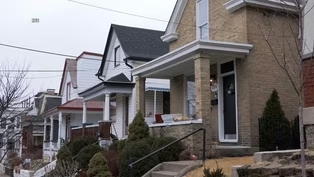
Bill Focused on Building More Homes in Kentucky
Video has Closed Captions
Clip: S4 Ep355 | 3m 25s | Lawmakers debate omnibus housing bill after addition of Airbnb provision. (3m 25s)
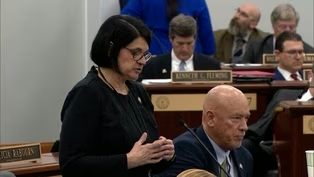
Bill Lets Districts Pursue New "Schools of Innovation" Options
Video has Closed Captions
Clip: S4 Ep355 | 2m 55s | Bill allows districts to decide whether to join Kentucky’s Schools of Innovation program. (2m 55s)
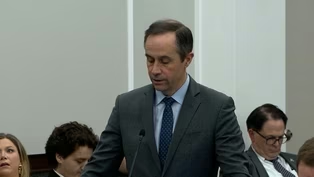
General Assembly Debates Budget Plan as Session Nears End
Video has Closed Captions
Clip: S4 Ep355 | 1m 37s | Lawmakers debate two-year state spending plan as clock winds down on 2026 session. (1m 37s)
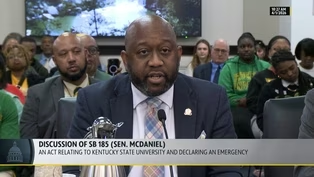
Kenutcky State University's "Reset for Success"
Video has Closed Captions
Clip: S4 Ep355 | 4m 18s | Bill calls for the restructuring of Kentucky State University. (4m 18s)

State Transportation Bills Make Way Through Legislature
Video has Closed Captions
Clip: S4 Ep355 | 3m 38s | Mother urges action to get vegetation cleared at rail crossings after son’s tragic death. (3m 38s)

Sweeping Changes Expected Under Gaming Bill
Video has Closed Captions
Clip: S4 Ep355 | 4m 10s | Kentuckians may soon see big changes to the gambling industry. (4m 10s)
Providing Support for PBS.org
Learn Moreabout PBS online sponsorship New Episode
- News and Public Affairs

Top journalists deliver compelling original analysis of the hour's headlines.

- News and Public Affairs

FRONTLINE is investigative journalism that questions, explains and changes our world.

 New Episode
 New Episode
 New Episode

 New Episode
 New Episode
 New Episode
 New Episode
Support for PBS provided by:
Kentucky Edition is a local public television program presented by KET