
March 9, 2026
Season 4 Episode 338 | 26m 32sVideo has Closed Captions
The latest U.S. soldier killed as part of the U.S. attack on Iran is a Kentuckian.
An Army Sergeant from Hardin County is the latest U.S. soldier to be killed in the attack on Iran, President Trump plans to discuss affordability during a visit to Northern Kentucky, the House overrides Gov. Beshear's first veto of the 2026 Kentucky General Assembly, and two Kentuckians seek to intervene in the DOJ's case against Secretary of State Michael Adams.
Problems playing video? | Closed Captioning Feedback
Problems playing video? | Closed Captioning Feedback
Kentucky Edition is a local public television program presented by KET
March 9, 2026
Season 4 Episode 338 | 26m 32sVideo has Closed Captions
An Army Sergeant from Hardin County is the latest U.S. soldier to be killed in the attack on Iran, President Trump plans to discuss affordability during a visit to Northern Kentucky, the House overrides Gov. Beshear's first veto of the 2026 Kentucky General Assembly, and two Kentuckians seek to intervene in the DOJ's case against Secretary of State Michael Adams.
Problems playing video? | Closed Captioning Feedback
How to Watch Kentucky Edition
Kentucky Edition is available to stream on pbs.org and the free PBS App, available on iPhone, Apple TV, Android TV, Android smartphones, Amazon Fire TV, Amazon Fire Tablet, Roku, Samsung Smart TV, LG TV, and Vizio.
Providing Support for PBS.org
Learn Moreabout PBS online sponsorshipmusic President Donald Trump is coming to Kentucky.
We'll tell you when, where and why.
[MUSIC] >> Since the 1990s, all cancer related deaths have decreased by 44%, except for colon cancer, which is increased by 1%.
>> So why is colon cancer different?
[MUSIC] >> It's hard for me to say across the board that this is going to be good for all of the viewers.
[MUSIC] >> And are you better off with fewer companies owning more TV stations?
We'll ask someone who knows all about it.
[MUSIC] >> Production of Kentucky edition is made possible in part by the KET Millennium Fund.
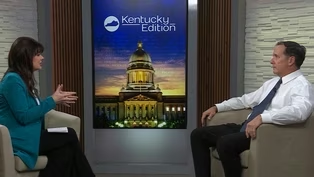
[MUSIC] >> Good evening and welcome to Kentucky edition for Monday, March 9th.
I'm Kelsey Starks here in our Louisville studios, filling in for Renee Shaw.
A seventh American soldier has now been killed as part of the U.S.
attack on Iran.
And this soldier is from Kentucky.
The military identified that service member as Army Sergeant Benjamin Pennington, aged 26, of Glendale in Hardin County.
Pennington was wounded at Prince Sultan Air Base in Saudi Arabia March 1st, when Iran attacked the base in retaliation for the U.S.
bombing.
He was assigned to the first Space Battalion, first Space Brigade, a unit within Army Space and Missile Defense Command.
Governor Andy Beshear reacted by saying, quote, Sergeant Pennington is a hero who sacrificed everything serving our country.
Please join Brittany and me as we pray for his family and our fellow Kentuckians during this difficult time.
U.S.
Senator Mitch McConnell said, quote, a grateful nation honors his life and his service to our country as he paid the ultimate sacrifice in defending American freedom.
Elaine and I are thinking of his family during this difficult time, and we pray for our troops still in harm's way in the Middle East.
We also have video from Hardin County, Sergeant Pennington's home county.
As the American flag was lowered to half staff.
President Donald Trump is scheduled to visit Kentucky this week.
The Republican Party of Kentucky says the president will be in Northern Kentucky to discuss what he's doing to, quote, Make America affordable again.
The event will be held at First Logistics Contract Packaging Facility in Hebron.
This will be President Trump's first visit to Kentucky during his second term in office.
He has visited the state numerous times, although not always as a sitting president.
He was here in 2022 for the Kentucky Derby, a year after his first term ended.
Prior to that, he was in Kentucky as president in 2019, when he held a campaign event for then Governor Matt Bevin at Rupp Arena in Lexington.
Changes could be coming to Medicaid in Kentucky today, the Medicaid Oversight and Advisory Board discussed the Medicaid Reform Act, or House Bill two.
It's already passed.
One Chamber.
As Mackenzie Spink reports, the bill includes stricter reporting requirements and higher co-pays.
That begins tonight's legislative update.
[MUSIC] >> Moab co-chair and sponsor of House Bill two, Representative Ken Fleming, gave a preview of some of the changes we can expect to see as the bill moves through the Senate.
Currently, the bill says the new timeline for Redetermining Medicaid status starts on July 1st of this year, but he intends for that to be pushed back.
>> If that were to Hale true, then according to the letter, we have to notify folks or have to notify folks within 90 days.
Well, that's in two weeks.
We're going to be changing that from July 1st of 26 to 1, one of 27.
>> Concerns about the redetermination process arose.
Citizen member Doctor Sheila Shuster supports a more streamlined self-declaration document, as opposed to submitting multiple forms of verification.
>> I think when you ask for a whole range of verifying.
Documents, you're going to get some discrepancy.
And as soon as there's a discrepancy, the person is stuck.
>> Sheriff Fleming says.
The state secretary of health and Family Services cabinet can make exceptions for those who experience hardships with reporting, and there is an appeals process available under House Bill two.
There would be a $20 co-pay to see a specialist, and an $8 co-pay for going to the emergency room for non-emergency services.
Some board members say the cost of collecting those co-pays won't benefit providers.
>> It wasn't that long ago, because I haven't been here that long, that we actually voted to take these away because they want cost effective, because they actually cost the system money trying to collect it.
>> I really would prefer we try to minimize that amount as much as possible.
And I'm suggesting maybe $5 to show that we've made at least a token effort to do something.
But again, my concern is this financial burden is going to fall disproportionately on rural providers, small providers.
>> Chair Fleming says he hopes the co-pays will redirect patients towards primary care providers, a service with no cost for Medicaid members.
>> If you look at a report that comes from the macOS, when it comes to individuals utilizing a emergency room for non-emergency services, you have a significant amount of money to the tune of around $90 million a year.
>> Melissa Newland is a medicaid member with several chronic illnesses.
She says the new co-pays for specialists could cost Kentuckians to skip out on essential health care.
>> Medicaid is the only way I can stay healthy enough to keep working.
We are already facing skyrocketing electric bills and inflated food prices.
So for someone with my list of specialists, $20 co-pays can add up fast.
Cost shifting co-pays beyond the federal minimum for low income Kentuckians would not encourage personal responsibility.
It will force us to choose between the needs of our family over our own health.
>> Health advocates also asked the board to consider moving the start date for the new co-pays to October 2028, which is the federal guideline currently, House Bill two would implement the new co-pays at the start of 2027 for Kentucky edition.
I'm Mackenzie Spink.
>> Representative Fleming says he also plans a change to House Bill two that will lower the unemployment rates that trigger work requirement waivers.
Waivers in applicable counties to the lower federal minimum.
More than 75% of Kentucky physicians are in urban parts of the state.
Kentucky's Senate president says that leaves many rural counties without proper health care.
He's calling on three Kentucky universities to come up with solutions.
Senate Joint Resolution 116, sponsored by State Senator Robert Stivers, directs the University of Kentucky, the University of Louisville, and Eastern Kentucky University to draw up solutions to address the state's physician shortage.
The universities would be asked for data on medically underserved populations, and then detailed the resources and agencies that could help solve the problem.
>> But since we are the ones who create the universities, they are creatures of statutes.
We can then direct them to do certain things.
So who better than those three universities to look at access to health care?
And it may not just be doctors, it may be other health care professionals.
It may be technology.
Many things there.
So occasionally we'll see that entities will say, well, we haven't you haven't given us any money to do this.
There is an appropriation of $250,000 that will help.
>> Senate Joint Resolution 116 passed unanimously on off the Senate floor.
It now heads to the House for consideration.
Lawmakers wasted no time overturning the first vetoed bill of the 2026 Kentucky General Assembly.
Governor Beshear vetoed House Bill 314 on Friday.
The bill was designed to streamline Kentucky wired.
That project was launched in 2013 with the goal of connecting every Kentucky county to fiber broadband cable Kentucky wired has faced numerous setbacks and criticism for delays and overspending.
House Bill 314 calls for removing governor appointed members of the Kentucky Communications Network Authority, which oversees that project, and replacing them with the Secretary of State, the Agriculture Commissioner, and the State Treasurer.
In his veto message, Governor Beshear said, quote, House Bill 314 is yet another unconstitutional Partizan power grab by the General Assembly to remove appointments and authority from a Democratic governor and send them to Republican officeholders.
Today, with no discussion, the House voted to override the governor's veto of HB 314.
The Senate will have a chance to do the same.
Now, Kentucky's Attorney General, Russell Coleman, says he's filed an emergency motion to keep more than 240 violent criminals behind bars.
Coleman says the Franklin circuit court invalidated part of the Safer Kentucky Act in February.
The act became law with the passage of House Bill five last year.
It broadened the definition of violent offender to include reckless homicide, attempted murder, carjacking, strangulation and more.
The act required criminals convicted of a violent offense to serve at least 85% of their sentence, Coleman says unless the Kentucky Court of Appeals blocks the circuit court's order, more than 240 of those criminals will go free.
Two Kentucky voters want to join the legal fight over voter registration data.
The Department of Justice sued Kentucky Secretary of State Michael Adams last month for his refusal to turn over the data, which includes driver's license information and Social Security numbers.
The DOJ says the info is needed to ensure clean voting rolls.
Secretary Adams says Kentucky law protects voters personal data, and that he won't hand it over unless a court orders him to do so.
Now, two voters, represented by the ACLU of Kentucky have filed a motion to intervene in the case.
They argue the DOJ's request threatens voter privacy and could enable voter disenfranchisement.
[MUSIC] [MUSIC] Local news is changing.
According to the University of Chicago, three media companies now control 40% of local news stations in the United States.
But consolidation doesn't always have to be a bad thing.
That's how a now former general manager of a Lexington TV station summed it up in an interview with Renee.
>> Shaw Chris, thank you so much for your time.
We appreciate it.
>> You're welcome.
It's my pleasure.
I'm glad to be here.
>> Yes.
Thank you for your willingness to help us understand it.
So many have read the news the week before when we recorded.
This was on a Friday and many people had been talking about this, particularly in the industry, but also viewers who were concerned about antitrust rules and if they're going to be better served by these types of acquisitions.
First of all, explain to the to the viewers what your role now is.
>> Is now I'm retired.
I look forward to spending a lot of time on the beach, traveling, and hanging with my family.
But prior to that, I've been the general manager of Wtvc for the last two years and change.
Prior to that.
I spent 22 years with gray Reckoning KET, also working as a senior vice president.
So I've been involved on the other side of this.
When we purchased a couple of major companies with gray, with Raycom and Meredith and was involved in the transitions there.
So I've seen all sides of it.
I have a very good understanding of what will probably be doing.
I don't know any of that other than what I've read in press releases, but I think it could be a real benefit to viewers here in central Kentucky and southern Kentucky, just based on what I what I see and what I know, the economics of the business.
>> Okay.
>> So frankly, the economics of the business have changed dramatically over the last few years with cord cutting and then the money that the individual stations need to pay to the networks and able to carry the programing.
And that money keeps going up where the cord cutting the retransmission dollars that the stations get keeps going down because of cord cutting.
>> Right.
And there's a lot of dynamics happening in the industry, right, from competition from other services, streaming services, etcetera, and just the economic bottom line.
But many are curious how does this not violate some type of antitrust rules?
How are viewers, the public better off when these things happen?
>> It's hard for me to say across the board that this is going to be good for all of the viewers.
I'll give you the situation in Louisville as an example, where you have ARB, which is the number one station in Louisville being purchased, the whole company Block Communications being purchased lock, stock and barrel by my old company, Gray Media.
And you have two dynamic, flourishing news organizations, and I don't honestly know how that's going to work out from a viewer perspective.
I know my friends who are running wave have some, have some ideas, and they should do a good job with it, but that'll be a challenge here for for us at Wtvq, we have had to have had the smallest newsroom in the Lexington market, just from the pure economics of it.
And I, Adam Simpson, is the I believe he's the president of Scripps.
And in his press release, he actually talks about bringing more reporters into Lexington to cover the neighborhoods in Kentucky and assuming that they do what they're going to say in the press release, I think that could be really good, because it's been a struggle for us to be able to get enough reporters out in the street to do what we need to do at Wtvq got a great team of people there.
The phrase that I've always used is small but mighty.
>> But people would think just off of there may be limited knowledge of the business that you would almost simulcast those local newscasts from X and just put them on TV, except for the national offerings, of course.
So that's not perhaps where it could go if they're going to expand the reporter staffing.
Sounds like that's opposite of.
>> What people.
May think.
I have no idea how they're going to do it, but there are times of day.
For instance, Wtvq has the only 9:00 news.
9 a.m.
well, had the only 9 a.m.
news in Lexington for a long, long time.
Fox recently started one up KY, but Lee X can't be on at 9:00 because you've got NBC programing today show third hour there.
There's also a 3:00 news on Wtvq that does quite well.
It's the only 3:00 news in the time period, and the guy's been doing that for years and does a does a really good job with that.
So that's two hours a day right there.
That's different.
But it doesn't.
>> Mean everyone at Wtvq is fired.
>> No no no no no no.
There were some changes in upper management.
Hence I'm here talking to you today.
Right.
But everybody else is still is still there.
And they're they're going to have a feeling out process to see who fits with the team and where they want to make changes, as is certainly their right to do.
>> At a time.
Chris when local news has never been more important, right.
The fact that at the bottom of it that it is about civic engagement, news, literacy and knowing your community, do you are you curious or fearful that that gets lost in all this?
Or perhaps it doesn't?
Perhaps this is the antidote to the dearth of local news.
I mean, other than just the bleed and the lead stuff, but real news that helps empower people in their decision making, perhaps this is the antidote to that.
>> It could.
It could well be.
Scripps is an organization that's very committed to quality in their in their newscasts.
I'm sort of a in process of becoming more of a snowbird.
But we have a place in Saint Petersburg, and Scripps owns the ABC in Saint Pete.
And I saw a I believe it was about a ten minute long package that could have fit very well on KET.
Right.
Talking about water usage and how data centers are sucking up all the all the water.
And I'm looking at that.
It's like, this is really, really good.
Yeah.
It wasn't just, you know, a shooting in a, you know, not so nice neighborhood or something.
It was something that, you know, dug in.
And I think that with this opportunity and I will also say this, I know there's some very good news minds over at X, Jennifer Smith is an excellent news director with a great reputation.
Delana is the assistant news director there, and I worked with her at KET.
She's super.
I think they're going to do a really good job, and this will be a win win for people in Lexington.
I can't say the same thing in every market.
You know, it's not maybe not going to work out, especially if you have a number one buying a number two.
But when you have a strong, definitive news leader buying a small but mighty station, you know it.
>> Could make a difference.
>> There's a.
>> There's a positive.
>> There's an absolutely there's a there's an opportunity there.
>> Physicians have seen an increase in colorectal cancer in younger patients in recent years.
According to the American Cancer Society, colorectal cancer is now the deadliest cancer in adults under the age of 50.
Our Christie Dutton spoke with gastroenterologist about what could be causing this unsettling trend.
>> Doctor William Evans from Norton Health Care is here.
Okay.
Doctor Evans research has shown that people are getting colorectal cancer at younger ages before the age of 50.
Why might that be?
>> That's a great question.
Nobody's 100% sure about this, but the Journal of American Medical Association came out with an article.
Since the 1990s, all cancer related deaths have decreased by 44%, except for colon cancer, which is increased by 1%.
We're seeing colon cancer in a younger age.
In 2018, we decreased the age to start colon cancer screening from 50 to 45.
But now research is showing that it is happening in folks that are younger.
A lot of the things that are coming up are lifestyle of younger folks and folks growing up, more obesity, decreased fiber in their diet, more alcohol consumption, less exercise and physical activity.
And then there are some environmental factors that play into that.
But that's what most suspect as of now okay.
>> And so in your practice, when you're seeing these patients come in that are of this younger age group which is below 50 years old, and you're seeing this type of cancer, colorectal cancer, is it more aggressive, is it deadly, or is it the same kind that you see in older patients?
>> It's going to be the same kind that we see in older patients.
But again, affecting a younger generation.
And the most important thing is that colon cancer is preventable with identifying those who are at high risk and doing screening.
Screening is effective to decrease the chance of getting colon cancer and dying of colon cancer by up to 30%.
So having patients know their family history and know if their mom, dad, brothers or sisters had colon cancer or more importantly, colon polyps, knowing when they were diagnosed, and then they can talk to their primary care physician or do some research and and get screened earlier before the age of 45.
>> Okay, so if I get screened and and polyps are found, I need to tell my siblings, my brothers, my sister, I need to tell people relate my parents, everybody related to me.
Right?
>> I would yes.
And that's what we recommend or I recommend to my patients is telling them, make sure you talk to your brothers and sisters, even talk to your cousins, aunts and uncles.
Let them know.
Talk about colon cancer.
Ask them, have you been screened or are you keeping up with that?
Because I think there's a lot of misconception about colon cancer and how important it is to be screened.
I think a lot of patients think the only way to get screened for colon cancer is a colonoscopy.
And colonoscopy patients are a little bit fearful of that, embarrassed that they have to do that procedure.
That procedure requires sedation.
It requires this preparation that patients have to drink, which is difficult and challenging, but doable.
But it requires you to take off time from work and so it can to try to overcome those things.
I think patients need to know there are other methods of screening.
>> Okay.
Like what?
>> Stool based testing?
Okay.
There are stool based tests that are done.
>> Is that the mail in there?
>> There?
Yes.
They're both mail in stool based tests one checks for blood in the stool.
The other one checks for DNA markers from precancerous colon polyps.
Those are a two step screening test, meaning if you do a stool test, you have.
If it comes back positive, you have to follow up with the colonoscopy.
The other important thing about a stool test is if it's negative, one has to be repeated annually.
The other one has to be repeated every three years.
Okay, so the disadvantage you have to do more of them.
The advantage is you don't have to take time off from work and etc.
that's needed for colonoscopy.
>> That is good to know.
Thank you so much for your time.
>> You're welcome.
Thanks for having me.
>> Some drillers struck oil in Kentucky, but they were looking for something else.
And a Kentucky state treasurer took a permanent vacation after helping himself to $100,000.
Our Toby Gibbs has more in this look back at this Week in Kentucky history.
>> March 11th, 1829.
As drillers look for salt brine in Cumberland County, they hit something else instead oil.
It led to one of the first commercial oil wells in the United States.
[MUSIC] Joseph Holt, a native of Breckinridge County, Kentucky, became U.S.
Postmaster General under President James Buchanan on March 9th, 1859.
[MUSIC] He would later serve as Buchanan's Secretary of War and as Judge Advocate General under President Abraham Lincoln.
[MUSIC] He opposed secession and worked to keep Kentucky in the Union during the Civil War.
Senator College played Transylvania on March 9th, 1880, in what's believed to be one of the first football games west of the Allegheny Mountains.
Honest dictate.
The Kentucky State Treasurer, who didn't live up to his nickname, boarded a train in Frankfort on March 14th, 1888, with two large bags of gold and silver coins.
He was never seen again.
Lexington's first TV station signed on as an NBC affiliate on March 15th, 1955.
It called itself the Pioneer Station and presented Governor Lawrence Wetherby with a coonskin cap.
Whitney Young junior drowned in Nigeria on March 11th, 1971.
[MUSIC] He was born in Shelby County, Kentucky in 1921 and went on to be president of the National Urban League.
[MUSIC] After his death.
President Richard Nixon spoke at his funeral in Kentucky, and that's what was happening this week in Kentucky history.
[MUSIC] I'm Toby Gibbs.
>> We hope you'll join us again tomorrow night at 630 eastern, 530 central for Kentucky Edition, where we inform, connect and inspire.
You can subscribe to our Kentucky Edition email newsletters and watch full episodes at ket.org.
You can also find Kentucky Edition on the PBS video app.
On your mobile device and smart TV.
You can also send us a story idea.
You can find us at Public Affairs at ket.org and give us a follow to stay in the loop.
Thank you so much for joining us.
Have a great night.
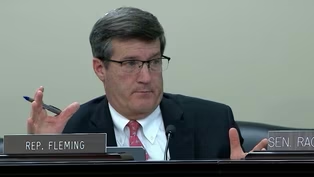
Changes Could Be Coming to Medicaid in Kentucky
Video has Closed Captions
Clip: S4 Ep338 | 3m 55s | Bill would tighten Medicaid reporting requirements. (3m 55s)
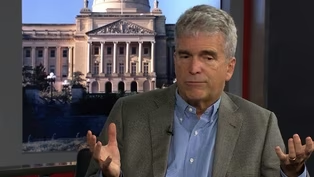
Changing Landscape of Local TV News
Video has Closed Captions
Clip: S4 Ep338 | 8m 5s | Discussion on the pros and cons of consolidation of local television news stations. (8m 5s)
First Vetoed Bill of 2026 Session Overturned
Video has Closed Captions
Clip: S4 Ep338 | 1m 1s | Lawmakers overturn the first vetoed bill of the 2026 Kentucky General Assembly. (1m 1s)
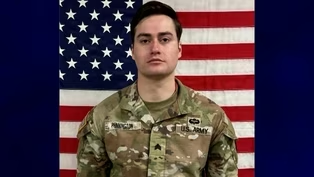
Kentucky Soldier Killed in Iran War
Video has Closed Captions
Clip: S4 Ep338 | 1m 6s | Kentucky soldier the seventh U.S. soldier to die in Iran war. (1m 6s)
More Americans Under 50 Getting Colon Cancer
Video has Closed Captions
Clip: S4 Ep338 | 4m 50s | Colorectal cancer deadliest cancer among those under 50. (4m 50s)

Search for Solutions to Rural Physician Shortage
Video has Closed Captions
Clip: S4 Ep338 | 1m 23s | Senate president wants universities to come up with solutions to rural physician shortage. (1m 23s)
Providing Support for PBS.org
Learn Moreabout PBS online sponsorship
- News and Public Affairs

Top journalists deliver compelling original analysis of the hour's headlines.

- News and Public Affairs

Today's top journalists discuss Washington's current political events and public affairs.












Support for PBS provided by:
Kentucky Edition is a local public television program presented by KET